Vendredi, le 9 novembre 2012
7 h 00 - 15 h 00 InscriptionSalon Verchères
8 h 00 - 10 h 16 Sessions scientifiques
Salon Frontenac
10 h 16 - 11 h 16 Pause santé / Visite des exposants
Salle de Bal
11 h 16 - 12 h 00 Sessions scientifiques
Salon Frontenac
12 h 00 - 13 h 30 Déjeuner
Salle de Bal
13 h 30 - 15 h 13 Sessions scientifiques
Salon Frontenac
15 h 13 - 16 h 15 Pause santé / Visite des exposants
Salle de Bal
16 h 15 - 17 h 10 Sessions scientifiques
Salon Frontenac
17 h 15 - 18 h 15 AUQ rencontre : cocktail avec les exposants
Salle de Bal
18 h 30 - 22 h 30 Soirée spectacle
Éspace 400e Bell
Samedi, le 10 novembre 2012
7 h 00 - 8 h 15 Petit déjeuner - causerieSalon Jacques-Cartier
6 h 45 - 10 h 00 Petit déjeuner
Salon Jacques-Cartier
8 h 30 - 10 h 40 Sessions scientifiques
Salon Frontenac
10 h 40 - 11 h 15 Pause santé / Visite des exposants
Salle de Bal
11 h 15 - 12 h 00 Sessions scientifiques
Salon Frontenac
12 h 00 - 13 h 15 Déjeuner-Conférence
Salon Jacques-Cartier
13 h 15 - 14 h 40 Sessions scientifiques
Salon Frontenac
14 h 45 - 17 h 00 Assemblee générale
Association des Urologues du Québec
Salon Frontenac
17 h 00 - 17 h 30 Assemblée générale
Fondation de l’Association des Urologues du Québec
Salon Frontenac
17 h 30 - 18 h 30 Periode libre
18 h 30 - 19 h 30 Cocktail
Remise des prix aux résidents et fellows à 19 h
Foyer Salle de Bal
19 h 30 - 00 h 00 Banquet du Président
Salle de Bal
Dimanche, le 11 novembre 2012
7 h 00 - 9 h 00 Petit déjeunerSalon Bellevue
8 h 40 - 12 h 30 Sessions scientifiques
Salon Frontenac
12 h 30 Clôture du congrès
37
e
Congrés Annuel : Programme général
Association des Urologues du Québec
Session scientifique 1
Concours des résidents et fellows
Objectifs éducatifs : À la fin de cette session, le participant connaîtra les nouveaux développements en recherche clinique et fondamentale. Il pourra apprécier les travaux de recherche des résidents et fellows en urologie. Modérateurs : Elie Antebi et Yves Caumartin
8 h 00 - 8 h 10 Mot de bienvenue
Steven P. Lapointe
8 h 10 - 8 h 19
Impact of Body Mass Index (BMI) on outcomes of patients with upper and lower urinary tract cancers treated by radical surgery: Results from a Canadian multicentre collaboration
Bassel G. Bachir;* Armen G. Aprikian;* Jonathan I. Izawa;† Joseph L. Chin;† Yves Fradet;‡ Adrian Fairey;± Eric Estey;± Niels Jacobsen;± Ricardo Rendon;¥ Ilias Cagiannos;§ Louis Lacombe;‡ Simon Tanguay;* Jean-Baptiste Lattouf;** Anil Kapoor;†† Edward Matsumoto;†† Fred Saad;** David Bell;¥ Peter C. Black;‡‡ Alan I. So;‡‡ Darrel Drachenberg;±± Wassim Kassouf*
*McGill University Health Centre, †University of Western Ontario, ‡Laval University, ±University of Alberta, ¥Dalhousie University, §University of Ottawa, **University of Montreal, ††McMaster University, ‡‡University of British Columbia, ±±University of Manitoba
Introduction: To evaluate the effect of body mass index (BMI) on outcomes after radical cystectomy (RC) and radical nephroureterectomy with bladder cuff excision (RNU) in a contemporary group of patients from a Canadian multicenter collaboration.
Methods: Data was collected from eight participating Canadian centres on patients who had undergone RC or RNU from 1998 to 2008. Patients without BMI data were excluded from analysis. Various clinico-pathologic parameters
among the three subsets of patients (BMI <25 kg/m2, 25-30 kg/m2, >30 kg/m2) were analyzed. Kaplan-Meier method was used to determine any difference in overall (OS), disease-specific (DSS), and recurrence-free survival (RFS) across the three distinctive weight classes. Multivariate analyses models were also constructed to assess the impact of BMI on survival.
Results: Data on BMI were available on 847 patients who had undergone RC as well as 664 patients who had undergone RNU. There was no dif-ference in histology, pathologic stage, grade and margin status among the three subsets of patients undergoing either type of surgery. However, RC patients with lower BMIs (<25 kg/m2) were significantly older, had more nodal metastasis and trended towards higher pathological stage while RNU patients with lower BMIs (<25 kg/m2) were significantly older and received less adjuvant chemotherapy compared to those with BMI >30 kg/m2. After adjusting for different variables on multivariate analysis, BMI was not an independent prognostic factor for OS and DSS in both surgical groups. Although BMI >30 kg/m2 was not associated with worse RFS in the RC group, it was associated with worse RFS in the RNU group.
Conclusion: Increased BMI does not seem to influence survival in patients undergoing RC. BMI >30 kg/m2 is associated with worse RFS in patients undergoing RNU.
8 h 19 - 8 h 28
A prospective study using a new bulking agent for the treatment of pediatric vesicoureteral reflux: Bulkamid
Jonathan Cloutier; Anne-Sophie Blais; Katherine Moore; Stéphane Bolduc CHUL (CHUQ), Université Laval
Introduction: Vesicoureteral reflux (VUR) is a prevalent disease in the pedi-atric population and the use of endoscopic treatment has become the first line of therapy, especially for low grade reflux. Commercially available products offer short term good success rate but their price are becoming an issue. Our objective was to evaluate the success of endoscopic treatment for VUR in children using (hydrogel cross-linked synthetic polymer bulking agent) (Bulkamid®), which is actually approved for periurethral injection. It has been documented to maintain its volume a long time after the injection. Methods: We performed a single center, single surgeon prospective off-label study using Bulkamid®; an hydrogel agent consisting of 97,5% water and 2.5% cross-linked synthetic polymer presented in a 1.0 ml syringe, to treat VUR. All patients underwent endoscopic subureteral double HIT technique injection. Every patient had a 3-month postoperative ultrasound and void-ing cystourethrogram (VCUG) to confirm the absence of de novo hydro-nephrosis and correction of VUR (grade 0). If recurrent pyelonephritis was documented after a negative postoperative VCUG, the test was repeated. Results: A total of 36 patients underwent Bulkamid® injection between March 2011 and January 2012. Median age at surgery was 43 months (range 10 mo to 21 yo). Eight males and 28 females were included for a total of 62 refluxing ureters. Bilateral reflux was identified in 23 patients (64%). Nine patients had duplex systems and 2 of them had reflux in both renal moieties. Reflux grade was I in 10, II in 18, III in 17, IV in 13 and V in 4 ureters. Mean volume injected was 1.07 ml. Success rate for grade 1 to 3 was 78% and overall, it was 69.4%.
Conclusion: Our short-term data demonstrated an interesting success rate principally for low grade reflux with the off-label use of this newly approved product. It was easily injected and the technique did not require any modifi-cation. Another interesting aspect of this product is his lower cost compared to other available bulking agents.
Sessions scientifiques I et II
vendredi (a.m.), le 9 novembre 2012
S150 CUAJ • December 2012 • Volume (6Suppl3)
© 2012 Canadian Urological Association
AUQ-QUA 2012
Les sessions scientifiques suivantes ont été rendues possibles grace à la contribution non restrictive de nos partenaires : PARTENAIRES ELITES/ELITE SPONSORS
Abbott Laboratories Ltd. Amgen Canada
Astellas Pharma Canada Inc. AstraZeneca
Janssen Inc. GlaxoSmithKline Inc. Pfizer Canada Sanofi-Aventis
Watson Pharma Company Canada
PARTENAIRES MAJEURS/MAJOR SPONSORS
Eli Lilly Canada Inc.
PARTENAIRES COLLABORATEURS/ASSOCIATE SPONSORS
Sessions scientifiques I et II
8 h 28 - 8 h 37
Chronic diseases, prostate cancer aggressiveness and mortality after radical prostatectomy
Vincent Fradet; Marc-André Allard; Yves Fradet; Louis Lacombe; André Caron; Hélène Hovingto
Centre Hospitalier Universitaire de Québec (CHUQ), Université Laval Introduction: Early but growing clinical, epidemiological and experi-mental studies are linking cancer in general to various chronic medical conditions. However, little is known about the association of chronic diseases with prostate cancer, and even less about their interactive effects on the mortality after radical prostatectomy. Our objective was thus to determine the impact of both chronic diseases and disease aggressive-ness on mortality from prostate cancer versus other causes after radical prostatectomy.
Methods: We conducted a retrospective study where we included all patients in whom we had comorbidity information at time of radical pros-tatectomy. From the comorbidity data, we calculated the age-adjusted Charlson score. Clinical follow-up was according to standard guidelines but left to the clinicians’s discretion. Also, we matched our institutional database to the one of l’Institut de la Statistique du Québec in June 2011 to identify mortality. The cause of mortality was determined from chart review and death certificates. We examined the associations between the Charlson score and the disease aggressiveness parameters at time of radical prostatectomy. Also, we conducted univariate and multivariate survival analysis assessing time to death from prostate cancer (DOD) versus from other causes (DOOC).
Results: The mean patient age was of 62.9 ± 6.3. The mean follow-up was of 8.8 ± 4.4 years. Pathologic tumour Gleason grade was of 8 or more in 19% and of 7 in 41%, while stage was of T4 in 2% and of T3 in 38%. Patients with greater comorbidities presented with more aggressive prostate cancers at prostatectomy, both in terms of tumour grade (Mantel-Haensel chi-square p=0.0006) and stage (p=0.0015). At multivariate Cox regres-sion, we observed an increased risk of DOD with increasing tumour stage (p=0.0001) and grade (p<0.0001) but not with increasing age-adjusted Charlson score (p=0.9). In contrast, we observed an increased risk of DOOC with increasing Charlson score (p<0.0001) but not with stage (p=0.9). There was a 32% increase in the risk of DOOC in patients with Gleason 7 disease (multivariate p=0.045), which was not significant in those with Gleason 8 (p=0.39) likely because of the strong risk of DOD. Conclusion: The Charlson score is a valid stratification tool of the risk of mortality from other causes even in patients undergoing radical prosta-tectomy. However, it is not associated with the risk of prostate cancer specific mortality. On the other hand, disease aggressiveness is positively associated with both risks of mortality from prostate cancer and other causes. This suggests that there may be a common link between chronic diseases and prostate cancer disease aggressiveness. More research to decipher the common causes, whether genetic or else, linking chronic diseases to prostate cancer aggressiveness are needed.
8 h 37 - 8 h 46
Clavien Classification in Urology: Is There Concordance among Post-graduate Trainees and Attending Urologists?
Sero Andonian; Armen Aprikian; Saad Aldousari; Tarik Benidir; Murilo Luz; Mohamed Elkoushy
Department of Surgery, Division of Urology, McGill Univesity Health Centre
Introduction: Clavien classification was originally derived as an objec-tive method of classifying complications in open surgery. However, its applicability to urology has not been studied. Therefore, the aim of the present study was to assess the agreement rate among urologists applying this classification to actual cases and to compare Clavien scores given by attending urologists to scores given by postgraduate trainees.
Methods: Twenty cases from surgical complications over a period of one year covering a tertiary care center were selected to compile the survey. The case scenarios were chosen to include both minor and major complications. After a briefing and explanation session concerning the classification, the survey was administered to 16 attending urologists and 16 urology postgraduate trainees. Concordance rates were recorded for
each case separately and as a pool of cases. Weighted kappa statistics were calculated to assess the interrater agreement.
Results: Twenty cases were evaluated among 32 participants. The mean concordance rate was 81 % (50- 100%, 95%CL: 7.67). Three of the 20 scenarios (15%) had concordance rate of 100% while 7 (35%) had con-cordance rates below 80%. In two cases, the scores given by postgraduate trainees were significantly different from that given by attending urologists (p≤0.03). In one case, postgraduate trainees gave a significantly lower score (grade I and II by 75% and 25%, respectively) than attending urolo-gists (grade I, II, and III in 25, 50, and 25%, respectively) (p=0.01). In the other case, 94% of postgraduate trainees had graded the complication either IIIb (94%) or higher while the attending urologists graded it as IIIb (75%) or lower (p=0.03). There was no significant difference between both groups in terms of overall scoring of complications (p=0.12) where Kappa statistics revealed a good agreement level between both groups (k=0.753, p<0.001).
Conclusions: There was good overall concordance among post-graduate trainees and attending urologists in application of Clavien Classification in urology cases.
8 h 46 - 8 h 55
Impact de l’indice de prolifération tumorale mesuré avec Ki-67 sur la progression du cancer de la prostate et la mortalité après prostatectomie radicale
Patrice Desmeules; Hélène Hovington; André Caron; Louis Lacombe; Yves Fradet; Bernard Têtu; Vincent Fradet
L’Hôtel-Dieu de Québec, Centre Hospitalier Universitaire de Québec (CHUQ), Université Laval
Introduction et objectifs : Le comportement clinique du cancer de la prostate est hautement variable et ne peut être prédit de façon satisfaisante simplement par des critères cliniques et histopathologiques. L’émergence de nouveaux marqueurs pronostiques est souhaitable pour identifier les candidats à une thérapie plus agressive. Cette étude vise à définir l’impact de l’indice de prolifération tumorale, tel que mesuré par la détection du marqueur nucléaire Ki-67, sur la récidive et surtout sur la mortalité par cancer après prostatectomie radicale.
Matériels et méthodes : Le devis d’étude fut de cohorte rétrospective. Les 251 sujets inclus avaient un suivi clinique complet et ont été sélectionnés au hasard à partir de notre banque de données de prostatectomie radicale pour créer une micropuce tissulaire. Les tissus tumoraux ont été échantil-lonnés sur 6 sites par spécimen de prostatectomie radicale pour créer cette micropuce d’une manière standardisée. L’immunohistochimie a été effectuée avec un anticorps dirigé contre Ki-67 (DAKO). Un décompte manuel exhaustif des noyaux cellulaires tumoraux positifs a été fait pour chaque site échantillonné. La moyenne des 6 sites tumoraux par patient a été calculée. Des analyses de survie univariées et multivariées (co-variables : âge, grade de Gleason et stade) ont été réalisées.
Résultats : L’âge médian des patients était de 64.0 (Q1=59.2—Q3=67.8) ans. Le suivi médian après prostatectomie était de 11.0 ans (Q1=8.9— Q3=12.3). En analyse Kaplan-Meier, un indice de prolifération tumorale élevé (5% et plus versus moins de 5% de cellules Ki-67-positives) est associé à un taux augmenté de récidive biochimique (logrank p=0.0012) et de mortalité par cancer (p<0.0001) après prostatectomie radicale. Toutefois, l’indice de prolifération tumorale n’est pas associé au taux de mortalité par autres causes que le cancer (p=0.24). Les modèles multivariés de régression de Cox révèlent qu’un indice de prolifération élevé est associé avec une augmentation par un facteur 8 du risque de mortalité par cancer (RR=7,99; IC=2,18-29,26; p=0.0017).
CUAJ • December 2012 • Volume (6Suppl3) S152
Sessions scientifiques I et II
8 h 55 - 9 h 04
Active surveillance for Prostate Cancer Compared with Immediate Treatment: A United States - Canadian economic comparison
Alice Dragomir; Fabio Cury; Armen Aprikian McGill University Health Centre
Introduction: Active surveillance is an accepted management strategy for patients with low-risk prostate cancer. The costs associated with active surveillance strategy compared with immediate active treatment were recently evaluated in the US healthcare system (Keegan et al, Cancer, 2011). The corresponding estimates in the Canadian healthcare context are unknown. The main objective of this study was to evaluate the costs associated with active surveillance (AS) and treatment in the context of Quebec’s public healthcare system. The secondary objective was to identify factors potentially explaining differences between the US and Canadian systems.
Methods: A Markov model with Monte-Carlo microsimulations was adapted from Keegan et al (Cancer, 2011) for the Canadian context in order to simulate the cost of prostate cancer treatment over a 5-year period for patients initially on AS. The patients on AS were assumed to receive delayed treatment at a rate of 7% per year. Active treatment included radi-cal prostatectomy (RP), image-modulated radiotherapy (IMRT), brachy-therapy, androgen deprivation therapy (ADT), and IMRT plus ADT. The probability of receiving each treatment was assumed to be 0.4 for RP, 0.25 for IMRT, 0.1 for IMRT plus ADT, 0.15 for brachytherapy and 0.1 for ADT. All assumptions were derived from Keegan et al (Cancer, 2011) in order to allow direct comparison. ll costs were assigned in Canadian dollars ($) and reflect Quebec’s public healthcare system. Accordingly, the costs of medical procedures related to treatments and medical visit costs were based on RAMQ’s lists: ‘’Manuel des Médecins Spécialistes, 2012’’ and ‘’Manuel des médecins spécialistes services de laboratoire, 2012’’. Moreover, the costs of medications were obtained from the 2012 RAMQ’s list of medications approved for public reimbursement. For all other costs published sources were used. The cost of AS and treatment were categorized into initial cost and follow-up cost over the 5-year period. The treatment course of 10,000 incident subjects initially on AS was simulated over a 5-year period by applying the Markov model. Results: With AS, the average cost of prostate cancer management over the 5-year period was estimated at $5 312 (95%CI: $5 245 to $5 387) per patient. The weighted mean cost corresponding to the immediate treatment strategy was estimated at $9 349 per patient. Over the 5-year period, these result in a relative reduction of the mean cost of approxi-mately 43.2%. In addition, 30% of patients on AS will have received a delayed treatment and have incurred higher costs estimated at $10 009 per patient. Among these patients, the minimum individual cost was $7 882 and the maximum individual cost was $24 920, respectively. Conclusion: Despite the fact that clinical data, clinical practice guidelines and the management of prostate cancer are quite similar over the North-American continent, the US and Canadian evaluation of costs shows differences, which are principally attributed to medical costs. These fig-ures translate into a difference in relative reduction of cost of prostate cancer management obtained with AS of approximately 36% in US when compared to 43.2% in Canada. Accordingly, the cost savings per patient, related to AS could be more important in Canada than those estimated in US. However, this cost estimate comparisons must be validated in Canadian-derived assumptions as well as a comprehensive economic audit of Canadian practice cost evaluation. Our Markov model will be furthermore adapted to address these elements.
9 h 04 - 9 h 13
Définir un « trifecta » pour les petites masses rénales en post-opératoire de néphrectomie partielle par laparoscopie
Yves Fradet; Vincent Fradet; Annie Imbeault; Louis Lacombe; Yves Caumartin; Jean-François Audet; Thierry Dujardin; Annie-Claude Blouin; Frédéric Pouliot
Centre Hospitalier Universitaire de Québec (Hôtel-Dieu-de-Québec, Hôpital Saint-François d’Assise)
Introduction et objectifs : Décider du traitement d’une petite masse rénale (PMR) est devenu de plus en plus complexe avec le développe-ment de techniques chirurgicales minimaledéveloppe-ment invasives, la reconnais-sance de l’importance de la fonction rénale et du risque bien établi de décès par cancer du rein. Bien que plusieurs auteurs aient étudié séparément les issues de morbidité, d’oncologie et de fonction rénale après la néphrectomie partielle par laparoscopie (NPL), le pourcentage de patients atteignant une combinaison idéale des trois issues (trifecta) demeure inconnu. L’objectif de l’étude était donc principalement de préciser ce pourcentage en utilisant différentes définitions possibles de trifecta. L’objectif secondaire était de mesurer l’impact des facteurs péri-opératoires liés au patient, à la tumeur et à la chirurgie sur la probabilité d’atteindre le trifecta.
Matériels et méthodes : Entre 2003 et 2008, 318 patients ont subi une NPL pour une PMR dans le Centre Hospitalier Universitaire de Québec (CHUQ). 179 patients rencontraient nos critères d’inclusion, c’est-à-dire une masse unique, une pathologie maligne et un taux de filtration glomérulaire (TFG) pré-opératoire ≥60 ml/min. Après une collecte de données rétrospective, nous avons généré plusieurs définitions possibles de trifecta en combinant les critères de morbidité, d’oncologie et de fonction rénale.
Résultats : Les patients avaient respectivement une moyenne d’âge, de score ASA, d’indice de masse corporelle (IMC), de diamètre de tumeur (mm) et de TFG pré-opératoire (ml/min) de 59, 2, 28, 25 et 83. Le suivi moyen était de 44 mois. En choisissant la définition suivante comme le meilleur trifecta: absence de récidive, TFG ≥60 au plus long suivi et absence de complication ≥IIIb selon la classification de Clavien-Dindo, 77.7% des patients réussissaient à l’atteindre, avec respectivement 96.1%, 96.7% et 83.2% des patients qui répondaient indépendamment aux critères choisis de morbidité, d’oncologie et de fonction rénale. En analyse univariée, les patients qui atteignaient le trifecta étaient plus jeune, avaient un IMC plus petit, un meilleur score ASA et une plus petite tumeur (p<0.05). En utilisant d’autres définitions, entre 20.7 et 98.3% des patients atteignaient le trifecta.
Conclusions : Après la NPL, la fonction rénale à long terme était le critère le plus fréquemment responsable d’un échec à l’obtention du trifecta. Ces résultats démontrent que la NPL est une intervention chirurgicale rare-ment morbide et que la néphrectomie radicale par laparoscopie (NRL) ne devrait pas être justifiée si basée sur les issues de morbidité et d’oncologie. Enfin, notre travail sert de base à l’utilisation d’un trifecta pour comparer le succès de la NPL à d’autres approches chirurgicales.
9 h 13 - 9 h 22
Échecs physiques de l’électrode lors de la stimulation des nerfs sacrés
Maude Carmel; Andrew Lenis; Bradley Gill; Courtenay Moore; Sandip Vasavada; Raymond Rackley
Cleveland Clinic, Cleveland, Ohio
Introduction et objectifs : La stimulation des nerfs sacrés (SNS) est un traitement reconnu pour les dysfonctions urinaires et intestinales réfrac-taires. L’amélioration de la technique chirurgicale et de programmation ont réduits de façon considérable les complications et le taux de révision de l’appareil. Plusieurs études ont évalué quelques variables associées à l’échec de SNS à long terme tel que le taux de migration de l’électrode et les paramètres de stimulation initiaux, mais aucune étude n’a étudié les facteurs intrinsèques à l’électrode lors d’échecs. Cette étude a pour but de décrire les anormalités de l’électrode de SNS lors d’échecs théra-peutiques à long terme.
Sessions scientifiques I et II
2003 à Décembre 2011. Une révision de leurs dossiers a été effectuée pour identifier les patients qui avaient des impédances anormales lors de l’interrogation de l’appareil durant les visites de suivi et les patients ayant subis une révision chirurgicale ou une explantation de leur appareil. Résultats : SNS a été implanté chez 623 patients entre janvier 2003 et décembre 2011. L’âge moyen des patients était de 50.7 ans et l’indice de masse corporel moyen était de 28.5 kg/m2. Le suivi moyen était de 4.1 ans. L’indication de SNS était urgence/fréquence mictionnelle et inconti-nence urinaire d’urgence chez 79.4% des patients and rétention urinaire non obstructive chez 17.4% des patients. En tout, 87 cas d’impédances anormales ont été identifiées chez 73 patients (11.7%). Les fractures d’électrodes (impédance >4000 Ohms) représentaient 64.3% (56/87) des anormalités, 33.3% (29/87) étaient des courts circuits (impédances <50 Ohms) et 2.2% (2/87) étaient des anormalités mixtes. Des révisions ou explantations ont été nécessaires dans 63.2% des cas, tous après une tentative infructueuse de reprogrammation de l’appareil. Tous les cas de courts circuits et 52.7% des fractures d’électrodes touchaient plus qu’une seule électrode. L’électrode 3 représentait 33% des fractures, alors que les électrodes 0, 1 et 2 comptaient toutes pour 22% des échecs. Les fractures d’électrodes ont été notées 28 [11-41.7] mois après l’implantation, tandis que les court circuits ont été notés 5 [2-12.5] mois après l’implantation. Conclusions : Des anormalités d’impédances surviennent chez 11.7% des patients après l’implantation permanente de SNS. La majorité nécessite une révision chirurgicale. Les fractures d’électrodes représentent 63% des anormalités. L’électrode 3 (plus proximale) semble avoir un taux de frac-ture plus élevé. L’optimisation de la réponse des autres électrodes durant l’implantation de même que la programmation autour de l’électrode 3 pourrait minimiser le besoin de révision chirurgicale.
9 h 22 - 9 h 31
The management of post-transplant lymphoceles: Evolution toward a less invasive approach
Marie-Pier Deschênes Rompré; Yoro Diallo; Sacha Deserres; Louis Lacombe; Réal Noël; Jean-Guy Lachance; Isabelle Côté; Isabelle Houde; Yves Caumartin
Renal transplantation unit and urology division, L’Hôtel-Dieu de Québec, Université Laval
Introduction: Lymphocele is a common complication following kidney transplantation and may have devastating consequences on the graft function. In our experience, lymphocele management has dramatically evolved overtime toward a less invasive approach. The purpose of this study is to review efficacy and complications associated with their treat-ment.
Methods: Between January 1990 and December 2010, 962 kidney transplantations have been performed in our institution. The transplanta-tions were conducted by multiple surgeons using a single technique. On 961 recipients, 152 (15.8%) developed a lymphocele postoperatively. Characteristics of recipients and donors, peri-transplant details, long-term function and survivals were retrospectively collected. Descriptive analy-sis of patients who developed a post-transplant lymphocele has been performed to assess efficacy and complications of different management options.
Results: From the 152 patients presenting a post-transplant lymphocele, 119 (78%) required an active treatment. Aspiration was the most fre-quently used (52%) but was associated with a low success rate (15%). Indwelling drainage improved the success rates up to 34% but was asso-ciated with higher risk for infectious complications (14%). At first, inter-nal marsupialization of the lymphocele was the operation of choice for refractory lymphoceles and was necessary for 44% of our symptomatic patients with a 50% success rate and a 17% complication incidence. Later, sclerotherapy with proviodine was used in 35% of our cohort with a high success rate of 97% and a complication rate of 5%.
Conclusion: In our experience, post-transplant lymphocele management has evolved favourably toward a minimally invasive approach with provi-odine sclerotherapy. This treatment strategy has been associated with a high success rate and low incidence of complications. Consequently, it is the authors’ opinion that this treatment option should be favored early in the treatment of symptomatic lymphoceles post renal transplantation.
9 h 31 - 9 h 40
The use of dorsally placed buccal mucosal grafts in the recon-struction of complex bulbar urethral strictures
Talal Al-Qaoud; Faysal Yafi; Anastassia Abatzoglou; Alex Brzezinski McGill University
Introduction: Our goal was to present our experience with repairing long-segment urethral strictures with single-stage urethroplasty using a dorsal onlay buccal mucosal graft.
Matériels et méthodes : Restrospective data was collected on patients who underwent dorsal onlay buccal mucosal graft urethroplasty for long-segment urethral strictures between 2009 and 2012. Collected variables included etiology of the stricture, previous procedures, age, location and length of stricture, length of flap, failure and need for additional interventions. Results: Twelve patients had underwent dorsal onlay mucosal graft ure-throplasty between 2009 and 2012, with a median age of 37 years (range 17-48). All strictures were bulbar in location with a mean length of 3.5 cm (median 3.5 cm), and the mean length of the grafts was 4.2 cm (median 4 cm). At a mean follow-up of 7.8 months (median 2.5 months), there were no failures observed, with none of the patients requiring any endo-scopic or surgical interventions.
Conclusion: Short-term results for dorsal onlay buccal mucosa graft ure-throplasty appear very promising in long-segment bulbar urethral stric-tures. However, longer follow-up is required to further magnify the success of the approach and its validation.
9 h 40 - 9 h 49
Systematic review of the effectiveness of bowel preparation and antibiotic prophylaxis in preparation of adults with invasive blad-der cancer unblad-dergoin
Marc Rhainds; Martin Coulombe; Yves Fradet; Louis Lacombe; Vincet Fradet; Martin Lagacé; Martin Bussières
Centre Hospitalier Universitaire de Québec-Campbelton regional Hospital, New-Brunswick
Introduction: Although no consensus exist among experts, bowel prepa-ration (BP) and antibiotic prophylaxis (ABP) are commonly used as peri-operative interventions in radical cystectomy (RC). The objective of this work is to assess the effectiveness of perioperative BP and ABP in adults undergoing RC.
Methods: A search was performed in Pubmed, Embase, the Cochrane Library, and grey literature to identify systematic reviews (SR), random-ized controlled trials (RCTs) and observational studies (OS). Selection, quality assessment, and data extraction from articles were performed by two independent reviewers. Primary outcomes were surgical sites infec-tions and anastomotic leaks. Synthesis review was shared with bladder cancer experts.
Results: 358 studies were retrieved for efficacy assessment. One RCT and three OS on BP as well as one SR and one OS on ABP were included after quality assessment. Studies showed that BP prior to RC with urinary diversion does not demonstrate any significant advantage in perioperative outcomes (e.g., surgical site infection, anastomotic leakage). A lack of well-designed studies investigating the need for ABP in urologic interven-tions was observed. No clear interpretation can be done regarding the best ABP regimen (multidose, unidose, no dose) to prevent postopera-tive complications in patients undergoing RC. Two studies on BP and none for ABP were included among 176 citations retrieved on adverse events (AE). BP appears to be well tolerated in most patients and minor AE were reported.
CUAJ • December 2012 • Volume (6Suppl3) S154
Sessions scientifiques I et II
9 h 49 - 9 h 58
Prévention du cancer de la prostate : Effets de l`huile de krill et de l`huile de poisson sur l’inflammation
Xavier Moreel; Bertrand Neveu; Gabrielle Villeneuve; Yves Fradet; Pierre Julien; Vincent Fradet
Centre Hospitalier de l’Université Laval-Québec
Introduction et objectifs : L’inflammation est un facteur de risque impor-tant du développement et de la progression du cancer de la prostate. Nous avons développé un modèle de culture primaire de cellules prostatiques, grâce auquel nous avons montré que l’inflammation prostatique est très variable entre les individus et qu’un haut niveau d’inflammation est asso-cié aux cancers agressifs de la prostate. Avec ces travaux, nous voulons étudier l’incorporation des acides gras issus de l’huile de poisson et de l’huile de krill dans les cellules épithéliales prostatiques en culture et leurs effets sur l’inflammation prostatique.
Matériels et méthodes : Toutes les expériences ont été réalisées en trip-licats. Les cellules épithéliales proviennent de biopsies prostatiques pré-levées chez un patient opéré par prostatectomie radicale pour un cancer de la prostate localisé à la glande avec un score de Gleason de 7. Les biopsies sont prélevées dans la zone normale périphérique de la prostate et sont mises en culture dans un milieu sélectif. L’ajout d’huile de pois-son, d’huile de krill ou de milieu contrôle se fait à 90% de confluence pendant 24 heures. L’inflammation prostatique est dosée par la sécrétion d’Il-8 dans le milieu de culture et est normalisée par l’ADN total. Après récolte, les cellules sont lavées 4 fois dans de l’HBBS, puis les lipides membranaires sont extraits par la méthode de Folch. Le profil des acides gras est obtenu par chromatographie en phase gazeuse.
Résultats : L’ajout d’huile de poisson ou d’huile de krill augmente les niveaux membranaires d’oméga-3 (13 fois, p<0.0001 et 12 fois, p=0.003) et d’oméga-6 (1,5 et 1.2 fois, p>0.08) dans les cellules en culture. Les acides gras issus de l’huile de krill (phospholipides) sont incorporés plus rapidement que ceux de l’huile de poisson (triglycérides). Toutefois, l’ajout d’huile de poisson ou d’huile de krill a un effet pro-inflammatoire chez ce patient avec niveau inflammatoire bas.
Conclusions : L’intégration des acides gras issus de l’huile de krill se fait plus rapidement que ceux issus de l’huile de poisson. Chez un patient avec un niveau inflammatoire prostatique bas, les deux huiles ont un effet pro-inflammatoire. La prévention du cancer de la prostate par sup-plémentation en huile de poisson ou en huile de krill ne doit pas être proposée à chaque patient.
9 h 58 - 10 h 07
Preoperative delays prior to radical cystectomy in patients with bladder cancer: a population-based study
Fabiano Santos; Armen Aprikian; Eduado Franco
McGill University - Division of Cancer Epidemiology and Montreal General Hospital
Introduction: Bladder cancer (BC) is the second most common uro-logical cancer and the sixth most common diagnosed malignancy in Canada. Muscle-invasive BC is often treated by radical cystectomy (RC). Preoperative delays are a major concern with respect to outcomes in BC patients. We reported in 2006 that preoperative delays prior to RC for BC were high and that there was a detrimental effect on mortality. This study was undertaken to determine if preoperative delays have been changing in more recent years in Quebec. Therefore, the objectives of this study are (1) to characterize and measure the impact of the different components of delay experienced by BC patients before RC in Quebec; (2) to analyze temporal trends in delay during a 10 year period; (3) to identify predictors of longer delays and (4) to determine the impact of the various components of delay on survival.
Methods: We conducted a retrospective cohort study using data from patients who underwent a RC for BC from 2000 to 2009. The cohort was obtained with the linkage of two administrative databases: the Régie de l’assurance maladie du Québec (RAMQ), and the Fichier des évenements démographiques de l’Institut de la statistique du Québec (ISQ). The RAMQ database provides prospectively collected data on medical services dis-pensed to all Quebec residents. The ISQ provides demographic data on
all births and deaths in Quebec. To be included in the study, patients must have undergone a RC in Quebec, and also have medical services data available for the two year period before RC. We determined several components of delay for each patient. Descriptive statistics were used to summarize the characteristics of the study population. The relationship between each delay variable and its potential predictors were analyzed trough the Kruskall–Wallis test.
Results: 2988 patients met inclusion criteria and were included in this study (75% were males, 65% were older than 60 years of age). Prior to RC, 82% of patients underwent cystoscopy, and 75% had transurethral resection of bladder tumor (TURBT). Mean delay from cystoscopy to RC and from TURBT to RC were 80 days (95% CI: 77-81) and 60 days (95% CI: 58-61), respectively (Medians: 64 days and 50 days, respectively). Furthermore, median cystoscopy to RC delay increased from 2000 to 2009 (60 to 76 days, p<0.001). Patients who had three or more TURBTs had significant longer delays, when compared to patients with 2 or 1 TURBT (median: 60 days, p<0.001). Median TURBT to RC delay also progressively increased from 2000 to 2009 from 40 to 63 days (p<0.001). Conclusion: Since our last report, preoperative delays have been progres-sively increasing over time. Previous results from our team showed that a delay of more than 12 weeks is associated with worse long-term overall survival following surgery for BC. Results on predictors of longer delays and its impact on survival will be presented at the time of the conference.
10 h 07 - 10 h 16
From podium to press: The 10-year publication rate of abstracts presented at the annual meetings of the Quebec Urological Association
Talal Al-Qaoud; Faysal Yafi; Armen G Aprikian McGill University
Introduction: Our aim was to determine the rate of peer-reviewed publi-cations stemming from abstracts presented at the annual meetings of the Quebec Urological Association (QUA).
Methods: All abstracts presented at the annual meetings of the QUA between 2000 and 2010 were obtained from the QUA archives and were searched using the PubMed database. To maximize the search yield, both author names and titles were used to aid in retrieving published abstracts. Analyzed variables included number of publications, year of publication, submitting institution and impact factor of the publishing journal accord-ing to the 2010 Thomson Reuters report. Analysis of variance was used to detect significance in trends.
Results: At a median follow-up of 6 years (range 1-11), 248 of 446 (55%) abstracts were published. When stratifying by institution, the publication rates were 66% (95/144), 49% (82/167), 36% (25/69), and 71% (10/14) for Quebec universities, and 69% (36/52) for non-Quebec universities (p<0.001). The mean impact factors (IF, Total IF/Total published) of pub-lishing journals per institution were 3.18, 4.54, 3.24, and 2.87 for Quebec universities, and 4.86 for non-Quebec universities (p=0.04).
Sessions scientifiques I et II
Session scientifique II
Objectifs éducatifs : À la fin de cette session, les participants seront en mesure de :
1. Connaître les mecanismes d’action, contre indications et effets sec-ondaires de l’oxygénotherapie hyperbare systemique (OTHS). 2. Discuter de certaines indications de l’OTHS.
3. Visualiser l’organisation physique d’un complexe de médecine hyperbare.
11 h 16 - 11 h 45
Indications de traitement en oxygénothérapie hyperbare
Conférencier : Mario Côté Service médecine hyperbare, CSSS Alphonse-Desjardins
CUAJ • December 2012 • Volume (6Suppl3) © 2012 Canadian Urological Association
AUQ-QUA 2012
S156
Session scientifique III
Objectifs éducatifs : Les participants apprendront le rôle de la mesure de la testosterone sérique dans le suivi du traitement de dérivation androgénique. Une mise à jour sur la suppression intermittent androgénique de même que la théorie de l`échappée androgénique seront révises et ainsi mieux compris par l’auditoire.
Session scientifique IV
Concours des résidents et fellows
Objectifs éducatifs : À la fin de cette session, le participant connaîtra les nouveaux développements en recherche clinique et fondamentale. Il pourra appreciér les travaux de recherche des résidents et fellows en urologie. Modérateurs : Michel Carmel et Jean-Baptiste Lattouf
13 h 40 - 13 h 49
Long-Term Use of Solifenacin in Pediatric Patients with Overactive Bladder: Extension of a Prospective Open-Label Study
Geneviève Nadeau; Annette Schroder; Katherine Moore; Lucie Genois; Ève Pellerin; Stéphane Bolduc
Division d’Urologie, Centre Hospitalier Universitaire de Québec (CHUQ), Université Laval
Introduction: Pediatric urologists frequently encounter children presenting symptoms of bladder overactivity. Optimal anticholinergic pediatric dosage is not well known. Historically, oxybutinin has been effective in treating overactive bladder but is poorly tolerated. Tolterodine has been shown to be as effective as oxybutinin with fewer side effects (S/E). Newer agents, such as solifenacin, could be an alternative but their use in children as not been widely utilized. Therefore, the objective was to evaluate the effect of Solifenacin to treat urinary incontinence in children with overactive/neu-rogenic bladder that were refractory to oxybutinin or tolterodine treatment. Methods: Paediatric patients presenting refractory overactive bladders with incontinence were offered to enter a prospective off-label protocol using adjusted-dose regimens of solifenacin (1.25 to 10 mg). Inclusion
crite-ria were: absence of correctable neurological anomalies (MRI), failure of symptoms improvement under intensive behavioural and medical (oxybu-tinin or tolterodine) therapies and/or significant S/E with other agents. The follow-up consisted of voiding diaries, post-void residuals, urine cultures, ultrasound and UDS. Families were questioned for continence, S/E, compli-ance, change in behaviour and quality of life. The primary end-point was efficacy toward continence and the secondary end-points were tolerability and safety.
Results: A total of 237 patients (112 girls, 125 boys) were enrolled. Fifty-two patients with neurogenic bladder (NDO) (24 on CIC) and 185 with overac-tive bladder (OAB) completed a minimum of 6-months follow-up. Mean age at initiation was 9.1 and 9.7 years and they were on solifenacin for a mean of 17 and 32 months for OAB and NDO respectively. Urodynamic capacity for OAB patients improved from 125±51 ml to 305±96 ml and uninhibited contractions decreased from 72±24 to 10±12 cmH2O. For NDO patients, urodynamic capacity improved from 151±80 ml to 325±164 ml and uninhibited contractions decreased from 64±27 to 19±17 cmH2O. Continence improved every OAB patients (47 dry, 50 significantly and 88 moderately improved) and for NDO patients (17, 17, 18). Patients reported mild or moderate side effects in 15% of cases and 3 withdrew from the protocol due to S/E. Seven patients developed significant post-void residuals (>20%). Blood tests and EKG remained normal.
Conclusion: In the presence of overactive bladder refractory to oxybutinin or tolterodine, solifenacin is an effective alternative to improve symptoms in children. Tolerability was acceptable and the adjusted-dose regimen appeared safe.
13 h 49 - 13 h 58
Comparison entre l’échographie et la scintigraphie à l’acide dimer-captosuccinique dans l’évaluation des cicatrices renales
Maryse Marceau-Grimard; Christian Cote; Stephane Bolduc; Marcel Dumont; Katherine Moore
CHUQ-CHUL
Introduction et objectifs : L’objectif de cette étude est de rapporter les résul-tats et les coûts de la prostatectomie ouverte comparé à la prostatectomie robot-assistée dans un centre hospitalier de soins tertiaires.
Matériels et méthodes : Une analyse rétrospective a été faite des 200 derni-ers patients opérés par un chirurgien expérimenté avec la voie ouverte (MG) et des 200 derniers patients opérés par un chirurgien expérimenté avec la voie robot-assistée (LG), et ce, en date du 1r octobre 2011.
Résultats : Les 2 groupes avaient des caractéristiques démographiques simi-laires, incluant l’âge moyen (64,7 vs. 64,2), l’indice de masse corporelle (27,2 vs. 27,2), et le taux de chirurgie abdominale antérieure (31% vs. 27%). Le groupe ouvert comportait plus de cancers à haut risque comparé au groupe robot (32,5% vs. 8,5%). La durée opératoire était moindre pour les chirurgies ouvertes, avec un temps opératoire peau-à-peau moyen de 114,2 mins contre 233,6 mins. Le groupe ouvert a présenté des pertes sanguines moyennes plus élevées (402,8 ml vs. 287,5 ml). Le taux de transfusion sanguine a été comparable, soit 1,5% (3/200) pour le groupe ouvert et 3,5% (7/200) pour le groupe robot. Pour les 100 derniers cas, la durée d’hospitalisation moyenne était de 1,78 jours pour la chirugie ouverte et 1,76 jours pour la chirurgie robot-assistée. Le groupe ouvert avait plus de cancers de haut grade dans la pathologie chirurgicale, avec un score de Gleason 8 ou plus dans 23,5% des cas comparé à 3,5% dans le groupe robot. Le taux de marges chirurgicales positives était comparable à 31% pour la chirurgie ouverte et 24,6% pour la chirurgie robot-assistée. Le taux était aussi comparable après stratification entre les stades pT2 et pT3. Les
Sessions scientifiques III, IV, V, VI
Vendredi (p.m.), le 9 novembre 2012
Les sessions scientifiques suivantes ont été rendues possibles grace à la contribution non restrictive de nos partenaires : PARTENAIRES ELITES/ELITE SPONSORS
Abbott Laboratories Ltd. Amgen Canada
Astellas Pharma Canada Inc. AstraZeneca
Janssen Inc. GlaxoSmithKline Inc. Pfizer Canada Sanofi-Aventis
Watson Pharma Company Canada
PARTENAIRES MAJEURS/MAJOR SPONSORS
Eli Lilly Canada Inc.
PARTENAIRES COLLABORATEURS/ASSOCIATE SPONSORS
Sessions scientifiques III, IV, V, VI
résultats postopératoires préliminaires ont révélé un taux d’incontinence urinaire à l’effort à 12 mois comparable à 3,9% pour la voie ouverte et 5,8% pour la voie robot-assistée. Le taux de survie sans récidive biochi-mique à 12 mois était aussi comparable à 95,7% et 94,3% respective-ment. Le coût supplémentaire pour la prostatectomie robot-assistée a été calculé à 5629$ par cas.
Conclusions : Dans cette étude, la prostatectomie par voie ouverte a présenté un temps opératoire plus court et un coût plus faible comparé à la chirurgie robot-assistée. Le taux de transfusion sanguine, la durée d’hospitalisation et le taux de marges chirurgicales positives étaient com-parables.
14 h 07 - 14 h 16
Cost-effectiveness analysis of sacral neuromodulation in refrac-tory overactive bladder: A Canadian perspective
Hamid Sadri;1 Jacques Corcos;2 Neil E. Dwyer;3 Gary J. Gray;4 Magali Robert;5 Jerzy B. Gajewski;6 Magdy M. Hassouna;7 Le Mai Tu;8 Sophie Ramsay8
1Medtronic of Canada; 2Jewish General Hospital; 3Moncton Hospital; 4Royal Alexandra Hospital; 5Foothills Hospital; 6Queen Elizabeth II
Hospital; 7Toronto Western Hospital; 8Centre hospitalier universitaire de Sherbrooke
Introduction: A substantial number of refractory overactive bladder patients fail conservative treatment with optimized medical therapy (OMT) and may benefit from minimally invasive procedures, including sacral neuromodulation (SNM) or onabotulinumtoxin-A (BoNT-A) injection. Currently, the safety, efficacy and effectiveness are conventional hurdles for patient access. With the evolving treatment options actually available, the efficiency evaluation of a treatment modality which is considered in the health economic analysis should be implemented with the afford-ability issue through budget impact analysis. The goal of this study was to estimate the cost-effectiveness of SNM vs. OMT and BoNT-A. Methods: An economic Markov model with Monte Carlo simulation was used to assess the incremental cost-effectiveness ratio (ICER) of SNM vs. BoNT-A and OMT. The model calculated the ICER in deterministic (base-case) and probabilistic (sensitivity) analysis from a Canadian provincial payer’s perspective over a 10-year time horizon with 9-month Markov cycles. The willingness-to-pay or acceptability curve for ICER calculation was assumed at $50,000. Clinical data, healthcare resource utilization and utility scores were acquired from recent publications and an expert
Fig. 1.
CUAJ • December 2012 • Volume (6Suppl3) S158
Sessions scientifiques III, IV, V, VI
panel of 7 Canadian surgeons. Cost data (2011-Dollars) were derived from provincial health insurance policy, drug benefit formulary, and hospital data. All cost and outcomes were discounted at 3% rate.
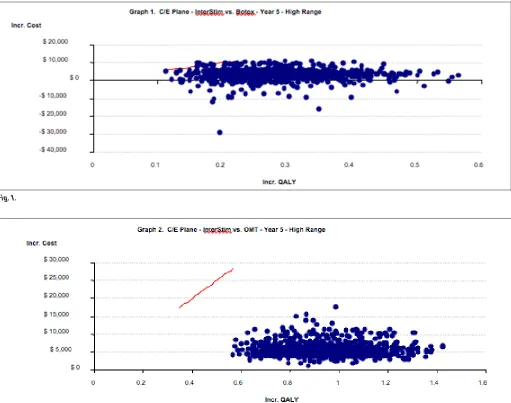
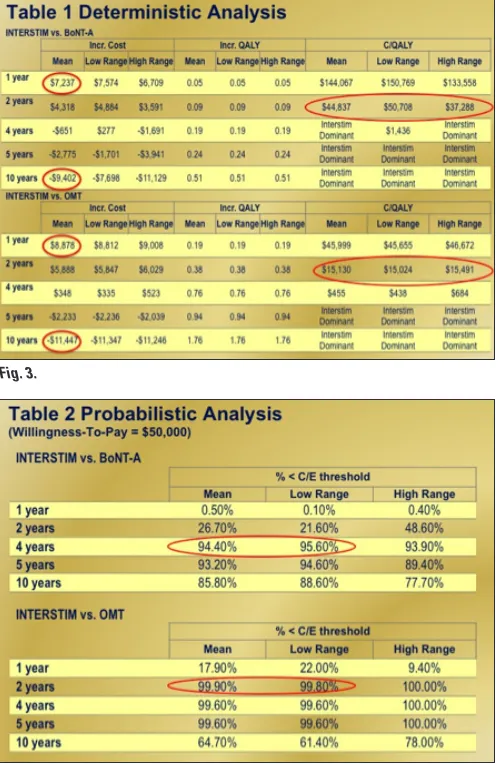
Results: The annual incremental cost of SNM vs. BoNT-A was $7,237 in year-1 and -$9,402 in year-10 (Fig. 1), and between $8,878 to -$11,447 vs. OMT (Fig. 2). In the base-case deterministic analysis, the ICER for SNM vs. BoNT-A and OMT were within the acceptable range ($44,837 and $15,130, respectively) at the second year of treatment, with SNM being dominant in the consequent years (Fig. 3). Furthermore, the prob-ability of ICER obtained from the base-case deterministic analysis of being below the acceptability curve was >94.4% for SNM vs. BoNT-A at year 4 and >99.9% for SNM vs. OMT at year 2 (Fig. 4). Finally, graphs 1 and 2 show the cost-effectiveness of SNM when compared to BoNT-A and OMT modalities at year-5.
Conclusions: SNM is a cost-effective treatment option for the management of patients with refractory overactive bladder when compared to either BoNT-A or OMT. From a Canadian payers’ perspective, SNM should be considered as first line treatment option in patients with refractory overactive bladder.
14 h 16 - 14 h 25
Optimal outcome after permanent seed prostate brachytherapy: The TRIFECTA analysis
Audrey Tetreault-Laflamme; Guila Delouya; Daniel Taussky; Thomas Zilli Departement de Radio-Oncologie, Centre hospitalier de l’Université de Montréal Hôpital Notre-Dame
Introduction: The purpose of this study was to assess in a combined analysis (Trifecta) the optimal outcome for patients treated with exclusive permanent seed PB, as defined by the likelihood of achieving disease control and preserve normal urinary and sexual functions.
Methods: 384 patients with localized prostate cancer were treated with PB at our institution between 2005 and 2010. Excluding patients without erectile dysfunction (ED) not responding to medication (grade 3 from the Common Terminology Criteria for Adverse Events version 3.0, CTCAE v 3.0) and with a minimal follow-up of one year, a total of 233 patients were considered for the analysis. All patients were implanted with 125I using an intraoperative, inverse planned PB technique at a dose of 144 Gy. Biochemical control (BC), genito-urinary (GU) and sexual toxicity rates were assessed. Patients with concurrent BC, no GU toxicity and preserved sexual potency at 1, 2, 3, and 4 years were classified in the
Trifecta group. BC was defined as prostate-specific antigen (PSA) level lower than the preceding PSA and as a PSA ≤0.5 ng/ml for years 1 and 2 and for years 3 and 4, respectively. Absence of GU toxicity was defined as an International Prostate Symptom Score (IPSS) of no more than three points higher than baseline score at 1 year and as the complete absence of GU toxicity (CTCAE v 3.0 grade 0) on years 2 to 4. Patients with Grade 0 to 2 ED (2=medication necessary) were deemed as sexually potent. Multivariate analysis was performed to predict for Trifecta at 1, 2 and 3 years in 111 patients with complete data set on each point in time from years 1-3
Results: Trifecta endpoints were achieved in 70% (n=163), 47.4% (n=83), 48.1% (n=50) and 54.5% (n=30) of the patients on years 1 to 4 after PB, respectively. The BC rates were 100%, 76.2%, 64.6% and 75.4% at 1, 2, 3 and 4 years, respectively. The corresponding potency rates were 93,6%, 90%, 93,7% and 95,2%, while the rates of Grade 0 GU toxicity were 74.2%, 61%, 73.3% and 74.6%. In the multivariate analysis, prostate D90 (p=0.047) and V100 (p=0.021) on year 1, and age at year 2 (p=0.038) and 3 (p=0.032) were significant predictors of Trifecta.
Conclusion: The Trifecta endpoints were achieved approximately in 50% of the patients in the time range varying from years 2 to 4 after PB. The most common reason excluding patients from the Trifecta group remained urinary toxicity. Although our criteria for Trifecta were very strict, results of this series were comparable with previous prostatectomy studies.
14 h 25 - 14 h 34
Le stade de la tumeur sur la re-résection trans-urethral prédit la rechute et la progression du carcinome urothéthial superficiel de haut risque
Mathieu Latour; Jean-Baptiste Lattouf; Mohamed Bishr; Fred Saad Centre de recherche du Centre hospitalier de l’Université de Montréal (CRCHUM)
Introduction et objectifs : Actuellement, la prise en charge des patients avec un carcinome urothélial superficiel de haut risque est en débat afin de déterminer les avantages d’une procédure conservative, avec préserva-tion de la vessie, plutôt qu’une cystectomie précoce. De nombreux efforts sont mis en place pour déterminer des facteurs pronostiques cliniques et biologiques utiles pour guider ce débat. Notre objectif était d’évaluer les variables cliniques, en termes d’indicateur de progression et récurrence, chez les patients avec carcinome urothélial superficiel de haut risque, qui suivent une résection trans-urétrale de re-staging (re-RTU).
Patients et méthodes : Les données cliniques de 348 patients avec car-cinome urothélial superficiel, traités au centre hospitalier de l’Université de Montréal (division d’urologie) entre 2004 et 2012, ont été révisées. De ceux-ci 59 patients avec tumeur superficiel de haut risque, ayant subi un re-RTU et n’ayant pas été réévalués à un stade de la maladie avec envahissement du muscle, ont été inclus dans l’étude.
Résultats : Sur les re-RTU, 30 patients n’avaient pas de maladie résiduelle (pTo) alors que 29 en avaient. Des 30 patients avec pTo, 13 (43,3%) ont Fig. 3.
Sessions scientifiques III, IV, V, VI
eu une rechute de la maladie (temps médian de 13,3 mois) et 2 (6,6%) ont montré une progression de la maladie (temps médian 23 mois). Des 29 patients avec tumeur résiduelle sur la re-RTU, 23 (79.3%) ont eu une rechute (temps médian 5.4 mois) et 9 (31%) ont progressé (temps médian 11 mois). En analyses multivariées, le stade de la tumeur sur la re-RTU et le régiment de BCG (induction vs maintenance) étaient des facteurs indépendants de rechute (p=0.001 HR: 1.85, p<0.001 HR: 0.09, respec-tivement), alors que pour la progression, le stade de la re-RTU était le seul facteur pronostique indépendant (p=0.019 HR: 1.89).
Conclusions : La présence de pTo sur re-RTU est associée à un meilleur intervalle de progression et de rechute de la maladie. Les patients avec une persistance du cancer superficiel sur re-RTU nécessitent un proche suivi et pourraient être considéré dans certains cas pour une cystectomie précoce.
14 h 34 - 14 h 43
Relationship between stone type, stone culture and urine culture in patients undergoing percutaneous nephrolithotomy
Naeem Bhojani; James E. Lingeman; James C. Williams Indiana University School of Medicine
Introduction: One of the most significant complications of percutaneous nephrolithotomy (PCNL) is sepsis. In order to avoid this complication, pre-operative urine cultures are used to adequately treat patients before performing PCNL. Moreover, patients who are known to harbor struvite stones are exceedingly scrutinized when preparing for PCNL. However, it has been shown that non-struvite stone formers may harbor equally lethal bacteria. As well, peri-operative stone cultures can harbor different bacteria than pre-operative urine cultures. The objective of this study is to demonstrate the relationship between stone type, stone culture and urine culture in order to unable one to adequately treat and/or prevent sepsis post-PCNL.
Methods: We performed a retrospective data analysis of percutaneous nephrolithotomy patients treated at one institution between 1999 and 2009. Inclusion criteria for this study comprised patients who had results for both stone and urine cultures as well as stone mineral content. Results: The overall agreement between urine and stone culture occurred in 361 cases (72.7%) and the rate of discordance was similar in both the struvite and non-struvite stone forming groups (26.2% and 27.4% respec-tively) (Table 1). A positive stone culture in the presence of sterile urine occurred in 10.5% of patients overall and this occurred most frequently in non-struvite stone formers (n=47, 10.8%). Of patients presenting with both a positive urine and stone culture (n=151), 67 or 44.4% (13.5%
overall) were found to have different infectious organisms between the urine and the stone cultures. Therefore, 24% of patients will present with a positive stone culture in the presence of sterile urine (10.5%) or a dif-ferent organism cultured from stone than from urine (13.5%).
Conclusion: The simplification of the infection stone being synonymous with struvite stone may have negative consequences in the clinical treat-ment and managetreat-ment of stone disease. As well, the utilization of urine cultures alone will often lead to misidentification of the actual infectious organism present in the kidney. Therefore, it is our belief that both the urine culture, as well as the stone culture, are useful in identifying and managing infectious risk associated with PCNL.
Session scientifique V
Objectifs éducatifs : À la fin de cette session, les participants seront en mesure de :
1. Comprendre les différentes étapes de la neuromodulation des racines sacrées.
2. Connaître l’évaluation et les indications cliniques de cette modalité de traitement.
3. Avoir une connaissance sur les données cliniques récentes de la neuromodulation sacrée afin d’améliorer la prise en charge éfficace de ces différentes dysfonctions mictionnelles complexes..
15 h 30 - 16 h 00
La neuromodulation sacrée: Où en sommes-nous ?
Conférenciere : Le Mai Tu Modérateur : Martine Jolivet
Session scientifique VI
Objectifs éducatifs : À la fin de cette session, les participants connaÎtront mieux les nouveautés dans la vessie hyperactive, les nouvelles lignes directrices de diagnostic, d’investigations et de traitements. Ils pourront ainsi prendre en charge les patients atteints de cette entite en sachant bien utiliser les astuces et les stratagèmes des derniers algorithmes disponibles.
16 h 15-17 h 00
Quoi de neuf au niveau de la vessie hyperactive
Conférencier : Francois Haab Hopital Tenon Paris, France Modérateur : Martine Jolivet
Table 1. Culture results of percutaneous nephrolithotomy patients grouped by stone mineral content
Stone mineral
Content Both negative (%)
Only positive urine culture (%)
Only positive stone culture (%)
Both urine and stone culture
positive (%) Total (%)
Struvite 9 (14.8) 11 (18.0) 5 (8.2) 36 (59.0) 61 (100)
Other 201(46.2) 72 (16.6) 47 (10.8) 115 (26.4) 435 (100)
CUAJ • December 2012 • Volume (6Suppl3) © 2012 Canadian Urological Association
AUQ-QUA 2012
S160
Session scientifique VII
Objectifs éducatifs : À la fin de cette session, le participant connaîtra les nouveaux développements en recherche clinique et fondamentale. Il pourra apprécier les travaux de recherche des résidents et fellows en urologie.
7 h 00 - 8 h 00 Déjeuner causerie Salon Jacques-Cartier
Prise en charge de cas complexes du cancer de la prostate
Conférenciers : Wassim Kassouf, Fred Saad, Eric Vigneault Modérateur : Michel Carmel
Session scientifique VIII
Objectifs éducatifs : À la fin de cette session, le participant connaîtra les nouveaux développements en recherche clinique et fondamentale. Il pourra apprécier les travaux de recherche des résidents et fellows en urologie. Modérateurs : Jean-Luc Descotes et Steven P. Lapointe
8 h 30 - 8 h 39
Comparative study for the carbonic anhydrase-IX, vascular endo-thelial growth factor and platelet derived growth factor receptor-alpha immunohitochemicale
Mohamed Bishr; Cécile Le Page; Philippe O. Gannon; Véronique Barrès; Roula Albadine; Fred Saad; Jean-Baptiste Lattouf
Centre de recherche du Centre hospitalier de l’Université de Montréal (CRCHUM) and Institut du cancer de Montréal, Centre hospitalier de l’Université de Montréal (CHUM)
Introduction: Approximately 60% of sporadic clear cell renal cell carci-noma (ccRCC) cases harbor a mutated VHL gene. VHL gene is involved in the regulation of the hypoxia induced factor1-α (HIF1-α). Dysregulation of this pathway results in high expression of carbonic anhydrase-IX (CA-IX),
vascular endothelial growth factor (VEGF) and platelet derived growth factor receptor (PDGFR-α) among other target proteins. Our objectives were to compare the patterns of immunohistochemical (IHC) expression of CA-IX, VEGF and PDGFR-α in RCC and evaluate their relation to the different clinicopathological variables.
Methods: Clinical data was obtained from 50 patients with RCC who underwent either radical or partial nephrectomy in the Centrehospitalier de l’Université de Montréal (CHUM). A tissue microarray containing 150 cores (1 normal and 2 cancerous cores per patient) was constructed. The specificity of the antibodies used in this study was validated by Western blot. A pathologist scored the distribution and the intensity of the IHC staining for each biomarker.
Results: IHC staining for VEGF and PDGFR-α was cytoplasmic and mem-branous for CA-IX. We noted a statistically significant difference in the IHC expression of CA-IX, VEGF and PDGFR-α between normal kidney tissue and RCC (p<0.001), while between ccRCC and papillary RCC, only CA-IX and PDGFR-α showed significant difference (p<0.001). In the ccRCC group, an inverse correlation was observed between the percentage of cells showing positive CA-IX staining and the intensity of VEGF staining (p=0.014). Statistically significant correlations were observed between CA-IX expression and the Fuhrman nuclear grade, tumor size and surgi-cal margins (p=0.049, p=0.001, p=0.033 respectively) and between VEGF and Fuhrman nuclear grade, T stage and stage group (p=0.025, p=0.012, p=0.006 respectively).
Conclusion: In ccRCC, the IHC expression of CA-IX and VEGF are more correlated to the clinicopathological variables than PDGFR-α. Combining these biomarkers together could improve their correlation with clinical parameters and their potential prognostic ability.
8 h 39 - 8 h 48
Holmium laser enucleation of the prostate (HoLEP) for glands larger than 200 grams
Naeem Bhojani; Jessica A. Mandeville; James E. Lingeman Indiana University School of Medicine
Introduction: Holmium laser technology allows for enucleation of very large prostate glands with outcomes equivalent to or superior to those of open simple prostatectomy. Here we describe our experience with HoLEP for glands ≥200 grams.
Methods: Between January 1999 and February 2011, 58 patients with glands ≥200 grams underwent HoLEP at our institution. All procedures were performed by one surgeon (JEL). Residents and/or fellows assisted in all cases.
Results: Mean patient age was 72.6 years. Mean pre-operative patient char-acteristics include transrectal ultrasound (TRUS) volume of 218 grams, AUA symptom score (AUASS) of 18.9, Qmax of 7.5 ml/sec, post-void residual (PVR) of 237.6 cc and PSA of 19.9 ng/mL. Twenty-nine percent (17/58) of patients required catheterization (intermittent catheterization or indwelling catheter) pre-operatively. Mean enucleation and morcellation times were 86.7 min (range 30-211 min) and 49.3 min (range 23-133 min) respec-tively. Mean enucleation and morcellation efficiency were 2.8 g/min and 6.3 g/min. Mean weight of tissue resected was 213.4 grams (range 111.1 – 532.2 grams). Two patients (3.4%) required perineal urethrostomy in order to complete the procedure. Eight patients (13.8%) had concomitant proce-dures (bladder neck incision (2), cystolithopaxy (5), bladder biopsy (1)). One patient (1.7%) required cystotomy for tissue retrieval. One patient required same-day take back for clot evacuation and one patient required take back 48 hours operatively to complete morcellation. Mean pre- and
post-Sessions scientifiques VII, VIII, IX, X, XI
Samedi (a.m.), le 10 novembre 2012
Les sessions scientifiques suivantes ont été rendues possibles grace à la contribution non restrictive de nos partenaires : PARTENAIRES ELITES/ELITE SPONSORS
Abbott Laboratories Ltd. Amgen Canada
Astellas Pharma Canada Inc. AstraZeneca
Janssen Inc. GlaxoSmithKline Inc. Pfizer Canada Sanofi-Aventis
Watson Pharma Company Canada
PARTENAIRES MAJEURS/MAJOR SPONSORS
Eli Lilly Canada Inc.
PARTENAIRES COLLABORATEURS/ASSOCIATE SPONSORS