Equity and efficiency in the scaled-up
implementation of integrated neglected
tropical disease control: the health
economics protocol of the
COUNTDOWN multicountry
observational study in Ghana,
Cameroon and Liberia
Maame Esi Woode,1 Jahangir A. M. Khan,1 Rachael Thomson,2
Louis Wilhelmus Niessen,1,3,4 the COUNTDOWN Consortium
To cite: Woode ME, Khan JAM., Thomson R, et al. Equity and efficiency in the scaled-up implementation of integrated neglected tropical disease control: the health economics protocol of the COUNTDOWN multicountry observational study in Ghana, Cameroon and Liberia. BMJ Open 2018;8:e020113. doi:10.1136/ bmjopen-2017-020113
►Prepublication history for this paper is available online. To view these files, please visit the journal online (http:// dx. doi. org/ 10. 1136/ bmjopen- 2017- 020113).
Received 16 October 2017 Revised 6 April 2018 Accepted 24 April 2018
1Department of Clinical Sciences, Liverpool School of Tropical Medicine, Liverpool, UK 2Department of Parasitology, Liverpool School of Tropical Medicine, Liverpool, UK 3Centre for Applied Health Research and Delivery, Liverpool School of Tropical Medicine, Liverpool, UK
4Department of International Health, Johns Hopkins School of Public Health, Baltimore, USA
Correspondence to
Dr Maame Esi Woode; Maame. Woode@ lstmed. ac. uk
AbstrACt
Introduction Worldwide, millions of individuals are affected by neglected tropical diseases (NTDs). They are frequently the poorest and most marginalised members of society. Their living conditions, among other things, make them susceptible to such diseases. Historically, several large-scale treatment programmes providing mass drug administrations (MDAs) were carried out per single disease but over the last decade there has been an increasing trend towards co-implementation of MDA activities given the resources used for such programmes are often the same. The COUNTDOWN multicountry studies focus on scaled-up implementation of integrated control strategies against four diseases: lymphatic filariasis, onchocerciasis, schistosomiasis and soil-transmitted helminthiasis. The objective of the COUNTDOWN economic study is to assess the multicountry implementation of control interventions in terms of equity, impact and efficiency.
Methods The health economic study uses different analytical methods to assess the relationship between NTDs and poverty and the cost-effectiveness of different large-scale intervention options. Regression analysis will be used to study the determinants of NTD occurrence, the impact of NTDs on poverty, factors that hinder access to MDAs and the effect of NTDs on quality-of-life of those affected, including disability. Cost-effectiveness analyses of various integration methods will be performed using health economic modelling to estimate the cost and programme impact of different integration options. Here, cost-effectiveness ratios will be calculated, including multivariate sensitivity analyses, using Bayesian analysis.
Ethics and dissemination Ethics approval has been received both at the Liverpool School of Tropical Medicine and in all participating countries. Results of the various substudies will be presented for publication in peer-reviewed journals.
study dates 1 July 2016 to 30 June-October 2019.
IntroduCtIon
Neglected tropical diseases (NTDs) impact the lives of over 1 billion people in low-in-come and middle-inlow-in-come countries.1 An estimated 5.9 million years of healthy life were lost in Sub-Saharan Africa (SSA) due to schistosomiasis (SCH), onchocerciasis (OV), lymphatic filariasis (LF) and soil-transmitted helminthiasis (STH) in 2013.2 About 90% of
the global NTD disease burden is attributable to 7 of the 17 NTDs: these are SCH, OV, the
strengths and limitations of this study
► This study will enable us to study the relationship between poverty and neglected tropical diseases (NTDs) from different angles: poverty distribution of NTDs, impact of NTDs on households, the access and adherence of households to mass drug adminis-trations (MDAs) and the cost and cost-effectiveness of (MDAs).
► Secondary outcomes can allow us to assess often not considered (direct and indirect) impacts of NTDs including its effect on labour market participation and on schooling.
► A main limitation is with the duration of the study. To fully observe the poverty impact of NTDs and the role MDAs play, a longer period of study will be ap-propriate, preferably beyond 2 years. This is, howev-er, a first step in the right direction.
► The short period of time (maximum of 2 years for most interventions) limits the ability to fully appre-ciate the impact of the different interventions on several socioeconomic variables such as education, labour market participation, incomes and adulthood outcomes.
on 17 July 2018 by guest. Protected by copyright.
http://bmjopen.bmj.com/
three STHs (roundworm, whipworm and hookworm), Trachoma and LF.3
Since Grossman’s 1972 influential work on the demand for health, studies on the impact of health status on economic conditions have greatly increased.4 5 The focus
has mainly been placed on HIV-AIDS, malaria and tuber-culosis.6–8 The impact of NTDs on families, communities
and economies, though under-researched, is considered to be immense.9 This may lead to school absenteeism,
poor performance in school and a loss of productivity, including the inability to undertake agricultural work with consequent impact on food security and nutri-tional quality.1 3 10 11 These effects, together with a
reduc-tion in the individual’s quality of life (QoL), can cause psychological problems and an increase in the demand for healthcare which may result in catastrophic health expenditures.1 3 10–12 The few studies that exist find
signif-icant effects on families and communities.13 For example,
studies have shown that LF leads to an annual produc-tivity loss of about US$1 billion in India.14 STH or SCH
infection during childhood may have negative long-term effects on cognition and memory.10 15 16
NTDs affect the poorest and most marginalised individ-uals and households, for whom neither prevention nor treatment is accessible.13 17 They disproportionately affect
individuals whose living and working conditions make them especially vulnerable.18–20 Generally, lack of access
to health services makes it difficult to diagnose and treat such infections early. Thus, not only may NTDs lead to poverty, they may also be caused by it. The vicious cycle of NTDs and poverty needs to be better understood. The relatively low global burden assigned to these diseases, however, means that they are often not high on the agenda of relevant stakeholders.21–24
Various NTDs, including LF, OV, SCH and STH, have cost-effective prevention and treatment options.21 These
are often administered annually via national mass drug administration (MDA) or mass administration of medi-cines (MAM) programmes.21 For example, OV and LF
are often controlled using the donated drug ivermectin (IVM), at a cost of between US$14 and US$3030 per disability-adjusted life-year (DALY) averted.21 25 These
costs arise mostly from the distribution of the medication, training community distributors, supervision and moni-toring and evaluation.25
In-country MDA programmes may come at substantial cost. They involve the use of both health and educational facilities and employees including teachers. This involves both time and direct monetary costs.26–29 A recent study
estimates that the total societal and household benefits obtained by achieving the 2020 London Declaration NTD targets for LF, OV, SCH, STH and trachoma is US$27.4 for each dollar spent for the period 2015–2020 with a return of US$42.8 for the 2021–2030 period.9 The declaration
focuses on the elimination of LF and blinding trachoma and the control of OV, SCH and STH by 2020.30
In the case of high co-endemicity and comorbidity, the issue of integrated preventive chemotherapy (PC), as
opposed to vertical PC, becomes particularly attractive. From the health system perspective, integrating NTD control programmes is a means of using resources more effectively and building more responsive processes.31–33
This could lead to increases in coverage rates, an essential prerequisite for all NTD elimination policies.34 A recent
study found that using the integrated PC programme for treating trachoma, SCH, STH and LF in six districts in Niger saved 16% in programme costs for 2008 and 21% in 2009.34
Reaching the 2020 targets will be beneficial to both individuals and other stakeholders9 and will contribute to
the fight against poverty.35 However, current drug
admin-istration campaigns are limited in the extent to which they integrate with broader efforts to address diseases and build stronger health systems. In addition, studies on the economic effects of these programmes are rare and in cases where they exist tend to focus on cost-effectiveness analysis (CEA) and on single diseases, rather than taking a broader health systems approach. Hard-to-reach groups, as well as equity impact, have rarely been included. There-fore, detailed assessments of the cost, cost-effectiveness and societal impact of expanded access to treatment of all population groups are urgently needed.
The main objectives of the COUNTDOWN project are to study the most effective, cost-effective, sustain-able and acceptsustain-able current and complementary strate-gies to implement scaled-up NTD treatments in Ghana, Cameroon, Liberia and Nigeria. This should lead to meeting the 2020 London Declaration goals and strengthen in-country health systems. This present study aims to identify generalisable factors which influence the acceptance, effectiveness, efficiency and equity impact of scale-up from a health systems approach. It also explores the most effective strategies to work with community drug distributors (CDDs) and community health workers (CHWs) to extend the scaling up of MDA to include hard-to-reach communities and build the resilience of vulnerable and marginalised groups. The project will study the various ways of integrating NTD programmes to strengthen health systems, foster cross-sector working (eg, sanitation, water resources and agriculture) to deliver a sustainable impact in support of NTD affected populations.
More specifically, the health economics component of the project has three main substudies. Substudy 1 aims to analyse the economic burden of NTDs at the house-hold level by means of househouse-hold surveys, at baseline and (selective) postimplementation of NTD efforts. Substudy 2 aims to study the value for money of the investment in COUNTDOWN interventions from a societal perspec-tive. These interventions include expanded community treatment of SCH and STH in Ghana and Cameroon and a treatment of OV with doxycycline (and ground larvi-ciding) in Cameroon. Costing surveys will be carried out and used together with data from the household survey, existing economic models and reference prices. Substudy 3 will estimate the budgetary impacts of the
on 17 July 2018 by guest. Protected by copyright.
http://bmjopen.bmj.com/
COUNTDOWN interventions and identify opportunities for affordable scale-up and integrated implementation at the national, district and community level.
MEthods And dEsIgn
substudy 1: analyse the economic burden of ntds, using secondary data and carrying out household level surveys, at baseline and (selective) postimplementation of ntd effort
The goal is to analyse issues around NTD-related health inequalities. The focus will be on the bidirectional rela-tionship between health and poverty as well as the effect of NTDs on disability. We will look at (1) the socioeco-nomic determinants of NTD community prevalence, (2) the relationship between poverty and NTDs, (3) issues of accessibility and adherence to MDAs and (4) the relation-ship between NTDs and disability. This substudy will be carried out in Ghana, Cameroon and Liberia.
The socioeconomic determinants of NTD community prevalence Setting
Nationally representative data will be used, namely, the sixth Ghana Living Standards Survey (GLSS6) collected in 2012/2013, the fourth Cameroonian Household Survey (ECAM 4) collected in 2014 and the Liberian Household Income and Expenditure Survey (LHIES) collected in 2014/2015.36–38
The goal of the GLSS6, which was initiated by the World Bank in 1980, is to collect information on house-hold consumption and expenditure, health-related infor-mation, education and community level using various survey instruments.36 The GLSS6 data collection took
place from 18 October 2012 to 17 October 2013.
The ECAM collected information in 2014, which included expenses and acquisition of household goods, demography, individual time use, education, health and income of household members.
The goal of the LHIES was to collect household level information on education, health, employment, water and sanitation, expenditures, household resources among others.39 The survey used a two-stage sampling
methodology. Data collection was over a 1-year period from 1 January 2014 to 1 January 2015.37
Data analysis
We will use community-level prevalence estimates from the national NTD programmes in various countries and from an extensive grey literature review for the years before the socioeconomic data were collected. To study the socioeconomic and demographic determinants of community NTD prevalence, we will run separate ordi-nary least squares (OLS) regressions for each NTD in question. We will also run a multivariate OLS model to account for possible co-endemicity. There is a likelihood of reverse causality between the measures of household wealth and NTD prevalence.
While poverty might lead to NTD infections, having a high NTD prevalence might also lead to poverty. We will
therefore need to control for potential biases. We will employ the instrumental variables approach, provided a good instrument is found for endogenous variables. An instrument is defined as any variable that (1) is correlated with the endogenous variable, but not with the depen-dent variable and (2) is uncorrelated with the error term of the main equation.40 Appropriate instruments will be
used where feasible.
The relationship between poverty and NTDs, and disability and NTDs
Setting, sampling strategy and sample size
The COUNTDOWN consortium will develop a survey to collect household level data on sociodemographic char-acteristics, education, general health, health spending, disability (adapting the DHS disability questions and the EQ-5D) and MDA access in selected communities in Ghana, Cameroon and Liberia. The COUNTDOWN interventions will also involve the direct testing of house-hold members for diseases. With these parasitological and socioeconomic data, we will study the impact of the NTDs on household incomes, schooling and labour market participation in the selected community. We will also analyse the socioeconomic factors that make individ-uals in these communities vulnerable to NTDs and their access to the national MDA programmes.
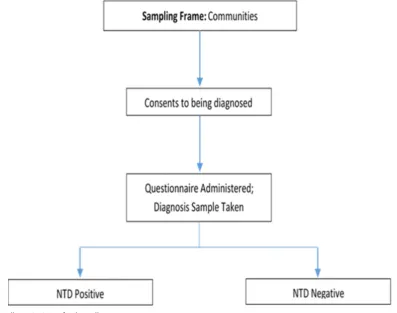
In order to study the direct impact of NTDs on house-holds, we will need to be able to match individuals affected by NTDs to others not infected by the respective diseases. The COUNTDOWN project will conduct diagnostic tests for different NTD infections at the household level in Ghana (SCH and STH) and Cameroon (OV). These diagnostics will therefore enable such analyses. The study sites for this work will include sites from the two interven-tion strategies described in substudy 2. Figure 1 gives a summary of the sampling strategy for the baseline survey in relation to the COUNTDOWN interventions.
We will select cases with NTD infections with a match to controls (individuals) based on age and gender. For each selected case, two controls (individuals who are not infected by the NTD under study) will be assigned. To determine the required sample of cases needed for the analysis, we will use the methodology of tests for two correlated proportions in a matched case–control design41 such that if we assume that the intervention will improve the rate of primary endpoint from 5% to 10% (OR of 2) and 0.2 of the correlation coefficient for the primary endpoint, 630 cases (1260 controls) will provide 90% power at a 0.05 significance level. We will add 25 extra cases to account for non-response and attrition, implying a total sample size of 655 cases and 1310 controls. These sample sizes will be revised if needed, based on the final diagnostic results.
Data analysis
Poverty distribution of NTDs
To study the poverty distribution of households in communities with high NTD prevalence and compare
on 17 July 2018 by guest. Protected by copyright.
http://bmjopen.bmj.com/
this with other communities, we will rank households based on a poverty measure. We will use three measure-ments of poverty, namely, household consumption expen-diture, household income and an asset index (AI). We will provide the standard measures of poverty in terms of expenditure and incomes. However, given that data of this type are often collected retrospectively and, in some cases, individuals are unwilling to provide such informa-tion, the quality of data collected is often low.
The AI relies less on recall as it will be created from a list of assets owned by the household. AIs are often used as relative measures of poverty, especially if income data is of poor quality.42 Principal component analysis (PCA) will be used22 to classify the households into five asset quin-tiles. We will use Student’s t-tests to compare AIs between the districts, in general, and the subdistricts with high NTD prevalence. The proportion of households with and without NTDs in the two poorest asset quintiles (first and second) will be considered as a measurement of poverty.43
It is expected that higher proportions of households in the poorest quintiles will be infected with NTDs.
NTDs and catastrophic health spending
Using total household consumption expenditure and household health expenditure (out of pocket (OOP) spending) for NTDs, we will measure the incidence of catastrophic health expenditure (CHE). Households that will incur NTD-related health expenditure corre-sponding to 10% or more of total household consumption
expenditure or 40% of total household non-food expen-diture will be classified as facing CHE.44
Incidence of CHE in households with and without NTDs will be calculated for assessing the impact of NTDS on CHE incidences. The determining factors of CHE will then be studied using a logistic regression. Further, to estimate the poverty impact, we will calculate what proportions of households fall below the poverty line (daily expenditure of US$1.90 per person45) by
calcu-lating total household expenditure with and without household health expenditure for NTDs.
The effect of NTDs on poverty
To study the possible effect of NTDs on poverty, concentration indices will be estimated using the AI. These indices are used to measure the degree of socio-economic-related inequality in health sector variables. In our case, the relevant variable is NTD infection. Multi-nomial, biprobit and nested logit regression analyses will be carried out to test whether NTD infections influence wealth, education and labour market participation.46 We
will test and control for potential endogeneity using the instrumental variables approach where appropriate.
The relationship between NTDs and disability
A descriptive analysis will be carried out to examine the disability status of individuals infected with NTDs. We will estimate a logistic regression and a bivariate probit model to examine the impact of NTDs on disability.
Figure 1 Sampling strategy for baseline survey.
on 17 July 2018 by guest. Protected by copyright.
http://bmjopen.bmj.com/
Inclusion, exclusion and eligibility
All individuals from selected households in Ghana and Cameroon who provided written informed consent to be interviewed and to give samples to be tested for NTDs will be included in the study. We will exclude individuals and households who did not give consent to be interviewed and to provide samples.
Individuals of the same gender and age as a case (up to two such individuals per case) who had provided written informed consent to give samples and were tested to have not had any of the NTDs being studied as part of the COUNTDOWN project and their consenting house-hold members will be included. Individuals unable to give consent and all individuals who were tested to be NTD negative, but withdrew consent will be excluded.
Accessibility and adherence to national MDA programmes Setting, sampling strategy and sample size
We will use community-level prevalence estimates from the national NTD programmes in various countries and from an extensive grey literature review. To study access and adherence to national MDA programmes and to the COUNTDOWN interventions, we will collect primary data on household characteristics, access and adherence using a household questionnaire. Following Offei and Anto,47 we will divide the communities into rural and urban areas. From each group, we will randomly select communities. Households will be randomly selected from each community using a random list of households gener-ated from the total number of households in the district, where each household will be given a unique identifica-tion number.
We calculate the required sample size using the formula47:
where we fix our desired statistical significance level at 5% ( Zα
2 = 1.96). If we assume an average national MDA
coverage of 85% (´p = 0.85) and a 5% (d = 0.05) precision,
we will need a sample size of 195 households split propor-tionally across the selected communities. To account for non-responses we will include an extra 10%, bringing the total number of households to 214. We will interview the head of each household or the most knowledgeable person in the household. The head of the household is defined as the person who makes the decisions or has the final say within the household. For the individual-specific questions, consenting individuals (or a parent or guardian for individuals below the age of 15) will be interviewed.
Data analysis
The analysis will begin with a descriptive study of accessi-bility and adherence based on individual, household and community characteristics including information on the CDDs. This will be followed by an empirical analysis using both the nested and sequential logit models.
Though we can analyse access and adherence sepa-rately, it is important to recognise the possible correla-tions between the two. It is possible that individuals who do not have access to treatment and those who do not adhere are similar. In addition, the question of adher-ence only comes into play after gaining access to MDAs, and thus our data is of the nested/sequential form. We will use the Heckman two-step model to correct for any selection bias.
Inclusion, exclusion and eligibility
All individuals from selected households in Liberia, Ghana and Cameroon who provided written informed consent to be interviewed and to give samples to be tested for NTDs will be included in the study. We will exclude individuals and households who did not give consent to be interviewed and to provide samples. Individuals unable to give consent and all individuals who were tested to be NTD negative, but withdrew consent will be excluded.
substudy 2: cost-effectiveness analyses of countdown interventions
The goal is to assess whether each of the interventions is good value for money.48
Setting
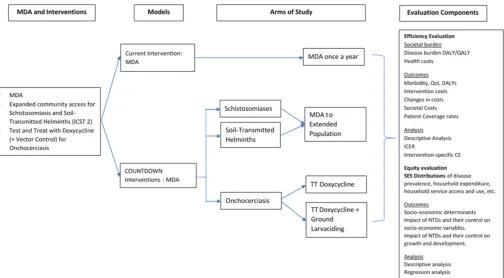
The COUNTDOWN project aims to implement several interventions for three NTDs. An extended MDA inter-vention for SCH and STH and a treatment with doxy-cycline together with specific vector control measures (using larviciding) for OV. The extended MDA inter-vention for SCH and STH will be carried out in Ghana and Cameroon. It involves the provision of praziquantel (PZQ) and mebendazole (MBD) (or albendazole, ALB, for Ghana) to the whole community. The current treat-ment in both countries are school based. Treattreat-ment will take place at time period 0 months and 12 months with parasitological tests taking place at time 0 months, 6 months, 12 months and 18 months.
For the OV study in South Western Cameroon, 10 of the 20 selected communities will receive doxycycline without ground larviciding, while the other 10 will receive doxy-cycline with ground larviciding. Doxydoxy-cycline will only be offered to the individuals who have tested positive for OV. Doxycyline treatment is over a 5-week period where indi-viduals take a dose each day during this 5-week period.
These interventions are presented in figure 2. The sample for our study will be individuals in these interven-tion studies.49 Both interventions will be carried out over
an 18-month period. The medicines will be provided to everyone in the selected community and they are free to take part in the intervention or decline. A full description of the SCH/STH intervention in Ghana can be found in Campbell et al50 and the full protocols for the work in
Cameroon are available on request.
Data analyses
We will compare the proposed interventions to the already existing intervention of one MDA annually. CEA
on 17 July 2018 by guest. Protected by copyright.
http://bmjopen.bmj.com/
in low-income and middle-income countries is often diffi-cult due to a lack of (accurate) costing data.51 We will use
market values and proxies to overcome some of these challenges in obtaining cost estimates. In our study, we will use direct observation methods such as time and motion techniques, activity logs, participant recorded activity logs and patient diaries as well as participant-based methods such as self-reported activity logs and direct assessment during the interventions.48 Household-specific cost
infor-mation will also be collected.
We will adopt the societal perspective for this study. This, in general, implies that (1) there is an inclusion of all productivity gains and losses, (2) the cost of drugs and other inputs will be measured using opportunity costs and (3) health state utilities are estimated using of community preferences.52 53 The costs will be the loss of
non-health related welfare due to the use of resources for health provision, while the benefits will relate to the gains in welfare due to an improvement in health.54
Cost analysis
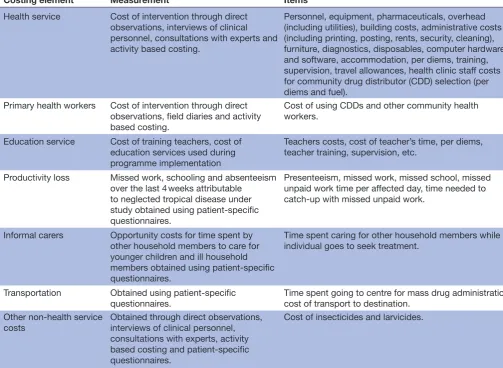
The COUNTDOWN interventions involve different types of costs including the patient-specific costs, the health system costs, the cost of primary healthcare workers including CDDs and the education system costs for school-based interventions. Patient-specific costs include productivity losses (absenteeism, presenteeism, loss of schooling time, etc), transportation costs and other costs (both direct and indirect) incurred by the patient when they take part in the intervention.
To estimate the total costs, we will use a retrospective micro-costing methodology. The main cost dimensions include programme-specific expenditure, the opportu-nity costs or value of governmental contributions related to in-kind costs of using local government staff and vehi-cles and the value of CDD’s time, the international costs of programme coordination, reporting and technical support.27–29 55
A comprehensive list of resources consumed in the provision of the different interventions will be created using direct observation of the intervention process and via interviews with clinical personnel, consultations with experts and activity-based costing.56 The general list of
costing will fall under health service use, productivity loss, informal carers, transportation and other non-health service costs. These are presented in table 1. We will use a discounting rate of 3% adjusting further for inflation.57
All cash expenditures paid for the implementation of the intervention will be estimated.27–29 55
Effectiveness: programme evaluation
In measuring the effectiveness of NTD control through MDAs, several studies have used varying indicators. These range from infection cases averted to DALYs.26 28 29 58 We
will use infection cases averted as measured by change in infection occurrence as our main effectiveness measure. Other indicators include measures of disease intensity (from the stool, urine, blood and skin snip samples) and other morbidity indicators such as anaemia for SCH, lymphangio-adenitis for LF and skin nodules for OV. The Figure 2 Concept map for health economics evaluations alongside the COUNTDOWN interventions. DALY, disability adjusted life year; ICER, incremental cost-effectiveness ratio; MDA, mass drug administration; NTD, neglected tropical disease; QALY, quality adjusted life year; QoL, quality of life.
on 17 July 2018 by guest. Protected by copyright.
http://bmjopen.bmj.com/
OV parasitology will enable us have follow-up informa-tion for the same individuals, while the SCH and STH parasitology will be a repeated cross-section at 6 months interval. We will also check for MDA coverage (both for COUNTDOWN interventions and National MDA programmes).
Cost-effectiveness analyses
We will measure cost-effectiveness using the incremental cost-effectiveness ratio (ICER) against the baseline situation.
Sensitivity analyses
Sensitivity analyses will be carried out to find out the effect of a change in some key variables on the cost-effec-tiveness of the interventions. We will start with univariate analyses and then proceed to multivariate analysis using regression. Tornado graphs will be produced to show the changes in ICER as a result of changes in parameter values. In the multivariate analysis, more than one vari-able will be allowed to vary in the regressions.
We will also carry out probabilistic sensitivity analyses through the use of Monte-Carlo simula-tions. Cost-effectiveness acceptability curves will be produced using non-parametric bootstrap techniques.
For comparability, parametric techniques will also be applied using the Fieller’s theorem method.59 This
method calculates CIs for ratios with the assumption that both the numerator and the denominator follow a bivariate (log-) normal distribution. The distribu-tion of the cost-effectiveness ratio is not required to be either normal or symmetric. Bayesian techniques will be adopted where appropriate.
Outcomes Primary outcomes
► Direct costs: drugs, staff time, equipment, transport, OOP.60
► Indirect costs: production losses, other uses of time including schooling and leisure.
► Intangibles: pain and suffering, adverse effects from medicines.
► Incremental cost-effectiveness ratio.
Secondary outcomes
► Disease occurrence. ► Severity.
► Morbidity. Table 1 Costing dimensions
Costing element Measurement Items
Health service Cost of intervention through direct
observations, interviews of clinical personnel, consultations with experts and activity based costing.
Personnel, equipment, pharmaceuticals, overhead (including utilities), building costs, administrative costs (including printing, posting, rents, security, cleaning), furniture, diagnostics, disposables, computer hardware and software, accommodation, per diems, training, supervision, travel allowances, health clinic staff costs for community drug distributor (CDD) selection (per diems and fuel).
Primary health workers Cost of intervention through direct
observations, field diaries and activity based costing.
Cost of using CDDs and other community health workers.
Education service Cost of training teachers, cost of
education services used during programme implementation
Teachers costs, cost of teacher’s time, per diems, teacher training, supervision, etc.
Productivity loss Missed work, schooling and absenteeism
over the last 4 weeks attributable to neglected tropical disease under study obtained using patient-specific questionnaires.
Presenteeism, missed work, missed school, missed unpaid work time per affected day, time needed to catch-up with missed unpaid work.
Informal carers Opportunity costs for time spent by
other household members to care for younger children and ill household members obtained using patient-specific questionnaires.
Time spent caring for other household members while individual goes to seek treatment.
Transportation Obtained using patient-specific
questionnaires. Time spent going to centre for mass drug administration, cost of transport to destination.
Other non-health service
costs Obtained through direct observations, interviews of clinical personnel,
consultations with experts, activity based costing and patient-specific questionnaires.
Cost of insecticides and larvicides.
on 17 July 2018 by guest. Protected by copyright.
http://bmjopen.bmj.com/
Inclusion, exclusion and eligibility
All individuals who consented to participate in the inter-vention and to being interviewed for the cost-effective-ness study will be included in the sample. Individuals and their households will be removed from the sample if they are, for whatever reason, unable to give consent to be interviewed or change their minds during the inter-viewing process. Individuals and their households will be removed from the case–control study if they rescind their consent for the second interview at any time before the end of that second interview.
substudy 3: model-based analysis: macro-micro economic impact of ntd control
The goal of this substudy is to estimate the long-term impact and cost-effectiveness of NTD control using Markov time-dependent macro-micro simulation model and discrete event simulation (DES).61 We will look at
the budgetary impact of wider implementation of NTD control. In addition, we will look at the cost-effective-ness of integrating PC programmes studied as part of the COUNTDOWN project.
Setting
Using results from substudies 1 and 2, we will simulate the potential effects of the different COUNTDOWN interven-tions on disease occurrence. We are interested in finding out how different integration strategies will perform in terms of disease control and elimination. We will model these effects over a 10-year period with projections of potential benefits and costs in monetary and non-mon-etary terms.
Data analysis and outcomes
We will estimate the disease impact and cost-effectiveness of the different interventions over a specified period using inputs and results from previous cost-effectiveness studies. We will use a Markov model with external (intervention
costs) and internal costing (health system costs). We will also use DES models to incorporate specific epidemiolog-ical results.62 We will address parameter uncertainty using
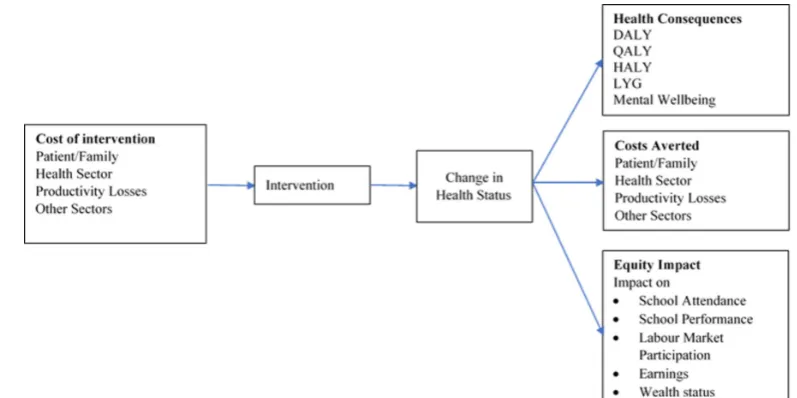
Monte-Carlo simulations and Bayesian analysis. Figure 3 presents a basic description of the model. This figure is adapted from Drummond et al.63
Based on the data collected and the results obtained, we will test different integration strategies and the effects they will have on the disease. We will also examine the cost-effectiveness of the different strategies and their limitations.
Results will initially be presented at various conferences, seminars and workshops in the countries of study and internationally. Results will also be published in peer-re-viewed journals. A summary of the results will be included in the final COUNTDOWN project report.
Patient and public involvement
Patients were not directly involved in the development of the health economics component of the COUNTDOWN project. NTD programme managers were consulted on the design of the work and are included in the list of involved COUNTDOWN members.
dIsCussIon
The goal of the proposed project is to study the economics of NTDs by focusing on the equity and effectiveness in the scaled-up implementation of integrated NTD control. The focus is on four disease groups, namely, SCH, STH, LF and OV. The health economics component will have three different objectives: (1) to analyse the economic burden of NTDs at the household level, by carrying out household level surveys, at baseline and (selective) post-implementation of NTD effort, (2) to study the cost-ef-fectiveness of the COUNTDOWN intervention and (3) to study the macro-micro economic impact of NTD control.
Figure 3 Economic decision model components. DALY, disability adjusted life year; HALY, healthy adjusted life years; LYG, life years gained; QALY, quality adjusted life year.
on 17 July 2018 by guest. Protected by copyright.
http://bmjopen.bmj.com/
In terms of limitations, there is the risk of individuals refusing to be tested for the diseases for various reasons at either the baseline or during the follow-up. Without a specific diagnosis, it will be difficult to study the impact of NTDs on the households and the risk factors as some individuals will be asymptomatic. The sample size will, in turn, be limited by our ability to carry out diagnostics.
This limitation aside, the proposed studies will offer valuable and unique insights on the costs, effectiveness and the equity impact of NTDS and their integrated control on the most vulnerable individuals living on the fringes of society. It will offer insights on the paths to be taken towards the elimination of these diseases and the benefits to be obtained by focusing on these diseases. It will provide significant economic evidence to health policymakers and implementation functionaries towards NTD control and help decision-makers to integrate further the prevention and treatment of such diseases and their control in current health systems.
Ethics and dissemination
The study received approval from the following:
► The Liverpool School of Tropical Medicine Research Ethics Committee (Research Protocol (16-053, 16-061)).
► The Comité National d’éthique de la recherche pour la santé humaine (No. 2016/11/838/CE/CNERSH/ SP, No. 2016/11/833/CE/CNERSH/SP).
► The Ghana Health Service Ethics Review Committee (No. GHS-ERC: 16/01/2017).
► The University of Liberia, Pacific Institute for Research and Evaluation Institutional Review Board (UL-PIRE IRB) (No. 17-02-027 with assurance No. FWA00004982).
The study also received the required administrative clearances from the Ministry of Public Health, Republic of Cameroon (No. 631–03.17 and No. 631–01.17).
Acknowledgements The authors would like to thank Professor Dualo Wang and Dr Tao Chen for their statistical help in calculating sample sizes. We would also like to thank Professor David Molyneux for his invaluable comments. Dr Njoumemi Zakariaou also provided invaluable comments on the initial draft of the protocol. In addition, we extend our thanks to the following members of the COUNTDOWN Consortium who provided useful comments on the article: Adams Emily, Asare Kwabena, Ayok Maureen, Biritwum Nana-Kwadwo, Campbell Suzy, Cunningham Lucas, Dean Laura, Garshong Bertha, Gyapong Margaret, Hamill Louise, Kollie Karsor, Lar Luret, Lawong Bernsah Damian, MacPherson Eleanor, Minetti Corrado, Osei-Atweneboana Mike, Reimer Lisa, Sosu Fred, de Souza Dziedzom, Stothard Russell, Taylor Mark, Tchuem-Tchuenté Louis-Albert, Theobald Sally, Turner Joe, Wanji Samuel, Njoumemi Zakariou.
Collaborators COUNTDOWN Consortium: Adams Emily, Asare Kwabena, Ayok Maureen, Biritwum Nana-Kwadwo, Campbell Suzy, Cunningham Lucas, Dean Laura, Garshong Bertha, Gyapong Margaret, Hamill Louise, Kollie Karsor, Lar Luret, Lawong Damian, MacPherson Eleanor, Minetti Corrado, Osei-Atweneboana Mike, Reimer Lisa, Sosu Fred, de Souza Dziedzom, Stothard Russell, Taylor Mark, Tchuem-Tchuenté Louis-Albert, Theobald Sally, Turner Joe, Wanji Samuel, Njoumemi Zakariou.
Contributors MEW, JK, LWN designed the health economics study. MEW wrote the protocol and the initial draft of the protocol paper with guidance from JK and LWN. RT provided invaluable comments at the research design phase and on all drafts of the paper. Various COUNTDOWN members provided useful comments to the protocol and/or this paper. All authors read and approved the final manuscript.
Funding COUNTDOWN is a multidisciplinary research consortium dedicated to investigating cost-effective, scaled-up and sustainable solutions, necessary to control and eliminate the seven most common NTDs by 2020. COUNTDOWN was formed in 2014 and is funded by UKAID part of the Department for International Development (DFID). Grant ID: PO 6407. DFID has not been involved in the writing of the protocol nor the protocolmanuscript.
Competing interests None declared.
Patient consent Not required.
Ethics approval The Liverpool School of Tropical Medicine Research Ethics Committee, the Comité National d’éthique de la recherche pour la santé humaine, the Ghana Health Service Ethics Review Committee and the University of Liberia, Pacific Institute for Research and Evaluation Institutional Review Board.
Provenance and peer review Not commissioned; externally peer reviewed.
open access This is an open access article distributed in accordance with the Creative Commons Attribution Non Commercial (CC BY-NC 4.0) license, which permits others to distribute, remix, adapt, build upon this work non-commercially, and license their derivative works on different terms, provided the original work is properly cited and the use is non-commercial. See: http:// creativecommons. org/ licenses/ by- nc/ 4. 0/
© Article author(s) (or their employer(s) unless otherwise stated in the text of the article) 2018. All rights reserved. No commercial use is permitted unless otherwise expressly granted.
rEFErEnCEs
1. World Health Organization,. “First WHO report on neglected tropical
diseases: working to overcome the global impact of neglected tropical diseases”. Geneva: The World Health Organization, 2010. 2. Institute of Health Metrics and Evaluation, “GBD Data Tool”. 2013
http://www. healthdata. org/ gbd- data- tool (accessed 9 Jul 2016).
3. Norris J, Adelman C, Spantchak Y, et al. “Social and economic
impact review on neglected tropical diseases”. Washington DC: The Hudson Institute and the Sabine Vaccine Institute, 2012.
4. Gyimah-Brempong K, Wilson M. Health human capital and economic
growth in Sub-Saharan African and OECD countries. The Quarterly
Review of Economics and Finance 2004;44:296–320. 5. Chakraborty S, Das M. Mortality, human capital and persistent
inequality. J Econ Grow 2005;10:159–92.
6. Kambou G, Devarajan S, Over M. The economic impact of AIDS in an African country: simulations with a computable general equilibrium
model of Cameroon1. J Afr Econ 1992;1:109–30.
7. Arndt C. HIV/AIDS, human capital, and economic growth prospects
for Mozambique. J Policy Model 2006;28:477–89.
8. Couderc N, Drouhin N, Ventelou B. “SIDA et croissance economique:
Le Risque d'une "Trappe Epidémiologique"”. Revue d'Economie
Politique 2006;116:697–715.
9. Redekop WK, Lenk EJ, Luyendijk M, et al. The Socioeconomic
Benefit to Individuals of Achieving the 2020 Targets for Five
Preventive Chemotherapy Neglected Tropical Diseases. PLoS Negl
Trop Dis 2017;11:e0005289.
10. Sakti H, Nokes C, Hertanto WS, et al. Evidence for an association
between hookworm infection and cognitive function in Indonesian
school children. Trop Med Int Health 1999;4:322–34.
11. Lenk EJ, Redekop WK, Luyendijk M, et al. Productivity loss related to
neglected tropical diseases eligible for preventive chemotherapy: a
systematic literature review. PLoS Negl Trop Dis 2016;10:e0004397.
12. Litt E, Baker MC, Molyneux D, et al. Neglected tropical diseases
and mental health: a perspective on comorbidity. Trends Parasitol
2012;28:195–201.
13. Conteh L, Engels T, Molyneux DH. Socioeconomic aspects of
neglected tropical diseases. Lancet 2010;375:239–47.
14. Ramaiah KD, Das PK, Michael E, et al. The economic burden of
lymphatic filariasis in India. Parasitol Today 2000;16:251–3.
15. Bleakley H. Disease and development: evidence from hookworm
eradication in the American South. Q J Econ 2007;122:73–117.
16. Campbell SJ, Nery SV, Doi SA, et al. Complexities and perplexities:
a critical appraisal of the evidence for soil-transmitted helminth
infection-related morbidity. PLoS Negl Trop Dis 2016;10:e0004566.
17. Hotez PJ, Fenwick A, Savioli L, et al. Rescuing the bottom
billion through control of neglected tropical diseases. Lancet
2009;373:1570–5.
18. Hansen A, Chaignat CL. Neglected tropical diseases: equity and
social determinants,” in equity, social determinants and public health programmes. Geneva: World Health Organization, 2010.
on 17 July 2018 by guest. Protected by copyright.
http://bmjopen.bmj.com/
19. Stolk WA, Kulik MC, le Rutte EA, et al. Between-country inequalities in the neglected tropical disease burden in 1990 and 2010, with
projections for 2020. PLoS Negl Trop Dis 2016;10:e0004560.
20. Houweling TA, Karim-Kos HE, Kulik MC, et al. Socioeconomic
inequalities in neglected tropical diseases: a systematic review. PLoS
Negl Trop Dis 2016;10:e0004546.
21. Canning D. Priority setting and the ‘neglected’ tropical diseases.
Trans R Soc Trop Med Hyg 2006;100:499–504.
22. Vyas S, Kumaranayake L. Constructing socio-economic status
indices: how to use principal components analysis. Health Policy
Plan 2006;21:459–68.
23. Molyneux DH, Savioli L, Engels D. “Neglected tropical diseases:
progress towards addressing the chronic pandemic”. Lancet
2016;67:30171–4.
24. de Vlas SJ, Stolk WA, le Rutte EA, et al. Concerted efforts to control
or eliminate neglected tropical diseases: how much health will be
gained? PLoS Negl Trop Dis 2016;10:e0004386.
25. Waters HR, Rehwinkel JA, Burnham G. Economic evaluation of
mectizan distribution. Trop Med Int Health 2004;9:A16–A25.
26. Turner HC, Truscott JE, Hollingsworth TD, et al. Cost and
cost-effectiveness of soil-transmitted helminth treatment programmes:
systematic review and research needs. Parasit Vectors 2015;8:355.
27. Goldman AS, Brady MA, Direny A, et al. Costs of integrated mass
drug administration for neglected tropical diseases in Haiti. Am J
Trop Med Hyg 2011;85:826–33.
28. Leslie J, Garba A, Oliva EB, et al. Schistosomiasis and
soil-transmitted helminth control in Niger: cost effectiveness of school based and community distributed mass drug administration
[corrected]. PLoS Negl Trop Dis 2011;5:e1326.
29. Brooker S, Kabatereine NB, Fleming F, et al. Cost and
cost-effectiveness of nationwide school-based helminth control in
Uganda: intra-country variation and effects of scaling-up. Health
Policy Plan 2008;23:24–35.
30. World Health Organisation. WHO neglected tropical diseases. 2012 http://www. who. int/ neglected_ diseases/ London_ Declaration_ NTDs. pdf (accessed 29 Aug 2017).
31. Molyneux DH, Hotez PJ, Fenwick A. "Rapid-impact interventions": how a policy of integrated control for Africa's neglected tropical
diseases could benefit the poor. PLoS Med 2005;2:e336.
32. Linehan M, Hanson C, Weaver A, et al. Integrated implementation of
programs targeting neglected tropical diseases through preventive
chemotherapy: proving the feasibility at national scale. Am J Trop
Med Hyg 2011;84:5–14.
33. Hotez P, Raff S, Fenwick A, et al. Recent progress in integrated
neglected tropical disease control. Trends Parasitol 2007;23:511–4.
34. Leslie J, Garba A, Boubacar K, et al. Neglected tropical diseases:
comparison of the costs of integrated and vertical preventive
chemotherapy treatment in Niger. Int Health 2013;5:78–84.
35. Samuels F, Pose RR. “Why neglected tropical diseases matter in reducing poverty”. Development Progress Working Paper 2013;03.
36. Ghana Statistical Service. “Ghana Living Standards Survey Round 6
(GLSS 6) main report”. Accra: Ghana Statistical Service, 2014. 37. Liberia Institute of Statistics and Geo-Information Services (LISGIS).
Liberia - household income and expenditure survey 2014 - 2015. Monrovia: Liberia Institute of Statistics and Geo-Information Services (LISGIS), 2016.
38. Institut National de la Statistique du Cameroun. Results of the fourth Cameroon household survey (ECAM 4) of 2014: preliminary report ECAM 4. 2010 http://www. statistics- cameroon. org/ news. php? id= 208 (accessed 09 Jul 2017).
39. Liberia Institute of Statistics and Geo-Information Services (LISGIS),.
Enumerator manual: Household Income and Expenditure Survey (HIES 2014 - 2015). Monrovia: Liberia Institute of Statistics and Geo-Information Services (LISGIS), 2016.
40. Davidson R, MacKinnon JG. EconometrIc theory and methods. New
York: Oxford University Press, 2003.
41. NCSS. NCSS Statistical Software. https://www. ncss. com/ (accessed 02 Nov 2016).
42. Boelaert M, Meheus F, Sanchez A, et al. The poorest of the poor: a
poverty appraisal of households affected by visceral leishmaniasis in
Bihar, India. Trop Med Int Health 2009;14:639–44.
43. Khan JA, Trujillo AJ, Ahmed S, et al. Distribution of chronic disease
mortality and deterioration in household socioeconomic status in
rural Bangladesh: an analysis over a 24-year period. Int J Epidemiol
2015;44:1917–26.
44. Xu K, Evans DB, Kawabata K, et al. Household catastrophic health
expenditure: a multicountry analysis. Lancet 2003;362:111–7.
45. World Bank. World development indicators 2016. Washington DC:
World Bank, 2016.
46. Miguel E, Kremer M. Worms: identifying impacts on education and
health in the presence of treatment externalities. Econometrica
2004;72:159–217.
47. Offei M, Anto F. Compliance to mass drug administration programme for lymphatic filariasis elimination by community members and
volunteers in the Ahanta West District of Ghana. J Bacteriol Parasitol
2014;5:180.
48. Mogyorosy Z, Smith P. The main methodological issues in costing health care services: a literature review. 2005. CHE Research Paper 7.
49. Campbell SJ, Osei-Atweneboana M, Biritwum N-K, et al. What is
needed to expand preventive chemotherapy access to non-target groups? The COUNTDOWN study protocol for alternative mass drug administration strategies against schistosomiasis and
soil-transmitted helmintiasis in Ghana. Tropical Medicine 2018;3:10.
50. Campbell S, Osei-Atweneboana M, Stothard R, et al. The
COUNTDOWN study protocol for expansion of mass drug administration strategies against schistosomiasis and
soil-transmitted helminthiasis in Ghana. Trop Med Infect Dis 2018;3:10.
51. Hendriks ME, Kundu P, Boers AC, et al. Step-by-step guideline
for disease-specific costing studies in low- and middle-income
countries: a mixed methodology. Glob Health Action 2014;7:23573.
52. Garrison LP, Mansley EC, Abbott TA, et al. Good research practices
for measuring drug costs in cost-effectiveness analyses: a societal
perspective: the ISPOR Drug Cost Task Force report – part II. Value
Health 2010;13:8–13.
53. Ramsey S, Willke R, Briggs A, et al. Good research practices for
cost-effectiveness analysis alongside clinical trials: the ISPOR
RCT-CEA Task Force report. Value Health 2005;8:521–33.
54. World Health Organization. Making choices in health: WHO guide
to cost-effectiveness analysis. Geneva: World Health Organization, 2003.
55. Phillips M, Mills A, Dye C. Guidelines for cost-effectiveness analysis
for vector control. Geneva: PEEM Secretariat, World Health Organization, 1993.
56. Henry SG, Ness RM, Stiles RA, et al. A cost analysis of colonoscopy
using microcosting and time-and-motion techniques. J Gen Intern
Med 2007;22:1415–21.
57. Sarker AR, Islam Z, Khan IA, et al. Estimating the cost of
cholera-vaccine delivery from the societal point of view: A
case of introduction of cholera vaccine in Bangladesh. Vaccine
2015;33:4916–21.
58. Turner HC, Truscott JE, Fleming FM, et al. Cost-effectiveness
of scaling up mass drug administration for the control of soil-transmitted helminths: a comparison of cost function and constant
costs analyses. Lancet Infect Dis 2016;16:838–46.
59. Polsky D, Glick HA, Willke R, et al. Confidence intervals for
cost-effectiveness ratios: a comparison of four methods. Health Econ
1997;6:243–52.
60. Phillips C. What is cost-effectiveness? 2009 http://www. medicine. ox. ac. uk/ bandolier/ painres/ download/ whatis/ Cost- effect. pdf (accessed 10 Jul 2016).
61. Davis S, Stevenson M, Tappenden P, et al. Cost-effectiveness
modelling using patient-level simulation. Sheffield: Decision Support Unit, School of Health and Related Research, University of Sheffield, 2014.
62. Kvizhinadze G, Ikeda T, Blakely T. Modelling options for ABC-CBA:
burden of disease epidemiology, equity and cost-effectiveness programme (BODE3). Wellington: Department of Public Health, University of Otago, 2012.
63. Drummond MF, Sculpher MJ, Torrance GW, et al. Methods for the
economic evaluation of health care programmes. New York: Oxford University Press, 2005.
on 17 July 2018 by guest. Protected by copyright.
http://bmjopen.bmj.com/