R E S E A R C H
Open Access
The lag projective (anti-)synchronization of
chaotic systems with bounded nonlinearity
via an adaptive control scheme
Tianbo Wang
1*, Shouwei Zhao
1, Wuneng Zhou
2and Weiqin Yu
1*Correspondence: available at the end of the article
Abstract
This paper investigates the lag projective synchronization and anti-synchronization problems for a general master-slave chaotic system with bounded nonlinearity. An adaptive controller is designed to guarantee that the slave system synchronizes with the master system by using Lyapunov stability theory and the idea of bang-bang control. Different from some existing master-slave models, the nonlinear terms in the considered chaotic system only need to satisfy bounded conditions. Furthermore, the structure of the master system does not need to match that of the slave system. Finally, three numerical examples are given to illustrate the main results.
1 Introduction
In the past few decades, the synchronization of master-slave chaotic systems has become a hot research topic in the nonlinear science field. One of the most important reasons is its potential applications in the real world such as the secure communications [, ], telecom-munication [–], chemical reactions and biological systems [, ],etc.For a master-slave system, the synchronization means that the state of a slave system follows the state of a master system asymptotically by using the output of the master system to control the slave system. It is well known that the state trajectories of chaotic systems closely depend on the initial conditions, then it is difficult to drive a master-slave chaotic system with different initial conditions to achieve synchronization. In particular, for a master-slave chaotic sys-tem with different state equations, this problem becomes much more difficult.
To date, many papers on the study of the synchronization control of chaotic systems have appeared. For example, Suet al.investigated the synchronization of a discrete master-slave chaotic system with impulsive effect in [], and Qiet al.investigated theH∞
syn-chronization of a discrete master-slave chaotic system with external disturbance in [], respectively. In these two papers, the master system is required to match well the slave sys-tem; moreover, the nonlinear parts in the master-slave system must satisfy the Lipschitz condition. For continuous cases, there are also many related results. For instance, in [] and [], Yanget al.and Xuet al.studied the lag synchronization of the chaotic system with time delay. The anti-synchronization of chaotic systems is investigated in [, ] by using the adaptive control method. The projective synchronization of chaotic systems is studied by utilizing adaptive back-stepping control, state feedback control and impulsive control in [–], respectively. Similar results can be found in [–] and the references
therein. In these papers, the chaotic synchronization problems mainly include synchro-nization, projective synchrosynchro-nization, anti-synchronization and lag synchronization. The used synchronization control methods mostly include the state feedback control, pinning control, adaptive control and impulsive control.
Although there have been a lot of literature works studying the synchronization problem of chaotic systems, we find the following deficiencies: () Most of them require the nonlin-ear parts in the chaotic systems to satisfy the Lipschitz condition. () Each paper usually only could solve a single synchronization problem, which leads to the lack of a unified method to solve all the synchronization problems for the same master-slave model. Moti-vated by these factors, we aim in this paper to find a kind of effective method to deal with all the synchronization problems for a general master-salve chaotic system. The contribu-tions of this paper are as follows: (i) The lag projective synchronization which can include synchronization, projective synchronization, anti-synchronization and lag synchroniza-tion at the same time is investigated. (ii) The considered master-slave system model is different from the systems in the literature, in which the nonlinearities only need to sat-isfy a bounded condition. Moreover, the state equations of the master system and the slave system are non-identical. (iii) The presented results are very concise and it is easy to adjust the synchronization rate by the control gains.
The rest of this paper is organized as follows. In Section , the investigated master-slave chaotic system is presented and an adaptive synchronization controller is designed. In Section , three numerical examples are provided to illustrate the effectiveness of the obtained method. Conclusions are drawn in Section .
Notations
RnandRn×mdenote then-dimensional Euclidean space and the set ofn×mreal matrices, respectively.R+stands for the set of positive real numbers. For ann-dimensional vector
v= (v,v, . . . ,vn)T∈Rn, whose norms are defined asv= semi-definite matrix (respectively, positive definite matrix), where X,Y are symmetric matrices.Inis then×nidentical matrix.
2 Synchronization control scheme
Consider a general master-slave chaotic dynamical system that is described as follows:
Master:x˙(t) =Ax(t) +f(x(t),t),
Slave:y˙(t) =By(t) +g(y(t),t) +u(t), ()
where x(t) = (x(t),x(t), . . . ,xn(t))T ∈Rn and y(t) = (y(t),y(t), . . . ,yn(t))T ∈Rn are the
state vectors of the master system and the slave system, respectively.A∈Rn×nandB∈ Rn×nare two known real matrices,f(·) :Rn×R
+→Rnandg(·) :Rn×R+→Rnare two bounded nonlinear vector functions.u(t)∈Rnis the control input to be determined.
For given scalarsτ ≥ andμ= , define the error state ase(t) =y(t) +μx(t–τ), then one can obtain the following error system:
˙
Definition For given constantsτandμ, master-salve chaotic system () is said to be lag projective synchronization if
lim
t→+∞e(t)= ()
for any initial conditions.
Remark The aim of this paper is to design a suitable controlleru(t) such that the con-trolled slave system synchronizes with the master system. Thus, by Definition , one only needs to design a controller such that error system () is stable.
Remark Especially, master-salve chaotic system () is said to be lag anti-synchronization ifμ= ; master-salve chaotic system () is said to be lag synchronization ifμ= –. When time delayτ= , master-salve chaotic system () is said to be anti-synchronization ifμ= ; master-salve chaotic system () is said to be synchronization ifμ= –; master-salve chaotic system () is said to be projective synchronization ifμ=±. Then Definition unites
sev-eral kinds of synchronization definitions together and is very gensev-eral.
In order to study the lag projective synchronization of master-slave chaotic system (), the following assumption is firstly given.
Assumption Assume that the nonlinear functions in master-slave system () are bounded,i.e., there exist two constantsMf ≥ andMg≥ such that
fx(t),t∞≤Mf, g
y(t),t∞≤Mg
hold for anyx(t),y(t)∈Rnandt> .
Remark There exist a lot of papers that study the synchronization problems of master-slave chaotic systems. Different from them, the nonlinear functionsf(x(t),t) andg(y(t),t) in system () need not satisfy the Lipschitz condition. In fact, the bounded functions could satisfy the Lipschitz condition. For example,f(z) =sin
z is bounded but does not satisfy
the Lipschitz condition in the neighborhood of zero. Conversely, the functions satisfying the Lipschitz condition may not be bounded. For instance,f(z) =zsatisfies the Lipschitz condition but it is not bounded. Therefore, the Lipschitz condition and bounded condition are different. To the best of our knowledge, the results on this topic are few.
In this paper, the following controller and updated laws are designed
⎧
to promote master-slave system () achieving synchronization, where α andβ are any given positive constants,P∈Rn×n is a positive definite symmetric matrix to be
deter-mined.
Theorem Suppose master-slave chaotic system()satisfies Assumption.If there exist
hold,then master-slave chaotic system()synchronizes well under the action of adaptive controller(),whereαandβare any given positive constants.
Proof Choose the following Lyapunov function:
andL*are sufficiently large positive constants to be determined in the sequel. The derivative ofV(e(t)) along the state trajectories of system () is
Inequalities () and () yield that
˙
Ve(t)≤eT(t)PA+ATP– L*Pe(t) + Mf|μ|+Mg–L*Pe(t). ()
From inequalities () and (), we have
˙
Ve(t)< .
By the Lasalle invariance principle of differential equation, it is known that all the state trajectories of system () converge to the set S = {e(t)|e(t) = }, which implies that
limt→+∞e(t)= and the slave system synchronizes with the master system. This
com-pletes the proof.
Remark Adaptive controller () is divided into three parts. The first and second parts can be thought of as the state feedback control, and the last part can be thought of as a suitable complement for the bounded nonlinearities in the chaotic system by using the idea of the bang-bang control.
Remark It is easy to see that adaptive controller () can always drive the slave system to synchronize with the master system since inequalities () and () always have feasible solutions. Different from the methods in [, ], our method does not need to do some complex computation. Furthermore, the synchronization rate can be altered through ad-justing the control gainsαandβ.
Remark From Theorem , it is also easy to design the synchronization controller, anti-synchronization controller, lag anti-synchronization controller and projective anti-synchronization controller for chaotic system ().
3 Numerical simulations
In this section, three examples are given to show the effectiveness of the proposed method.
Example Consider the known second-order non-autonomous chaotic system []
¨
y(t) +δdcosy(t) –d+ ˙y(t) +c–cosy(t)siny(t) =δcoswt, ()
wherec,d,δ,w,are positive constants.
Lety(t) =x(t) andy˙(t) =x(t), then system () can be transformed to
˙
x(t) =x(t), ˙
x(t) = –δ[dcosx(t) –d+ ]x(t) – (c–cosx(t))sinx(t) +δcoswt ()
or
˙
x(t) =Ax(t) +fx(t),t,
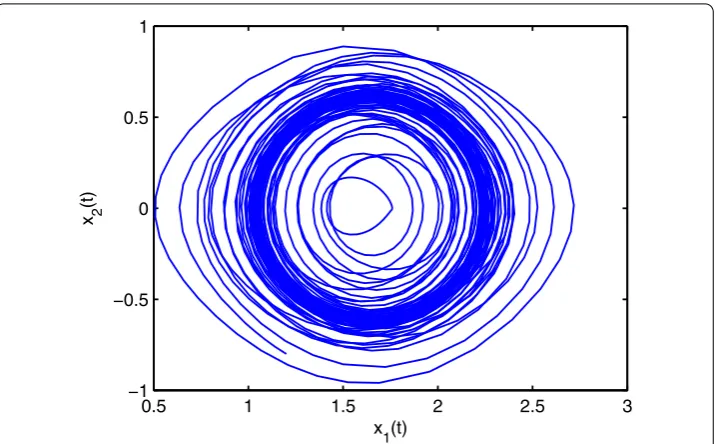
Figure 1 Phase diagram of system()with initial conditionx(0) = (1.2, –0.8)T.
the phase diagram of system () is shown in Figure . This figure shows that the state tra-jectories are bounded fort> , thenf(x(t),t) is bounded for all thex(t) and Assumption is satisfied. Taking two non-autonomous systems defined by () to constitute a master-slave system, settingμ= – andτ= , and computing by the LMI’s Toolbox in the Matlab, the following feasible solutions
P=diag{, }, L*= ., L*= .
are obtained. Under the action of adaptive controller (), taking the initial conditions as
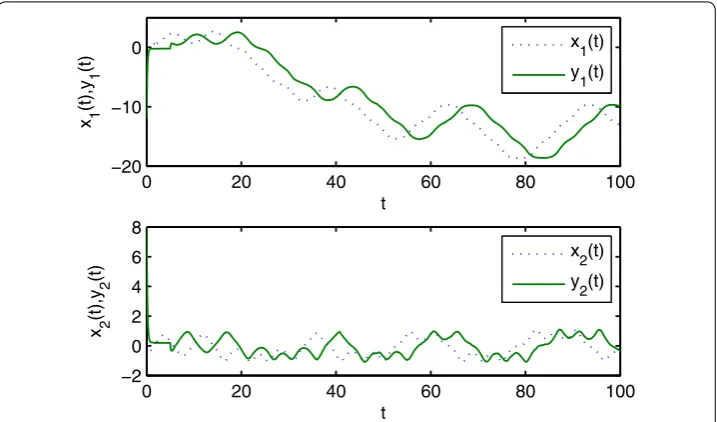
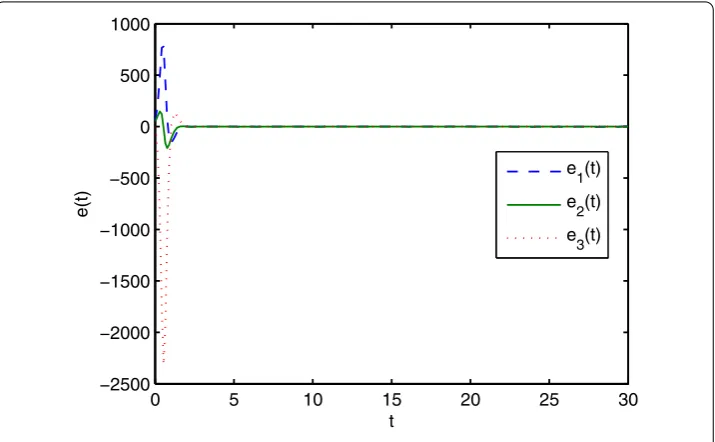
x() = (., –.)Tandy() = (–, )T,α=β= ., we show the state trajectories of error system () and updated laws in adaptive controller () in Figures -, respectively. These figures show that the master-slave system is lag synchronization.
Remark In [], Wuet al.investigated a synchronization problem of the master-slave system composed of system (). Using their methods, one needs to do some complex computation and discussion. Hence, our method is more concise than theirs.
Example Consider the following Chua’s circuit []:
⎧ ⎪ ⎨ ⎪ ⎩
˙
x(t) =a[x(t) –mx(t)] –ah(x(t)), ˙
x(t) =x(t) –x(t) +x(t), ˙
x(t) = –bx(t),
()
whereh(x(t)) =(m–m)(|x(t) +c|–|x(t) –c|),a= ,b= .,c= ,m= –/ and
m= /. System () can be represented by
˙
Figure 2 State trajectories of the master-slave system with initial conditionsx(0) = (1.2, –0.8)Tand y(0) = (–12, 8)T.
Figure 3 Synchronization error trajectories.
whereA=
–am
a
– –b
,f(x(t),t) = (–ah(x(t)), , )T. Taking this system as the master
sys-tem, the corresponding slave system is
˙
y(t) =Ay(t) +gy(t),t,
whereg(y(t),t) = (,h(y(t)), )T. Since
Figure 4 State trajectories of updated laws.
Figure 5 State trajectories of the master-slave system with initial conditionsx(0) = (20, –20, 50)Tand
y(0) = (40, 70, –50)T.
thenf(x(t),t)∞=g(y(t),t)∞≤ac|m–m|, which implies that Assumption holds. Considering the anti-synchronization of the master-slave system composed of system (), choosingμ= ,τ= , and computing by the LMI’s Toolbox in the Matlab, one can obtain the feasible solutions of inequalities () and () as follows:
Figure 6 Anti-synchronization error trajectories.
Figure 7 State trajectories of updated laws.
Taking the initial conditions asx() = (, –, )Tandy() = (, , –)T,α=β= ., under the action of adaptive controller (), we show the illustration results in Figures -, respectively. These figures show that the master-slave system is anti-synchronization.
Example Consider the following dynamical system:
˙
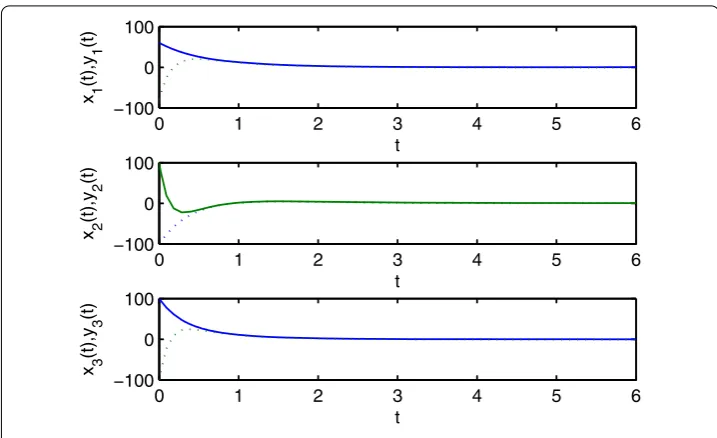
Figure 8 State trajectories of the master-slave system with initial conditionsx(0) = (60, –100, 100)T
andy(0) = (–80, 100, –100)T.
Figure 9 Synchronization error trajectories.
where A=
– –. . –
–
,f(x(t),t) = (sin|x
(t)|+ε,sin
|x(t)|+ε,sin
|x(t)|+ε)
T,ε= ..
Tak-ing system () as the master system, and y˙(t) =Ay(t) –g(y(t),t) as the slave system, where g(y(t),t) = (cos
|y(t)|+ε,cos
|y(t)|+ε,cos
|y(t)|+ε)
T, it is easy to see f(x(t),t) ∞ =
g(y(t),t)∞ ≤ for any x(t),y(t)∈ R, and f(x(t),t) and g(y(t),t) do not satisfy the Lipschitz condition. Considering the synchronization of this master-slave system and choosing μ= –, τ = , after computing by the LMI’s Toolbox in the Matlab, one can get the feasible solutions of inequalities () and () as follows:
Figure 10 State trajectories of updated laws.
Taking the initial conditions asx() = (, –, )T andy() = (–, , –)T,α= β = ., under the action of adaptive controller (), we show the illustration results in Figures -. These figures show that the master-slave system is synchronization. It should be noticed that the nonlinear function in system () is bounded but does not satisfy the Lipschitz condition.
4 Conclusions
In this paper, the lag projective (anti-)synchronization problems for a kind of master-slave chaotic systems by using the adaptive control method have been investigated. Based on the Lasalle invariance principle of differential equation and the idea of the bang-bang con-trol, an adaptive controller with simple updated laws has been proposed. Three numerical examples have shown that the obtained method is effective.
Competing interests
The authors declare that they have no competing interests.
Authors’ contributions
TW and SZ drafted the manuscript, WZ and WY performed the numerical illustration. All authors read and approved the final manuscript.
Author details
1College of Fundamental Studies, Shanghai University of Engineering Science, Shanghai, 201620, P.R. China.2College of
Information Sciences and Technology, Donghua University, Shanghai, 200051, P.R. China.
Acknowledgements
This work is supported by the Connotative Construction Project of Shanghai University of Engineering Science (nhky-2012-13).
Received: 16 March 2013 Accepted: 5 July 2013 Published: 24 July 2013
References
1. Sundar, S, Minai, A: Synchronization of randomly multiplexed chaotic systems with application to communication. Phys. Rev. Lett.85, 5456-5459 (2000)
3. Li, ZJ, Cao, XQ, Ding, N: Adaptive fuzzy control for synchronization of nonlinear teleoperators with stochastic time-varying communication delays. IEEE Trans. Fuzzy Syst.19, 745-757 (2011)
4. Song, QK, Cao, JD: Synchronization of nonidentical chaotic neural networks with leakage delay and mixed time-varying delays. Adv. Differ. Equ.2011, 16 (2011)
5. Dimassi, H, Loria, A: Adaptive unknown-input observers-based synchronization of chaotic systems for telecommunication. IEEE Trans. Circuits Syst. I, Regul. Pap.58, 800-812 (2011)
6. Hua, CC, Liu, XP: Delay-dependent stability criteria of teleoperation systems with asymmetric time-varying delays. IEEE Trans. Robot.26, 925-932 (2010)
7. Pikovsky, A, Rosenblum, M, Kurths, J: Synchronization: A Universal Concept in Nonlinear Sciences. Cambridge University Press, Cambridge (2001)
8. Pecora, LM, Carroll, TL: Synchronization in chaotic systems. Phys. Rev. Lett.64, 821-824 (1990)
9. Su, H, Ding, XH: Synchronization in time-discrete delayed chaotic systems. Neurocomputing73, 478-483 (2009) 10. Qi, DL, Liu, MQ, Qiu, MK, Zhang, SL: ExponentialH∞synchronization of general discrete-time chaotic neural networks
with or without time delays. IEEE Trans. Neural Netw.21, 1358-1364 (2010)
11. Yang, XS, Zhu, QX, Huang, CX: Lag stochastic synchronization of chaotic mixed time-delayed neural networks with uncertain parameters or perturbations. Neurocomputing74, 1617-1625 (2011)
12. Xu, YH, Zhou, WN, Fang, JA, Sun, W: Adaptive lag synchronization and parameters adaptive lag identification of chaotic systems. Phys. Lett. A374, 3441-3446 (2010)
13. Li, XF, Leung, CS, Han, XP, Liu, XJ, Chu, YD: Complete (anti-)synchronization of chaotic systems with fully uncertain parameters by adaptive control. Nonlinear Dyn.63, 263-275 (2011)
14. Al-sawalha, MM, Noorani, MSM: Adaptive reduced-order anti-synchronization of chaotic systems with fully unknown parameters. Commun. Nonlinear Sci. Numer. Simul.15, 3022-3034 (2010)
15. Farivar, F, Shoorehdeli, MA, Nekoui, MA, Teshnehlab, M: Chaos control and modified projective synchronization of unknown heavy symmetric chaotic gyroscope systems via Gaussian radial basis adaptive backstepping control. Nonlinear Dyn.67, 1913-1941 (2012)
16. Du, HY, Zeng, QS, Wang, CH, Ling, MX: Function projective synchronization in coupled chaotic systems. Nonlinear Anal., Real World Appl.11, 705-712 (2010)
17. Cao, JD, Daniel, WCH, Yang, YQ: Projective synchronization of a class of delayed chaotic systems via impulsive control. Phys. Lett. A373, 3128-3133 (2009)
18. Li, XD, Ding, CM, Zhu, QX: Synchronization of stochastic perturbed chaotic neural networks with mixed delays. J. Franklin Inst.347, 1266-1280 (2010)
19. Yassen, MT: Adaptive chaos control and synchronization for uncertain new chaotic dynamical system. Phys. Lett. A
350, 36-43 (2006)
20. Chen, SH, Yang, Q, Wang, CP: Impulsive control and synchronization of unified chaotic system. Chaos Solitons Fractals
20, 751-758 (2004)
21. Wu, RC, Liu, JL: Isochronal function projective synchronization between chaotic and time-delayed chaotic systems. Adv. Differ. Equ.2012, 37 (2012)
22. Lee, SM, Ji, DH, Park, JH, Won, SC:H∞Synchronization of chaotic systems via dynamic feedback approach. Phys. Lett. A372, 4905-4912 (2008)
23. Zhang, D, Xu, J: Projective synchronization of different chaotic time-delayed neural networks based on integral sliding mode controller. Appl. Math. Comput.217, 164-174 (2010)
24. Choi, YP, Ha, SY, Yun, SB: Complete synchronization of Kuramoto oscillators with finite inertia. Physica D240, 32-44 (2011)
25. Xia, YH, Yang, ZJ, Han, MA: Lag synchronization of unknown chaotic delayed Yang-Yang-Type fuzzy neural networks with noise perturbation based on adaptive control and parameter identification. IEEE Trans. Neural Netw.20, 1165-1180 (2009)
26. Feng, GZ, Cao, JD: Master-slave synchronization of chaotic systems with a modified impulsive controller. Adv. Differ. Equ.2013, 24 (2013)
27. Pan, L, Zhou, WN, Fang, JA, Li, DQ: Synchronization and anti-synchronization of new uncertain fractional-order modified unified chaotic systems via novel active pinning control. Commun. Nonlinear Sci. Numer. Simul.15, 3754-3762 (2010)
28. Gan, QT, Xu, R, Kang, XB: Synchronization of chaotic neural networks with mixed time delays. Commun. Nonlinear Sci. Numer. Simul.16, 966-974 (2011)
29. Huang, H, Feng, G, Cao, JD: Exponential synchronization of chaotic Lur’e systems with delayed feedback control. Nonlinear Dyn.57, 441-453 (2009)
30. Wu, XF, Gui, ZF, Lin, Q, Cai, JP: A new Lyapunov approach for global synchronization of non-autonomous chaotic systems. Nonlinear Dyn.59, 427-432 (2010)
doi:10.1186/1687-1847-2013-225