Volume 2007, Article ID 25945,9pages doi:10.1155/2007/25945
Research Article
A Chip-Level BSOR-Based Linear GSIC Multiuser Detector for
Long-Code CDMA Systems
A. Bentrcia,1A. Zerguine,1and M. Benyoucef2
1Electrical Engineering Department, King Fahd University of Petroleum and Minerals, P.O.Box 1387, Dhahran 31261, Saudi Arabia 2Department of Electronics, Faculty of Engineering, University of Batna, Batna 05000, Algeria
Received 7 March 2007; Revised 7 August 2007; Accepted 10 October 2007
Recommended by Chia-Chin Chong
We introduce a chip-level linear group-wise successive interference cancellation (GSIC) multiuser structure that is asymptotically equivalent to block successive over-relaxation (BSOR) iteration, which is known to outperform the conventional block Gauss-Seidel iteration by an order of magnitude in terms of convergence speed. The main advantage of the proposed scheme is that it uses directly the spreading codes instead of the correlation matrix and thus does not require the calculation of the cross-correlation matrix (requires 2NK2floating point operations (flops), whereNis the processing gain andKis the number of users) which reduces significantly the overall computational complexity. Thus it is suitable for long-code CDMA systems such as IS-95 and UMTS where the cross-correlation matrix is changing every symbol. We study the convergence behavior of the proposed scheme using two approaches and prove that it converges to the decorrelator detector if the over-relaxation factor is in the interval ]0, 2[. Simulation results are in excellent agreement with theory.
Copyright © 2007 A. Bentrcia et al. This is an open access article distributed under the Creative Commons Attribution License, which permits unrestricted use, distribution, and reproduction in any medium, provided the original work is properly cited.
1. INTRODUCTION
Actual cellular systems such as IS-95 and UMTS are long-code CDMA systems. The spreading long-codes used in the uplink channels are long codes which span thousands of symbols. These spreading codes are also known as random codes since they appear to change randomly from one symbol period to another.
The main reason for not incorporating multiuser detec-tors in current cellular systems is that the latter are long-code systems while most multiuser detectors developed until now assume a short-code system [1]. Depending on whether a long-code or a short-code system is considered, multiuser detectors can be divided into two categories: symbol level (also known as narrowband) and chip level (also known as wideband) [2]. Symbol-level multiuser detectors act on the matched filter outputs while chip-level multiuser detectors act directly on the received signal. Moreover, symbol-level multiuser detectors make use of the cross-correlation coeffi -cients whereas chip-level multiuser detectors use the spread-ing codes directly and thus avoid the calculation of the cross-correlation matrix. This very attractive property of chip-level multiuser detectors is the key-point for developing low-complexity multiuser detectors for long-code CDMA sys-tems.
e1,G+1 e2,G+1
Figure1: Multistage structure of the chip-level linear BSOR-GSIC detector.
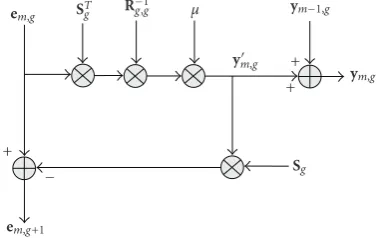
Figure2: Basic group interference cancellation unit (GICU) for the chip-level linear BSOR-GSIC detector.
to the decorrelator detector only, the authors in [7] proposed a chip-level linear GSIC detection scheme that converges not only to the decorrelator detector as in the case of [6] but to the LMMSE detector as well.
In this work, we prove that the proposed scheme in [6] is in fact equivalent to the block Gauss-Seidel iterative method if the group-detection scheme is the decorrelator detector. Moreover, we propose a new scheme that is equivalent to the BSOR iterative method, which is well known to outperform the conventional block Gauss-Seidel method by an order of magnitude in terms of convergence speed. We study its con-vergence behavior and determine the condition of conver-gence using two different approaches that lead to the same result.
The work proposed here has two contributions. The first contribution consists of identifying the structure proposed in [6] as a block Gauss-Seidel iterative method if the group detection scheme is the decorrelator detector. This is very important because it enables the use of the rich theory of iterative methods to study the convergence behavior of the scheme in [6]. The second contribution, which is based on iterative methods theory, consists of proposing a weighted group SIC structure that is equivalent to the block SOR it-erative method that is known to exhibit fast convergence.
The work of [7], which is based on matrix transformation, is therefore totally different from the one proposed here as the former proposes a group SIC structure that is able to converge to either the decorrelator detector or the LMMSE detector. However, the proposed structure converges to the decorrelator detector only.
Finally, it is important to know that the work reported here considers linear group detection only. Nonlinear group detection can be found in a work such as the one reported in [8].
2. SYSTEM MODEL AND THE PROPOSED BSOR-BASED
LINEAR GSIC STRUCTURE
In this work, we consider a scenario of an uplink channel whereKusers transmit simultaneously over a synchronous additive white Gaussian noise (AWGN) channel using binary phase shift keying (BPSK). Each user is characterized by its own pseudonoise code of lengthNchips. The received signal is expressed in vector form as
r=SAb+n, (1)
whereSis anN×Kmatrix of linearly independent spreading codes,Ais aK×Kmatrix of the received amplitudes,bis a K-length vector of transmitted binary symbols, and finally n is an N-length vector of independently and identically-distributed additive white Gaussian-identically-distributed samples with zero-mean and varianceσ2and are defined as
S=s1,s2,. . .,sk,. . .,sK∈ code, received amplitude, and data symbol of thekth user, respectively.
In the following we assume that the K-users are par-titioned into G groups, where the gth group consists of Ug users such that K = U1 +U2+ · · ·+UG and thus the matrix of spreading codes can be partitioned as S = (S1,S2,. . .,Sg,. . .,SG) where Sg = (sg,1,sg,2,. . ., sg,ug,. . .,sg,Ug) ∈ {−1/
√
N, 1/√N}N,Ug. We defineR = STS as the cross-correlation matrix of the spreading codes,Ri,j= STiSj as the (ith,jth) submatrix of R, andAg as thegth di-agonal submatrix of matrixA. We assume thatR andRg,g (for g = 1, 2,. . .,G) are nonsingular (since the spreading codes are assumed to be linearly independent). Therefore, both matrices RandRg,g (for g = 1, 2,. . .,G) are positive definite.
The proposed linear weighted GSIC detector which we call for brevity the chip-level linear BSOR-GSIC detector consists of group interference cancellation units (GICU) ar-ranged in a multistage structure ofMstages as illustrated in
matrixR−1
g,g and then by a weighting factorμto estimate the vector of the partial decision variablesym,gof users of thegth group at themth stage that isym,g = μR−1
g,gSTgem,g. The vec-tor of the decision variables of the users of thegth group at themth stage is obtained by summing up the vector of de-cision variables of the previous stage ym−1,g and the vector of partial decision variables of the current stageym,g, that is, ym,g=ym,g+ym−1,g.
The residual signal for the next GICU is obtained by spreading the vector of the partial decision variablesym,gand subtracting it from the residual signal of the current GICU em,g, that is,em,g+1=em,g−Sgym,g.
3. CONVERGENCE ANALYSIS
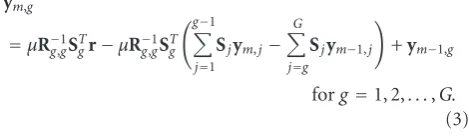
Lete1,1=rbe the input signal to the chip-level linear BSOR-GSIC scheme, at themth stage, the vector of decision vari-ables of thegth group of users at themth stage of the chip-level linear BSOR-GSIC detector is derived as
ym,g
=μR−1
g,gSTgr−μR−g,1gSTg
g−1
j=1
Sjym,j− G
j=g Sjym−1,j
+ym−1,g
forg=1, 2,. . .,G.
(3)
Exact derivation of (3) is given in Appendix A. At conver-gence, we haveym,g =ym−1,g =y∞,g wherey∞,g is the vector of decision variables at convergence, therefore (3) is equiva-lent to
y∞,g
=μR−1
g,gSTgr−μR−g,1gSTg
g−1
j=1 Sjy∞,j−
G
j=g Sjy∞,j
+y∞,g
forg=1, 2,. . .,G.
(4)
Equation (4) is equivalent to
μR−g,1gSTg G
j=1
Sjy∞,j=μR−g,1gSTgr forg=1, 2,. . .,G. (5)
SinceRg,gis nonsingular, (5) could be written in matrix form as
STSy∞=STr. (6)
Finally, (6) could be written as
y∞=R−1STr. (7)
Therefore, if the proposed scheme converges, it converges to the decorrelator detector.
4. CONDITIONS OF CONVERGENCE
4.1. First approach
This approach allows the identification of the proposed scheme as the BSOR iterative method, which facilitates the
determination of the condition of convergence. Let us first establish the analogy between the proposed scheme and the corresponding iterative method used to solve a set of linear equations which is known as the BSOR method.
The matrixRcould be decomposed into three parts, that is,R =D−L−U,where Dis block diagonal matrix, that is D =diag(R1,1,R2,2,. . .,Rg,g,. . .,RG,G), andLandUare the remaining lower-left and upper-right block triangular parts of R, respectively. After some manipulations, (3) could be written in matrix form as
ym= D−μL−1μSTr+ [1−μ)D+μUym −1
(8)
which is exactly the BSOR iteration. SeeAppendix Bfor the exact derivation of (8). Note that if μ=1 (this is the case for the scheme proposed in [6] where the group detection scheme is the decorrelator detector), the iteration in (8) re-duces to the block Gauss-Seidel iteration. For the conver-gence of (8), we use the following corollary [9].
Corollary 1. LetRbe an K-by-K hermitian matrix andR=
D−L−U, whereDis block diagonal matrix, andLandUare the remaining lower-left and upper-right block triangular parts ofR. IfD is positive definite, then the block successive over-relaxation method is convergent for allyoif and only if 0< μ <
2 andRis positive definite.
Thus, for real μ, the iteration in (8) converges if μ ∈ ]0, 2[. Nevertheless, one should setμwithin the interval ]1, 2[ which corresponds to over relaxation (acceleration) since the interval ]0, 1[ corresponds to under relaxation (deceleration) and it is basically used to ensure convergence of the block Gauss-Seidel iteration if it is not convergent. The calculation of the optimum value ofμfor which the convergence is max-imum depends on the maxmax-imum eigenvalue of the iteration matrix [D−μL]−1[(1−μ)D+μU], which is complicated to be computed. However, one can get a cheap fairly-accurate estimate of the optimum value of μbased on some upper bound on the maximum eigenvalue of the iteration matrix as in [10].
4.2. Second approach
This approach was used in [6] to study the convergence be-havior of the GSIC detector. We adopt it here to determine the condition of convergence of the proposed scheme. From
Figure 2, we have
ym,g =μR−g,1gSTgem,g+ym−1,g. (9)
For convergence we have
lim m→∞
∀g
ym,g−ym−1,g
=lim m→∞
∀g
μR−g,1gSTgem,g
=lim m→∞
∀g
em,g =0.
However, we can writeem,gas
Therefore, the chip-level linear BSOR-GSIC converges if
λmax
Ωg<1, (13)
whereλmax is the maximum eigenvalue. Since for square ma-tricesXandY with the same dimensions, the matricesXY andYXhave the same eigenvalues, all the Ωg, 1 ≤ g ≤ G have the same eigenvalues. Thus, we consider the case where g = G.
Consequently, the chip-level linear BSOR-GSIC con-verges if
λmax
ΩG<1. (14)
In the following, we consider the following lemma [6].
Lemma 1. condition in (14) is satisfied and the linear BSOR-GSIC is guaranteed to converge. We have max1≤g≤G(|λmax(Bg)|)<1, same condition as for the BSOR method.
5. COMPUTATIONAL COMPLEXITY
The computational complexity of the proposed detector re-quiresMGg=1Ug(4N+1)+
The computational complexity of the symbol-level linear BSOR-GSIC detector which is illustrated inFigure 3is
M
Figure3: Basic interference cancellation unit for the symbol-level BSOR-GSIC detector.
However, the evaluation of the matched filter outputs and R=STSneeds (2N−1)Kand 2NK2, respectively. Thus, the
flops. Finally, the decorrelator detector needs at least (lower bound) [11] (11K3+ (3/2)K2+K) + 2NK2+ (2N−1)K.
It is clear from the expression above that the computa-tional complexity is a function of the number of usersKand the number of users within each groupUg. For the rest of the parameters such as the processing gainN and the number of stagesM, they are fixed. It is important to note that the number of stagesM needed for convergence should be less thanKso that the computational complexity is in the order ofO(K2) rather thanO(K3) for the decorrelator detector. This is the situation for the most practical cases as it is shown inFigure 6. The computational complexity of the proposed chip-level linear BSOR-GSIC detector and the symbol-level linear BSOR-GSIC detectors is illustrated inFigure 4.
5 10 15 20 25 30 35 Number of users (K)
0 5 10 15
×104
Nu
m
b
er
o
f
fl
o
p
s
Proposed chip-level linear BSOR-GSIC detector Symbol-level linear BSOR-GSIC detector
(a)
5 10 15 20 25 30 35
Number of users (K) 0
5 10 15
×104
Nu
m
b
er
o
f
fl
o
p
s
Proposed chip-level linear BSOR-GSIC detector Symbol-level linear BSOR-GSIC detector
(b)
Figure4: Computational complexity of chip-level and symbol-level BSOR-GSIC detectors for (a)M=K/2, (b)M=K/5.
6. EFFECT OF GROUPING
The effect of users’ grouping on the convergence behavior of the GSIC detector was studied partially in [6] and in detail in [12]. It was shown that if the group-detection scheme is the decorrelator detector, as in our case, the convergence speed increases with decreasing the number of groups. Thus, it is favorable to decrease the number of groups as much as pos-sible. However, decreasing the number of groups results in increasing the size of each group and therefore increasing the computational complexity of the proposed detector since the cross-correlation matrix of each group of users has to be in-verted. Hence, users’ grouping (the number of groups) is a system design parameter that is determined by the tradeoff between convergence speed and computational complexity. Simulation results showing the effect of grouping are pro-vided inSection 8.
7. EXTENSION TO THE CASE OF ASYNCHRONOUS
MULTIPATH FADING CDMA CHANNEL
For the case of asynchronous CDMA multipath fading chan-nel, the structure presented in Figures1and2are the same, only the spreading code matrix for thegth groupSg is sub-stituted bySg whereSg = (sg,1,sg,2,. . .,sg,ug,. . .,sg,Ug) and sg,ug =sg,ug∗hug. Herehugis the vector of the complex fading coefficients of theugth user’s channel and∗denotes the con-volution operation. Moreover, the conjugate operators (H) should replace all the transpose operators (T). In this case, then, the cross-correlation matrixR =SHSis hermitian (as a result of combining the code cross-correlation matrix and the complex gain multipath fading channel matrix) and may become singular in some cases. In [11], it was found that the cross-correlation matrix is nonsingular ifKL≤ 3N, where Lis the number of multipaths. Based on this practically sup-ported fact, it follows that the proposed structure will con-verge to the decorrelator detector if the conditionKL≤ 3N is satisfied.
Moreover, all the aforementioned convergence analysis and conditions of convergence are valid for this case as well, that is, the proposed structure converges to the decorrelator
detector if it converges and the condition of convergence is 0< μ <2. This will be validated in the simulation section.
8. SIMULATION RESULTS
To show the important reduction in computational com-plexity one can gain by using the proposed chip-level mul-tiuser detector, the computational complexity of the chip-level/symbol-level BSOR-GSIC detectors is evaluated using the expressions inSection 6and plotted inFigure 4. HereG is equal to 4 andNis set to 31 throughout the simulations. Two cases are assumed: in (a) the number of stages needed to approximate the decorrelator detector’s average BER perfor-mance (average BER of all users) isM=K/2while in (b)M =K/5. It is clear that in both cases the computational com-plexity of the proposed chip-level BSOR-GSIC detector is less than that of the symbol-level BSOR-GSIC detector and this difference between the two increases significantly for high loads, that is, ifK/N≈1.
0.2 0.4 0.6 0.8 1 1.2 1.4 1.6 1.8 2 Relaxation factor
10−4 10−3 10−2 10−1
Av
er
ag
e
B
E
R
(d
B
)
Matched filter detector Decorrelator detector
Linear BSOR-GSIC detector (G=2) Linear BSOR-GSIC detector (G=10)
Figure5: Average BER of the chip-level linear BSOR-GSIC detector versus the relaxation factor.
2 4 6 8 10 12 14
Number of chip-level linear BSOR-GSIC stages 10−3
10−2 10−1 100
Av
er
ag
e
B
E
R
(d
B
)
Matched filter detector Decorrelator detector
Chip-level linear BSOR-GSIC detector (μ=1) Chip-level linear BSOR-GSIC detector (μ=1.2) Chip-level linear BSOR-GSIC detector (μ=1.4) Chip-level linear BSOR-GSIC detector (μ=1.6) Chip-level linear BSOR-GSIC detector (μ=1.8)
Figure 6: Convergence behavior of the chip-level linear BSOR-GSIC detector for different values of the relaxation factor.
InFigure 6, the convergence behavior of the proposed detector is investigated. The SNR is set to 8 dB, K = 20, G = 2 and perfect power control is assumed. The num-ber of chip-level linear BSOR-GSIC stages is varied be-tween 1 and 15 and the average BER performance of the proposed detector is evaluated for μ = 1, 1.2, 1.4, 1.6, and 1.8. It is clear that the chip-level linear BSOR-GSIC
5 10 15 20 25 30
Number of users 10−5
10−4 10−3
Av
er
ag
e
B
E
R
(d
B
)
Matched filter detector Decorrelator detector
Linear BSOR-GSIC detector (2 stages) Linear BSOR-GSIC detector (3 stages)
Figure7: Capacity of the chip-level linear BSOR-GSIC detector for G=2.
1 2 3 4 5 6 7 8 9 10
Near-far ratio 10−4
10−3 10−2 10−1 100
BER
(dB)
Matched filter detector Decorrelator detector
Linear BSOR-GSIC detector (μ=1) Linear BSOR-GSIC detector (μ=1.2) Linear BSOR-GSIC detector (μ=1.4) Linear BSOR-GSIC detector (μ=1.6) Linear BSOR-GSIC detector (μ=1.8)
Figure8: Near-far resistance of the chip-level linear BSOR-GSIC detector for different values of the relaxation factor (G=2).
1 2 3 4 5 6 7 8 9 10 Near-far ratio
10−4 10−3 10−2 10−1 100
BER
(dB)
Matched filter detector Decorrelator detector
Linear BSOR-GSIC detector (μ=1) Linear BSOR-GSIC detector (μ=1.2) Linear BSOR-GSIC detector (μ=1.4) Linear BSOR-GSIC detector (μ=1.6) Linear BSOR-GSIC detector (μ=1.8)
Figure9: Near-far resistance of the chip-level linear BSOR-GSIC detector for different values of the relaxation factor (G=10).
InFigure 7, the capacity (number of users) of the pro-posed scheme is evaluated. Here, the SNR is set to 10 dB,G= 2,μ=1.2 and perfect power control is assumed. We note that with increasing the number of stages the linear BSOR-GSIC detector can support more users, for example, for an average BER of 10−3theproposed scheme withM=3 can support up to 25 users whereas that withM=2 can support 20 users.
In Figures8and9, the near-far resistance of the proposed scheme is assessed. For the near-far ratio, the amplitude of the first user is fixed and the amplitude of the other users is varied from one to 20 times that of the first user. The BER of the first user versus the near-far ratio is then plotted. The SNR is set to 10 dB,M =4, andK=20. ForFigure 8(G= 2), the near-far resistance is maximum for a relaxation fac-tor of 1.2 whereas the near-far resistance is maximum for a relaxation factor of 1.4 inFigure 9(G=10).
In Figure 10, the effect of grouping is illustrated. It is clear that as the number of groups decreases (the size of each group increases), the convergence speed of the proposed structure increases. However, the computational complexity on the other hand increases as well. This agrees well with the results obtained in [12].
InFigure 11, we change the relaxation factor in the inter-val ]0, 2[ to illustrate its impact on the average BER (average of all users’ BER) of the proposed scheme in an asynchronous CDMA multipath Rayleigh fading channel. Now, the SNR is set to 6 dB,M=4,K=24, vehicular A outdoor channel power delay profile for WCDMA is used and perfect power control is assumed. Two different groupings are used, specifically,G =2 andG=12 equally sized groups are used. We see that the minimum achievable average BER level is for a relaxation
2 4 6 8 10 12 14 16 18 20
Number of chip-level linear BSOR-GSIC stages 10−2
Av
er
ag
e
B
E
R
(d
B
)
Matched filter detector Decorrelator detector
Linear BSOR-GSIC detector (G=2) Linear BSOR-GSIC detector (G=4) Linear BSOR-GSIC detector (G=10)
Figure10: Effect of grouping on the convergence behavior of the BSOR-GSIC detector.
0.2 0.4 0.6 0.8 1 1.2 1.4 1.6 1.8 2 Relaxation factor
10−3 10−2 10−1
Av
er
ag
e
B
E
R
(d
B
)
Matched filter detector Decorrelator detector
Linear BSOR-GSIC detector (G=2) Linear BSOR-GSIC detector (G=12)
Figure11: Average BER of the chip-level linear BSOR-GSIC detec-tor versus the relaxation facdetec-tor for the case of asynchronous CDMA multipath Rayleigh fading channel.
factor of about 1.2 forG=2 and 1.4 forG =10. It is easy to note that the proposed scheme converges if the relaxation factor is between 0 and 2. Moreover, the minimum achiev-able BER is for a relaxation factor of about 0.8, which is in a good agreement with the theory.
9. CONCLUSION
In this work, a chip-level linear GSIC structure that is equiv-alent to the BSOR iterative method and makes use of the spreading codes directly is proposed; this enables its practi-cal implementation in long-code CDMA systems (e.g., IS-95 and UMTS) where the cross-correlation matrix is changing every symbol. Simulation results indicate that significant im-provement in terms of BER performance, capacity, detection delay, and near-far resistance can be obtained by using the proposed scheme compared to that proposed in [6].
APPENDICES
A. DERIVATION OF(3)
The residual signal of the first GICU at the first stage is given bye1,1=r. FromFigure 2, the residual signal of the second group of users is obtained in terms of the vectors of the deci-sion variables as
Hence, the residual signal of thegth group of the first stage is given by
The residual signal of the 1st group of the second stage is given bye2,1=e1,G+1wheree1,G+1=r−
G j=1Sjy1,j. The residual signal of the 2nd group of the second stage is given by
Continuing in the same way, we get the residual signal of the gth group at themth stage as
This is equivalent to
ym,g =μR−g,1gSgTr−μR−g,1gSTg
Multiplying both sides byRg,g, we get
This can be written in matrix form as
Dym=μSTr+μLym+μUym−1+ (1−μ)Dym−1, (B.4)
whereD=diag(R1,1,R2,2,. . .,Rg,g,. . .,RG,G),LandUare the remaining lower-left and upper-right block triangular parts ofR, respectively. Hence, (8) is obtained.
ACKNOWLEDGMENT
The authors acknowledge the support provided by King Fahd University of Petroleum and Minerals.
REFERENCES
[1] J. G. Andrews, “Interference cancellation for cellular systems: a contemporary overview,” IEEE Wireless Communications, vol. 12, no. 2, pp. 19–29, 2005.
[2] R. M. Buehrer, N. S. Correal-Mendoza, and B. D. Woerner, “A simulation comparison of multi-user receivers for cellular CDMA,”IEEE Transactions on Vehicular Technology, vol. 49, no. 4, pp. 1065–1085, 2000.
[3] K. Jamal and E. Dahlman, “Multi-stage serial interference can-cellation for DS-CDMA,” inProceedings of the IEEE 46th Ve-hicular Technology Conference (VTC ’96), vol. 2, pp. 671–675, Atlanta, Ga, USA, April 1996.
[4] L. K. Rasmussen, T. J. Lim, and A. Johansson, “A matrix-algebraic approach to successive interference cancellation in CDMA,”IEEE Transactions on Communications, vol. 48, no. 1, pp. 145–151, 2000.
[5] D. Guo, L. K. Rasmussen, S. Sun, and T. J. Lim, “A matrix-algebraic approach to linear parallel interference cancellation in CDMA,”IEEE Transactions on Communications, vol. 48, no. 1, pp. 152–161, 2000.
[6] A.-L. Johansson and L. K. Rasmussen, “Linear group-wise successive interference cancellation in CDMA,” inProceedings of the IEEE 5th International Symposium on Spread Spectrum Techniques & Applications (ISSSTA ’98), vol. 1, pp. 121–126, Sun City, South Africa, September 1998.
[7] A. Bentrcia, A. Zerguine, A. U. Sheikh, and M. Benyoucef, “A new linear group-wise SIC multiuser detector,”IEEE Commu-nications Letters, vol. 11, no. 2, pp. 176–178, 2007.
[8] A. Kapur and M. K. Varanasi, “Multiuser detection for over-loaded CDMA systems,” IEEE Transactions on Information Theory, vol. 49, no. 7, pp. 1728–1742, 2003.
[9] R. S. Varga,Matrix Iterative Analysis, Springer, Berlin, Ger-maany, 2nd edition, 2000.
[10] A. Grant and C. Schlegel, “Convergence of linear interference cancellation multiuser receivers,”IEEE Transactions on Com-munications, vol. 49, no. 10, pp. 1824–1834, 2001.
[11] M. Junti, Multiuser demodulation for DS-CDMA systems in fading channels, Ph.D. thesis, Department of Electrical Engi-neering, Oulu University, Oulu, Finland, 1998.