Volume 2008, Article ID 462710,12pages doi:10.1155/2008/462710
Research Article
Minimum BER Receiver Filters with Block Memory for
Uplink DS-CDMA Systems
Are Hjørungnes1and M ´erouane Debbah2
1UNIK - University Graduate Center, University of Oslo, Instituttveien 25, P.O. Box 70, 2027 Kjeller, Norway 2Alcatel-Lucent Chair on Flexible Radio, ´Ecole Sup´erieure d’ ´Electricit´e, Plateau de Moulon, 3 Rue Joliot-Curie,
91192 Gif-sur-Yvette Cedex, France
Correspondence should be addressed to Are Hjørungnes,[email protected]
Received 24 September 2007; Revised 28 January 2008; Accepted 10 March 2008
Recommended by Tongtong Li
The problem of synchronous multiuser receiver design in the case of direct-sequence single-antenna code division multiple access (DS-CDMA) uplink networks is studied over frequency selective fading channels. An exact expression for the bit error rate (BER) is derived in the case of BPSK signaling. Moreover, an algorithm is proposed for finding the finite impulse response (FIR) receiver filters with block memory such that the exact BER of the active users is minimized. Several properties of the minimum BER FIR filters with block memory are identified. The algorithm performance is found for scenarios with different channel qualities, spreading code lengths, receiver block memory size, near-far effects, and channel mismatch. For the BPSK constellation, the proposed FIR receiver structure with block memory has significant better BER with respect toEb/N0and near-far resistance than
the corresponding minimum mean square error (MMSE) filters with block memory.
Copyright © 2008 A. Hjørungnes and M. Debbah. This is an open access article distributed under the Creative Commons Attribution License, which permits unrestricted use, distribution, and reproduction in any medium, provided the original work is properly cited.
1. INTRODUCTION
CDMA is a multiple access technique where the user sepa-ration is done neither in frequency, nor in time, but rather through the use of codes. However, the frequency selective fading channel destroys in many cases the codes separation capability and equalization is needed at the receiver. Since the beginning of the nineties, multiuser detection [1– 3] has provided multiuser receivers with different perfor-mance/complexity tradeoffs. Usual target metrics concern either maximizing the likelihood, the spectral efficiency, or minimizing the mean square error. In many cases, analytical expressions of the multiuser receivers performance can be obtained which depend mainly on the noise structure, the channel impulse response, the nature of the codes, and the receiver parameters [4–7].
In the present work, minimum BER is used as a target metric for designing the DS-CDMA FIR receiver filters for BPSK signaling, where the receiver has one FIR multiple-input single-output (MISO) filter with block memory for each user. It is assumed that the system is synchronized. Various works (see, e.g., [8–10]), have minimized BER with
respect to the receiver parameters in a perfect synchronized system when the receiver is modeled by amemorylessblock receiver filter. In [11], they have studied minimum BER receiver filter for single-user SISO systems and no transmitter filter was considered. An adaptive algorithm for finding minimum BER filterswithoutblock memory in the receiver filters was proposed in [12]. The case of receiver filters with block memory of a DS-CDMA system has been studied for blind equalization in [13], and the problem of CDMA receiver design has also been studied in [14], however, the problem ofminimum BERreceiver filter design for multiuser CDMA systems has to the best of our knowledge not been treated in the literature for communication over frequency selective channels.
complex-valued minimum BER FIR MISO receiver filters with block memory, for given spreading codes and known channel impulse responses. Note that the additive noise on the channel is complex-valued and it might be colored. Finally, (iv) several properties of the minimum BER filters with block memory are identified.
The rest of this paper is organized as follows.Section 2 introduces the DS-CDMA model and formulates the DS-CDMA receiver optimization problem mathematically. Section 3presents the proposed solution, andSection 4 sum-marizes the proposed numerical optimization algorithm. InSection 5, numerical results obtained with the proposed algorithm are presented and comparisons are made against the MMSE receiver with block memory. Conclusions are drawn inSection 6. Finally, three appendices contain proofs and tools used in the article throughout.
2. DS-CDMA MODEL
2.1. Special notations
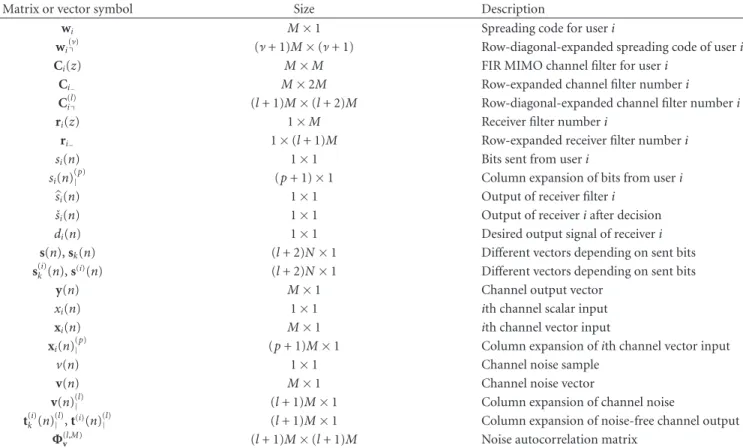
In this contribution, receiver filters with finite block memory are used in a DS-CDMA system for communication over frequency selective FIR channels. For helping the reader to keep track of the special notations,Table 1summarizes the most important quantities used in this paper, and gives the size of these symbols. The special notation is introduced in order to solve the FIR DS-CDMA receiver filter design problem in a compact manner when the filters have finite block memory.
In this article, all the indexing begins with 0. LetA(z)= η
i=0A(i)z−i be an FIR MIMO filter of order η and size
M0×M1, such that the block memory of the filter isη. The matrix A(i) is the ith coefficient (note that the argument indicates wheather the matrix is in the time domainA(i) or in theZ-domainA(z). We want to consequently use uppercase bold symbols for matrices and lowercase boldface symbols for vectors, and that is the reason why we have chosen this convention.) of the FIR MIMO filter A(z) and it has size
M0×M1. Therow-expandedmatrixA− obtained from the
FIR MIMO filterA(z) is anM0×(η+ 1)M1matrix given by
A−=[A(0), A(1),. . .,A(η)].
Let q be a nonnegative integer. The row-diagonal-expandedmatrixA(q)of the FIR MIMO filterA(z) of orderq
is a (q+ 1)M0×(η+q+ 1)M1block Toeplitz matrix given by:
A(q)= ⎡ ⎢ ⎢ ⎢ ⎣
A(0) · · · A(η) · · · 0
..
. . .. . .. ... ...
0 A(0) · · · · A(η) ⎤ ⎥ ⎥ ⎥
⎦. (1)
Letνbe a nonnegative integer. The symbolnis used as a time index in this article andnis an integer. Lety(n) be a vector time-series of sizeM×1. The column expansion of
y(n) of orderνhas size (ν+1)M×1 and is defined asy(n)(|ν)= [yT(n),yT(n−1),. . .,yT(n−ν)]T, where the operator (·)T
denotes transposition.
wi
M×1
si(n)
Order 0 xi(n)
xi(n) ↑M
↑M
. . . ↑M
z−1
z−1
z−1
. . .
(a)
ri(z)
1×M y(n)
Orderl
y(n)
ˆ
si(n) ↓M
↓M
. . . ↓M z
z
z
. . .
ˇ
si(n) DEC(·)
(b)
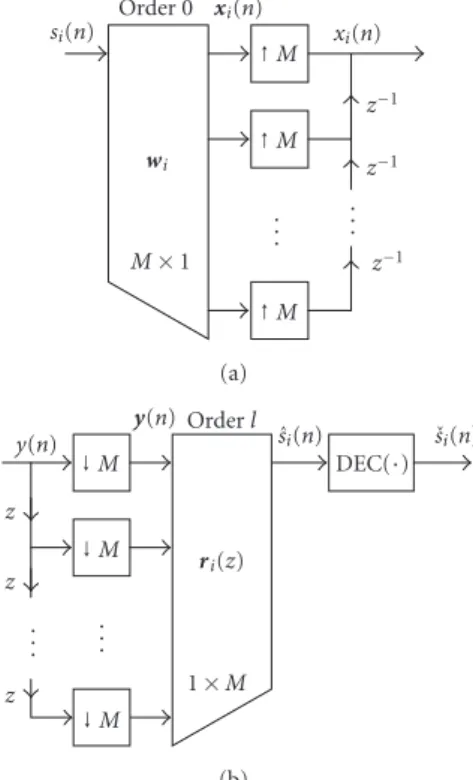
Figure 1: (a) DS-CDMA transmitter number i. (b) DS-CDMA receiver part designed for decoding user numberi.
2.2. Transmission model for user numberi
Let the number of users beN. It is assumed that the sequence of equally likely BPSK information bitssi(n)∈ {−1, 1}sent
by user number i ∈ {0, 1,. . .,N −1} is an independent and identically distributed time-series, uncorrelated with the additive channel noise and the data sequences sent by the other users. si(n) are spread with a spreading code having
spreading factor M. Let the vectorwi be anM ×1 vector
containing the spreading code for user numberi. The vector
wi is an FIR single-input multiple-output (SIMO) filter
without block memory that increases the sampling rate of the original signal by the factor M. It is assumed that the receiver knows the values of all the vectorswi, and they can
be chosen arbitrarily, that is,wi ∈ CM×1, where Cdenotes
the set of complex numbers, such that any complex-valued (or real-valued) spreading code might be used.Figure 1(a) shows theith transmitter of the DS-CDMA system and the DS-CDMA receiver part that is designed to decode user number i is shown by Figure 1(b). In Figure 1, z−1 is the delay element, z is the advance element, ↑M is expansion with factorMmeaning thatM−1 zeros are inserted between each sample, and ↓M is decimation by M; see [15]. The input sequence xi(n) to theith channel, seeFigure 1(a), is
stacked into an M ×1 vector xi(n) according to xi(n) =
[xi(Mn),xi(Mn+ 1),. . .,xi(Mn+M−1)]T. The spreading
operation may be written as xi(n) = wisi(n). In order to
produce theM×1 vectory(n) from a scalar time-seriesy(n), see Figure 1(b), the following blocking structure is used:
Let p be a nonnegative integer. Using the previously
interpreted as column-expansion operator working on the scalar time-series si(n); see also the notation introduced
in Section 2.1) wi(p) = Ip+1 ⊗ wi has size (p + 1)M ×
(p + 1), where Ip+1 represents the (p + 1) × (p + 1) identity matrix,⊗is the Kronecker product, andsi(n)(|p) =
[si(n),si(n−1),. . .,si(n−p)]Thas size (p+ 1)×1.
Theith user has the following scalar multipath channel transfer function: Hi(z) =
the blocking and unblocking operations inFigure 1are used.
Ci(z) is given byCi(z) = Ci(0) +Ci(1)z−1, where the two
matrix channel coefficients are given by
Ci(0)=
The channel is assumed to be corrupted by zero-mean additive Gaussian complex-valued circularly symmet-ric noise, denoted by v(n), which is independent of the transmitted signals. The additive channel noise vectorv(n) of size M×1 can be expressed asv(n)= [v(Mn),v(Mn+ 1),. . .,v(Mn + M −1)]T. The channel noise is assumed
to have known second-order statistics, which might be colored in general. The autocorrelation matrix of size (l+ 1)M × (l + 1)M of the (l + 1)M × 1 vector v(n)(|l) is defined asΦ(vl,M)E
v(n)(|l)v(n)(|l)H, where the operator (·)H denotes conjugate transpose. Let the variance of the
components of the complex-valued Gaussian circularly symmetric additive channel noise v(n) be given by N0 = 1/MTr{Φ(0,v M)}, where Tr{·} is the trace operator.N0 and Φ(l,M)
v are assumed to be known in the receiver. The average
energy per bit Eb at the input of the channels is given by Eb = 1/ N
N−1
i=0 E[xHi (n)xi(n)] = 1/ N
N−1
i=0 wiHwi. Let the
channel conditionbe defined as the value of the energy per bit-to-noise ratio (i.e.,Eb/ N0).
There is one receiver filter for each of the N users. Receiver filter numberitakes theM×1 input vectory(n) and produces a scalar as its output; seeFigure 1(b). The size of theith receiver filter is 1×M, and its transfer functionri(z)
the receiver filter numberi. The block memorylis assumed to be fixed and known. The developed theory is valid for any nonnegative numberl, and it will be demonstrated in Section 5 that a significant gain can be achieved by using filters with memory, that is,l >0, compared to memoryless filters, that is, l = 0. The desired signal at the output of the receiver filter number i is di(n) = si(n− δ), where δ ∈ {0, 1,. . .,l+ 1}denotes the decision delay, andδis the same for allNusers. Since uplink is considered, the receiver is trying to estimate the original information bits from all of the N users by means of N MISO receiver filters with block memory. At the output of the MISO receiver filter
ri(z), a decision device is used to recover the original data
information bits. The blocks denoted by DEC(·) estimate the information bits and its output is denoted by ˇsi(n).
These estimates are found by taking the real value of a complex-valued sequence si(n) and then a hard decision
is made returning +1 if si(n) is nonnegative and −1 if
si(n) is negative. The used memoryless decisions units are
suboptimal and better performance can be obtained if more advanced soft decoding techniques are employed.
2.3. Block description and input-output relationship
A block description of the whole DS-CDMA system is shown inFigure 2. All the input signals of the system are assumed to be jointly wide sense stationary (WSS) (Table 1summarizes the sizes of quantities widely used in this paper).
The row-expanded FIR filter, of size 1×(l+ 2), from the input of transmitter numberito the output of the receiver filter numberiis given byri−C
(l)
iw (l+1)
i . The received signal vectory(n) can be expressed as
Table1: Symbols, sizes, and descriptions of widely used quantities.
Matrix or vector symbol Size Description
wi M×1 Spreading code for useri
wi(ν) (ν+ 1)M×(ν+ 1) Row-diagonal-expanded spreading code of useri Ci(z) M×M FIR MIMO channel filter for useri
Ci− M×2M Row-expanded channel filter numberi
C(il) (l+ 1)M×(l+ 2)M Row-diagonal-expanded channel filter numberi ri(z) 1×M Receiver filter numberi
ri− 1×(l+ 1)M Row-expanded receiver filter numberi
si(n) 1×1 Bits sent from useri
si(n)(|p) (p+ 1)×1 Column expansion of bits from useri
si(n) 1×1 Output of receiver filteri
ˇ
si(n) 1×1 Output of receiveriafter decision
di(n) 1×1 Desired output signal of receiveri
s(n),sk(n) (l+ 2)N×1 Different vectors depending on sent bits s(ki)(n),s(i)(n) (l+ 2)N×1 Different vectors depending on sent bits
y(n) M×1 Channel output vector
xi(n) 1×1 ith channel scalar input
xi(n) M×1 ith channel vector input
xi(n)(|p) (p+ 1)M×1 Column expansion ofith channel vector input
v(n) 1×1 Channel noise sample
v(n) M×1 Channel noise vector
v(n)(|l) (l+ 1)M×1 Column expansion of channel noise
t(ki)(n)
(l)
| ,t(i)(n)(|l) (l+ 1)M×1 Column expansion of noise-free channel output Φ(l,M)
v (l+ 1)M×(l+ 1)M Noise autocorrelation matrix
Order 0
w0
s0(n) x0(n)
Order 0
w1 x1
(n)
s1(n)
Order 1
C0(z)
Order 1
C1(z)
Order 0
sN−1(n) wN−1
xN−1(n)
. . . Order 1
CN−1(z)
1×1 M×1 M×1 M×M M×1 1×M 1×1 1×1 1×1 .
.
. ... . . .
v(n)
y(n) Orderl
r0(z)
ˆ
s0(n)
DEC(·) sˇ0(n) Orderl
r1(z)
ˆ
s1(n)
DEC(·) sˇ1(n)
Orderl
rN−1(z)
ˆ
sN−1(n)
DEC(·) ˇ
sN−1(n)
Figure2: Block model of theNusers DS-CDMA system.
be one of these vectorss(n), wherek ∈ {0, 1,. . ., 2N(l+2) − 1}, and define the (l+ 2)N×1 vectors(ki)(n) as s(ki)(n)
sk(n)(sk(n))(l+2)i+δ. Whenever the index k is not required, s(i)(n) might be used to denote one of the s(i)
k (n) vectors.
Since (sk(n))k ∈ {−1, 1}, the vector s(i)(n) will always
contain +1 in the vector component number (l+ 2)i+δ. Therefore, there exists a total of
K2(l+2)N−1 (6)
differents(i)(n) vectors.
The convolution of the zero block memory SIMO filter
wiand the first-order MIMO channel transfer functionCi(z)
is denoted bybi(z), andbi(z) has sizeM×1 and order 1. The
row expansion ofbi(z) is given bybi− =Ci−w (1)
i , andbi−,Ci−,
andwi(1) have sizesM×2,M×2M, and 2M×2, respectively. The row-diagonal expansion ofbi(z) of order lis given by b(il)=C
(l)
iw (l+1)
i , andb (l)
i,C (l)
i, andw (l+1)
i have sizes (l+1)M× (l+ 2), (l+ 1)M×(l+ 2)M, and (l+ 2)M×(l+ 2), respectively. Let the matrix Tbe defined as T [b(0l),b
(l)
1,. . .,bN−1 (l)
],
and it has size (l+ 1)M×(l+ 2)N.
The output of theith receiver filter at time instance n
is denoted by si(n) and it is given by si(n) = ri−y(n) (l)
| .
It follows from (4) that y(n)|(l) is given by y(n)(|l) = N−1
k=0C (l)
kw (l+1)
k sk(n) (l+1)
| +v(n)(|l). The overall expression for
the output signal of the receiver filter numberican be written as
si(n)=ri−Ts(n) +ri−v(n) (l)
2.4. MMSE receiver
The average mean square error (MSE) over all theNusers is defined as MSE =1/ NNi=−01MSEi, where MSEi is the MSE
position numberk and zeros elsewhere. By calculating the derivative with respect to r∗i, where (·)∗ means complex conjugation, the MMSE receiver filter (the MMSE filters are called Wiener filters; see for example [17]) numberiis given by
For the DS-CDMA receiver optimization, the following inner product will be used: for bi ∈ C1×(l+1)M a complex-valued
row vector, then thereceiver inner productis defined as It can be shown that the following inequality is valid:
Reb0,b1
with equality holding if and only ifb0=βb1for an arbitrary positiveconstantβ. Thereceiver normis defined by
b0Φ(l,M)
Re{·} and Im{·} denote the real and imaginary parts of the matrix they are applied to and j = √−1 is the imaginary unit. It can be shown that the real-valued matrix Re{Φ(l,M)
v } is symmetric and that the real-valued matrix
Im{Φ(l,M)
v }is skew-symmetric. Let also the real matrixΦ∈
R2(l+1)M×2(l+1)Mbe defined as
It can be shown that the matrixΦis symmetric. Since
Reb0,b1
v }can be interpreted as an inner product between two vectors inR1×2(l+1)M.
Let the symbolt(ki)(n)(|l)denoting thekth vector of size (l+ 1)M×1 be defined ast(ki)(n)(|l)Ts(ki)(n). As seen from the right-hand side of (7), t(ki)(n)(|l) is the column vector expansion of order l of the noise-free input vector to the receiver, of size (l+ 1)M×1, when the vectors(ki)(n) was sent from the transmitters. Furthermore, lett(i)(n)(l)
| = Ts(i)(n).
The vector (t(ki)(n)(|l))H[Φ(vl,M)]−1 has size 1×(l+ 1)M, and this vector is named areceiver-signal vector.
It is assumed that the system is synchronized such that the noise-free eye diagrams are in the middle of their analogue counterparts. The positive part of theith noise-free eye diagram at time instantnis defined as the real part of the noise-free signal at the output of the receiver filterri(z) at
timenwhen the desired signal isdi(n)=si(n−δ)=+1. From
(7) andFigure 2, it can be seen that Re{ri−Ts(i)(n)}is the real part of the output of theith MISO receiver filterri(z) at time nwhen the vector given bys(i)(n) was transmitted with no channel noise. At timen, theith receiver filterri−is trying to estimate the value of the desired signaldi(n)=si(n−δ). In
the vectors(i)(n), the value corresponding tos
i(n−δ) is equal
to +1 due to the definition ofs(i)(n). The positive part of the
ith noise-free eye diagram can be expressed as Reri−Ts system has an open noise-free eye diagram at the output of theith receiver filter, then the expressions in (15) must be positive for allk∈ {0, 1,. . .,K−1}.
Definition 1. Let user number i have spreading code of length M given by wi and let the M ×M channel block
transfer matricesCi(z) be given. These channels are said to be
(l,δ)linear FIR equalizableif there existNlinear FIR MISO receiver filters ri(z) with size 1×M and block memory l,
see (3), such that all theNnoise-free eye diagrams are open when the delay through the system isδ.
Note that there exist channels that are not linear FIR equalizable for (l,δ)= (0, 0), but the same channels might be linear FIR equalizable for larger values of lor δ. There existscalar channelsthat are not linear FIR equalizable for some values ofNandM, but if these values are sufficiently increased, then the communication system becomes linear FIR equalizable.
Definition 1is similar to [11, Definition 1], where an equalizable SISO channel for the single user case was defined, without spreading codes and with no signal expansion, that is,M=1.
Definition 2. Theithreceiver-signal setRiis defined as
Ri=
receiver filtersri− that has a positive real part of the receiver inner product with all the receiver-signal vectors. Since the receiver-signal vectors generate the setRi, see (16), the set Ri is a cone when the channels are linear FIR equalizable.
The sets in (16) are calledreceiver-cone, when the channels are linear FIR equalizable.
In general, for linear FIR equalizable channels, only subsetsof the receiver-signal cones will result in open noise-free eye diagrams. From (15), it is seen that for linear FIR equalizable channels, theith noise-free eye diagram is open if the following condition is satisfied: the vectorri−lies inside thesubsetofRithat has a positive real part of receiver inner
product with all the receiver-signal vectors.
Definition 2is an extension of [11, Definition 2], because the problem considered there was for SISO single user case without spreading codes in the transmitters and without signal expansion, that is,M = 1. In the above definition, complex vectors are assumed even though the coefficientsgk
are real in (16).
If the channel noise is approaching zero for linear FIR equalizable channels, then it is asymptotically optimal that all the noise-free eyes are open since this leads to a BER that approaches zero. All systems operating on equalizable channels having open noise-free eye diagrams have identical input and output signals when the original signal is in the set {−1, +1}and the noise is approaching zero. If the noise level is increased, then the proposed solution can be applied.
2.6. Exact expression of the BER
The total average BER for the system given inFigure 2can be expressed as
BERiis the BER of vector component numberiof the output
vector ˇs(n) [ˇs0(n), ˇs1(n),. . ., ˇsN−1(n)]T, and it can be where Pr{·} is the probability operator and Pr{A} = E[Pr{A|B}] with the expected value taken with respect toB.
were used. In order to simplify further the expression above, it is important to realize that the left-hand side of the last
inequality is a real Gaussian stochastic variable with mean and variance
where Re2{·}denotes thesquaredvalue of the real part of the argument. By utilizing the distribution of the vectorss(n) ands(ki)(n), the definition of theQ-function together with the expression for BER is an extension of [9, equation (3)] to include complex variables and for the case wherel > 0. For
l=0, the expression is also in accordance with [12, equation (20)], although the expression in [12] contains twice as many terms for each sum overk. The reason is that in [12], it has not been considered that the vectors s(ki)(n) contain +1 in vector component number (l+ 2)i+δ, independently ofk. Experiments show that there is an excellent match between the theoretical performance given in (17) and performance achieved by Monte Carlo simulations.
2.7. Receiver filter normalization and
problem formulation
From (17) and (20), it can be deduced that the exact value of the BER is independent of the receiver inner product norm of the vectorsri−. Therefore, there is no loss of optimality by choosing The robust receiver design problem can be therefore formu-lated as
Ploblem 1: min
{r0(z),r1(z),...,rN−1(z)}
BER. (22)
3. MINIMUM BER RECEIVER FILTER DESIGN WITH BLOCK MEMORY
3.1. Property of the minimum BER receiver filters
The following lemma states the importance of the receiver-signal cones when designing optimal receiver MISO filters for linear FIR equalizable channels.
Lemma 1. If the channels are linear FIR equalizable, then the minimum BERith receiverri lies inRi.
3.2. Numerical optimization algorithm
The necessary conditions for optimality of theith receiver filter can be expressed as (∂/∂∗ri−) BER = 01×(l+1)M. The following two conjugate derivatives will be useful:
∂ the necessary conditions for optimality can be reformulated as By introducing the results from (23) into (24) and using the normalization in (21), then (25) can be rewritten as
ri=
Note that the solution is not explicit inri−. The following result now follows immediately.
Theorem 1. Assume that the channels are linear FIR equal-izable and that the normalization in (21) is used, then the optimal receiver filter numberisatisfies(25)and it lies inRi.
Equation (25) reduces to [11, equation (12)] whenN =
M = 1, the matrix Φ(vl,M) is proportional to the identity
matrix, and only real filters and signals are present.
The steepest decent method is used in the optimization of theith receiver filter with memory. It can be shown that the following result holds:
∂ This result is an extension [12, equation (23)] to the case of complex signals, colored circularly symmetric noise, and receiver filters with length (l+ 1)M, that is, block memory
l. For real variables, the above equation reduces to [12, Equation (23)], except for a factor 2 which exists due to the distinct definition of the derivative used here when working
with complex variables; see [18, Appendix B]. When using the normalization in (21), then (26) can be simplified to
∂
When the channel conditions are getting worse, that is, Eb/ N0→0+, one can obtain explicit expression of the minimum BER receiver. Indeed, the real fraction √ last approximation in (B.2), inAppendix B, can be used to simplify the expression for BERias
BERi= By means of the inequality in (11), for bad channel conditions (Eb/ N0→0+) the optimalith receiver filter can be designed such that
ri−=
where β is a positive constant chosen such that (21) is satisfied. The result in (29) is an extension to the MISO case of the average matched receiver filter that is found in [19]. From (29), it follows that the optimal receiver filter number
i for bad channel conditions lies in the ith receiver-signal set Ri given by (16). Equation (29) could also be derived (9) that MMSE receiver numberiis proportional to the result in (29).
3.4. HighEb/ N0regime
Proposition 1. If BER <1/2K, then all theNnoise-free eye diagrams are open.
Proof. The proof of this proposition can be found in Appendix C.
Step 1: Initialization
Choose values forN,M,l,q=1,δ,wi, andCi(z), which is assumed to be known
is chosen as the termination scalar Estimate the noise correlation matrixΦ(l,M)
v
Initialize the receiver MISO filters with memory Step 2: DS-CDMA receiver filter optimization
for eachi∈ {0, 1,. . .,N−1}do: p=0
repeat
η(ip)= ∂ ∂r∗i−
BER$$$$
ri−=r(i−p)
(use (27))
λp=arg min λ>0
BER$$r
i−=r(i−p)−λη
(p)
i
r(i−p+1)=r
(p)
i− −λpη
(p)
i r(i−p+1)=
r(i−p+1) r(p+1)
i− Φ(l,M)
v p=p+ 1 untilr(i−p)−r
(p−1)
i− Φ(l,M)
v < end
Algorithm1: Pseudocode of the numerical optimization algorithm.
Only a sketch of proof is given: the receiver filters can be shown to be global optima following the same procedure that was used in [11, proof of Theorem 1] or of [8, Proposition 1] for each of theNMISO receiver filters with block memory.
When the channel condition improves, the ratio √
2Reri−t (i)
k (n)
(l)
|
/ri−Φ(l,M)
v approaches infinity. Since the functionQ(x) approaches zero very fast whenxapproaches infinity, the following approximation of the BERiexpression
can be done: BERi
= 1
K K−1
k=0
Q
⎛ ⎜ ⎝
√
2Reri−t (i)
k (n)
(l)
|
ri−Φ(l,M)
v
⎞ ⎟ ⎠
≈k
KQ
⎛ ⎜ ⎜ ⎜ ⎝ √
2min0≤k≤K−1Re ri−,
t(ki)(n)(|l)HΦ(vl,M)−1!
Φ(l,M)
v "
ri− Φ(l,M)
v
⎞ ⎟ ⎟ ⎟ ⎠,
(30)
where the integer k ∈ {1, 2,. . .,K} is the number of branches in the ith noise-free eye diagram that achieve the minimum eye opening. Therefore from the first approximation in (B.2), it is seen that the optimal ith receiver filter should be designed such that the expression min0≤k≤K−1Re{ ri−, (t
(i)
k (n)
(l)
| )
H
[Φ(vl,M)]−1Φ(l,M)
v }/ri−Φ
(l,M)
v is maximized. This can equivalently be stated as follows: under the constraint ri−Φ(vl,M) = 1, maximize the expression min0≤k≤K−1Re{ ri−, (t
(i)
k (n)
(l)
| )
H
[Φ(vl,M)]−1Φ(l,M)
v }. In [19], an algorithm is developed to solve a problem similar to this optimization problem, but for the real SISO single user case. This algorithm can be generalized to include receiver MISO
complex multiuser case with block memory that is treated in this article, but this is not presented here due to space limitations. Since the algorithm maximizes the minimum noise-free eye diagram opening, it follows that the resulting receiver numberilies inRifor equalizable channels.
Convergence problems might occur with the steepest descent numerical optimization when the channel noise is extraordinarily small, that is, whenEb/ N0→∞. The reason
for this are the small values of the norm of the derivativeη(ip);
seeAlgorithm 1. This convergence problem can be avoided by deriving a similar algorithm as the one derived in [19] for the case of good channel conditions (Eb/ N0→∞).
4. NUMERICAL OPTIMIZATION ALGORITHM
The proposed way of optimizing the DS-CDMA receiver MISO filters with memory through the steepest descent method [20] is summarized with pseudocode in Algorithm 1. The whole system can be optimized for the different possible values of the delay δ. The initial value for the MISO receiver filter coefficients with memory should be chosen appropriately. One possibility is to use filter coefficients from filters of the same block memory size, where the filters are optimized according to the MMSE criterion for a low value of Eb/ N0; see Section 3.3. When
the minimum BER receiver MISO filters with memory have been found for a certain channel condition Eb/ N0,
these values can be used as initial values for other channel conditions which are close to the one already optimized.
The one-dimensional (1D) optimization performed in Step 2 for findingλpspeeds up the convergence considerably
in comparison to the use of a constant value for λp. The
1D search is done by brute force, that is, an exponentially increasingly spaced grid is chosen with a strictly positive starting value from the current point in the direction of the negative derivative−η(ip)
. The range of chosen values for
λdepends on the channel qualityEb/ N0 and it was chosen from a small positive number up to 100Eb/ N0, whereEb/ N0 is expressed in linear scale.
The proposed minimum BER filter algorithm with block memory is guaranteed to converge at least to a local minimum since at each step, the objective function is decreased and the objective function is lower bounded by zero. An alternative way to show that the proposed algorithm is guaranteed to converge is to use the global convergence theorem [20].
Remark 1. Note that the derivation of the linear receiver filter coefficients is performed once for each realization of the channel, but not for every symbol. The complexity of the filter optimization grows exponentially with respect to
l and N; see (6). However, the complexity of the filter implementation within one realization of the channel is linear. This is in contrast to the maximum likelihood detector, which has an exponential complexity for every new received symbol even though the channel stays constant.
5. RESULTS AND COMPARISONS
We have proposed exact average BER expressions for given channels for the DS-CDMA system, see (17) and (20), and, therefore, the BER results presented in this section is found by averaging these exact BER expressions for different channel realizations for both the proposed minimum BER receiver filters and the alternative MMSE filters presented in Section 2.4.
Let the (L+ 1)×1 vectorhi[hi(0),hi(1),. . .,hi(L)]T.
The channel impulse response coefficientshi(k) were taken
from a white complex Gaussian random process with zero mean and variance 1/L+ 1. Real normalized gold codes [21] were used as spreading codeswi, the delay was chosen asδ=
l+ 1/2, andv(n) was white.
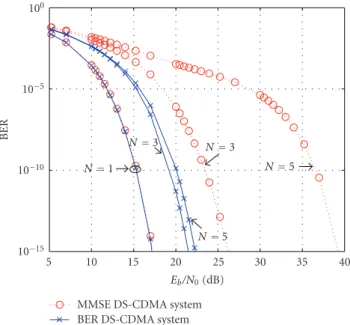
The BER versusEb/ N0performances of the MMSE and the minimum BER DS-CDMA systems are shown inFigure 3 for different number of usersN. FromFigure 3, it is seen that whenN=1, the performances of the MMSE and minimum BER systems are almost the same for all values of Eb/ N0.
WhenNis increased, the overall performance of the system is worse, however, as seen fromFigure 3, there is a significant gain by using the minimum BER system compared to the minimum BER system. When the number of users are increased, the overall BER versusEb/ N0performance of the system is worse because of multiuser interference (MUI). It is seen that the proposed system is less sensitive to MUI than the MMSE system. FromFigure 3, it is seen that for example for BER=10−10 andN = 5, about 16.5 dB in E
b/ N0 can
be gained by the proposed minimum BER system over the MMSE system. The proposed minimum BER system and
5 10 15 20 25 30 35 40
Eb/N0(dB)
10−15
10−10
10−5
100
BER
N=5
N=3
N=5
N=1
N=3
MMSE DS-CDMA system BER DS-CDMA system
Figure 3: BER versus Eb/ N0 performances of the MMSE
DS-CDMA system (· · · ◦ · · ·) and the proposed minimum BER DS-CDMA system (− × −) for different number of usersN∈ {1, 3, 5}, when M = 7,L = 5, and l = 0. WhenN increases, then the performance curves move upwards.
the MMSE system have the same number of receiver filter coefficients in all the filters when equal values ofM,N,L,
δ, and l are used. The transmitter filters in both systems are identical. The proposed system is more complicated to design than the MMSE system, but after the filters are found, the MMSE and minimum BER filters have the same complexity. The proposed method is iterative, and when finding the minimum BER filters, several sums ofKelements must be found, so the design complexity of the proposed algorithm is significantly higher than the closed form MMSE design complexity; see (9). However, the significant gain of the proposed system might justify the increase in design complexity, and, in addition, the proposed method can be used to find linear filters with block memory which has the minimum BER versusEb/ N0performance.
Figure 4shows the BER versusEb/ N0 performance for different number of usersNof the proposed minimum BER DS-CDMA system and the MMSE DS-CDMA system when
−5 0 5 10 15 20
Eb/N0(dB)
10−15
10−10
10−5
100
BER
N=5
N=1
N=3
MMSE DS-CDMA system BER DS-CDMA system
Figure 4: BER versus Eb/ N0 performances of the MMSE
DS-CDMA system (· · · ◦ · · ·) and the proposed minimum BER DS-CDMA system (− × −) for different number of usersN∈ {1, 3, 5}, when M = 7,L = 5, and l = 0. WhenN increases, then the performance curves move upward.
MMSE and minimum BER filters is small; see for example [11].
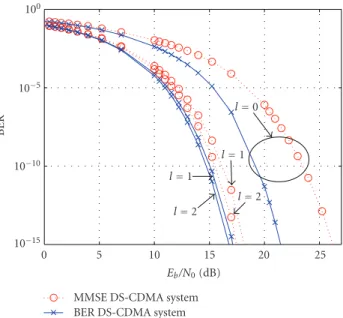
Figure 5shows the BER versusEb/ N0 performances of the MMSE and the proposed minimum BER systems when
M=7,L=5, andN=3 andl∈ {0, 1, 2}. Whenlincreases, the performance of the two systems improves. FromFigure 5, it is seen that a significant improvement can be achieved by increasingl from 0 to 1 in this example, however, there is only a small improvement in performance whenlincreases from 1 to 2. This shows that there is a significant advantage to introduce receiver filters with memory in DS-CDMA uplink communication systems.
5.1. Effect of channel estimation errors
It was assumed that the receiver knows exactly all the channel coefficients. This is not realistic in all practical situations. Assume that the receiver is optimized for the channel transfer functionsCi(z), however, due to channel estimation errors,
the channel coefficients used in the communication system areCi(z), where the transfer functionsCi(z) andCi(z) have
the same order and size. Let hi contain the L+ 1 scalar
channel coefficients corresponding toCi(z). As a measure of
the mismatch (MM) between the actual channelshiand the
channels used in the optimizationhi, MM=1/ N
N−1
i=0 hi− hi2 is used. To generate the actual transfer function, the
relationhi=hi+qiwas used, whereqihas size (L+ 1)×1
and it is white complex Gaussian distributed with equal variance for each component where the variance depends on the current value of MM. It is assumed that the statistics of the error vector (qi) stays constant for all theN channels
0 5 10 15 20 25
Eb/N0(dB)
10−15
10−10
10−5
100
BER
l=0
l=1
l=2
l=2
l=1
MMSE DS-CDMA system BER DS-CDMA system
Figure 5: BER versus Eb/ N0 performances of the MMSE
DS-CDMA system (· · · ◦ · · ·) and the proposed minimum BER DS-CDMA system (−×−) for different values of receiver filter memory l∈ {0, 1, 2}, whenM=7,L=5, andN=3. Whenlincreases, then the performance curves move downward.
for a given value of the MM. When interpreting the size of MM it is important to remember that E[hH
i hi] = 1.
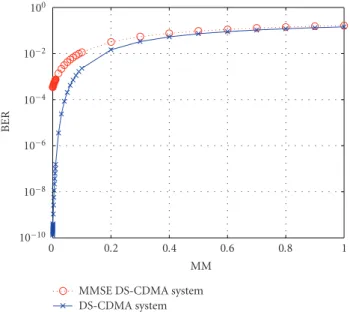
Figure 6 shows the BER versus MM performances of the MMSE and minimum BER systems. Since the value of MM depends on the realization ofhi, Monte Carlo simulations
were used. 10000 realizations of the actual channelshiwere
generated for each value ofMMand then the BER, in (17), was averaged for all these realizations. Figure 6 gives an indication of the sensitivity of the MMSE and minimum BER receiver to errors in the channel coefficients. It is seen that the proposed minimum BER receiver is more robust against channel estimation errors than the MMSE receiver.
5.2. Near-far resistance effect
Let ui(n) be the noise-free M×1 vector time-series that
is the output of channel Ci(z); seeFigure 2. Let Pi be the
received signal power from user numberi.Pican be found
as Pi = E[ui(n)2] = Tr{Ci−[I2 ⊗wiwHi ]CHi−}. Let the channel impulse responses be scaled such that all Pi = P
for i ∈ {1, 2,. . .,N − 1}. The received signal power P0 from user number 0 can be different from the other received powers. The near-far ratio (NFR) in dB is defined as NFR= 10 log10P0/P. InFigure 7, the BER0versus NFR performance is shown for the DS-CDMA systems using MMSE receiver filters and the proposed minimum BER receiver filters. From (17) and (20), it can be deduced that receiver filter number
i is chosen such that BERi is minimized. Since the
0 0.2 0.4 0.6 0.8 1 MM
10−10
10−8
10−6
10−4
10−2
100
BER
MMSE DS-CDMA system DS-CDMA system
Figure6: BER versus MM performances of the MMSE DS-CDMA system (· · · ◦ · · ·) and the proposed DS-CDMA system (− × −), whenl=0,M=7,L=5,N=5, andEb/ N0=20 dB in all cases.
−20 −18 −16 −14 −12 −10 −8 −6 −4 −2 0 NFR (dB)
10−20
10−15
10−10
10−5
100
BER
0
MMSE DS-CDMA system BER DS-CDMA system
Figure7: BER0versus NFR performances of the MMSE DS-CDMA
system (· · · ◦ · · ·) and the proposed minimum BER DS-CDMA system (− × −), whenl=0,M=7,L=5,N =5, andEb/ N0 =
20 dB in all cases.
6. CONCLUSIONS
Exact BER were derived for a DS-CDMA system using receiver filters with block memory. Based on this expression, a framework was developed for finding linear minimum BER receiver filters with block memory. A numerical iterative optimization algorithm was proposed that is able to converge to a locally optimal solution. The proposed receiver filters with block memory can be found through a numerical optimization procedure. Numerical examples showed that the proposed minimum BER receivers can perform sig-nificantly better than the MMSE receivers with the same filter memory. It was shown that by introducing memory into the receiver filters, that is, by allowing l > 0, a significant performance gain of the DS-CDMA system was
(a)
(c)
(b)
P
Figure 8: Illustration of the situation in the proof ofLemma 1. (a) represents the hypersphere in R1×2(l+1)M with radius 1 and center at the origin. The shaded sector of (b) represents the part of the cone in R1×2(l+1)M with vertex at the origin that is lying inside the hypersphere with respect to the receiver inner product. (c) represents the ith receiver that lies outside the cone in (b). P represents the hyperplane that lies between the cone and the ith receiver, passing through the origin, chosen such that the reflection of theireceiver using the receiver inner product about the hyperplanePlies inside the cone.
achieved. Several properties of the minimum BER filters with block memory were also identified. The results might be extended to regular constellations such as multilevel PAM, QAM, and PSK. These constellations will require a significantly larger number of vectors containing all possible sent signal combinations, such that the final SER expressions will contain a large number of terms.
APPENDICES
A. PROOF OFLEMMA 1
Proof. Observe first that if ri has a component in the
set span(t(ki)(n))H[Φ(vl,M)] −1⊥
, where the operator ⊥ means the orthogonal complement with respect to the receiver inner product of the set it is applied to, this component will not contribute anything to the expression of the BER, see (17) and (20), but it will reduce the length of ri that can be used by ith receiver component
that lies in span{(t(ki)(n))H[Φ(vl,M)]−1}. Therefore, the com-ponent of the optimal MISO receiver ri− filter that lies in
span(t(ki)(n))H[Φ(vl,M)] −1⊥
is zero.
From the definition of linear FIR equalizable channels and due to the result in (14), it follows that the vec-torsRe(t(ki)(n))H[Φ(vl,M)]−1, Im(t(ki)(n))H[Φ(vl,M)]−1 ∈ R1×2(l+1)Mform a cone whose vertex is at the origin. Assume
that the optimal receiver [Re{ri−}, Im{ri−}] lies outside this cone, but on the hypersphere inR1×2(l+1)Mwith radius 1 and
center at the origin. LetPbe a hyperplane inR1×2(l+1)M that
theQ-function is monotonic decreasing, it is clear that the BER using the reflection is smaller than when theith receiver lies outside the cone. Since the receiver lying outside the cone and the indexiwere chosen arbitrarily, it is impossible that the optimal receiver filters lie outside the receiver-signal cones.
B. THEQ-FUNCTION AND ITS APPROXIMATIONS TheQ-function is a positive monotonic decreasing function defined for real numbersxas follows:
Q(x)=√1 2π
,∞
x e
−t2/2
dt. (B.1) This means that the function Q(x) is equal to the proba-bility that a real zero-mean unit-variance Gaussian random variable is greater than the real number x. The following approximations are used [19]:
Q(x)≈ ⎧ ⎪ ⎪ ⎪ ⎪ ⎨ ⎪ ⎪ ⎪ ⎪ ⎩
1 √
2π xe
−x2/2
, for large positive values ofx,
1 2−
1 √
2πx, for values ofxclose to zero.
(B.2)
C. PROOF OFPROPOSITION 1
Proof. Assume that not all the noise-free eyes are open. This means that there exists at least one noise-free eye that is closed, for example, the one with index numberi, wherei∈ {0, 1,. . .,N−1}. From (20), it can be seen that BERi≥1/2K,
which implies that BER≥1/2K.
ACKNOWLEDGMENTS
The authors thank to Marius Sˆırbu for fruitful discussions related to this paper. Part of this work was presented in [22]. This work was supported by the Research Council of Norway project 176773/S10 called OptiMO and the Aurora project entitled “Communications under Uncertain Topologies.” This work was supported by Alcatel-Lucent within the Alcatel-Lucent Chair on flexible radio at SUPELEC.
REFERENCES
[1] S. Verd ´u, “Minimum probability of error for asynchronous Gaussian multiple-access channels,” IEEE Transactions on Information Theory, vol. 32, no. 1, pp. 85–96, 1986.
[2] R. Lupas and S. Verd ´u, “Near-far resistance of multiuser detectors in asynchronous channels,” IEEE Transactions on Communications, vol. 38, no. 4, pp. 497–507, 1990.
[3] A. J. Viterbi, “Very low rate convolution codes for maximum theoretical performance of spread-spectrum multiple-access channels,”IEEE Journal on Selected Areas in Communications, vol. 8, no. 4, pp. 641–649, 1990.
[4] D. Guo and S. Verd ´u, “Multiuser detection and statistical mechanics,” in Communications, Information and Network Security, V. Bhargava, H. V. Poor, V. Tarokh, and S. Yoon, Eds., pp. 229–277, chapter 13, Kluwer Academic Publishers, Dordrecht, The Netherlands, 2002.
[5] S. Shamai and S. Verd ´u, “The impact of frequency-flat fading on the spectral efficiency of CDMA,”IEEE Transactions on Information Theory, vol. 47, no. 4, pp. 1302–1327, 2001. [6] S. Verd ´u and S. Shamai, “Spectral efficiency of CDMA with
random spreading,”IEEE Transactions on Information Theory, vol. 45, no. 2, pp. 622–640, 1999.
[7] D. Guo and S. Verd ´u, “Replica analysis of large-system CDMA,” in Proceedings of the IEEE Information Theory Workshop, pp. 22–25, Paris, France, March-April 2003. [8] X. Wang, W.-S. Lu, and A. Antoniou, “Constrained
minimum-BER multiuser detection,”IEEE Transactions on Signal Process-ing, vol. 48, no. 10, pp. 2903–2909, 2000.
[9] C.-C. Yeh, R. Lopes, and J. R. Barry, “Approximate minimum bit-error rate multiuser detection,” inProceedings of the IEEE Global Telecommunications Conference (GLOBECOM ’98), vol. 6, pp. 3590–3595, Sydney, Australia, November 1998. [10] I. N. Psaromiligkos, S. N. Batalama, and D. A. Pados, “On
adaptive minimum probability of error linear filter receivers for DS-CDMA channels,”IEEE Transactions on Communica-tions, vol. 47, no. 7, pp. 1092–1102, 1999.
[11] C.-C. Yeh and J. R. Barry, “Adaptive minimum bit-error rate equalization for binary signaling,”IEEE Transactions on Communications, vol. 48, no. 7, pp. 1226–1235, 2000. [12] S. Chen, A. K. Samingan, B. Mulgrew, and L. Hanzo, “Adaptive
minimum-BER linear multiuser detection for DS-CDMA signals in multipath channels,”IEEE Transactions on Signal Processing, vol. 49, no. 6, pp. 1240–1247, 2001.
[13] X. Wang and H. V. Poor, “Blind equalization and multiuser detection in dispersive CDMA channels,”IEEE Transactions on Communications, vol. 46, no. 1, pp. 91–103, 1998.
[14] G. B. Giannakis, Y. Hua, P. Stoica, and L. Tong, Eds.,Signal Processing Advances in Wireless and Mobile Communciations, vol. I-II, Prentice-Hall, Upper Saddle River, NJ, USA, 2001. [15] P. P. Vaidyanathan, Multirate Systems and Filter Banks,
Prentice-Hall, Englewood Cliffs, NJ, USA, 1993.
[16] A. Scaglione, G. B. Giannakis, and S. Barbarossa, “Redundant filterbank precoders and equalizers part I: unification and optimal designs,” IEEE Transactions on Signal Processing, vol. 47, no. 7, pp. 1988–2006, 1999.
[17] M. L. Honig, P. Crespo, and K. Steiglitz, “Suppression of near-and far-end crosstalk by linear pre- near-and post-filtering,”IEEE Journal on Selected Areas in Communications, vol. 10, no. 3, pp. 614–629, 1992.
[18] S. Haykin,Adaptive Filter Theory, Prentice-Hall, Englewood Cliffs, NJ, USA, 2nd edition, 1991.
[19] P. Galko and S. Pasupathy, “Optimization of linear receivers for data communication signals,”IEEE Transactions on Infor-mation Theory, vol. 34, no. 1, pp. 79–92, 1988.
[20] D. G. Luenberger, Linear and Nonlinear Programming, Addison-Wesley, Reading, Mass, USA, 2nd edition, 1984. [21] D. V. Sarwate and M. B. Pursley, “Crosscorrelation properties
of pseudorandom and related sequences,”Proceedings of the IEEE, vol. 68, no. 5, pp. 593–619, 1980.