R E S E A R C H
Open Access
Bernoulli numbers and certain convolution
sums with divisor functions
Daeyeoul Kim
1, Aeran Kim
2and Nazli Yildiz Ikikardes
3**Correspondence:
3Department of Elementary
Mathematics Education, Necatibey Faculty of Education, Balikesir University, Balikesir, 10100, Turkey Full list of author information is available at the end of the article
Abstract
In this paper, we investigate the convolution sums
(a+b+c)x=n
a,
ax+by=n
ab,
ax+by+cz=n
abc,
ax+by+cz+du=n abcd,
wherea,b,c,d,x,y,z,u,n∈N. Many new equalities and inequalities involving convolution sums, Bernoulli numbers and divisor functions have also been given.
MSC: 11A05; 33E99
Keywords: inequality of Diophantine equations; Bernoulli numbers; convolution sums
1 Introduction
Throughout this paper,N,Z, andCwill denote the sets of positive integers, rational in-tegers, and complex numbers, respectively. The Bernoulli polynomialsBk(x), which are
usually defined by the exponential generating function
text
et– =
∞
k=
Bk(x)
tk
k!,
play an important role in different areas of mathematics, including number theory and the theory of finite differences. The Bernoulli polynomials satisfy the following well-known identity:
N
j=
jk=Bk+(N+ ) –Bk+()
k+ , k≥. ()
It is well known thatBk=Bk() are rational numbers. It can be shown thatBk+= for
k≥, and is alternatively positive and negative for evenk. TheBk are called Bernoulli
numbers.
Forn,k∈Nwiths∈N∪ {}, we define
σs(n) =
d|n
ds, Fk(n) =
⎧ ⎨ ⎩
, ifk|n,
, ifkn.
The exact evaluation of the basic convolution sum
n–
m=
σ(m)σ(n–m)
first appeared in a letter from Besge to Liouville in . Ramanujan’s work has been ex-tended by many authors,e.g., see []. For example, the following identity
n–
m=
σ(m)σ(n–m) =
σ(n) + ( – n)σ(n)
()
is due to the works of Huardet al.[]. In [], Ramanujan also found nine identities, includ-ing (), of the form
n
m=
σr(m)σs(n–m) =Aσr+s+(n) +Bnσr+s–(n),
whereAandBare certain rational numbers. We refer to [] for a similar work. Lahiri [] obtained the most general result by evaluating the sum
m+···+mr=n
ma
· · ·marrσb(m)· · ·σbr(mr) (r≥),
where the sum is over all positive integersm, . . . ,mr satisfyingm+· · ·+mr=n,ai∈
N∪ {}, andbi∈N.
The convolution identities have many beautiful applications in modern number theory, in particular in modular forms, since they appear in the coefficients of the Fourier expan-sions of classical Eisenstein series. For example, a very well-known work of Serre onp-adic modular forms (see []). For some of the history of the subject, and for a selection of these articles, we mention [, ] and [], and especially [] and []. We also refer to [] and [].
In this paper, we shall investigate the convolution sums
(a+b+c)x=n
a,
ax+by=n
ab,
ax+by+cz=n
abc,
ax+by+cz+du=n
abcd.
In fact, we will prove the following results.
Theorem . Let n be a positive integer.Then we have
(a+b+c)x=n
a= σ(n) –
σ(n) +
σ(n) >
B(n– ) ()
with n≥.
Remark . Letαbe a fixed integer withα≥, and let
Pyrα(x) =
be theαth order pyramid number. In fact, in (), ifn=pis a prime number, then we obtain
(a+b+c)x=p
a=Pyr(p– ). ()
This result is similar to [, ()].
Theorem . Let M be an odd positive integer.Let R,r∈N∪ {}with R≥r.Then we have
A(R,r) :=
ax+by=RM
ax=rm
modd
ab= R–r–r+– σ(M) >
R–r–
r+– B(q+ ) ()
with M= q+ .
Theorem . Let mbe an odd positive integer.Let r,r∈Nand r∈N∪ {}with r>
r>r.Then we have
A(r,r,r) :=
ax+by+cz=rm
ax+by=rm
ax=rm
modd
modd
abc= r–r–r–r+– r+– σ
(m). ()
Theorem . Let m be an odd positive integer.Let r,r,r∈Nand r∈N∪ {}with
r>r>r>r.Then we have
ax+by+cz+du=rm
ax+by+cz=rm
ax+by=rm
ax=rm
modd
modd
modd
abcd= ·
–r–r–r–r+– r+– r+–
×rσ
(m) + (–)r–rr+r–b(m)
when∞n=b(n)qn=q∞n=( –qn)( –qn).
Theorem . Let M be an odd positive integer.Let r,R∈N∪ {}.Then we have
R≤r<log(RMm )
ax+by=RM
ax=rm
modd
ab
=
·R+– R++ σ(M) –
·R+M– R+– σ(M) .
Corollary . For R>r,we have the following lower bound of A(R,r)and the upper bound
of A(r,r,r),
A(R,r) >
σ
and
A(r,r,r) <
σ
r–m
.
2 Bernoulli number derived from Diophantine equations(a+b+c)x=na Lemma . Let n∈N.Let f :Z→Cbe an odd function.Then
(a,b,c,x)∈N
(a+b+c)x=n
f(a+b) +f(b–c)=
e|n e–
k=
(e–k– )f(e–k).
Proof We can write the equality as
(a+b+c)x=n
f(a+b) +f(b–c)
=
k≥
f(k)
(a+b+c)x=n a+b=k
+
(a+b+c)x=n b–c=k
–
(a+b+c)x=n b–c=–k
=
k≥
f(k)
(a+b+c)x=n a+b=k
=
e|n
(e– )f(e– ) + (e– )f(e– ) +· · ·+e– (e– )f()
=
e|n e–
k=
(e–k– )f(e–k).
This completes the proof of the lemma.
Proof of Theorem. Letf(x) =x. Then Lemma . becomes
(a+b+c)x=n
{a+ b–c}=
σ(n) –σ(n) +
σ(n) ()
and
(a+b+c)x=n
a= σ(n) –
σ(n) +
σ(n). ()
Using (), we note that
p–
j=
j=
B(p– ) –B =
B(p– )
sinceB= . It is easily checked that
p(p– )(p– )
>
(p– )(p– )(p– )
We can write that
(a+b+c)x=n
a>
B(n– )
withn≥. This completes the proof of the theorem.
We list the first ten values of(a+b+c)x=nain Table .
Remark . Let
f(x) :=
(a+b+c)t=x
a
and
g(x) :=
x(x– )(x– ) =Pyr(x– ).
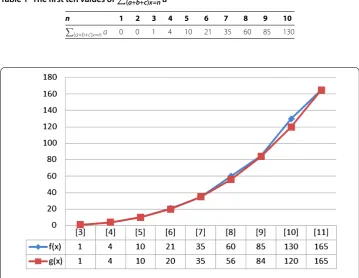
Ifxis a prime integer, by () and (), thenf(x) =g(x).
The first nine values off(x) andg(x) are given in Figure . In Figure , we plot the graphs for the values of the sumsf(x) andg(x) in Remark . whenx= , , , , , , , , .
Table 1 The first ten values of(a+b+c)x=na
n 1 2 3 4 5 6 7 8 9 10
(a+b+c)x=na 0 0 1 4 10 21 35 60 85 130
3 Two lemmas
where the Kronecker delta symbol is defined by
δi,j=
Proof We note that
Therefore, () becomes
This completes the proof of the lemma.
Example .
Proof It is similar to Lemma ..
4 A study ofax+by=nab
Proof of Theorem. We observe that
Therefore, () becomes
ax+by=RM
ax=rm
modd
ab=r+–
m<R–rM m
σ(m)σ
R–rM–m
=r+–
m<R–rM σ(m)σ
R–rM–m
–
m<R–r–M
σ(m)σ
R–rM– m
+
m<R–r–M
σ(m)σ
R–rM– m
=r+– ·R–r–σ(M), ()
where we refer to (),
m<n/
σ(m)σ(n– m) =
σ(n) + ( – n)σ(n) + σ(n/)
+ ( – n)σ(n/)
in [, (.)] and
m<n/
σ(m)σ(n– m) =
σ(n) + ( – n)σ(n) + σ(n/)
+ σ(n/) + ( – n)σ(n/)
in [, Theorem ]. Thus, we obtain
A(R,r) = R–r–
r+– σ(M)
> R–r–r+– σ(M) –σ(M)
> R–r–r+–
q(q+ )(q+ )
≥R–r–r+–
B(q+ ) –B
()
withM= q+ . This completes the proof of this theorem.
Theorem . Let M be an odd positive integer.Let R∈Nand r∈N∪ {}with R>r.Then we have
(a)
ax+by=RM
ax=rm
modd
xeven
(b)
ax+by=RM
ax=rm
modd
xeven
yeven
ab= R–r–r– σ(M),
(c)
ax+by=RM
ax=rm
modd
xeven
yodd
ab=
ax+by=RM
ax=rm
modd
xodd
yeven
ab= R–r–r– σ(M),
(d)
ax+by=RM
ax=rm
modd
xodd
yodd
ab= R–r–σ(M).
Proof
(a) First, we note that
m<R–rM m
σ(m)σ
R–rM–m= R–r–σ(M), ()
by (). Therefore,
ax+by=RM
ax=rm
modd
xeven
ab=
ax+by=RM ax=rm
modd
ab
=
ax+by=RM
ax=r–m
modd
ab
=
m<R–rM m
a|r–m a
b|r(R–rM–m)
b
=r– r+–
m<R–rM m
σ(m)σ
R–rM–m
= R–r–r– r+– σ(M),
(b) We observe that
so () becomes
rr–
Corollary . Let M be an odd positive integer.Let R∈Nand r∈N∪ {}with R>r.Then
Proof From (), we deduce that
n–
Proof By Theorem ., we have
Similarly, the other terms of () are
Proof of Theorem. The proof starts as follows:
Then the second term of () is
=
Proof of Theorem. From Theorem ., we observe that
Thus, we refer to
(a) The proof is similar to Theorem .. Let us consider that
Then Thus, () becomes
(b) We sketch the proof as follows:
Proof of Corollary. Firstly, from (), we note that
t–t= –(t– )+ and < t–t≤
with <t≤
t
. Putt= ( )r then
<
r+– r ≤
. ()
Thirdly, we considerf(t) =t( –t)with <t< . Then, we easily check that <f(t)≤
so
<
r+– r ≤
. ()
Consider
r –
r– – =
– ()r–
< ()
withr> . From (), we deduce that
r–<σ
r– and
r–< σ
r–. ()
From (), () and (), we compute thatA(r,r,r) <σ(r–m). 5 A study ofax+by+cz+du=nabcd
Corollary . Let m be an odd positive integer.Let r,r,r∈Nand r∈N∪ {}with
r>r>r>r.If r,r,r≡– (mod),then we have
r+σ
(m)≡(–)r–r+·r+rb(m) (mod·r+r+r+).
Proof From Theorem ., we have
ax+by+cz+du=rm
ax+by+cz=rm
ax+by=rm
ax=rm
modd
modd
modd
abcd= ·
–r–r–r–r+– r+– r+–
×rσ
(m) + (–)r–rr+r–b(m) . ()
Sincer,r,r≡– (mod) by the assumption, therefore, r+– ≡ (mod). So from
(), we have
–r–r–r–rσ
(m) + (–)r–rr+r–b(m) ≡ (mod). ()
By multiplying () by r+r+r+, we obtain the proof.
6 Another convolution sums
Theorem . Let M∈NwithM.Let R∈Nand r∈N∪ {}with R≥r.Then we have
A∗(R,r) :=
ax+by=RM
ax=rm m
ab= ·
R–r–r+–
σ(M) ()
and if R>r,then
A∗(R,r) > ·σ
R–r–M.
Proof It is similar to Theorem .. So we obtain that
ax+by=RM
ax=rm m
ab=
r+–
m<R–rM m
σ(m)σ
R–rM–m
=
r+–
m<R–rM σ(m)σ
R–rM–m
–
m<R–rM |m
σ(m)σ
R–rM–m
=
r+–
m<R–rM σ(m)σ
R–rM–m
–
m<R–r–M
σ(m)σ
R–rM– m.
Then we refer to
m<n
σ(m)σ(n– m) =
σ(n) + ( – n)σ(n) + σ
n
,
ifn≡ (mod) in [, Theorem ]. Therefore, we get (). By (), we note that
A∗(R,r) =
R–r–r+–
σ(M)
= ·
(R–r)r+–
σ(M). ()
It is well known that
Table 2 Values ofb(n) (1≤n≤12)
n b(n) n b(n)
1 1 7 1,016
2 –8 8 –512
3 12 9 –2,043
4 64 10 1,680
5 –210 11 1,092
6 –96 12 768
withr≥. Combine () and (),
A∗(R,r) > ·
(R–r)σ (M)
> ··
((R–r)– )
– σ(M)
= ·σ
R–r–M
with (,M) = . This completes the proof of this theorem.
Appendix
The first twelve values ofb(n) forn∈Nare given in Table .
Competing interests
The authors declare that they have no competing interests.
Authors’ contributions
All authors contributed equally and significantly in this article. All authors read and approved the final manuscript.
Author details
1National Institute for Mathematical Sciences, Doryong-dong, Yuseong-gu, Daejeon, 305-811, South Korea.2Department
of Mathematics, Institute of Pure and Applied Mathematics, Chonbuk National University, Chonbuk, Chonju, 561-756, South Korea. 3Department of Elementary Mathematics Education, Necatibey Faculty of Education, Balikesir University,
Balikesir, 10100, Turkey.
Acknowledgements
The first author was supported by the National Institute for Mathematical Sciences (NIMS) grant funded by the Korean government (B21303).
Received: 20 June 2013 Accepted: 23 August 2013 Published: 23 September 2013
References
1. Ramanujan, S: On certain arithmetical functions. Trans. Camb. Philos. Soc.22, 159-184 (1916)
2. Huard, JG, Ou, ZM, Spearman, BK, Williams, KS: Elementary evaluation of certain convolution sums involving divisor functions. In: Number Theory for the Millennium, vol. II, pp. 229-274 (2002)
3. Melfi, G: On some modular identities. In: Number Theory, pp. 371-382. de Gruyter, Berlin (1998)
4. Lahiri, DB: On Ramanujan’s functionτ(n) and the divisor functionσ(n). I. Bull. Calcutta Math. Soc.38, 193-206 (1946) 5. Serre, JP: Formes modulaires et fonctions zetap-adiques. In: Modular Functions of One Variable, vol. III. Proc.
International Summer School, Univ. Antwerp, 1972. Lecture Notes in Math., vol. 350, pp. 191-268. Springer, Berlin (1973)
6. Cheng, N, Williams, KS: Evaluation of some convolution sums involving the sum of divisors functions. Yokohama Math. J.52, 39-57 (2005)
7. Williams, KS: Number Theory in the Spirit of Liouville. London Mathematical Society Student Texts, vol. 76. Cambridge University Press, Cambridge (2011)
8. Cho, B, Kim, D, Park, H: Evaluation of a certain combinatorial convolution sum in higher level cases. J. Math. Anal. Appl.406(1), 203-210 (2013)
9. Royer, E: Evaluating convolution sums of the divisor function by quasimodular forms. Int. J. Number Theory3(2), 231-261 (2007)
10. Kim, D, Bayad, A: Convolution identities for twisted Eisenstein series and twisted divisor functions. Fixed Point Theory Appl.2013, 81 (2013)
12. Kim, D, Kim, A, Sankaranarayanan, A: Bernoulli numbers, convolution sums and congruences of coefficients for certain generating functions. J. Inequal. Appl.2013, 225 (2013)
doi:10.1186/1687-1847-2013-277