R E S E A R C H A R T I C L E
Open Access
Efficient use of a hybrid decoding technique
for LDPC codes
Walter Prado de Souza Guimarães
1*, José S Lemos-Neto
2and Valdemar C da Rocha Jr
2Abstract
A word error rate (WER) reducing approach for a hybrid iterative error and erasure decoding algorithm for low-density parity-check codes is described. A lower WER is achieved when the maximum number of iterations of the min-sum belief propagation decoder stage is set to certain specific values which are code dependent. By proper choice of decoder parameters, this approach reduces WER by about 2 orders of magnitude for an equivalent decoding complexity. Computer simulation results are given for the efficient use of this hybrid decoding technique in the presence of additive white Gaussian noise.
Keywords: Iterative decoding; LDPC codes; Erasure decoding
Introduction
Low-density parity-check (LDPC) codes were first intro-duced by Gallager in 1963 [1] and rediscovered by Mackay [2] in late 1990s. LDPC codes are characterized by a sparse parity-check matrix H, for which an iterative decoder becomes an attractive option. One example is the belief propagation (BP) decoder which achieves the optimal MAP (Maximum a Posteriori) decoding condition if the code graph does not contain cycles ([3], p. 211). However, most LDPC codes have cycles in their Tanner graph repre-sentation, mainly for small and medium blocklengths [4], which adversely affect code performance. The BP decod-ing operation is executed for a preset number of iterations, and in case of a decoding failure, it leads to a frame error which implies a number of bits erroneously decoded. In the error-floor region, where LDPC codes exhibit a sud-den saturation in word error rate (WER) for a sufficiently high signal-to-noise ratio (SNR), the bit errors are primar-ily caused by trapping sets ([3], p. 225). A considerable amount of research has gone into designing decoders to mitigate the errors caused by trapping sets [4-6].
In [7], a bi-mode decoder for LDPC codes was pro-posed for the additive white Gaussian noise (AWGN) channel, called a hybrid decoder (HD). The HD system operates in two modes (stages), where in mode 1 (first
*Correspondence: [email protected]
1Department of Electronics and Communications, State University of Amazonas, Manaus 69050-020, Brazil
Full list of author information is available at the end of the article
stage) a min-sum BP decoding is employed and in mode 2 (second stage) an iterative erasure decoder is used. One cycle of the HD operation includes at least one passage through the min-sum BP decoder, and if necessary, it also includes a passage through the erasure decoder.
In this article, we make a more efficient use of the HD system introduced in [7]. In comparison with [7], the nov-elty here is the experimental determination of appropriate values for the number of iterations for the min-sum BP decoder which permits to perform a fine tune on the HD system. Furthermore, a new material has been added to explain the estimation of the number of bits to be erased at the end of an unsuccessful BP decoding, and computer simulations were performed to investigate the behavior of certain LDPC codes in the presence of AWGN by analyzing the following:
• Behavior of the number of errors resulting after a decoding failure;
• Impact on the performance of HD systems caused by setting a specific number of iterations in a min-sum BP decoder, such that the cardinality of the
remaining bit error pattern is small in case of unsuccessful BP decoding;
• Performance curves obtained by computer simulation for some LDPC codes used in the IEEE 802.11n standard [8], under the constraints on the decoding conditions indicated earlier.
Nowadays, LDPC codes are continually in high demand, and that causes a strong need for the development of low-complexity decoding algorithms for these codes to enable low-cost high-throughput decoder implementations. As mentioned in [9], there are three main approaches to reduce the complexity of LDPC decoding, namely
1. Simplification of computations performed by the decoder
2. Reducing the number of iterations needed to converge
3. Reducing the complexity cost of an iteration.
Different approaches have been followed to reduce the complexity of LDPC decoding. For example, by replacing the sum-product check node computation by a simpler function [10], to simplify the computations, or using var-ious scheduling techniques to increase the convergence rate by altering the order of updating messages dur-ing the iteration [11], or usdur-ing the forced convergence method [12]. In [9], an approach named lazy schedul-ing was employed to force a reduction in the complexity of decoding computations without reducing the number of iterations. Here, we address an approach whereby the maximum number of iterations is reduced without paying a penalty for loss in performance.
Hybrid decoding system
We illustrate in Figure 1 the basic digital communica-tion system adopted for the computer simulacommunica-tion of some selected LDPC codes. At the transmitter, a binary infor-mation K-tuple u = (u1,u2,. . .,uK) feeds the encoder for a binary LDPC codeCto produce the codewordc = (c1,c2,. . .,cN). Each codeword is then processed by a mapper in such a way that each digit 0 is converted to the integer+1 and each digit 1 is converted to the integer−1. At the mapper output, the N-tuplex = (x1,x2,. . .,xN) is generated where xi, 1 ≤ i ≤ N, denotes an integer equal either to+1 or−1. TheN-tuplexis sent through an AWGN channel, the output of which is denoted by
y, expressed as y = x + n, where n = (n1,n2,. . .,
nN) denotes a vector whose coordinates are AWGN
samples introduced by the channel with zero mean and varianceσ2.
At the receiver, decoding consists of processing y to recoveru, and this is performed in at most two decoding
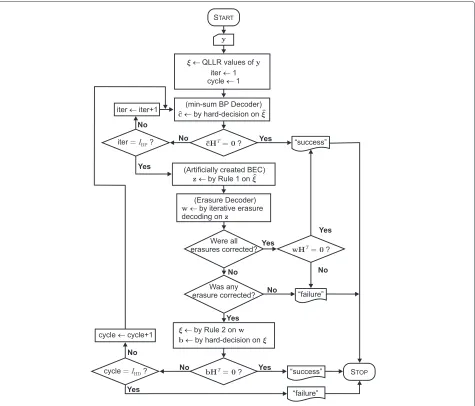
stages as we explain in the sequel according to the flowchart in Figure 2. On receiving the N-tuple y, the decoder converts y into a vector ξ = (ξ1,ξ2,. . .,ξN) whose coordinates are values of a quantized logarithmic likelihood ratio (QLLR) [13]. The first decoding stage employs a min-sum BP decoder. LetIBPdenote the
max-imum number of iterations for the first decoding stage. After each iteration, the min-sum BP decoder gener-ates anN-tupleξˆ = (ξˆ1,ξˆ2,. . .,ξˆN)of reliability values, which is converted to a binary form by hard-decision and denoted as cˆ = (cˆ1,cˆ2,. . .,cˆN). The binaryN-tuplecˆ is tested for its syndrome by means of the operationcHˆ T, whereHTdenotes the transpose of the code parity-check matrix. A well-established result for linear block codes ([14], p. 70), guarantees that if cHˆ T = 0 occurs, then we can consider cˆ to be the transmitted codeword and the HD cycle is successfully interrupted. Otherwise, i.e., if cHˆ T = 0, then a new iteration is performed by the BP decoder and the newly generatedcˆis tested to check whether cHˆ T = 0. The BP decoder iterations continue until the conditioncHˆ T = 0is satisfied or else the num-ber of iterations reaches the valueIBP. AfterIBPiterations
are performed and decoding is not successful, instead of declaring a decoding failure, the resulting N-tupleξˆ of reliability values is used by an artificially created binary erasure channel (BEC) [7] to produce anN-tuplezof 0’s, 1’s, and erasures.
For a given positive integer X, let SX denote a set containing X coordinates, X < N, selected among N
coordinates with lowest reliability values inξˆ. The value of each one of thoseXselected coordinates is mapped tozas an erasure, and the remainingN−Xcoordinates inξˆare mapped tozas either 0’s or 1’s by hard-decision according to Rule 1 as follows:
Rule 1.
zi=
, fori∈SX
ˆ
ci, fori∈/SX,
wheredenotes an erasure.
The iterative erasure correction decoder then acts on
z to correct the erasures introduced by Rule 1. In case all erasures are corrected, the HD cycle is interrupted and the erasure decoder outputs a binary N-tuplew. If
Figure 2Flowchart illustrating the HD operations performed on to recover .
wHT = 0, thenwis considered to be a codeword; other-wise, a decoding failure occurs. However, if all erasures are not corrected but at least one erasure is corrected when the erasure decoding operation is finished, the erasure decoder outputs anN-tuple win which the coordinate values coincide with corresponding coordinate values inz, except for those coordinates where erasures inzhave been corrected and, therefore, will contain binary values inw. Next,wis associated to anN-tuple of reliability valuesξ by Rule 2 as follows:
Rule 2.
ξj=
ˆ
ξj, wj=orwj= ˆcj,
−ˆξj wj= ˆcj.
When the erasure decoding operation is finished, we notice in ξ that the QLLR values from the previous BP
decoding are kept if the corresponding digits remained erased or if their values are the same as those already com-puted at the previous BP decoding. Otherwise, the sign of the corresponding QLLR value is changed. A binaryN -tupleb, obtained by hard-decision on the coordinate val-ues ofξ, has its syndrome computed to find out whether decoding has been successful or not. If not so and the maximum number of cycles of the HD algorithm, denoted byIHD, has not been reached, thenξis used as input to the min-sum BP decoder and thus a new HD cycle is initiated.
The choice of a value forX
performance since, in the erasure iterative decoding pro-cess, as the number of introduced erasures increases, it is less and less likely to find parity-check equations con-taining a single erased bit which could thus be solved. The set of erased bits which cannot be decoded with the code parity-check equations is called astopping set[15].
Definition 1(Reference [15]).Astopping setSin a linear block codeCis a subset of the set of variable nodes (or bit nodes) of the code Tanner graph, such that all neighbors of S(parity-check nodes) are connected toSat least twice.
Whenever there is a decoding failure on the first decod-ing stage, then the second decoddecod-ing stage is employed to process the output of an artificially created BEC. The input to the BEC is the binary sequencecˆproduced by the min-sum BP decoder at the end of theIBPth iteration. Our
motivation to employ an iterative erasure decoding stage is the following. For a given block code with minimum Hamming distanced, it is well known that any erasure pat-tern containing up tod−1 erasures ([14], p. 81) can be corrected, as well as a large fraction of patterns containing
dor more erasures, as long as the number of erasures in a codeword does not exceed the number of parity-check digits and these erasures do not cover a codeword [16]. As shown later, typical useful values ofXare much larger thand.
Definition 2(Reference [17]).Thestopping distanceof a linear block codeC, denoted ass(H), is defined as the set of least cardinality among all stopping sets of codeC.
The number of distinct stopping sets of a linear code Cdetermines the code performance with erasure iterative decoding [17]. The performance of code C with block-lengthN, for a specific parity-check matrixH, as a func-tion of the BEC erasure probability, is computed with the probabilityPH(), i.e., the word erasure rate, expressed as ([18], p. 313)
whereT(δ)denotes the total number of distinct combi-nations ofδpositions with erasures andS(δ)denotes the number of such combinations which constitute a stopping set. Thus, the ratio S(δ)/T(δ)can be interpreted as the probability of a given setδof erased digits to be a stopping set. All erasure patterns containing a number of erasures less than the stopping distances(H)can be corrected by the erasure iterative decoder. Apparently, a good choice forX should satisfyX ≤ s(H), in which case all erasure patterns would be corrected. However, a small value for
s(H)may be insufficient for the possibleSXto contain the majority of the errors present in theN-tuplesξˆ.
Definition 3.We define an N-tuple containing errors produced when BP decoding fails asdetected if all erro-neous positions are contained inSX.
Definition 4.We define an N-tuple containing errors produced when BP decoding fails as corrected if it can be detected, and the corresponding binary word cˆ pro-duced by the erasure iterative decoder belongs to codeC, i.e.,cˆ∈C.
For two LDPC codes used in the IEEE802.11n stan-dard and used as examples in this article, namely the
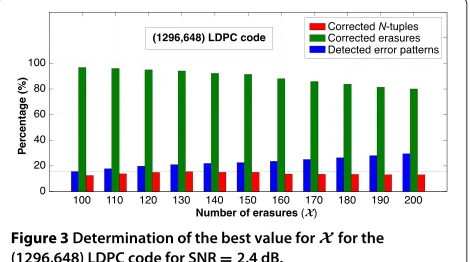
(1296, 648)and the(1296, 864)codes, the best value forX was determined by computer simulation of the HD algo-rithm by trying out various values forX,s(H) ≤ X, and computing the percentage of detected error patterns, the percentage of corrected erasures, and the percentage of errors corrected in the receivedN-tuple. The best value ofX for the(1296, 648)LDPC code is X = 130 as can be viewed in Figure 3. For the(1296, 864)LDPC code, the best value ofXis equal to 100 as indicated in Figure 4. By observing Figures 3 and 4, we notice that by increasingX, there is a corresponding increase in the percentage detec-tion of error patterns (blue bars); however, this comes accompanied by a decrease in the percentage correction of erasures (green bars) due primarily to the presence of stopping sets. We notice that the(1296, 648)code has a
minimum distanced = 23, while the minimum distance
of the (1296, 864) code, although not known exactly, is estimated to be at most 20, i.e., both minimum distances are much less than the corresponding values ofX. Other SNR values were tested to analyze the behavior of the two codes considered here, and similar results to those shown in Figures 3 and 4 were obtained.
Error event analysis
In the HD scheme, ideally after the last iteration of an unsuccessful min-sum BP decoding, all remaining bit
Figure 4Determination of the best value forXfor the (1296,864) LDPC code for SNR=3.2 dB.
errors should be included among those X erased posi-tions in theN-tuplez. That is more likely to occur when either the value ofX is large or else when the cardinal-ity of the remaining bit error pattern is small. Opting for
a large X in many cases may not be a good approach
because it can give rise to stopping sets ([3], p. 244), thus hampering the success of the iterative erasure decoder as we can observe by analyzing the behavior of the green bars in Figures 3 and 4. On the other hand, the number of bit errors for a given frame error occurrence can vary significantly along the intermediate iterations [5], i.e., the cardinality of the remaining bit error pattern can vary sig-nificantly. The variation in the number of erroneous bits at the output of a BP decoder after an unsuccessful decoding motivated us to develop an error event analysis in order to perform a fine tune on the HD system [7], more specif-ically for selecting an appropriate value for IBP. In [7],
initially, an arbitrary value ofIBPwas employed for the first
stage of the HD system, which is a min-sum BP decoder. In this manner, there was no clue to the number of remain-ing errors when IBP iterations were performed and the
decoding was not successful. When that happened, it was likely that the BP decoder had reached a trapping set ([3], p. 651). Once a trapping set has been reached, it is not pos-sible, by performing more iterations with the BP decoder, to get out of it and successfully decode the received word. According to ([3], p. 652), the variation in the cardinal-ity of the remaining bit error patterns occurs due to the behavior of the trapping sets that dominate the error floor. Trapping sets can be classified into one of three classes according to their behavior ([3], p. 652): (1) a stable trap-ping set (also called a fixed-point trapping set), (2) a periodically oscillating trapping-set, and (3) an aperiodic oscillating trapping set. The relevance of the variation in the cardinality of the remaining bit error patterns depends on the class of trapping sets that dominate the error-floor region. In general, there is no known theoretical way to establish the trapping sets for a given code. Thus, find-ing trappfind-ing sets is in general a difficult task because it requires intensive computer simulations at very low error rates which often take months to run ([3], p. 651). As an
alternative to the usual computer simulation, we develop an error event analysis, which has a much lower com-putational cost, and apply it to two LDPC codes of the IEEE802.11n standard used as examples in this article. The purpose of the error event analysis is to find out the average behavior of the min-sum BP decoding, with respect to the variation in the number of errors after each iteration, in case of a decoding failure. If the cardinality of the remaining bit error patterns varies significantly, we expect to find out values for the number of iterations for which the number or erroneous bits is minimal and thus choose one of these values forIBP. As a result, the
proba-bility that erroneous bits are included among theXerased positions in theN-tuplezis higher.
In the sequel, we present results of computer sim-ulations performed for two LDPC codes used in the IEEE802.11n standard, namely the (1296, 648) and the
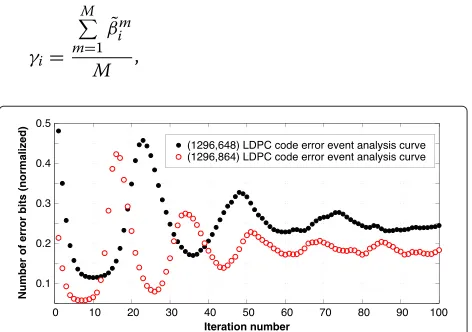
(1296, 864) codes. Our purpose is to find out the aver-age behavior of the min-sum BP decoding with respect to the variation in the number of errors remaining after each iteration in case of a decoding failure. The number of bit errors is averaged over the number of intermediate itera-tions of a min-sum BP decoder. The procedure employed to generate the curves in Figure 5 works as follows.
Let βi be the number of errors in an estimated N -tuple in the ith iteration of the min-sum BP decoding algorithm, wherei≤IBP. In case of a min-sum BP decod-ing failure, letxm = {β1m,β2m,. . .,βIBPm } denote themth sample sequence having for each coordinate the number of errors in the corresponding BP iteration. The
coor-dinates in sequence xm are then normalized by their
largest value giving rise to the normalized sequencexm˜ = { ˜β1m,β˜2m,. . .,β˜Im
BP}. Averaging the overallmth normalized
˜
xm sequences gives rise to the γ = {γ1,γ2,. . .,γIBP} sequence, whoseith coordinate (corresponding toith iter-ation) is expressed by
γi= M m=1
˜ βim
M ,
whereMdenotes the maximum number of samples con-sidered in the analysis. Thus, the sequenceγ allows us to track the average behavior of the min-sum BP decoding algorithm with respect to the variation in the number of errors at each iteration. The results shown in Figure 5 are for the two codes of interest, where the horizontal axis represents the number of decoding iterations, and the ver-tical axis represents the average normalized number of bit errors at each iteration of the min-sum BP algorithm,γi, 1 ≤ i≤ IBP = 100. In Figure 5, for the(1296, 648)code, the curve is plotted for SNR= 2.4 dB andM=525 sam-ples, and for the(1296, 864)code, the curve is plotted for SNR=3.2 dB andM=510 samples. Since trapping sets depend not only on the graphical structure of the code but also on the channel ([3], p. 653), it is noteworthy that other SNR values were tested to analyze the behavior of the two codes in the situation described, and similar results to those shown in Figure 5 were obtained. In agreement with [6], for both LDPC codes considered, the number of remaining errors after a BP decoding failure exhibit an oscillating behavior as illustrated in Figure 5. The result-ing number of bit errors may reach higher values, referred to aspeak pointsor lower values (local minima) referred to asvalley points.
Although the error event analysis performed for the codes examined may not be enough to draw precise con-clusions about the class of the trapping sets that dominate the error-floor region, it is enough to perform a fine tune of the HD system as we show in the next section.
Efficient use of the hybrid decoder
Figure 6 shows some performance curves for the
(1296, 648) LDPC code. First, we consider decoding the
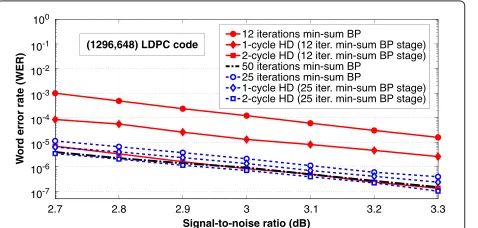
(1296, 648)LDPC code usingIBP = 12 iterations for the min-sum BP decoder (first stage) of the HD system. The value IBP = 12 is very close to a valley point in the curve shown in Figure 5, i.e., for which low cardinality bit error patterns in the estimatedN-tuple are expected. It is noticed in Figure 6 that to achieve the same performance, in terms of WER, the HD system withIHD = 1 (1 cycle) requires an SNR around 0.3 dB lower than that required
Figure 6Performance curves for the (1296, 648) LDPC code.
for a conventional min-sum BP decoder with IBP = 12 iterations. Similarly, forIHD=2 (2 cycles), the HD system requires an SNR around 0.6 dB lower than that required for a conventional min-sum BP decoder with IBP = 12 iterations.
Furthermore, for the range of SNR values in Figure 6, the WER for the HD system with 1 cycle is lower than that for a conventional min-sum BP decoder withIBP =12 itera-tions by approximately 1 order of magnitude. For 2 cycles, the resulting WER for the HD system is lower by 2 orders of magnitude than that for a conventional min-sum BP decoder withIBP=12 iterations.
Figure 6 also illustrates the results obtained for the
(1296, 648) LDPC code for IBP = 25 iterations. We observe in Figure 5 that IBP = 25 iterations is close to a peak point and large cardinality error patterns are expected. ForIBP = 25, an analysis similar to that from the previous case shows that the HD system with 1 cycle requires an SNR around 0.1 dB lower than that of a min-sum BP decoder forIBP=25 iterations in order to achieve the same performance in terms of WER. For a 2-cycle HD, a reduction of 0.2 dB results, again in comparison with a min-sum BP decoder forIBP=25 iterations. With respect to the values of WER, forIBP = 25, we observe that the difference between the values of WER for the HD system with 2 cycles and for a min-sum BP decoder withIBP=25 iterations is smaller than 1 order of magnitude. In sum-mary, in terms of WER, no considerable gain results if the value chosen forIBPis close to a peak point in Figure 5. On the other hand, we obtain a more efficient use of the HD system for the(1296, 648)LDPC code by setting the value ofIBPclose to a valley point in Figure 5.
A procedure similar to that described for the(1296, 648)
code was also performed for decoding the (1296, 864)
code using the HD system, and the corresponding results are shown in Figure 7. As expected, for IBP = 10 iter-ations, which is very close to a valley point in Figure 5, the use of the HD system produces better results than those for IBP = 16 iterations, which is a peak point in Figure 5, according to the analysis described earlier for the
(1296, 648)code.
Performance curves in Figures 6 and 7 for the min-sum BP algorithm with 50 iterations serve as a reference value. By settingIBPclose to a valley point, the HD system needs an overall reduced number of iterations to achieve a sim-ilar performance to the min-sum BP decoding scheme, with equivalent implementation complexity.
Conclusions
The oscillating behavior of the error rate versus num-ber of iterations, featured by some LDPC codes of the IEEE802.11n standard, was exploited in order to take advantage of the so-called valley points in the error event analysis. The goal achieved here was an enhancement of the performance of the bi-modal hybrid decoder from [7]. Simulation results show that a more efficient use of the HD system is obtained when the min-sum BP decoder employs a maximum number of iterations correspond-ing to points close to and possibly includcorrespond-ing a valley point and avoiding values close to and possibly includ-ing a peak point. In particular, the error event analysis for the(1296, 648)code in Figure 5 indicates for 12 iter-ations a number of remaining errors much smaller than for 25 iterations, whenever there is a decoding failure. However, in general, a BP decoder employing a maximum of 25 iterations on average will fail less times than when employing a maximum of 12 iterations. A similar reason-ing applies to other LDPC codes of similar parameters as well as to LDPC codes of similar block length. In particu-lar, it applies to the(1296, 864)code that was considered here.
Competing interests
The authors declare that they have no competing interests.
Acknowledgements
This work received partial support from the Brazilian National Council for Scientific and Technological Development - CNPq, Project 304696/2010-2, and from the Pernambuco State Foundation to Support Science and Technology -FACEPE, Project 0288-0.34/10.
Author details
1Department of Electronics and Communications, State University of
Amazonas, Manaus 69050-020, Brazil.2Department of Electronics and Systems,
Federal University of Pernambuco, Recife 50740-550, Brazil.
Received: 8 April 2013 Accepted: 9 January 2014 Published: 26 February 2014
References
1. RG Gallager, Low-density parity-check codes. Ph.D. thesis, MIT Press, Cambridge (1963)
2. DJC Mackay, Good error-correcting codes based on very sparse matrices. IEEE Trans. Inform. Theory.45(2), 399–431 (1999)
3. WE Ryan, S Lin,Channel Codes: Classical and Modern. (Cambridge University Press, Cambridge, 2009)
4. S Gounai, T Ohtsuki, T Kaneko, Modified belief propagation decoding algorithm for low-density parity check code based on oscillation, in
Proceedings of the IEEE 63rd Vehicular Technology Conference VTC 2006 Spring,Melbourne, 7–10 May 2006 (IEEE Piscataway, 2006), pp. 1467–1471 5. E Alghonaim, MA Landolsi, A El-Maleh, Improving BER performance of
LDPC codes based on intermediate decoding results, inProceedings of the
IEEE International Conference on Signal Processing and Communications ICSPC 2007,Dubai, 24–27 Nov 2007 (IEEE Piscataway, 2007), pp. 1547–1550 6. Y Han, E Ryan, Low-floor decoders for LDPC codes. IEEE Trans. Commun.
57, 1663–1673 (2009)
7. WPS Guimarães, JS Lemos-Neto, VC da Rocha Jr, A hybrid iterative decoder for LDPC codes, inProceedings of the 9th International Symposium on Wireless Communication Systems ISWCS 2012,Paris, 28–31 Aug 2012 (IEEE Piscataway, 2012), pp. 979–983
8. IEEE Standards Association,IEEE 802.11n-D1.0 - IEEE 802.11n Wireless LAN Medium Access Control MAC and Physical Layer PHY Specifications. (IEEE, Piscataway, 2006)
9. D Levin, E Sharon, S Litsyn, Lazy scheduling for LDPC decoding. IEEE Commun. Lett.30(1), 70–72 (2007)
10. J Zhang, M Fossorier, G Du, J Zhang, Two-dimensional correction for min-sum decoding of irregular LDPC codes. IEEE Commun. Lett.
10, 180–182 (2006)
11. J Zhang, M Fossorier, Shuffled belief propagation decoding, in
Proceedings of the 36th Asilomar Conference on Signals, Systems and Computers,Pacific Grove, 3–6 Nov 2002 (IEEE Piscataway, 2002), pp. 8–15 12. G Fettweis, E Zimmermann, W Rave, Forced convergence decoding of
LDPC codes: EXIT chart analysis and combination with node complexity reduction techniques, inProceedings of the 11th European Wireless Conference,Nicosia, 10–13 Apr 2005 (IEEE Piscataway, 2005), pp. 1–8 13. J Chen, A Dholakia, E Eleftheriou, MPC Fossorier, XY Hu,
Reduced-complexity decoding of LDPC codes. IEEE Trans. Commun.
53(8), 1288–1299 (2005)
14. S Lin, DJ Costello,Error Control Coding, 2nd edn. (Prentice Hall, Englewood Cliffs, 2004)
15. C Di, D Proietti, I Telatar, T Richardson, R Urbanke, Finite-length analysis of low-density parity-check codes on the binary erasure channel. IEEE Trans. Inform. Theory.48(6), 1570–1579 (2002)
16. PR Freitas, V da Rocha, JS Lemos-Neto, On the iterative decoding of binary product codes over the binary erasure channel, in2011 8th International Symposium on Wireless Communication Systems (ISWCS),Aachen, 6–9 Nov 2011 (IEEE Piscataway, 2011), pp. 126–130
17. M Schwartz, A Vardy, On the stopping distance and the stopping redundancy of codes. IEEE Trans. Inform. Theory.52(3), 922–932 (2006) 18. S Johnson,Iterative Error Correction Turbo, Low-Density Parity-Check and
Repeat-Accumulate Codes. (Cambridge University Press, Cambridge, 2010)
doi:10.1186/1687-1499-2014-32
Cite this article as:Guimarãeset al.:Efficient use of a hybrid decoding
technique for LDPC codes.EURASIP Journal on Wireless Communications and Networking20142014:32.
Submit your manuscript to a
journal and benefi t from:
7Convenient online submission
7Rigorous peer review
7Immediate publication on acceptance
7Open access: articles freely available online
7High visibility within the fi eld
7Retaining the copyright to your article