R E S E A R C H
Open Access
On achieving network throughput demand
in cognitive radio-based home area networks
Mohd Adib Sarijari
1,2*, Mohd Sharil Abdullah
2, Gerard JM Janssen
1and Alle-Jan van der Veen
1Abstract
The growing number of wireless devices for in-house use is causing a more intense use of the spectrum to satisfy the required quality-of-service such as throughput. This has contributed to spectrum scarcity and interference problems particularly in home area networks (HAN). Cognitive radio (CR) has been recognized as one of the most important technologies which could solve these problems and sustainably meeting the required communication demands by intelligently exploiting temporarily unused spectrum, including licensed spectrum. In this paper, we propose a throughput demand-based cognitive radio solution for home area networks (TD-CRHAN) which aims at effectively and efficiently meet the ever-increasing throughput demand in HAN communication. It is shown numerically and by simulations that a TD-CRHAN can satisfy the requested throughput from the network devices and has high utilization of the available throughput. The analysis further shows that, by setting the achievable throughput to be as close as possible to the total demanded throughput (instead of maximizing it), a TD-CRHAN is able to relax the tight
cooperative spectrum sensing requirements which significantly improves cooperative spectrum sensing parameters, such as the local spectrum sensing time and the number of cooperative spectrum sensing devices. Finally, it is shown that these cooperative spectrum sensing parameters can be further improved when additional channels are available.
Keywords: Home area network communication; Throughput; Cognitive radio; Cooperative spectrum sensing
1 Introduction
A future home area network (HAN) is envisaged to con-sist of a large number of devices that support various applications including smart grid, security and safety sys-tems, voice call, and video streaming. Most of these home devices are communicating based on various wireless net-working technologies such as WiFi, ZigBee, and Bluetooth which typically operated in the already congested ISM licensed-free frequency band [1]. As these devices are located in a small physical space (i.e., limited by the size of the house) creating a dense HAN, they might inter-fere one another and causing a severe limitation to the quality of service (QoS) such as throughput. These issues are further aggravated in dense cities where the HAN also receives interference from neighboring HANs. Cog-nitive radio (CR) is seen as one of the most promising technologies to solve these problems and at the same
*Correspondence: [email protected]
1Faculty of Electrical Engineering, Mathematics and Computer Sciences, Delft University of Technology, 2628CD Delft, the Netherlands
2Faculty of Electrical Engineering, Universiti Teknologi Malaysia, 81310 UTM Johor Bahru, Johor, Malaysia
time fulfill the HAN’s communication needs. CR technol-ogy enables the HAN devices to intelligently exploit idle spectrum including licensed spectrum for their commu-nications, avoiding from being interfered as well as caus-ing interference to others (in particular, the incumbent user).
A key component of CR-based networks is spectrum sensing, i.e., to reliably identify temporarily unused spec-trum which is then exploited. Many existing works on throughput-based spectrum sensing focus on maximiz-ing the achievable throughput. In [2], the maximum achievable throughput is obtained by optimizing the local spectrum sensing time, subject to a certain level of spec-trum owner protection. The work in [3] incorporates the parameters from spectrum sensing (i.e., sensing time and number of cooperating devices decided the chan-nel is occupied) and spectrum access (i.e., transmission probability) and optimizes those parameters to yield the maximum throughput for a given spectrum set. Fur-ther, in [4], the optimal sensing order for the channels
is determined based its occupancy history, i.e., by corre-lating the channel availability statistics across time and frequency, in order to maximized the total achievable throughput. In addition, in our previous work [5] and in [6], throughput maximization is achieved by deter-mining the optimal local spectrum sensing time, number of cooperating nodes and fusion strategy. However, aim-ing at maximizaim-ing the achievable network throughput leads to tight requirements on cooperative spectrum sens-ing parameters (e.g., spectrum senssens-ing time and number of cooperating devices). On the other hand, in practice, every communication network has a certain demanded throughput; hence, a maximization of the achievable network throughput without taking into consideration the actual network’s needs is inefficient. Throughout this paper, we refer to this throughput maximization-based solution in spectrum sensing as the conventional case.
In this work, we propose a throughput demand-based cognitive radio communication for home area networks (TD-CRHAN), where, instead of maximizing the achiev-able throughput, the TD-CRHAN seeks to tightly sat-isfy the network throughput demand. To the best of our knowledge, this is the first work proposing such an objective for CR-based HAN communication. In the TD-CRHAN, the optimal local spectrum sensing time and number of cooperating devices required for spectrum sensing are determined, and it is shown that these are significantly lower as compared to the values from the conventional scheme. In addition, by taking into consid-eration the total throughput demand in designing the CR-based HAN communication, the TD-CRHAN scheme is also able to determine the optimal number of channels needed for the HAN.
We mathematically model the proposed TD-CRHAN scheme and formulate a suitable optimization problem with corresponding constraints. In the derivations, we consider general expressions for the cooperative spec-trum sensing performance parameters (i.e., cooperative probability of false alarm, and detection). This supports scenarios in which the signal-to-noise ratio (SNR) of the incumbent user is not the same at different sensing devices and supports more general fusion rules, not lim-ited to OR and AND rules only. Note that most of the pre-vious works consider the same incumbent signal strength at all sensing devices and/or only consider OR and AND rules [2, 5–7] in order to simplify the analytical models and derivations. Assuming the same SNR is not realistic, in particular for indoor environments, because the sens-ing devices will be located at various locations where for example, devices that are located near the window may receive a relatively strong incumbent user’s signal while devices which are located further inside the house will experience a very low signal strength.
Finally, we thoroughly analyze the performance of the TD-CRHAN, numerically and through simulations, where we compare the performance with the conventional scheme, illustrate the impact of different parameter set-tings, and demonstrate the significant gains obtained from TD-CRHAN.
The remaining of this paper is organized as follows. Section 2 explains the proposed TD-CRHAN; Section 3 presents the derivation of the considered system model and the cooperative spectrum sensing, as well as the for-mulation of the problem and the proposed solution; the numerical analysis and the simulation results are pre-sented in Sections 4 and 5, respectively; and the conclu-sions are in Section 6. A list of key symbols used in this paper is given in Table 1.
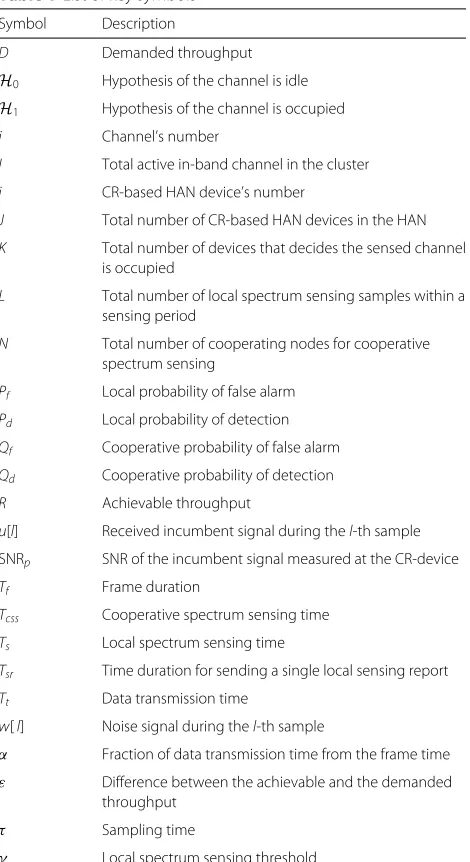
Table 1List of key symbols
Symbol Description
D Demanded throughput H0 Hypothesis of the channel is idle H1 Hypothesis of the channel is occupied i Channel’s number
I Total active in-band channel in the cluster j CR-based HAN device’s number
J Total number of CR-based HAN devices in the HAN K Total number of devices that decides the sensed channel
is occupied
L Total number of local spectrum sensing samples within a sensing period
N Total number of cooperating nodes for cooperative spectrum sensing
Pf Local probability of false alarm Pd Local probability of detection Qf Cooperative probability of false alarm Qd Cooperative probability of detection R Achievable throughput
u[l] Received incumbent signal during thel-th sample SNRp SNR of the incumbent signal measured at the CR-device Tf Frame duration
Tcss Cooperative spectrum sensing time Ts Local spectrum sensing time
Tsr Time duration for sending a single local sensing report Tt Data transmission time
w[l] Noise signal during thel-th sample
α Fraction of data transmission time from the frame time ε Difference between the achievable and the demanded
throughput τ Sampling time
2 Throughput demand-based cognitive radio home area network (TD-CRHAN)
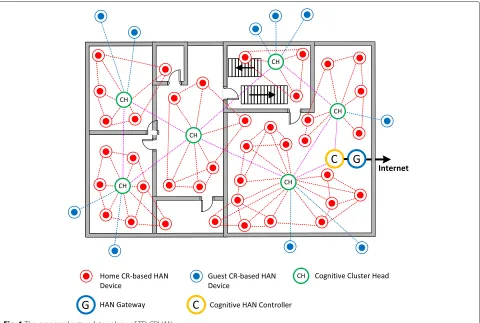
2.1 TD-CRHAN topology
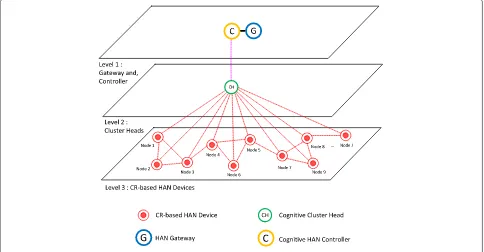
The proposed TD-CRHAN topology is based on a net-work of clustered CR devices as shown in Fig. 1. It consists of a HAN gateway (G), a cognitive HAN controller (C), a number of cognitive cluster heads (CHs) and many CR-based HAN devices. In such a network, the cognitive HAN controller is connected to the HAN gateway with a fixed connection while the CHs are linked to the cog-nitive HAN controller through wireless multi-hop links. The CHs are deployed such that each area of the house is covered. The communication among CHs is in a meshed manner. Each CH will form a network cluster. The CR-based HAN devices will need to connect to one of the clusters in order to communicate with or through the HAN network.
The functionalities of each network component are fur-ther described as follows.
The HAN gatewayis the communication gateway for the HAN network to the outside world (i.e., the internet). Normally, the HAN gateway is connected to the internet service provider (ISP) for internet access through an Ethernet or Optical Fiber cable.
The other possible connection is via a wireless link, e.g., the WiMAX or LTE network.
The cognitive HAN controlleris the device that is responsible to manage and coordinate the spectrum usage of the HAN. For this, the cognitive HAN controller needs to construct a spectrum map database for the particular HAN environment. This database consists of a list of channels that the CH can use in their cluster, and the condition of each channel, i.e., the statistics of the channel activities including channel utilization. It is constructed from the information fed by the CHs using for example the concept of MAC-layer sensing [8]. From this
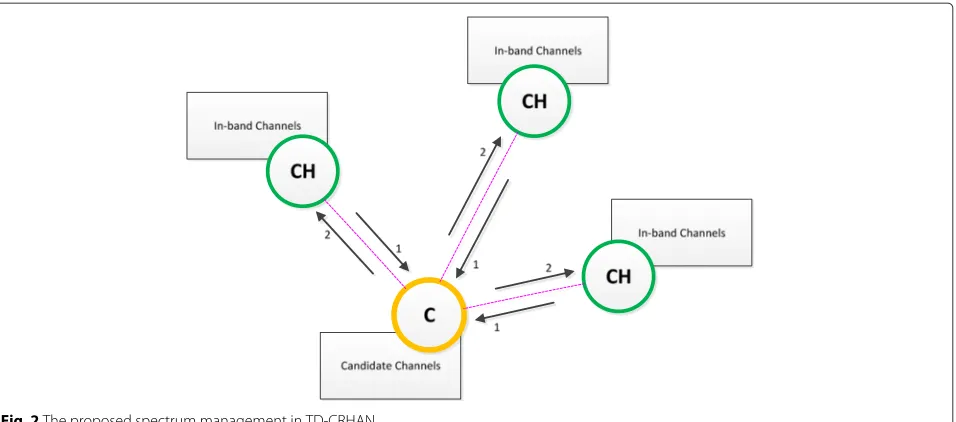
database, the cognitive HAN controller will provide the CHs with the channels that they could scan and utilize for their cluster. Therefore, the channels that the CHs are going to exploit are optimal and not random. In addition, in this way, the cognitive HAN controller also knows which channels are being utilized by which CHs and which are still unallocated. In this work, the channels that are allocated to the CHs are called in-band channels while the channels that are not allocated are called candidate channels. This concept is illustrated as in Fig. 2.
Fig. 2The proposed spectrum management in TD-CRHAN
The cognitive cluster head (CH)is responsible to manage the usage of the cluster’s in-band channels including sensing and access. A CH can request for more channels from the cognitive HAN controller if the current in-band channels are not enough to support its network cluster demand. Each CH will utilize different channels from the other CHs creating a distributed multi-channel network in the HAN. In addition, a CH is also responsible for selecting and grouping the CR-based HAN devices that are connected to it to perform the cooperative spectrum sensing (CSS) task. Besides, it also needs to schedule and distribute the selected and grouped CR-based HAN devices on when and where to sense, respectively. For CSS, a CH also acts as the fusion center where the local sensing results from the sensing devices will be reported to and the decision of spectrum availability will be made. Last but not least, from the CSS results, a CH is required to report the channel utilization and occupancy to the cognitive HAN controller periodically in order for the controller to construct and keep the spectrum map database up to date.
CR-based HAN devicesare the devices that carry out various HAN applications including smart grid, security and safety, and home automation. These devices will connect to one of the clusters to get access and communicate with or through the HAN network. Besides performing the communication for its application, CR-based HAN devices also need to execute the spectrum sensing task. We consider two types of CR-based HAN devices: home and guest devices. Home devices are devices which belong to
the HAN-owner, while guest devices do not belong to the HAN-owner. An example of a guest device is a neighbor’s device which needs to off-load its traffic, e.g., due to congestion in its own HAN network. Another example is a device that passes through the house and wants to connect to the internet through the HAN network. For the home CR-based HAN devices, the communication topology within the cluster is in a mesh. However, the guest devices are only allowed to connect to the CH.
2.2 TD-CRHAN operation
In TD-CRHAN, CR-based HAN devices need to be con-nected to one of the clusters in order to get access and communicate with or through the HAN network. For this, any cluster joining mechanism such as listed in [9] can be applied. One of the simple mechanisms is as employed in the IEEE 802.22 standard [10]. In this standard, the CH transmits a beacon at the beginning of each frame in each of the in-band channel. Alternatively, this beacon can be sent in one of the highest quality in-band channels. A CR-based HAN device will search for one of these beacons at its start-up and connect to the corresponding CH’s clus-ter once the beacon is found. If the CR-based HAN device can hear beacons from multiple CHs, it may choose to join either one cluster based on for example the signal strength and/or the signal quality of the received beacons [9].
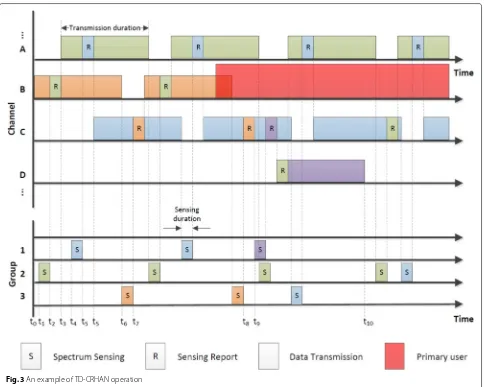
Figure 3 illustrates the TD-CRHAN operation for one network cluster. In a TD-CRHAN, the bandwidth of the cluster is adaptable, it can be expanded or shrunk depend-ing on the total throughput demand of the network clus-ter. In the example in the figure, at timet0, the cluster only
Fig. 3An example of TD-CRHAN operation
due to a new connected device, the number of in-band channels is increased to two channels with the addition of channel A, and to three channels with the addition of channelC, respectively. The additional in-band chan-nels are obtained from the pool of candidate chanchan-nels at the cognitive HAN controller. This process is illustrated by the arrows labeled “2” in Fig. 2. The cognitive HAN controller will provide the cluster with the best candi-date channels it has. These channels will be passed on to the CH.
In addition, at timet9, the cluster shrinks its bandwidth
by releasing one of its in-band channels that is channelD due to a decrease in the network demand, e.g., due to a device leaving the cluster. The released channel is selected from the lowest quality channels among the in-band chan-nels. This channel will be returned to the cognitive HAN controller and becomes a candidate channel that can be used by other clusters. This process is illustrated by the arrows labeled “1” in Fig. 2.
During typical CR operation, spectrum sensing will be executed first before any channel can be used for data
transmission. In this work, the CSS method is considered. Therefore, the sensing operations will consist of spectrum sensing and reporting segments. For this, the CR-based devices will be grouped together forming multiple spec-trum sensing groups in the cluster. For instance, in Fig. 3, three sensing groups are formed: groups 1, 2, and 3. The CH will schedule and distribute the spectrum sensing tasks among these groups. In doing so, the CH has to ensure as much as possible that the group which is sched-uled for sensing does not have any group member involved in active communication during this sensing period.
the sensing reporting transmission will not interfere with the incumbent user of the channel, and the quality of the reporting channels are also ensured. Note that the sens-ing report information is very crucial, hence it needs to be highly reliable [12]. In case the dedicated common control channel is used, a dedicated channel will be required and the reporting transmission could cause this channel to be congested, and thus it may become the bottleneck of the network [11].
If the CSS results show that a channel is highly occupied (often busy), the CH will withdraw this channel from its in-band channels’ list and return it to the HAN gateway. In the meantime, the CH can request for an additional in-band channel from the HAN controller to overcome the throughput degradation due to this highly occupied in-band channel. This scenario is illustrated at timest8and
t9in Fig. 3 where the returned channel is channelBand
the new channel is channelD, respectively. In this exam-ple, the channel is returned to the HAN controller after one time it is sensed to be occupied.
In the next sections, we consider schemes to satisfy the TD-CRHAN network throughput demand with high resource (available throughput) utilization, and we deter-mine the optimal local spectrum sensing time, the number of cooperating sensing devices and the number of active in-band channels needed.
3 System model
A simple network model (one cluster) of the proposed TD-CRHAN network is shown in Fig. 4. It consists of a HAN gateway (G), a cognitive HAN controller (C), a
cluster head (CH), and J CR-based HAN devices n as j,j=1, 2,. . .,J. Every CR-based HAN device is equipped with a half-duplex radio that can be tuned to any combi-nation ofIchannels for data transmission and reception. This can be done by using, for example, the non-contiguous OFDM (NC-OFDM) technology [13]. Besides data communication, each CR-based HAN device is also able to perform a narrow-band spectrum sensing in which the sensing bandwidth is equal to the bandwidth of a single channel.
3.1 Cooperative spectrum sensing
In CSS, each cooperating CR-based HAN device will peri-odically sample the spectrum and send its local spectrum sensing result to a fusion center (in our case, this is the CH). The CH will combine these local spectrum sens-ing results ussens-ing a certain fusion strategy to make the final decision on whether the sensed spectrum is idle or not. In this work, a hard-fusion strategy is considered in which each cooperating CR-based HAN device makes a local decision and sends only this decision to the CH. The local decision is a binary hypothesis test: decide whether the sensed channel is idle, given by hypothesis H0, or
occupied, given by hypothesisH1. Each of the
spectrum-samples observed by a CR-based HAN device can be modeled as
x[l]=
w[l] :H0
u[l]+w[l] :H1 (1)
where l = 1, 2,. . .,L. Here, L is the total number of observation samples made by a CR-based HAN device
within the local spectrum sensing period Ts such that
L = Ts/τ, whereτ is the sampling period. We assume that the Nyquist sampling condition holds, i.e., τ is at least one over twice the channel bandwidth. Further,u[l] is the received incumbent signal and w[l] is the addi-tive noise signal, during thel-th sample.u[l] is given by u[l]=s[l]∗h[l], withs[l] is the transmitted incumbent sig-nal andh[l] is the impact of Rayleigh fading channel. Note that u[l] does not contain the impact of additive noise but the additive noise component is taken into account in w[l]. Both w[l] andu[l] are assumed to be independent and identically distributed (i.i.d.) random processes with zero mean and varianceσw2andσu2, respectively. We con-sider additive white Gaussian noise (AWGN) forw[l] and a random signal with a Gaussian distribution foru[l].
In this paper, energy detection is considered for spec-trum sensing. The received power is estimated as
ˆ
E is the output of the energy detector which is used as input for a binary hypothesis test of the CR-based HAN device. In the test,Eˆis compared to a predefined threshold γ to decide on hypothesisH0orH1. The performance of
this test is characterized by two metrics: the probability of detection (Pd) and the probability of false alarm (Pf). The
probability that a CR-based HAN device decides that the channel is occupied (i.e.,Eˆ > γ) underH1is given by
while the probability that a CR-based HAN device decides that the channel is occupied underH0is
Pf =P
From [2, 5], for a targeted probability of detection P¯d,
the corresponding probability of false alarm Pf can be
expressed as
whereQ(·)denotes the usual Q-function (the tail proba-bility of the standard normal distribution), and SNRp :=
σ2
u/σw2 is the signal-to-noise ratio of the incumbent user at the sensing device. Alternatively, if a targetP¯f needs to be achieved, the achievablePdcan be formulated as [2, 5]
PdP¯f, SNRp,Ts=Q local spectrum sensing timeTsis not restricted. From (5)
or (6) it follows that [2, 5]
In this paper, we consider CSS with a hard-fusion strat-egy, wherein each cooperating CR-based HAN device sends its local decision to the CH. The CH makes the final decision and decidesH1if at leastK out ofN
cooperat-ing CR-based HAN devices have decided that the channel is occupied; otherwiseH0will be decided. This strategy
is known as the K-out-of-N fusion rule. The coopera-tive probability of detectionQdand false alarmQf under
this fusion rule can be derived using the Poisson-Binomial distribution theorem as [3, 14, 15]
Qd=
Akis a set consisting of all possible subsets ofk
elements ofN, representing thek out of N sensing devices that locally decide that the channel is occupied,
A(a)
k ∈Ak, wherea is an index, is one of the sets in
Ak,
g,h∈N are sensor indices.
There are three special cases in this fusion rule: 1) if K = 1, the cooperative detection will become the OR combining rule, 2) ifK = N, the fusion scheme follows the AND rule, and 3) ifK = N2, the decision is known as the majority rule. In addition, ifPdj(andPfj) are identi-cal for all devicesj(i.e.,Pdj = PdandPfj = Pf,∀j) which can be achieved for example by adapting the sensing time of each sensing device differently, then (8) and (9) can be simplified and formulated by using the normal Binomial distribution (instead of Poisson-Binomial), and become
Qd=
In CR, Qd reflects the quality of protection of the
band-owner and is determined by the regulator or the standardization body such as the IEEE (for example, in IEEE 802.22,Qdis required to be greater or equal to 0.9, [10]). On the other hand, Qf is important for the CR
devices (in our case, the CR-based HAN devices). A lower Qf will provide a higher opportunity for the CR-based
HAN devices to access the spectrum and hence attain a higher network throughput. Note that IEEE 802.22, which is actually meant for rural area and large distance, is used as an example because it defines the spectrum sensing specifications (e.g., the probability of detection constraint) that are needed in this paper. Other newer standards like IEEE 802.11af and IEEE 802.15.4m would be more useful to home scenario, but there are no specifications given for the spectrum sensing because they are using the database method instead. In fact, the spectrum sensing parame-ters (e.g.,Qd ≥0.9 constraint) used in the numerical and simulation in this paper are as examples and they can be changed to the desired values.
3.2 Problem formulation
Figure 5 shows the timing diagram of a single channel operation where the sensing-transmit task alternates in time. In this figure, Tf is the time duration of a frame
which is a constant, and it comprises two sub slots: a sub slot for the cooperative spectrum sensingTcss, and sub slot
for data transmission Tt. The former is further divided
into two parts, namely a time for local spectrum sensing Tsand the time required to send the sensing result to the
CHTsr. For reporting the local spectrum sensing result,
a TDMA-based channel access scheme is employed, that is, the first CR-based device sends its decision in the first time slot, the second device in the second time slot, and so on (the same scheme is considered in [6]); thus, the total reporting time required forNcooperating devices is N·Tsr.
Note that we have
Tf =Tcss+Tt (12)
Tcss=Ts+NTsr. (13)
In addition, if the transmission uses rectangular signal pulses, then the maximum data rate for a single channel can be calculated as
C= mW
2 (bit/second). (14)
whereWis the null-to-null bandwidth of the channel, and m=log2(M)(bit/symbol) is the modulation order of the transmission whenMmodulation levels are used.
In cognitive radio, each channel in the spectrum is peri-odically sensed and may only be utilized for data transmis-sion if it is sensed idle, i.e.,Eˆ < γ. This may happen under bothH0andH1. Let the achievable throughput under
sce-nario H0 beR0. This throughput is smaller thanC by a
factor (1− Qf), the probability that the channel is
cor-rectly detected as idle. Likewise, underH1, the achievable
throughputR1is smaller thanCby a factor(1−Qd), which
is the probability that the occupied channel is wrongly detected as idle. This probability is significant in case the incumbent signal is weak (e.g., due to the distance from the incumbent node to the CR network).
We also need to consider that for both scenarios the throughput is scaled by a factorα = Tt/Tf, the fraction
of time within a frame that data is transmitted. Using (12) and (13), we can writeαas a function of the sensing time Tsand number of sensing devicesNas
α(Ts,N)=1−(
Ts+NTsr)
Tf
. (15)
Overall, this gives
R0=α(Ts,N)(1−Qf)C (16)
R1=α(Ts,N)(1−Qd)C, (17)
The achievable throughput of a single channel can then be formulated as
R=P(H0)R0+P(H1)R1 (18)
where P(H0) and P(H1) are the a priori probabilities
that the channel is idle and occupied, respectively. These probabilities can be estimated before the CR network is deployed based on a long-term measurement or it can be measured online based on for example, the concept of MAC-layer sensing [8]. Substituting (18) in (16) and (17) gives
Let R(i) be the achievable throughput for channel i, then the total achievable throughput for a cluster withI simultaneously active channels can be calculated as
Rt=
Suppose that CR-based HAN device jhas a through-put demand ofdj. Then the total throughput demand in a
cluster, coming ofJCR-based HAN devices, becomes
Dt= J
j=1
dj (21)
This information can be acquired by the CH from each connected CR-based HAN device, for example at the time that the device is requesting to join the cluster, or updated by the CR-based HAN device to the CH whenever there is a change in its throughput demand.
Letε = Rt−Dtbe the difference betweenRt andDt.
Using (19)–(21), we can writeεas
ε(I,α)=
3.3 Throughput demand-based CR communication
It is important to ensure that the difference betweenRt
andDtis as small as possible. A positive value ofεmeans
that the available throughput of the active channels in the cluster is underutilized while a negative value means that the QoS of the throughput demand is not fulfilled. Notice that in a TD-CRHAN, in case that a cluster’s demand is higher than the capacity of a single channel i.e.,Dt > Rt,
the CH in the particular cluster should ask for additional
channels from the cognitive HAN controller until the demand is met.
Theoretically, if the number of channelsIis unlimited, then the TD-CRHAN scheme can support any amount of throughput demand. With a higher number of channels, we can reduce Ts and N (c.f., (20)). However,
activat-ing more channels will consume more bandwidth. Hence, optimal values ofI,TsandN, that can give the minimumε
should be determined. This optimization problem can be written as
duration and the number of cooperating nodes involved in CSS for channel i; Imax is the maximum number of
channels available to be exploited;Q(di)is the cooperative probability of detection for channeliandβ(i) is a lower bound on this. The constraintε≥0 is included to ensure that the throughput demand is met.
It is shown in [16] that the optimal solution for (23) can be achieved when constraintQ(di) ≥ β(i) ,∀i is satisfied with equality. When this constraint is at equality and for a chosen fusion thresholdK (in this paper, we consider K = N2), the corresponding device’s probability of detectionPdcan be found fromQ(di)using Eq. (10). Notice
that to use this equation, it is required that the proba-bility of detectionPd is the same for all sensing devices,
while the effect of different SNRp is absorbed by the
device’s probability of false alarmPf (c.f. Eq. (5)). Although
the simplified Eq. (10) is used to find the probability of detectionPd, the general Eq. (9) is used to calculate the
cooperative false alarmQf. In addition, notice that finding
the optimalTsandNis equivalent to finding the optimal
α(i.e., maximizingαwill minimizeTsandN); hence, we
also can write (23) as
For this optimization problem, we propose to find the solution by using a two-dimensional search method.
4 Numerical analysis
In this section, we numerically analyze the performance of the TD-CRHAN and compare it with the conventional solution. For this section, let us assume that the SNR(pij) =
SNRpandP
H(i) 0
=P(H0), i.e., are the same, for alliand
j, and we note that these parameters will be randomized based on a uniform distribution during the simulation analysis (Section 5). The following values are considered
and fixed throughout this section in which most of them are also used in [6]:Tf = 105μs,Tsr = 4μs,β(i) = 0.9
and W(i) = 5 MHz, for all i. Moreover, in this work, the majority fusion rule is considered for the CSS as this has been found to be optimal or nearly optimal [5, 6, 17]. For the solution of the optimization problem, we consider Ts(i)=TsandN(i)=Nfor alli.
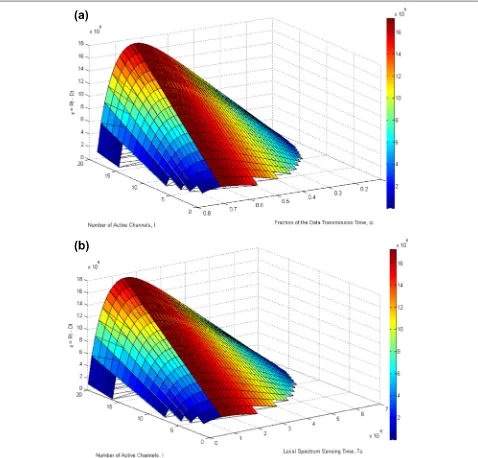
Graphs ofεversus the total number of in-band channels I and a) the data transmission time coefficient α, and b) the duration required for local spectrum sensing Ts,
are shown in Fig. 6a, b, respectively, where SNRp = −7
dB, P(H0) = 0.7, N = 6, and Dt = 3.5 Mb/s. Note
Fig. 7Effects of different total number of in-band channelsIonanormalizedε=Dε
t, andbfraction of time used for spectrum sensing
(i.e., normalized sensing time= Ts
Tf). This is a comparison between TD-CRHAN and the conventional scheme. For this,Dtis fixed at 3.5 Mb/s andN=6
Fig. 8Impact of varying number of cooperating sensing devicesNonanormalizedε= Dε
t, andbfraction of time used for spectrum sensing
(i.e., normalized sensing time= Ts
Fig. 9Effects of different cluster’s throughput demand,Dtonanormalizedε= Dεt,bnumber of in-band channelsIused, andcfraction of time used for spectrum sensing (i.e., normalized sensing time=Ts
Tf). This is a comparison between TD-CRHAN and the conventional schemes. For this, we
take SNRp= −7 dB andN=6
that all points on the graphs satisfy every constraint given in (24). It is seen that for each value ofI,ε(Ts) andε(α)
are both concave functions in which the peak points of these functions are the maximum achievable through-put of the cluster. In the conventional CR, these points are considered as optimal. However, it is seen from these graphs that there is an excess throughput (i.e., ε > 0), which is then not going to be used by the network. This throughput underutilization becomes larger with increasing the number of in-band channelsI. In contrast, TD-CRHAN tries to find the lowest point of this graph which is the minimum possible εand at the same time satisfies all the constraints listed in (24). By doing this, TD-CRHAN can relax the required local spectrum sensing timeTsand the number of cooperating nodesNof the CR
system.
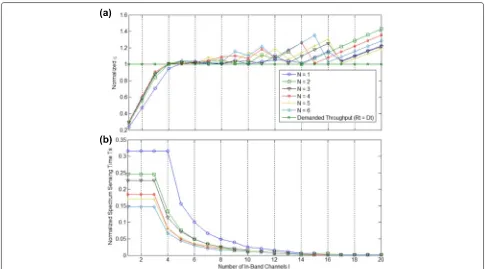
From Fig. 6, the optimal points of the conventional and the proposed TD-CRHAN are taken out and the normalizedεis plotted in Fig. 7a, and the corresponding normalized sensing timeTs(i.e., fraction of time used for
spectrum sensing in a frame) is plotted in Fig. 7b. It is seen thatεis linearly proportional to the number of in-band channelsIfor the conventional case. This is because the total achievable throughputRt for this case is equal
to the maximum achievable throughput of each channel multiplied by the total number of in-band channels, i.e., Rt = R·I(due to the above assumptions, we haveR(i) =
R, ∀i); hence, the largerI, the higherεirrespective of the Dt. On the other hand, in a TD-CRHAN,Rtis adjusted as
near as possible toDt, which is actually the minimization
and the spectrum sensing timeTsis significantly relaxed
as compared to the conventional scheme (as shown in Fig. 7b). These gains become larger asIbecomes higher. It is also denoted in Fig. 7a that the minimumIrequired to satisfyDtis 4. Projecting this point to Fig. 7b (as depicted
by the red arrows) shows that, even at this point, TD-CRHAN obtains around 51 % gain on the requiredTs in
comparison with the conventional case.
Further, the impact of the number of cooperative sens-ing devicesNon the proposed TD-CRHAN is analyzed as depicted in Fig. 8. In general, it can be seen that, the higher N, the lesser theTsrequired, which means a higherNwill
reduce the burden of sensing on the individual CR-based HAN device. However, it can be noticed thatTs is
satu-rated and then becomes constant after a certainI(in this caseI>6); thus, at this point, an increase ofNorIwould
not reduceTsanymore, hence it will increase the value of
εas witnessed in Fig. 7a.
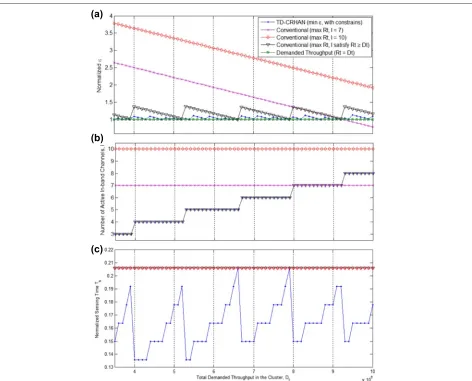
Next, with the same setting, we analyze the perfor-mance of the proposed TD-CRHAN in comparison with the conventional one for differentDt. Three scenarios of
the conventional settings are considered: 1) maximization of Rt with I = 7, 2) maximization ofRt with I = 10,
and 3) maximization ofRtwithIis set based on the
net-work throughput demandDtsuch thatRt≥Dt. Figure 9a
shows that the TD-CRHAN scheme satisfies the through-put demand at all times and has least throughthrough-put under-utilization compared to other schemes, in particular for the cases thatRis maximized withoutDt consideration.
Worse, the conventional plot without Dt consideration
(i.e., scenarios 1 and 2) are unable to satisfy the demanded throughput after a certain point (for instance, in this case:
Fig. 10Performance of TD-CRHAN in comparison with the conventional schemes for different SNRpconditions. The performance is measured in term ofanormalizedε= Dε
t,bnumber of in-band channelsIused, andcfraction of time used for spectrum sensing (i.e., normalized sensing
time=Ts
scenario 1 could not satisfy the demand forDt>9.3 Mb/s
as the number of in-band channels is fixed to 7). In con-trast, in principle the proposed TD-CRHAN can support an unlimitedDtifIis unlimited.
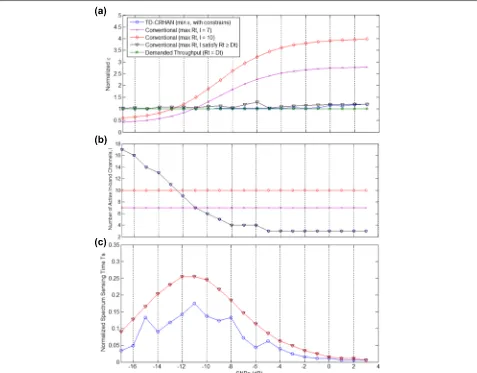
We then numerically analyze the impact of the channel conditions, i.e., SNRpandP(H0), on the performance of
TD-CRHAN as well as the three conventional schemes of which the results are shown in Figs. 10 and 11, respec-tively. It is witnessed that, for the proposed TD-CRHAN scheme, Dt will always be satisfied at minimum ε for
almost any SNRporP(H0)values (as shown in Figs. 10a
and 11a). This is because, a TD-CRHAN allows for an adaptive number of active in-band channels I (refer to Figs. 10b and 11b) and local spectrum sensing durationTs
(refer to Figs. 10c and 11c) where these values are opti-mized such that the resultant achievable throughputRt
is very close to the corresponding demand Dt.
Specifi-cally, for I, at a very low SNRp or P(H0), its value will
be increased while it will be reduced to the minimal at a high SNRp or P(H0). Notice that Dt is still satisfied
even for P(H0) = 0 in which the network throughput
at this point is acquired from theP(H1)part (i.e., at the
expense of a high I). For Ts, it is seen in Fig. 10c that
it is adjusted to a lower value at a very low SNRp. This
is because at this point, ε (and Rt) is influenced more
by Ts but less by Pf (and Qf) as at a very low SNRp, a
high Ts does not provide a significant reduction to Pf
(i.e., this can be seen from (5), as plotted in Fig. 12). On such a case, a lowerTsis more favorable in order to
sat-isfy the demanded throughput Dt and meet the ε ≥ 0
constraint. However,Pf (andQf) become more dominant
with the increase of SNRpup to a certain point, but yet it
is dominated byTswhenPf becomes saturated; this can
be observed in Fig. 10c. Similarly with Fig. 11c, that is at a very lowP(H0),Tswill be set to a lower value as a high
Tsis not beneficial because at this instance most of theRt
Fig. 11Performance of TD-CRHAN in comparison with the conventional schemes for differentP(H0)conditions. The performance is measured in
term ofanormalizedε=Dε
t,bnumber of active in-band channelsIused, andcfraction of time used for spectrum sensing (i.e., normalized sensing
time= Ts
Fig. 12PfversusTsfor different SNRpwithPdfixed at 0.9
comes fromP(H1)(c.f., (19)). Note that in (19) a higher
Tsleads to a lowerQf and therefore a higherRt; at a very
low P(H0), a lower Qf does not help because this part
ofRt is suppressed by the value ofP(H0)itself, and vice
versa.
5 Simulation results and analysis
In this section, we run Monte Carlo simulations on the proposed TD-CRHAN scheme and the three
conventional cases and compare the results with the numerical results. The settings for this simulation are the same as in Section 4 except the SNR of the incumbent user (i.e., SNRpj) is randomly set for each CR-based device j based on the Uniform distribution within the range of−11 and 3 dB (i.e., SNRpj ∼ U(−11, 3)dB, for all j). We consider this range for this simulation in order to capture the dynamic behavior of the sensing qualities (i.e., Pd and Pf) and observe the impact of different sensing
Fig. 13Simulation results on the effects of using different total number of in-band channelsIonanormalizedε= Dε
t, andbfraction of time used
for spectrum sensing (i.e., normalized sensing time= Ts
Tf). This is a comparison between TD-CRHAN and the conventional schemes. For this, SNRpjis
time Ts values. For SNRp higher than 3 dB, only a few
samples with single device sensing (without cooperation) are required to obtain an already very high probability of detectionPd and very low probability of false alarm Pf. For low SNRp used, i.e.,−11 dB and less, an increase of
the sensing time does not really give significant improve-ment of the sensing qualities. We repeat the simulation 1000 times and the results are averaged. It can be seen from Fig. 13 that, in general, the patterns of the simula-tion results are similar with the graphs from the numerical analysis (refer to Fig. 7). However, notice that the opti-mal sensing time in the simulation is less than in the numerical analysis which is caused by the possible high value of the incumbent user signal strength in the sim-ulation (i.e., between −11 and 3 dB as compared to a fix −7 dB, respectively). In addition, Fig. 14 shows that the corresponding cooperative and the individual false alarm probabilities, i.e.,Qf andPfj,∀j, respectively, of the proposed TD-CRHAN varies according to the number of in-band channelsI available. In TD-CRHAN, for the same total throughput demand Dt, an increase of the
number of in-band channelsI will decrease the required achievable throughputR(i) of each channeli, hence this
reduces the required Qf and the corresponding Pfj,∀j. This then further reduces the required sensing timeTs, as
can be seen in Fig. 13. Besides, it can be observed from Fig. 14a that the probability of false alarm Pfj of sensing devicejdepends on its SNRpj: a lower SNRpjdevice has a higherPfj.
Finally, a Monte Carlo simulation is executed in which all network parameters are uniformly randomized (i.e., Dt ∼ U(3.5, 10) Mb/s, SNR(pij) ∼ U(−11, 3) dB and
P
H(i) 0
∼ U(0, 1), ∀i,j) to evaluate the performance of the TD-CRHAN in a more practical scenario. The graphs of the normalized εand sensing time Ts, versus
the number of in-band channel I for N = 1, 2,. . ., 6 are plotted as shown in Fig. 15. Similarly, it is observed that with the proposed TD-CRHAN scheme, the net-work throughput demand Dt is satisfied at all times for
all N. However, it is seen that a lower number of coop-erating sensing devices N will require a higher sensing timeTs, and moreover at a certain point, a higher
num-ber of channelsIis even required (i.e., in this case,I ≥ 4 for N = 1 and 2 compared to I ≥ 3 for N = 3, 4, 5, and 6).
Fig. 14The correspondingafalse alarm probabilityPfjof each devicej, andbcooperative false alarm probabilityQf, from the simulation of which
Fig. 15Simulation results of the total number of active channelsIversus:anormalizedε= Dε
t, andbfraction of time used for spectrum sensing
(i.e., normalized sensing time= Ts
Tf). This is for different number of cooperating devices i.e.,N=1, 2,· · ·, 6 with more practical scenario in which all
network parameters are randomly chosen, i.e.,Dt∼U(3.5, 10)Mb/s, SNR(pij)∼U(−11, 3)dB andP(H0)∼U(0, 1), for alliandj
6 Conclusions
To support the ever-rising throughput demand of home area networks (HAN), we proposed in this paper a cog-nitive radio (CR)-based communication scheme called TD-CRHAN. The TD-CRHAN aims at satisfying the demanded network throughput with equality by deter-mining the optimal local spectrum sensing time, the number of cooperating sensing devices, and the num-ber of active in-band channels needed. This leads to an efficient scheme which provides a higher utilization of the occupied channels. It was shown by extensive numerical analysis and through simulations that TD-CRHAN is able to relax the tight cooperative spectrum sensing requirements and provides significant gains on the cooperative spectrum sensing parameters (i.e., spec-trum sensing time and number of cooperating devices), compared to the conventional solution. More specif-ically, TD-CRHAN reduces the required local spec-trum sensing time by more than 51 %. Furthermore, it was shown that these cooperative spectrum sens-ing parameters can be further improved with the avail-ability of additional cooperating devices or channels (bandwidth).
Competing interests
The authors declare that they have no competing interests.
Acknowledgements
The work has been supported partially by the Ministry of Education, Malaysia.
Received: 18 September 2014 Accepted: 11 September 2015
References
1. M Nekovee, A survey of cognitive radio access to tv white spaces. Int. J. Digit. Multimed. Broadcast.2010(236568) (2010). doi:10.1155/2010/ 236568
2. Y-C Liang, Y Zeng, ECY Peh, AT Hoang, Sensing-throughput tradeoff for cognitive radio networks. IEEE Trans. Wirel. Commun.7(4), 1326–1337 (2008). doi:10.1109/TWC.2008.060869
3. L Tan, L Le, Joint cooperative spectrum sensing and MAC protocol design for multi-channel cognitive radio networks. EURASIP J. Wirel. Commun. Netw.2014(1), 101 (2014). doi:10.1186/1687-1499-2014-101 4. G Umashankar, AP Kannu, Throughput optimal multi-slot sensing
procedure for a cognitive radio. IEEE Commun. Lett.17(12), 2292–2295 (2013). doi:10.1109/LCOMM.2013.102613.131825
5. RA Rashid, A. H. F. A. Hamid, N Fisal, MA Sarijari, RA Rahim, A Mohd, in2012 IEEE Symposium on Wireless Technology and Applications (ISWTA). Optimal user selection for decision making in cooperative sensing, (2012), pp. 165–170. doi:10.1109/ISWTA.2012.6373834
6. S Maleki, SP Chepuri, G Leus, Optimization of hard fusion based spectrum sensing for energy-constrained cognitive radio networks. Phys. Commun. 9(0), 193–198 (2013). doi:10.1016/j.phycom.2012.07.003
7. M Najimi, A Ebrahimzadeh, SMH Andargoli, A Fallahi, A novel sensing nodes and decision node selection method for energy efficiency of cooperative spectrum sensing in cognitive sensor networks. IEEE Sensors J.13(5), 1610–1621 (2013). doi:10.1109/JSEN.2013.2240900
9. K-LA Yau, N Ramli, W Hashim, H Mohamad, Clustering algorithms for cognitive radio networks: A survey. J. Netw. Comput. Appl.45(0), 79–95 (2014). doi:10.1016/j.jnca.2014.07.020
10. IEEE Standard for information technology– local and metropolitan area networks– specific requirements– part 22: Cognitive wireless RAN medium access control (MAC) and physical layer (PHY) specifications: Policies and procedures for operation in the TV bands, 1–680 (2011). IEEE Std 802.22-2011, doi:10.1109/IEEESTD.2011.5951707
11. M Timmers, S Pollin, A Dejonghe, L Van der Perre, F Catthoor, A distributed multichannel MAC protocol for multihop cognitive radio networks. IEEE Trans. Veh. Technol.59(1), 446–459 (2010). doi:10.1109/TVT.2009.2029552 12. S Chaudhari, J Lunden, V Koivunen, HV Poor, Cooperative sensing with
imperfect reporting channels: Hard decisions or soft decisions? IEEE Trans. Sig. Process.60(1), 18–28 (2012). doi:10.1109/TSP.2011.2170978 13. R Rajbanshi, AM Wyglinski, GJ Minden, in1st International Conference on
Cognitive Radio Oriented Wireless Networks and Communications. An efficient implementation of NC-OFDM transceivers for cognitive radios, (2006), pp. 1–5. doi:10.1109/CROWNCOM.2006.363452
14. VRS Banjade, N Rajatheva, in8th International Symposium on Wireless Communication Systems(ISWCS). Primary user capacity maximization in cooperative detection network using m out of n fusion rule, (2011), pp. 482–486. doi:10.1109/ISWCS.2011.6125406
15. YH Wang, On the number of successes in independent trials. Stat. Sin. 3(2), 295–312 (1993)
16. ECY Peh, Y-C Liang, YL Guan, Y Zeng, Optimization of cooperative sensing in cognitive radio networks: A sensing-throughput tradeoff view. IEEE Trans. Veh. Technol.58(9), 5294–5299 (2009). doi:10.1109/TVT. 2009.2028030
17. W Zhang, RK Mallik, K Letaief, Optimization of cooperative spectrum sensing with energy detection in cognitive radio networks. IEEE Trans. Wirel. Commun.8(12), 5761–5766 (2009). doi:10.1109/TWC.2009. 12.081710
Submit your manuscript to a
journal and benefi t from:
7Convenient online submission 7 Rigorous peer review
7Immediate publication on acceptance 7 Open access: articles freely available online 7High visibility within the fi eld
7 Retaining the copyright to your article
![Figure 5 shows the timing diagram of a single channeltime slot, the second device in the second time slot, andso on (the same scheme is considered in [6]); thus, thetotal reporting time required forNCHoperation where the sensing-transmit task alternates in](https://thumb-us.123doks.com/thumbv2/123dok_us/946400.1115496/8.595.55.540.500.719/channeltime-considered-thetotal-reporting-required-fornchoperation-transmit-alternates.webp)