R E S E A R C H
Open Access
Link adaptation for energy-efficient uplink
coordinated multi-point receptions
Young-Han Nam
1*, Lingjia Liu
1,2, Guowang Miao
1and Charlie Jianzhong Zhang
1Abstract
We investigate link adaptation methods for energy-efficient uplink coordinated multi-point receptions. A system model for practical cellular networks is introduced, in which only a subset of base stations participates in cooperative link adaptation and cooperative decoding for uplink transmissions. To cope with channel-state-information (CSI) mismatch incurred from the system model, link adaptation controllers implementing rate back-off from the maximum achievable rate calculated with the mismatched CSI is introduced. From analytical and
simulation results, it is concluded that under a certain condition, the rate back-off does not help to improve energy efficiency, where, for example, the condition holds when the CSI errors are modeled as additive Gaussian random variables. Furthermore, energy efficiency of multi-user spatial-division-multiple-access uplink transmissions is studied in isolated cooperative cellular networks. In this scenario, an analytical expression for the optimal link adaptation achieving maximum energy efficiency is obtained.
Keywords:coordinated multipoint receptions, CoMP, energy efficiency
1 Introduction
Spectral efficiency and energy efficiency are important metrics for wireless communication systems. While con-temporary wireless telecommunications standards, e.g., LTE-Advanced mainly focuses on enhancing spectral efficiency (e.g., [1]), there is growing interest in improv-ing energy efficiency, partly because the development of battery technology has not kept in pace with the demand of mobile communications [2,3]. Energy-effi-cient communications also tend to reduce electromag-netic interference and lessen environmental impacts, for example, heat dissipation and electronic pollution. Therefore, recent research starts to focus on energy-effi-cient communication techniques [4-9].
Coordinated multi-point (CoMP) transmissions/recep-tion is one example scheme studied in LTE-Advanced [1] primary targeting on increasing cell-edge user equip-ment’s (UE’s) spectral efficiency. In CoMP
transmis-sions, multiple base stations coordinate their
transmissions so that served UEs receive data streams with higher downlink (DL) spectral efficiency. In CoMP
receptions, multiple base stations coordinate reception/ decoding of packets from UEs to achieve higher uplink (UL) spectral efficiency.
While there have been lots of researches on through-put improvement of CoMP (for UL CoMP refer to [10] and references therein; for DL CoMP refer to [11,12] and references therein), to the authors’best knowledge, little efforts have been put so far on energy-efficient CoMP communications. In this article, we investigate energy-efficient link adaptation for UL CoMP communi-cations in cellular networks. For this purpose, we define an energy-efficiency metric, in a unit of nats/Joule,1by extending the energy-efficiency metric introduced in [9]. The energy-efficiency metric accounts for both transmit power and circuit power. The transmit power models all the power used for reliable data transmission. On the other hand, the circuit power represents the average power consumption of device electronics, e.g. filters, mixers, and digital-to-analog converters, and this por-tion of power consumppor-tion excludes that of the power amplifier and is independent of the transmission state. The newly introduced metric can measure energy effi-ciency of both the single-cell operations and the CoMP operations, despite fundamental differences of available channel state information (CSI).
* Correspondence: [email protected] 1
Dallas Telecomm. R&D Center, Samsung Telecomm. America, Dallas, Texas, 75082, USA
Full list of author information is available at the end of the article
In the first part of the article, we investigate the energy efficiency of a CoMP reception scheme of a
sin-gle UE’s uplink transmission in a cellular network,
where only a subset of base stations participate in the
cooperative decoding, and the other UEs’ signals
intended to the other base stations in the network may interfere with the single UE’s uplink signals. In this sce-nario, the CSI experienced during the actual transmis-sion may be different from the CSI used for link adaptation, owing to un-coordinated interference from the other UEs.
To cope with the CSI mismatch, we consider a link adaptation controller implementing a rate back-off from the maximum achievable rate calculated with the mis-matched CSI. Then, we analyze the energy efficiency of the link adaptation controller and we show that if a cer-tain condition is satisfied, then the link adaptation con-troller may still rely on the mismatched CSI in order to achieve the maximum energy efficiency.
In the second part of the article, we analyze the opti-mal energy efficiency of a CoMP reception scheme of multiple UEs’ uplink transmission in a cellular network, where all the base stations participate in the cooperative decoding. In this interference-free scenario, we assume that perfect CSI is available at the link adaptation con-troller and analyzes conditions for achieving the optimal energy efficiency. In particular, we provide analytical expressions for the optimal power allocation for a two-UE two-base-station system.
The notations used in this article are summarized as in the following. Italic characters, e.g.,K, h, are used for representing scalar variables. Boldface lowercase Roman characters, e.g.,h, are used for representing vectors, and boldface uppercase Roman characters, e.g., H, are used for representing matrices. Boldface Italic lowercase char-acters, e.g., h, are used for representing either random variables or random vectors, while boldface Italic upper-case characters, e.g.,Hare used for representing random matrices.AHdenotes the Hermitian transpose of matrix
A, andh*denotes complex conjugate of a complex
sca-larh. |h| denotes the absolute value of a complex scalar h, and ||h|| denotes the L2 norm of a complex vectorh.
ℂdenotes the set of complex numbers.
2 System model
We consider an uplink transmission ofKsingle-antenna
UEs in a cellular network composed of M¯ base stations. M≤ ¯Mclustered base stations in the cellular network
cooperate to decode the UEs’ uplink signals. For the
cooperation, each of theM base stations are connected
to a central controller with fiber, where the fiber trans-mission is assumed to be information lossless. The cen-tral controller has a link adaptation controller and a
receiver. The link adaptation controller determines transmission rate and transmission power for the UEs based on the available CSI, and commands the UEs to transmit messages with the determined rate and power. On the other hand, the receiver decodes the transmitted
messages from received signals. As the Mbase stations
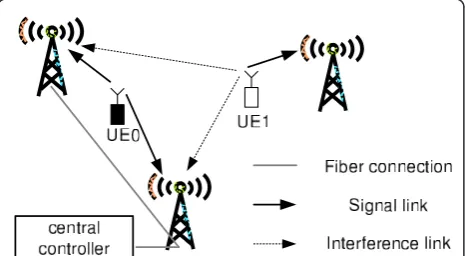
receives interfering signals from the other UEs transmit-ting to the otherM¯ −Mnon-cooperating base stations in the cellular network as well as signal components from the KUEs, the channel state, especially the inter-ference state, used for demodulation at the receiver is not necessarily the same as the state reported to the link adaptation controller because of time-varying inter-fering signals from other non-cooperating users. This discrepancy of CSI is sometimes calledflashlight effect in the wireless telecommunications industry [1]. Figure
1 illustrates the system model for K = 1, M = 2 and
¯
M= 3, where UE 0 transmits signals to K= 2 cooperat-ing base stations, while UE 1’s signals interferes with UE O’s signals at the receiver at the central controller.
Under the system model considered in this section, we consider both single-user and multi-user transmission scenarios with uplink CoMP receptions. In Section 3, we consider energy-efficient uplink CoMP receptions of a single user in a partially cooperating cellular wireless network, in which only a subset of base stations per-forms cooperation. For single-user transmissions, the further refined system model in Section 3 is general enough to reflect some important aspects of the real-life cellular networks, and at the same time, it is possible to obtain some analytical results. However, for multi-user multi-cell link adaptations, the system model of Section 3 is difficult to analyze. To obtain some insights of multi-user transmission scenarios aided by CoMP
10−2 10−1 100 101
0 0.05 0.1 0.15 0.2 0.25 0.3 0.35 0.4 0.45 0.5
σw
B
M=1 M=2 M=3 M=4
reception, we make further simplifying assumption of fully cooperating cellular networks in Section 4.
3 Energy-efficient uplink transmission schemes with K= 1 andM ¯M
3.1 Definition of energy efficiency with imperfect CSI Traditionally, energy efficiency is defined for a single
link (M = 1), under the assumption that both the link
adaptation controller and the receiver are aware of the channel state, and the channel state stays the same dur-ing the link adaptation and the reception. Under this assumption, link adaptation controller can always adapt transmission power and rate so that the packet is suc-cessfully decoded with probability oneaccording to the
Shannon’s channel coding theorem [13]. Then, given a
channel coefficient hÎℂ, the energy efficiency for the single link, where a UE alwayssuccessfully transmits a packet with transmission rateRby spending total power P=PT+PC to a receiver, is defined (e.g., [9]) as
Uh(PT)
R(PT,h) PT+PC
nats per Joule (1)
Assuming capacity achieving channel codes and suffi-ciently large block length, we haveR(PT, h) = ln(1 + |h|
2
PT) nats. The maximal energy efficiencyU∗hfor a given channel coefficienthis achieved with the optimal rate and power allocationP∗T(h):
Now, once a distribution of the random variable h
characterizing his given, the optimal energy efficiency of the networkU⋆can be defined asU∗EUh∗.
However, as the channel states used for the link adap-tation is not necessarily the same as those for the recei-ver, we consider a general framework for taking potential imperfectness of CSI at the link adaptation controller and extend the energy efficiency definition accordingly. For the uplink transmission considered in this section, we make the following assumptions.
• (Assumption 1) The actual channel vector of the
network during the transmission of a packet is hÎ
ℂM× 1
, and themth component of h, denoted byhm,
is the channel coefficient between BS mand the UE.
The received signals at each BS are corrupted by cir-cularly symmetric additive white Gaussian noise (AWGN) of zero mean and unit variance. We note that this assumption models a receiver treating inter-ference signals from the other UEs transmitting to the other base stations as noise and scaling the
received signal, so that the interference-plus-noise power is one.
•(Assumption 2) The receiver is aware of the actual channel vectorh.
•(Assumption 3) The link adaptation controller determines the transmission rateRand the transmis-sion power PT based on CSIh˜ =h−w, where wÎ
ℂM× 1
is a random vector characterizing the CSI error and models the un-coordinated interference from other UEs in the cellular network. The link adaptation controller is aware2 of the distribution of
w.
•(Assumption 4) To cope with channel outages, the link adaptation controller applies a power back-off strategy to determine the transmission rate. The controller assumes that the transmission power is aPTwhere a Î (0,1] for the rate calculation, even
though the actual transmission power isPT. In this
case, the transmission rate R is determined as
R=R(PT,h,α)= ln
1 +αPTh˜
2
.
Under these assumptions, we defineexpected energy
efficiencyof the network seen at the link adaptation con-trollerU˜h˜ (PT,R).
Here, the numerator is the average throughput (nats per channel use) achieved with the transmission rate RPT,h˜,α
[14], and Pr(O) is the probability of
hypothe-tical channel outage events seen at the link adaptation controller:
is the maximum achievable rate
with the hypothetical actual channelh˜+w, and hence ¯
. Then, the optimal
transmission power and transmission rate P∗T andR*
with a givenh˜ are determined by,
PT∗,R∗= arg max
PT,R ˜
Uh˜(PT,R), (5)
Once a distribution of the random vectorh˜ character-izingh˜ =h+w is given as well as the distribution ofw, the optimal energy efficiencyU˜∗of the network can be defined asU˜∗EU˜∗˜
h
.
3.2 With perfect CSI at the link adaptation controller In this subsection, we consider the uplink transmission with perfect CSI at the link adaptation controller. To model this case, in addition to the four assumptions in Section 3.1, we further assume that the CSI error vector
w is deterministically0so that h˜ =h, and that the link
adaptation controller chooses a= 1, regardless of the
CSI h. In this case, the maximization problem of (6)
reduces to (2) and has been analyzed in [9], as in the following theorem.
Theorem 1.The optimal power allocation P∗Tand the optimal transmission rate R* for the uplink transmission with perfect CSI at the link adaptation controller with a givenhis obtained by the following relation:
PT∗=
We note that efficient algorithms are available to solve the power maximization (7), e.g., from [9].
3.3 With imperfect CSI at the link adaptation controller The expected energy efficiency at the link adaptation controller U˜h˜(PT) of the uplink transmission modeled in Section 3.1 is further expanded as,
˜
Denoting the probability density function and
cumula-tive distribution function of random variableh˜+was the expected energy efficiency is
˜
The maximal expected energy efficiency with this link adaptation controller is obtained through a joint
maximization overPTand a:
˜ U∗˜
h= maxPT,α U˜h˜ (PT,α) (11)
We obtain the following theorem on this joint maximization.
and let A be a positive real number satisfying the fol-lowing relation: mission rate achieving the maximum expected energy efficiency are achieved witha* = 1:
PT∗ =P(1)T and R∗ =R(1). (14)
Otherwise, the transmission power and the transmis-sion rate achieving the maximum expected energy effi-ciency are achieved witha* < 1,andP∗T, anda*satisfies
Proof. See Appendix A
Theorem 2 states that when a condition of PT(1)≤A holds, the link adaptation controller can maximize the expected energy efficiency by choosing PT =P(1)T and
R= ln
1 +PT(1)h˜2
with treating h˜ as the actual CSI,
where P(1)T can be efficiently found by algorithms
intro-duced in [9]. To see when the condition of PT(1)≤A
holds, we need to take a closer look at A, which is a
parameter determined dependent on the distribution of
w.
As an example case, we consider a circularly
sym-metric Gaussian distribution for each component ofw,
with mean 0 and varianceσ2
w. Then,h˜+w 2
is
non-central chi-square distributed, with degrees of freedom
2M, meanh˜2and non-centrality parameter2h˜2/σw2.
To evaluate Ain (13), we further assume thath˜= 1,,
Pc = 1 and consider various σ2
first notice that PT(1)≈1.72withh˜= 1regardless of
the value ofσ2
w asPT(1)does not depend on the
distribu-tion of w. In addition, we define
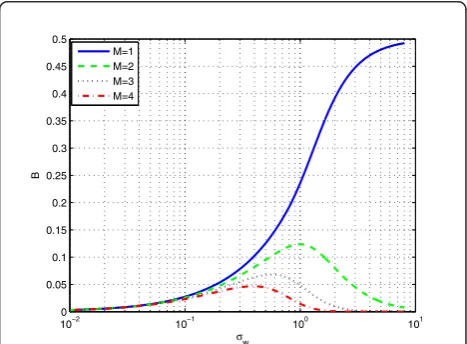
B
f
h˜+wh˜
/
1−F
h˜+wh˜
and evaluate
Bwith these parameters as shown in Figure 2. Since the left hand side of (13) is a decreasing function of A, the Ameeting the condition (13) gets smaller asBincreases.
As shown in Figure 2,Bis bounded above for a givenM
and sw > 0, and hence the minimumA satisfying the
condition (13) is greater than the supremum of B
obtained with the given M andsw > 0. For example,
when M= 1, the supremum ofBis equal to 0.5, andA
satisfying the condition (13) with B = 0.5 is A ≃ e2, which is greater thanPT(1)= 1.72. Since the supremum
of B further reduces as M increases, a greater A is
needed to satisfy the condition (13) with the supremum
of BasM increases. From these observations, we find
that for M ≥ 1, the condition of A≥P(1)T = 1.72holds for allσ2
w>0, and hence the link adaptation controller
can simply assign PT=P(1)T and R= ln
1 +P(1)T h˜2
without explicitly considering the variance of the CSI error σ2
w for achieving the maximum expected of the
network.
When the condition ofPT(1)≤Aholds, the maximum
expected energy efficiency of the uplink coordinated multi-point reception with imperfect CSI at the link adaptation controller is
˜ U*˜
h=
ln(1 +P(1)T ˜h2)
P(1)T +PC
·(1−F ˜h+w(√α ˜h)).(16)
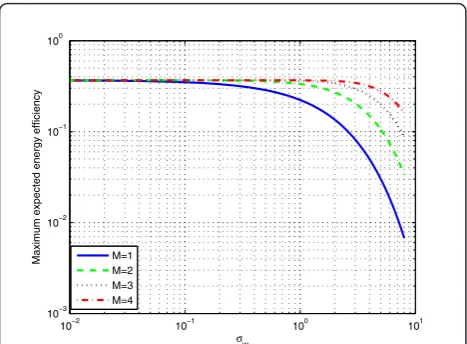
For example, the resultant maximum expected energy efficiency with ˜h= 1,PC= 1and wwhose elements are distributed with circularly symmetric Gaussian with
mean 0 and variance σ2
w is shown in Figure 3. U˜∗h˜
decreases assw increases and it increases as the number
of cooperating base stationsMincreases.
In general, given a distribution of h˜, which is a
ran-dom vector characterizing h˜, the maximum expected
energy efficiencyU˜∗ =E(U˜∗˜
h)increases as we increase
the M number of base stations participating in the
cooperative link adaptation and decoding, because of the increased transmission rates and smaller outage probability for a given transmission rate thanks to the diversity reception of the coordinated multi-point reception.
4 Energy-efficient uplink transmission schemes with K≥1 andM¯ =M
To get some insights of the possible advantages of employing uplink multi-user transmissions in a CoMP setting, we consider a relaxed setting of an isolated cel-lular network of Mcooperating base stations in this sec-tion. In the isolated network, the uplink transmissions do not suffer from flash-light effect, and hence both link adaptation controller and the receiver have perfect knowledge of the actual channel states. To model this case, we make the following assumptions:
• (Assumption 1)The actual channel matrix of the
network during the transmission of a packet is H Î
ℂM×K
, and the (m, k) component ofH, denoted byhmk,
is the channel coefficient between BS m and UE k,
wheremÎ {1,...,M} and kÎ {1,...,K}. The received sig-nals at each BS are corrupted by circularly symmetric additive white Gaussian noise (AWGN) of zero mean and unit variance.
•(Assumption 2)The receiver is aware of the actual channel matrixH.
• (Assumption 3) The link adaptation controller determines theKUE’s transmission powers {PT,1,...,PT,
K} and rates {R1, ..., RK} based on the perfect CSIH,
Figure 2Bevaluated with variousswforM= 1,2,3,4.
10−2 10−1 100 101
0 0.2 0.4 0.6 0.8 1 1.2 1.4 1.6
Circuit power (P
C)
Energy efficiency (U)
K=1 K=2
such that the maximum sum rate is achieved with the selected powers when either successive interference can-cellation (SIC) or joint maximum-likelihood (ML) decoding is used at the central controller.
From the capacity region of the Gaussian multiple-access channel [13], the maximum sum rate is given by
ciency of the cellular network with channel matrixHis defined by,
Then the optimal power control to achieve the maxi-mum energy efficiency and the optimal energy efficiency can be found as,
p∗(H) = arg max
p
UH(p) and UH∗ =UH(P∗(H)).(19)
When the distribution of a random matrixH
charac-terizingHis given, we further define the optimal energy efficiency of the network asU∗=E(U∗H).
When K= 1, the optimal link adaptation parameters
P∗T,1andR∗1can be found as in Theorem 1. On the other
hand, whenK ≥1, we can prove the following lemma
for the optimization problem (19).
Lemma 3.UH(p)defined in(18)is strictly
quasi-con-cave inp.
Proof. As log detI+kPT,khkhHk
is concave in p, it can be straightforwardly verified that (18) is strictly quasi-concave inp.
If a strictly quasi-concave function has a local maxi-mum, then the local maximum is global maximum.
Relying on this property of UH(p), we prove the
following.
Theorem 4.The optimal power controlp=p*is found by solving the following system of equations:
UH(p) =hH1
Proof Taking the first order partial derivative ofUH(p)
onpT1, we obtain, Furthermore, by equating the partial derivative with 0, we obtain,
the system of equations giving the optimal power allocation.
Some insights of the power control equations in
The-orem 2 can be obtained with analyzing K = M = 2.
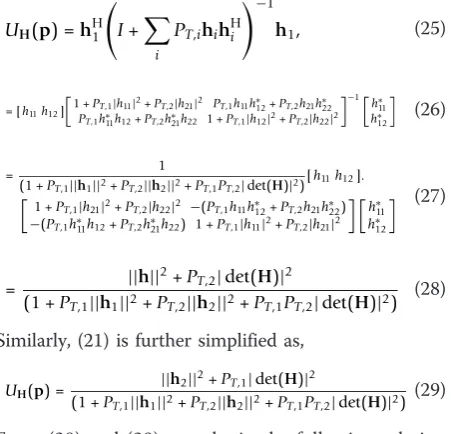
Similarly, (21) is further simplified as,
UH(p) = ||
h2||2+PT,1|det(H)|2
(1 +PT,1||h1||2+PT,2||h2||2+PT,1PT,2|det(H)|2) (29)
From (28) and (29), we obtain the following relation betweenPT,1and PT,2.
This relation implies that the link adaptation control-ler should assign more power to the user with better channel, which gives us a similar intuition as the water-filling power control for parallel channels [13].
When substituting (30) to (19), the joint optimization (19) over two variables PT,1 andPT,2 is simplified into an easier optimization over a single variablePT,1.
Figure 4 shows the optimal energy efficiencyU* over
different values of the circuit power PC evaluated for
transmissions in a isolated cellular network composed of two base stations (M = 2). For the evaluation, statisti-cally independent circularly symmetric Gaussian chan-nels are generated with zero mean and unit variance for the links. From the figure, we observe that multi-user transmissions are more energy-efficient than single-user transmissions; thanks to the multiplexing gain of the effective multi-input-multi-output (MIMO) channel. On the other hand, we also observe that the multi-user energy-efficiency gain decreases as the circuit power Pc
increases. This is partly because when the circuit power Pc is large, the denominator of the energy efficiency (18)
is dominated by the circuit power.
5 Conclusions
In this article, we investigated the energy efficiency of CoMP link adaptations and CoMP reception schemes of uplink transmission in a cellular network. To model typical implementation of CoMP in the cellular net-work, we first considered a scenario where only a sub-set of base stations participate in the cooperative link adaptation and cooperative decoding for a single UE,
in which case, the other UEs’ signals intended to the
other base stations in the network interfere with the single UE’s uplink signals, and hence the CSI experi-enced during the actual transmission is different from the CSI used for link adaptation. To cope with the CSI mismatch, we consider a link adaptation controller implementing a rate back-off from the maximum achievable rate calculated with the mismatched CSI. According to the analysis, we found that the maximum energy efficiency of the link adaptation controller is achieved when no rate back-off is employed, when a certain condition is satisfied. We also showed by simu-lation that the condition holds when the CSI errors are
modeled as additive Gaussian random variables. Furthermore, in order to see benefits of multi-user uplink transmissions for energy efficiency, we analyzed the optimal energy efficiency of a link adaptation method and a CoMP reception scheme of multiple UEs’ uplink transmissions in a cellular network, where all the base stations participate in the cooperative decoding. In this interference-free or perfect-CSI sce-nario, we obtained analytical expressions for the opti-mal power control with arbitrary numbers of UEs and base stations. The optimal power allocation gives simi-lar intuition as water-filling in parallel channels, that is, we need to assign more power to a better-quality channel, to achieve the maximum energy efficiency We also provided a simulation result showing that two-user spatial-division-multiple-access transmissions achieves larger maximum energy efficiency than single-user transmissions in the same cellular network.
Appendix A Proof of Theorem 2
We first write the maximization problem as in the fol-lowing:
˜ U∗˜
h= maxPT,α
˜
Uh˜(PT,α) = max PT
max
α U˜h˜(PT,α)
. (31)
To get some insight for the inner maximization, we take a partial derivative ofU˜h˜(PT,α)overaand obtain,
∂U˜h˜(PT,α)
∂α =
PT|| ˜h||2
(PT+PC)
1 +αPT|| ˜h||2
·(1−F|| ˜h+w||( √
α|| ˜h||))
−ln
1 +αPT|| ˜h||2
PT+PC ·
f|| ˜h+w||(√α|| ˜h||).
(32)
The first term in (32) is a monotonically decreasing
function ofa, while the absolute value of the second
term is a monotonically increasing function ofa, where aÎ (0,1]. Hence, the partial derivative is monotonically decreasing. The partial derivative has the positive
supre-mum at a = 0, and the infimum ata = 1. If the
infi-mum of the partial derivative is non-negative, i.e., if
PT|| ˜h||2
1 +PT|| ˜h||2ln1 +PT|| ˜h||2 ≥
f|| ˜h+w||(|| ˜h||)
1−F|| ˜h+w||(|| ˜h||), (33)
thenU˜h˜(PT,α)is monotonically increasing and hence the maximumUh˜(PT,α)is achieved with a = 1. Here, the left hand side is a decreasing function of PT, and
hence the condition (33) is equivalent toPT≤A, where
A=g−1
f|| ˜h+w||(|| ˜h||)
1−F|| ˜h+w||(|| ˜h||)
, (34)
10−2 10−1 100 101
10−3 10−2 10−1 100
σw Maximum expected energy efficiency M=1
M=2 M=3 M=4
and
g(x) = x|| ˜h||
2
1 +x|| ˜h||2ln1 +x|| ˜h||2. (35)
In this case, the joint maximization (31) becomes
˜ U∗˜
h= maxPT
ln
1 +PT|| ˜h||2
PT+PC ·
(1−F|| ˜h+w||(|| ˜h||)). (36)
As (1−F|| ˜h+w||(|| ˜h||)) does not depend on PT, and
hence this maximization problem overPT is essentially
the same problem as the one in Theorem 1; P∗Tand R*
are readily obtained from Theorem 1 as
P∗T=
1 U∗h−
1 || ˜h||2
+
and R∗= ln(1 +PT∗|| ˜h||2). (37)
On the other hand, if the partial derivate is negative at a= 1, there exists an optimal a=a*Î (0,1) that maxi-mizes Uh˜(PT,α), anda*satisfies the following:
PT|| ˜h||2
1 +α∗PT|| ˜h||2
ln1 +α∗PT|| ˜h||2
= f|| ˜h+w||( √
α∗|| ˜h||)
1−F|| ˜h+w||(√α∗|| ˜h||). (38)
Here we note thata* is a function ofPT, and hence
we denotea* = a*(PT). Then, the joint maximization
(31) now becomes
˜ U∗˜
h= maxPT U˜˜h(PT,α∗(PT)). (39)
Conflicting interests
The authors declare that they have no competing interests.
1
For better mathematical representations and for con-venience of analysis, we use“nats” instead of“bits,” for the unit of information. 1 nats = log2ebits.
2
This assumption can be justified as in the following. As mentioned earlier in this paper, because of the flash-light effect, the channel state used for demodulation,h and the one reported to the link adaptation controller,
˜
h, are not necessarily the same. However, the link
adap-tation controller can obtain h from the receiver once
the demodulation is finished. Therefore the link adapta-tion controller can determine the distribuadapta-tion ofw.
Author details
1Dallas Telecomm. R&D Center, Samsung Telecomm. America, Dallas, Texas,
75082, USA2EECS Department of Electrical Engineering and Computer Science University of Kansas, Lawrence, 66045, USA
Received: 29 June 2011 Accepted: 23 November 2011 Published: 23 November 2011
References
1. 3GPP TR 36814, Evolved Universal Terrestrial Radio Access (E-UTRA); Further advancements for E-UTRA Physical layer aspects: Physical channels and modulation v1.0.0 (Feb. 2009)
2. K Lahiri, A Raghunathan, S Dey, D Panigrahi, Battery-driven system design: a new frontier in low power design. inProc Intl Conf on VLSI Design, Bangalore, India, 261–267 (Jan. 2002)
3. GW Miao, N Himayat, Li Y, A Swami, Cross-layer optimization for energy-efficient wireless communications: a survey9(4), 529–542 (2009) 4. S Verdu, Spectral efficiency in the wideband regime. IEEE Trans Inf Theory.
48(6), 1319–1343 (2002). doi:10.1109/TIT.2002.1003824
5. F Meshkati, HV Poor, SC Schwartz, NB Mandayam, An energy-efficient approach to power control and receiver design in wireless networks. IEEE Trans Commun.5(1), 3306–3315 (2006)
6. S Cui, AJ Goldsmith, A Bahai, Energy-constrained modulation optimization. IEEE Trans Wirel Commun.4(5), 2349–2360 (2005)
7. G Miao, N Himayat, Li Y, D Bormann, Energy-efficient design in wireless OFDMA. inProc IEEE Conf Commun. ICC’2008(2008)
8. GW Miao, N Himayat, Li GY, S Talwar, Low-complexity energy-efficient OFDMA. inProc IEEE Conf Commun. ICC’20091–5 (June 2009) 9. G Miao, N Himayat, Y Li, Energy-efficient link adaptation in
frequency-selective channels. IEEE Trans Commun.58(2), 545–554 (2010) 10. P Marsch, G Fettweis, Uplink comp under a constrained backhaul and
imperfect channel knowledge. IEEE Trans Wirel Commun (2010). (Submitted)
11. L Liu, Y Nam, J Zhang, Proportional fair scheduling for multi-cell multiuser mimo systems, inProc CISS(Princeton, NJ, May 2010)
12. L Liu, J Zhang, J-C Yu, J Lee, Intercell Interference Coordination through Limited Feedback, Int. J Digit Multimedia Broadcasting (2010). Article ID 134919, 7 pages, 2010
13. TM Cover, JA Thomas,Elements of Information Theory, (Wiely, 1991) 14. Y Nam, PK Gopala, H El Gamal, Resolving collisions via incremental
redundancy: Arq diversity, inProc INFOCOM(Anchorage, AK, May 2007)
doi:10.1186/1687-1499-2011-184
Cite this article as:Namet al.:Link adaptation for energy-efficient uplink coordinated multi-point receptions.EURASIP Journal on Wireless Communications and Networking20112011:184.
Submit your manuscript to a
journal and benefi t from:
7Convenient online submission 7Rigorous peer review
7Immediate publication on acceptance 7Open access: articles freely available online 7High visibility within the fi eld
7Retaining the copyright to your article