R E S E A R C H
Open Access
Average minimum transmit power to achieve
SINR targets: performance comparison of various
user selection algorithms
Umer Salim
1*and Dirk Slock
2Abstract
In multi-user communication from one base station (BS) to multiple users, the problem of minimizing the transmit power to achieve some target-guaranteed performance (rates) at users has been well investigated in the literature. Similarly, various user selection algorithms have been proposed and analyzed when the BS has to transmit to a subset of the users in the system, mostly for the objective of sum rate maximization. We study the joint problem of minimizing the transmit power at the BS to achieve specific signal-to-interference-and-noise ratio (SINR) targets at users in conjunction with user scheduling. The general analytical results for the average transmit power required to meet guaranteed performance at the users’ side are difficult to obtain even without user selection due to joint optimization required over beamforming vectors and power allocation scalars. We study the transmit power minimization problem employing non-linear dirty paper coding (DPC) technique and with various user selection algorithms, namely semi-orthogonal user selection (SUS), norm-based user selection (NUS), and angle-based user selection (AUS). Starting from the derivation of a transmit power upper bound (that becomes tight for large SINR targets), the average minimum transmit power is derived for NUS and SUS, for any number of users. For the special case when only two users are selected, we further derive a similar expression for AUS and a power lower bound, which may serve to benchmark the performance of any selection scheme. Simulation results performed under various settings indicate that SUS is by far the better user selection criterion.
1. Introduction
A. Motivation
In multi-antenna downlink (DL) systems, the characteri-zation of the capacity (rate) regions and the maximiza-tion of the sum rate have been among the most widely studied subjects. The capacity region of DL single-antenna systems was first studied by Cover in [1]. After the discovery of spatial multiple antenna gains for sin-gle-user (SU) systems in [2,3], the focus of research shifted to multiple antenna multi-user (MU) systems. Conditioned upon the availability of perfect channel state information (CSI), the capacity region of multi-antenna DL channel is known [4-7], and hence the opti-mal (dirty paper coding (DPC), first proposed in [8] was shown to be the optimal strategy in [4]) and a wide vari-ety of suboptimal (but less complicated) transmission
strategies have been proposed and analyzed. In many practical wireless systems, maximizing the throughput may not be the primary objective. A very important design objective for multi-antenna MU systems is to achieve a particular link quality over all links with mini-mum transmission power, which is equivalent to achiev-ing certain signal-to-interference-and-noise ratios (SINR) or data rates over corresponding links. This pro-blem, in some sense, is the dual problem of the sum rate maximization under a fixed power constraint. Cer-tainly, from an operator’s perspective, the minimization of average transmit power to achieve these SINR targets is of prime importance.
Combined MU transmission with user scheduling has been widely analyzed in the sum rate maximization per-spective (see [9-12] and the references therein), but very rarely for the objective of the transmit power minimiza-tion. Very pertinent questions in this area include how does the minimum average transmit power decay with the number of users or the number of BS transmit * Correspondence: [email protected]
1Intel Mobile Communications, France
Full list of author information is available at the end of the article
antennas. Similarly, the optimal user selection scheme for transmit power minimization has never been investi-gated. In the context of the sum rate maximization, the semi-orthogonal user selection (SUS) has been shown to behave asymptotically optimal [11] and is widely believed to be the best greedy user selection strategy [9,10,12], but no such study has been conducted for the transmit power optimization problem with hard SINR targets, and no analytical results for average transmit power are known. Hence, the characterization of the average minimum transmit power for various user selec-tion mechanisms and relative performance comparisons are very relevant research objectives.
B. The state of the art
The problem of minimizing the DL transmit power required to meet users’SINR constraints by joint opti-mization of transmit beamforming (BF) vectors and power allocation scalars was first solved in [13] and was later treated in [14,15] with feasibility issues. These solu-tions are based upon the duality of uplink (UL) and DL channels. Exploiting this UL-DL duality, iterative algo-rithms were proposed to find the optimal BF vectors and the optimal power assignments to the users, and the convergence of these algorithms was shown to the optimal solution. For MU channels (either UL or DL) with Gaussian signalling, [15] showed that the problem of minimizing the transmit power to achieve specific SINR targets bears a relatively simple solution due to the added structure that may be exploited by successive interference cancellation (SIC) in the UL and by DPC-based encoding for known interference in the DL chan-nels, and the results were presented in [15-17]. The optimal BF strategy turns out to be the minimum-mean-square-error (MMSE) solution, where each user will see no interference from the already encoded users, due to DPC-based encoding and each BF treats the interference of unencoded users as extra noise, and power allocation for each user is done to raise its SINR level to the target SINR. Actually, the DL problem is solved by first solving the dual UL problem, due to its relatively simple structure.
There is a line of work by Karipidis et al., where they studied QoS and Max-Min fair transmit BF for multiple multicast groups [18,19], showing the original problem to be NP-hard and proposing solutions for relaxed ver-sions. This work essentially differs from our work as we stick to the DL channel, but investigate the performance of user selection algorithms with the criterion of average transmit power fulfilling hard SINR targets.
The performance of different user selection algorithms for transmit power minimization was studied in [20] ([21] is the journal version). The Gaussian MU systems were analyzed without exploiting the extra system
structure through SIC or DPC, when SINR targets are large. They obtained analytical expressions for the aver-age minimum transmit power required for guaranteed rates with norm-based user selection (NUS) and angle-based user selection (AUS) in the limiting case, when only two users are selected. For the same scenario of two selected users, the expressions for average minimum transmit power were derived for NUS, AUS, and SUS employing SIC (in UL) or DPC (in DL) in [22].
C. Contribution
We study the problem of average transmit power mini-mization to meet users’SINR constraints in conjunction with user scheduling. In this MU system with Gaussian signalling, we make use of DPC-based encoding in the DL channel. As the channel information is already required at the BS for BF and power assignments, this additional processing does not require any extra infor-mation. This problem formulation gives twofold advan-tage over [20]: first, no iterations are required to compute the optimal BF vectors and power allocation scalars and second, less average power is required at the transmitter to satisfy the same SINR constraints. On the negative side, DPC encoding is computationally cumber-some [11], and practical DPC code design is still an active area of research (see [23,24] and references therein). We first derive an upper bound of the transmit power required to satisfy users’ SINR targets that is shown to be tight for large SINR targets. Based upon this bound, the average minimum transmit power expressions are derived for any number of users selected through SUS, NUS, or random user selection (RUS). For the case of two active users, we derive similar analytical expression with AUS. A lower bound of the average minimum transmit power is also derived for the two-user case, which may serve to benchmark any two-user selection mechanism. Detailed performance comparison is provided for these user selection schemes with derived results and Monte Carlo simulations. It turns out that NUS and AUS are strictly suboptimal when compared with SUS.
For the objective of the minimization of transmit power to achieve hard SINR targets, the optimal DPC encoding order is an open problem, although numerical simulations indicate that a good choice of encoding order is such that the weaker user gets decoded with least interference [15]. The optimization of encoding order is out of the scope of this paper, and we stick to the above-defined encoding strategy.
(time-frequency in OFDMA) resource block, with all users being scheduled on one or another resource block. The optimization of such a user assignment can only be attained by a computationally exhaustive search, which calls for greedy suboptimal approaches. In one such greedy approach, the user selection gets performed per resource block, sequentially treating the various resource blocks. This means that for a given resource block, the user selection gets performed from a pool of users, the size of which is decreasing as we progress through the list of resource blocks. The selection process for each resource block is then of the form considered here. But as the sizeKof the pool of users to choose from is vary-ing, we analyze the user selection process for varyingK.
D. Organization
This contribution is organized as follows. Section 2 describes the system model. Section 3 gives a brief over-view of the problem of transmit power minimization without user selection. In Section 4, certain user selec-tion algorithms are reviewed, for which later we analyze the performance. The main results of the paper, the analytical expressions for the average minimum transmit power for different user selection schemes, are pre-sented in Section 5. The proof details have been rele-gated to appendices to keep the subject material simple and clear. The performances of these user selection algorithms are compared in Section 6 followed by the concluding remarks in Section 7.
NOTATION: Lowercase letters represent scalars, bold-face lowercase letters represent vectors, and boldbold-face uppercase letters denote matrices. A† denotes the Hermitian transpose of matrixA. The identity matrix of n dimensions is denoted by In.E denotes statistical expectation. For a random variablexhaving the cumula-tive distribution function (CDF) ofF, its expected value is denoted asEF[x].
2. System model
The system, we consider, consists of a BS having M transmit antennas andKsingle-antenna user terminals. In the DL, the signal received by kth user can be expressed as
yk=h†kx+zk, k= 1, 2,. . .,K (1)
whereh†1,h†2,. . .,h†Kare the channel vectors of users 1 through user K with hk Î ℂM × 1 andx Î ℂM × 1 denotes the signal transmitted by the BS. The terms z1,
z2, ..., zK represent independent zero-mean complex
Gaussian additive noise terms. The system parameters have been normalized such that every user suffers from the unit variance noise. We denote the concatenation of the channels byH†F= [h1,h2,. . .,hK], so HF is K ×M
forward channel matrix withkth row equal to the chan-nel of kth user (h†k). The channel is assumed to be block fading, staying constant for its coherence length and then changing to an independent state. The entries of the forward channel matrix HF are i.i.d. complex
Gaussian with zero mean and unit variance. We make the simplifying assumption of the presence of perfect CSI at the transmitter (CSIT), so as to focus completely on the performance of different user selection algorithms.
The SINR constraints of the users are denoted by g1, g2, ...,gK. As SINR is a direct measure of the successful
signal decoding capability at a receiver (user), these con-straints can be easily translated to rate concon-straints. IfKs
out of Kusers (implyingKs <K) are selected for
trans-mission during each coherence interval, the channel input × can be written as x=VP1/2u, where V∈CM×Ks
denotes the beamforming matrix with normalized col-umns, P is Ks ×Ks diagonal power allocation matrix
with positive real entries, andu∈CKs×1is the vector of
zero-mean unit-variance Gaussian information symbols. Hence,E[Tr(P)]is the average transmit power that can be minimized by optimizing over the beamforming matrix V, and the power allocation matrixPto achieve the SINR targets. We select this average minimum transmit power as the performance metric and study the performance of various user selection algorithms when users’SINR targets need to be satisfied.
3. Overview of transmit power minimization problem
The signal received bykth user can be written as
yk=h†kVP1/2u+zk, k= 1, 2,. . .,Ks
=pkh†kv¯kuk+
Ks
j=1
j=k
pjh†kv¯juj+zk, (2)
wherepkrepresents the power allocated to the stream
of kth user. The second term in the expression repre-sents the interference contribution at kth user, due to the beams meant for other selected users. Based upon this received signal, the SINR ofkth user can be written as
SINRk=
pk|h†kv¯k|2
Ks
j=1
j=k
pj|h†kv¯j|2+ 1
.
(3)
noise. Such receivers are commonly known in the lit-erature as SU receivers [25,26]. Without user selection, the problem of optimization of beamforming vectors and power allocation was solved in [14,15] using the UL-DL duality for a fixed encoding/decoding order (see Section 4.3 and 5.2 in [15] for details). They gave iterative algorithms to obtain the optimal beamforming vectors and the optimal power allocation for each user. The optimal beamforming vectors corresponding to a particular (suboptimal) power allocation are obtained, then power allocations are updated corresponding to these beamforming vectors. This process is repeated till both converge to their optimal values. Unfortu-nately, general closed-form expressions for the trans-mit power required to achieve SINR targets do not exist, due to intricate inter-dependence of beamform-ing vectors and power allocations, as is evident from Equation (3).
For MU systems with Gaussian signalling, if DPC-based successive encoding is employed at the transmit-ter from Ks to 1, then kth user will only receive the
interference of those users, which are encoded after its own data encoding. The signal of already encoded users falls in the paradigm of known interference and can be treated without any power penalty [4,8]. Hence, the effective signal received atkth user will be
yk=pkh†kv¯kuk+
k−1
j=1
pjh†kv¯juj+zk. (4)
Based upon this received signal, the SINR of kth user can be written as
SINRk=
pk|h†kv¯k|2
k−1
j=1
pj|h†kv¯j|2+ 1
.
(5)
For this MU system, the optimal BF vectors and power assignments can be computed using back substi-tution without any iteration. Although iterations are not required in this scenario, yet beamforming vector and power allocation of one user depend upon the BF vec-tors and power assignments of already treated users. For the same noise variance at each user, the minimum transmit power required for a particular channel instance is given by the following expression [15,17]:
ptx(h1,h2,. . .,hKs) = Ks
i=1
γi h†iZ−i 1hi
, (6)
where the columns ofZi make a subspace gathering
the contributions from the channels of those users,
which will produce interference forith user and is given by the following expression
Zi=IM+
i−1
j=1
pjhjh†j. (7)
4. Review of user selection algorithms
There is a plethora of user selection algorithms in the literature, and hence a comprehensive review is out of the scope of this paper. In this section, we briefly give the overview of three most famous user selection algo-rithms for which we later study the problem of transmit power minimization and derive the corresponding aver-age power expressions.
A. Greedy semi-orthogonal user selection (SUS)
The greedy SUS algorithm is outlined as follows: (1) LetSbe an empty space and label all channel vec-tors unprocessed. Fromi= 1 toKs
(2) Project all unprocessed channels onto the null space ofS.
(3) Select the user,πS(i), with largest 2-norm projec-tion and label it processed.
(4) Set S to be the span of all processed channel vectors.
This scheduling algorithm was first proposed in [9] and was used in conjunction with DPC, similar to our setting. Later, it was analyzed with linear zero-forcing in [10], and also appears in [11,12] with an additional user-removal step. All these references have shown that it performs very well for sum rate maximization, but it requires complete CSI of all the users.
B. Norm-based user selection (NUS)
This simplified scheme does not require full CSI, and the users are selected based only upon their channel norms, one scalar value per user. Hence,Kusers are sorted in des-cending order of their channel norm values, and the first Ks(strongest) users are selected for transmission in each
scheduling interval. Thus, NUS index,πN(i), corresponds toith user in the sorted list. This user selection has been studied in [27-29] is an extension of single-user selection from [30] to MU scenarios and is reminiscent of selection diversity based processing [31].
C. Angle-based user selection (AUS)
The simplified AUS algorithm is outlined as follows: (1) The first selected user πA(1) is the user with the largest norm. The spaceAcontainsπA(1).
(3) Project all unprocessed channels onto the null space ofA.
(4) Select the user,πA(i), with largest 2-norm projec-tion and label it processed.
(5) Set A to be the span of all processed channel vectors.
The second normalization step, after the selection of first strongest user, makes the channel-norm effect go away completely, and the selection criterion becomes the mutual orthogonality of users’channel vectors. AUS has been analyzed in [21,32].
D. Random user selection (RUS)
The RUS selects the active users independent of their channel realizations. The active users can be selected following a round-robin algorithm for fairness in terms of being in the active pool or based upon users’ subscription conditions (the users paying more rates to service providers could be given some kind of priority over other users). RUS may serve more the purpose of judging the performance of other selection schemes than itself being used as a selection scheme.
5. Transmit power with user selection: main results
In this section, we give the main results of this paper. We start with the following lemma, which gives an upper bound of the minimum transmit power, given in Equation (6).
Lemma 1 (Minimum Transmit Power to achieve SINR Targets):The minimum transmit power to achieve SINR targetsγ1,γ2, ...,γKsfor Ksusers is given by the following
expression:
ptx(h1,h2,. . .,hKs)≤ Ks
i=1
γi
||hi||2sin2θ(i−1)
(8)
whereθ(i-1)is the angle whichhisubtends with the (i-
1)-dimensional subspace spanned byh1,h2, ...,hi-1fori> 1 andθ0= π2, and this inequality becomes tight with large SINR targets.
Proof: The proof details for this lemma appear in Appendix A. ■
This lemma about the required transmit power to achieve SINR targets bears a very nice intuitive explana-tion. It says that the effective channel strength of each user is the energy in the projection of this user’s channel when it is projected on the null space of its interference subspace, the subspace spanned by the channels of those users who create interference for this user as a func-tion of encoding order. In our setting, where encoding order isKsto 1, the interference subspace for useriis the
subspace spanned by the channels of users 1, 2, ...,i- 1.
Then each user is allocated the minimal power corre-sponding to its effective channel energy such that it achieves its SINR target. The sum of these powers gives the minimum transmit power required to achieve SINR targets atKsactive users.
Another very important remark about this lemma is that the term appearing in the denominator ||hi||2sin2
θ(i-1) is the orthogonalized squared norm–the metric of
greedy SUS algorithm proposed in 4-A. The greedy selection algorithm selects one user in each iteration having the maximum orthogonal norm, thus requiring the minimum power to get its SINR target satisfied. This makes the SUS algorithm the greedy algorithm for power minimization objective.
Now we present further results, the analytical expres-sions for the average minimum transmit power required to achieve SINR targets at users when these users are selected obeying different user selection algorithms as detailed in Section 4. For these selected users, the opti-mal beam-forming vectors and the power assignments are computed as outlined in Section 3. We restrict the users to have the same SINR targets g. Otherwise, the users with smaller SINR targets become relatively better candidates compared to those with higher targets for the objective of transmit power minimization.
Theorem 1 (Average Minimum Transmit Power for NUS):Consider a DL system having a BS equipped with M transmit antennas and Ksingle-antenna users, each having an SINR constraint ofg, and Ksactive users are
selected for simultaneous transmission from the pool of Kusers in each coherence block. If the active users are chosen through NUS, then the average minimum trans-mit power, denoted aspN(Ks, K), is bounded as:
pN(Ks,K)≤γ Ks
i=1
EF||h||2(M,KS+1−i,K;x)
1 x
EFsin2θ(i−1)(M;x)
1 x
(9)
where F||h||2(M,r,K;x)denotes the cumulative
distri-bution function (CDF) of rth order statistic of squared norm among K-independent M-dimensional complex Gaussian vectors, and Fsin2θ
j(M;x)denotes the CDF of
sin2θjwhereθj is the angle that anM-dimensional
vec-tor subtends with an independent j-dimensional sub-space. Further, this bound becomes tight for large SINR targets.
Proof: The proof details for Theorem 1 and its asso-ciated Corollaries 2 and 3 appear in Appendix C. ■
Corollary 2 (NUS for 2 Users): When Ks = 2 active
users are selected through NUS in each coherence block, the average minimum transmit power to achieve SINR targetgis bounded as:
pN(2,K)≤γ
KαM,K−1−
K−2− 1 M−2
αM,K
whereaM,Kis a constant solely governed byMandK
and is defined to be
αM,K and the regularized Gamma function [33], respectively.
Corollary 3 (NUS for 4 Users): When Ks = 4 active
users are selected through NUS in each coherence block, the average minimum transmit power to achieve SINR targetgis given by:
pN(4,K)≤γMM−−41αM,K+KαM,K−1−(K−1)αM,KMM−−13+
Theorem 4 (Average Minimum Transmit Power for SUS): For an M-transmit antenna BS and K single-antenna users, if Ksactive users are selected through
SUS for simultaneous transmission, each having an SINR constraint of g, the average minimum transmit power, denoted bypS(Ks, K), is bounded as:
Proof:The proof details for Theorem 4 and Corollaries 5 and 6 appear in Appendix D. ■
Corollary 5 (SUS for 2 Users): When Ks = 2 active
users are selected through SUS in each block, the upper bound of average minimum transmit power to achieve SINR target is given by:
pS(2,K)≤γ(αM,K+KαM−1,K−1−(K−1)αM−1,K). (13)
Corollary 6 (SUS for 4 Users): When Ks = 4 active
users are selected through SUS in each coherence block, the average minimum transmit power to achieve the SINR targets is:
Theorem 7 (Average Minimum Transmit Power for RUS): For anM-antenna BS havingKsingle- antenna users in the pool, whenKsactive users are selected randomly for
simultaneous transmission, the average minimum transmit power required, denoted bypR(Ks, K), so that each ofKs
users achieves its SINR targetgis given by:
pR(Ks,K) =pN(Ks,Ks) (14)
Proof: As RUS is independent of channel realizations, the selected users show the same statistics as if there is
no user selection. This behavior can be obtained when the pool of available users to NUS is of size Ks, hence
there is no user selection and we get the average power required for RUS. ■
Theorem 8 (Average Minimum Transmit Power for AUS):Consider a DL system having a BS equipped with M-transmit antennas andKsingle-antenna users, each having an SINR constraint of g, andKs= 2 users are
selected for simultaneous transmission in each coher-ence block. If the user selection is done through AUS, the average minimum transmit power is bounded as:
pA(2,K)≤γ
Proof:The proof sketch appears in Appendix E. ■ Theorem 9 (Performance Benchmark for 2 Selected Users):For a system with anM-antenna BS andK single-antenna users having large SINR targets, a lower bound on the average minimum transmit power, in case ofKs= 2
active users, required to achieve SINR targets is given by:
pL(2,K) =γ
Proof:The proof is outlined in Appendix F. ■ It is worth noting that this lower bound is for transmit power averaged over channel realizations, as there could be certain realizations that may require lesser power to meet users’SINR targets.
6. Performance comparison
In this section, we compare the performance of user selection algorithms treated in previous sections when the metric of interest is the average minimum transmit power required to satisfy users’ SINR constraints. For analysis and comparison, separate curves have been plotted for all the user selection algorithms for two cases:
(i) upper bounds of the power using the analytical results derived in previous section and
(ii) Monte Carlo simulation curves representing the true average minimum power.
The curves show that upper bound results are reason-ably close to the true powers.
For all the simulation setups, optimal user selection and its average minimum power have been determined through exhaustive search over all possible user combi-nations. These curves are represented as “OPT”in the following figures. Furthermore, for the case of two selected users, the lower bound of the average minimum power has been plotted using Theorem 9.
minimization objective, as indicated in the discussion following Lemma 1.
A. The case ofKs= 2 selected users
The plot of average minimum transmit power required to attain specific SINR targets gversus the number of antennas at the BS appears in Figure 1 for the consid-ered user selection algorithms. A minor gap is visible between the SUS simulation curve (true SUS power) and the SUS analytical upper bound as the orthogona-lized norm distributions were bounded in the proof (see Appendix D for details). We remark that SUS per-forms better than other user selection schemes, but with the increase in the number of transmit antennas, NUS also performs very well. The similar behavior was observed in [20], and the reason comes from the fact that with the increase in the number of transmit antennas, users’ channels start becoming (close to) spatially orthogonal (this is clearly visible through the angle distributions such as Fsin2θ
i(M;x)in Appendix B).
Furthermore increase in M causes to increase the dimensions of the transmit signal space that provides the BS more flexibility to choose appropriate BF vectors for any fixed Ks.
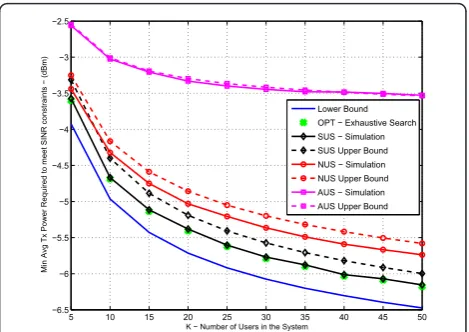
Figure 2 plots the curves of the average minimum transmit power versus the number of users for a fixed number of transmit antennas. SUS simulation curve overlaps OPT exhaustive search curve, but we remark that NUS does not behave very well in this scenario, because it chooses users without paying any attention to their spatial orthogonality, which may affect significantly the interference observed by the selected users. The degradation incurred by NUS w.r.t. OPT increases further with largeK.
B. The case ofKs= 4 selected users
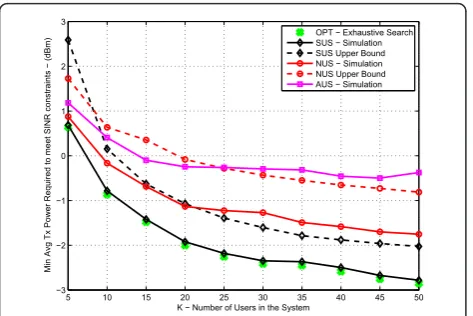
We plot the average minimum transmit power required to achieve certain SINR targets versus the number of transmit antennas and versus the number of system users in Figures 3 and 4, respectively, for the user selec-tion algorithms of interest. For both of these plots, the number of selected users is 4. We observe the same behavior as observed for the case of 2 selected users. SUS gives the same performance as of the exhaustive search approach. For large number of transmit antennas, NUS performs close to the optimal, even AUS achieves a reasonable performance.
On the other hand, for a fixed number of transmit antennas at the BS, when the number of users present in the system increases, NUS shows an increasing per-formance degradation. The reason is that NUS captures
3 4 5 6 7 8 9 10
−9
−8
−7
−6
−5
−4
−3
−2
−1
M − Number of Tx Antennas at the BS
Avg Power Required to meet SINR constraints
−
(dBm)
Lower Bound OPT −Exhaustive Search SUS − Simulation SUS Upper Bound NUS − Simulation NUS Upper Bound AUS − Simulation AUS Upper Bound
Figure 1Avg. Min. Transmit Power vs. M forK= 10,KS= 2,g=
10 dB,s2= 0.1. The curves show that SUS fully overlaps the OPT
curve. NUS also performs well and moves close to OPT curve with increasing number of transmit antennas.
5 10 15 20 25 30 35 40 45 50 −6.5
−6 −5.5 −5 −4.5 −4 −3.5 −3 −2.5
K − Number of Users in the System
Min Avg Tx Power Required to meet SINR constraints
−
(dBm)
Lower Bound OPT − Exhaustive Search SUS − Simulation SUS Upper Bound NUS − Simulation NUS Upper Bound AUS − Simulation AUS Upper Bound
Figure 2Avg. Min. Transmit Power vs. Nb. of Users forM= 4,
KS= 2,g= 10 dB,s2= 0.1. The curves show that SUS completely
overlaps the optimal curve. NUS shows performance degradation as the number of users increases.
5 6 7 8 9 10 11 12
−6 −5 −4 −3 −2 −1 0 1
M − Number of Tx Antennas at the BS
Min Avg Tx Power Required to meet SINR constraints
−
(dBm)
OPT − Exhaustive Search SUS − Simulation SUS Upper Bound NUS − Simulation NUS Upper Bound AUS − Simulation
Figure 3Avg. Min. Transmit Power vs. M forK= 10,KS= 4,g=
10 dB,s2= 0.1. The curves show that SUS completely overlaps the
the raw aspect of multi-user diversity, which governs only the self-signal power, but pays no attention to the inter-user spatial separation, which might have a larger impact on the interference power. The worst performance of AUS is expected, as it pays no attention to the strength of the selected users, which is quite important for power minimi-zation objective. Again, Figure 4 shows SUS giving the performance of exhaustive OPT curve when all other selection schemes are getting worse.
C. Power minimization and power efficiency
To have an idea about how much power BS is spending per user and how does this power per user scale with the number of simultaneously scheduled usersKs, we plot the
average minimum power per user versus the number of usersKsin Figure 5. To get the power per user averaged
in each scheduling group, the average minimum power per user values have been obtained by dividing the total minimum BS power to satisfy SINR targets ofKsusers by
Ks. As expected, even for this power per user metric, SUS
shows much better performance than NUS or AUS. AUS shows very bad performance and is highly power ineffi-cient even for small number of simultaneously scheduled users. We remark a large increase in per-user power for a fixed SINR target with increase in number of simulta-neously scheduled users. This shows that communication is power efficient whenKsis much smaller thanMand
becomes quite power inefficient when the number of scheduled users is close to the number of BS antennas.
7. Conclusions
In this paper, we have studied the performance of various user selection algorithms in terms of the average mini-mum transmit power required to satisfy specific SINR targets at users’side. General closed-form expressions of
the average minimum transmit power for the three user selection algorithms, namely SUS, NUS, and RUS, were derived when any number of users are selected for simul-taneous transmission. Furthermore, for the special case when only two users are selected for simultaneous trans-mission, similar expressions are derived for AUS and a power lower bound, which serves to benchmark other selection algorithms. SUS, which has been shown to behave close to optimal for the sum rate maximization objective under fixed power constraint, shows equally attractive performance in this dual problem setting of transmit power minimization to achieve hard SINR tar-gets. An interesting observation is the fact that SUS is the greedy algorithm for power minimization objective. For a fixed number of users and increasing number of transmit antennas, NUS performs close to SUS. In the comple-mentary setting of fixed number of BS transmit antennas, the performance of NUS degrades with an increase in the number of system users. Furthermore, power efficiency curves provided in this study may help the network operators decide how many users should be scheduled for simultaneous transmission per resource block.
Appendix A
Proof of Lemma 1: minimum instantaneous transmit power
The instantaneous transmit power required to achieve the SINR targets atKsactive users
having channelsh1,h2, ...,hKsis given by the following
expression from [15]
ptx(h1,h2,. . .,hKs) = Ks
i=1
γi h†iZ−i1hi
, (17)
5 10 15 20 25 30 35 40 45 50 −3
−2 −1 0 1 2 3
K − Number of Users in the System
Min Avg Tx Power Required to meet SINR constraints
−
(dBm)
OPT − Exhaustive Search SUS − Simulation SUS Upper Bound NUS − Simulation NUS Upper Bound AUS − Simulation
Figure 4Avg. Min. Transmit Power vs. Nb. of Users forM= 5,
KS= 4,g= 10 dB,s2= 0.1. SUS Simulation curve overlaps the
OPT exhaustive curve but NUS-Simulation shows more performance degradation with increasing number of users.
1 2 3 4 5 6 7 8 9 10 −12.5
−12 −11.5 −11 −10.5 −10 −9.5 −9 −8.5 −8 −7.5
Ks − Number of Selected Users
[Avg. Min Power / Ks]
−
(dBm)
SUS − Simulation NUS − Simulation AUS − Simulation
Figure 5Avg. Min. Transmit Power per User vs. Nb. of Selected
Users forM= 10,K= 20,g= 10 dB,s2= 0.1. The curves show
that communication becomes highly power inefficient when the number of simultaneously scheduled usersKsgrows close to the
whereZiis given by the following expression
Zi=IM+
i−1
j=1
pjhjh†j. (18)
The minimum power allocated to the stream of 1st user to achieve its SINR targetg1is
p1= γ1
h†1IMh1
= γ1
||h1||2
. (19)
The power allocated to the stream of 2nd user to achieve its SINR targetg2is
p2= γ2
h†2Z−21h2 (20)
Non-identity Z−21appears because user 2 will see the interference from the stream of 1st user.
Z−21= (IM+p1h1h†1)−1 (21)
Applying the matrix inversion lemma (MIL) to the right-hand side (R.H.S.) of the above equation, we get
Z−21=IM−p1h1(1 +p1||h1||2)−1h†1 ≥IM−p1h1(p1||h1||2)−1h†1.
(22)
For two positive definite matrices A and B, A >B implies thatA-Bis positive definite [34]. Asp1 ||h1||2
= g1 from Equation (19), this inequality will become
tight when the SINR targetg1 is large.Z−21becomes
Z−21≥IM−p1h1(p1||h1||2)−1h†1=IM−
h1h†1 ||h1||2
(23)
This renders
h†2Z−21h2≥ ||h2||2−|
h†2h1|2 ||h1||2
=||h2||2(1−cos2θ1) =||h2||2sin2θ1, (24)
where θ1 denotes the angle thath2subtends with the
1-dimensional subspace spanned by h1. Hence, the
power allocation was done over the stream of 2nd user, so that it achieves its SINR targetg2that would be
p2≤ γ2
||h2||2sin2θ1 (25)
The power allocated to the stream of 3rd user is given by
p3= γ3
h†3Z−31h3 (26)
with
Z−31= (IM+p1h1h†1+p2h2h†2)−
1. (27)
Taking h´i=√pihi and then H12= [h´1h´2], we get
Z3= (IM+H12H†12). Applying MIL to the R.H.S. of the above equation,Z−31can be written as
Z−31=IM−H12(I2+H†12H12)−1H†12 ≥IM−H12(H12† H12)−1H†12
(28)
where it is trivial to show that
(H†12H12)−1−(I2+H†12H12)−1is positive semi-definite.
I2 matrix adds 1 to the diagonal elements ofH†12H12, which are p1||h1||2, andp2||h2||2, respectively. Asp1 || h1||2 = g1, and p2||h2||2=
γ2
sin2θ1
> γ2, the above
inequality will be tight for large SINR targets. As
H12(H†12H12)−1H†12is the projection matrix over the column space of H12, i.e., over the space spanned by
h1 and h2, the product h†3Z−31h3gives the energy of the channel h3projected over the subspace orthogonal to that spanned by h1andh2.
h†3Z−31h3≥ ||h3||2−h3†H12(H†12H12)−1H†12h3
=||h3||2(1−cos2θ2) =||h3||2sin2θ2 (29)
where θ2 is the angle subtended by h3 with the 2-dimensional subspace spanned by h1and h2. Hence,
the power allocated to the stream of 3rd user to raise its SINR tog3is given by
p3≤ γ
3 ||h3||2sin2θ2
. (30)
In fact, this procedure generalizes to any number of users, and the power allocated to the stream of ith active user is given by
pi≤ γi
||hi||2sin2θ(i−1)
, (31)
where θ(i-1) is the angle that hi makes with the (i
-1)-dimensional subspace spanned by h1, h2, ..., hi-1
as a function of encoding order. Summing the powers allocated to all active users, the minimum transmit power to achieve SINR targets at Ksusers is
given by:
ptx(h1,h2, . . . ,hKs)≤ Ks
i=1
γi
||hi||2sin2θ(i−1)
Appendix B
Some useful distributions
In this appendix, we give some useful cumulative distri-bution functions (CDF), for which probability density functions (PDF) can be computed by simple differentiation.
A. Channel norm distributions
Most of the channel norm (squared) distributions given in this subsection are known relations, others have been computed using the tools from order statistics [35]. If all the users haveM - dimensional spatially i.i.d. com-plex Gaussian channels, the squared channel norm, ||
hi||2for anyi, isc2distributed with 2M degrees of
free-dom. This CDF can be represented as [33]
F||h||2(M;x) =G(M,x), (33)
where G denotes the regularized Gamma function [33], and is defined as
G(M,x) = 1
(M)
x
0
e−ttM−1dt. (34)
The PDF corresponding to CDFF||h||2(M;x)is given by
f||h||2(M;x) =
e−xxM−1
(M) . (35)
We also need the CDF for rth largest squared channel norm among K independent channel vectors. The CDF of therth largest order statistic among Ki.i.d. variables, each of which has the CDF of F||h||2(M;x), is given by
[35]
F||h||2(M,r,K;x) = K
j=K+1−r
K j
F||h||2(M;x)]j[1−F||h||2(M;x)K− j
(36)
The CDFs for the largest, the second largest, third-order, or fourth-order statistics can be determined easily by plugging in appropriate value of r. The distribution of any random user amongKusers that does not have the largest norm can be specified as (from [20])
F||h||2(M,1,´ K;x) = K
K−1F||h||2(M;x)− 1
K−1[F||h||2(M;x)]
K (37)
where1´stands for a random user which is not the first order statistic.
B. Channel direction distributions
In this subsection, we give some useful distributions of the sin2 and cos2 of the angle between a vector and a subspace. If we have K i.i.d. M-dimensional Gaussian distributed vectors, i.e.,hiÎℂMfor useri, we can com-pute the distribution of the sin2 and cos2 of the angle between one vector and the subspace spanned by a sub-set of the other vectors. This angle is defined as the (sole) principal angle of vector hi with the subspace
[36]. For a channel vectorhjand a subspace spanned by
i independent Gaussian vectors h1, h2, ..., hi, if θi
denotes the angle hj subtends with this i-dimensional
subspace, the projection of hjon this subspace cos2 θi
has a b distribution with parameters i and M - i (see [37,38] for details). sin2 θi= 1 - cos2 θialso has the beta
distributions with shift of parameters b (M - i, i). The CDF of sin2θi, denoted asFsin2θi(M;x)is given by
Fsin2θ i(M;x) =
Bx(M−i,i)
B(M−i,i)=
(M−1)! (M−i−1)!(i−1)!
x
t=0
tM−i−1(1−t)i−1dt, (38)
whereBandBxdenote the beta function and the
reg-ularized beta function, respectively [33,38]. Ifθ1 denotes the angle that an M-dimensional vector hjmakes with an independent vector h1 (one-dimensional subspace),
the distribution of sin2 θ1is given by
Fsin2θ
1(M;x) =x
M−1. (39)
The CDFs of projection with larger subspaces can be obtained by putting the appropriate value for the dimen-sion of the subspace in Equation (38), w.r.t. which orthogonalization is performed.
We saw that the energy in the orthogonal projection of one vector over another independent vector assumes the CDF of Fsin2θ
1(M;x). If there areKsuch projections
(each having the CDF of Fsin2θ
1(M;x)), the CDF of the
largest (1st order) projection is given by
Fsin2θ
1(M, 1,K;x) = [Fsin2θ1(M;x)]
K =xK(M−1). (40)
Appendix C
Proof of Theorem 1: norm-based user selection
In the proof of the theorem for NUS and the rest of the appendices, we make extensive use of the useful CDFs that have been grouped together in Appendix B, so we highly encourage the readers to go through the previous appendix for proper understanding of these proofs and the notation associated to those CDFs.
For NUS, the users are selected as described in Sec-tion 4. The squared norm of theith selected userπN(i) is theith largest amongKusers, and hence is distribu-ted asF||h||2(M,i,K;x). We reproduce the expression for
minimum transmit power below
ptx(h1,h2,. . .,hKs)≤γ Ks
i=1
1
||hi||2sin2θ(i−1)
. (41)
As NUS is solely based upon users’ channel norms and the Gaussian distributed vectors have independent norms and directions, the directional properties of these vectors are as if they are randomly selected. Hence, sin2
independent i-dimensional subspace, is distributed as
Fsin2θ
i(M;x)as detailed in Appendix B.
For the above expression, encoding order isKsto 1. In
terms of NUS indices, this encoding order is fromπN(1) to
πN
(Ks), i.e., the strongest userπN(1) will face the
interfer-ence of all other users who get encoded later. For the user whose signal gets decoded with (i-1) interference streams would be the one encoded at (Ks-i+ 1)-th order. Hence,
its NUS index would beπN(Ks-i + 1), and its squared
norm would be distributed asF||h||2(M,Ks+ 1−i,K;x). As
its interference subspace is (i- 1)-dimensional, the sin2of its angle with this subspace is distributed asFsin2θ
(i−1)(M;x).
If we denote the average transmit power, required to satisfy target SINRs atKsusers selected through NUS from a pool
ofKusers, bypN(Ks, K), this can be obtained by computing
the expectations in the following expression:
pN(Ks,K)≤γ
Like Lemma 1, this bound will be tight for large SINR targets.
A. NUS for 2 users
When only two users are selected through NUS for simultaneous transmission, the ordering strategy remains the same (the weaker user gets decoded with no interference), and the average power required can be computed by taking only the first two terms of the general NUS transmit power expression.
pN(2,K)≤γ
(obtained by its differentiation) is given by
f||h||2(M, 1,K;x) =K[G(M,x)]K−1e
−xxM−1
(M) . (44)
It allows us to compute the following expectation:
EF||h||2(M,1,K;x)
where the last equality is the definition of the constant termaM,K, defined in Equation (11), which only depends
upon the specific values ofMandK. Similarly, it can be shown that
The expectation concerning the angle distribution can also be computed as follows:
EFsin2θ1(M;x)
Combining the results of these expectations in Equation (43) and doing some rearrangements gives the result of Corollary 2. The average transmit power when 4 users are selected through NUS (Corollary 3) can be computed, similarly, by taking the first four terms from the general NUS average transmit power expression.
Appendix D
Proof of Theorem 4: semi-orthogonal user selection
For computing the average power required to satisfy SINR targets, we need the CDFs of the random variables as a consequence of the use of SUS algorithm in the expression given below: one with the largest channel norm on the null space of the subspace spanned by the channel vectors of i - 1 earlier selected users. The Ks selected users through
SUS need to be DPC encoded. The encoding order in the above expression is Ks to 1. The optimal encoding
order in terms of SUS indices would be πS(1) to πS (Ks), so that the weaker user gets the least interference
[25]. Unfortunately, it is not possible to determine the resulting CDFs with this encoding order, so we use the suboptimal encoding order from πS(Ks) toπS(1), where
πS
(i) will receive the interference of i - 1 users, indexed from πS(i - 1) to πS(1). This encoding order aligns the SUS metric, orthogonalized squared norm ||
hi||2sin2θ(i-1), with the denominator of above
expres-sion. The average power computation requires the CDF of ||hi||2sin2θ(i-1). Statistically, this represents the
largest norm among K- (i - 1) norms inM - (i - 1)-dimensional subspace, which is the null space of the subspace spanned by the channel vectors of i - 1 ear-lier selected users in previous SUS iterations. Unfortu-nately, this CDF is hard to compute, so we ease the computation using [[39], Lemma 3], which was also used in [[11], Appendix III]. Following [39], we ortho-gonalize all the channel vectors w.r.t. i - 1 arbitrary vectors, so for each of them, the squared norm is c2 distributed with 2(M -i + 1) degrees of freedom, denoted as F||h||2(M−i+ 1;x). Let us denote the
vectors byh˜j, thenith largest norm of these orthogona-lized vectors will be
||hi||2=ith max||hj||2, j= 1,. . .,K. (49)
The distribution of ||ĥi||2 is given by
F||h||2(M−i+ 1,i,K;x), the ith largest ofKinstances in
(M -i + 1)-dimensional space. Lemma 3 in [39] shows that statistically ||ĥi||2 is smaller than ||hi||2sin2θ(i-1).
Thus, the average power required to satisfy target SINRs atKsusers selected from a pool ofKusers through SUS
is given by:
The second inequality is the consequence of lower bounding the orthogonalized squared norms by the use of [[39], Lemma 3]. As CDF for ||ĥi||2 is known, we get
The average transmit power expressions when 2 or 4 users are selected through SUS (Corol-laries 5 and 6) can be obtained by taking the first two or four terms, respectively, from the general SUS average power expression and computing the integrals.
Appendix E
Proof of Theorem 8: angle-based user selection
When 2 users are selected through AUS, the first selected user πA(1) is the strongest user among
K users, whose squared norm is distributed as
F||h||2(M, 1,K;x). As norms and directions are
inde-pendent, the distribution of sin2 of the angle that other K - 1 vectors individually make with the first selected vector (1-dimensional subspace) all follow the distribution of Fsin2θ
1(M;x). The second selected
user πA(2) amongK - 1 users is the one making the largest angle with the first user. Hence, statistically, sin2 of this angle is the largest order statistic among K - 1 instances and is distributed as
Fsin2θ
1(M, 1,K−1;x)(see Appendix B for details). The
squared norm of πA(2) is distributed as the squared norm of any random user which is not the user with the largest norm, and hence the CDF is
F||h||2(M,1,´ K;x), (see Equation (37) in Appendix B).
We keep the same user ordering as detailed in NUS proof such that weaker user’s signal gets decoded
with lesser interference. The average transmit power for this user selection is given by:
pA(2,K)≤γ
This will give the result for the case of two users. Unfortunately, we could not extend the average power required with AUS to the general case of Ksusers due
to added complexity.
Appendix F
Proof of Theorem 9: performance benchmark
To compute a lower bound on the average minimum transmit power required to satisfy SINR targets of g, we assume that SINR targets are large and the inequality in Lemma 1 is tight. The two selected users are assumed to have the two largest norms, as in NUS having the CDFs of F||h||2(M, 1,K;x)and F||h||2(M, 2,K;x). Further,
the angle between their channel vectors is assumed to be the largest possible angle as in AUS, distributed as
Fsin2θ
1(M, 1,K−1;x). The similar strategy was employed
in [[21], Lemma 2] to obtain a bound in the non-DPC case. Hence, with optimal ordering (the weaker user gets decoded with no interference), the lower bound on the average transmit power can be obtained by comput-ing the expectations in the followcomput-ing expression:
pL(2,K) =γ
The research work carried out at Intel Mobile Communications leading to these results has received funding from the European Community’s Seventh Framework Program (FP7/2007-2013) SACRA project (grant agreement 249060).
EURECOM’s research is partially supported by its industrial members: BMW Group, Swiss-com, Cisco, ORANGE, SFR, ST Ericsson, Thales, Symantec, SAP, Monaco Telecom. The research of EURECOM is also supported in part by the EU FP7 projects CROWN, SACRA, and WHERE2.
Author details
1Intel Mobile Communications, France2Mobile Communications Department
of EURECOM, France
Competing interests
The authors declare that they have no competing interests.
Received: 1 December 2010 Accepted: 11 October 2011 Published: 11 October 2011
References
1. T Cover, Broadcast channels. IEEE Trans Inf Theory18, 2–14 (1972). doi:10.1109/TIT.1972.1054727
2. IE Telatar, Capacity of multi-antenna Gaussian channels. Eur Trans Telecommun.10, 585–595 (November 1999). doi:10.1002/ett.4460100604 3. GJ Foschini, MJ Gans, On limits of wireless communications in a fading
environment when using multiple antennas. Wirel Pers Commun.6, 311–335 (1998). doi:10.1023/A:1008889222784
5. P Viswanath, D Tse, Sum capacity of the multiple antenna Gaussian broadcast channel and uplink-downlink duality. IEEE Trans Inf Theory49, 1912–1921 (2003). doi:10.1109/TIT.2003.814483
6. G Caire, S Shamai (Shitz), On the achievable throughput of a multiantenna Gaussian broadcast channel. IEEE Trans Inf Theory49, 1691–1706 (2003). doi:10.1109/TIT.2003.813523
7. W Yu, JM Cioffi, Sum capacity of Gaussian vector broadcast channels. IEEE Trans Inf Theory50, 1875–1892 (2004). doi:10.1109/TIT.2004.833336 8. M Costa, Writing on dirty paper. IEEE Trans Inf Theory29, 439–441 (1983).
doi:10.1109/TIT.1983.1056659
9. Z Tu, R Blum, Multiuser diversity for a dirty paper approach. IEEE Commun Lett.7, 370–372 (2003). doi:10.1109/LCOMM.2003.815652
10. G Dimic, N Sidiropoulos, On downlink beamforming with greedy user selection: performance analysis and a simple new algorithm. IEEE Trans Signal Process.53, 3857–3868 (2005)
11. T Yoo, A Goldsmith, On the optimality of multiantenna broadcast scheduling using zero-forcing beamforming. IEEE J Sel Areas Commun.24, 528–541 (March 2006)
12. T Yoo, N Jindal, A Goldsmith, Multi-antenna downlink channels with limited feedback and user selection. IEEE J Sel Areas Commun.25, 1478–1491 (September 2007)
13. F Rashid-Farrokhi, KJ Ray Liu, L Tassiulas, Transmit beamforming and power control for cellular wireless systems. IEEE J Sel Areas Commun.16, 1437–1450 (1998). doi:10.1109/49.730452
14. M Schubert, H Boche, Solution of the multi-user downlink beamforming problem with individual SINR constraints. IEEE Trans Veh Technol.53, 18–28 (2004). doi:10.1109/TVT.2003.819629
15. M Schubert,Power-aware spatial multiplexing with unilateral antenna cooperation, PhD thesis (TU Berlin, 2003)
16. H Boche, M Schubert, A general duality theory for uplink and downlink beamforming, inProceedings of IEEE Vehicular Technology Conference Fall (September 2002)
17. M Schubert, H Boche, Joint dirty paper pre-coding and downlink beamforming, inProceedings of ISSSTA, 536–540 (September 2002) 18. E Karipidis, ND Sidiropoulos, Z-Q Luo, Quality of service and max-min fair
transmit beamforming to multiple cochannel multicast groups. IEEE Trans Signal Process.56, 1268–1279 (2008)
19. E Karipidis, ND Sidiropoulos, L Tassiulas, Joint QoS multicast power/ admission control and base station assignment: A geometric programming approach, inProceedings of 5th IEEE Workshop on Sensor Array and Multi-Channel Signal Processing(July 2008)
20. X Zhang, E Jorswieck, B Ottersten, A Paulraj, User selection schemes in multiple antenna broadcast channels with guaranteed performance, in Proceedings of IEEE Workshop on Signal Processing Advances in Wireless Communications(2007)
21. X Zhang, E Jorswieck, B Ottersten, A Paulraj, On the asymptotic optimality of opportunistic beamforming with hard SINR constraints. EURASIP J Adv Signal Process.2009, 1–12. Special issue on Multiuser MIMO Transmission with Limited Feedback, Cooperation, and Coordination (2009)
22. U Salim, D Slock, Performance of different user selection algorithms for transmit power minimization, inProceedings of Asilomar Conference on Signals, Systems and Computers(Pacific Grove, CA, USA, 2009)
23. R Zamir, S Shamai (Shitz), U Erez, Nested linear/lattice codes for structured multiterminal binning. IEEE Trans Inf Theory48, 1250–1276 (2002). doi:10.1109/TIT.2002.1003821
24. U Erez, ST Brink, A close-to-capacity dirty paper coding scheme. IEEE Trans Inf Theory51, 3417–3432 (2005). doi:10.1109/TIT.2005.855586
25. D Tse, P Viswanath,Fundamentals of Wireless Communications(Cambridge University Press, Cambridge, UK, 2005)
26. TM Cover, JA Thomas,Elements of Information Theory(Wiley, New York, 1991)
27. Z Shen, R Chen, JG Andrews, RW Heath, BL Evans, Low complexity user selection algorithms for multiuser mimo systems with block diagonalization. IEEE Trans Signal Process.54, 3658–3663 (2006)
28. D Hammarwall, M Bengtsson, B Ottersten, Utilizing the spatial information provided by channel norm feedback in SDMA systems. IEEE Trans Signal Process.56, 3278–3293 (2008)
29. S Han, C Yang, M Bengtsson, AI Perez-Neira, Channel norm-based user scheduler in coordinated multi-point systems, inProceedings of IEEE Global Communications Conference(Honolulu, HI, USA, 2009)
30. R Knopp, PA Humblet, Information capacity and power control in single-cell multiuser communications, inProceedings of International Conference on Communications, Seattle, USA, 331–335 (June 1995)
31. A Paulraj, inDiversity Techniques in the Mobile Communications Handbook, ed. by Gibson JD (CRC Press, 1999)
32. J Joung, AH Sayed, User selection methods for multiuser two-way relay communications using space division multiple access. IEEE Trans Wirel Commun.9, 2130–2136 (2010)
33. M Abramowitz, A Stegun,Handbook of Mathematical Functions with Formulas, Graphs, and Mathematical Tables(Dover Publications, 1964) 34. RA Horn, CR Johnson,Matrix Analysis(Cambridge University Press,
Cambridge, UK, 1985)
35. HA David,Order Statistics(Wiley, New York, 1980)
36. H Golub, CF Van Loan,Matrix Computations(John Hopkins Press, 1996) 37. N Jindal, Antenna combining for the MIMO downlink channel. IEEE Trans
Wirel Commun.10, 3834–3844 (2008)
38. AK Gupta, S Nadarajah,Handbook of Beta Distribution and Its Applications (CRC, 2004)
39. MA Maddah-Ali, MA Sadrabadi, AK Khandani, Broadcast in MIMO systems based on a generalized QR decomposition: Signaling and performance analysis. IEEE Trans Inf Theory54, 1124–1138 (2008)
doi:10.1186/1687-1499-2011-127
Cite this article as:Salim and Slock:Average minimum transmit power
to achieve SINR targets: performance comparison of various user
selection algorithms.EURASIP Journal on Wireless Communications and
Networking20112011:127.
Submit your manuscript to a
journal and benefi t from:
7Convenient online submission 7Rigorous peer review
7Immediate publication on acceptance 7Open access: articles freely available online 7High visibility within the fi eld
7Retaining the copyright to your article