Cite as: Can Urol Assoc J 2018;12(6):203-10. http://dx.doi.org/10.5489/cuaj.4870
Published online February 23, 2018
Abstract
Introduction: Non-muscle-invasive bladder cancer (NMIBC) accounts for 75‒85% of all urothelial bladder cancers (UBC). Many UBC patients are also afflicted by diabetes mellitus (DM). It has been postulated that several oral hypoglycemic agents could impact disease-specific survival (DSS), but the data are sparse among NMIBC patients. Our primary objective was to evaluate the impact of metformin on DSS and overall survival (OS) in NMIBC patients. Methods: This is a retrospective, population-based study that used linked administrative databases to identify diabetic patients ≥66 years who were subsequently diagnosed with NMIBC in Ontario between 1992 and 2012. Cumulative use of metformin and other hypoglycemic agent were calculated before and after NMIBC diag-nosis. DSS and OS were estimated using multivariable competing risk and Cox proportional hazards models, respectively.
Results: A total of 1742 subjects were included in the study. After a median followup of 5.2 years, 1122 (64%) had died, including 247 (15%) deaths as a result of UBC. On multivariable analysis, cumulative duration of metformin use after NMIBC diagnosis did not appear to impact DSS (hazard ratio [HR] 1.1; 95% confidence interval [CI] 0.92‒1.2), whereas glyburide use appeared to have a detrimental effect (HR 1.17; 95% CI 1.02‒1.3). None of the other hypoglycemic agents had an impact on OS.
Conclusions: In this large, population-based study, we have pro-vided further evidence that metformin use does not significantly impact DSS among diabetic patients diagnosed with NMIBC. However, our findings demonstrate that glyburide use inversely affects DSS. The detrimental effect of glyburide on DSS will require further validation.
Introduction
Urothelial bladder cancer (UBC) is the fifth most common solid organ cancer in North America, with over 74 000 new cases diagnosed every year in the U.S. alone.1 UBC
is especially prevalent among the elderly, with an average age at diagnosis of 73 years.1 Fortunately, approximately
75% of cases are non-muscle-invasive bladder cancer (NMIBC).2 Although associated with high recurrence rates,
these cancers have lower progression and metastatic rates than muscle-invasive tumours (MIBC).3,4
Many NMIBC patients are also afflicted by diabetes mel-litus (DM), which affects over 25% of individuals aged 65 and older.5 Metformin, a member of the biguanide
medica-tion class, is considered to be the first-line therapy in the management of DM.6 Interestingly, metformin has recently
gained interest for its antineoplastic properties against a num-ber of non-genitourinary and genitourinary cancers.7-9 More
specifically, there have been in vitro and animals studies demonstrating putative antineoplastic effects of metformin on UBC.10 However, there are limited clinical data evaluating the
role of metformin in UBC patients and results, thus far, have been equivocal.11-13 Furthermore, many of these studies were
underpowered and only one of them assessed NMIBC.12 It
has also been proposed that other oral hypoglycemic agents may have a potential impact on cancer outcome.14,15
Our primary objective was to assess the impact of cumu-lative use (after NMIBC diagnosis) of metformin on the dis-ease-specific survival (DSS) and the overall survival (OS). The secondary objectives were to assess the impact of met-formin (before NMIBC diagnosis) and other hypoglycemic agents (before and after NMBIC diagnosis) on both the DSS and OS. We hypothesized that metformin after NMIBC diag-nosis is associated with improved DSS and OS, while the other studied hypoglycemic agents have no impact.
Patrick O. Richard, MD
1; Ardalan E. Ahmad, MD
2; Shaheena Bashir, MD
2; Alexandre Zlotta, MD
2,3;
Bimal Bhindi, MD
2; Ricardo Leao, MD
2; Madhur Nayan, MD
2; Aza Mohammed, MD
2; Neil E. Fleshner, MD
2;
Girish S. Kulkarni, MD
2,41Division of Urology, Departments of Surgery, Centre Hospitalier Universitaire de Sherbrooke and Centre de Recherche du CHUS, Sherbrooke, QC; 2Division of Urology, Departments of Surgery and Surgical Oncology, Princess Margaret Cancer Centre, University Health Network and the University of Toronto, Toronto, ON; 3Division of Urology, Departments of Surgery, Mount Sinai Hospital and the University of Toronto, Toronto, ON; 4Institute for Clinical Evaluative Sciences, Toronto, ON; Canada
Methods
Study population
This was an institutional review board-approved, popula-tion-based, retrospective study. Individuals diagnosed with incident UBC in Ontario and concomitant DM between January 1, 1992 and December 31, 2012 were identified using administrative databases. Individuals with other con-comitant neoplasms (other than non-melanoma skin cancer) were excluded. The cohort was also restricted to subjects
≥66 years of age at the time of DM and UBC diagnosis. Since staging and pathological data were unavailable or incom-pletely captured with the available administrative databases, NMIBC patients were identified as individuals with UBC who had not undergone a cystectomy and/or radiotherapy and/or systemic chemotherapy treatments (i.e., radical or systemic therapy) within six months of the diagnosis of UBC, as these treatments are usually reserved for MIBC and/or advanced UBC (Supplementary Table 1). Similarly, individuals who were lost to followup or who died within six months of diagnosis were excluded, as the anti-diabetic medications were unlikely to have affected their outcomes and because those who died of UBC during that period were more likely to have been diagnosed with MIBC or advanced disease. Lastly, individuals diagnosed with DM after UBC diagnosis were also excluded.
Data sources
All medical procedures in Ontario are reimbursed by a single payer system (Ontario Health Insurance Plan [OHIP]) that cov-ers over 95% of the population.16 To identify the management
of subjects diagnosed with NMIBC, several validated data-bases were linked together (Ontario Cancer Registry [OCR], the Registered Persons Database and the Ontario Diabetes Database [ODD]).17,18 The ODD is a population-based
dis-ease registry that uses a validated algorithm based on hos-pitalizations and physician visits to identify individuals with physician-diagnosed DM.19 These aforementioned databases
were then linked to the Ontario Drug Benefit Database (ODB), which is another reliable and validated database that contains information on all medications dispensed in Ontario to indi-viduals over 65 years of age.20 Thus, we restricted the cohort
to diabetic individuals ≥66 years at the time of diagnosis as a mean to limit uncaptured medication exposure prior to study entry. This provided a minimum look-back window of one year to minimize the risk that included subjects were exposed to the studied drugs prior to being captured in the ODB (i.e., limited the possibility of incomplete drug history). Eligible individuals were observed until they experienced an event or until their last contact with the Ontario health system.
Statistical analysis
Descriptive statistics consisting of medians and interquartile range (IQR) were reported for continuous variables, while proportions were used to report categorical variables. The ODB database was used to identify all prescriptions for hypoglycemic medications between the date of DM diag-nosis and the end of followup. The drug identifier numbers used to identify each drug are summarized in Supplementary Table 2. The drugs were categorized into five distinct groups: metformin, glyburide, thiazolidinediones (pioglitazone, rosiglitazone), insulin, and other oral hypoglycemic agents (chlorpropamide, gliclazide, tolbutamide, glimepiride, sit-agliptin, saxsit-agliptin, nateglinide, repaglinide).
The cumulative daily duration of exposure was deter-mined by adding the duration of each single prescription. During periods where individuals were deemed to be off the drug, the cumulative duration of exposure remained unchanged. Cumulative exposure to the different medica-tions was divided between exposure before and after UBC diagnosis, with the objective to use post-diagnosis exposure as the main exposure variable while adjusting for exposure before UBC diagnosis in the multivariable models. A cumu-lative exposure analysis was used as opposed to the more traditional ever vs. never approach, as it offers, according to the literature, less bias estimate of the true effect.21 OS was
calculated from the date of UBC diagnosis to the date where the individual experienced death or the date of censoring (i.e., end of the study followup period [December 31, 2014] or lost to followup [i.e., date of last contact with OHIP]). DSS was calculated in a similar fashion, with non- UBC-related deaths considered competing events.
The effect of cumulative duration of exposure to hypogly-cemic medications before and after NMIBC on the risk of OS was assessed using Cox proportional hazards model, whereas a proportional subdistribution hazard model (i.e., competing risks) with time dependent weights was used to assess their impact on the DSS. All models were adjusted for patient’s baseline characteristics at the time of UBC diagnosis (sex, age, year of diagnosis, area of residency, Charlson comorbidity score, time since diagnosis of DM, and neighborhood income quintile, which was identified derived from each individual postal code) and for cumula-tive use of all included hypoglycemic agents, categorized as previously mentioned, into use before and after NMIBC diagnosis. In particular, adjustment for use of thiazolidinedi-ones was made given their known association with UBC.22
To decrease the risk of bias, all cumulative drug exposures before and after NMIBC diagnosis were modelled as time-dependent covariates and as continuous variables.23
clinically negligible, all HRs are presented as an estimate of the effect of 12 months of use. Two sensitivity analyses were also performed. The first one included all individuals who died within six months of the UBC diagnosis, while the second was restricted to individuals diagnosed with DM after 1996, after which the prescription duration variable in ODB became a mandatory entry field. All statistical analyses were performed using SAS 9.4 and R version 3.1.3 statistical software. All analyses were two sided, with p-values less than 0.05 considered statistically significant.
Results
During the study period, 38 383 individuals were diagnosed with UBC in Ontario, of which 10 144 were known dia-betics. Of these, 7011 individuals were excluded because of prior malignancy (n=1917), because of the age criterion (n=3971), because they were deemed to have MIBC (n=775), and because they died within six months of the diagnosis (n=348). An additional 1391 individuals were also excluded because they were diagnosed with DM after the UBC diagno-sis. Therefore, the final cohort comprised of 1742 individuals with underlying DM diagnosed prior to NMIBC and who were ≥66 years of age at the time of diagnosis (Fig. 1).
The median age at NMIBC diagnosis was 78 years (IQR 75–83) while the median time between diagnosis of DM and NMIBC diagnosis was 3.5 years (IQR1.3–6.9). Overall, 523 (30%) and 813 (47%) individuals were exposed to metformin before and after NMIBC diagnosis, respectively. The median exposure before and after diagnosis was 1.5 years (IQR 0.6–
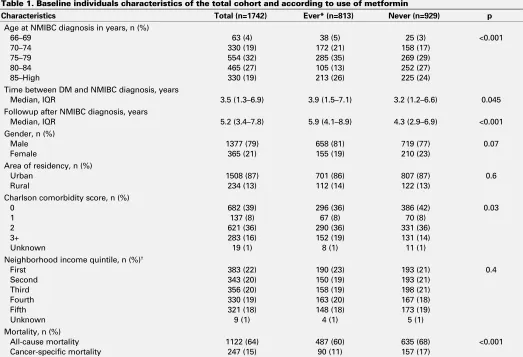
3.2) and 1.9 years (IQR 0.6–3.7), respectively. The second most commonly used anti-diabetic agent was glyburide, with 419 (24%) and 545 (31%) individuals exposed to the drug before and after NMIBC diagnosis, respectively. The median exposure to glyburide before and after diagnosis was 1.6 years (IQR 0.5–3.7) and 1.5 years (IQR 0.5–3.4), respectively. Summaries of the cohort baseline characteristics (categorized according to previous use of metformin) and hypoglycemic agents exposure are presented in Tables 1 and 2.
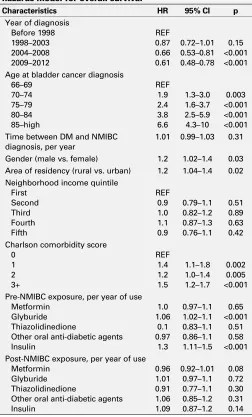
During a median followup of 5.2 years (IQR 3.4–7.8) after NMIBC diagnosis, 1122 (64%) died overall and 247 (15%) died of UBC. On multivariable analysis, the cumulative use of metformin (HR 0.96; 95% CI 0.92–1.01) and other hypo-glycemic agents after NMIBC diagnosis was not associated with OS (Table 3). Similarly, on the competing risk model, the use of metformin after NMIBC diagnosis had no impact on the DSS (HR 1.1; 95% CI 0.92–1.2) (Table 4).
However, the use of glyburide was associated with a 17% increase in the risk of death due to NMIBC for every year of use (HR 1.17; 95% CI 1.02–1.3). The remaining hypogly-cemic agents had no association with DSS. The absence of a statistically significant association with metformin and the presence of a detrimental effect of glyburide on DSS were corroborated by the first sensitivity analysis that included patients who died within six months of UBC diagnosis. However, in the second sensitivity analysis that restricted the cohort to individuals diagnosed with DM after 1996, the association between glyburide and DSS was no longer statistically significant, possibly due to an underpowered analysis (Supplementary Table 3).
Subjects with newly diagnosed UBC from 1992–2012 (n=38 383)
10 144 were also diagnosed with DM during their lifetime
3133 subjects with DM, older than 66 years of age with NMIBC
1742 subjects with DM, older than 66 years of age subsequently diagnosed
with NMIBC
!!
• Diagnosed with UBC prior to DM diagnosis (n=1391) Excluded
Excluded
• History of other malignancy (n=1917)
• Younger than 66 years old at the time of UBC or DM diagnosis (n=3971)
• Radiotherapy, chemotherapy, or cystectomy within 180 days of diagnosis (n=775)
• Died within 6 months of UBC diagnosis (n=348)
Discussion
Over the last decade, there have been an increasing num-ber of publications supporting the role of metformin as an anti-neoplastic agent.7-13 Metformin lowers blood
glu-cose by activating AMP-activated protein kinase (AMPK). Activation of AMPK reduces mammalian target of rapa-mycin (mTOR) signaling which in turn leads to inhibition of cancer cell growth and proliferation.24 Activation of
the mTOR pathway has been previously implicated in the tumorigenesis of UBC, while its inhibition has been shown to inhibit tumorigenesis.25,26
Despite this rationale, the result of this large population-based study failed to demonstrate an association between metformin use in NMIBC patients and DSS or OS. Similarly, in a smaller study by Rieken et al, which included 125 patients with DM, no difference in OS or DSS was attrib-uted to metformin use.12 Interestingly, the authors did report
that metformin users were at lower risk of disease recur-rence (HR 0.48, 95% CI:0.26-0.89) than non-DM patients.
Table 1. Baseline individuals characteristics of the total cohort and according to use of metformin
Characteristics Total (n=1742) Ever* (n=813) Never (n=929) p
Age at NMIBC diagnosis in years, n (%) 66–69
Time between DM and NMIBC diagnosis, years
Median, IQR 3.5 (1.3–6.9) 3.9 (1.5–7.1) 3.2 (1.2–6.6) 0.045
Followup after NMIBC diagnosis, years
Median, IQR 5.2 (3.4–7.8) 5.9 (4.1–8.9) 4.3 (2.9–6.9) <0.001 Gender, n (%)
Area of residency, n (%) Urban
Charlson comorbidity score, n (%) 0
Neighborhood income quintile, n (%)†
First
*Defined as use of metformin before or after NMIBC diagnosis during the study period. †First denotes the lowest quintile; fifth, the highest. DM: diabetes mellitus; IQR: interquartile range; NMIBC: non-muscle-invasive bladder cancer.
Table 2. Anti-diabetic exposure before and after bladder cancer diagnosis Other oral anti-diabetic agents use
Before NMIBC diagnosis Non-medical management 245 (14) —
Given the limitations of our database, we were unable to validate the benefit of metformin on disease recurrence. As they suggested, their findings could be the result of the beneficial use of metformin, but another possible explana-tion is that the DM itself potentiated recurrence secondary to impaired glucose tolerance, promoting tumour growth.27
Regardless, given the absence of impact on survival, the true benefit of metformin among individuals diagnosed with NMIBC needs to be questioned. Conversely, metformin may have a potential role among individuals with MIBC. Two retrospective studies have demonstrated that, among individuals who had undergone cystectomy for their UBC, metformin use had a protective effect on DSS while the use of other oral hypoglycemics agents did not.11,13
This study is the first to suggest a detrimental effect of gly-buride on DSS among diabetic individuals with NMIBC. This effect became non-significant when the cohort was restricted to individuals diagnosed with DM after 1996, but with a HR in the same direction. Therefore, this absence of statistical significance may simply reflect an underpowered analysis. Glyburide, also known as glibenclamide, is a gen-eration sulfonylurea and is often used as first- or second-line therapy for the treatment of DM.6 It improves glucose
control by promoting insulin secretion and by enhancing insulin action and function.28 This effect seems to be the
result of reduced conductance of ATP-sensitive K+ chan-nels. Interestingly, various studies have demonstrated that several types of K+ channels are present in different tumour
Table 4. Time-dependent multivariable competing risk model for bladder cancer-specific survival
Characteristics HR 95% CI p
Year of diagnosis Age at bladder cancer diagnosis
66–69 Time between DM and NMIBC
diagnosis, per year
1.0 0.96–1.1 0.70
Gender (male vs. female) 0.80 0.59–1.1 0.15 Area of residency (rural vs. urban) 0.91 0.62–1.3 0.62 Neighborhood income quintile Charlson comorbidity score, n (%)
0 Pre-NMIBC exposure, per year of use
Metformin Glyburide Thiazolidinedione
Other oral anti-diabetic agents Insulin Post-NMIBC exposure, per year of use
Metformin Glyburide Thiazolidinedione
Other oral anti-diabetic agents Insulin
CI: confidence interval; DM: diabetes mellitus; HR: hazard ratio; NMIBC: non-muscle-invasive bladder cancer.
Table 3. Time-dependent multivariable Cox proportional hazards model for overall survival
Characteristics HR 95% CI p
Year of diagnosis Age at bladder cancer diagnosis
66–69 Time between DM and NMIBC
diagnosis, per year
1.01 0.99–1.03 0.31
Gender (male vs. female) 1.2 1.02–1.4 0.03 Area of residency (rural vs. urban) 1.2 1.04–1.4 0.02 Neighborhood income quintile Pre-NMIBC exposure, per year of use
Metformin Glyburide Thiazolidinedione
Other oral anti-diabetic agents Insulin Post-NMIBC exposure, per year of use
Metformin Glyburide Thiazolidinedione
Other oral anti-diabetic agents Insulin
cells (including urothelial carcinoma) and that they played an important role in the regulation of tumour cell prolifera-tion and apoptosis.14,15 It has been suggested that a
reduc-tion in K+ channel activity is associated with a decrease in apoptosis rates through unknown mechanisms. On the other hand, an increase in K+ channels activity has also been shown to inhibit tumorigenesis through a downregulation of proliferation rates.
Ultimately, the net impact of glyburide on tumour cells remains poorly understood.15 The current literature
evaluat-ing the impact of glyburide (and sulfonylureas in general) on cancer incidence and cancer-related mortality is highly discordant.9,11-13,29-32 Additionally, most studies have not
evaluated glyburide separately from other sulfonylureas and very little has been published on the impact of the drug on UBC.11-13 Therefore, further studies of the impact of glyburide
on DSS are needed to validate our findings. Nevertheless, our study does provide evidence of an association between an increase in UBC-related death and glyburide after adjusting for baseline characteristics. It is also important to note that this is not the first time that oral hypoglycemic agents have been implicated in UBC progression. Thiazolidinediones, a class of medications introduced in the late 1990s to treat type II DM, have recently been associated with a slightly higher risk of developing UBC.22
To the best of our knowledge, this study is the largest to evaluate the impact of metformin on UBC oncological outcomes, which makes it less prone to spurious findings compared to small single-institution cohorts. Moreover, although we restricted the population to individuals ≥66 years, our population-based design renders our findings more generalizable.
Nevertheless, this study does have limitations. First, our analysis was limited to individuals ≥66 years of age because of the inherent limitation of ODB coverage. As a result, it is unclear whether our findings apply to a younger popula-tion. Second, compliance to medication and reasons for medication changes over time are unknown. It is possible that changes in medication reflect varying severity of DM, which may, in turn, have impacted survival outcomes. Third, stage and pathological data were not readily available. Therefore, in order to define our NMIBC study population, we had to make assumptions (which have yet to be valid-ated) regarding treatment delivery to define our cohort. We cannot exclude the possibility that some individuals with MIBC were included in the current study, although it is expected that the proportion of patients with MIBC managed with radical transurethral resection alone should be low. Similarly, it is possible that some very high-risk NMIBC were excluded because of early/immediate cystectomy within six months of diagnosis. However, given the progression rate of NMIBC and infrequent use of immediate cystectomy, it is suspected that only a small number of these patients
were excluded for this reason. Fourth, we were also unable to capture the severity of diabetes, presence or absence of metabolic syndrome, body mass index, smoking status, and whether or not an individual received intravesical chemo-therapy or Bacillus Calmette-Guerin treatment. These factors may have influenced our results. Fifth, we were unable to draw any meaningful conclusions with regards to the impact of thiazolidinedione, insulin, and other oral anti-diabetic agents due to the small number of patients who used these agents during the study period. Finally, we were not able to evaluate the impact of anti-diabetic drugs on disease recur-rence or progression.
Conclusion
This large, population-based study provided strong evi-dence that metformin use was not associated with either improved DSS or OS among diabetic individuals diagnosed with NMIBC. Although metformin may have anti-neoplas-tic properties, our data do not support its use for NMIBC. Meanwhile, diabetic individuals taking glyburide were at increased risk of cancer-specific mortality compared to indi-viduals not on this drug. Further studies are warranted to validate these findings.
Competing interests: Dr. Richard has attended advisory boards for BMS and Sanofi; and has been a speaker for AbbVie, Astellas, and Jasssen. Dr. Zlotta has attended advisory boards for Amgen, Astellas, Ferring, Paladin, and Sanofi; has received educational grants from Pfizer, Red Leaf Medical, and Sanofi; and has participated in clinical trials supported by Sanofi. Dr. Fleshner has been a consultant for Amgen, Astellas, and Janssen; has participated in clinical trials for Amgen, Astellas, Ferring, and Janssen; and has received grant funding from Canadian Cancer Society Research Institute and Prostate Cancer Canada. The remaining authors report no competing personal or financial interests related to this work.
Acknowledgments: This study was supported by the Institute for Clinical Evaluative Sciences (ICES), which is funded by an annual grant from the Ontario Ministry of Health and Long-Term Care (MOHLTC). The opinions, results, and conclusions reported in this paper are those of the authors and are independent from the funding sources. No endorsement by ICES or the Ontario MOHLTC is intended or should be inferred.
This paper has been peer-reviewed.
References
1. American Cancer Society. Cancer facts and figures 2015. Atlanta, Ga: American Cancer Society; 2015. 2. Burger M, Catto JW, Dalbagni G, et al. Epidemiology and risk factors of urothelial bladder cancer. Eur
Urol 2013;63:234-41. https://doi.org/10.1016/j.eururo.2012.07.033
3. van der Heijden AG, Witjes JA. Recurrence, progression and followup in non-muscle-invasive bladder cancer. Eur Urol 2009;8:S556-62. https://doi.org/10.1016/j.eursup.2009.06.010
5. Centers for Disease Control and Prevention. National Diabetes Statistics Report 2014 [cited 2016 February 23rd]. Available at: https://www.cdc.gov/diabetes/pdfs/data/2014-report-estimates-of-diabetes-and-its-burden-in-the-united-states.pdf. Accessed April 17, 2018.
6. Handelsman Y, Bloomgarden ZT, Grunberger G, et al. American Association of Clinical Endocrinologists and American College of Endocrinology clinical practice guidelines for developing a diabetes mellitus compre-hensive care plan, 2015. Endocr Pract 2015;S1:1-87. https://doi.org/10.4158/EP15672.GLSUPPL 7. He XK, Su TT, Si JM, et al. Metformin is associated with slightly reduced risk of colorectal cancer and
moderate survival benefits in diabetes mellitus: A meta-analysis. Medicine (Baltimore) 2016;95:e2749. https://doi.org/10.1097/MD.0000000000002749
8. Kozak MM, Anderson EM, von Eyben R, et al. Statin and metformin use prolongs survival in patients with resectable pancreatic cancer. Pancreas 2016;45:64-70. https://doi.org/10.1097/ MPA.0000000000000470
9. Margel D, Urbach DR, Lipscombe LL, et al. Metformin use and all-cause and prostate cancer-specific mortality among men with diabetes. J Clin Oncol 2013;31:3069-75. https://doi.org/10.1200/ JCO.2012.46.7043
10. Zhang T, Guo P, Zhang Y, et al. The antidiabetic drug metformin inhibits the proliferation of bladder cancer cells in vitro and invo. Int J Mol Sci 2013;14:24603-18. https://doi.org/10.3390/ijms141224603 11. Nayan M, Bhindi B, Yu JL, et al. The effect of metformin on cancer-specific survival outcomes in diabetic
patients undergoing radical cystectomy for urothelial carcinoma of the bladder. Urol Oncol 2015;33:386. e7-13. https://doi.org/10.1016/j.urolonc.2015.05.024
12. Rieken M, Xylinas E, Kluth L, et al. Association of diabetes mellitus and metformin use with onco-logical outcomes of patients with non-muscle-invasive bladder cancer. BJU Int 2013;112:1105-12. https://doi.org/10.1111/bju.12448
13. Rieken M, Xylinas E, Kluth L, et al. Effect of diabetes mellitus and metformin use on oncologic outcomes of patients treated with radical cystectomy for urothelial carcinoma. Urol Oncol 2014;32:49.e7-14. https://doi.org/10.1016/j.urolonc.2013.07.006
14. Bortner CD, Cidlowski JA. Ion channels and apoptosis in cancer. Philos Trans R Soc Lond B Biol Sci 2014;369:20130104. https://doi.org/10.1098/rstb.2013.0104
15. Wang Z. Role of K+ channels in regulating tumour cell proliferation and apoptosis. Pflugers Arch 2004;448:274-86. https://doi.org/10.1007/s00424-004-1258-5
16. Robles S, Marrett L, Clarke E, Risch H. An application of capture-recapture methods to the estimation of com-pleteness of cancer registration. J Clin Epidemiol 1988;41:495-501. https://doi.org/10.1016/0895-4356(88)90052-2
17. Holowaty E, Moravan V, Lee G, et al. A reabstraction study to estimate the completeness and accuracy of data elements in the Ontario Cancer Registry. Report submitted to Health Canada. 1996.
18. Juurlink D, Preyra C, Croxford R, et al. Canadian Institute for Health Information Discharge Abstract Database: A Validation Study. Toronto: Institute for Clinical Evaluative Science, 2006.
19. Hux JE, Ivis F, Flintoft V, et al. Determination of prevalence and incidence using a validated administrative data algorithm. Diabetes Care 2002;25:512-6. https://doi.org/10.2337/diacare.25.3.512 20. Levy AR, O’Brien BJ, Sellors C, et al. Coding accuracy of administrative drug claims in the Ontario Drug
Benefit database. Can J Clin Pharmacol 2003;10:67-71.
21. Nayan M, Juurlink DN, Austin PC, et al. Medication use and kidney cancer risk: A population-based study. Eur J Cancer 2017;83:203-10. https://doi.org/10.1016/j.ejca.2017.07.001
22. Ferwana M, Firwana B, Hasan R, et al. Pioglitazone and risk of bladder cancer: A meta-analysis of controlled studies. Diabet Med 2013;30:1026-32. https://doi.org/10.1111/dme.12144
23. Austin PC BL. Inflation of the type I error rate when a continuous confounding variable is categorized in logistic regression analyses. Stat Med 2004;23:1159-78. https://doi.org/10.1002/sim.1687
24. Zakikhani M, Dowling RJ, Sonenberg N, et al. The effects of adiponectin and metformin on prostate and colon neoplasia involve activation of AMP-activated protein kinase. Cancer Prev Res (Phila) 2008;1:369-75. https://doi.org/10.1158/1940-6207.CAPR-08-0081
25. Chiong E, Lee IL, Dadbin A, et al. Effects of mTOR inhibitor everolimus (RAD001) on bladder cancer cells. Clin CancerRes 2011;17:2863-73. https://doi.org/10.1158/1078-0432.CCR-09-3202 26. Makhlin I, Zhang J, Long CJ, et al. The mTOR pathway affects proliferation and chemosensitivity of urothelial
carcinoma cells and is upregulated in a subset of human bladder cancers. BJU Int 2011;108:E84-90. https://doi.org/10.1111/j.1464-410X.2010.09844.x
27. MacKenzie T, Zens MS, Ferrara A, et al. Diabetes and risk of bladder cancer: Evidence from a case-control study in New England. Cancer 2011;117:1552-6. https://doi.org/10.1002/cncr.25641 28. Luzi L, Pozza G. Glibenclamide: An old drug with a novel mechanism of action? Acta Diabetol
1997;34:239-44. https://doi.org/10.1007/s005920050081
29. Ruiter R, Visser LE, van Herk-Sukel MP, et al. Lower risk of cancer in patients on metformin in comparison with those on sulfonylurea derivatives: Results from a large, population-based, followup study. Diabetes Care 2012;35:119-24. https://doi.org/10.2337/dc11-0857
30. Bo S, Castiglione A, Ghigo E, et al. Mortality outcomes of different sulphonylurea drugs: The results of a 14-year cohort study of type 2 diabetic patients. Eur J Endocrinol 2013;169:117-26. https://doi.org/10.1530/EJE-13-0299
31. Bowker SL, Majumdar SR, Veugelers P, JA. J. Increased cancer-related mortality for patients with type 2 diabetes who use sulfonylureas or insulin. Diabetes Care 2006;29:254-8. https://doi.org/10.2337/ diacare.29.02.06.dc05-1558
32. Gandini S, Puntoni M, Heckman-Stoddard BM, et al. Metformin and cancer risk and mortality: A sys-tematic review and meta-analysis taking into account biases and confounders. Cancer Prev Res (Phila) 2014;7:867-85. https://doi.org/10.1158/1940-6207.CAPR-13-0424
Correspondence: Dr. Patrick O. Richard, Division of Urology, Departments of Surgery, Centre Hospitalier Universitaire de Sherbrooke and Centre de Recherche du CHUS, Sherbrooke, QC, Canada; [email protected]
Supplementary Table 1. Ontario Health Insurance Plan (OHIP) physician billing claims used to identify bladder cancer-related management
Billing claims – code
Fee code: OHIP definition
Cystectomy Cystectomy – partial: S482; S483; S490
Cystectomy – complete: S484; S485; S453; S440 Chemotherapy Complex single agent or multi-agent therapy:
G345
Special single agent or multi-agent therapy: G359
Supplementary Table 2. Studied drugs and drug identifier numbers used
Drug names Drug identifier numbers
Metformin 02148765; 00990329; 02167786; 02162822; 02099233 02233999; 02045710; 02230026; 02229516; 02223562 00314552; 02257726; 02388766; 02380722; 02380196 02379767; 02378841; 02242974; 02353377; 02378620
02246820; 02242794; 02269031; 02162849; 02230475 02333872; 02333856; 02333864
Glyburide 00454753; 00808733; 00720933; 02224550; 02236733; 01913670; 01913654; 02230036; 02020734; 01987534; 01900927; 02248008; 02350459; 02248009; 02350467; 02236734; 01913689; 01913662; 02230037; 02020742;
01900935; 02224569; 01987836; 00012599; 00808741; 00720941 Other anti-diabetic drugs
Other sulfonyureas Chlorpropamide Gliclazide Tolbutamide Glimepiride
00399302; 00024708; 00024716; 00021350; 00377937; 00312711; 02297795; 02242987; 02356422; 02245247; 02294400; 02229519; 02238103; 00765996; 00012602; 00013889; 00021849; 00093033; 00312762;
02375842;02333554; 02245272
DPP4 Sitagliptin Saxagliptin
02303922; 02388839; 02388847; 00012602; 00013889; 00021849; 00093033; 00312762; 02375842; 02333554
Meglitinides Nateglinide Repaglinide
02245439; 02245440; 02245438; 02357453; 02355663; 02354926; 02239924; 02239925; 02357461; 02355671; 02354934; 02357488; 02355698; 02354942; 02239926; 02321475; 02321483; 02321491
Thiazolidinedione Pioglitazone Rosiglitazone
02241112; 02241113; 02241114; 02245272; 02303442; 02303124; 02302942; 02302861; 02242572; 02301423; 02298279; 02297906; 02397307; 02391600; 02384906; 02375850; 02274914; 02326477; 02307677; 02303450; 02303132; 02242573; 02302950; 02302888; 02301431; 02298287; 02297914; 02375869; 02384914; 02365529; 02274922; 02339587; 02326485; 02307723; 02242574; 02303469; 02303140; 02302977; 02302896; 02301458;
02298295; 02297922; 02384922; 02375877; 02365537; 02274930; 02339595; 02326493
Insulin 00587737; 00612197; 01959239; 00981044; 09853804; 09853782; 02024268; 02024225; 01959220; 00983870; 02024284; 02024233; 01986805; 00632686; 00586714; 09853774; 09853774; 09853766; 00612189; 00980765; 00795879; 00773654; 00632694; 01959212; 00981052; 01986821; 01985973; 09851925; 09853855; 09853871; 09853863; 09853847; 09853839; 09853812; 01962663; 01962639; 01962655; 00889121; 00889105; 00889091; 01962647; 02025248; 02024322; 02024314; 02024306; 02024292; 02024217; 00650925; 00733075; 00612200;
00646148; 00644358; 02024276; 02024241
Supplementary Table 3. Results of the multivariable models for the two sensitivity analyses assessing the impact of oral hypoglycemic use post-NMIBC diagnosis
Models (n) Post-NMIBC exposure, per year of use* Disease-specific survival Overall survival
HR (95% CI) HR (95% CI)
Sensitivity analysis #1 (n=2092)†
Metformin Glyburide Thiazolidinedione Other oral anti-diabetic agents
Insulin
1.1 (0.93–1.2) 1.26 (1.1–1.4) 0.55 (0.24–1.3) 0. 81 (0.49–1.3) 1.3 (0.84–1.9)
0.96 (0.92–1.0) 1.0 (0.97–1.1) 0.92 (0.78–1.1)
1.0 (0.94–1.2) 1.1 (0.98–1.2) Sensitivity analysis #2
(n=1222)‡
Metformin Glyburide Thiazolidinedione Other oral anti-diabetic agents
Insulin
0.95 (0.77–1.2) 1.05 (0.81–1.4) 0.73 (0.27–2.0) 0.46 (0.15–1.4) 1.7 (1.1–2.4)
0.93 (0.88–0.99) 1.02 (0.96–1.09) 1.07 (0.87–1.3) 0.97 (0.85–1.1) 1.1 (0.87–1.3)