R E S E A R C H
Open Access
Iterative detection for
frequency-asynchronous distributed
Alamouti-coded (FADAC) OFDM
Bong-seok Kim
1and Kwonhue Choi
2*Abstract
We propose a near intercarrier interference (ICI)-free and very low complexity iterative detector for
frequency-asynchronous distributed Alamouti-coded (FADAC) orthogonal frequency division multiplexing (OFDM). In the previous cancelation schemes, the entire subcarrier signals from one transmit (TX) antenna are estimated and canceled in the received signal from the other TX antenna and vice versa. However, the reliability of the estimated symbols are revealed to significantly vary across the subcarriers and thus, the poorly estimated symbols lead to the incorrect cancelation. Motivated from this, we first propose a scheme which does not cancel the interfering
subcarrier(s) at the half band edges which undergo very high interference in FADAC-OFDM. For further improvement, we propose a so-called selective scheme which instantly measures the reliability of the detected symbols at each iteration and then exclude the unreliable symbols in the estimated interference generation.
Moreover, the proposed scheme has a drastically reduced complexity by converting the cancelation process from the subcarrier domain to the time domain. In accordance with the analysis on the considered reliability measures, the numerical results show that the proposed scheme achieves the near ICI-free level only within three or four iterations for wide ranges of SNR, frequency offset, and delay spread.
Keywords: Iterative MIMO, Alamouti, ICI cancelation, OFDM, Distributed antennas, Frequency offset
1 Introduction
Recently, several studies on Alamouti-coded OFDM (orthogonal frequency division multiplexing) for cooper-ative systems have been reported. One of the main chal-lenging issues in this area is to mitigate self-interference due to the carrier frequency offset (CFO) between the dis-tributed transmit antennas [1–8]. Very recently in [4], the so-called FADAC-OFDM (frequency-asynchronous dis-tributed Alamouti-coded OFDM) has been proposed and shown to outperform the other existing approaches in [3–5]. In contrast to the conventional distributed Alamouti-coded OFDM, FADAC-OFDM is free from ICI (intercarrier interference) terms from the near subcarri-ers due to its ICI self-cancelation property only by simple Alamouti-decoding process. Especially, [4] tried to exploit this ICI self-cancelation property even in the selective
*Correspondence: [email protected]
2Department of ICE in Yeungnam University, 280 Daehak-Ro, Gyeongsan, Gyeongbuk, 38541, Republic of Korea
Full list of author information is available at the end of the article
fading channel by dividing the entire subcarriers into multiple subblocks. However, in the severely frequency-selective fading channels, FADAC-OFDM gets worse due to non-negligible inter-block ICI terms.
Meanwhile, in [5–7], typical types of iterative ICI can-celation schemes for the conventional Alamouti-coded OFDM with the distributed antennas have been proposed. Since the conventional Alamouti-coded OFDM [9] has no ICI self-cancelation property for frequency and tim-ing asynchronous distributed antennas, the accuracy of the initial detection is poor. Thus, a considerable num-ber of iterations of cancelation has to be performed until the performance converges. Moreover, the converged per-formances are not so impressive. Although in [5] they derived the performance result close to no-CFO case, they assumed the perfect ICI cancelation which has not been justified. The schemes in [6, 7] rapidly break down as the CFO gets larger than 0.5. Moreover, they have high com-putation overheads because at each iteration, the required number of complex multiplications for the interference
reconstruction is 4N2whereNdenotes the total number of OFDM subcarriers.
Recently, in [10] and [14], the decision-directed iter-ative ICI cancelation schemes to distributed multiple input multiple output (MIMO) have been proposed. In [14], the authors considered spatial modulation MIMO as the application system model and they showed the performance results only for the small values of CFO. In [10], we, the authors of this paper, combined a typi-cal decision-directed iterative ICI cancelation scheme to FADAC-OFDM. We achieved better performance com-pared with [5] even with low complexity due to better initial detection performance of FADAC-OFDM com-pared to the conventional Alamouti-coded OFDM. This scheme uses all the detected symbols in the interference reconstruction step without any consideration of relia-bility of detection symbols. However, even in FADAC-OFDM, some of the detection symbols may eventually have relatively high possibility of errors due to severe ICI terms such as inter-block ICI as mentioned before. It is shown that after the first iteration, the performance fairly improves, but from the second iteration, the per-formance is stuck in the same value. This is because the reconstructed interference term for cancelation is not updated anymore due to the erroneous portion of the con-structed interference. Consequently, the performance gap between this scheme [10] and the case of no ICI is still considerable.
In order to solve drawbacks of the previous cancelation scheme [10], it is important to carefully decide whether or not to use each of the detected symbols in the interfer-ence reconstruction step at each iteration. In other words, we have to use or devise a certain measure to assess the reliability of the detected symbols at each iteration, based on which we have to exclude the unreliable symbols in the interference reconstruction.
To this end, we first propose a deterministic scheme where the fixed number of data symbols at the half band edges are not used in the interference reconstruction because they themselves undergo very high interference in FADAC-OFDM, and thus, they are less reliable. In order to further improve the cancelation performance, we propose a method which instantaneously measures the reliability of the soft detected symbols [12] at each iteration and then exclude the unreliable symbols in the estimated interference generation. We jointly employ two reliability check measures: (1) square error of the deci-sion variable from the corresponding constellation point and (2) the detection consistency for two consecutive iterations.
Apart from the ICI cancelation performance itself, the computational complexity of the scheme should be feasi-ble from the implementation viewpoint. In the proposed scheme, we employ a drastically low complexity structure
which attains the complexity reduction in terms of poly-nomial order.
The remainder of this paper is structured as fol-lows: First, we review FADAC-OFDM in Section 2. In Section 3, we first review our previous iterative cancela-tion scheme and its problem and then we propose two types of iterative cancelation schemes. In Section 4, we propose a complexity-reduced ICI cancelation structure. In Section 5, we provide the various performance results which support the improved ICI cancelation capability of the proposed schemes.
2 Review on FADAC-OFDM
In this paper, we are considering the iterative ICI can-celation schemes for FADAC-OFDM. In this section, we describe the motivation of FADAC-OFDM and give a self-contained review on the TX and receive (RX) structures of FADAC-OFDM. In addition, we revisit its residual ICI terms for the subsequent sections.
FADAC-OFDM has been proposed for FO-tolerant Alamouti-coded OFDM for frequency-asynchronous dis-tributed antenna systems [4]. FADAC-OFDM employs a frequency reversal structure at the TX side. Then, FADAC-OFDM detects the symbols by performing sim-ple linear combining after two separate DFT operations with local carriers synchronized to each TX antenna. By doing so, FADAC-OFDM cancels the major parts of intra-block ICI terms from neighboring subcarriers, and thus, FADAC-OFDM significantly improves the performance for the distributed antenna systems. However, despite the ICI self-cancelation property of FADAC-OFDM, two kinds of ICI terms, i.e., intra-block ICI and inter-block ICI, still remain non-negligible. This leads us to consider a fur-ther cancelation of the remaining ICI terms by using an iterative cancelation scheme which will be introduced in Section 3.
2.1 The system model and the OFDM symbol structure of FADAC-OFDM
In this section, we introduce the system model and the OFDM symbol structure of FADAC-OFDM. We consider the distributed antenna system that is composed of two TX antennas and one RX antenna. In each TX antenna,
OFDM-modulated signals are transmitted with N total
subcarriers, as in [1–6]. Let the variablexb,l denote the lth data symbol of the bth subblock and the variables Xb(A,k)andXb(B,k)denote the Alamouti-coded symbols at the
kth subcarrier of bth subblock of TX antennas A and
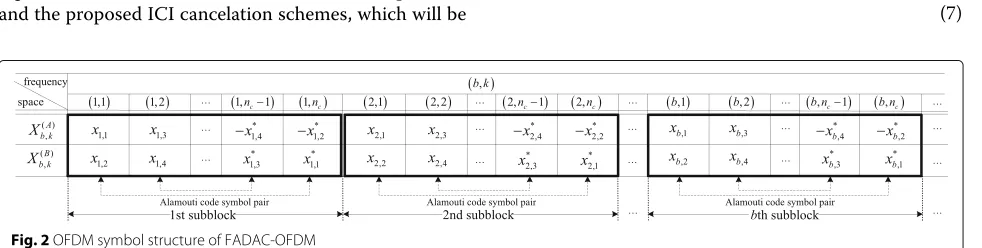
B, respectively. Figures 1 and 2 show the OFDM
sym-bol structures of the conventional distributed Alamouti-coded (CDAC) OFDM [5, 6] and FADAC-OFDM [4], respectively.
Fig. 1OFDM symbol structure of CDAC-OFDM
space-frequency Alamouti code structure [15], i.e., Xb(A,k)
andXb(B,k)are set to
Xb(A,k) =
xb,1 ifk=1,
−x∗b,2 ifk=2, (1)
X(bB,k) =
xb,2 ifk=1,
x∗b,1 ifk=2, (2)
wherexb,1 andxb,2 denote the two data symbols for the bth subblock.
Meanwhile, in FADAC-OFDM, the subblock size (the number of subcarriers per subblock) is larger than 2, and then, Alamouti-coded symbol pairs are packed into the mirror images in each subblock as shown in Fig. 2. Specifically, N-total subcarriers are partitioned into Nb
subblocks, and thus, the block sizencis equal toN/Nb.
Thus, in FADAC-OFDM,X(bA,k)andXb(B,k)for 1 ≤ b ≤ Nb
are set as follows:
Xb(A,k) =
xb,2k−1 for 1≤k≤nc/2, −x∗b,2(n
c−k+1) fornc/2+1≤k≤nc, (3)
X(bB,k) =
xb,2k for 1≤k≤nc/2, x∗b,2(n
c−k)+1 fornc/2+1≤k≤nc. (4)
We assume that the fading is locally flat over the Alamouti-coded block. To justify this assumption, the block sizencis set smaller than the coherent bandwidth.
From Figs. 1 and 2, it is straightforward that as an extreme
case, the FADAC-OFDM with nc = 2 is equivalent to
CDAC-OFDM.
2.2 RX structure of FADAC-OFDM
Figure 3 shows the overall structures for the previous and the proposed ICI cancelation schemes, which will be
explained later. The parts inside the bold boxes which are common to both structures correspond to the RX struc-ture of FADAC-OFDM. We assume that there exists an inevitable carrier frequency offset (CFO) between fc(A)
and fc(B) which denote the received carrier frequencies
from distributed TX antennasAandB, respectively. Two FFTs (fast Fourier transforms) are performed on the RX signal by separately synchronizing to two asynchronous TX antennas’ carrier frequencies and arrival timings.
Let the variablesr(A)andr(B)denote two FFT input vec-tors synchronized to TX antennasAandB, respectively, as shown in Fig. 3, then the FFT outputs corresponding to thekth elements of thebth subblock of two TX antennas are expressed as [10]
R(bA,k) = Hb(A,k)Xb(A,k)+Ib(A,k)+w(bA,k) (5)
R(bB,k) = Hb(B,k)Xb(B,k)+Ib(,Bk)+w(bB,k) (6)
wherew(bA,k)andw(bB,k)are AWGN terms andHb(A,k)andHb(B,k) are channel fading coefficients at the kth subcarrier of thebth subblock from TX antennas A and B, respectively, and they are each independent and follow zero mean, unit variance complex Gaussian distribution.
The variablesIb(A,k)andIb(B,k)denote ICI terms due to CFO and they are expressed as follows:
Ib(A,k)= Nb
β=1 nc
m=1
Q((β−b)nc+m−ε−k)Hβ(B,m)Xβ(B,m),
(7)
a
b
Fig. 3Receiver structures for the previous scheme in [10] (a) and the proposed scheme (b)
Ib(B,k)= Nb
β=1 nc
m=1
Q((β−b)nc+m+ε−k)Hβ(A,m)X( A) β,m
(8)
where ε is the normalized CFO between two transmit
antennas, i.e.,ε = (fc(B)−fc(A))/fwhere fis the
sub-carrier spacing and Q(x) is the ICI coefficient given as [16]
Q(x)= sin(πx) Nsin((π/N)x)exp
jπ(1−1/N)x. (9)
With a typical Alamouti decoding, the normalized deci-sion variables (DVs) x˜b,2k−1 and x˜b,2k corresponding to xb,2k−1andxb,2k, respectively, are obtained as follows:
˜
xb,2k−1 =
Hb∗,(kA)R(bA,k)+Hb(B,n)
c−k+1R ∗(B) b,nc−k+1
Hb(A,k)2+Hb(B,n)
c−k+1
2
, (10)
˜
xb,2k =
Hb∗,(kB)R(bB,k)−Hb(A,n)
c−k+1R ∗(A) b,nc−k+1
Hb(B,k)2+Hb(A,n)
c−k+1
2
. (11)
Substituting (5) and (6) into (10), with Xb(A,k) and Xb(B,k) replaced by (3) and (4), results inx˜b,2k−1as the summation of the data symbolxb,2k−1and degrading effect terms, i.e., interference termib,2k−1and noise termwb,2k−1, respec-tively, as follows [4]:
˜
xb,2k−1=xb,2k−1+
Hb∗,(kA)Ib(A,k)+Hb(B,n)
c−k+1I ∗(B)
b,nc−k+1
Hb(A,k)2+Hb(B,n)
c−k+1
2
interference term,ib,2k−1
+ H
∗(A)
b,k w
(A)
b,k +H
(B)
b,nc−k+1w ∗(B)
b,nc−k+1
Hb(A,k)2+Hb(B,n)
c−k+1
2
.
noise term,wb,2k−1
(12)
w∗b(,nB)
c−k+1. Meanwhile, substituting (7) and (8) intoib,2k−1 in (12), ib,2k−1 is expressed as the summation of the intra-block ICI and inter-block ICI terms, as follows:
ib,2k−1=
We assume that the block size nc is set smaller than
coherent bandwidth, that is, the fading is locally flat over the Alamouti-coded block. By our assumption,Hb(A,k)and Hb(B,k)are replaced byHb(A) andHb(B), respectively. There-fore, iintrab,2k−1 is expressed as the summation of the four
interference termsiintra,b,2k−(11),iintra,b,2k−(12),iintra,b,2k−(13), andiintra,b,2k−(41), as
Figure 4 shows the variances of the four interference
terms mentioned above forε = 0.2 andε = 0.5. Intu-carriers of the half subblock where the desired subcarrier
5 10 15 20 25 30
Measured ICI power [dB]
subcarrier index, k
ε=0.2 ε=0.5 ib,2intra,(1)k−1,1, ib,2intra,(4)k−1,1
ib,2intra,(2)k−1,1, ib,2intra,(3)k−1,1
Fig. 4The variances of the four terms in intra-block ICI withnc=32 forε=0.2 andε=0.5
belongs to, whereasiintra,b,2k−(12)andiintra,b,2k−(13)are the ICI from the other half subblock [4].
Let us focus on one of the dominant intra-block ICI terms iintra,b,2k−(14). From (9), Q(x) = Q∗(−x), and thus, Q∗(−(m−ε−k))=Q(m+ε−k), and from (3) and (4), X(bA,n)
c−m+1 = −X ∗(B)
b,m. Using these properties and
intro-ducing a new indexing variable, i.e.,m = nc−m+1 to
rearrangenc/2+1≤m≤ ncin reverse order,iintra,b,2k−(41)in
(14) can be rewritten as
Therefore, (12) is rewritten as the summation of the data symbol, the minor part of the intra-block ICI term, inter-block ICI term, and additive noise term, as follows:
˜
xb,2k−1=xb,2k−1+2ibintra,,2k−(21)+iinterb,2k−1+wb,2k−1 (17)
Using a similar calculation and notation,xb,2k is
repre-sented without difficulty and loss of generality as
˜
xb,2k=xb,2k+2ibintra,,2k(2)+ibinter,2k +wb,2k. (18)
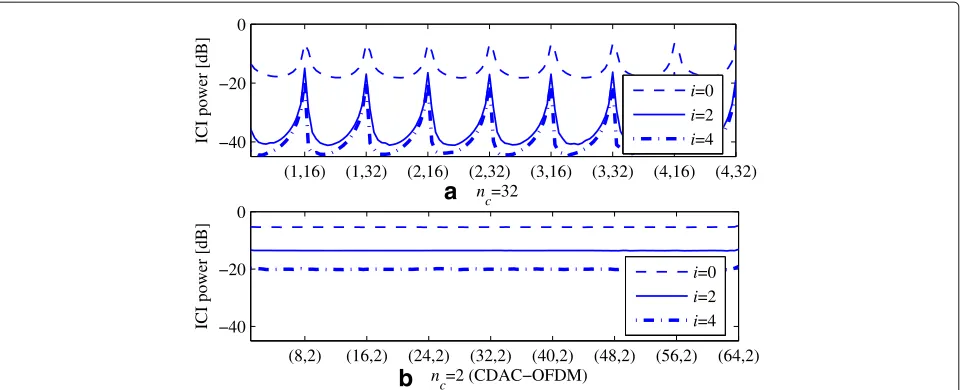
Figure 5a shows the normalized average ICI powers in the decision variables according to the pair of subblock number and subcarrier index, i.e.,(b,k)with N = 256 andnc = 32. The termiin the legend denotes the
num-ber of the iterative cancelations whose detailed algorithm will be proposed in the subsequent subsection. In Fig. 5a, it is shown that even without the iterative cancelation
(i = 0), the ICI power of FADAC-OFDM is maintained
lower than−15 dB in the middle of half subblocks even for a large ε, i.e., 0.5. This is due to the intrinsic prop-erty of FADAC-OFDM, i.e., the major ICI terms from the neighboring subcarriers in the considered subblock are completely self-canceled. Meanwhile, despite intra-block ICI self-cancelation, the ICI power sharply increases at the half band edges (k = nc/2 ork = nc). This is because
in the vicinity of the half subblock edges, the frequency distances between the considered subcarrier and the sub-carriers belonging to the counterpart (the other side) half subblock or the consecutive subblocks decrease and the interferences from these subcarriers are not canceled by FADAC-OFDM as shown in (17) and (18).
Motivated from this, by using an iterative cancelation step which will be introduced in the next section, we try to cancel further the remaining ICI terms. In Fig. 5a, by employing iterative cancelation, it is shown that ICI powers at half band edge and band edge significantly decrease compared to the case before iterative cancela-tion. However, the ICI powers at half subblock edges are still relatively large compared to the middle band. This is because the iterative ICI cancelation is not perfect, and thus, the reason for high interferences at the half subblock edges mentioned above still holds.
For a reference, Fig. 5b shows the normalized ICI power
of FADAC-OFDM with nc = 2 which is equivalent to
CDAC-OFDM. With nc = 2, the feature of
FADAC-OFDM, i.e., self-cancelation of the intra-block ICI term, is meaningless because there exists only one subcarrier in each half subblock. Thus, the ICI powers over all subcarriers are very high as shown in Fig. 5b, and the iter-ative cancelation is not so effective either. This implies that CDAC-OFDM is not suitable for the frequency-asynchronous distributed antenna systems.
Figure 6 shows the bit error rate (BER) results of
FADAC-OFDM according to the subblock size nc with
ε = 0.5 for the several cases of Tmax which denotes
the maximum delay spread of multi-path, andT denotes
the OFDM symbol duration. It is shown that the opti-malncis larger than 2 and is getting larger as the delay
spread decreases, which accords with our expectation. In addition, as the delay spread decreases, the suboptimal zone where the performance is rather insensitive toncis
getting wider. However, ifnc is set excessively large, the
performance is getting worse.
(1,16) (1,32) (2,16) (2,32) (3,16) (3,32) (4,16) (4,32)
−40 −20 0
n
c=32
ICI power [dB]
(8,2) (16,2) (24,2) (32,2) (40,2) (48,2) (56,2) (64,2)
−40 −20 0
b
a
n
c=2 (CDAC−OFDM)
ICI power [dB]
i=0
i=2
i=4
i=0
i=2
i=4
2 4 8 16 32 64 128 256
10−4
10−3
10−2
10−1
subblock size, n
c
BER
Tmax=T/10 T
max=T/50 Tmax=T/100
Fig. 6The BER results according toncfor the severalTmaxs,ε=0.5 for BPSK withEb/N0=20 dB
3 Combining iterative ICI cancelation schemes to FADAC-OFDM
3.1 The previous iterative ICI cancelation scheme for FADAC-OFDM
The procedure of the previous iterative ICI cancelation scheme to FADAC-OFDM in [10] is shown in Fig. 3a. First, FADAC-OFDM is performed for initial detection. Then, the estimated ICI terms are generated by using initial detection symbols and channel information to subtract ICI terms from RX signal. This is iteratively performed by updating the detection symbols at each iteration. Denote
ˆ
x(bi,2)k−1andxˆ(bi,2)kas the detection symbols obtained by slic-ingx˜b,2k−1andx˜b,2k in (17) and (18), respectively, at the ith iteration. By substitutingxˆ(bi,2)k−1andxˆ(bi,2)kinto (3) and (4) and then into (7) and (8), we reconstruct the estimated versions ofIb(A,k)andIb(B,k), respectively, at theith iteration. DenoteIˆb(A,k)(i)andˆIb(,Bk)(i)as the estimated versions ofIb(A,k) andIb(B,k) at the ith iteration, respectively. We update the FFT outputsR(bA,k)andR(bB,k)at theith iteration as follows:
R(bA,k,i)←Rb(A,k)− ˆIb(A,k,i), (19)
R(bB,k,i)←Rb(B,k)− ˆIb(B,k,i), (20)
whereRb(A,k,i)andRb(B,k,i)denote the updated versions ofR(bA,k) andR(bB,k), respectively, at theith iteration. Finally, at each iteration, we perform the Alamouti combining in (10) and (11) usingR(bA,k,i)andR(bB,k,i)to obtain the updated detection symbolsxˆ(bi,2+k1−)1andxˆ(bi,2+k1), respectively, for the next ((i+ 1)th) iteration.
In [10], it is shown that due to the good performance of FADAC-OFDM by intra-subblock ICI self-cancelation, this basic iterative scheme for FADAC-OFDM achieves better performance with lower complexity compared with [5]. However, this scheme still has room to be improved. Due to high ICI power at the subband edges shown in
Fig.5, the detection symbols at those edges are more likely to be erroneously detected compared to the other detec-tion symbols. The incorrect detecdetec-tion symbols result in the incorrect ICI term reconstruction and thus the incor-rect ICI cancelation. As a result, even with increasing iterations, the improvement of performance is limited and the error probability is stuck in a certain point where the non-negligible incorrect contribution to the recon-structed ICI term is not self-corrected by the iterations any more. This will be checked out again in the simulation results.
3.2 The proposed iterative ICI cancelation schemes In the previous section, we addressed the issue of the pre-vious iterative ICI cancelation in [10], i.e., the drawback of using the entire detection symbols for ICI reconstruction and cancelation. To tackle this issue, we propose two types of selective ICI cancelation schemes.
3.2.1 Scheme I. DS scheme
As the first scheme to avoid the problem of using the unreliable symbol detection at the subband edges, we simply do not use the fixed number of symbols at the sub-band edges for ICI term reconstruction. In other words, if we denotexˆ(bi,2,usedk−1) andxˆ(bi,2,usedk ) as the symbol estimates which will be finally used to reconstruct the ICI terms for cancelation at theith iteration, they are set as follows:
ˆ
x(bi,2,usedk−1) =
0 ifk∈E
ˆ
x(bi,2)k−1, elsewhere , (21)
ˆ
x(bi,2,usedk ) =
0 ifk∈E
ˆ
x(bi,2)k, elsewhere , (22)
whereE is a set of indices of edge subcarriers, i.e.,E =
{1, 2,. . .,M,nc
2 −M+1,n2c −M+2,. . .,n2c}, andMis the number of data symbols (subcarriers) at each edge to be excluded in the ICI term reconstruction. For exam-ple, ifMis set to 2 withnc = 16, then setE is equal to {1, 2, 7, 8}. Consequently, 2M(=Mpairs of Alamouti code) data symbols are not used, and they are replaced by null data symbols in the ICI term reconstruction. Simply by excluding 2Mdetection symbols at the edge in each sub-block which are severely interfered by inter-sub-block ICIs, we can avoid the performance degradation due to wrong ICI term cancelation. Another merit of this scheme is that it does not need any additional hardware or computations compared to [10].
ICI power at each subcarrier instantaneously varies. This implies that some of the edge subcarriers can eventually undergo rather small instantaneous ICI despite the high average ICI power. As we need the instantaneous relia-bility of the detection symbols to decide whether or not to use each detection symbol, the proposed DS (deter-ministically selective) scheme which simply excludes the fixed number of band edge subcarriers still has room to be improved if we can accommodate the instantaneous reliability of the detection symbols.
3.2.2 Scheme II. AS scheme
To alleviate the problem of the proposed DS scheme men-tioned in the previous paragraph, we propose another so-called adaptively selective (AS) scheme. In the proposed AS scheme, we use two measures for the instantaneous reliability of the detection symbols. As one of the relia-bility measures, we use the square error between the soft decision variablex˜and its nearest constellation pointxˆas the tentative decision value [11]. Let us denote this relia-bility measure for a certain detection symbolxˆbyγ, then it is calculated as
γ = |˜x− ˆx|2. (23)
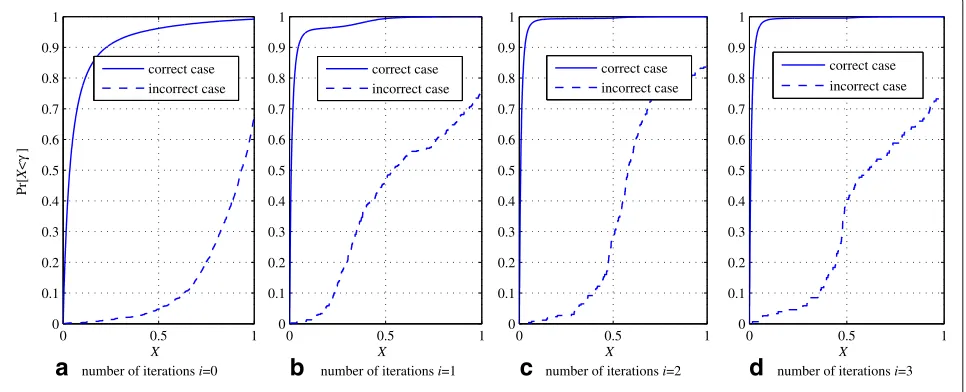
In order to check whether or not this measure well reflects the reliability of the detection symbol, we sim-ulated the cumulative distribution function (CDF) of γ for the correct detection case and the incorrect
detec-tion case. Figure 7 shows CDFs of γ for two (correct
and incorrect) cases when N = 256 andnc = 16. It is
clear in Fig. 7 that γ for the correct case is distributed in the quite low range whereas γ for the incorrect case is distributed in the quite high range. For example, in the initial (i = 0) detection, for the correct detection case, 96% ofγs is smaller than 0.5 whereas for the incorrect
detection case, 95% ofγs is larger than 0.5. This feature becomes even more remarkable as the iteration goes on. This implies that by simply comparingγ with a threshold, we can properly measure the reliability of the correspond-ing detection symbol. We use the followcorrespond-ing criterion to decide whether or not to use the detection symbol in the ICI reconstruction.
wherexˆ(used)denotes the actual value which will be used in the ICI reconstruction andρis a threshold value which determines whether or not the detection is sufficiently reliable or not.
Note in Fig. 7 that this criterion possibly misses the cor-rect symbols or possibly uses the incorcor-rect symbols in the ICI reconstruction step. The thresholdρshould be set by considering both of these two possibilities. The optimum value will vary according to the channel parameters, the system parameters, or even the iteration layer. However, in the practical system, it is likely to use, rather, a constant threshold, i.e., global suboptimal setting, and thus, we can-not avoid the performance loss compared to the optimized case.
To complement this, we use another measure to assess the reliability of the detection symbols, i.e., detection con-sistency between two consecutive iterations. If a certain detection symbol is sufficiently reliable at theith iteration, the detection result would not change in the(i+1)th iter-ation. Hence, we treat a detection symbol as the reliable one if its detection result is maintained between two con-secutive iterations. This measure well compromises the probability that the first criterion in (24) uses the incor-rect symbol(s) in the ICI reconstruction step. For example, when a certain incorrect detection symbol has a smallγ,
0 0.5 1
number of iterations i=0
a
c
d
number of iterations i=2
we conclude that it eventually has the smallγ and it is unreliable if the detection result in the previous iteration is not equal to the detection result in the current iteration. Summing up, the proposed AS scheme uses the follow-ing criterion for selectfollow-ing the detection symbols in the ICI reconstruction step.
In order to check whether or not the two conditions in (25) and (26) well discriminate the correct or incor-rect detections, we have to see the two kinds of condi-tional probabilities: (1)pconditionfalse denoting the probability of incorrect symbol detection despite the condition being satisfied (“false rate” in short) and (2)pconditionmiss denoting the probability of correct symbol detection despite the condition being unsatisfied (“miss rate” in short). First, pconditionfalse for two conditions are written as follows:
pC1false = Pr
andpconditionmiss for two conditions are written as follows:
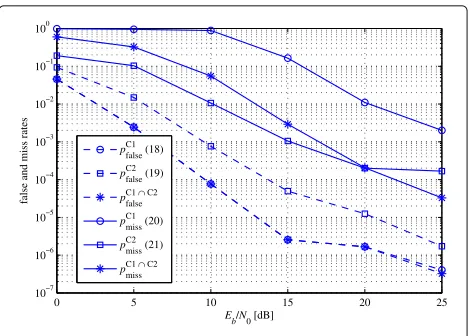
pmissC1 = Prxˆb(i,2)k−1=xb,2k−1|γb(i,2)k−1> ρ expressions hold forxb,2k, we exclude the expressions for xb,2k−1without loss of generality. To avoid the wrong can-celation, we have to lowerpconditionfalse , and to avoid missing the correct detection symbols, we have to lowerpconditionmiss . Figure 8 shows the four conditional probabilities in
(27)–(30) withρ = 0.4 and ε = 0.5. Due to
symme-try,xb,2k should have the same results. The condition C1
has smaller false rate but much larger miss rate com-pared to the condition C2. We can expect the performance improvement by jointly using the two conditions. To con-firm this, the results for the joint condition C1C2
false and miss rates
pfalseC1 (18)
which is adopted in the proposed AS scheme are also plot-ted in Fig. 8. Note that this joint condition achieves much lower miss rate than that of using the condition C1 alone while achieving the false rate as low as that of using the condition C1 alone. Compared to the condition C2, the joint condition has the similar level of miss rate in the practically high (signal-to-noise ratio) SNR region while achieving quite smaller false rate.
4 Complexity reduction
The hardware structures of the iterative cancelations in [5–7, 10] are basically the same. They all include the cal-culations for reconstructing the interference term at each FFT outputs expressed in (7) and (8) at each iteration. The interference term in (7) and (8) have 2Ncomplex multipli-cations. As there are two FFTs withNoutputs, the overall required number of complex calculations for interference term reconstruction per iteration is equal to 4N2.
Meanwhile in the proposed scheme, we modify this complexity-expensive structure into a mathematically equivalent but low complexity structure. Figure 3 shows the receiver structures for the previous iterative cancela-tion scheme in [10] and the proposed scheme. Instead of performing cancelation at the FFT output stage (subcar-rier domain), we can equivalently cancel the interference at the FFT input stage (time domain). Hence, the recon-structed interference corresponds to the time domain version. The reduced computation is intuitive due to the fact that the time domain interference takes the form of just a single sampled vector but it contains theNparallel interfering subcarriers.
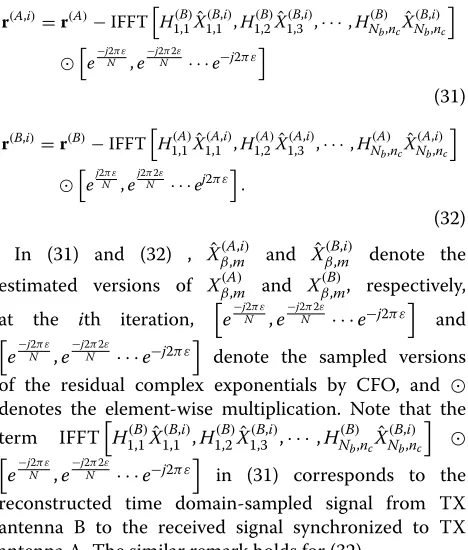
r(B,i), respectively, which are the updated versions given as
denote the sampled versions of the residual complex exponentials by CFO, and denotes the element-wise multiplication. Note that the term IFFTH1,1(B)Xˆ1,1(B,i),H1,2(B)Xˆ1,3(B,i),· · ·,HN(B)
in (31) corresponds to the reconstructed time domain-sampled signal from TX antenna B to the received signal synchronized to TX antenna A. The similar remark holds for (32).
In order to prove that the time domain ICI can-celation of the proposed scheme is identical to the frequency (subcarrier) domain cancelation, let us
expand (31) first. We denote the nth output of IFFT,
i.e., IFFT
Then, to reconstruct the received signal from the other TX antenna (antenna B here) in the time domain, the sam-pled versions of the residual complex exponential term are multiplied toη(A,i)(n). Thenth sample of the received
signal from the other TX antenna in the time domain is denoted by i(A,i)(n), and then, i(A,i)(n) is expressed as
By using the summation formula for the geometric series, (36) is rewritten as
Fk(A)= 1 thus, it is proved that the proposed time domain can-celation is equivalent to the previous subcarrier domain cancelation.
Note that in each of (31) and (32),N,N/2 log2N, and Nmultiplications are required for IFFT input vector gen-eration, N-point IFFT operation, and N-point complex sinusoid multiplication, respectively. In addition, we have to include the computations for two FFT blocks for the original OFDM demodulation which are now inside the cancelation loop (see Fig. 3a) unlike the previous sub-carrier domain cancelation schemes (see Fig. 3b). Conse-quently, 4N +2Nlog2N multiplications are required in total at each iteration to reconstruct the interference in the time domain cancelation as shown in Table 1.
Table 1The number of multiplications required in the operations for the interference term reconstruction at each branch per iteration of the proposed scheme
Operation Number of multiplications
IFFT input vector generation N
IFFT for time domain conversion N2log2N
N-point complex sinusoid multiplication N
FFT for the original OFDM demodulation N2log2N
Note that asNincreases to the practical range, the com-putational complexity of the proposed structure is pro-portional toNlog2Nwhereas that of the previous scheme is proportional toN2. Figure 9 and Table 2 compare the complexity between the previous subcarrier domain can-celation schemes and the proposed time domain cancela-tion scheme. It is remarkable that the proposed structure drastically reduces the complexity compared to the previ-ous subcarrier domain cancelation schemes while main-taining the mathematical equivalence to the subcarrier domain cancelation schemes.
5 Simulation results
In this section, we provide the simulation results to evalu-ate the performance of the proposed scheme. Commonly, we setN=256. Regarding multi-path profile for generat-ingHb(A,k)andHb(B,k), the number of multi-paths is 8 and their delays are distributed uniformly in [ 0Tmax] whereTmaxis the maximum delay spread. The guard interval is set to be larger thanTmax. The subcarrier spacing (=1/TwhereT= OFDM symbol duration prior to the guard time insertion) is set to 15 kHz by referring to the Long-Term Evolution (LTE) standard. For the proposed AS (adaptive selective) scheme, the threshold valueρis set to 0.4 regardless of the iteration number and the other parameters.
Figure 10 shows BERs of iterative ICI cancelation schemes according to the number of iterationsiforε =
0.5 with binary phase shift keying (BPSK) andTmax =
T/100,T/50, and T/10. The subblock size of
FADAC-OFDM frame nc is set to 8 irrespective of Tmax. We
exclude the extremely frequency-selective fading channels
where the optimal nc of FADAC-OFDM is equal to 2,
and then, the transmitter structure of FADAC-OFDM is trivially the same as that of CDAC-OFDM.
2 4 8 16 32 64 128 256 512 1024
0 1 2 3 4 5 6 7 8 9 10x 10
4
Number of subcarriers N
Number of complex multiplicatons
previous (subcarrier domain cancelation) proposed (time domain cancelation)
Fig. 9Number of complex multiplications per iteration
Table 2Comparison of the number of multiplications between the previous and the proposed schemes according toN
N Previous
(frequency domain)
Proposed (time domain)
Proposed/previous
64 4096 1024 0.25
128 16,384 2304 0.14
256 65,536 5120 0.07
512 262,144 11,264 0.04
1024 1,048,576 24,576 0.02
As a baseline for the performance comparison, CDAC-OFDM with the iterative ICI cancelation using the entire detection symbols in the OFDM frame is included. Note that the iterative ICI cancelation results in almost no improvement to CDAC-OFDM. This is because the initial detection performance of CDAC-OFDM under frequency-asynchronous environment is poor, and thus, the ICI cancelation based on unreliable initial detection does not work properly. On the other hand, the itera-tive ICI cancelation works better for the case when it is applied to FADAC-OFDM which has a superb initial detection performance. However, the performance gain of ICI cancelation scheme in [10] is still not so significant. This scheme uses all the detected symbols in the inter-ference reconstruction step without any consideration of the reliability of the detection symbols. Even in FADAC-OFDM, some of the detection symbols may eventually have relatively high possibility of errors due to severe ICI terms such as inter-block ICI as mentioned before. It is shown that after the first iteration, the performance fairly improves but from the second iteration, the performance is stuck in the same value. This is because the recon-structed interference term for cancelation is not updated anymore due to the erroneous portion of the constructed interference. Consequently, the performance gap between the scheme in [10] and the case of no ICI is still significant. Note that two proposed schemes in this paper achieve significantly improved performance compared to the scheme in [10]. In the first iteration, the proposed DS
scheme withM = 1 achieves a substantially decreased
BER compared to the scheme in [10]. This implies that simply excluding the band edge subcarriers can efficiently avoid the erroneous ICI reconstruction. This results in the significant improvement by the canceling ICI from the rest of the subcarriers in the first iteration. However, the band edge subcarriers will not be canceled in the remain-ing iterations as well, and the BER converges to a still significantly higher level than that of the ICI-free case.
0 1 2 3 4 5 10−7
10−6 10−5 10−4 10−3 10−2
number of iterations, i
a
Tmax=T/100b
c
BER
0 1 2 3 4 5
10−7 10−6 10−5 10−4 10−3 10−2
number of iterations, i
T max=T/50
0 1 2 3 4 5
10−7 10−6 10−5 10−4 10−3 10−2
number of iterations, i
Tmax=T/10 CDAC−OFDM +cancelation
FADAC−OFDM+cancelation [10]
proposed DS (M=1)
proposed AS (ρ=0.4)
ICI−free CDAC−OFDM +cancelation
FADAC−OFDM+cancelation [10]
proposed DS (M=1)
proposed AS (ρ=0.4)
ICI−free
CDAC−OFDM +cancelation
FADAC−OFDM+cancelation [10]
proposed DS (M=1)
proposed AS (ρ=0.4)
ICI−free
Fig. 10 a–cBER according to the number of iterations forε=0.5 and the severalTmaxs withnc=8
that adaptively selecting the detection symbols for ICI reconstruction works properly, and as the iteration goes on, even the band edge subcarriers having high ICI power are gradually canceled. Despite the inferior performance of the proposed DS scheme to the proposed AS scheme, the proposed DS scheme has a merit that it is easy to implement and needs nearly no complexity overhead.
We can further improve the performances of the pro-posed schemes by more carefully optimizing or adaptively changing the system parameters such as the subblock size
of FADAC-OFDM nc, M for the proposed DS scheme,
or ρ for the proposed AS scheme. However, we do not
cover this case because the main point of this paper is to make sure of the improved performance of the proposed schemes even with suboptimal parameters. In addition, adaptively changing the system parameters is practically a burden in terms of system implementation.
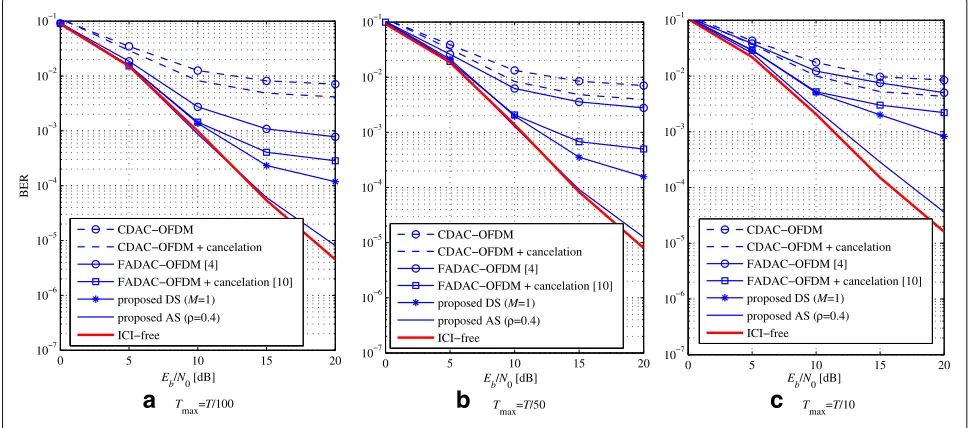
Figure 11 shows BERs according to Eb/N0with i = 4 and ε = 0.5. From Fig. 10, i is set to 4 since the
per-formances of all cases roughly converge at i = 4. The
results for the schemes without ICI cancelation are also included to see the improvement by adding the iterative
0 5 10 15 20
10−7
10−6
10−5
10−4
10−3
10−2
10−1
E
b/N0 [dB]
a
Tb
c
max=T/100
BER
0 5 10 15 20
10−7
10−6
10−5
10−4
10−3
10−2
10−1
E
b/N0 [dB]
Tmax=T/50
0 5 10 15 20
10−7
10−6
10−5
10−4
10−3
10−2
10−1
E
b/N0 [dB]
T max=T/10
CDAC−OFDM
CDAC−OFDM + cancelation FADAC−OFDM [4]
FADAC−OFDM + cancelation [10]
proposed DS (M=1)
proposed AS (ρ=0.4)
ICI−free
CDAC−OFDM
CDAC−OFDM + cancelation FADAC−OFDM [4]
FADAC−OFDM + cancelation [10]
proposed DS (M=1)
proposed AS (ρ=0.4)
ICI−free
CDAC−OFDM
CDAC−OFDM + cancelation FADAC−OFDM [4]
FADAC−OFDM + cancelation [10]
proposed DS (M=1)
proposed AS (ρ=0.4)
ICI−free
0.5 0.6 0.7 0.8 0.9 1
10−8
10−7
10−6
10−5
10−4
10−3
10−2
10 −1
frequency offset, ε
a Tmax=T/100 b c
BER
0.5 0.6 0.7 0.8 0.9 1
10−7
10−6
10−5
10−4
10−3
10−2
frequency offset, ε
Tmax=T/50
0.5 0.6 0.7 0.8 0.9 1
10−7
10−6
10−5
10−4
10−3
10−2
10−1
frequency offset, ε
Tmax=T/10 CDAC−OFDM + cancelation FADAC−OFDM [4]
FADAC−OFDM + cancelation [10]
proposed DS (M=1)
proposed AS (ρ=0.4)
ICI−free CDAC−OFDM + cancelation
FADAC−OFDM [4]
FADAC−OFDM + cancelation [10]
proposed DS (M=1)
proposed AS (ρ=0.4)
ICI−free CDAC−OFDM + cancelation
FADAC−OFDM [4]
FADAC−OFDM + cancelation [10]
proposed DS (M=1)
proposed AS (ρ=0.4)
ICI−free
Fig. 12 a–cBER according toεandi=4 for severalTmaxs withnc=8
ICI cancelation. Although there exist slight deviations in the high SNR region, the proposed AS scheme achieves nearly ICI-free performance with the fixed system param-eters over the wide SNR range and the considered delay spread range.
In Fig. 12, the BER results are plotted for the large CFO (>0.5) cases. Although the performance gradually degrades and gets off from the ICI-free level as the CFO increases, the proposed schemes still attain the signifi-cant ICI reduction. Especially, the proposed AS scheme maintains the BER still in the meaningful level even for CFO >0.5. This is because the FADAC-OFDM basi-cally holds its intrinsic feature, i.e., intra-block ICI self-cancelation irrespective of CFO although the inter-block ICI level increases as CFO increases. On the other hand, the ICI cancelation schemes to CDAC-OFDM abruptly break down as CFO gets larger than 0.5. For reference, see Fig. 5 in [6] and Fig. 5 in [7] which we cannot overlay on Fig. 12 in this paper as the system parameters and the channel parameters are not the same.
To investigate the performance under the practical sit-uation, we also consider the case when there exists a channel estimation error. Figure 13 shows the BER results of each cancelation scheme according to the variance of the channel estimation error withε=0.5,i=4,Eb/N0= 20 dB, Tmax = T/250, and nc = 32. The model of the
imperfect channel estimation in [13] is employed, and the channel estimation error refers to the normalized one by the mean channel gain. The results show that per-formance degradation of the proposed scheme increases and the performance gaps among the schemes accord-ingly decrease as the variance of the error exceeds 0.2.
Note however that in the practical range of the chan-nel estimation error, say, lower than 0.2, all the schemes’ performances are almost insensitive to the channel esti-mation error and thus the significant performance gap between the proposed AS scheme and the other schemes still remains the same.
6 Conclusions
We proposed an enhanced iterative ICI cancelation scheme distributed Alamouti-coded OFDM both in terms of the performance and the complexity. By avoiding the incorrect cancelation due to incorrect symbols, the pro-posed scheme achieves better performance than other ICI cancelation schemes. Only within three or four iterations,
0 0.1 0.2 0.3 0.4 0.5
10−6 10−5 10−4 10−3 10−2 10−1 100
Variance of the channel estimation error
BER
CDAC−OFDM + cancelation FADAC−OFDM + cancelation [10] proposed AS (ρ=0.4)
the proposed scheme achieves near ICI-free performance by instantaneously reflecting the reliability of detection symbols at each iteration. As for complexity, by con-verting the ICI cancelation with functional equivalence, the proposed scheme has a drastically reduced computa-tional complexity. The performance results shown in this paper sufficiently appeal as a promising solution for the current and future cooperative transmit antenna systems using OFDM waveform and Alamouti code. The proposed scheme will be further improved by combining with some sophisticated schemes, such as the adaptively selective cancelation based on the soft decision feedback [12]. We leave this as one of our future works.
Acknowledgements
This work was supported in part by the DGIST R&D Program of the Ministry of Science, ICT and Future Planning, Korea (17-IT-01), Basic Science Research Program through the National Research Foundation (2015R1D1A3A01015970) funded by the Ministry of Education, and the Information Technology Research Center support program (IITP-2016-R2718-16-0035) supervised by the Institute for Information & Communications Technology Promotion funded by the Ministry of Science, ICT and Future Planning, Korea.
Competing interests
The authors declare that they have no competing interests.
Author details
1Advanced Radar Technology Laboratory in DGIST, 333 Techno
Jungang-daero, Hyeonpung-myeon, Dalseong-gun, Daegu, 42988, Republic of Korea.2Department of ICE in Yeungnam University, 280 Daehak-Ro,
Gyeongsan, Gyeongbuk, 38541, Republic of Korea.
Received: 7 June 2016 Accepted: 1 February 2017
References
1. H Wang, XG Xia, Distributed space-frequency codes for cooperative communication systems with multiple carrier frequency offsets. IEEE Trans. Wirel. Commun.8(2), 1045–1055 (2009)
2. Z Li, XG Xia, An Alamouti coded OFDM transmission for cooperative systems robust to both timing errors and frequency offsets. IEEE Trans. Wirel. Commun.7(5), 1839–1844 (2008)
3. K Choi, Inter-carrier interference-free Alamouti-coded OFDM for cooperative systems with frequency offsets in non-selective fading environments. IET Commun.5(15), 2125–2129 (2011)
4. B Kim, K Choi, FADAC-OFDM: frequency asynchronous distributed Alamouti-coded OFDM. IEEE Trans. Vehi. Tech.64(2), 466–480 (2015) 5. Y Zhang, J Zhang, inProc. IEEE WCNC 2009. Multiple CFOs compensation
and BER analysis for cooperative communication systems, (2009), pp. 1–6 6. T Lu, H Lin, T Sang, inProc. IEEE ISPMRC 2010. An SFBC-OFDM receiver to
combat multiple carrier frequency offsets in cooperative communications, (2010)
7. J Lee, H Lin, T Sang, inProc. IEEE ISCAS 2012. An SFBC-OFDM receiver with MLSE equalizer to combat multiple carrier frequency offsets, (2012) 8. Y Yao, X Dong, Multiple CFO mitigation in amplify-and-forward
cooperative OFDM transmission. IEEE Trans. on Commun.12(60), 3844–3854 (2012)
9. K Lee, D Williams, inProc. IEEE GLOBECOM ’00. A space-frequency transmitter diversity technique for OFDM systems, (2000), pp. 1473–1477 10. B Kim, J Lee, D Jeong, K Choi, inProc. ITNG 2014. Combining successive ICI
cancelation to ICI suppressed Alamouti coded OFDM for frequency asynchronous distributed antenna systems, (2014)
11. OE Agazzi, N Seshardsi, On the use of tentative decisions to cancel intersymbol interference and nonlinear distortion (with application to magnetic recording channels). IEEE Trans. Inf. Theory.2(43), 394–408 (1997)
12. SH Muller, WH Gerstacker, JB Huber, inProc. GLOBECOM ’96. Reduced-state soft-output trellis-equalization incorporating soft feedback, (1996), pp. 95–100
13. Y Chen, C Tellambura, Performance analysis of maximum ratio transmission with imperfect channel estimation. IEEE Commun. Lett.4(9), 322–324 (2005)
14. B Zhou, Y Xiao, P Yang, S Li, inProc. WiCOM, 2011. An iterative CFO compensation algorithm for distributed spatial modulation OFDM systems, (2011)
15. SM Alamouti, A simple transmitter diversity scheme for wireless communications. IEEE J. Select. Areas Commun.16(8), 1451–1458 (1998) 16. P Dharmawansa, N Rajatheva, H Minn, An exact error probability analysis of OFDM systems with frequency offset. IEEE Trans.Commun.57(1), 26–31 (2009)
Submit your manuscript to a
journal and benefi t from:
7Convenient online submission
7Rigorous peer review
7Immediate publication on acceptance
7Open access: articles freely available online
7High visibility within the fi eld
7Retaining the copyright to your article
![Fig. 3 Receiver structures for the previous scheme in [10] (a) and the proposed scheme (b)](https://thumb-us.123doks.com/thumbv2/123dok_us/932517.1113343/4.595.59.539.87.431/fig-receiver-structures-previous-scheme-proposed-scheme-b.webp)