Toward understanding the 3.4
µ
µ
µ
µ
µ
µ
µ
µ
m and 9.7
µ
µ
µ
µ
µ
µ
µ
µ
m extinction feature variations
from the local diffuse interstellar medium to the Galactic center
Jian Gao1,2, B. W. Jiang1, and Aigen Li2
1Department of Astronomy, Beijing Normal University, Beijing, 100875, China 2Department of Physics and Astronomy, University of Missouri, Columbia, Missouri 65211, USA
(Received August 10, 2008; Revised November 28, 2008; Accepted December 4, 2008; Online published February 12, 2010)
Observationally, both the 3.4µm aliphatic hydrocarbon C-H stretching absorption feature and the 9.7µm amorphous silicate Si-O stretching absorption feature show considerable variations from the local diffuse inter-stellar medium (ISM) to Galactic center (GC): both the ratio of the visual extinction (AV) to the 9.7µm Si-O
optical depth (τ9.7µm) and the ratio ofAVto the 3.4µm C-H optical depth (τ3.4µm) of the solar neighborhood
local diffuse ISM are about twice as much as that of the GC. In this work, we try to explain these variations in terms of a porous dust model consisting of a mixture of amorphous silicate, carbonaceous organic refractory dust (as well as water ice for the GC dust).
Key words:Interstellar extinction, dust, silicate, aliphatic hydrocarbon, infrared astronomy.
1.
Introduction
The interstellar extinction law is one of the primary sources of information about the interstellar grain popula-tion, and one often obtains direct information on the compo-sition of interstellar dust from spectral features in extinction (Draine, 2003). These spectral features also provide strong constraints on interstellar grain models. With the advent of ground-based and space borne infrared (IR) telescope facil-ities, the IR extinction continuum and absorption features have been receiving increasing attention and play an essen-tial role in recovering the intrinsic energy distribution of ce-lestial objects and inferring the characteristics of interstellar dust.
In the interstellar extinction curve, the 2175 ˚A bump is outstanding in the ultraviolet (UV), while in the IR, there are a number of prominent absorption features as well: (1) the ubiquitous 9.7µm and 18µm features respectively due to the Si-O stretching and O-Si-O bending modes of amorphous silicates; (2) the 3.4µm feature due to the C-H stretching mode of aliphatic hydrocarbon dust, as ubiq-uitously present in the ISM of the Milky Way and exter-nal galaxies as the 9.7µm and 18µm silicate bands, ex-cept this feature is not seen in dense molecular clouds (see Pendleton, 2004 for a review); (3) the 3.3µm and 6.2µm weak features seen in both local sources and GC sources (Schutteet al., 1998; Chiaret al., 2000), respectively due to the C-H stretching and C-C stretching modes of poly-cyclic aromatic hydrocarbon (PAH) molecules; and (4) in dense clouds the 3.1µm feature due to the O-H stretching mode of water ice as well as a number of weaker features at 4.68µm (CO), 7.68µm (CH4), 4.28µm, 15.2µm (CO2),
Copyright cThe Society of Geomagnetism and Earth, Planetary and Space Sci-ences (SGEPSS); The Seismological Society of Japan; The Volcanological Society of Japan; The Geodetic Society of Japan; The Japanese Society for Planetary Sci-ences; TERRAPUB.
doi:10.5047/eps.2008.12.006
3.54µm, 9.75µm (CH3OH).
The 9.7µm silicate extinction profile varies among dif-ferent sightlines; in particular, its optical depth τ9.7µm
(relative to the visual extinction AV) shows considerable
variations from the local diffuse ISM (LDISM) to the Galactic center (GC): AV/τ9.7µm ≈18.2 for LDISM
dif-fers from that of the GC (AV/τ9.7µm ≈ 8.4) by a
fac-tor of∼2.2 (see Table 1; also see Draine, 2003).∗1 Roche
and Aitken (1985) argued that AV/τ9.7µmvaries because
there are fewer carbon stars in the central regions of the Galaxy and the production of carbon-rich dust may be sub-stantially reduced compared with the outer Galactic disk. However, as shown in Table 1, the 3.4µm C-H feature of aliphatic hydrocarbon dust also exhibits a similar behavior:
AV/τ3.4µm ≈ 274 for LDISM is higher than that of the
GC (AV/τ3.4µm≈146) by a factor of∼1.9 (see Table 1).
If the argument of Roche and Aitken (1985) was valid, one would expect a much smallerAV/τ3.4µmratio in the
LD-ISM than that of the GC. Sandfordet al.(1995) tried to quantitatively explain this phenomena by assuming that the abundance of the C-H carrier (relative to other dust com-ponents) gradually increases from the local ISM toward the GC.∗2 However, this requires that amorphous silicate dust
and aliphatic hydrocarbon dust should not be solely respon-sible for the visual extinction. If one has to invoke an addi-tional dust component (most likely a population of carbon dust which does not show the characteristic 3.4µm feature, say, graphite) making an appreciable contribution to AV,
one would encounter a severe carbon budget problem (see Snow and Witt, 1996).
∗1Cohen et al. (1989) argued that the observed 9.7µm dip on which
τ9.7µmwas measured may be partly contributed by PAHs (i.e. the red
tails of the PAH 7.7µm and 8.6µm bands and the blue tail of the 11.3µm band could form an “artificial” 10µm dip). But this would result in a smallerτ9.7µmfor the GC and a largerτ9.7µmfor the LDISM (since
the PAH emission is more likely to present in the LDISM while toward the GC PAHs are seen in absorption), quite on the opposite.
Table 1. Observational values ofAV/τ3.4µmandAV/τ9.7µm. AV/τ3.4µm AV/τ9.7µm References
240±40 Sandfordet al.(1991)
250±40 Pendletonet al.(1994)
333 16.7 Adamsonet al.(1990)
Local diffuse ISM
18.5 Roche and Aitken (1984)
18.5±2 Draine (2003)
19.2±0.6 Boweyet al.(2004)
Mean for local ISM 274 18.2
150±20 Pendletonet al.(1994)
143 8.31 McFadzeanet al.(1989)
Galactic Center
8±3 Becklinet al.(1978) 9 Roche and Aitken (1985)
Mean for GC 146 8.4
Along the lines of sight toward the GC, there are dense molecular clouds.∗3In cold, dense molecular clouds,
inter-stellar dust is expected to grow through coagulation (as well as accreting an ice mantle) and the dust is likely to be porous (Jura, 1980). In this work, we demonstrate that the observed variations of AV/τ9.7µm and AV/τ3.4µm from the
LD-ISM to the GC could be explained in terms of composite porous dust.
2.
Model
We consider a composite porous dust model consisting of amorphous silicate, carbon, and vacuum (in dense clouds silicate dust and carbon dust are coated with water ice). We take the optical constants of Draine and Lee (1984) for amorphous silicate, of Li and Greenberg (1997) for car-bonaceous organic refractory (to represent the carbon dust component), of Li and Greenberg (1998) for water ice. The mass densities of silicate dust, organic refractory dust and ice are taken to beρsil ≈ 3.5 g cm−3,ρcarb ≈ 1.8 g cm−3
andρice ≈1.2 g cm−3, respectively. We take the mass ratio
of organic refractory dust to silicate dust to bemcarb/msil=
0.7 and the mass ratio of water ice to organic refractory dust and silicate dust to bemice/ (mcarb+msil)=0.8, as inferred
from the cosmic abundance constraints (see appendix A of Li and Lunine, 2003a).
For the dust in the local diffuse ISM, we assume the dust to be a solid compact mixture of amorphous silicate and organic refractory materials withmcarb/msil=0.7. We take
the dust size to bea=0.1µm, the typical grain size for the dust in the diffuse ISM (see Draine, 1995). For the dust in the dense molecular clouds along the lines of sight toward the GC, we assume that silicate dust and organic refractory dust are equally coated with an ice layer and then form a
∗2They also pointed out that the C-H and Si-O carriers may be coupled,
perhaps in the form of silicate-core organic-mantle grains. This idea is challenged by the nondetection of the 3.4µm feature polarization along sightlines where the 9.7µm feature polarization is detected (Adamsonet al., 1999; Chiaret al., 2006; also see Li and Greenberg, 2002). It is possible that the 3.4µm feature may be not produced by a carrier residing in a mantle on a silicate core but by very small (unaligned) grains (Chiar
et al., 2006).
∗3The sightline toward the Galactic center source Sgr A∗ suffers about
∼30 mag of visual extinction (e.g. see McFadzeanet al., 1989), to which molecular clouds may contribute as much as∼10 mag (Whittetet al., 1997).
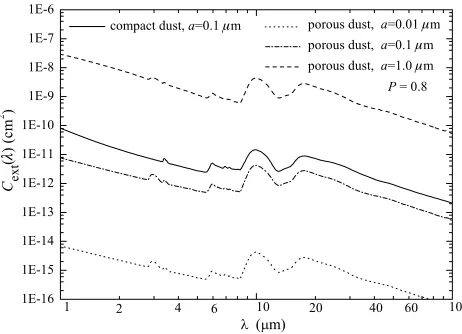
Fig. 1. Extinction cross sectionsCext(λ)of different types of dust. The 3.1µm water ice O-H feature shows up in the extinction profiles of porous dust.
porous aggregate (see Li and Lunine, 2003b). For porous dust, a key parameter is the porosity P (or fluffiness; the fractional volume of vacuum in a grain). We will consider a range of porosities. We assume all grains are spherical in shape; the porous grain sizea is defined as the radius of the sphere encompassing the entire porous aggregate. In order to find suitable porosityPand dust sizeafor the dust in the dense molecular clouds to reproduce the observed
AV/τ9.7µm and AV/τ3.4µm ratios toward the GC, we
leave bothPandaadjustable.
We use Mie theory in combination with the Maxwell-Garnett and Bruggeman effective medium theories (Bohren and Huffman, 1983; see eqs. 7–9 of Li and Lunine, 2003b and Kimuraet al., 2008b) to calculate the optical properties of composite porous grains. This approach is valid for com-puting the integral scattering characteristics (e.g. extinction, scattering, absorption cross sections, albedo and asymme-try parameter; see Hage and Greenberg, 1990; Wolffet al., 1994).
For illustration, we plot in Fig. 1 the 1–100µm extinction cross sectionsCext(λ)of compact dust (for the local diffuse
ISM) and porous dust (for dense clouds toward the GC). For a given dust size, both AV andτ3.4µm, τ9.7µm
Fig. 2. Schematic illustration of obtainingCext(9.7µm), the excess 9.7µm extinction cross section above the continuum. It is obtained by (1) fitting the 9.7µm model profile with a Drude function and subtracting the continuum which is fitted with a six-order polynomial, (2) integrating the continuum-subtracted extinction profile (which is approximated by a Drude function) over wavelength, and finally (3) dividing the integrated value with the width of the interstellar 9.7µm silicate absorption feature.
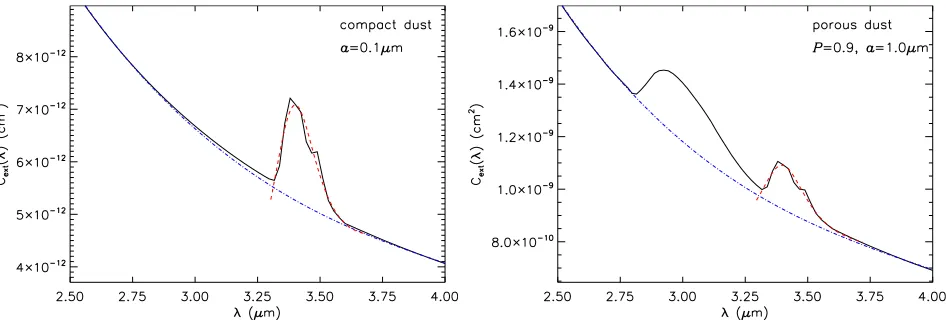
Fig. 3. Same as Fig. 2 but for the 3.4µm feature. In the right panel, the 3.1µm water ice O-H feature shows up in the extinction profile of porous dust.
is somewhat less significant forτ3.4µmandτ9.7µmthan
for AV(thusAV/τ3.4µmand AV/τ9.7µm decrease
mod-erately with the increase ofP; see Table 2). This is because with the same size, a porous grain contains less dust mate-rial than its solid counterpart. The effective dielectric func-tions of porous dust are reduced. In the IR the extinction for dust of∼0.1µm is dominated by absorption (i.e. in the Rayleigh regime) and is roughly proportional to the imagi-nary parts of the dielectric functions (see Li, 2008). There-fore porous dust produces smaller τ3.4µm and τ9.7µm
than its solid counterpart of the same size. In the optical, both absorption and scattering are important. The introduc-tion of vaccum leads to a reducintroduc-tion of the dielectric func-tions of the dust which will decrease both the absorption and scattering.
For models consisting of single-sized dust, the ratio of
AVto the optical depth of the 9.7µm silicate feature is
sim-ply AV/τ9.7µm ≈ 1.086Cext(V)/Cext(9.7µm), where
Cext(V) is the extinction cross section at V band (λ =
5500 ˚A),Cext(9.7µm)is theexcessextinction cross
sec-tion of the 9.7µm feature above the continuum, and the factor “1.086” arises from the conversion of extinction (in magnitude) to optical depth. We obtainCext(9.7µm)by
integrating the 9.7µm model extinction profile (with the
continuum subtracted) over wavelength (see Fig. 2 for il-lustration) and then dividing the integrated value with the width of the interstellar 9.7µm silicate absorption feature. The same procedure is applied to the 3.4µm feature to calculateCext(3.4µm)so as to obtain AV/τ3.4µm (see
Fig. 3 for illustration).
3.
Results and Discussion
We calculate AV/τ3.4µm and AV/τ9.7µm for various
dust models with a range of porosities and dust sizes. The results are tabulated in Table 2. For a given dust size
a=0.1µm, porous dust results in smallerAV/τ3.4µmand
AV/τ9.7µmvalues than compact dust (see Section 2). This
is encouraging that porous dust which is likely present in the dense molecular clouds along the sightlines toward the GC indeed is on the right track to account for the observed
AV/τ3.4µmandAV/τ9.7µmvariations from the local
dif-fuse ISM to the GC. More specifically, from Table 2 we see that the dust withP ∼0.8–0.9 anda ∼0.5–1µm can ap-proximately explain the observed variations ofAV/τ3.4µm
andAV/τ9.7µm(by a factor of∼2) from the local diffuse
Table 2. AV/τ3.4µmandAV/τ9.7µmcalculated for various dust models.
Dust Porosity size AV/τ3.4µm FWHM AV/τ9.7µm FWHM
model P (µm) (µm) (µm)
Diffuse ISM dusta 0 0.1 243 0.14 38.2 2.18
0.1 0.1 216 0.14 32.3 2.19
0.2 0.1 192 0.14 27.3 2.19
0.1 80 0.14 5.9 2.18
0.5 150 0.15 13.3 2.18
0.8 1.01.5 186127 0.170.19 16.314.8 2.182.21
2.0 102 0.19 11.5 2.26
GC dust 3.00.1 5572 0.200.14 6.15.1 2.342.08
0.5 126 0.14 9.3 2.08
0.9 1.01.5 165193 0.150.16 12.815 2.092.11
2.0 198 0.15 15.6 2.11
3.0 174 0.16 14.1 2.16
aDiffuse ISM dust is taken to be a mixture of amorphous silicate and organic refractory substance.
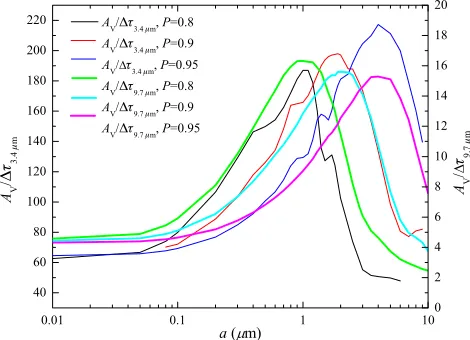
Fig. 4. Variations ofAV/τ3.4µmandAV/τ9.7µmwith dust size.
In Fig. 4, we show AV/τ3.4µm and AV/τ9.7µm as
a function of dust size for P = 0.8,0.9,0.95. It is clearly seen that for a given porosity, the variation of
AV/τ3.4µm with dust size exhibits a tendency similar to
that of AV/τ9.7µm. This suggests that with a dust size
distribution taken into account, we would still maintain the variation tendency. For small, highly porous grains (a < 0.05µm), AV/τ3.4µm and AV/τ9.7µm are nearly
independent of size since they are more or less in the Rayleigh regime in the optical-IR and therefore AV/Vdust, τ3.4µm/Vdustandτ9.7µm/Vdust are independent of grain
size (whereVdustis the dust volume). The visual extinction
AVreaches its maximum ata ∼ λ/[2πa(n−1)] (where
nis the real part of the refractive index of the porous dust at wavelengthλ; see Li, 2008). At even large sizes, while
AVreaches a constant (i.e. in the geometric optics regime) τ3.4µm andτ9.7µm increase witha (till they reach their
respective peak values). This explains why AV/τ3.4µm
andAV/τ9.7µmdecrease withaafter they reach their peak
values.
ForAV/τ3.4µm, our model withmcarb/msil =0.7 (and
P = 0.8, a = 0.5–1.5µm) is consistent with the ob-served factor-of-two variations in the local ISM and toward the GC (see Tables 1, 2). However, the model values of
AV/τ9.7µmfor both the diffuse ISM dust (AV/τ9.7µm≈
38.2) and the GC dust (AV/τ9.7µm≈16.3) are higher by a
factor of∼1.5–2 than that observed in the local diffuse ISM (AV/τ9.7µm ≈ 18.2) and the GC (AV/τ9.7µm ≈ 8.4).
This discrepancy may result from the underestimation of the silicate mass fraction.
With an increased silicate mass fraction, say,
mcarb/msil = 0.5 which is consistent with the in situ
measurements of comet Halley (Jessberger and Kissel, 1991) and widely adopted in cometary dust modeling (Greenberg, 1998; Greenberg and Li, 1999; Kolokolova
et al., 2004; Kimura et al., 2006, 2008a; Mann et al., 2006; Kolokolova and Kimura, 2010), we obtain
AV/τ3.4µm ≈252 and AV/τ9.7µm ≈27.1 for the local
ISM (assuming compact dust), andAV/τ3.4µm≈154 and
AV/τ9.7µm ≈ 11.3 for the GC (assuming porous dust).
These values are closer to that observed. It is expected that with a smaller mcarb/msil (i.e. a larger silicate mass
fraction), one would obtain a smaller AV/τ9.7µm while
AV/τ3.4µm does not change much. Thus the observed
variations of AV/τ3.4µm and AV/τ9.7µm from the local
ISM to the GC could be explained. It is worth noting that, based on a detailed analysis of the GC 5–8µm absorption spectra obtained from the Kuiper Airborne Observatory, Tielens et al. (1996) argued that silicate dust may con-tribute as much as 60% of the interstellar dust volume. This would translate tomcarb/msil ≈0.34 if we assume that the
remaining 40% of the interstellar dust volume is all from the 3.4µm C-H feature carrier (which is indeed a very generous assumption).
et al., 1995), a distribution of dust sizes, and the possible porous nature of the diffuse ISM dust (e.g. see Mathis and Whiffen, 1989) will be considered.
Acknowledgments. We thank the anonymous referees for their very helpful comments. We thank Dr. H. Kimura for sharing with us his work prior to publication. This work is supported in part by NSFC grant No. 10603001, SRFDP grant No. 20060027013 and NCET-05-0144. AL is supported in part by NASA/HST Cycle-15 Theory Program and NSF grant AST 07-07866.
References
Adamson, A. J., D. C. B. Whittet, and W. W. Duley, The 3.4µm interstellar absorption feature in Cyg OB2 no. 12,Month. Not. R. Astron. Soc.,243, 400–404, 1990.
Adamson, A. J., D. C. B. Whittet, A. Chrysostomou, J. H. Hough, D. K. Aitken, G. S. Wright, and P. F. Roche, Spectropolarimetric con-straints on the nature of the 3.4µm absorber in the ISM,Astrophys. J., 512, 224–229, 1999.
Becklin, E. E., G. Neugebauer, S. P. Willner, and K. Matthews, Infrared observations of the galactic center. IV—The interstellar extinction, As-trophys. J.,220, 831–835, 1978.
Bohren, C. F. and D. R. Huffman,Absorption and Scattering of Light by Small Particles, Wiley, New York, 1983.
Bowey, J. E., M. G. Rawlings, and A. J. Adamson, 10µm absorption spectra of silicates for two new diffuse ISM sightlines,Month. Not. R. Astron. Soc.,348, L13–L17, 2004.
Chiar, J. E., A. G. G. M. Tielens, D. C. B. Whittet, W. A. Schutte, A. C. A. Boogert, D. Lutz, E. F. van Dishoeck, and M. P. Bernstein, The composition and distribution of dust along the line of sight toward the galactic center,Astrophys. J.,537, 749–762, 2000.
Chiar, J. E., A. J. Adamson, D. C. B. Whittet, A. Chrysostomou, J. H. Hough, T. H. Kerr, R. E. Mason, P. F. Roche, and G. Wright, Spectropolarimetry of the 3.4µm feature in the diffuse ISM toward the Galactic Center Quintuplet Cluster,Astrophys. J.,651, 268–271, 2006. Cohen, M., A. G. G. M. Tielens, and J. D. Bregman, Mid-IR spectra of
WC 9 stars—The composition of circumstellar and interstellar dust,
Astrophys. J.,344, L13–L16, 1989.
Draine, B. T., Properties of dust in diffuse clouds, inThe Physics of the Interstellar Medium and Intergalactic Medium, edited by A. Ferrara, C. F. McKee, C. Heiles, and P. R. Shapiro, ASP Conf. Ser.,80, 133–147, 1995.
Draine, B. T., Interstellar dust grains,Ann. Rev. Astron. Astrophys.,41, 241–289, 2003.
Draine, B. T. and H. M. Lee, Optical properties of interstellar graphite and silicate grains,Astrophys. J.,285, 89–108, 1984.
Greenberg, J. M., Making a comet nucleus,Astron. Astrophys.,330, 375– 380, 1998.
Greenberg, J. M. and A. Li, All comets are born equal: infrared emission by dust as a key to comet nucleus composition,Planet. Space Sci.,47, 787–795, 1999.
Hage, J. I. and J. M. Greenberg, A model for the optical properties of porous grains,Astrophys. J.,361, 251–259, 1990.
Jessberger, E. K. and J. Kissel, Chemical properties of cometary dust and a note on carbon isotopes,IAU Colloq. 116: Comets in the post-Halley era,167, 1075–1092, 1991.
Jura, M., Origin of large interstellar grains toward Rho Ophiuchi, Astro-phys. J.,235, 63–65, 1980.
Kimura, H., L. Kolokolova, and I. Mann, Light scattering by cometary dust numerically simulated with aggregate particles consisting of identical spheres,Astron. Astrophys.,449, 1243–1254, 2006.
Kimura, H., T. Chigai, and T. Yamamoto, Mid-infrared spectra of cometary dust: the evasion of its silicate mineralogy,Astron. Astrophys.,482, 305– 307, 2008a.
Kimura, H., T. Chigai, and T. Yamamoto, Infrared spectra of dust aggre-gates in cometary comae: Calculation with olivine formed by exother-mic cheexother-mical reactions,Astrophys. J., 2008b (private correspondence, submitted).
Kolokolova, L. and H. Kimura, Comet dust as a mixture of aggregates and solid particles: model consistent with ground-based and space-mission results,Earth Planets Space,62, this issue, 17–21, 2010.
Kolokolova, L., M. S. Hanner, A.-C. Levasseur-Regourd, and B. ˚A. S. Gustafson, Physical properties of cometary dust from light scattering and thermal emission, inComets II, edited by M. C. Festou, H. U. Keller, and H. A. Weaver, 577–604, University of Arizona Press, Tucson, 2004. Li, A., Optical properties of dust, inSmall Bodies in Planetary Sciences, edited by I. Mann, A. Nakamura, and T. Mukai, 167–188, Springer, 2008.
Li, A. and J. M. Greenberg, A unified model of interstellar dust,Astron. Astrophys.,323, 566–584, 1997.
Li, A. and J. M. Greenberg, A comet dust model for theβPictoris disk,
Astron. Astrophys.,331, 291–313, 1998.
Li, A. and J. M. Greenberg, Mid-Infrared spectropolarimetric constraints on the core-mantle interstellar dust model,Astrophys. J.,577, 789–794, 2002.
Li, A. and J. I. Lunine, Modeling the infrared emission from the HR 4796A disk,Astrophys. J.,590, 368–378, 2003a.
Li, A. and J. I. Lunine, Modeling the infrared emission from the HD 141569A disk,Astrophys. J.,594, 987–1010, 2003b.
Mann, I., M. K¨ohler, H. Kimura, A. Cechowski, and T. Minato, Dust in the solar system and in extra-solar planetary systems,Astron. Astrophys. Rev.,13, 159–228, 2006.
Mathis, J. S. and G. Whiffen, Composite interstellar grains,Astrophys. J., 341, 808–822, 1989.
McFadzean, A. D., D. C. B. Whittet, M. F. Bode, A. J. Adamson, and A. J. Longmore, Infrared studies of dust and gas towards the Galactic Centre—3–5µm spectroscopy,Month. Not. R. Astron. Soc.,241, 873– 882, 1989.
Pendleton, Y. J., Hydrocarbons in meteorites, the Milky Way, and other galaxies, inAstrophysics of Dust, edited by A. N. Witt, G. C. Clayton, and B. T. Draine, ASP Conf. Ser.,309, 573–588, 2004.
Pendleton, Y. J., S. A. Sandford, L. J. Allamandola, A. G. G. M. Tielens, and K. Sellgren, Near-infrared absorption spectroscopy of interstellar hydrocarbon grains,Astrophys. J.,437, 683–696, 1994.
Roche, P. F. and D. K. Aitken, An investigation of the interstellar extinc-tion. I. Towards dusty WC Wolf-Rayet stars,Month. Not. R. Astron. Soc.,208, 481–492, 1984.
Roche, P. F. and D. K. Aitken, An investigation of the interstellar extinc-tion. II. Towards the mid-IR sources in the Galactic centre,Month. Not. R. Astron. Soc.,215, 425–435, 1985.
Sandford, S. A., L. J. Allamandola, A. G. G. M. Tielens, K. Sellgren, M. Tapia, and Y. J. Pendleton, The interstellar C–H stretching band near 3.4µm—Constraints on the composition of organic material in the diffuse ISM,Astrophys. J.,371, 607–620, 1991.
Sandford, S. A., Y. J. Pendleton, and L. J. Allamandola, The galactic distribution of aliphatic hydrocarbons in the diffuse ISM,Astrophys. J., 440, 697–705, 1995.
Schutte, W. A. and 10 colleagues, ISO-SWS observations of IR absorption bands of the diffuse ISM: The 6.2µm feature of aromatic compounds,
Astron. Astrophys.,337, 261–274, 1998.
Snow, T. P. and A. N. Witt, Interstellar depletions updated: Where all the atoms went,Astrophys. J.,468, L65–L68, 1996.
Tielens, A. G. G. M., D. H. Wooden, L. J. Allamandola, J. Bregman, and F. C. Witteborn, The infrared spectrum of the Galactic center and the composition of interstellar dust,Astrophys. J.,461, 210–222, 1996. Whittet, D. C. B., A. C. A. Boogert, P. A. Gerakines, W. A. Schutte,
A. G. G. M. Tielens, T. deGraauw, T. Prusti, E. F. van Dishoeck, P. R. Wesselius, and C. M. Wright, Infrared spectroscopy of dust in the diffuse ISM toward Cygnus OB2 No. 12,Astrophys. J.,490, 729–734, 1997.
Wolff, M. J., G. C. Clayton, P. G. Martin, and R. E. Schulte-Ladbeck, Mod-eling composite and fluffy grains: The effects of porosity,Astrophys. J., 423, 412–425, 1994.