CSEIT1722133 | Received : 22 March 2017 | Accepted: 31 March 2017 | March-April-2017 [(2)2: 548-555 ]
International Journal of Scientific Research in Computer Science, Engineering and Information Technology © 2017 IJSRCSEIT | Volume 2 | Issue 2 | ISSN : 2456-3307
548
Investigation of the Effectiveness of Modulation Technique for
Wireless Communication with QPSK base Encoding
Deepti Agrawal1,Dr. J. S. Yadav2
1
PhD Research Scholar, Electronics and Communication Department, Mewar University, Chittorgarh, Rajasthan, India
2Associate Professor, Electronics and Communication Department, MANIT, Bhopal, Madhya Pradesh, India
ABSTRACT
Today 3G system wireless access method used for communication where used GSM and CDMA. but OFDM has the potential to surpass the capability of CDMA structures and provide the wireless access method for 4G systems. In This Paper presents a methods for used maximum spectral efficiency from Orthogonal Frequency Division Multiplexing (OFDM) systems. the application of OFDM in multiuser structures, besides has focused on approaches for improving the system spectral efficiency. This Technique will have to improve the spectral efficiency to achieve the capacities required. Our research will have providing the capacity to facilities and features for necessitate 100 Mbps through a fixed network, and provide on-demand, with adjustable bandwidth provision. It will also combine a range of applications including cellular phones, cordless phones, and mobile data networking for personal, residential and business uses. this paper investee of harmful effects on OFDM, OFDM show the effect of band pass filtering with QPSK encoding technique, for use of a raised cosine guard period, Additive White Gaussian Noise (AWGN) on modulation BER rate, clip ping distortion, frequency offset errors, and time synchronization error. These techniques utilize knowledge of the radio channel response, to enhance the frequency, and subcarrier modulation. modulation autonomously enhances the modulation system, applied to each subcarrier so that the spectral productivity is exploited, while preserving a target Bit Error Rate (BER), and also study OFDM technology with multipath.
Keywords : Orthogonal Frequency Division Multiplexing (OFDM) systems, Subcarrier,Bit Error Rate (BER), Additive White Gaussian Noise (AWGN), frequency.
I. INTRODUCTION
In This review paper we investigates the success of
Orthogonal Frequency Division
Multiplexing(OFDM) as a modulation method for wireless radio uses. The key objective was to access the appropriateness of OFDM as a modulation technique for a fixed wireless phone structure for rural areas of Asia. The mobile technology is attractive an vital part as it is accessible almost everywhere in the world. Mobile computing in the recent years forming a new computing milieu. The fact that, the mobile computing has been inhibited by poor resources, extremely dynamic variable connectivity and limited energy sources. The strategy of stable and efficient mobile information schemes has been
becomes more complex. However, its suitability for more universal wireless applications has also been evaluated.
Figure 1. Frequency spectrum of OFDM subcarrier signals
areas, where the customer base is small, but the cost of mounting a wired phone network is very high. One technique of dropping the high infrastructure cost of a wired scheme is to use affixed wireless radio network. The problem with this is that for rural and urban areas, large cell sizes are obligatory to obtain sufficient coverage. These consequences in problems caused by large signal path damage and extended delay times in multipath signal propagation.
Currently Universal Scheme for Mobile telecommunications (GSM) technology is being applied to secure wireless phone schemes in rural areas, However, GSM uses Time Division Multiple Access (TDMA), which has a extraordinary symbol rate leading to problems with multipath producing inter-symbol interference.
Several techniques are under consideration for the next generation of digital phone schemes, with the objective of improving cell ability, multipath resistance, and flexibility. Code Division Multiple Access (CDMA) as well as Coded Orthogonal Frequency Division Multiplexing (COFDM) are the example of these techniques. Both these techniques could be applied to providing a fixed wireless scheme for rural areas. However, each technique has different properties, making it more suitable for precise applications.
In proposed model, baseband signals were modulated by the inverse DFT (IDFT) in the transmitter, then they demodulated by DFT in the receiver. Therefore, all the subcarriers were overlapped through others in the frequency domain, while the DFT modulation still pledges their orthogonality, as shown in Fig. 1.
Moreover, the window technique was introduced in this paper to attack the inter-symbol interference (ISI) and inter carrier interference (ICI) problems.
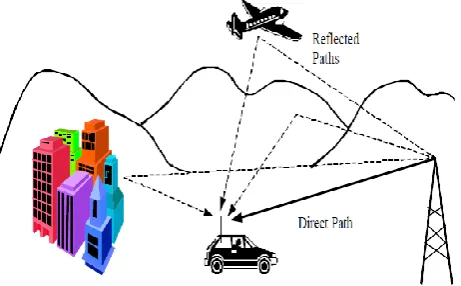
Figure 2. Digram show the multiple reflected signals which cause constructive or destructive interference at the transmitter and receiver site.
COFDM is presently being used in numerous new radio broadcast structures including the suggestion for high definition digital television, Digital Video Broadcasting (DVB) and Digital Audio Broadcasting (DAB). However, some study has been conducted in to the usage of COFDM as a
transmission method for mobile
telecommunication schemes. With CDMA structures, all users transmit in the same frequency band using specific codes as a basis of channelization. The transmitted evidence is spread in bandwidth by multiplying it by a wide band width pseudo random arrangement. Both the base station and the mobile station identify these random codes which are used to modulate the data sent, and permitting it to de-scramble the received signal.
In practice, the standard frequency offset is divided into an numeral part (multiple of the subcarrier spacing) and a insignificant part (less than one-half of the subcarrier spacing) so that they can be predictable discretely. If it is not precisely estimated and compensated, the fractional frequency offset (FFO) can terminate the orthogonality of the subcarriers and outcome is inter-carrier interference [1], while the integer frequency offset (IFO) will lead to a circular shift of the subcarrier.
II. METHODS AND MATERIAL
Related Work
Eonpyo et al. [2], praposed a new spectrum sensing method for orthogonal frequency division multiplexing (OFDM) schemes with pilot tones for equalization convenience. The time domain signal cross-correlation method exploits the periodic feature of pilot signals embed in time domain OFDM signals, while random data signals decline the credit performance. The novel spectrum sensing method employs parallel pairs of cross correlates and comb filters, and reducing the effect of random data signals by comb filters.
New TDSC-MRC method employing parallel pairs of cross correlator and comb filter is proposed for sensing OFDM signals. Due to significant reduction of random data signals by the filter bank, after it substantial SNR gain is achieved prior to employing the TDSC-MRC method. The SNR improvement is obtained at the cost of enlarged computational complexity due to comb filtering.
However, considering 5dB SNR gain of the MRC method over the Neyman-Pearson (NP) method at the cost of 20 times computational complexity [3]. There Simulation results show that the proposed method provides improvement of the sensing performance by near 1.2 dB in SNR over the TDSC-MRC method. Since SNR gain by comb filtering does not depend on the type of TDSC method, the SNR gain is sustained when the NP
method is adopted instead of the MRC method.
Gangxiang and Zukerman [4] investigates that the Traditional ITU-T fixed frequency grid-based optical transport networks suffer numerous problems such as low fiber spectral efficiency, trouble in supporting large bandwidth super-channels, and inflexibility in network bandwidth reconfiguration and modification.
To overcome these problems, a new-generation optical transport network founded an ideas of agile spectrum operation and elastic bandwidth allocation. This new generation network is called coherent optical orthogonal frequency-division multiplexing (CO-OFDM) optical transport network. It employs the talented CO-OFDM transmission technique and the new-generation bandwidth-variable ROADMs that use the coherent discovery capability of the CO-OFDM transmission for optical channel filtering.
The CO-OFDM optical transport network is characterized by randomly assigning center frequency and bandwidth of an optical channel, thereby providing flexibility in network policy and operation and attaining efficient fiber spectrum consumption. Despite the increasing attention and substantial growth, there are still many outstanding issues concerning the implementation of CO-OFDM optical transport networks.
Deepti and Yadav [5] presented the review article on the architectures of the CO-OFDM optical transport network and deliberates important issues, chiefly involving network control plane, light path routing and spectrum assignment, influence of channel modulation format and optical reach, sub wavelength traffic grooming, network survivability, and network reconfiguration.
vigorous in the face of radio channel impairments. Digital modulation techniques contribute to the fruition of our mobile wireless communications by growing the volume, speed and quality of wireless networks. In their paper, they concentrate on digital modulation systems, such as M-PSK (M-ary Phase Shift keying) and M-QAM (M-(M-ary Quadrature Amplitude Modulation) over an additive white Gaussian Noise (AWGN) channel to analysis the presentation of an OFDM structure in terms of bit error rate (BER). This is estimated through a simulation, which make it clear that, for high-capacity data rate transmission, the M-QAM modulation is enhanced than the M-PSK modulation.
In their paper, author say the evaluated BER performance of an OFDM structure with two digital modulation systems, i.e. ary PSK and M-ary QAM, over an AWGN channel. OFDM is a influential modulation technique to reach high data rate and is able to eliminate ISI. It is computationally efficient due to its usage of FFT techniques for implementing modulation and demodulation functions. It is detected from the M-ary PSK BER plots that the BER is less in the case of 4-PSK for a low Eb/N0 than in the 8- PSK and structure is appropriate for low-capacity, short-distance application.
The evaluation of M-ary PSK and M-ary QAM schemes indicate that, the BER is big in M-PSK as compared to M-QAM and it is generally liable on its applications. For a higher value of M, such as data to be professionally and accurately transmitted over a radio channel, which is even in a multipath environments. OFDM transmits data by using a large quantity of narrow bandwidth carriers. These carriers are frequently spaced in frequency, creating a block of spectrum. The frequency spacing and time synchronization of the carriers is selected in such a method that the carriers are orthogonal, sense that they do not cause interference to apiece further.
In OFDM all the carriers must be carefully controlled to preserve the orthogonality of the carriers. So that, OFDM is generated fast picking the spectrum obligatory, based on the input data, with modulation used. Each carrier has been used to produced carriers which allocated approximately data to transmit.
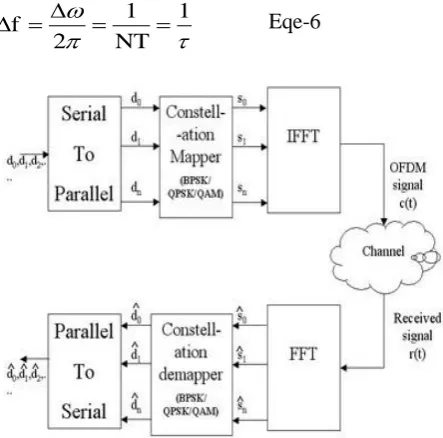
The mandatory amplitude and phase of the carrier is then calculated on the base of modulation (typically differential BPSK, QPSK, or QAM). The mandatory spectrum is converted back to its time domain signal using an Inverse Fourier Transform. In majority of the applications, an Inverse Fast Fourier Transform (IFFT) technique is generally used universally. The IFFT achieves the transformation professionally in data transmission, and the data is transmitted in parallel by assigning each data word to one carrier in the transmission carrier signals formed are orthogonal. The scheme process is given as follows.
A) Mathematical Analysis
The real signal is the actual part of sc (t). and were Ac (t) and φc (t), the amplitude and phase of the carrier, can differ on a symbol. The values of the parameters are continuous over the symbol duration period t. OFDM consists of many carriers. Thus the complex signal Ss(t) is characterized by:
This is a constant signal. If we consider the waveforms of separately component of the signal over the single (one) symbol period, formerly the variables Ac (t) and φc (t) take on stable values, which depend on the frequency of that particular carrier, so it can be rewritten:
фn (t) = фn
A n (t) = A n
If the signal is sampled using a sampling frequency of 1/T, then the resultant signal is represented by:
At this point, we have restricted the time ended which we examine the signal to N samples. It is convenient to sample ended the period of the one data symbol. Thus we have a relationship: t=NT in the form of variable. If we currently simplify Eqe-3, without a damage of generality by letting ω0=0, then the signal develops as:
)kT
Now Eqe-4 can be compared with the general form of the inverse Fourier transform: was obligatory for orthogonality thus, one consequence
of preserving orthogonality is that the OFDM signal
Figure 3. OFDM Transmitter and Receiver block diagram
B) Modulation of Data
The input data to transmitted on respectively carriers is variance encoded with earlier symbols, which is recorded into a Phase Shift Keying (PSK) format. Meanwhile differential encoding needs an initial phase reference with an additional symbol which is added at the start for this purpose.
Figure 4. Representation of OFDM with QPSK Encoding in Matlab tools
C) Serial to Parallel Conversion
The input data stream is configured into the word size for essential transmission, with 2 bits/word for QPSK, and it was shifted into a parallel format. The input data is transmitted in parallel by assigning individually data word to one carrier in the transmission.
D) Inverse Fourier Transform
The necessary spectrum is worked out, then an inverse Fourier transform is used to discovery the
corresponding to the time waveform. The adding of separately symbol in to the start of guard period.
E) Guard Period
The guard period was used to make up of two segments. Half (1/2) of the guard period is a cyclic extension of the sign to be transmitted. The other Half (1/2) of the guard period time is a zero (0) amplitude transmission. This was to permit for symbol timing to be definitely recovered by envelope detection However it was not necessary in any of the simulations where the timing could be accurately determined the position of the given samples. After the guard period has been adding, In to the symbols then renewed back to a serial time waveform.
F) Channel
A channel model is realistic to the transmitted signal. and this model permits for the multipath, signal to noise ratio, and peak power clipping to be controlled. The signal to noise ratio is usual by adding a known amount of white noise to the transmitted signal. Then Multipath delay are spread adding by simulating. Were the delay spread using an FIR filter method. The length of the FIR filter characterizes the maximum delay spread, although the coefficient amplitude represents the mirrored signal magnitude.
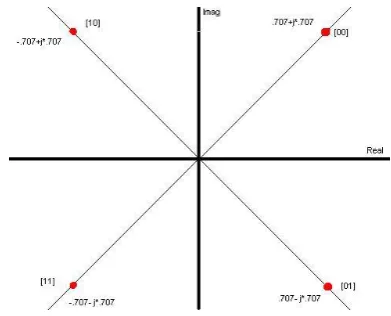
Figure 4. Presentation of QPSK Encoding method
G) QPSK
The OFDM approach is based on a binary coding system called QPSK, which is a 2-bit per symbol format. The persistence of this system is to detect errors and increase security by encoding the data. We
Randomizer
Complexirize r
Realizer
De-Channelizer Noiserizer Channelizer
Original Random Data Now
Reconstructed 10 Channels with Random Noise
Erro r Subtracts Output Minus Input Splits N-Bits in to 16
separate channels performs IFFT
will use the following digital encoding system as an example of OFDM policy
The universal full design of the OFDM system starts at an analog to digital converter (ADC) that converts analog data to word digital. the basis of data is a digital component, such as a computer, this step is bounced. The digital data sorted, of every two bits into its equivalent QPSK presentation as presented above in Fig 5. The data is sorted so it is encoded contingent on which quadrant of the complex plane and it lies in. Given an example, a bit pairing system show bit pair of [10] would correspond to -0.707+ j*0.707, [01] would correspond to the 0.707-j*0.707 and so on.
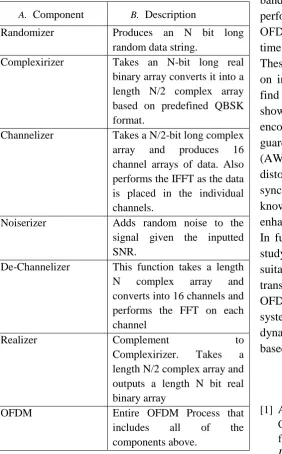
Table 1. Show Components using in Matlab
A. Component B. Description
Randomizer Produces an N bit long random data string.
Complexirizer Takes an N-bit long real binary array converts it into a length N/2 complex array based on predefined QBSK format.
Channelizer Takes a N/2-bit long complex array and produces 16 channel arrays of data. Also performs the IFFT as the data is placed in the individual channels.
Noiserizer Adds random noise to the signal given the inputted SNR.
De-Channelizer This function takes a length N complex array and converts into 16 channels and performs the FFT on each channel
Realizer Complement to Complexirizer. Takes a length N/2 complex array and outputs a length N bit real binary array
OFDM Entire OFDM Process that includes all of the components above.
IV.CONCLUSION
In this paper we have been discussed the current status of research and investigations on the OFDM scheme and find that the OFDM appears a suitable method to obtained a modulation technique for getting high performance wireless telecommunications system. The problems encountered when the OFDM is used in a multiuser environment has not been discussed widely in the past literatures. Some possible problem arises is receiver may require a big dynamic range in order to handle the bulky signal strength variation between users. In Some research paper practical tests performed on a low bandwidth baseband signal. So far only some main performance criteria have been tested, which are OFDM’s tolerance to multipath delay spread, start time error, peak power clipping and channel noise. These include effect of frequency stability errors on impulse noise effects and OFDM. This paper find harmful effects on OFDM, where OFDM show the effect of band pass filtering with QPSK encoding technique, for use of a raised cosine guard period, Additive White Gaussian Noise (AWGN) on modulation BER rate, clip ping distortion, frequency offset errors, and time synchronization error. Techniques utilize the knowledge of the radio channel response, to enhance the frequency, and subcarrier modulation. In future some more work may be conducted on studying forward error correction that would be suitable for different applications, like data transmission. Several modulation techniques for OFDM are BPSK, 256PSK, 16PSK. By this system performance gains might be possible by dynamically selecting the modulation technique based on the type of data being transmitted.
V. REFERENCES
[1] A. Al-Dweik, A. Hazmi, S. Younis, B. Sharif, and C. Tsimenidis, “Carrier frequency offset estimation for OFDM systems over mobile radio channels,”
[2] Eonpyo Hong, Kiseon Kim, Dongsoo Har, “Spectrum Sensing by Parallel Pairs of Cross-Correlators and Comb Filters for OFDM Systems With Pilot Tones”, IEEE SENSORS JOURNAL, VOL. 12, NO. 7, JULY 2012
[3] H. S. Chen, W. Gao, and D. G. Daut, “Spectrum sensing for OFDM systems employing pilot tones,”
IEEE Trans. Wireless Commun., vol. 8,no. 12, pp. 5862–5870, Dec. 2009.
[4] Gangxiang Shen, Moshe Zukerman, “Spectrum-Efficient and Agile CO-OFDMOptical Transport Networks:Architecture, Design, and Operation, IEEE Communications Magazine • May 2012. [5] Deepti Agrawal, J.S.Yadav, “A Technique
COFDM For Improving Efficiency To Transmitted An Images Through Modulation Technique For Wireless Communication Problem”, -IJRASET, Vol3, issue 11 feb 2015.