Volume 2008, Article ID 865393,11pages doi:10.1155/2008/865393
Research Article
An Evaluation of Interference Mitigation Schemes for
HAPS Systems
Bon-Jun Ku,1Do-Seob Ahn,1and Nam Kim2
1Department of Global Area Wireless Technology Research, Electronics and Telecommunications Research Institute,
Daejeon 305-350, South Korea
2Information and Communication Engineering Division, Chungbuk National University, Cheongju 360-763, South Korea
Correspondence should be addressed to Bon-Jun Ku,[email protected]
Received 28 September 2007; Revised 25 February 2008; Accepted 23 May 2008
Recommended by Abbas Mohammed
The International Telecommunication Union-Radiocommunication sector (ITU-R) has conducted frequency sharing studies between fixed services (FSs) using a high altitude platform station (HAPS) and fixed-satellite services (FSSs). In particular, ITU-R has investigated the power limitations related to HAPS user terminals (HUTs) to facilitate frequency sharing with space station receivers. To reduce the level of interference from the HUTs that can harm a geostationary earth orbit (GEO) satellite receiver in a space station, previous studies have taken two approaches: frequency sharing using a separated distance (FSSD) and frequency sharing using power control (FSPC). In this paper, various performance evaluation results of interference mitigation schemes are presented. The results include performance evaluations using a new interference mitigation approach as well as conventional approaches. An adaptive beamforming scheme (ABS) is introduced as a new scheme for efficient frequency sharing, and the interference mitigation effect on the ABS is examined considering pointing mismatch errors. The results confirm that the application of ABS enables frequency sharing between two systems with a smaller power reduction of HUTs in a cocoverage area compared to this reduction when conventional schemes are utilized. In addition, the analysis results provide the proper amount of modification at the transmitting power level of the HUT required for the suitable frequency sharing.
Copyright © 2008 Bon-Jun Ku et al. This is an open access article distributed under the Creative Commons Attribution License, which permits unrestricted use, distribution, and reproduction in any medium, provided the original work is properly cited.
1. INTRODUCTION
A high-altitude platform station (HAPS) is a station that is located at an altitude of 20–50 km It is designed to provide various services in a wide coverage range over a terrestrial area and a short delay over a satellite network [1, 2]. Due to these service characteristics, HAPS is considered to be a new infrastructure that can substitute or fill in conventional systems, including terrestrial and/or satellite systems. Specifically, the possibility of utilizing HAPS as base stations for IMT-2000 services, as gateway links, and as an infrastructure for broadband wireless services has been investigated [3–5]. As HAPS utilizes the frequency bands previously allocated for conventional systems, investigations of issues on the frequency sharing between these systems have been conducted [6].
The International Telecommunication Union-Radio-communication sector (ITU-R) has studied frequency shar-ing between HAPS and terrestrial systems for the
IMT-2000 service, between HAPS and terrestrial systems for fixed services (FS), and between HAPS for FS and satellite systems for fixed-satellite services (FSSs) [7–9]. Due to the recent increase in the demand for broadband services, frequency sharing studies related to higher-frequency bands are very important for the efficient use of frequency resources. For this reason, ITU-R has conducted the studies related to limiting the transmit power of HAPS user terminals (HUTs) in order to protect satellite receivers utilizing the frequency bands of 47-48 GHz [10]. The 47-48 GHz frequency bands were previously allocated to the FFS spectrum to accommo-date feeder links that serve to supply broadcasting satellite services [11].
North pole
z-axis
Latitude,φe=90◦
Fixed longitude line
HUT HAPS coverage
HAPS platform
Earth station of satellite (ES) Nadir
SAC RAC
UAC
HUT Off-axis angle,φh
Latitude of the HAPS platform or ES
Off-axis angle,φs
Satellite Center of the Earth
Latitude,φe=0◦
y-axis
Magnification
Earth HAPS
Satellite
x
y z
φe
Desired path Interfering path
Figure1: Description of HAPS and GEO systems.
same frequency band within a cocoverage area. The aggregate interference from the HUTs to a space station receiver would be minimally acceptable when there is no overlap between service areas. The use of FSSD is a simple approach that avoids harmful interference from HUTs to geostationary earth orbit (GEO) receivers in the space station. This is not desirable in terms of sharing because a very long separation distance may be required.
On the other hand, a recent study [12] demonstrated frequency sharing between two systems by applying an FSPC to the HUTs. Various methodologies have been investigated to determine the power level for the HUT; the results of these studies contributed to ITU-R. In this paper, several impor-tant points during the application of these two schemes for frequency sharing are addressed using the contribution results of [12] to ITU-R. Detailed performance evaluation results of these schemes are provided.
In addition to the aforementioned evaluations of conven-tional schemes, new evaluation results of frequency sharing studies applicable to the HUTs are introduced. Adaptive beamforming schemes (ABSs) are practically mandatory for future wireless communication systems, not only for efficient interference mitigation but also for high-quality service. However, there have been no reported results related to sharing via ABS between the two systems in the frequency bands of 47-48 GHz. ABS is applied to HUTs to maintain the main beam in the direction of the HAPS platform and to create a null condition in the direction of a GEO receiver. The performance of ABS is compared with that of FSPC by
obtaining the cumulative distribution function (CDF) of the interference level. However, ABS is sensitive to errors caused by imprecise sensor calibrations. Considering this, the effects of the errors due to the pointing mismatch under the null condition are analyzed. Finally, a hybrid approach combining FSPC and ABS is applied in order to take advantage of both schemes and the performance evaluation results are presented.
This paper is organized as follows.Section 2describes the system model and the related system parameters to calculate the interference level from the HUTs to a GEO receiver. Section 3presents the methodology that calculates the inter-ference from the HUTs to a GEO receiver. The procedure of calculating the CDF of the interference level that is received from the transmitted power of HUTs is then presented, and the estimation results are shown according to the latitude of the HAPS platform. After showing the interference analysis results using various conventional interference mitigation schemes including FSSD and FSPC inSection 4, new results are introduced using ABS and its variant inSection 5. This paper concludes withSection 6.
2. SYSTEM MODEL
2.1. System configuration
Ground range (km)
HAPS nadir (center of the HAPS coverage)
UAC SAC RAC
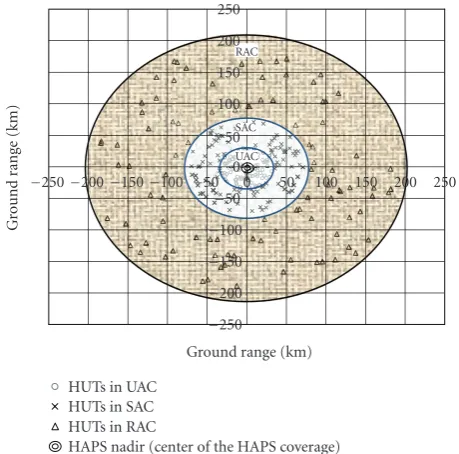
Figure2: An example of HUT distribution.
Table1: HAPS coverage zones.
Coverage area Elevation angles (degrees) Ground range (km)
UAC 90–30 0–36
SAC 30–15 36–76.5
RAC 15–5 76.5–203
in three-dimensional (3D) coordinates. At the bottom of Figure 1, a 3D constellation of an HAPS system exists along with a satellite in the GEO. Here, the target range was magnified to estimate the interference, and it is represented in theyz plane. They- andz-axes represent the lines from the center of the Earth to the satellite and to the North Pole, respectively.
The HAPS system consists of the HAPS platform and a number of HUTs distributed in the HAPS coverage. The HAPS service coverage areas consist of urban area coverage (UAC), suburban area coverage (SAC), and rural area coverage (RAC) areas that are delineated mainly according to the elevation angles. This is based on the assumption that the HAPS nadir is located at the center of the UAC. SAC and RAC surround the UAC, as indicated inFigure 1.
The satellite system has a GEO receiver in a space station and an earth station (ES) based on the ground. As a satellite system is considered in the GEO, it is assumed that the HAPS platform is located at the same longitude with the satellite in a worst-case scenario. The satellite is located at the GEO, that is,φe =0 degrees, at a height that is 36,000 km above sea level. The ES of the satellite is located at the nadir of the HAPS platform to consider the worst case. The desired paths shown here as solid lines indicate the signal paths from HUTs to the HAPS platform in the HAPS system and the signal path
from the ES to the satellite receiver in the satellite system. The interfering paths represented here as dotted lines indicate the signal paths from the HUTs to the satellite receiver. The angle φhis the off-axis angle from the main beam of a transmitting HUT antenna to the satellite, and the angleφsis the off-axis angle from the main beam of the receiving satellite antenna to a HUT.
2.2. HAPS system
HAPS service coverage zones are divided into UAC. SAC and RAC depending on the elevation angle of the HUTs, as shown inTable 1[13]. Each coverage area has a maximum of 100 HUTs respectively. Each HUT has a bandwidthBof 2 MHz; the transmitting power densityPtand the maximum antenna gain Gmax of the HUTs differ depending on the
coverage area, as shown in Table 2 [13]. By analyzing the link budget of the HAPS system, it is possible to obtain the appropriate transmit power and antenna gain for the HUTs. It is assumed that the HUTs are distributed randomly in each zone.Figure 2shows an example of a HUT distribution scheme on the ground.
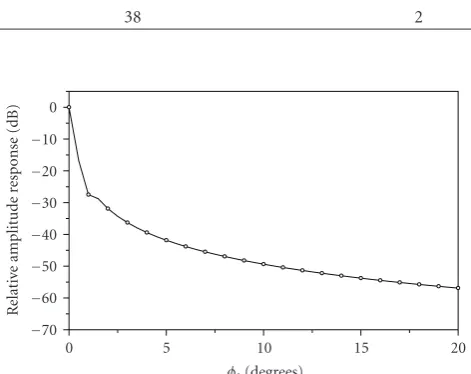
The antenna beam pattern of [14] is used here for the HUT. The antenna beam pattern,Gh(φh) is expressed by
Gh(φh)=
whereGmaxandDare the maximum antenna gain defined in
Table 2and the antenna diameter of the HUT, respectively, andλis the wavelength in meters.φmis given by
φm = 20λ
D
Gmax − 2 + 15 logD
λ. (2)
Figure 3shows the relative amplitude response with the off-axis angle,φh, of the transmitting HUT antenna using (1).
2.3. GEO satellite system
A GEO satellite system consists of a GEO receiver in a space station and an ES on the ground. An interference criterion of
Table2: HUT transmitter parameters.
Figure3: Antenna beam patterns for the HUT.
in [9]. For the GEO receiver, antenna beam pattern of [15], Gs(φs), is used, as expressed by
Gs(φs)=
Here, the maximum antenna gain, Gmax for the satellite
receiver is 51.8 dBi and one-half the 3 dB beamwidth,φ3 dB,
is given by [15]
φ3 dB ≈ 10(44.5−Gmax)/20. (4)
Figure 4shows the antenna beam pattern using the off-axis angleφsof a satellite receiver. To compare the coverage of the satellite with that of HAPS, the diameter of the coverage,lcis calculated in km using
lc= 2×36, 000
Figure4: Antenna beam pattern for the GEO receiver.
The service coverage of a satellite on the ground is approx-imately 271 km in diameter at the equator. The coverage includes all of the HUTs in UAC and SAC as well as most of them in RAC, implying that the GEO receiver may experience strong interference from the HUTs.
3. ESTIMATION OF THE INTERFERENCE LEVEL
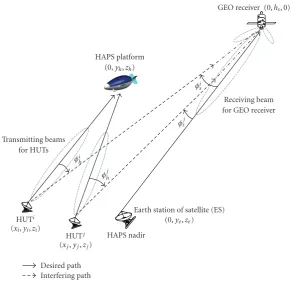
In this section, the methodology that calculates the inter-ference level from the HUTs to the GEO receiver is pre-sented.Figure 5shows the geometric configuration for the estimation of the interference between the HAPS and satellite systems. Referring to the 3D coordinate configuration in Figure 1, the coordinates of theith HUT, HUTi, are denoted as (xi,yi,zi).Similarly, the coordinates of the HAPS platform, the GEO receiver, and the ES are (0,yh,zh), (0,hs, 0), and (0,ye,ze), respectively. The angleφhi represents the off-axis angle to the satellite from the main beam of the transmitting HUTi antenna. The angle φi
s represents the off-axis angle from the main beam of the receiving satellite antenna to the HUTi.
The estimated receiving interference power density received by the GEO receiver can be calculated as [9]
Pr=
GEO receiver (0,hs, 0)
Earth station of satellite (ES) (0,ye,ze)
Figure5: Geometric configuration for interference estimation.
off-axis angle φi
h of the ith HUT, Gs(φis) is the receiving antenna gain for the off-axis angleφi
sof the satellite antenna, La(θi) is atmospheric absorption for the elevation angle from θi theith HUT,λis the wavelength in meters, anddis the distance between the HUT and the satellite in km. Thus,Pr can be regarded as the aggregated interference power from all HUTs.
In order to estimate Pr in (6), 300 locations of HUTs were randomly generated. The antenna gain with the off-axis angles for the HUTs and the GEO receiver were initially obtained. The off-axis angles,φhi andφis, can be calculated from HUTito the HAPS platform, from HUTito the GEO receiver, from the HAPS platform to the GEO receiver, from the GEO receiver to the ES, and from HUTi to the ES, respectively. The path lengths can be obtained from the coordinates of the HUTs, the HAPS platform, the GEO receiver, and the ES.
Here, the propagation attenuation term La(θi) in (6) is considered. Assuming that the height of HUTs is zero, the atmosphere attenuation La(θi) is defined by (8) in
the frequency band from 47.9 GHz to 48.2 GHz [8]. This depends on the elevation angleθi of the ith HUT and the latitudeφeof the HAPS platform:
La(θi)=
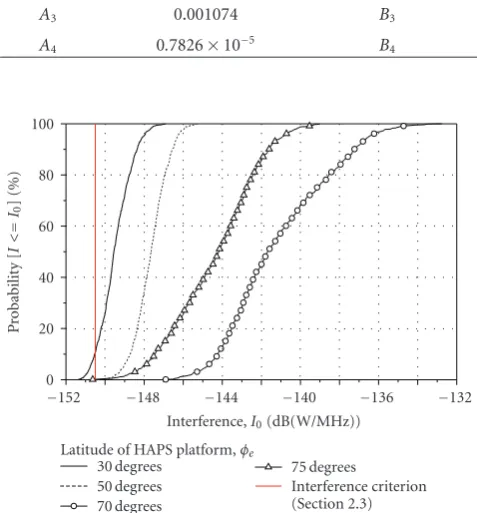
One thousand independent simulations were run and the CDF of the interference levels was then estimated. Figure 6 shows the estimated CDF, that is, the cumulative probability of interference, I, that is less than or equal to I0 in thex-abscissa. It was found that the interference level
Table3: Constant values.
Constants Values Constants Values Constants Values
A1 0.7262 B1 0.6962 C1 0.6864
A2 0.03534 B2 0.03555 C2 0.03632
A3 0.001074 B3 0.001076 C3 0.001103
A4 0.7826×10⁻⁵ B4 0.7840×10⁻⁵ C4 0.8073×10⁻⁵
Interference,I0(dB(W/MHz))
−152 −148 −144 −140 −136 −132
P
robabilit
y
[
I<
=
I0
](
%
)
0 20 40 60 80 100
Latitude of HAPS platform,φe
30 degrees 50 degrees 70 degrees
75 degrees
Interference criterion (Section 2.3)
Figure6: Interference level with the latitude of the HAPS platform φe.
4. INTERFERENCE ANALYSIS USING CONVENTIONAL APPROACHES
4.1. FSSD approach
The separation distance can be considered as an easy means of determining the sharing condition between wireless systems. In a previous study by [9, 16], the separation distance satisfying the criterion of a GEO receiver was estimated.Figure 7shows the minimum separation distance, ds, required to satisfy the interference criterion according to various HAPS platform latitudes as represented byφe. If the HAPS platform is located at the latitudesφe = 0◦, the separation distancedsshould be more than 145 km between the HAPS nadir and the ES. As more HUTs face a GEO receiver as the latitude of the HAPS platform φe increases, a greater separation distance is needed at a higher latitude. FSSD is a simple but inefficient way to bring this about, as a very long separation distance may be required for two systems to use the same frequency bands.
4.2. FSPC approach
As an alternate approach to FSSD, FSPC can be used. In this section, the concept and results of a performance evaluation of the FSPC are given, and several problems when applying
Latitude of HAPS platform,φe(degrees)
0 10 20 30 40 50 60
M
inim
um
separ
ation
distanc
e,
ds
(km)
100 150 200 250 300 350 400 450 500 550
Figure 7: Separation distance with the latitude of the HAPS platformφe.
it are discussed using the contribution results to ITU-R originally proposed by [12].
HAPS using frequency bands of 47-48 GHz may expe-rience significant rain attenuation; such a system requires a sufficient rain attenuation margin to overcome it. However, during most clear-sky days, these relatively high margins have been shown to result in harmful interference to a satellite system [9]. This implies that an appropriate power control mechanism can reduce the interference level. A methodology to determine the minimum required power level for the HUT using FSPC was investigated, and the results are presented in the Recommendation ITU-R SF.1843 [12]. The results show that perfect sharing can be achieved between HUTs and a GEO receiver in a cocoverage area, that is, without any distance separation.
In the FSPC scheme, the transmit power level of the HUT is controlled. This reduces the harmful interference in the direction of a GEO receiver. If HUTs are equipped with power control systems, they can reduce or increase the transmit power depending on the conditions and not exceed the interference criterion of the GEO receiver in a cocoverage area. In clear-sky conditions, HUTs reduce these power levels, and on rainy days, they increase the power up to the rain attenuation margin defined in [13].
Interference,I0(dB(W/MHz))
−160 −158 −156 −154 −152 −150
P
robabilit
y
[
I<
=
I0
](
%
)
0 20 40 60 80 100
Latitude of HAPS platform,φe(degrees)
30 50 55
60
Interference criterion (Section 2.3)
Figure8: Interference level with the latitude of an HAPS platform φe, using the FSPC scheme (PR=5 dB).
with anyφevalue. However, any HUTs power control failure may cause a power loss of up to 5 dB, which can lead to serious performance degradation of the HAPS system. In addition, as shown in Figure 9, if a HUT is located at a border of a rainy region and a clear-sky region, the signal path from the HUT to the satellite does not experience any rain attenuation, which may cause strong interference. For this reason, an efficient technique to control the antenna sidelobes is required, leading to an efficient beamforming technique. This is investigated in detail in the next section.
5. A NEW ANALYSIS RESULTS
5.1. Ideal ABS approach
5.1.1. Basic concept
Adaptive beamforming can provide an efficient means of interference mitigation. Figure 10 shows an example of a HUT system with an adaptive beamforming device. The system consists of receiving and transmitting beamformers. The number of elements,M, determines the antenna gain of the HUT. The incident wave impinges on the array at any angles that are normal to the array surface. The signal in each branch is weighted in order to point to the target. It is assumed that the same weighting vectors are used in the receiver and the transmitter, that is, [win
0,win1,. . .,wMin−1] =
[wout
0 ,wout1 ,. . .,wMout−1].This is discussed inSection 5.1.2.
It is assumed that the system is equipped with a minimum-variance beamformer (MVB) in [17] and that the HUT can estimate the optimum weighting vectors to reduce the interference signal in the direction of the GEO receiver. Here, the antenna beam pattern of the MVB for the interference analysis is presented. MVB is used to minimize the variance of the input signals with the interfered signals, satisfying the constraint in which the power for the desired direction should be characterized by unity. Assuming M
HAPS platform
GEO receiver
HUT
HUT
HUT
HUT Rainy region Clear-sky region
Desired path with the reduced rain attenuation margin Interfering path with the reduced rain attenuation margin Desired path with the maximum rain attenuation margin Interfering path with the maximum rain attenuation margin
Figure9: Scenario in the case of strong interference.
linear array elements spaced by a half wavelength between them in the receiving module, this concept can be expressed as [18]
w= arg w∗a(θe)=1
minw∗Rxw, (9)
where w is the M-by-1 optimum weighting vector of the beamformer, Rx is the M-by-M correlation matrix of the received signal covariance, anda(θe) is theM-by-1 steering vector with the electrical angle θe related to the angle of incidenceφhthat is normal to the array surface defined by
θe=πsinφh. (10)
Here,Tand∗represent the transposition of a matrix and complex conjugate of the matrix.
Generally, it is possible to solve the optimum solution given in (9) using the method of Lagrange [18, 19]. Combining the variance equation defined byw∗Rxwwith the constrained partw∗a(θe)=1 gives
wmv= R
−1
x a(θe) a(θe)∗R−1
x a(θe)
. (11)
Transceiver of HUT
Weighting values estimator Weighting vector
Received signals Beamformer
Weighting vector .
. .
. . .
win 0
win 1
win
M−1
yin(t)
wout 0
wout
M−2
woutM−1 yout(t)
Figure10: Block diagram for the HUT using ABS.
signal for the direction of the HAPS platform, imposes a null in the direction of GEO.
Via (11), the antenna beam pattern of the MVB can be expressed as
G(φh)=10 log10wmvHa(θe) 2
. (12)
5.1.2. Analysis on the frequency translation effect
In the previous section, it was assumed that the same weighting vectors are used in the receiver and the transmitter. Here, the effect of this is analyzed. The concept of the reuse of the weight has been introduced for land mobile cellular systems [20]. For the time-division duplex (TDD), the weight obtained during the receiving time slot can be reused in the transmitting time slot as a fixed parameter, as the carrier frequency of the uplink, fu, is equal to that of the downlink,fd. This no longer holds for the frequency-division duplex (FDD) [20,21]. Generally, utilizing the same array weight gives rise to null positioning error between the up-and down-link, as the antenna element spacing normalized by the wavelength varies in proportion to the difference in frequency. A good example of this is a beamforming system with FDD in the IMT-2000 frequency bands that uses a carrier frequency of 2140 MHz for the downlink and 1950 MHz for the uplink. Figure 11 compares the beam patterns of the receiver and the transmitter when the interfering signal is at 25 degrees. If the same array weights are used for the receiver and the transmitter, a comparatively large null pointing error of approximately 2.5 degrees is produced. This is shown inFigure 11. To address this issue, Ohgane proposed the reconfiguration of the weight vector by comparing the transmitting and receiving array patterns and adjusting the weight value for transmission [20].
This is analyzed in the application of HAPS FDD system. According to Resolution 122 (Rev. WRC-2007), the frequency bands 47.9–48.2 GHz and 47.2–47.5 GHz, each
φh(degrees)
−80 −60 −40 −20 0 20 40 60 80
A
m
plitude
response
(dB)
−60
−40
−20 0 20
fu: 1950 MHz fd: 2140 MHz
Null positioning error
Figure11: Comparison of the beam patterns of the receiver and transmitter using IMT-2000 frequency bands.
φh(degrees)
−80 −60 −40 −20 0 20 40 60 80
A
m
plitude
response
(dB)
−60
−40
−20 0 20
fd: 47.35 GHz fu: 48.05 GHz
Figure12: Comparison of the beam pattern of the receiver and the transmitter of the HUT using MVB.
5.1.3. Interference analysis results
An important factor related to the reduction of the interfer-ence that is harmful to the GEO receiver is that a very low sidelobe level of the HUTs that face the GEO receiver should be obtained. The same analysis procedure from (6) to (8) used in the previous section is followed using the antenna beam pattern in (12).
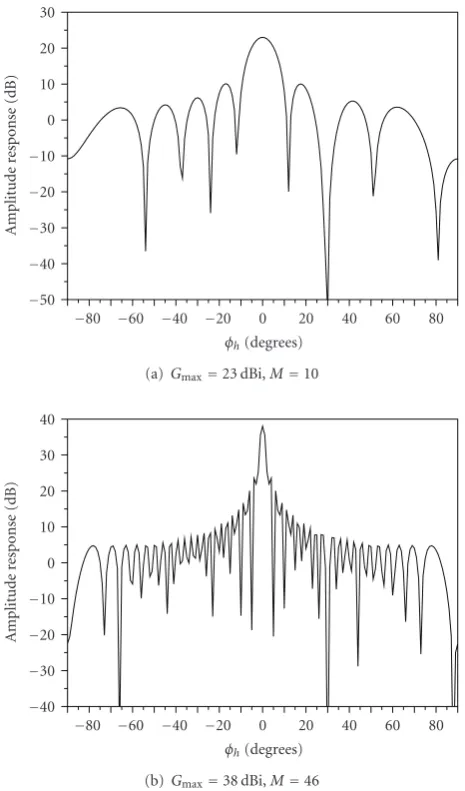
Figure 13 shows an example of the adaptive beam patterns when theGmax values of the HUT are 23 dBi and
38 dBi, respectively, (seeTable 2). In this example, the desired and interfering direction is 0 and 30 degrees, respectively. When the antenna beam patterns in (12) are used for the transmitting beams, a symmetric beam for all direction can be assumed by extending the 2D antenna beam pattern in Figure 13 to 3D. As shown in Figure 14, when the ABS is applied to the HUTs, two systems can share a cocoverage without any power reduction in the HUTs.
5.2. Hybrid approach
The ABS can cause pointing errors at the null, which may introduce harmful interference to other systems. In order to offset this pointing error, the FSPC approach can be used in conjunction with the ABS. The effect of the error due to the null pointing mismatch on the amount of interference to the satellite is initially analyzed. It is assumed thatMlinear array elements with the uniform amplitude distribution experience pointing error at the null defined by [22]
σ2 Δ=
12 M3σ
2
Φ, (13)
whereσΔ2is the variance of the pointing error andσΦ2 is the
phase error variance. The parameters σΦ of contemporary
microwave amplifiers can provide a phase nonidentity within a limit of 10 degrees [23]. In the case of phase distribution errors of 5 and 10 degrees, the total range of the pointing
φh(degrees)
−80 −60 −40 −20 0 20 40 60 80
A
m
plitude
response
(dB)
−50
−40
−30
−20
−10 0 10 20 30
(a)Gmax=23 dBi,M=10
φh(degrees)
−80 −60 −40 −20 0 20 40 60 80
A
m
plitude
response
(dB)
−40
−30
−20
−10 0 10 20 30 40
(b)Gmax=38 dBi,M=46
Figure13: An example of an antenna beam pattern using ABS.
Interference,I0(dB(W/MHz))
−170 −165 −160 −155 −150 −145
P
robabilit
y
[
I<
=
I0
](
%
)
0 20 40 60 80 100
Without any IMS scheme FSPC (PR=5 dB)
Ideal ABS
Interference criterion (Section 2.3)
Interference,I0(dB(W/MHz))
Pointing error,σΔ
0 degree 1 degrees
2 degrees
Interference criterion (Section 2.3)
Figure 15: CDF of interference levels according to the pointing errors,σΔ.
error is approximately 1 and 2 degrees, respectively.Figure 15 shows the CDF of the interference levels according to various pointing error values. If pointing errors are not controlled within at least 1 degree, the aggregated interference level may exceed this criterion. In order to overcome the increase in the interference due to the pointing error, a hybrid method that combines ABS with FSPC can be used. The advantage of the hybrid scheme can be understood by comparing the required power control range that regulates the interference to the satellite. A large power control range indicates a high probability of system outage in case of failure or error in power control scheme. Therefore, the outage probability can be reduced using the ABS with the reduced power control range. Figure 16 shows the required power control range according to theσΔ value of the ABS scheme compared to
the conventional FSPC scheme. It is clear that, even with a very large value of σΔ, the power control range can be
reduced considerably. For example, the reduction in the power control range exceeds 50% and 40% if theσΔ value
is 1 and 2 degrees, respectively.
6. CONCLUSION
Sharing issues between FS using HAPS and FSS systems were studied with a focus on the uplink from HUTs to a GEO receiver. In this paper, several sharing methodologies based on the FSSD and FSPC were presented. The FSSD is a simple approach that avoids harmful interference from HUTs to a GEO receiver. However it is not desirable in terms of sharing. The FSPC also has a drawback in that reducing the power levels of the HUTs may result in performance degradation of the HAPS system.
In this paper, an interference mitigation effect was demonstrated by applying the ABS to HUTs in a manner that overcomes the aforementioned drawbacks. However, HUTs using ABS may give rise to interference that is harmful to a satellite receiver when an amount of beam pointing error exists due to phase disturbance on the array antenna
Pointing error,σΔ(degrees)
0 0.5 1 1.5 2
Figure 16: Power control range, PR, according to the pointing
errors,σΔ.
elements. Finally, a hybrid approach combining FSPC with ABS considering the beam pointing errors was presented. From the analysis results, it was shown that the two systems can share the same frequency bands in a cocoverage case even when beam pointing errors pertaining to HUTs exist. The present analysis results reveal that an ABS scheme combined with FSPC can reduce the power control range by 40% compared to a conventional FSPC scheme.
ACKNOWLEDGMENTS
This work was supported by the IT R&D program of KCC/IITA[2008-F-013-01, Development of spectrum engi-neering and millimeterwave utilizing technology]. The authors wish to thank Professor Dr. Sooyoung Kim for useful discussions that significantly improved earlier versions of this paper.
REFERENCES
[1] T. C. Tozer and D. Grace, “High-altitude platforms for wireless communications,”Electronics & Communication Engineering Journal, vol. 13, no. 3, pp. 127–137, 2001.
[2] Radio Regulations, Footnote 1.66A, International Telecom-munication Union (ITU), 2004.
[3] D. Grace, J. Thornton, G. Chen, G. P. White, and T. C. Tozer, “Improving the system capacity of broadband services using multiple high-altitude platforms,”IEEE Transactions on Wireless Communications, vol. 4, no. 2, pp. 700–709, 2005. [4] B. Taha-Ahmed, M. Calvo-Ramon, and L. de Haro-Ariet,
“High altitude platforms (HAPs) W-CDMA system over cities,” in Proceedings of the 61st IEEE Vehicular Technology Conference (VTC ’05), vol. 4, pp. 2673–2677, Stockholm, Sweden, May-June 2005.
[7] Recommendation ITU-R M.1641, “A methodology for co-channel interference evaluation to determine separation dis-tance from a system using high-altitude platform stations to a cellular system to provide IMT-2000 service within the boundary of an administration,” ITU, 2006.
[8] Recommendation ITU-R F. 1501, “Coordination distance for systems in the fixed service (FS) involving high-altitude platform stations (HAPSs) sharing the frequency bands 47.2– 47.5 GHz and 47.9–48.2 GHz with other systems in the fixed service,” ITU, 2000.
[9] Recommendation ITU-R SF. 1481-1, “Frequency sharing between systems in the fixed service using high-altitude platform stations and satellite systems in the geostationary orbit in the fixed-satellite service in the bands 47.2–47.5 and 47.9–48.2 GHz,” ITU, 2002.
[10] Resolution 122 (revised in World Radiocommunication Con-ference (WRC)—2003), “Use of the bands 47.2–47.5 GHz and 47.9–48.2 GHz by high altitude platform stations (HAPS) in the fixed service and by other services,” ITU, 2003.
[11] Radio Regulations, Footnote 5.552A, International Telecom-munication Union (ITU), 2004.
[12] Recommendation ITU-R SF. 1843, “Methodology for deter-mining the power level for ground terminals to facilitate sharing with space station receivers in the bands 47.2–47.5 GHz and 47.9–48.2 GHz,” ITU, 2007.
[13] Recommendation ITU-R F. 1500, “Preferred characteristics of systems in the fixed service using high altitude platforms operating in the bands 47.2–47.5 GHz and 47.9–48.2 GHz,” ITU, 2000.
[14] Recommendation ITU-R F. 699, “Reference radiation patterns for fixed wireless system antennas for use in coordination studies and interference assessment in the frequency range from 100 MHz to about 70 GHz,” ITU, 2003.
[15] Recommendation ITU-R S. 672, “Satellite antenna radiation pattern for use as a design objective in the fixed-satellite service employing geostationary satellites,” ITU, 1997.
[16] B.-J. Ku, J.-M. Park, and D.-S. Ahn, “Analyzing separation distance from HAPS to satellite earth station in V band,” in
Proceeding of the 21st International Technical Conference in Circuit/Systems, Computers and Communications (ITC-CSCC ’06), vol. 2, pp. 441–444, Chiang Mai, Thailand, July 2006. [17] J. Capon, “High-resolution frequency-wavenumber spectrum
analysis,”Proceedings of IEEE, vol. 57, no. 8, pp. 1408–1418, 1969.
[18] S. Haykin,Adaptive Filter Theory, Prentice Hall Information and System Sciences Series, Prentice Hall, Englewood Cliffs, NJ, USA, 1996.
[19] J. Litva, Digital Beamforming in Wireless Communications, Artech House, Boston, Mass, USA, 1996.
[20] T. Ohgane, “Spectral efficiency improvement by base station antenna pattern control for land mobile cellular systems,”
IEICE Transactions on Communications, vol. E77-B, no. 5, pp. 598–605, 1994.
[21] G. Xu and H. Liu, “Effective transmission beamforming scheme for frequency-division-duplex digital wireless com-munication systems,” inProceedings of the 20th IEEE Inter-national Conference on Acoustics, Speech and Signal Processing (ICASSP ’95), vol. 3, pp. 1729–1732, Detroit, Mich, USA, May 1995.
[22] R. J. Mailloux, Phased Array Antenna Handbook, Artech House, Boston, Mass, USA, 1994.
[23] B.-J. Ku, D.-S. Ahn, S.-P. Lee, et al., “Radiation pattern of multibeam array antenna with digital beamforming for stratospheric communication system: statistical simulation,”