Volume 2008, Article ID 346730,9pages doi:10.1155/2008/346730
Research Article
Analysis of Coded FHSS Systems with Multiple Access
Interference over Generalized Fading Channels
Salam A. Zummo
Department of Electrical Engineering, King Fahd University of Petroleum and Minerals (KFUPM), Dhahran 31261, Saudi Arabia
Correspondence should be addressed to Salam A. Zummo,[email protected]
Received 14 April 2008; Revised 30 June 2008; Accepted 11 August 2008
Recommended by Ibrahim Develi
We study the effect of interference on the performance of coded FHSS systems. This is achieved by modeling the physical channel in these systems as a block fading channel. In the derivation of the bit error probability over Nakagami fading channels, we use the exact statistics of the multiple access interference (MAI) in FHSS systems. Due to the mathematically intractable expression of the Rician distribution, we use the Gaussian approximation to derive the error probability of coded FHSS over Rician fading channel. The effect of pilot-aided channel estimation is studied for Rician fading channels using the Gaussian approximation. From this, the optimal hopping rate in coded FHSS is approximated. Results show that the performance loss due to interference increases as the hopping rate decreases.
Copyright © 2008 Salam A. Zummo. This is an open access article distributed under the Creative Commons Attribution License, which permits unrestricted use, distribution, and reproduction in any medium, provided the original work is properly cited.
1. INTRODUCTION
A serious challenge to having good communication quality in wireless networks is the time-varying multipath fading environments, which causes the received signal-to-noise ratio (SNR) to vary randomly. One solution to fading is the use of spread spectrum (SS) techniques, which randomizes the fading effect over a wide frequency band. The main types of SS are the direct sequence SS (DSSS) and the frequency hopping SS (FHSS). FHSS is the transmission technique in Bluetooth, GSM, and the IEEE802.11 standard.
In FHSS, each user starts transmitting his data over a narrow band during a time slot (called dwell time), and then hops to other bands in the subsequent time slots according to a pseudorandom (PN) code (sequence) assigned to the user [1]. Thus, the transmission in FHSS takes place over the wideband sequentially in time. The main advantage of FHSS is the robust performance under multipath fading, interference, and jamming conditions. In addition, FHSS posses inherent frequency diversity, which improves the system performance significantly over fading channels [1]. Furthermore, data sent over a deeply faded frequency band can be easily corrected by employing error correcting codes with FHSS systems [1]. In particular, convolutional codes are considered to be practical for short-delay applications
because the performance is not affected significantly by the frame size.
In cellular networks, multiple access interference (MAI) may arise when more than one user transmit over the same frequency band at the same time in the uplink. This happens when users in closely located cells are assigned PN codes that are not perfectly orthogonal. In this case, a collision
occurs when two users transmit over the same frequency band simultaneously, which degrades the performance of both users significantly. Also, MAI may be due to the lack of synchronization between users transmitting in the same cell [2–4]. In this case, the borders of time slots used by different users to hop between frequency bands are not aligned, that is, a user hops before or after other users. This case is referred to as asynchronous FHSS. The performance of channel coding with fast FHSS and partial-band interference is well studied in the literature as in [5–8]. However, not much work was done to investigate the performance of coding with slow FHSS and partial-band interference.
U S
Encoder interleaverChannel Binary
modulator FHSS
Figure1: Block diagram of a coded FHSS transmitter.
[9]. Then, the pairwise error probability (PEP) is derived by conditioning over the number of interfering users in the network and then by averaging over this number. In modelling the MAI, we consider the exact statistics in the case of perfect channel state information (CSI) and Nakagami fading, as well as the Gaussian approximation in the case of imperfect CSI and Rician fading. We investigate that the tradeoff between channel estimation and diversity in FHSS systems is studied in order to approximate the optimal hopping rate in FHSS systems with MAI, defined as the hope rate at which the performance of the FHSS system is the best compared to its performance using different hopping rates.
The outline of this paper is as follows. The coded FHSS system model is described in Section 2. In Section 3, a union bound on the bit error probability for coded FHSS systems is derived for different fading statistics and channel estimation assumptions. Results are discussed inSection 4
and conclusions are presented inSection 5.
2. SYSTEM MODEL
The general block diagram of a coded FHSS transmitter is shown in Figure 1. The transmitter consists of a binary encoder (e.g., convolutional or turbo), an interleaver, a modulator, and an FHSS block. Time is divided into frames of duration NT, where T is the transmission interval of a bit. Each frame is encoded using a rate Rc encoder, and each coded bit is modulated using BPSK. Then, each frame is transmitted using FHSS, where the transmitter hops J times during the transmission of a frame. Thus, the frame undergoes J independent fading realizations, where blocks of m = N/J bits undergo the same fading. In the FHSS context, the transmission duration ofmbits represents the dwell time of the system. Effectively, each packet undergoes a block fading channel [9]. Note that the frame is bit-interleaved prior to the FHSS transmission in order to spread burst errors in the decoder.
We consider a multiple-access FHSS network ofKusers. The frequency band is divided into Q bands and users transmit their data by hopping randomly from one band to another. When more than one user transmit over the same band simultaneously, a hit (or collision) occurs. Throughout this paper, we assume synchronous transmission with a hit probability given by ph = 1/Q. Given that only k users (among the total of K users operating in the network) interfere with the user of interest, the matched filter sampled output at timelin the jth hop is given by
yj,l=
Eshjsj,l+zj,l+ k
f=1
EIhf,jsf,j,l, (1)
where Es is the average received energy,sj,l = (−1)cj,l:cj,l is the corresponding coded bit out of the channel encoder,
and zj,l is a noise sample modeled as independent zero-mean Gaussian random variable with a variance of N0/2. The coefficienthjis the channel gain in hop jwhich can be written ashj=ajexp(jθj), whereθjis uniformly distributed in [0, 2π) andajis the channel amplitude.
If a line-of-site (LOS) exists between the transmitter and the receiver, the channel amplitude is modeled as a Rician random variable [10]. In this model, the received signal consists of a specular component due to the LOS and a diffuse component due to multipath. Hence, the channel gain in each hop is modeled asCN(b, 1), wherebrepresents the specular component. Thus, the SNR pdf of a Rician fading is given by
fγ(x)=(1 +κ)
Ω exp
−κ−(1 +κ)x
Ω
×I0
⎛
⎝2 κ(1 +κ)x
Ω
⎞
⎠, x≥0, (2)
where κ = b2 is the energy of the specular component and I0(·) is the zero-order modified Bessel function of the first kind. In this context, κ denotes the specular-to-diffuse component ratio. Another fading distribution is the Nakagami distribution, which was shown to fit a large variety of channel measurements. In Nakagami fading channels, the pdf of the received SNR [11] is given by
fγ(x)=
μ Ω
μxμ−1
Γ(μ)exp
−μx
Ω
, x >0, μ >0.5, (3)
whereΓ(·) is the Gamma function andμ= Ω2/Var[√γ] is the Nakagami parameter that indicates the fading severity.
The termEIin (1) is the average received energy for each of interfering user andsf,j,lis the signal of thefth interfering user in the jth hop. The termhf,jdenotes the channel gain affecting the fth interfering user in hop j and modeled as CN(0, 1). We define the signal-to-interference ratio (SIR) as the ratioΔ= Es/EI. The SIR indicates the relative received energy of each of the interfering signals to the received energy of the desired signal. The average signal-to-interference-and-noise ratio (SINR) givenkinterfering users is defined as
Λ(k)= Es N0/2 +kEI =
Rcγb 1/2 +kγb/Δ
, (4)
whereγb=Es/RcN0is the SNR per information bit.
The receiver employs maximum likelihood (ML) sequence decoding which is optimal for minimizing the frame error probability. If perfect CSI is available at the receiver, the decoder chooses the codeword S = {sj,l, j = 1,. . .,J, l = 1,. . .,m} that maximizes the metric:
m(Y,S|H)=
J
j=1 m
l=1
Rey∗j,lhjsj,l
, (5)
where Y = {yj,l, j = 1,. . .,J, l = 1,. . .,m}. The metric used in the case of imperfect CSI is presented inSection 3.2
3. BIT ERROR PROBABILITY
For linear convolutional codes withrinput bits, the bit error probability is upper bounded [12] as
Pb≤1
wherer is the number of input bits to the encoder in each time interval,dminis the minimum distance of the code, and Pe(d) is the PEP defined as the probability of decoding a received sequence as a weight-dcodeword given that the all-zero codeword is transmitted. In (6),wd is the number of codewords with output weightdobtained from the weight enumerator of the code [12].
In FHSS systems, the PEP in (6) is a function of the distribution of the d nonzero bits over the J hops. This distribution is quantified assuming uniform channel interleaving of the coded bits over the hops [13]. Denote the number of hops with weight v by jv and define w = min(m,d), then the hops are distributed according to the patternj= {jv}wv=0if weights. Then, Pe(d) is determined by averaging over all possible hop patterns as
Pe(d)=
The probability of a hop patternjfor a weight-dcodeword is computed using combinatorics as
p(j|d)=( on the bit error probability of convolutional coded FHSS systems.
It should be noted that carefully designed interleavers may outperform the uniform interleaver. However, analyzing coded systems with specific interleavers is much more complicated. Note that the number of summations involved in computing Pe(d) in (8) increases as the hop length increases. A good approximation to the union bound is obtained by truncating (6) to a small value of dmax < N. However, it is well known that the low-weight terms in the
union bound dominate the performance at high SNR values, where the bound is more useful. Therefore, our bound approximation becomes more accurate at high SNR, where the bound is more useful.
The PEP conditioned on the channel fading gains and the hop patternjis given by
Pe(d|H,j)=Prm(Y,S|H)−mY,S|H<0|d,S,H,j, (11)
where H = {hj}Jj=1. The PEP is found by substituting the decoding metric for a given receiver in (11) and then averaging over the fading gains as discussed below.
3.1. Perfect CSI
Conditioning on the number of interfering users and substituting the metric (5) in (11), the PEP for BPSK with perfect CSI is given by
Pe(d|H,j,k)=Pr
Given thatk users are interfering with the user of interest, and conditioned on the fading amplitudes affecting the jth hop, the short-term SINR in thejth hop is written as in [14–
whereaf is the fading gain of the signal arriving from the fth interfering user. In (13), we assumed that the desired and interfering signals have different average-received energies related byΔ =Es/EI. In order to find (12), the statistics of the SINR defined in (13) have to be found.
The PEP for coherent BPSK conditioned on the fading amplitudes and number of interfering users is given by
Pe(d|H,j,k)=Q
whereαθ=1/(2sin2θ) and
Φβ(s)=Eβ e−sβ! (16)
is the moment generating function (MGF) of the random variable β. Note that the product in (15) results from the independence of the fading variables affecting different hops in a frame.
In order to find the MGF ofβ, we need to derive its pdf which is a function of the number of interfering users. The conditional pdf of the SINR, given that the number of interfering users isk for integer values of the Nakagami parameterμ[14], is found to be
Since users collide with probabilityphand the total number of users isK, the number of interfering users is a binomial random variable with parametersphandK. Hence, the pdf of the SINR is found by averaging (17) over the statistics of the number of interfering users as follows:
fβ(x)=
Therefore, the MGF of the SINR,βis given by
Φβ(s)= integer Nakagami parameters [14], it is given by
Φβ|k(s)= μμ
where U(·;·;·) is the confluent hypergeometric function of the second kind defined in [20]. The MGF required to evaluate (15) is found by substituting (20) in (19) and that is available in any numerical package such as Mathcad. Once the MGF is evaluated, the PEP is evaluated by substituting (19) in (15). Since the integral in (15) is definite, its computation is straightforward using standard numerical integration packages.
3.1.2. Gaussian approximation
The performance analysis of coded FHSS using the exact statistics of the SINR defined in (13) is not always a straight-forward task, especially the cases of for Rician fading and imperfect CSI. To overcome this problem, the interference term is approximated by a Gaussian random variable [21]. According to [21], if the number of interfering users exceeds 5, the interference term in (1) can be safely approximated to be a Gaussian random variable with zero-mean and a variance ofkEI. In this paper, we will use this approximation for the cases of Rician fading and imperfect CSI.
Using the Gaussian approximation to simplify (12), the distribution of Re{yj,l}conditioned onajis Gaussian with a meanEsajsj,land a varianceN0/2+kEI. In order to simplify, the PEP is found by averaging (22) over the number of interfering userskas
Pe(d|H,j)=
One issue to be noted in (23) is that the Gaussian approxima-tion of interference may not result in a good approximaapproxima-tion for the terms with small number of interfering users k. Thus, we expect that our performance analysis will result in an optimistic result compared to the real case. However, for the sake of a preliminary system dimensioning, such an approximation will be enough.
In order to find the PEP, (23) is averaged over the statistics of the Rician fading amplitudes in (2) resulting in
Pe(d|j)= 1
corresponding received signal conditioned onk interfering users is given by
yj,p= whereejis the estimation error given by
ej=
If the number of interfering users is large enough, the interference term can be approximated by a Gaussian distribution with zero-mean and variance ofkEI. Therefore, the distribution ofejisCN(0,σe2), whereσe2=(N0+kEI)/Ep. In an ML sequence decoding rule, it is desired to find the codeword that maximizes the likelihood function p(Y,H |
S). In [13], this ML rule was shown to be diffi cult-to-implement in a Viterbi receiver. Therefore, the following suboptimal decoding metric that maximizes the likelihood functionp(Y|H, S) is employed:
Substituting the decoding metric (27) in (11), the PEP for the suboptimal decoder becomes
Using the Gaussian approximation to simplify (28), we observe that the distribution of yj,l conditioned onhj is a complex Gaussian random variable with a meanEssj,lE[hj|
is the correlation coefficient between the actual channel gain and its estimate. Thus, the PEP for the suboptimal decoder is given by
wheredjis the number of nonzero error bits in hopjand we have assumed thatEp =Es, that is, the energy used for pilot signals is equal to the signal energy. Define the normalized
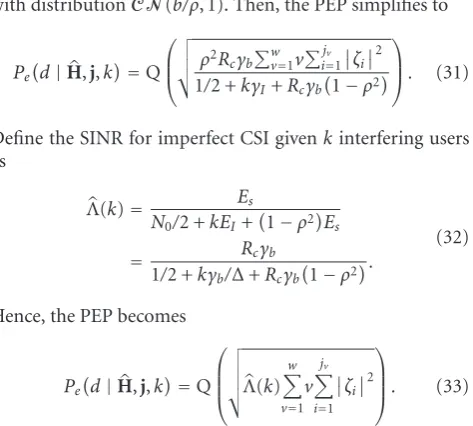
complex Gaussian random variable ζj = (hj −b)/σ +b/ρ with distributionCN(b/ρ, 1). Then, the PEP simplifies to
Pe
Define the SINR for imperfect CSI givenkinterfering users as
Hence, the PEP becomes
Pe
Averaging (33) over the fading amplitudes and the number of interfering users, the PEP of coded FHSS systems over Rician fading channels with imperfect CSI is given by (24) withΛ(k) being replaced withΛ( k).
4. RESULTS AND DISCUSSION
To illustrate the results, we consider coded FHSS systems employing a rate-1/2 convolutional code with a frame size ofN=2×512 coded bits. The union bound is truncated to a distancedmax ≤ 15 in order to reduce the computational complexity. Throughout the results, we assume thatQ=79 as in the Bluetooth technology. For the case of perfect CSI over Nakagami fading, only the exact analysis is employed, whereas the Gaussian approximation is used in the cases of Rician fading and imperfect CSI.
Figure 2 shows the performance of an FHSS network with 10 users and perfect CSI for different hop lengths. We observe that the obtained analytical results closely approximate the simulation results. Thus, the proposed analytical approach provides an accurate measure of the performance of coded FHSS systems with MAI. In the rest of this paper, only analytical results are shown in order to make the presentation of the results clear.
10−10
10−9
10−8
10−7
10−6
10−5
10−4
10−3
10−2
10−1
Pb
4 6 8 10 12 14 16
Eb/N0(dB)
m=1
m=8
m=16
m=32
m=64
Figure2: Performance of a rate-1/2 convolutionally coded FHSS system with perfect CSI for 10 users (K = 10) and different hop lengthsm=1, 8, 16, 32, 64 (solid: approximation using the union bound, dash: simulation).
10−9
10−8
10−7
10−6
10−5
10−4
10−3
10−2
10−1
Pb
4 6 8 10 12 14 16 18 20
Eb/N0(dB)
K=1
K=10
K=20
K=40
K=60
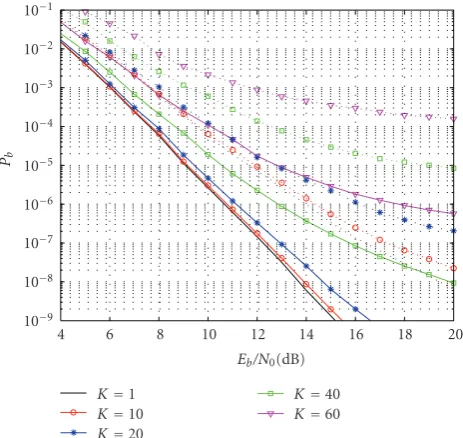
Figure 3: Performance of a convolutionally coded FHSS system over Nakagami fading with perfect CSI for different number of users
Kand SIR=5 dB, (solid:m=1, dashed:m=64).
provided to the coded system, which increases the impact of interference on the performance of the system.
Figure 5shows the SINR required for the coded FHSS system to achievePb=10−5over Rayleigh fading versus the number of usersKwith perfect CSI for different hop lengths. In the figure, we observe that as the hop length increases, the required SNR increases up to a maximum number of users beyond which the required performance cannot be achieved.
10−9
10−8
10−7
10−6
10−5
10−4
10−3
10−2
10−1
Pb
4 6 8 10 12 14 16 18 20
Eb/N0(dB)
m=1
m=8
m=16
m=32
m=64
Figure 4: Performance of a convolutionally coded FHSS system over Nakagami fading with perfect CSI for different hop lengthsm
and SIR=5 dB, (solid:K=1, dashed:K=40).
8 10 12 14 16 18 20
Eb
/N
0
(dB)
100 101 102
K
m=1
m=8
m=16
m=32
m=64
m=128
Figure5: SNR required for a convolutionally coded FHSS system to achievePb=10−5over Nakagami fading versus the number of users
Kwith perfect CSI form=1, 8, 16, 32, 64, 128 and SIR=5 dB.
10−9
10−8
10−7
10−6
10−5
10−4
10−3
10−2
10−1
Pb
2 4 6 8 10 12 14 16
Eb/N0(dB)
K=1
K=10
K=20
K=40
K=60
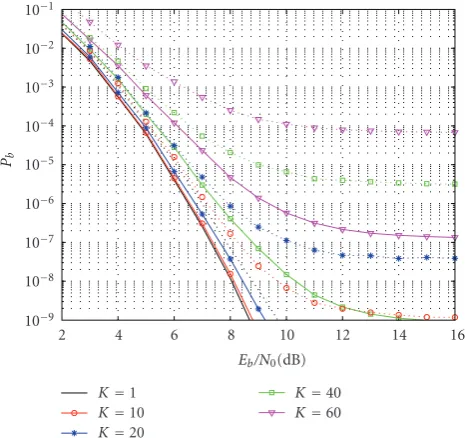
Figure 6: Performance of a convolutionally coded FHSS system over a Rician fading withκ=10 dB and perfect CSI for different number of usersKand SIR=5 dB, (solid:m=1, dashed:m=64).
The performance of the coded FHSS system over Rician fading withκ =10 dB and perfect CSI is shown inFigure 6
for different number of users and hop lengths ofm=1 and m=64. Comparing with the results for Nakagami fading, we observe that the performance loss due to increasing the hop length decreases as the fading becomes less severe. Similar to the case of Nakagami fading, the performance loss due to interference increases as the hop length increases. Note that the error floor resulting from the interference is lower in the case of Rician compared to that in the case of Nakagami fading. In Figure 7, the performance of the coded FHSS system over a Rician fading withκ =10 dB and perfect CSI is shown for different hop lengths and number of users of 1 and 40.
The results of imperfect CSI are obtained using only pilot estimation (OPE) with Ep = Es. In this case, the estimation error variance ofσ2
e =(N0+kEI)/Es. In simulating systems with OPE, one coded bit is punctured every m coded bits to account for the rate reduction resulting from inserting a pilot signal in each hop. This affects the whole distance distribution of the resulting code and may reduce the minimum distance of the code. The resultant code rate after puncturing is given by
%
Rc= mRc
m−1. (34)
Table 1 shows the code rates and the minimum distances of the punctured codes for different hop lengths. According to the table, we conclude that systems with short hop are expected to have more channel diversity at the cost of lower minimum distance and worse channel estimation quality.
In Figure 8, we show the performance of the coded FHSS system over Rayleigh and Rician fading channels with OPE for a number of users K = 20 and different hop
10−9
10−8
10−7
10−6
10−5
10−4
10−3
10−2
10−1
Pb
2 4 6 8 10 12 14 16
Eb/N0(dB)
m=1
m=8
m=16
m=32
m=64
Figure 7: Performance of a convolutionally coded FHSS system over a Rician fading withκ=10 dB and perfect CSI for different hop lengthsmand SIR=5 dB, (solid:K=1, dashed:K=40).
Table1: Rates and minimum distances of the punctured rate-1/2 convolutional codes.
m Code RateRc% dmin
4 0.667 4
8 0.571 5
16 0.533 6
32 0.516 6
64 0.508 6
lengths. We can observe that as the fading becomes more severe (Rayleigh compared to Rician), the optimal hop length decreases because the diversity becomes more crucial to the performance as the fading becomes more severe. In addition, the optimal hop length decreases as the SINR increases since diversity becomes more important at high SINR.
10−9
10−8
10−7
10−6
10−5
10−4
10−3
10−2
10−1
Pb
2 4 6 8 10 12 14 16 18 20 22
Eb/N0(dB)
m=8
m=16
m=32
m=64
m=128 Rayleigh
Rician (K=10 dB)
Figure 8: Performance of a convolutionally coded FHSS system over Rayleigh and Rician fading channels with an OPE receiver for number of usersK=20, SIR=5 dB, and different hop lengthsm= 8, 16, 32, 64, 128, (solid: Rayleigh, dashed: Rician withκ=10 dB).
8 10 12 14 16 18 20
Eb
/N
0
(dB)
100 101 102
K
m=8
m=16
m=32
m=64
m=128
Figure9: SNR required for a convolutionally coded FHSS system achievePb=10−4over Rayleigh fading versus the number of users
Kwith an OPE receiver for SIR=5 dB andm=8, 16, 32, 64, 128.
In Figure 9, we observe that the optimal hop for the coded FHSS system over Rayleigh fading channel is m =
32, for all the number of users. In Figure 10, the same information shown inFigure 9 is shown for Rician fading channel withκ =10 dB, where we observe that the optimal hop increases as the channel become less severe (i.e., as the Rician factor increases) since diversity becomes less important. In particular, for Rician fading channels with
4 5 6 7 8 9 10
Eb
/N
0
(dB)
100 101 102
K
m=8
m=16
m=32
m=64
m=128
Figure10: SNR required for a convolutionally coded FHSS system to achievePb=10−4over Rician fading withκ=10 dB versus the
number of usersKwith an OPE receiver for SIR=5 dB andm= 8, 16, 32, 64, 128.
κ =10, the cases ofm = 16 andm = 32 compete for the optimal hop length, and the former wins as the number of users increases.
5. CONCLUSIONS
In this paper, we derived a union bound for coded FHSS systems with MAI. Results show that the performance loss due to interference increases as the hop length increases (or in other words as the number of hops in FHSS systems decreases). This performance loss increases as the number of users increases. Furthermore, the tradeoffbetween channel diversity and channel estimation under interference condi-tions has been investigated analytically. It was found that as the fading becomes more severe (Rayleigh as compared to Rician), the optimal hop length decreases. In addition, the optimal hop length decreases as the SINR increases since diversity becomes more important at high SINR. Furthermore, the optimal hop length tends to increase as the SIR increases for the same reason. In the case of channel estimation, the proposed analytical approach can be safely applied to FHSS systems with large number of users.
ACKNOWLEDGMENT
The author acknowledges the support provided by King Fahd University of Petroleum and Minerals (KFUPM) to conduct this research under grant FT040009.
REFERENCES
[2] E. A. Geraniotis and M. B. Pursley, “Error probabilities for slow-frequency-hopped spread-spectrum multiple-access communications over fading channels,”IEEE Transactions on Communications, vol. 30, no. 5, part 2, pp. 996–1009, 1982. [3] G. Einarsson, “Coding for a multiple-access
frequency-hopping system,”IEEE Transactions on Communications, vol. 32, no. 5, pp. 589–597, 1984.
[4] A. W. Lam and D. V. Sarwate, “Multiple-user interference in FHMA-DPSK spread-spectrum communications,” IEEE Transactions on Communications, vol. 34, no. 1, pp. 1–12, 1986. [5] W. E. Stark, “Coding for frequency-hopped spread-spectrum communication with partial-band interference—II: coded performance,”IEEE Transactions on Communications, vol. 33, no. 10, pp. 1045–1057, 1985.
[6] M. B. Pursley and W. E. Stark, “Performance of Reed-Solomon coded frequency-hop spread-spectrum communications in partial-band interference,”IEEE Transactions on Communica-tions, vol. 33, no. 8, pp. 767–774, 1985.
[7] G. L. Stuber, J. W. Mark, and I. F. Blake, “Diversity and coding for FH/MFSK systems with fading and jamming—part I: mul-tichannel diversity,” IEEE Transactions on Communications, vol. 35, no. 12, pp. 1329–1341, 1987.
[8] E. Geraniotis and J. W. Gluck, “Coded FH/SS communications in the presence of combined partial-band noise jamming, Rician nonselective fading, and multiuser interference,”IEEE Journal on Selected Areas in Communications, vol. 5, no. 2, pp. 194–214, 1987.
[9] R. J. McEliece and W. E. Stark, “Channels with block interference,”IEEE Transactions on Information Theory, vol. 30, no. 1, pp. 44–53, 1984.
[10] S. Rice, “Statistical properties of a sine wave plus random noise,”Bell Systems Technical Journal, vol. 27, pp. 109–157, 1948.
[11] M. Nakagami, “The m-distribution—a general formula of intensity distribution of fading,” in Statistical Methods in Radio Wave Propagation, W. C. Hoffman, Ed., Pergamon Press, Elmsford, NY, USA, 1960.
[12] A. J. Viterbi, “Convolutional codes and their performance in communication systems,”IEEE Transactions on Communica-tions, vol. 19, no. 5, part 1, pp. 751–772, 1971.
[13] S. A. Zummo, P.-C. Yeh, and W. E. Stark, “A union bound on the error probability of binary codes over block-fading channels,”IEEE Transactions on Vehicular Technology, vol. 54, no. 6, pp. 2085–2093, 2005.
[14] V. A. Aalo and J. Zhang, “Performance analysis of maximal ratio combining in the presence of multiple equal-power cochannel interferers in a Nakagami fading channel,” IEEE Transactions on Vehicular Technology, vol. 50, no. 2, pp. 497– 503, 2001.
[15] J. Cui and A. U. H. Sheikh, “Outage probability of cellular radio systems using maximal ratio combining in the presence of multiple interferers,”IEEE Transactions on Communications, vol. 47, no. 8, pp. 1121–1124, 1999.
[16] J. H. Winters, “Optimum combining in digital mobile radio with cochannel interference,”IEEE Transactions on Vehicular Technology, vol. 33, no. 3, pp. 144–155, 1984.
[17] Y.-D. Yao and A. U. H. Sheikh, “Investigations into cochannel interference in microcellular mobile radio systems,” IEEE Transactions on Vehicular Technology, vol. 41, no. 2, pp. 114– 123, 1992.
[18] V. A. Aalo and J. Zhang, “On the effect of cochannel inter-ference on average error rates in Nakagami-fading channels,”
IEEE Communications Letters, vol. 3, no. 5, pp. 136–138, 1999.
[19] M. K. Simon, “Some new twists to problems involving the Gaussian probability integral,”IEEE Transactions on Commu-nications, vol. 46, no. 2, pp. 200–210, 1998.
[20] I. Gradshteyn and I. Ryzhik, Table of Integrals, Series, and Products, Academic Press, London, UK, 4th edition, 1965. [21] S. Verdu, Multiuser Detection, Cambridge University Press,