R E S E A R C H
Open Access
Robust L1 tracker with CNN features
Hongqing Wang and Tingfa Xu
*Abstract
Recently, L1 tracker has been widely applied and received great success in visual tracking. However, most L1 trackers use only the image intensity for sparse representation, which is insufficient to represent the object especially when drastic appearance changes occur. Convolutional neural network (CNN) has
demonstrated remarkable capability in a wide range of computer vision fields, and features extracted from different convolutional layers have different characteristics. In this paper, we propose a novel sparse representation model with convolutional features for visual tracking. Besides, to alleviate the redundancy from high-dimensional convolutional features, a feature selection method is adopted to remove noisy and irrelevant feature maps, which can reduce computation redundancy and improve tracking accuracy. Different from traditional sparse representation based tracking methods, our model not only exploits convolutional features to improve the robustness for describing the object appearance but also uses the trivial templates to model both reconstruction errors caused by sparse representation and the eigen-subspace representation. In addition, an unified objective function is proposed and a customized APG method is developed to effectively solve the optimization problem. Numerous qualitative and quantitative evaluations demonstrate that our tracker outperforms other state-of-the-art trackers in a wide range of tracking scenarios.
Keywords: CNN features, Visual tracking, Sparse representation, APG method
1 Introduction
Visual tracking plays an important role in computer vision and has received fast-growth attention in re-cent years due to its wide practical application such as pedestrian detection, vehicle navigation, security surveillance, and wireless communication [1–4]. In general, visual tracking is to track an interested tar-get which usually has been indicated in the first frame by a bounding box in video streams. The main challenge of visual tracking is the numerous appear-ance changes, such as occlusion, abrupt motion, illu-mination variation, in-plane rotation, out-of-plane rotation, deformation, and scale variation.
To overcome the above challenges, many effective trackers have been proposed in recent years [5, 6]. Generally, tracking algorithms can be classified into three different categories: discriminative, generative, and hybrid generative-discriminative. Discriminative
trackers formulate tracking as a binary classification problem, which search the target location and ex-tract target from the background. The main problem of discriminative trackers is that they cannot esti-mate the target-specific location due to the limited number of candidates. Generative trackers adopt an appearance model to represent the target appear-ance, which estimate the target state by finding the highest likelihood; the model is often updated online to deal with the appearance changes. The main problem of generative trackers is that the appearance model often exhibits some limitations thus cannot represent the target effectively [7–9]. Hybrid generative-discriminative trackers fuse the advantages of discriminative and generative trackers; researchers have proposed many effective hybrid generative-dis-criminative trackers recently [10–13]. The hybrid model can take advantage of the global characteris-tics of object and also exploit the useful information from the background. However, the complexity of hybrid model is relatively high, which will lead to a * Correspondence:[email protected]
School of Optoelectronics, Image Engineering & Video Technology Lab, Beijing Institute of Technology, Beijing 100081, China
high computational cost, thus cannot meet the requirement in practice.
Recently, as a generative tracking algorithm, sparse representation model has achieved outstand-ing performance [14]. Mei et al. [15] first propose the L1 tracker by casting the tracking problem as finding a sparse combination of a target template set and a trivial template set to approximate the target object. Then the sparsity is achieved by solv-ing an l1-regularized least squares problem. Ji et al. [16] improve the tracking accuracy by adding an l2 norm regularization on the trivial coefficients and use an accelerated proximal gradient approach for solving the minimization problem which has achieved both tracking accuracy and computational efficiency. Zhang et al. [17] exploit the intrinsic rela-tionship among different candidates which utilize the joint-sparsity property of candidates by casting track-ing as a multi-task problem. Jia et al. [18] exploit both partial information and spatial information of the target based on a novel alignment-pooling method and employ a template update strategy, which combines incremental subspace learning and sparse representation. Wang et al. [19] introduce l1 regularization into the principal component analysis (PCA) reconstruction and propose an online tracking algorithm, which approximates the target by linearly combining the PCA basis and a sparse set of trivial templates. Liu et al. [20] use a local sparse represen-tation for representing the target and exploit the sparse coding histogram to represent the dynamic dictionary basis distribution of the target model. Guo et al. [21] propose a novel multi-view structural local subspace method which jointly exploits the advantages of three sub-models and uses an alignment-weighting average method to obtain the optimal state of the target. Wang et al. [22] adopt squared templates to replace trivial templates to handle partial occlusion and propose a probabilistic collaborative representation framework, which reduces the complexity in traditional sparse model-based methods. Kim et al. [23] propose a novel structure-preserving sparse learning method, which preserves both local geometrical and discrim-inative structures within a multi-task feature selec-tion framework.
However, most of these methods mainly aim at improving the tracking accuracy or efficiency, they usually use the image intensity to construct the template set, which is less effective in expressing the structural information of the target, thus cannot cover severe appearance changes of the target object.
To solve this problem, many hand-crafted features have been used for visual tracking, such as
Haar-like features, histogram of oriented gradient (HOG) features, local binary pattern (LBP), and scale-invariant feature transform (SIFT). However, these hand-crafted features are not robust for generic ob-ject tracking. Convolutional neural network (CNN) models which learn hierarchical features from raw images on large-scale dataset have been widely used to represent the appearance of the target. Ma et al. [24] exploit the features from hierarchical layers of CNN within a correlation filter-based framework for visual tracking, learn linear correlation filters on each CNN layer, and adopt a coarse-to-fine method to estimate the target location. Wang et al. [25] analyze CNN features from different layers and use a novel tracking method which jointly exploits two convolutional layers to mitigate the drift prob-lem. Danelljan et al. [26] indicate that activations from the first convolutional layers achieve favorable tracking performance compared with the deeper layers within a discriminative correlation filter-based framework. In contrast to the traditional fea-ture descriptors, CNN feafea-tures contain more struc-tural information, which is crucial to localize the target in an unknown frame.
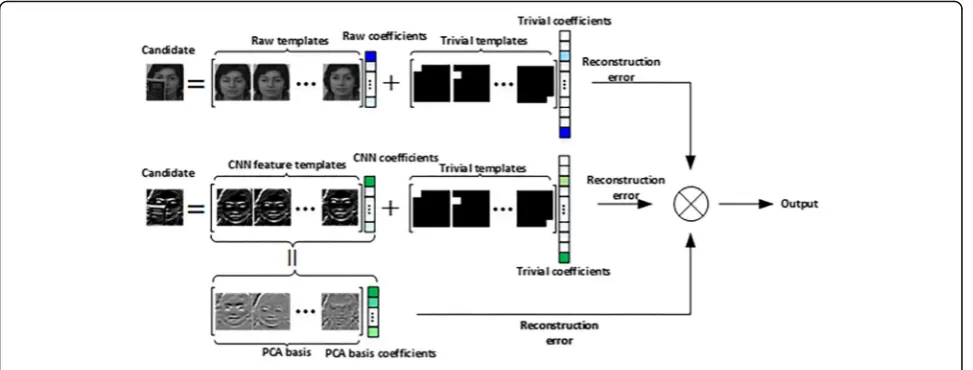
Motivated by the above observations, we present a novel L1 tracker with CNN features. The proposed ap-proach use a novel sparse representation model with convolutional features for visual tracking, which not only exploits CNN features to improve the robustness for describing the object appearance but also uses the trivial templates to model both reconstruction errors caused by sparse representation and the eigen-subspace representation. Besides, to alleviate redun-dancy of high-dimensional convolutional features, a feature selection method is adopted, which can reduce computation complexity and improve tracking accur-acy. This strategy makes the model jointly exploit the advantages of the CNN features with more structural information to effectively represent the target, and of both sparse representation and the incremental subspace learning simultaneously. In addition, a customized APG method is developed to effectively solve the optimization problem. Further-more, a robust observation likelihood metric is proposed.
2 Proposed model
2.1 CNN features
Most of the traditional L1 trackers usually use the image intensity to construct the template set. How-ever, the image intensity-based trackers can hardly handle the complicated situation in practical visual tracking due to the lack of target structural informa-tion. To this end, our algorithm introduces CNN fea-tures in describing the target template set.
Convolutional neural network (CNN) has been successfully applied in many computer vision fields, especially in complicated tasks such as object detec-tion, image classificadetec-tion, and object recognition [27]. Traditional CNN, which only the information from the last layer are used to represent the target, are effective in dealing with classification problems. However, adopting CNN for generic visual tracking directly is inadequate due to the lack of training samples and the computational complexity.
To overcome this problem, pre-trained CNN fea-ture extraction method is proposed in recent years. CNN features, extracted from different CNN layers, have different characteristics in describing the object [24]. The CNN features from deeper layer contains more high-level semantic information, which can be seen as structural information, have more distinguishing capabil-ities and thus is effective facing the situation when intra-class appearance variation occurs. However, the features from deep layer have very low spatial resolution so that it cannot fit the task in generic visual tracking, which aim to indicate the location of target. On the other hand, CNN features from earlier layer contain more fine-grained information, which means the more the discriminative cap-abilities, the more effective in locating the target. But with the less semantic information, features from earlier layer are more sensitive to intra-class appearance variations.
From the observation above, different from the com-mon strategy which use CNN feature extracted from the last layer, we exploit CNN features from hierarchical layers in order to make full use of the high-level struc-tural information as well as preserving the spatial infor-mation of target.
2.2 Feature selection
In this paper, we employ CNN features extracted from VGG Net [28], which is trained on the large-scale ImageNet dataset; note that other CNN models may also be used alternatively, such as AlexNet [29] and R-CNN [30].
VGG-19 Net (with 16 convolutional layers and 3 full connect layers) has more deep structure than other CNN models, which can provide more seman-tic information. Given an input image frame, due to the CNN pooling propagation, the spatial resolution
of each layer is more and more smaller, for instance, pool1 with the size of 224 × 224 and pool5 with only the size of only 7 × 7. The target in small size layers is hard to tell, so there is a need to resize each layer as a fixed size in order to locate the target accurately.
In this paper, we resize different layers to a constant size of 224 × 224 by using bilinear interpolation [31],
fk ¼X
i
ωkiFi ð1Þ
where the weight ωki depends on the position of k
and i neighboring feature vectors, and F denotes the feature space.
As discussed above, in order to utilize CNN features from multi-layers, we choose conv2-2, conv3-4, and conv5-4 layers as feature representations specifically.
However, CNN features are pre-trained mainly aimed at dealing with classification tasks, so there are plenty of neurons used in describing generic object, which results in a very large number of wasted features. Here, by wasted features, we mean features which are redundant in discriminating target from background, especially when target deformation occurs. Furthermore, deeper CNN features are high-dimensional features (e.g., 512 dimension for conv5-4), leading to an extremely high computational complexity.
In order to alleviate the influences of these wasted features, it is of great importance to adopt an appro-priate selection mechanism. From the experimental observation, we found that most redundant features have zero values for representing the target, so we adopt a sparse method to remove the redundancy similar to [25] and choose the feature with the lar-gest coefficient as the template set.
2.3 Sparse representation model with CNN features and incremental subspace constraint
corresponding sparse coefficients, and λ controls the amount of regularization. The optimal state is the state with smallest reconstruction error.
However, traditional sparse representation-based trackers have some drawbacks. First, the computa-tional complexity is relatively high which limit the real-time application. Secondly, they only use image intensity to construct the target template set, which can hardly handle the drastic appearance changes of target in practical visual tracking due to the lack of feature description. Thirdly, the target templates are only obtained from a previous couple of time in-stants, which cannot effectively obtain the underlying properties for modeling target appearance.
To solve the second problem, we use CNN tures in describing the object. However, CNN fea-tures from different convolutional layers have different characteristics, high-level features have more distinguishing capabilities while low spatial resolution, and low-level features have more discrim-inative capabilities while sensitive to appearance changes. So, we construct a target template set by using hierarchical CNN features as a more complete feature descriptor. Furthermore, CNN features have a very high dimension in contrast to image intensity-based trackers, which results in an extreme compu-tation complexity. In addition, most CNN features have barely contributed to effectively determine the exact location of the target, so we adopt a feature selection method to alleviate the redundancy.
To solve the third problem, an eigen template model is introduced for its ability to learn the tem-poral correlation of target appearances effectively from the past observation data by incremental update procedure, which compactly capture both rich and
redundant image properties [33]. The incremental vis-ual tracking (IVT) [34] algorithm can efficiently learn and update a low-dimensional PCA subspace repre-sentation of the target object and update the sample mean, which makes full use of the past observed target appearances. Experimental results have demon-strated that incremental learning of PCA subspace representation can deal with appearance changes caused by rotation, illumination variation, deformation and scale change efficiently. However, it has also been demonstrated that the performance of IVT tracker declines when partial occlusion occurs. Since the underlying assumption of PCA is that the error of each pixel is Gaussian distributed with small variances, this assumption does not hold anymore case of partial occlusion occurs. Furthermore, the IVT tracker may also fail when the target overlaps with a similar object.
In [19], each patch can be linearly represented by the eigenvectors corresponding to itself and the co-efficients of almost all other eigenvectors will be zero; hence, by introducing l1 regularization into the PCA reconstruction and modeling the error term e with arbitrary but sparse noise,
argmin
z;e
1
2ky−Uq−ek 2
2þτk ke 1 ð3Þ
where U∈ℝD×P is the PCA eigen basis matrix and P is the number of eigen basis vectors. q∈ℝP are the coefficients of U and τ controls the amount of regularization.
Motivated by [19], we model both reconstruction errors caused by sparse representation and the eigen subspace representation by solving
argmin
sponding sparse coefficients, t is the sample mean of target object, and σ balances the contribution of the two terms.
This strategy constrains the reconstruction of the sparse representation to have a minimal reconstruc-tion error in the PCA eigen basis representareconstruc-tion. Meaning that our model with incremental subspace constrains can model both reconstruction errors caused by sparse representation and the eigen-subspace representation. This method constructs the reliable part of the target using a few number of PCA basis.
By integrating the subspace constrained sparse repre-sentation model with CNN features extracted and selected from hierarchical CNN layers, we get
argmin
The above overall model takes advantages of both the capability of hierarchical CNN features in describ-ing the target and the subspace constrained sparse representation.
3 Optimization and the tracking algorithm
3.1 Optimization
Problem (5) can be decomposed into two sub-problems:
argmin
Problem (6-1) can be solved by the LASSO method [35] and problem (6-2) can be solved by the accelerated proximal gradient (APG) method [16]. APG method is an effective approach to solve the following unconstrained minimization problem,
minFð Þ þc Gð Þc ð7Þ
where F(c) is a differentiable convex function with Lipschitz continuous gradient andG(c) is a non-smooth convex function. We describe the details of solution as follows.
Let R=T−UUTTand S¼t−UUTt. Then the
prob-lem (6-2) can be reformed to the following formulation:
However, APG method cannot be used directly in our model since the original APG method is pro-posed for solving unconstrained minimization prob-lem, so there is a need to covert our model into an unconstrained problem.
Let 1T∈ℝN denotes the column vector with entries are all 1. Letψ(c) denotes the indicator function defined by
ψð Þ ¼c þ∞0 c≥0
otherwise
; ð9Þ
The problem (8) can be alternately reformed as the following unconstrained problem:
Then, we can use the APG approach to solve this minimization problem with
In the above formulation, we need to solve an optimization problem:
3.2 Particle filter tracking framework
Similar to [19], our method is based on Bayesian filtering framework in a Markov model. In a particle filter frame-work, given a set of observed image vectorsZ1 :t−1= [z1, z2,…,zt−1], the posterior probability can be recursively computed as
pðxtjz1:t−1Þ ¼ Z
pðxtjxt−1Þpðxt−1jzt−1Þdxt−1; ð13Þ
where p(xt|xt−1) is the dynamic model and xtindicates
the state vector.
At timet, by using Bayes rule, we get
pðxtjZtÞ ¼pðztjxtÞ
R
pðxtjxt−1Þpðxt−1jzt−1Þdxt−1
pðztjz1:t−1Þ ; ð14Þ
where p(zt|xt) denotes the observation likelihood of
ob-serving zt at statext. The state variable xtis composed
of six parameters xt= [tx,ty,θt,st,δt,φt]
T
, wheretx,ty,θt,
st,δt,φtdenotex,y translations, rotation angle, scale,
as-pect ratio, and skew resas-pectively.
The dynamic model is modeled by the Gaussian distribution,
pðxtjxt−1Þ ¼N
xt;xt−1; X
; ð15Þ
where∑is a diagonal covariance matrix.
Through the above method, we generate the candidates state set Xt¼ x1t;x2t;…;xnt
, wheren is the number of candidates sampled at each frame. For each particlexi
t, we crop out the related image region to getzi
t. Then, we get a candidate setZt¼ z1t;z2t;…;znt
∈RDn.
For each candidate, we solve the optimization problem using Algorithm 1. Then, the observation likelihood of statexi
t is given as
pzit;yitxit¼1
φexp −δ1zit−MaiM 2 2
exp −δ2yit−TciT 2 2
exp −δ3 UUT TciT−t
− Tci T−t
2
2
;
ð16Þ
with CNN features. The optimal state xt of frame t is
To alleviate the influences of object appearance changes, there is a need to update the target template and PCA basis dictionary dynamically.
First, we use the method proposed in [27] to update target template. This updating strategy can effectively alleviate the influences caused by noise and occlusion. However, the target template is achieved from a previous couple of time, so they are not capable of dealing with numerous appearance variations due to the lack of long-term adjustment.
Then, we update the PCA basis dictionary using the method proposed in [34] and replace the oldest target template with the PCA reconstruction of the optimal candidate when the estimated optimal state is achieved. The PCA eigen template model could learn the temporal correlation of object appearances by in-cremental SVD update procedure effectively, so it has the ability to cover a long period of appearance changes relatively.
By adopting the strategy proposed above, we co-update the target template and PCA basis for current target appearance and long-term adjustment to improve the performance of our tracker.
4 Experiments
In order to illustrate the performance of our tracker, we test the robustness of our algorithm on 12 challenging video sequences with other 9 state-of-the-art trackers. The trackers are L1APG [16], ASLA [18], MTT [36], LSK [37], SST [38], IVT [34], FRAG [39], KMS [40], and SRUCK [41].
The proposed algorithm in this paper is implemented in MATLAB 2014a on a PC with Intel i7-4790 CPU (3.6 GHz) and 16 GB RAM memory. Before the experi-ment, we adopt some parameters and modify them ac-cording to other cited published works. For example, the iteration number is set to be 5 in the optimization part, but the tracking performance improves little when it is set to 10 or other lager value and the computational cost also increases with the iteration number. We did many experiments to choose the best parameter values as fol-lows. Each sample is resized to 24 × 24 pixels. The num-ber of target templates is set to be 11 with one fixed template extracted from the first frame. The candidate numbern in each frame is 600. These values mainly affect the speed of the tracker; we choose them to
achieve a balance between the speed and the tracking performance. The number of PCA basis is set to be 10. The regularization factor λ is set to be 0.01, σ is set to be 0.1, andρis set to be 0.01. The balance factorsδ1,δ2, andδ3are set to be 10, 10, and 1. The Lipschitz constant
Lis set to be 8.
4.1 Qualitative evaluation
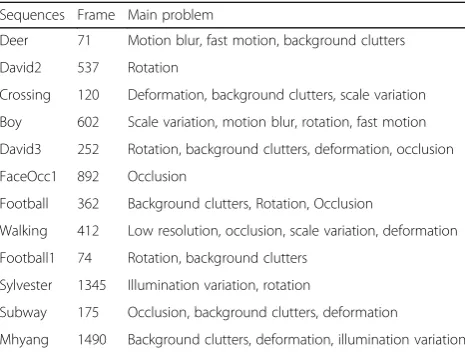
To evaluate our tracker with other state-of-the-art methods qualitatively, we choose 12 video sequences for testing. The 12 video sequences pose many challenging problems; Table 1 lists the characteristics of the sequences used in this paper.
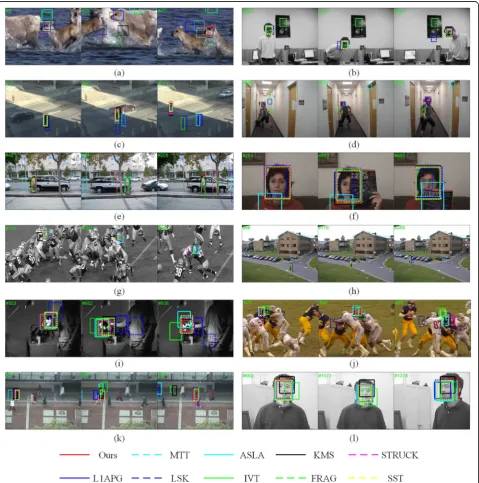
Compared with traditional sparse representation-based trackers (e.g., L1APG, MTT, ASLA, LSK, and SST), our tracker outperforms in a wide range of challenging scenarios, especially when occlusion, ro-tation, and deformation occurs. This mainly attri-butes to our tracker that exploits both the advantage of sparse representation and incremental subspace learning, as well as using CNN features for repre-senting the target. The incremental learning of PCA subspace representation method mainly aims at deal-ing with appearance changes caused by rotation, deformation, and scale variation, but it is sensitive to occlusion. In our algorithm, the occluded pixels of target object can be represented by the trivial tem-plates, so when partial occlusion occurs, our tracker is more robust than the IVT tracker. Traditional sparse representation-based trackers are sensitive to rotation and deformation because they only use the image intensity for representing the target, but our method adopts CNN features from hierarchical layers in order to make full use of the high-level structural information as well as preserving the spatial information of target, so our tracker is more robust than these traditional L1 trackers.
Table 1Tracking sequences used in this paper
Sequences Frame Main problem
Deer 71 Motion blur, fast motion, background clutters
David2 537 Rotation
Crossing 120 Deformation, background clutters, scale variation
Boy 602 Scale variation, motion blur, rotation, fast motion
David3 252 Rotation, background clutters, deformation, occlusion
FaceOcc1 892 Occlusion
Football 362 Background clutters, Rotation, Occlusion
Walking 412 Low resolution, occlusion, scale variation, deformation
Football1 74 Rotation, background clutters
Sylvester 1345 Illumination variation, rotation
Subway 175 Occlusion, background clutters, deformation
For example, in Fig. 2c–k, the target suffers from partial or total occlusion. In these scenarios, the IVT tracker pre-sents bad performance, while our tracker can cope with these situations effectively. In Fig. 2a–i, the targets suffer from drastic appearance changes. Our tracker can still handle these situations effectively because the adopting of CNN features can utilize more structural information, while other L1 trackers failed in most of these situations.
In conclusion, our tracker performs well in all the 12 sequences while other 9 state-of-the-art trackers fail in some sequences.
4.2 Quantitative evaluation
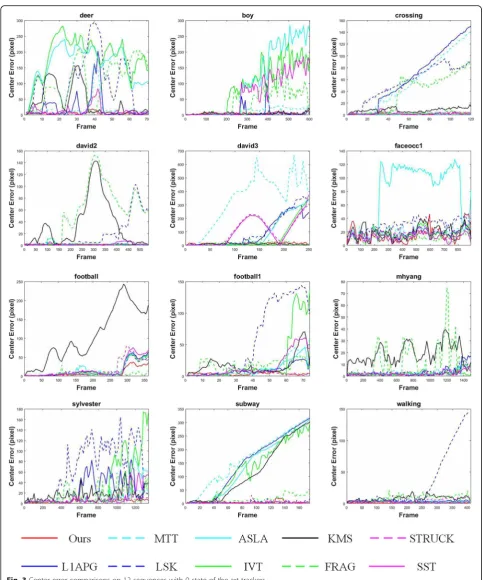
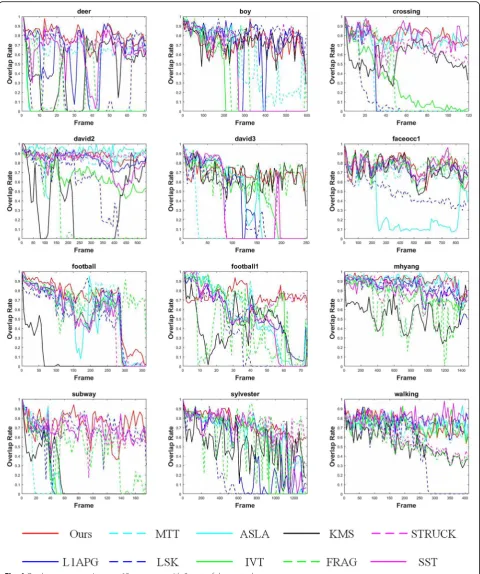
We provide quantitative comparisons of our tracker with other state-of-the-art methods in terms of center location error (CLE) and overlap rate (VOR). The CLE is measured
by the Euclidean distance between the estimated target cen-ter location and the ground truth cencen-ter location. The VOR is defined by areaðBT∩BGTÞ
areaðBT∪BGTÞ, where BTis the estimated target
bounding box andBGTis the ground truth bounding box. Figures 3 and 4 show the center error plot and the over-lap rate plot of different trackers for each video sequence.
In addition, we adopt the precision and success rate for evaluating the tracking performance. The precision criteria is the percentage of frames which estimated location is within a given threshold dis-tance of the ground truth and the success criteria is the ratios of successful frames at a given threshold ranged from 0 to 1.
Figure 5 shows the precision and success plots. The threshold of distance precision is 20 pixels and the threshold of overlap success rate is 0.5. Both precision plots and success plots show that our tracker is more robust than other state-of-the-art trackers over the 12 video sequences.
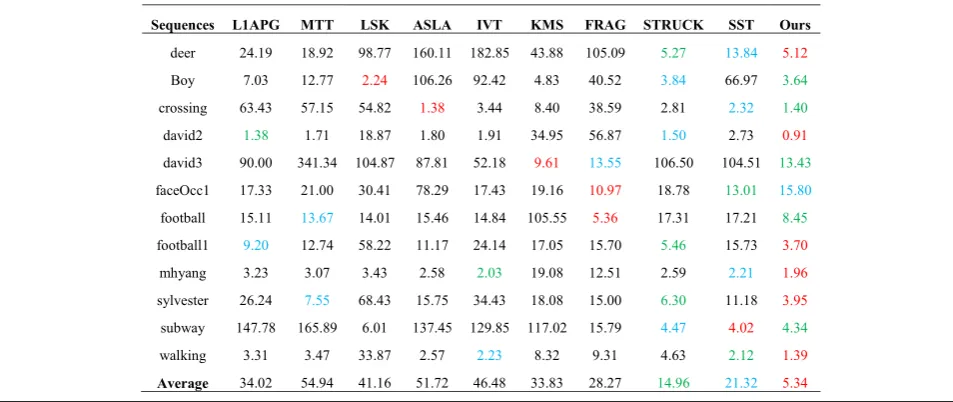
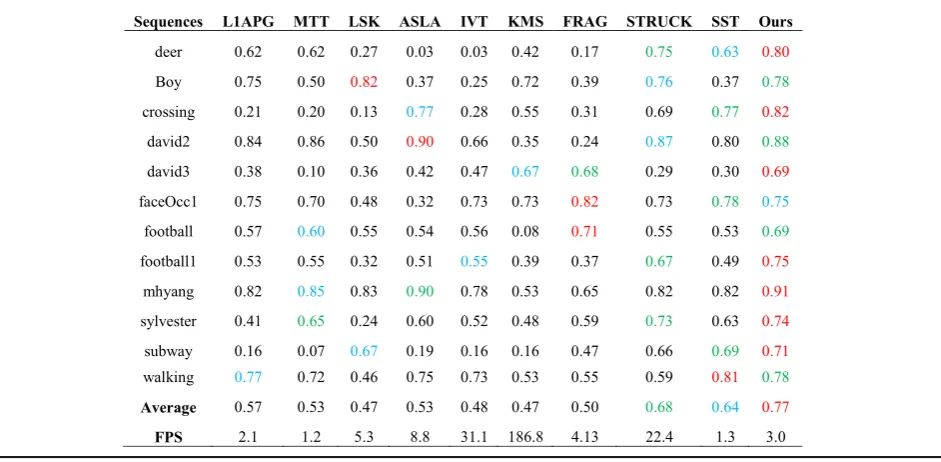
Tables 2 and 3 demonstrate the average center error and overlap rate of different tracking methods on each sequence. The best three results are marked in red, blue, and green fonts.
Note that in 6 of the 12 sequences (e.g., deer, david2, football1, mhyang, sylvester, and walking), the proposed tracker achieves the best average
Fig. 5Precision and success plots on 12 sequences with 9 state-of-the-art trackers
center error. In 7 of the 12 sequences (e.g., deer, crossing, david3, football1, mhyang, sylvester, and walking), the proposed tracker achieves the best overlap rate. In other sequences, our tracker achieves either the second or the third best scores. The pro-posed tracker also achieves both the best scores in average center error and average overlap rate for all the 12 sequences, meaning that our tracker outper-forms other state-of-the-art trackers in many chal-lenging situations significantly.
5 Conclusions
In this paper, we propose a robust L1 tracker with CNN features. Different from traditional sparse representation-based tracking algorithms, our model not only exploits convolutional features to improve the robustness for describing the object appearance but also uses the trivial templates to model both re-construction errors caused by sparse representation and the eigen-subspace representation. A customized APG method is developed to solve the optimization problem effectively. Both qualitative and quantitative evaluations demonstrate that our tracker outperforms other state-of-the-art trackers in many challenging situations.
Acknowledgements
The authors would like to thank Image Engineering & Video Technology Lab for the support.
Authors’contributions
HW and TX came up with the algorithm and improved the algorithm. HW wrote and revised the paper. Both authors read and approved the final manuscript.
Funding
This work was supported by the Major Science Instrument Program of the National Natural Science Foundation of China under Grant 61527802, the General Program of National Nature Science Foundation of China under Grant 61371132 and 61471043, and the International S&T Cooperation Program of China under Grant 2014DFR10960.
Competing interests
The authors declare that they have no competing interests.
Publisher’s Note
Springer Nature remains neutral with regard to jurisdictional claims in published maps and institutional affiliations.
Received: 27 September 2017 Accepted: 6 November 2017
References
1. L Baroffio, A Canclini, MCA Redondi, M Tagliasacchi, G Dán, E Eriksson, V Fodor, J Ascenso, P Monteiro,Enabling Visual Analysis in Wireless Sensor Networks, IEEE International Conference on Image Processing(2015), pp. 3408–3410 2. F Zhao, B Li, H Chen, X Lv, Joint beamforming and power allocation for
cognitive MIMO systems under imperfect CSI based on game theory. Wirel. Pers. Commun.73, 679–694 (2013)
3. F Zhao, X Sun, H Chen, R Bie, Outage performance of relay-assisted primary and secondary transmissions in cognitive relay networks. EURASIP J. Wirel. Commun. Netw.2014, 60 (2014)
4. F Zhao, L Wei, H Chen, Optimal time allocation for wireless information and power transfer in wireless powered communication systems. IEEE Trans. Veh. Technol.65, 1830–1835 (2016)
5. A Yilmaz, O Javed, M Shah, Object tracking: a survey. ACM Comput. Surv. 38, 13 (2006)
Table 3Average overlap rate for each sequence with 9 state-of-the-art trackers. The last row shows comparison results regarding
6. Y Wu, J Lim, MH Yang,Online Object Tracking: A Benchmark, IEEE Conference on Computer Vision and Pattern Recognition(2013), pp. 2411–2418 7. H Yang, L Shao, F Zheng, L Wang, Z Song, Recent advances and trends in
visual tracking: a review. Neurocomputing74, 3823–3831 (2011) 8. AW Smeulders, DM Chu, R Cucchiara, S Calderara, A Dehghan, M Shah,
Visual tracking: an experimental survey. IEEE Trans. Pattern Anal. Mach. Intell. 36, 1442–1468 (2013)
9. X Li, W Hu, C Shen, Z Zhang, A Dick, AVD Hengel, A survey of appearance models in visual object tracking. ACM Trans. Intell. Syst. Technol.4, 58 (2013) 10. Y Yin, X Wang, D Xu, F Liu, Y Wang, W Wu, Robust visual detection–
learning–tracking framework for autonomous aerial refueling of UAVs. IEEE Trans. Instrum. Meas.65, 510–521 (2016)
11. W Zhong, H Lu, MH Yang, Robust object tracking via sparse collaborative appearance model. IEEE Trans. Image Process.23, 2356–2368 (2014) 12. Y Yin, D Xu, X Wang, M Bai, Online state-based structured SVM combined
with incremental PCA for robust visual tracking. IEEE Trans. Cybern.45, 1988–2000 (2017)
13. S Chen, S Li, R Ji, Y Yan, S Zhu, Discriminative local collaborative representation for online object tracking. Knowl.-Based Syst.100, 13–24 (2016)
14. S Zhang, H Yao, X Sun, X Lu, Sparse coding based visual tracking: review and experimental comparison. Pattern Recogn.46, 1772–1788 (2013) 15. X Mei, H Ling, Robust visual tracking and vehicle classification via sparse
representation. IEEE Trans. Pattern Anal. Mach. Intell.33, 2259 (2011) 16. H Ji, H Ling, Y Wu, C Bao,Real Time Robust L1 Tracker Using Accelerated
Proximal Gradient Approach, IEEE Conference on Computer Vision and Pattern Recognition(2012), pp. 1830–1837
17. T. Zhang, B. Ghanem, S. Liu, N. Ahuja, Robust visual tracking via multi-task sparse learning, IEEE Conference on Computer Vision and Pattern Recognition.157, 2042-2049 (2012).
18. X Jia,Visual Tracking Via Adaptive Structural Local Sparse Appearance Model, IEEE Conference on Computer Vision and Pattern Recognition(2012), pp. 1822–1829 19. D Wang, H Lu, MH Yang, Online object tracking with sparse prototypes. IEEE
Trans. Image Process.22, 314 (2013)
20. B Liu, J Huang, C Kulikowski, L Yang, Robust visual tracking using local sparse appearance model and K-selection. IEEE Trans. Pattern Anal. Mach. Intell.35, 2968–2981 (2013)
21. J Guo, T Xu, G Shi, Z Rao, X Li, Multi-view structural local subspace tracking. Sensors17, 666 (2017)
22. H Wang, S Zhang, Y Du, H Ge, B Hu, Visual tracking via probabilistic collaborative representation. J. Electron. Imaging26, 013010 (2017) 23. H Kim, S Jeon, S Lee, JK Paik,Robust Visual Tracking Using
Structure-Preserving Sparse Learning, IEEE Signal Processing Letters, PP(2017), pp. 1–1 24. C Ma, JB Huang, X Yang, MH Yang,Hierarchical Convolutional Features for
Visual Tracking, IEEE International Conference on Computer Vision(2016), pp. 3074–3082
25. L Wang, W Ouyang, X Wang, H Lu,Visual Tracking with Fully Convolutional Networks, IEEE International Conference on Computer Vision(2016), pp. 3119–3127 26. M Danelljan, G Häger, FS Khan, M Felsberg,Convolutional Features for
Correlation Filter Based Visual Tracking, IEEE International Conference on Computer Vision Workshop(2015), pp. 621–629
27. Y Lecun, Y Bengio, G Hinton, Deep learning. Nature521, 436–444 (2015) 28. K. Simonyan, A. Zisserman, Very Deep Convolutional Networks for
Large-Scale Image Recognition, Computer Science, (2014).
29. A Krizhevsky, I Sutskever, GE Hinton,ImageNet Classification with Deep Convolutional Neural Networks, International Conference on Neural Information Processing Systems(2012), pp. 1097–1105
30. R Girshick, J Donahue, T Darrell, J Malik,Rich Feature Hierarchies for Accurate Object Detection and Semantic Segmentation, Computer Vision and Pattern Recognition(2014), pp. 580–587
31. B Hariharan, P Arbeláez, R Girshick, J Malik,Hypercolumns for Object Segmentation and Fine-Grained Localization(2014), pp. 447–456 32. X Mei, H Ling,Robust Visual Tracking Using L (1) Minimization, IEEE
International Conference on Computer Vision(2009), pp. 1436–1443 33. T Bai, YF Li, Robust visual tracking with structured sparse representation
appearance model. Pattern Recogn.45, 2390–2404 (2012)
34. DA Ross, J Lim, RS Lin, MH Yang, Incremental learning for robust visual tracking. Int. J. Comput. Vis.77, 125–141 (2008)
35. R Tibshirani, Regression shrinkage and selection via the lasso: a retrospective. J. R. Stat. Soc.73, 267–288 (2011)
36. T Zhang, B Ghanem, S Liu, N Ahuja, Robust visual tracking via structured multi-task sparse learning. Int. J. Comput. Vis.101, 367–383 (2013)
37. C Kulikowsk,Robust Tracking Using Local Sparse Appearance Model and K-Selection, IEEE Conference on Computer Vision and Pattern Recognition(2011), pp. 1313–1320
38. T Zhang, S Liu, C Xu, Y Shuicheng, B Ghanem, N Ahuja, MH Yang,Structural Sparse Tracking, IEEE Conference on Computer Vision and Pattern Recognition
(2015), pp. 150–158
39. A Adam, E Rivlin, I Shimshoni,Robust Fragments-Based Tracking Using the Integral Histogram, Computer Vision and Pattern Recognition, 2006 IEEE Computer Society Conference(2006), pp. 798–805
40. D Comaniciu, V Ramesh, P Meer, Kernel-based object tracking. IEEE Trans. Pattern Anal. Mach. Intell.25, 564–575 (2003)