R E S E A R C H
Open Access
A novel artificial bee colony algorithm for
radar polyphase code and antenna array designs
Xiu Zhang
1,2and Xin Zhang
1,2*Abstract
When designing radar, mobile, or satellite communication systems, optimization problems often come out and need to be handled to accomplish certain requirements. Polyphase code design and circular antenna array design
problems are considered in this paper. To deal with the two problems, a novel artificial bee colony (ABC) algorithm is proposed. A population reduction method is used in the proposed algorithm. Large population is initially set for exploration search, while population is reduced to a small one for exploitation search. Moreover, a new boundary repair method is proposed to amend the candidate solutions that violate boundary constraints. It hybridizes four popularly used repair methods in literature. The resulting algorithm is called population reduction and hybrid repair ABC (PRHRABC). Experiments are conducted on the two design problems. Results show that PRHRABC presents promising performance in dealing with the problems compared with standard and a state-of-the-art ABC algorithms.
Keywords: Radar system design, Antenna array design, Artificial bee colony, Boundary repair, Global optimization
1 Introduction
In the design of radar, mobile, or satellite communica-tion systems, optimizacommunica-tion problems are usually involved to accomplish certain requirements [1–4]. One exam-ple is pulse compression in the radar system design, in which a key issue is to choose appropriate waveform. Polyphase code is an effective method that could do pulse compression. The advantages of this method are their lower side lobes in the compressed signal and easier implementation of digital processing methods. Dukic and Dobrosavljevic [1] modeled the compression problem as a min-max nonlinear non-convex optimization problem. This problem was verified to be a multimodal one with numerous local optima. Another example is the design of circular shaped antenna array. This problem consid-ersN antenna elements placed on a circle of radiusrin thex–yplane. All elements constitute a circular antenna array. The objective is to suppress side lobes, minimize beamwidth, and accomplish null control at desired direc-tions by varying current and phase excitadirec-tions of antenna elements [5].
*Correspondence: [email protected]
1College of Electronic and Communication Engineering, Tianjin Normal University, Tianjin, China
2Tianjin Key Laboratory of Wireless Mobile Communications and Power Transmission, Tianjin Normal University, Tianjin, China
The aforementioned problems are difficult to han-dle, and effective algorithms are in great demand. This paper proposes a novel algorithm based on artificial bee colony (ABC) paradigm. ABC contains three bee groups: employed bees, onlooker bees, and scout bees. The initial food sources are supposed to be found by scout bees. Employed and onlooker bees then exploits the food sources in sequence until some food sources become exhausted. Scout bees are sent out explor-ing new food source in place of exhausted sources. In standard ABC, the number of employed bees is equal to that of onlooker bees. A population reduc-tion method is used in the proposed algorithm. The purpose of this method is to assist explorative search by keeping a large population in the former evolution-ary stage and turn to a small population for promot-ing exploitative search in the latter evolutionary stage. Moreover, a new boundary repair method is proposed to hybridize four commonly used repair methods in literature.
2 Standard artificial bee colony algorithm
This section describes standard ABC algorithm under the assumption that optimization problem is a minimization.
Maximization problem can be transformed to minimiza-tion by taking the negative.
Initially, a population is randomly created within the search space . The size of population is denoted as Np. Each solution in population is considered as a food source for honey bees. Besides the evaluation of initialized solutions, their associated fitness values are calculated as follows:
Employed bee phase.A swarm of employed bees is sent out to search around food sources for making honey. Usu-ally, the number of employed bees is equal toNpso that one employed bee searches one food source. Candidate solutionvi produced by employed bee iis implemented by: random integer andDis the number of variables.xiand xr1are different solutions of population. After evaluating vi, a greedy selection is implemented betweenviandxias follows.
xi=
vi, iff(vi) <f(xi)orfit(vi) >fit(xi)
xi, otherwise , (3)
Onlooker bee phase. A swarm of Np onlooker bees is sent out. Different from employed bees, an onlooker bee chooses a food source depending on the quality/goodness of that food source. High-quality food sources would attract more onlooker bees, while low quality sources have small chances to be searched. The quality of food sources can be defined according to the fitness of solutions. This behavior is realized by firstly calculating a probability value for each solution, then using roulette wheel selec-tion method to choose a food source. The probability ofxi is calculated by the following equation:
pi=
After choosing a food source, an onlooker bee produces a modification following (2). Then, a greedy selection is performed between the newly produced solution and the old one.
Scout bee phase.If a food source has been searched for a long time, its nectar amount would not decrease and it might be abandoned by honey bees. In this case, scout bees are send out exploring for new food sources. In stan-dard ABC, a parameter calledlimitis set to determine if
a food source should be abandoned. The abandoned solu-tion is replaced by a randomly created solusolu-tion. Note that the number that a solution (food source) is searched but not improved is counted as follows:
li=
0, iff(vi) <f(xi)orfit(vi) >fit(xi)
li+1, otherwise . (5)
Clearly, standard ABC includes two parameters: Np and limit. The impact of both parameters on the algo-rithm has been studied on a set of benchmark functions. Studies show that the proper setting of both parame-ters depends on the characteristics of application problem [6, 7]. Parameterlimitis not sensitive to the difficulty of problems;limit = 0.5NpDcould solve many benchmark functions and thus becomes default setting [6, 8].
In standard ABC, both employed bees and onlooker bees use formula (2). This formula could not fully reflect the behavior of onlooker bees. A new formula is intro-duced in quick ABC (qABC) algorithm for mimicking the behavior of onlooker bees [9].
vi,j=
xin,jbest+φi,j(xni,bestj −xr1,j), ifj=j1
xi,j, otherwise
, (6)
where xnibest represents the best solution amongst the neighbors of xi and itself. Euclidean distance is used to define neighborhood of a solution. Denote d(i,m) as the Euclidean distance between xi and xm. The mean Euclidean distance ofxiis computed by:
mdi=
Np
m=1d(i,m) Np−1
. (7)
Then, the neighbor ofxiis defined as the set of solutions with distanced(i,m)=r×mdi. Parameterris “neighbor-hood radius”. Whenr=0, qABC becomes standard ABC. Experimental results show that qABC improves the con-vergence performance of stand ABC when ris properly set. Note thatris suggested to be 1 in qABC [9].
3 Population reduction and boundary repair methods
3.1 Population reduction method
The mapping of algorithmic parameter and application problem can be expressed as:
Npnew=g(A,S,Npcur), (8) whereArepresents the problem attributes;Sis the evo-lutionary state of algorithm; Npcur is the size of current population. Mapping g is very hard to quantify and is simplified as follows. Consider two problem attributesD and a fixed-budget termination condition. Termination budget is the maximum number of function evaluations (MFE). Based on the search scope, evolutionary status of an algorithm could be divided into exploration, intermedi-ate, and exploitation. Initial population sizeNinit
set so that formula (8) could start working.Ninit
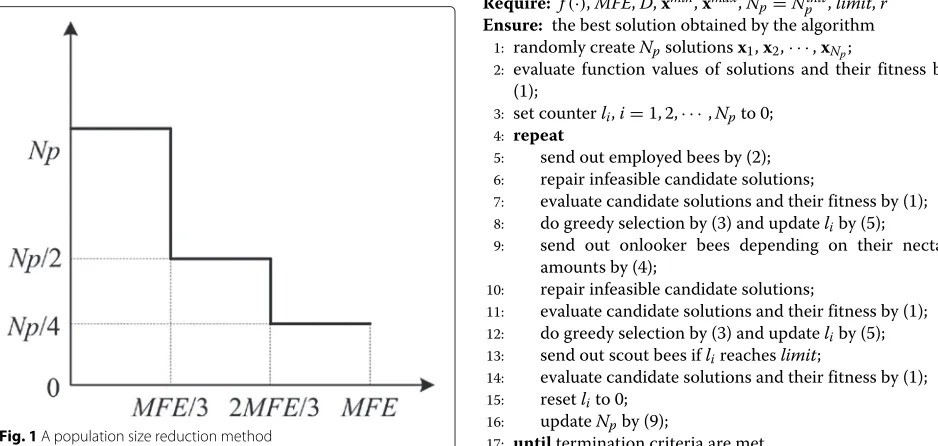
p is related withDbyNpinit=4D. A decreasing step function is taken to approximateg as shown in Fig. 1. The step function is expressed as:
Np=
⎧ ⎨ ⎩
Ninit
p , if 1≤feval≤MFE/3 0.5Ninit
p , ifMFE/3<feval≤2MFE/3 0.25Npinit, otherwise
. (9)
As in (9), MFE is evenly split into three evolutionary stages. In exploration stage, a large population size is used so that the algorithm could perform global search. Then, population size is reduced to half; solutions with high fit-ness are kept and those with low fitfit-ness are discarded. By doing this, elitist solutions survive. In exploitation stage, Npis equal to one forth ofNpinit. Algorithm could search around good solutions and perform local search to attain a promising solution.
Rather than existing researches on algorithmic parame-ter control methods [8, 10], the proposed population size reduction method could adapt parameters to handle prob-lems with different budget without the interface of users.
3.2 Boundary repair method
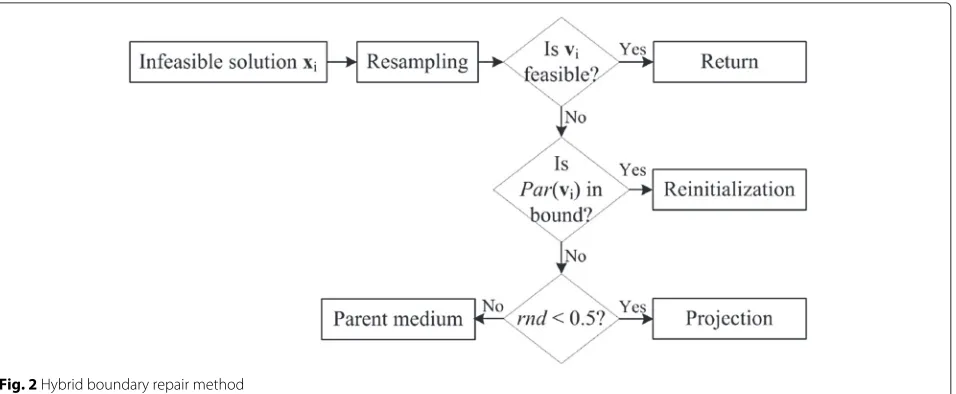
Recent study proves that boundary repair methods have great impact on the performance of evolutionary algo-rithms [11]. Popularly used repair methods in literature include reinitialization, projection, resampling, conser-vatism, wrapping, reflection, and parent medium [11, 12]. Inspired by previous researches of various repair meth-ods, a new scheme is proposed which is a hybrid of four repair methods: reinitialization, resampling, projection, and parent medium as shown in Fig. 2. In this figure, Par(vi)is the parent of candidate solutionvi, rnd∈(0, 1)
Fig. 1A population size reduction method
is a random number. Since resampling is firstly recom-mended, an infeasible candidate solution is repaired first using resampling. However, the computational cost of resampling method cannot be guaranteed. In the worst case, an infinite loop happens if none of the combina-tions produces a feasible solution. In our implementation, resampling is performed three times at most. For exam-ple, ifvi,g is infeasible using (2) or (6), two parentsxr1,g andxr2,gare resampled no more than three times; if a fea-sible vector is generated, then repair step is finished and turn to proceed the next individual; otherwise, turn to the following steps.
If vi,g is infeasible and its associated parent lies in the boundary of search space, reinitialization method is applied. Because in this case, both projection and parent medium methods are the same and cannot generate new gradients, reinitialization instead can create new elements and diversify population. If vectorvi,gis infeasible and its associated parent is feasible but not in boundary, then pro-jection and parent medium methods have equal chance to be selected. Because both methods are good choices, i.e., projection is the second choice and parent medium is sug-gested in [13], hence each method is assigned a probability 0.5 to be chosen for execution.
3.3 The proposed algorithm
Population size reduction and boundary repair methods are attached with qABC [9], which is a better imitation of the behavior of honey bees. The resulting algorithm is called population reduction and hybrid repair ABC (PRHRABC). The pseudo code of the algorithm is shown in Algorithm 1.
Algorithm 1Pseudo code of the PRHRABC algorithm
Require: f(·),MFE,D,xmin,xmax,N
p=Npinit,limit,r
Ensure: the best solution obtained by the algorithm 1: randomly createNpsolutionsx1,x2,· · ·,xNp;
2: evaluate function values of solutions and their fitness by (1);
3: set counterli,i=1, 2,· · ·,Npto 0;
4: repeat
5: send out employed bees by (2); 6: repair infeasible candidate solutions;
7: evaluate candidate solutions and their fitness by (1); 8: do greedy selection by (3) and updateliby (5);
9: send out onlooker bees depending on their nectar amounts by (4);
10: repair infeasible candidate solutions;
11: evaluate candidate solutions and their fitness by (1); 12: do greedy selection by (3) and updateliby (5);
13: send out scout bees iflireacheslimit;
14: evaluate candidate solutions and their fitness by (1); 15: resetlito 0;
16: updateNpby (9);
Fig. 2Hybrid boundary repair method
4 Experimental evaluation and analysis
In this section, the proposed algorithm is applied to deal with a polyphase code design and a circular shaped antenna array design problems.
Polyphase code design is often built as a min-max non-convex continuous optimization problem as shown in (10). This model is based on the attributes of aperiodic autocorrelation function and the assumption of coherent radar pulse processing in the receiver [1, 14]. This model contains numerous local optima which makes it difficult to solve.
min
x∈ f(x)=max{ϕ1(x),. . .,ϕ2m(x)}
s.t. ϕ2i−1(x)= D
j=i cos
j
k=|2i−j−1|+1
xk , i=1,. . .,D
ϕ2i(x)=0.5+ D
j=i+1 cos
j
k=|2i−j|+1
xk , i=1,. . .,D−1 ϕm+i(x)= −ϕi(x), i=1, 2,. . .,m
= {(x1,. . .,xn)∈ D|0≤xj≤2π,j=1,. . .,D} ,
(10)
wherem = 2D−1. In this model, variables correspond to the differences of symmetrized phase. The function objective is to minimize the biggest module amongst the samples of autocorrelation function. In this experiment, problem dimension is set toD= 20, which is larger than existing studies [14, 15].
As to antenna array design, suppose we consider N antenna elements spread on a circle of radiusrin thex– y plane. TheN elements constitutes a circular antenna array. The current I and phase excitations of all ele-ments are varied in order to suppress side lobes, minimize
beamwidth, and accomplish null control at desired direc-tions. This problem is modeled as follows [16]:
min
x∈ f(x)=fsll+fdir+fdes+fnull
s.t. fsll= |AF(ϕsll)|/|AF(ϕmax)| fdir=1/dir(ϕ0)
fdes= |ϕ0−ϕdes| fnull=numk=1|AF(ϕk)|
AF(ϕ)=Nn=1Inexp[jkr(cos(ϕ−ϕangn )
−cos(ϕ0−ϕnang))+βn]
, (11)
where N = 12, num ∈[ 50, 120] is the number of null control directions,ϕ0is the maximum radiation direction, ϕdes = 180o,In andβn are respectively the current and phase excitation of elementn. In this model,Inandβnare variables.
4.1 Experimental configuration
PRHRABC and qABC as well as standard ABC are cho-sen for experiment. The parameter setting for qABC is Np= 25, limit = 0.5NpD, andr = 1 as suggested in [6, 7, 9]. For PRHRABC,Npinitis set to 4D, limit = 0.5NpD, andr =1. For standard ABC,Np= 25, limit= 0.5NpD. All algorithms are implemented in Matlab and simulated on a PC with 3.4-GHz four-core CPU and 4 GB of mem-ory. Each problem is conducted 25 independent runs with MFE = 50,000. The source code of PRHRABC can be obtained from the first author upon request.
4.2 Experimental results
Table 1Statistics of the best function values found by PRHRABC, qABC, and ABC
Best Med Worst std p
Polyphase code
PRHRABC 1.1035 1.3000 1.4441 0.0885
qABC 1.1175 1.3454 1.5769 0.0933 0.0199 +
ABC 1.1929 1.3739 1.5226 0.0838 0.0397 +
Antenna array
PRHRABC −19.715 −18.590 −17.000 0.7865
qABC −19.604 −16.961 −14.892 1.0669 2.77e−5 +
ABC −18.889 −17.284 −13.719 1.1460 2.14e−5 +
results, Mann-Whitney U test (U test) is utilized with a significant level of α = 0.05. The pvalues comparing PRHRABC and qABC (or PRHRABC and ABC) are given in the second last column of Table 1. Symbol “+” in the last column indicates cases in which the null hypothesis is rejected, and PRHRABC displays a statistically superior performance byUtest. As thepvalues are less thanαfor both test cases, we can conclude that PRHRABC signifi-cantly outperforms qABC and ABC in this experiment.
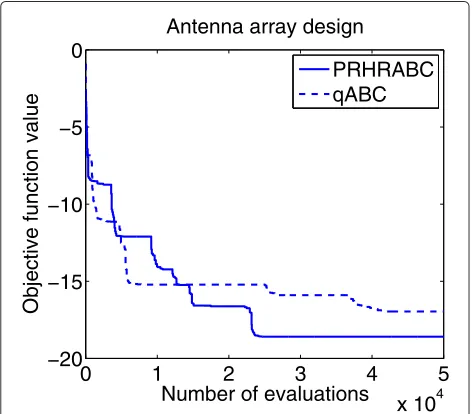
The convergence curves of PRHRABC and qABC for dealing with antenna array design are shown in Fig. 3. It is plotted as the median best objective function value found over 25 trials. From the beginning to 14,000 function eval-uations (FEs), the performance of the two algorithms is difficult to judge because the convergence lead changes several times. After 14,000 FEs, the proposed PRHRABC attains better solution than qABC and leads the evolution-ary process until the end. Thus, the proposed algorithm
0 1 2 3 4 5
Fig. 3Convergence graph of the proposed algorithm and qABC for antenna array design
shows good performance to deal with optimization prob-lems in system designs.
5 Conclusions
Optimization problems widely exist in radar, mobile, and communication system designs. These problems are fea-tured with multidimension, numerous local optima, or even NP-hard. Based on the artificial bee colony (ABC) paradigm, this paper proposes a population reduction method and a boundary repair method. Different from previous researches on algorithmic parameter control, the proposed method could adapt parameters to handle prob-lems with different budget setting without the interaction of users. Moreover, a hybrid boundary repair method is used to enhance the reliability of algorithm.
The proposed algorithm is tested on a polyphase code design and a circular shaped antenna array design prob-lems. Standard ABC and quick ABC (qABC), which is a state of the art ABC variant, are chosen as benchmark baselines. Experimental results show that the proposed algorithm significantly outperforms qABC and standard ABC for tackling the two problems. This suggests that the novel algorithm is a good one to solve optimization problems in radar, mobile, and communication system designs.
Competing interests
The authors declare that they have no competing interests.
Acknowledgements
This research was supported in part by the Tianjin Thousand Youth Talents Plan Project of Tianjin Normal University (ZX110023) and the Applied Basic Research Program of Tianjin (15JCYBJC51500, 15JCYBJC52300).
Received: 28 August 2015 Accepted: 18 January 2016
References
1. ML Dukic, ZS Dobrosavljevic, A method of a spread spectrum radar polyphase code design. IEEE J. Selected Areas Comm.8, 743–749 (1990) 2. M Dessouky, H Sharshar, Y Albagory, A novel tapered beamforming
window for uniform concentric circular arrays. J. Electromagn. Waves Appl.20, 2077–2089 (2006)
3. L Guo, H Deng, B Himed, T Ma, Z Geng, Waveform optimization for transmit beamforming with MIMO radar antenna arrays. IEEE Trans. Antennas Propagation.63(2), 543–552 (2015).
doi:10.1109/TAP.2014.2382637
4. Y-T Cheng, C-C Chiu, Optimization of the antenna location for relay cooperative system by apso. Wireless Personal Commun.83(4), 2485–2495 (2015)
5. MIH Dessouky, A Sharshar, YA Albagory, Efficient sidelobe reduction technique for small-sized concentric circular arrays. Prog. Electromagn.
Res.65, 187–200 (2006)
6. D Karaboga, B Basturk, On the performance of artificial bee colony (ABC) algorithm. Appl. Soft Comput.8(1), 687–697 (2008)
7. K Diwold, A Aderhold, A Scheidler, M Middendorf, Performance evaluation of artificial bee colony optimization and new selection schemes. Memetic Comput.3(3), 149–162 (2011)
9. D Karaboga, B Gorkemli, A quick artificial bee colony (qABC) algorithm and its performance on optimization problems. Appl. Soft Comput.23, 227–238 (2014)
10. J Brest, MS Maucec, Population size reduction for the differential evolution algorithm. Appl. Intell.29(3), 228–247 (2008) 11. J Arabas, A Szczepankiewicz, T Wroniak, inPPSN XI. Experimental
comparison of methods to handle boundary constraints in differential evolution (Springer, Berlin, Heidelberg, 2010), pp. 411–420
12. S Wessing, inProceedings of the 16th European Conference on Applications of Evolutionary Computation.EvoApplications’13. Repair Methods for Box Constraints Revisited (Springer, Berlin, Heidelberg, 2013), pp. 469–478 13. J Zhang, AC Sanderson, JADE: Adaptive differential evolution with
optional external archive. IEEE Trans. Evol. Comput.13(5), 945–958 (2009) 14. AM Perez-Bellido, S Salcedo-Sanz, EG Ortiz-Garcia, JA Portilla-Figueras, F
Lopez-Ferreras, A comparison of memetic algorithms for the spread spectrum radar polyphase codes design problem. Eng. Appl. Artif. Intell. 21(8), 1233–1238 (2008)
15. S Gil-Lopez, JD Ser, S Salcedo-Sanz, AM Perez-Bellido, JM Cabero, JA Portilla-Figueras, A hybrid harmony search algorithm for the spread spectrum radar polyphase codes design problem. Expert Syst. Appl. 39(12), 11089–11093 (2012)
16. S Das, PN Suganthan, Problem definitions and evaluation criteria for CEC 2011 competition on testing evolutionary algorithms on real world optimization problems. Technical report, Jadavpur Univ. and Nanyang Technol. Univ., India and Singapore (February 2011)
Submit your manuscript to a
journal and benefi t from:
7Convenient online submission 7Rigorous peer review
7Immediate publication on acceptance 7Open access: articles freely available online 7High visibility within the fi eld
7Retaining the copyright to your article