Volume 2010, Article ID 350198,13pages doi:10.1155/2010/350198
Research Article
Determining Localized Tree Construction Schemes Based on
Sensor Network Lifetime
Jae-Joon Lee,
1Bhaskar Krishnamachari,
2and C.-C. Jay Kuo
21Jangwee Research Institute for National Defence, Ajou University, Suwon 443-749, Republic of Korea 2Department of Electrical Engineering, University of Southern California, Los Angeles 90089-2564, CA, USA
Correspondence should be addressed to Jae-Joon Lee,[email protected]
Received 27 October 2009; Revised 2 June 2010; Accepted 1 July 2010
Academic Editor: Yu Wang
Copyright © 2010 Jae-Joon Lee et al. This is an open access article distributed under the Creative Commons Attribution License, which permits unrestricted use, distribution, and reproduction in any medium, provided the original work is properly cited.
The communication energy consumption in a data-gathering tree depends on the number of descendants to the node of concern as well as the link quality between communicating nodes. In this paper, we examine the network lifetime of several localized tree construction schemes by incorporating the communication overhead due to imperfect link quality. Our study is conducted based on empirical data obtained from a real-world deployment, which is further supported by mathematical analysis. For the case of a sparse node density, a large network size and a low link threshold, we show that the link-quality-based scheme provides the longer network lifetime than the minimum hop routing schemes. We present a lower bound on the number of nodes per hop and the link quality threshold of the radio range, which work together to result in a superior localized scheme for longer network lifetime.
1. Introduction
For data-gathering path construction, nodes have to deter-mine the next node to forward the data to the sink with a parent selection strategy. A localized tree construction scheme allows each node to select a parent node using its one-hop neighboring node information. Thus, the purpose of localized schemes is to reduce the communication over-head for the construction of a data-gathering path, which is desirable for energy-constrained wireless networks. Even though there have been studies on wireless network lifetime
[1–6], and a few studies on localized tree construction
[7], the effect of localized tree construction scheme on
the network lifetime has not been extensively examined. Here, we examine localized tree construction schemes with different parent selection strategies and analyze their impact on the network lifetime in conjunction with diverse network conditions such as node density, network size, and link quality between communicating nodes.
The routing path selection in conjunction with link quality have been examined in several studies. De Couto et al. present a path selection metric, which is called expected transmission (ETX) count. This metric is used to select the minimum number of transmissions required for
successful delivery to a destination among different paths
by incorporating the quality of each link on the path in
[8]. Draves et al. provide comparison among path selection
schemes based on link quality metrics and minimum hop
counts through detailed experiment in [9]. They find that
the expected transmission (ETX) count scheme provides higher throughput than minimum hop count scheme when
a DSR routing protocol [10] is used with stationary nodes.
Woo et al. [11] examine the effect of link quality on
different routing strategies in terms of hop distribution, path reliability, success rate from a source to the sink, and path stability. In their work, the minimum expected transmission scheme results in the highest end-to-end success rate. Seada et al. [12] present the analysis of forwarding strategies by incorporating link quality and calculate the energy efficiency in geographic routing. They show that the product of a packet reception rate and a distance metric provides the most
energy efficient geographic forwarding path. In addition to
the above work, several studies including [13,14] examine the link quality effect on connectivity.
In this paper, we examine several localized tree
con-struction schemes and point out the trade-offbetween
links to reduce the number of retransmissions, the number of descendants to be processed in the data-gathering tree will increase, which results in the increase of energy consumption for communication due to more data. On the other hand, if we decrease the amount of forwarded data by distributing workload to more nodes, selected link’s quality may not be the best and retransmissions can increase. Our study is conducted as follows. First, we examine the empirical data obtained from a real-world sensor deployment to capture the effects of different tree construction schemes on energy consumption. Then, to obtain the insight into the
above trade-offand derive criteria to reach longer network
lifetime, the energy consumption of each scheme is analyzed and compared. Finally, the global optimum is presented
and compared with the analytical results of different tree
construction schemes.
Our study shows that when the network size is small and the node density is high with a high link threshold (i.e., minimum packet reception rate that determines one-hop direct link or not between two nodes), minimum one-hop routing schemes achieve longer network lifetime than the scheme whose selection is based only on the link quality. However, with the opposite network conditions, the link-quality-based scheme can achieve longer network lifetime. We present lower bound on the number of nodes in a hop as a function network size, transmission energy portion, and radio range link quality, which guarantees that the load-balanced scheme achieves longer lifetime than the link-quality-based scheme. In addition, we present lower bound on link threshold as a function of node density, which guarantees the longer lifetime of the load-balanced scheme regardless of other network conditions such as the network size and the transmission energy portion. When the link
threshold is less than 1/√2, the load-balanced scheme does
not guarantee longer lifetime than the link-quality-based scheme in 1D linear topology and 2D grid topology.
The localized data-gathering tree construction schemes
with different parent selection criteria are described in
Section 2. We examine the effect of these schemes on energy consumption and network lifetime by incorporating a link quality metric and the communication load distribution
based on the empirical data inSection 3as well as analysis
in Section 4. Criteria for superiority of a localized scheme
in terms of network lifetime are analyzed inSection 5. The
comparison with the global optimal strategy is presented in
Section 6. Finally, concluding remarks and future research directions are presented inSection 7.
2. Localized Tree Construction Schemes
Data-gathering path can be selected based on the diverse criteria. The link quality can be used as a metric for routing path selection. Recently, the expected transmission (ETX) count of a link between two nodes is considered, which can be derived from the packet reception rate (PRR) of the link [8,9]. Mathematically, we have
ETXi j=ETXji= 1
PRRi j·PRRji, (1)
where ETXi j is the expected number of transmission
required for successful transmission over a link between
nodes i and j. Qualitatively speaking, a low ETX link can
require less energy consumption due to redundant retrans-mission than a higher ETX link. However, the quantitative effect of a link-quality-based path selection scheme on energy consumption and/or network lifetime has not been fully investigated before.
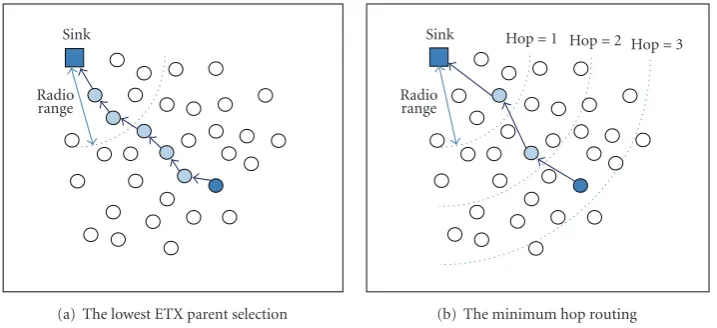
Besides link quality, the number of hops (called the hop count) to the destination is widely used for routing path selection. Each link can be counted as one hop. Then, the routing path with the minimum number of hop counts to the sink is the shortest path. The minimum hop routing (MHR) path can be constructed using the currently known hop level of neighboring nodes. In order to know its minimum hop level, the sink node sends the broadcasting message to all nodes initially once. In the MHR, each node selects a neighbor node in the upper hop level, which provides the minimum number of hops to the sink. Detailed discussion
of energy consumption in the MHR can be found in [15].
Rigorously speaking, the link quality and the radio range
will also affect energy consumption in addition to the hop
counts. Here, we incorporate the link quality into the energy consumption analysis of MHR schemes. By using the ETX link quality metric and the hop count to the sink, we will examine the following four localized tree construction schemes.
(i) The lowest ETX parent selection scheme, where a node selects a neighbor node that provides the lowest ETX link between each other and is closer to the sink. This scheme does not necessarily select a node in the upper hop level and accordingly the minimum hop (shortest path) routing may not be achieved.
(i) The random parent selection scheme with the MHR, where a node randomly chooses a parent among neighbor nodes in the upper hop level, which pro-vides the minimum hop routing to the sink.
(i) The lowest ETX parent selection scheme with the MHR, where a node chooses its neighbor node in the upper hop level that provides the lowest ETX.
(i) The balanced parent selection scheme with the MHR, where a node selects the neighbor node in the upper hop level that has the fewest number of children as a parent in the data-gathering tree.
The data-gathering trees for the lowest ETX parent selection and the minimum hop routing schemes are illustrated in
Figure 1.
The first scheme does not utilize the hop count but the link quality metric only while the other three schemes take the hop count into consideration for parent selection as well. These localized schemes are examined by real empirical data and analysis in the following sections.
3. Case Study with Real Empirical Data
Sink
Radio range
(a) The lowest ETX parent selection
Sink
Radio range
Hop=1 Hop=2 Hop=3
(b) The minimum hop routing
Figure1: The illustration of the data-gathering tree with the lowest ETX parent selection and the minimum hop routing schemes.
understand their impact on the communication load and discuss their differences. The data are from the experiments
conducted by the UCLA/CENS group [16], where the PRR of
each node from all other nodes is given. A set of 55 nodes was deployed in the ceiling of the lab in their indoor experiment. With this PRR information, we examine the connec-tivity between adjacent hop levels and the communication overhead distribution among nodes. Without respect to a target node, any other node that has a PRR for bidirectional links higher than the link threshold is called its neighboring node. In other words, every pair of neighboring nodes can directly communicate with each other if the successful packet transmission and reception rates are above the link threshold. Communication to all the other nodes may require multihop forwarding through neighboring nodes. The link threshold can be adjusted, which will change the hop level of nodes from the sink. The use of this threshold makes routing more reliable. As the link threshold increases, a constructed tree with more hop levels can provide higher throughput due to higher successful transmission rate of the link than a simple minimum hop count routing.
3.1. Data-Gathering Topology Maps. Figure 2 shows the deployment map of 55 sensor nodes and hop levels with four different tree construction schemes. A line represents a data-gathering link between adjacent hop levels, which will be discussed further. To forward the data to a sink, which is assumed to be located atFigure 2(a), each node should select a parent node towards the sink among neighboring nodes to construct a data-gathering tree. Nodes that have connection with the sink with the packet transmission and reception rates higher than the link threshold belong to the first-hop level and are represented by a diamond shape. For the lowest ETX parent selection, since the main objective of this scheme is to provide a high packet successful transmission rate, the link threshold for the first-hop level is set to 0.95. For all the other schemes that are based on the minimum hop routing (MHR), the link threshold is set to 0.9.
As shown inFigure 2(a), the lowest ETX parent selection without hop count consideration results in longer hop levels.
The longest hop level is 7. Since each node uses the lowest ETX parent selection, the distance between the parent and the children nodes tends to be close and the number of hop levels increases. All possible direct links between adjacent hop level nodes by the random parent selection scheme with
MHR are presented in Figure 2(b). Each node randomly
selects one among nodes that are connected with a direct link as its parent node. As the distance from the sink increases, the first-hop nodes have more direct links to the second-hop level nodes. With the link threshold 0.9, the MHR scheme significantly reduces the hop count as compared with the
lowest ETX scheme in Figure 2(a). Figure 2(c) shows the
connectivity graph of the lowest ETX parent selection with MHR. Since each node selects the lowest ETX neighboring nodes in the upper hop level, the selected parent nodes tend to be located at the edge of the hop level, closer to the second-hop level nodes. For the balanced scheme shown in
Figure 2(d), data forwarding paths to the sink are almost evenly spread among the first-hop level nodes.
We can summarize observations from these topology maps produced by four localized schemes as follows. If we exploit only link quality without using the hop count in the parent selection decision, the distance between the chosen link becomes relatively short and hop levels increases accordingly. When the MHR scheme is used, the link-quality-based selection results in an unbalanced topology where fewer nodes at the border of hop levels handle most data forwarding tasks from larger hop level nodes.
3.2. Link Quality and Communication Load. There exists
trade-offbetween the link-quality-based and the MHR-based
schemes, which will be examined in this section. Figure 3
1 (a) Lowest ETX parent selection
1
(b) Random parent selection (MHR)
1
(c) Lowest ETX parent selection (MHR)
1
(d) Balanced parent selection (MHR)
Figure2: The indoor deployment location of nodes and four data-gathering topology maps with localized tree construction schemes using the PRR data obtained by UCLA/CENS group: (a) the lowest ETX parent selection, (b) the random parent selection scheme (all possible links) with MHR, (c) the lowest ETX parent selection scheme with MHR, and (d) the balanced parent selection scheme with MHR.
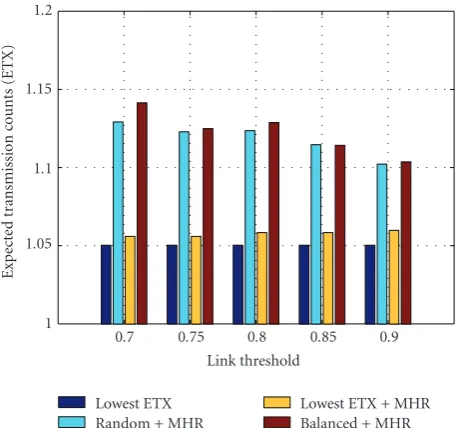
is that it chooses a parent node with the fewest children, which is consequently far from a selecting node. As the link threshold increases, the average link quality improves for both the random selection and the balanced selection scheme while the lowest ETX selection remains almost the same.
The amount of communication energy of a node during a data-gathering round is determined by the amount of data received from children nodes and transmitted to the parent
1 1.05 1.1 1.15 1.2
Expect
ed
tr
ansmission
co
unts
(ETX)
0.7 0.75 0.8 0.85 0.9 Link threshold
Lowest ETX Random + MHR
Lowest ETX + MHR Balanced + MHR
Figure3: The comparison of localized tree construction schemes: the average ETX of data-gathering paths with respect to link threshold.
Thus, the amount of communication energy per
data-gathering round by nodeican be calculated as
Ei=
j∈Ci
fjiETXji+β
k∈Pi
fikETXik, (2)
whereEiis the normalized energy consumption with respect
to the energy consumption for receiving denoted byErxand
β= Etx Erx =
1 + Eamp
Eelecdκ
, (3)
where Eamp andEelec denote the amplifier energy and the
electronic energy, respectively, anddis the radio range and
κ is the path loss exponent similar to [19]. By following
the parameters given in [1], we set Eelec = 50 nJ/bit and
Eamp = 100 pJ/bit/m2. Besides, whend =20 m andκ = 2,
β=1.8. We useCito denote the set of children nodes ofiand Pithe set of parent nodes ofi. The localized selection scheme chooses one parent, and fjiconsists of data generated by the
descendant nodes of nodejin addition to the data generated
by node j. Thus, fikconsists of
j∈Ci fjiand data generated
by nodei.
When the amount of generated data by each node per data-gathering round is assumed to be one unit, the number of descendants in the data-gathering tree constructed by localized tree schemes determines the communication load of each node. For the lowest ETX without MHR, there exists a larger communication load on the first-hop nodes due to longer hop levels and fewer first-hop nodes. The maximum
number of descendants obtained from Figure 2(a) is 33.
When MHR is used, the communication load is distributed among a larger number of first-hop nodes than the case of the
lowest ETX without MHR.Figure 4compares the number
of children nodes as a function of the distance between the
sink and the first-hop level nodes for three different tree
construction schemes with MHR. For the random parent selection, the expected number of children of first-hop node i is calculated as j∈Ci1/n
p
j, where j is a node belonging
to the second-hop level neighboring nodes of node i(Ci),
andnpj is the number of upper hop level neighboring nodes
of node j. Since there are only two nodes in the third hop
level, the number of children and descendants are almost the same.
Overall, the number of descendants tends to increase along the distance in the random selection scheme. The lowest ETX parent selection scheme can provide higher throughput at a given time, but it results in an extremely unbalanced communication load. This causes much faster energy depletion of some nodes so as to result in a large gap of energy depletion time among first-hop level nodes. The balanced parent selection scheme provides a similar energy depletion time among nodes.
In this paper, the maximum energy consumption,
denoted by maxiEi, is defined to be the time before the
death of the first node. The duration in which all nodes are functional is called the network lifetime. As discussed in [15],
even if workloads are different among the first-hop nodes
due to the use of different parent selection schemes with same hop levels, the energy depletion time of the last surviving node in the first hop would be the same. Thus, we focus on the time before the death of the first node.
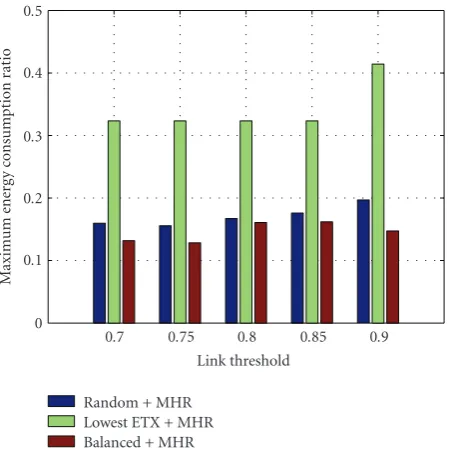
Figure 5 compares the maximum energy consumption
of different localized tree construction schemes with the
MHR when the maximum energy consumption of the lowest ETX without MHR is scaled to 1. The link quality based schemes result in significantly faster initial energy depletion while they provide high link quality. The balanced scheme maintains the initial network operation for longer time and the random selection scheme has relatively longer network lifetime, too. However, this observation is obtained from a small network with few hop levels and nodes. We need more
general discussion to analyze the trade-off among various
localized tree construction schemes with different network
parameters in the following section.
4. Analysis of Localized Tree
Construction Schemes
In the last section, we examined the effect of different
localized tree schemes on communication loads for one real
deployment case. It was observed that the effect of link
quality is not significant when MHR has a relatively large number of nodes in the first hop, since the communication load can be distributed and the energy consumption of a single node is reduced accordingly. However, it is not clear from this empirical data set whether a lower node density with a small number of nodes in the first hop produces the same result. In this section, we characterize how diverse network conditions (such as the node density
and the network size) affect the energy consumption of each
0
Distance from the sink Number of descendants Number of children (a) Random parent selection
0
Distance from the sink Number of descendants Number of children
(b) Lowest ETX parent selection
0
Distance from the sink Number of descendants Number of children (c) Balanced parent selection
Figure4: The number of descendants for the first-hop level nodes as a function of their distance to the sink under three parent selection schemes with MHR. Lowest ETX + MHR Balanced + MHR
Figure5: The ratio of the maximum energy consumption of MHR schemes to the maximum energy consumption of the lowest ETX scheme.
longer network lifetime than the link-quality-based scheme for any network conditions in the next section.
4.1. Energy Consumption of Localized Schemes. To capture
the effect of tree construction schemes with respect to
the node density and the network size, we examine the communication load of the linear topology as given in
Figure 6, where nodes are deployed linearly with equidis-tance. Furthermore, analysis of 2D topology is conducted in Section 5.2 to derive the criteria needed for a localized scheme to reach longer network lifetime.
The average link quality (PRR) is a decreasing function of the distance from the transmitting node as presented in [13].
PRR=0.1
PRR=0.5 PRR=0.8
PRR=1
Sink 1 2 3 4 5 · · · N−1 N
Figure6: Illustration of the linear topology.
Following the PRR model in [13], we adopt the approximate
PRR as a function of the distance, whose decreasing rate accelerates along the distance until the PRR reaches 0.5. The notation used in this analysis is summarized inTable 1. Note that, whendr =d1, there would be only one way to forward
the data to the sink. The only possible parent is the next node to the sink, which does not require any analysis and
comparison. Thus, we consider the cases wheredr is greater
than d1. In the case of linear topology with equidistance,
dr≥2d1. In the case of 2D grid topology,dr≥
√
2d1.
Some considerations in our analysis are explained below. While there could be fluctuation in link quality even in the static node deployment, energy depletion time can be analyzed through a long-term average of link quality for a given link length. In addition, as discussed in previous work [14,20], temporal variation of link quality should be minimal for links with good quality. It is worthwhile to point out that the PRR is actually the result built upon all underlying layer interactions. Since our focus is the long-term effect of the routing layer on network lifetime, we use the PRR to represent the cumulative effect of all underlying layers (including the MAC layer). Investigation on energy consumption with MAC layer interactions is an interesting research topic, which has been studied in previous work, for example, [21,22].
Table1: Summary of notation.
N Total number of nodes (network size)
r Number of nodes in one hop level with
MHR in linear topology
nc
i Number of children of nodei
nd
i Number of descendants of nodei
Ei Energy consumption of nodeiper round
d1 Distance between the nearest adjacent nodes
dr Radio range determined by link threshold
dN Distance between sink and the furthest node(network radius)
Nr Number of nodes in a radio range
ETXi j, ETX(d) Expected transmission count (ETX)
between nodesiandj, and distanced
ETX(dr), PRR(dr) Link threshold ETX and PRR
Sink 1 2 3 4 5 · · · N−1 N
Figure7: The lowest ETX parent selection scheme.
to the closet neighboring node provides the lowest ETX, each node selects its adjacent node that is closer to the sink as the parent node, that is, the next hop to the sink. Accordingly, each hop consists of one node and the maximum hop level isN. Thus, node 1, which is next to the sink, has the largest communication load to handle data-gathering (arg maxindi = 1). Thus, the energy consumption of node 1 determines the network lifetime, which is defined to be the initial node death time.
To analyze the energy consumption, we incorporate the link quality between adjacent nodes of node 1 in the data-gathering tree. When every node generates and sends one unit of data to the sink, the expected number of data units
received from children of node 1 is ETX(d1)(N−1), where
ETX(d1) is the number of transmission between nodes that
are one-node apart andd1is the node distance. The child of
node 1 is its adjacent node; that is, node 2. In addition, the expected number of transmission from node 1 to the sink is
ETX(d1)N. Thus, the energy consumption by node 1 during
a data-gathering round, which is normalized in terms of the
reception energy consumption based on the notation in (2)
is equal to
max
i Ei=E1=ETX(d1)(N−1) +βETX(d1)N, (4)
which is the maximum energy consumption by the lowest ETX parent selection scheme.
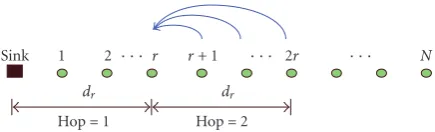
4.1.2. Random Parent Selection with MHR. The link thresh-old is used to determine the neighboring nodes that can directly communicate in a single-hop in the MHR schemes. Thus, each node selects a parent node in the upper hop level
neighboring nodes within the radio range dr, wheredr is
Sink 1 2
dr dr
Hop=1 Hop=2
· · · r r+ 1 · · · 2r · · · N
Figure8: The random parent selection scheme with MHR.
the maximum distance from the node that satisfies the link threshold. To calculate the maximum energy consumption for the random parent selection scheme with MHR, we first obtain the expected number of children of each node since each node selects a parent node randomly with an equal probability among upper hop level neighboring nodes within
the radio range as shown in Figure 8. Since the expected
number of children attached to nodeican be calculated as
j∈Ci1/n
p
j, theith node in the first-hop level, with 1≤i≤r, has the expected number of children as
Enc
Therth node, which is furthest from the sink among the first-hop nodes, has the maximum expected number of children (arg maxinci =r) as
r j=11/ j.
The expected number of descendants of nodei can be
calculated recursively as
The largest expected number of transmission from children to a first-hop node, which is to noder, is
The expected number of transmission to a sink from noder
is
Then, the maximum energy consumption by the random parent selection scheme in a data-gathering round can be
computed via (2), which is the energy consumption of node
rduring a data-gathering round.
4.1.3. Lowest ETX Parent Selection with MHR. In the lowest ETX parent selection with MHR, each node selects a parent node that provides the lowest ETX among the upper hop
level neighboring nodes. As shown in Figure 9, the node
that is closest to the boundary of the next longer hop level is selected. Thus, the maximum number of descendants is
Sink 1 2
dr dr
Hop=1 Hop=2
· · · r r+ 1 · · · 2r · · · N
Figure9: The lowest ETX parent selection scheme with MHR.
Sink 1 2
dr dr
Hop=1 Hop=2
· · · r r+ 1 · · · 2r · · · N
Figure10: The balanced parent selection scheme.
number of received data in the lowest ETX with MHR can be calculated as
max
i frxi=ETX(dr)(N−2r) + r
j=1
ETXdj . (9)
The expected number of data transmitted to the sink from noderis
max
i ftxi=ETX(dr)(N−r+ 1). (10)
The maximum energy consumption in the lowest ETX parent selection can be computed via (2) for noder.
4.1.4. Balanced Parent Selection with MHR. To achieve the balanced load among nodes in the same hop level, each node selects the furthest neighboring node (i.e., closest to the sink) in the upper hop level within the radio range that satisfies the link threshold as shown inFigure 10. The first-hop nodes have an equally distributed number of descendants from the
second-hop level, which is (N−r)/r. The maximum amount
of data received from the children is ETX(dr)(N−r)/r, and
the maximum transmitted data to the sink is ETX(dr)N/r.
Thus, the maximum number of data communication is equal among first-hop nodes. The maximum energy consumption by the balanced parent select scheme is
max
i Ei=ETX(dr) N−r
r +βETX(dr) N
r . (11)
4.2. Comparison of Localized Tree Construction Schemes.
Based on the obtained maximum energy consumption of
each localized scheme, we study the effects of the network
size (the total number of nodes), the node density, and the link threshold on the network lifetime. The network size
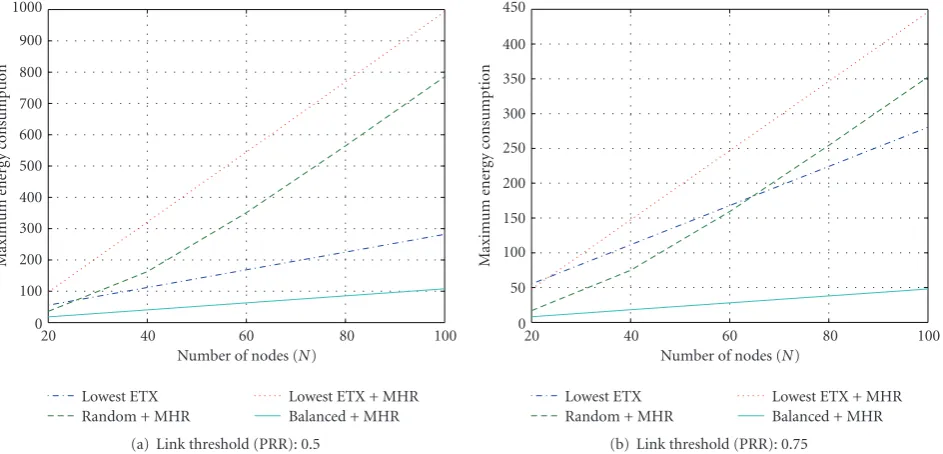
effect is compared inFigure 11. The number of nodes in a
hop level isr =10 in both figures. The lowest ETX scheme
achieves longer network lifetime than the random selection and the lowest ETX with MHR as the network size increases.
Among MHR schemes, the difference of the maximum
energy consumption between the balanced scheme and other schemes becomes larger.
Figure 12 compares the effect of the node density on the maximum energy consumption. Two link thresholds (expressed in terms of PRR) are presented in this figure and the network size (N) is 20. We compare the minimum hop routing (MHR) schemes and the link quality scheme with respect to the node density. As the node density increases, the energy consumption of three MHR schemes decreases while that of the lowest ETX scheme without MHR remains almost the same. The random selection scheme with MHR and the lowest ETX with MHR can provide longer lifetime than the lowest ETX as the number of nodes in a hop increases since communication loads can be more evenly distributed among the same hop level nodes. The lowest ETX without MHR can provide longer network lifetime when both the link threshold and the node density are low. When the link threshold is equal to 0.5 as given inFigure 12(a), the balanced scheme does not achieve longer network lifetime than the lowest ETX when the number of nodes in a hop level is less than around 3.5. From this observation, we will examine the criteria needed to achieve longer network lifetime of the balanced scheme in the next subsection.
The energy consumption result from the empirical data as presented inFigure 5is consistent with that of the linear topology with a high link threshold, a high node density and a small network size. Under these conditions, the lowest ETX without MHR has the larger maximum energy consumption as compared to MHR-based tree construction schemes.
5. Criteria for Longer Lifetime of
Balanced Scheme with MHR
As shown inFigure 12, the balanced scheme with the MHR
does not always achieve longer network lifetime than the lowest ETX scheme. This is because the balanced parent selection scheme may select a link of poor quality, which results in more data transmission over the link. Network lifetime is also related to the node density for a given network size. Thus, we would like to determine (1) the number of nodes in a hop, which share the communication load from the nodes in the longer hop levels and (2) the link threshold needed to guarantee longer network lifetime of the balanced scheme. First, we will investigate the criteria for linear topology based on the discussion inSection 4.1. Then, we will analyze the case of 2D topology.
5.1. Linear Topology Case. To obtain criteria for longer net-work lifetime of the balanced scheme than the lowest ETX, we compare the maximum energy consumption obtained
in (4) and (11). The energy consumption of the balanced
scheme should be less than that of the lowest ETX scheme. First, we determine lower bound of the number of nodes in a hop,r, to ensure longer lifetime of the following balanced scheme
r > 1
0
Lowest ETX + MHR Balanced + MHR (a) Link threshold (PRR): 0.5
0
Lowest ETX + MHR Balanced + MHR (b) Link threshold (PRR): 0.75
Figure11: The maximum energy consumption as a function of the network size (i.e., the total number of nodes,N, in a network).
We see that this lower bound is a function of the network size, the portion of energy consumption for transmission (β),
and the link threshold. The effect of the network size and
βis minor sinceN 1. AsN increases, the increase ofr
that quickly saturates and the gap between small and largeN
values is quite small. For the link threshold effect,rdecreases as the link threshold improves.
We can also obtain the link threshold that guarantees longer lifetime of the balanced scheme regardless of network
size andβthat depends on the transmitter power.
Theorem 1. The balanced scheme guarantees the longer
lifetime regardless of other network conditions including the network size, the transmitter power, if the link threshold
PRR(dr)is greater or equal to
√
1/r.
Proof. For a given network size and a node density, the condition for link threshold to achieve longer network lifetime of the balanced scheme can be obtained as
PRR(dr)>PRR(d1)
Basically, lower bound of the link threshold is determined by
node density r in a hop. Since r ≥ 2,N > r, andβ ≥ 1,
(r −1)/(N(1 +β)−1) is always greater than 0 and less
than 1. Thus, (1−(r−1)/(N(1 +β)−1)) is less than 1. In addition, PRR(d1) is less or equal to 1. Thus, the right-hand
side of (13), PRR(d1)
(1/r)(1−(r−1)/(N(1 +β)−1)), is always less than√1/rregardless of other parameters. Corollary 1. A link threshold PRR above1/√2always guaran-tees the longer lifetime of the balanced parent selection scheme regardless of the network size or node density, or any other parameters.
This link threshold lower bound comes from the minimum number of nodes in a hop, r = 2, when nodes are evenly deployed in the linear topology.
5.2. 2D Topology Case. To obtain the criteria for longer network lifetime of the balanced scheme in the 2D case, we first analyze the energy consumption of the lowest ETX scheme and the balanced scheme with the MHR in 2D case.
Figure 13 shows the illustration of a 2D network, where nodes are evenly distributed throughout the circular area and the sink is located at the center of the network. The distance
between two nearest adjacent nodes is d1, dr is the radio
range,dN is the radius of network area, andN is the total
number of nodes in the network as given inTable 1. When
nodes are evenly distributed in the network area, the number of nodes is approximately proportional to the size of the area where those nodes are located.
5.2.1. Energy Consumption of Lowest ETX Parent Selection. As discussed inSection 4.1.1, in order to select the lowest ETX link towards the sink, a node chooses its adjacent node that is closer to the sink as its parent node. Thus, nodes that are next to the sink have the largest communication load. We can obtain the number of these nodes that are next to the sink, which is N(d1/dN)2, by calculating the ratio of areas. The number of descendants per first-hop node is (dN/d1)2−1,
which is derived by dividing the number of nodes except the first hop by the number of nodes in the first hop. Thus, the maximum energy consumption of the lowest ETX parent selection scheme in 2D is equal to
0 50 100 150 200 250
M
aximum
energ
y
consump
ti
on
2 3 4 5 6 7 8 9 10
Number of nodes/hop (r) Lowest ETX
Random + MHR
Lowest ETX + MHR Balanced + MHR (a) Link threshold (PRR): 0.5
0 10 20 30 40 50 60 70 80 90
M
aximum
energ
y
consump
ti
on
100
2 3 4 5 6 7 8 9 10
Number of nodes/hop (r) Lowest ETX
Random + MHR
Lowest ETX + MHR Balanced + MHR (b) Link threshold (PRR): 0.75
Figure12: The maximum energy consumption as the number of nodes in a hop (r).
dN
d1
Sink
(a) The lowest ETX parent selection
dN dr
Sink
(b) The balanced parent selection with minimum hop routing
Figure13: The illustration of a 2D data-gathering tree with the lowest ETX parent selection and the minimum hop routing schemes.
5.2.2. Energy Consumption of Balanced Parent Selection with MHR. To achieve a balanced load among nodes, we perform node selection by following the description in
Section 4.1.4. The number of the first-hop nodes can be obtain by calculating the ratio of areas. In the minimum
hop routing, the first-hop radius is dr and the number
of the first-hop nodes (Nr) is N(dr/dN)2. The number of descendants of the first-hop node is (dN/dr)2−1, which can be obtained by the same approach as the lowest ETX parent selection scheme in the previous subsection. The maximum energy consumption of the balanced parent selection scheme with the MHR in the 2D case is
max
i Ei=ETX(dr)
dN dr
2
−1
+βETX(dr)
dN dr
2
.
(15)
From (14) and (15), we can obtain the lower bound on
the number of nodes in the first hop (Nr) to ensure longer
lifetime of the balanced scheme in the 2D case. In other words, the number of nodes to be deployed within a radio range (i.e., node density) to guarantee longer lifetime of the balanced scheme should satisfy the following condition:
Nr> N(d1/dN)
2
1−1−(d1/dN)2/
1 +β (1−ETX(d1)/ETX(dr))
.
(16)
threshold level to achieve longer network lifetime of the balanced scheme should satisfy the following condition:
PRR(dr)>PRR(d1)
1− 1−(d1/dr)2 1−(d1/dN)2/
1 +β. (17)
The minimum value of this link threshold can be derived
by following the procedure in proving Theorem 1 and
Corollary 1. SincedN is greater thand1andβis greater than
1, 1−(d1/dN)2/(1 +β) in the right-hand side of (17) is
greater than 0 and less than 1. Thus, PRR(d1) ≤1 and the
right-hand side of (17) is always less than d1/dr. We can conclude that when the link threshold is greater or equal to
d1/dr, the balanced scheme with the MHR always achieves
longer network lifetime than the lowest ETX parent selection scheme even in the 2D topology. In grid topology, since dr is greater or equal to
√
2d1, a link threshold with PRR
above 1/√2 guarantees longer lifetime of the balanced parent selection scheme.
6. Comparison to Global Optimum
In this section, we compare the network lifetime per-formance of localized tree construction schemes and the centralized scheme that uses the global knowledge of the network including the quality of all links. We present a linear programming formulation, which is similar to that
in [23]. Here, the main difference is that we incorporate
the link quality metric ETX into the energy consumption model. The objective is to find the optimal flow for every
directional links to maximize the network lifetime,T=1/Q,
which corresponds to duration of time before death of first node.
The two main constraints are the flow conservation constraint (see (18)) and the energy constraint (see (19)). By the flow conservation constraint, we mean that the outgoing flow from a node (say,Nj=0 fi j for node i) is the same as the aggregate of incoming flow to the same node,Nj=1fji,
plus the amount of data generated by that node, Gi. The
energy constraint is that the total energy consumed by a
node is bounded by its equipped energy capacity, Bi. We
focus on the communication energy consumption and the
calculation that follows (2) in Section 3.2. Thus, we can
incorporate the communication load with the link quality, which is represented by ETX, as
minQ
subject to N
j=1
fji+Gi= N
j=0
fi j
(18)
⎛ ⎝N
j=1
fjiETXji+β N
j=0
fi jETXi j ⎞ ⎠1
Bi ≤Q,
fi j≥0, Gi≥0, i=1 :N, j=0 :N.
(19)
In the above, the sink is represented by node 0 and data generating and forwarding nodes are represented by
Sink
Node 1
Node 3
Node 6
Node 8
Node 7
Node 5 Node 2
Node 4
High PRR link
Low PRR link (link threshold)
Figure14: The topology of an exemplary network.
nodes 1 to N. Bi is the battery capacity of node i. All
flows on links and the generated data by each node is nonnegative.
To examine the link threshold effect, we consider an
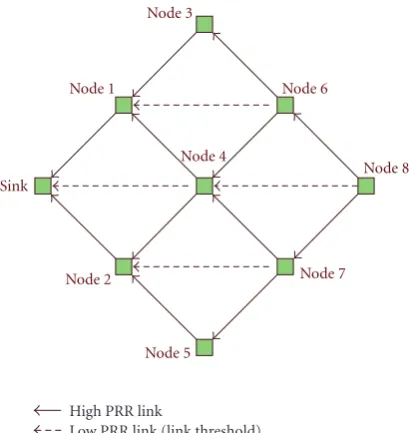
exemplary network with topology shown inFigure 14, which
consists of 8 nodes with one sink. There are two link quality values; namely, high PRR (low ETX) and low PRR (high ETX) links, for performance comparison. We fix the high PRR link to be 0.95 while the low PRR link varies from 0.6 to 0.9. We compare two localized tree construction schemes (i.e., the lowest scheme without the MHR and the balanced scheme) with the global optimal value.
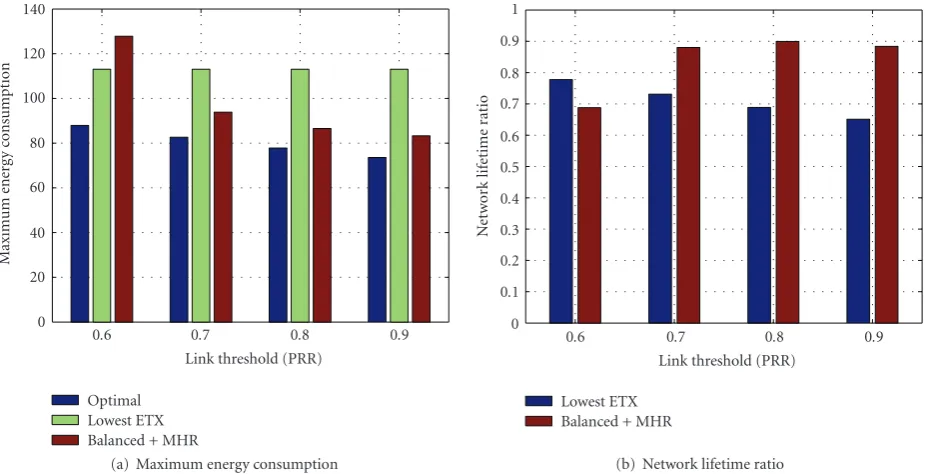
Figure 15compares the maximum energy consumption and the normalized network lifetime in terms of the optimal network lifetime parameterized by the low PRR link value equal to 0.6, 0.7, 0.8, and 0.9. We see that the maximum energy consumption of the optimal flow decreases as the link threshold increases since the optimized scheme balances the flow and load by utilizing low PRR links. For the lowest ETX scheme, it does not use the lower PRR link so that the maximum energy consumption remains the same regardless of the change of the link threshold value. When the link threshold for low PRR links is 0.6, the balanced scheme has significantly higher energy consumption as compared with that of the optimal flow and the lowest
ETX. This echoes the result in Section 5, namely, the
balanced scheme does not guarantee longer lifetime when
the link threshold is below 0.7 (≈ 1/√2). As the link
0 20 40 60 80 100 120 140
M
aximum
energ
y
consump
ti
on
0.6 0.7 0.8 0.9
Link threshold (PRR) Optimal
Lowest ETX Balanced + MHR
(a) Maximum energy consumption
0 0.1 0.2 0.3 0.4 0.5 0.6 0.7 0.8 0.9 1
N
etw
or
k
lifetime
ratio
0.6 0.7 0.8 0.9
Link threshold (PRR) Lowest ETX
Balanced + MHR
(b) Network lifetime ratio
Figure15: Comparison of the lowest ETX scheme and the balanced scheme in terms of (a) the maximum energy consumption and (b) the network lifetime normalized to the optimal network lifetime.
Figure 15(b)shows the ratio of two localized schemes to the optimal lifetime. The network lifetime of the lowest ETX scheme linearly decreases to the normalized optimal value as the link threshold increases. For the balanced scheme, almost 90% of the optimal network lifetime is achieved when the link threshold is 0.7 or above.
7. Conclusion and Future Work
Localized tree construction schemes with empirical data were examined and their performance was analyzed and compared. The link threshold and the node density are the
main factors that affect the energy consumption of each
localized scheme. In the dense node deployment with a high link threshold and a small network size, the MHR schemes reduce the energy consumption significantly when compared to schemes that use only the link quality for parent selection. However, for the opposite network conditions, the lowest ETX scheme can achieve longer network lifetime than MHR schemes. Criteria that guarantee longer network lifetime of the balanced parent selection scheme were derived for both linear topology and 2D topology.
In the future, we would like to examine a distributed topology establishment algorithm that incorporates link quality and load balancing to provide longer network lifetime under dynamic network conditions. In addition, we will examine the optimal link threshold that provides maximum lifetime. In the case of fixed node density deployments, the careful adjustment of link threshold will optimally balance communication overhead driven by imperfect link quality and communication load sharing by more nodes in a larger radio range.
Acknowledgment
This research was supported by the MKE, Korea, under the ITRC Support Program supervised by the NIPA (NIPA-2010-(C1090-1021-0011)).
References
[1] W. Heinzelman, A. Chandrakasan, and H. Balakrishnan, “Energy-efficient routing protocols for wireless microsensor networks,” inProceedings of the 33rd Annual Hawaii Interna-tional Conference on System Siences (HICSS ’00), 2000. [2] M. Bhardwaj and A. P. Chandrakasan, “Bounding the lifetime
of sensor networks via optimal role assignments,” in Proceed-ings of the 21st Annual Joint Conference of the IEEE Computer and Communications Societies (Infocom ’02), pp. 1587–1596, June 2002.
[3] M. Lotfinezhad and B. Liang, “Effect of partially correlated data on clustering in wireless sensor networks,” inProceedings of the 1st Annual IEEE Communications Society Confer-ence on Sensor and Ad Hoc Communications and Networks (SECON ’04), pp. 172–181, San Jose, Calif, USA, October 2004.
[4] C.-F. Chiasserini and M. Garetto, “Modeling the performance of wireless sensor networks,” inProceedings of the 23rd Annual Joint Conference of the IEEE Computer and Communications Societies (INFOCOM ’04), pp. 220–231, Hong Kong, March 2004.
[5] Y. Chen and Q. Zhao, “On the lifetime of wireless sensor networks,”IEEE Communications Letters, vol. 9, no. 11, pp. 976–978, 2005.
[6] H. Zhang and J. Hou, “On deriving the upper bound of
ACM International Symposium on Mobile Ad Hoc Networking and Computing (MoBiHoc ’04), pp. 121–132, May 2004. [7] C. Zhou and B. Krishnamachari, “Localized topology
gener-ation mechanisms for self-configuring sensor networks,” in
Proceedings of the IEEE Global Telecommunications Conference (Globecom ’03), San Francisco, Calif, USA, December 2003. [8] D. S. J. De Couto, D. Aguayo, J. Bicket, and R. Morris, “A
high-throughput path metric for multi-hop wireless routing,” in Proceedings of the 9th Annual International Conference on Mobile Computing and Networking (MobiCom ’03), pp. 134–146, September 2003.
[9] R. Draves, J. Padhye, and B. Zill, “Comparison of routing metrics for static multi-hop wireless networks,” inProceedings of the ACM Conference on Computer Communications (SIGCOMM ’04), pp. 133–144, Portland, Ore, USA, September 2004.
[10] D. B. Johnson and D. A. Maltz, “Dynamic source routing in ad hoc wireless networks,” inMobile Computing, pp. 153–181, Kluwer Academic Publishers, Dodrecht, The Netherlands, 1996.
[11] A. Woo, T. Tong, and D. Culler, “Taming the underlying challenges of reliable multihop routing in sensor networks,” inProceedings of the 1st International Conference on Embedded Networked Sensor Systems (SenSys ’03), pp. 14–27, Los Angeles, Calif, USA, November 2003.
[12] K. Seada, M. Zuniga, A. Helmy, and B. Krishnamachari, “Energy-efficient forwarding strategies for geographic routing in lossy wireless sensor networks,” inProceedings of the 2nd International Conference on Embedded Networked Sensor Systems (SenSys ’04), pp. 108–121, Baltimore, Md, USA, November 2004.
[13] M. Zuniga and B. Krishnamachari, “Analyzing the transitional region in low power wireless links,” inProceedings of the 1st Annual IEEE Communications Society Conference on Sensor and Ad Hoc Communications and Networks (SECON ’04), pp. 517–526, Santa Clara, Calif, USA, October 2004.
[14] J. Zhao and R. Govindan, “Understanding packet delivery performance in dense wireless sensor,” inProceedings of the 1st International Conference on Embedded Networked Sensor Systems (SenSys ’03), pp. 1–13, Los Angeles, Calif, USA, November 2003.
[15] J.-J. Lee, B. Krishnamachari, and C.-C. J. Kuo, “Aging analysis in large-scale wireless sensor networks,”Ad Hoc Networks, vol. 6, no. 7, pp. 1117–1133, 2008.
[16] A. Cerpa, J. L. Wong, L. Kuang, M. Potkonjak, and D. Estrin, “Statistical model of lossy links in wireless sensor networks,” inProceedings of the 4th ACM/IEEE International Symposium on Information Processing in Sensor Networks (IPSN ’05), pp. 81–88, Los Angeles, Calif, USA, April 2005.
[17] P. Lettieri, C. Schurgers, and M. Srivastava, “Adaptive link layer strategies for energy efficient wireless networking,”
Wireless Networks, vol. 5, no. 5, pp. 339–355, 1999.
[18] V. Raghunathan, C. Schurgers, S. Park, and M. B. Srivastava, “Energy-aware wireless microsensor networks,” IEEE Signal Processing Magazine, vol. 19, no. 2, pp. 40–50, 2002.
[19] N. Sadagopan and B. Krishnamachari, “Maximizing data extraction in energy-limited sensor networks,” inProceedings of the 23rd Annual Joint Conference of the IEEE Computer and Communications Societies (INFOCOM ’04), pp. 1717–1727, March 2004.
[20] A. Cerpa, J. L. Wong, M. Potkonjak, and D. Estrin, “Temporal properties of low power wireless links: Modeling and implications on multi-hop routing,” inProceedings of the 6th
ACM International Symposium on Mobile Ad Hoc Networking and Computing (MoBiHoc ’05), pp. 414–425, May 2005. [21] G. Lu, B. Krishnamachari, and C. S. Raghavendra, “An
adaptive energy-efficient and low-latency MAC for data gathering in wireless sensor networks,” in Proceedings of the 18th International Parallel and Distributed Processing Symposium (IPDPS ’04), pp. 3091–3098, April 2004.
[22] J. Haapola, Z. Shelby, C. Pomalaza-R´aez, and P. M¨ah¨onen, “Multihop medium access control for WSNs: an energy anal-ysis model,”EURASIP Journal on Wireless Communications and Networking, vol. 2005, no. 4, pp. 523–540, 2005.