R E S E A R C H
Open Access
MATF: a multi-attribute trust framework
for MANETs
Muhammad Saleem Khan
1, Majid Iqbal Khan
1, Saif-Ur-Rehman Malik
1, Osman Khalid
2, Mukhtar Azim
1and Nadeem Javaid
1*Abstract
To enhance the mobile ad hoc networks (MANETs) security, various trust-based security schemes have been proposed. However, in most of the trust-based security schemes, a node’s trust is computed based on a single trust attribute criteria, such as data forwarding. Using single trust attribute criteria may cause the bootstrapping problem, which refers to the time required by the trust-based scheme to build trust and reputation among nodes in the network. The bootstrapping problem in these schemes may provide more opportunities to misbehaving nodes to drop packets and remain undetected for longer time in the network. Moreover, using single trust attribute criteria does not effectively deal with the selective misbehavior by a smart malicious node.
In this work, we propose a scheme that is based on the multi-attribute trust criteria to minimize the bootstrapping time, which ultimately improves the performance of the scheme in terms of high malicious node detection rate, low false-positive rate, and packet loss rate. The contributions of this paper are (a) identification of trust attributes along with the development of a comprehensive multi-attribute trust framework (MATF) using multiple watchdogs for malicious node identification and isolation, (b) formal modeling and verification of our proposed MATF using HLPN, SMT-Lib, and Z3 Solver, and (c) simulation-based validation and evaluation of the proposed trust framework in the context of optimized link state routing (OLSR) protocol against various security threats, such as message dropping, message modification, and link withholding attacks. The simulation results revealed that the proposed trust framework achieves about 98 % detection rate of malicious nodes with only 1–2 % false positives. Moreover, the proposed MATF has an improved packet delivery ratio as compared to the single attribute-based scheme.
Keywords: Trust, Packet loss, Bootstrapping time, Security attacks, Formal verification, High-level Petri nets
1 Introduction
Due to the non-availability of central authority and the unreliability of wireless links, the routing protocols in mobile ad hoc networks (MANETs) are vulnerable to vari-ous types of security threats [1]. The resource-constrained nature of MANETs with continuously evolving topology and frequent network partitioning complicates the secu-rity challenges in MANETs’ routing. Most of the secure routing protocols for MANETs utilize some form of cryp-tography to ensure the network security [2–4]. However, there are scenarios, where cryptography techniques fail to capture malicious behavior of a node. For example,(a)to
*Correspondence: [email protected]
1Department of Computer Sciences, COMSATS Institute of Information Technology, Islamabad, Pakistan
Full list of author information is available at the end of the article
disrupt the network topology, a node may provide falsi-fied routing information to other nodes,(b)to preserve the battery, a node may not participate in the routing func-tions, and (c)a node may drop data packets instead of forwarding because of the malicious intention. To address these issues, trust-based security schemes [5–10] have been proposed to augment the security of traditional cryptography-based approaches.
In MANETs, trust can be defined as to what extent a node can fulfill the expectations of other node(s) as per the specification of an underlying communication pro-tocol [11]. In trust-based security schemes, each node within the network manages an independent trust table to compute and store the trust values of other nodes. The routing decisions are based on the computed trust values of the nodes. Although a lot of research work has been car-ried in the field of trust and reputation based systems in
MANETs, however, almost all the proposed schemes suf-fer from one basic problem known as bootstrapping prob-lem [12]. It refers to the time required by the trust-based scheme to build trust and reputation among nodes in the network. Such delay in accumulation of trust and reputa-tion is often not acceptable in time-critical applicareputa-tions. Due to the slow trust building process, a misbehaving node may have more opportunities to drop packets before being detected as malicious. One of the basic reasons for the aforementioned bootstrapping problem is that in most of the trust-based security schemes, an evaluated node’s trust is computed based on a single trust attribute, such as data forwarding [13–17]. Moreover, using single trust attribute may not effectively deal with the problem of selective misbehavior [12]. A smart malicious node may misbehave in the context of one network function and behave properly for other network functions. For example, a node may misbehave in the context of data forward-ing while demonstratforward-ing good behavior when dealforward-ing with the control packet forwarding. As the existing schemes [7–10, 13–17] use single trust attribute, the aforemen-tioned selective misbehaving node is declared as malicious node and isolated from the routing path, hence no longer will be available to be used for other network functions.
In trust-based security schemes, each node collects two major types of information about other nodes: first-hand information (based on self-observations) and second-hand information (based on the other node observations). In literature, efforts have been made to minimize the bootstrapping time and to increase the detection rate by using second-hand information to evaluate the trustwor-thiness of the nodes [14, 17]. However, the aforemen-tioned schemes still suffer from data sparsity problem [14]. In trust-based security schemes, data sparsity is a situation where lack of information or insufficient inter-action experience makes it difficult to evaluate the node’s trust, especially in the early time of network establish-ment. Moreover, using second-hand information without any filtration may cause bad-mouthing and false praise attack [11], which ultimately cause high false positive and false negative rate. In bad-mouthing attack, a misbehaving node propagates dishonest and unfair recommendations against an innocent node with a negative intention to confuse the trust model. Similarly, in false praise attack, a misbehaving node propagates unfairly positive recom-mendations against the malicious node to mislead the trust model.
It is also of critical importance to prove the correct-ness of the trust-based security schemes in dynamic and unpredictable environments, such as of MANETs. A well-established approach to prove the correctness of a system’s model is by employing a formal verification process [18].
To minimize the bootstrapping time and expedite the trust building process, and to effectively deal with the
selective misbehavior, there is a strong need for a mech-anism that works on multi-attribute-based trust strat-egy. Each node should be observed in the context of all the possible network functions, such as control message generation, control message forwarding, and data packet forwarding. Moreover, an efficient recommendation fil-tration technique is required to filter the source of infor-mation and inforinfor-mation itself. To avoid bad-mouthing and false praise attacks, second-hand information from only designated and trustworthy nodes must be considered in a trust computation process.
Our contributions: In this work, we address the boot-strapping and delusive trust dissemination problem when using second-hand information. We propose a trust-based security scheme which uses multi-attribute-based trust criteria, such as control packet generation, control packet forwarding, and data packet forwarding. Using multi-attribute trust criteria which minimizes the bootstrapping time and expedite the trust building process, as nodes are assessed in the context of different aforementioned network functions. Moreover, to avoid bad-mouthing and false praise attacks, second-hand information is consid-ered from only those nodes calledwatchdog nodes, whose trust values are above some threshold. Furthermore, second-hand information from recommender nodes with trust deviation (τdev) value1less than the deviation
thresh-old (τdev−th) will be considered in the trust computation
process. This paper has the following major contributions.
• Identification of the trust attributes for a node’s trust building process.
• Development of a comprehensive multi-attribute and multiple watchdog nodes trust framework (MATF) for malicious node detection and isolation.
• Formal verification of our proposed MATF using high-level Petri nets (HLPNs), satisfiability modulo theories-library (SMT-Lib), and Z3 Solver.
• Implementation of the proposed trust framework in the context of optimized link state routing (OLSR) protocol in NS-2 [19].
• Simulation-based validation and evaluation of the proposed MATF in comparison with the recently proposed trust scheme by Shabut et al. [14] (single trust-attribute-based scheme), against various security threats, such as message dropping, message modification, and link withholding attacks.
• Security analysis of the proposed MATF.
results and summarizes the performance evaluation of the proposed model. Security analysis of the proposed scheme is presented in Section 6, and the paper is concluded in Section 7.
2 Related work
Trust-based security schemes are one of the active research areas for ensuring the security in MANETs [20]. In recent years, different trust-based security schemes have been proposed to enhance the security in MANETs. In these schemes, nodes evaluate their neighbor nodes based on the first-hand information or using recommen-dations from other nodes [12, 20]. Though, these schemes paid some attention to the problem of bootstrapping and delusive trust dissemination problem, however, an effi-cient mechanism to mitigate the aforementioned problem is still a challenging issue in MANETs. We categorize the state-of-the-art schemes in the following categories.
2.1 Watchdog and path-rater schemes
One of the key works in trust-based schemes was
pre-sented by Marti et al. [13]. They proposed watchdog
and path-ratermechanisms implemented on the dynamic source routing (DSR) protocol to minimize the impact of malicious nodes on the throughput of the network. The aforementioned approach detects the misbehaving nodes by using only source node as a monitoring node. How-ever, the proposed scheme has some major shortcomings, such as it cannot detect the misbehaving nodes in the case of ambiguous collision, receiver collision, limited trans-mission power, partial dropping, and collaborative attacks [21]. Moreover, watchdog and path-rater mechanisms uti-lize only first-hand information for node misbehavior detection that causes the aforementioned issues.
2.2 Feedback-based schemes
To solve the issues in the watchdog and path-rater schemes, various approaches were proposed, such as acknowledgment-based detection systems including two network-layer acknowledgment-based schemes, termed as TWOACK [22], adaptive acknowledgment (AACK) [23], and enhanced adaptive acknowledgment (EEACK) [21]. The TWOACK scheme has focused to solve the receiver collision and limited transmission power prob-lems of the watchdog and path-rater approach. Every data packet transmitted is acknowledged by every three con-secutive nodes along the path from the source to the destination. Sheltami et al. [23] proposed an improved version of the acknowledgment-based scheme, AACK. The AACK is the intrusion detection system which is a combination of TWOACK and end-to-end acknowledge-ment scheme. Although, AACK has significantly reduced the overhead as compared to TWOACK scheme, it still suffers from the problem of detecting malicious nodes
generating false misbehavior report and forged acknowl-edgment packets. To remove the shortcomings of the acknowledgement-based schemes, Shakshuki et al. [21] proposed EAACK protocol to detect misbehavior nodes in MANETs’ environment using digital signature rithm (DSA) [24] and Rivest-Shamir-Adleman (RSA) algo-rithm [25] digital signatures. Although, their technique can validate and authenticate the acknowledgement pack-ets, yet at the expense of extra resources, and it also requires pre-distributed keys for digital signatures.
2.3 Network monitoring-based schemes
Buchegger et al. presented a cooperation of nodes-fairness in distributed ad-hoc networks (CONFIDANT) protocol [7] to detect misbehaving nodes in the network. In addi-tion to first-hand informaaddi-tion, second-hand informaaddi-tion is also used while computing a node’s trustworthiness. In CONFIDANT protocol, first-hand information is propa-gated after every 3 s, while weight given to the second-hand information is 20 %. To avoid false praise attack [11], only negative experiences as second-hand informa-tion are shared among nodes. One of the shortcomings in CONFIDANT protocol is that ALARM messages used in the protocol can be exploited by the bad-mouthing nodes. Bad-mouthing nodes may generate ALARM mes-sages against the legitimate nodes to induce biasness in the protocol’s results [22]. Similarly, a collaborative reputa-tion mechanism to enforce node cooperareputa-tion in MANETs called CORE [9] also uses the second-hand information to compute the reputation of a node. Only positive expe-riences are shared by the node with other nodes in the network to avoid bad-mouthing attack.
In contrast to CONFIDANT and CORE [9],
observation-based cooperation enforcement in ad hoc networks (OCEAN) protocol [26] uses only first-hand observation to avoid false praising and bad-mouthing type of attack. In OCEAN, avoid-list strategy is imple-mented to not forward the traffic from misbehaving nodes. However, if a node identifies that its ID is inserted to the avoid-list, it may change its strategy. A tamper-proof hardware is required to secure the avoid-list to avoid the aforementioned incident.
recommender nodes R1,R2. . .RN send the bad reputa-tion value of misbehaving nodeMto evaluating nodeE,
while nodeEhas a good reputation value about nodeM
based on its own first-hand information. In the aforemen-tioned proposed scheme [14], such recommendations are filtered out because of more deviation in the trust values. In contrast, our proposed MATF scheme filters the rec-ommendation by using the following methodology. When recommendations received at the evaluating node from the recommender node about some particular evaluated node, the evaluating node averages the recommendations already received from all the watchdog nodes (recom-mender nodes) then, finds the trust deviation of the rec-ommender node’s trust value from the average trust value. If the deviation in trust values is less than certain deviation threshold, weight is given to the recommendations in the trust computation; otherwise, no weight is given to these recommendations.
Li et al. [27] proposed a simple trust model which takes into account the packet forwarding ratio as met-ric to evaluate the trustworthiness of neighbor nodes. A node’s trust is computed by the weighted sum of packet forwarding ratio. To find a path trust, continued prod-uct of node’s trust values in a routing path is computed. The aforementioned approach only considers packet for-warding behavior as a trust metric. A trust prediction model based on the node’s historical behavior called trust-based source routing (TSR) protocol was presented in [28]. On the basis of assessment and prediction results, the nodes can select the shortest trusted route to trans-mit the required packets. One of the weaknesses of this work is that no second-hand information is considered for trust computation that may result in bootstrapping and data sparsity problem [14]. Trust-based security schemes like [16] only consider the security of data traffic, while schemes like [29, 30] only consider the security of con-trol traffic. Moreover, the aforementioned solutions result in more energy consumption due to excessive information propagation and detection messages. In [31], energy effi-ciency is considered as one of the parameters and have improved previously existing trust-based algorithms.
To summarize, the trust-based security schemes dis-cussed in this section have some open problems that need to be solved. Most of the existing schemes use single trust criteria for the trust building process that causes the bootstrapping and data sparsity problem. Minimiz-ing the bootstrappMinimiz-ing time and the data sparsity prob-lem is still an open issue [12, 14]. Moreover, using all the available information from each and every node in the network does help in building reputation and trust among nodes quickly, but as discussed earlier, it makes the system vulnerable to false report attacks. To solve the aforementioned false praise and bad-mouthing attacks, there should be a mechanism which filters the spurious
second-hand information. Although, the aforementioned approaches suggest the misbehavior detection schemes, these schemes use single trust attributes like data forward-ing. Moreover, second-hand information are considered from recommender nodes without any filtration that can result in erroneous trust estimation, especially under high nodal mobility. In contrast, our proposed MATF is based on multiple trust attributes with multiple observer nodes that results in better trust estimation. Second-hand infor-mation are considered from recommender nodes with deviation values less than the deviation threshold, which results in better trust estimation, especially under high nodal mobility.
3 MATF: the proposed scheme
In this section, we present the trust attributes, trust for-mulation in the proposed MATF, a mechanism for trust deviation test, and watchdog node selection process. In the proposed MATF, the watchdog node is the desig-nated neighbor node of the evaluating node to monitor the activities of the evaluated nodeBon the basis of defined trust attributes and is represented byW. It can be the eval-uating node itself or any other node that has been assigned the monitoring task by the evaluating node. The evaluat-ing node computes the final trust of the evaluated node based on its own observations and those reported by the watchdog nodes. Our proposed trust model consists of three steps. The first step is the monitoring step, in which an evaluating nodeSand watchdog nodesWnobserve the behavior of an evaluated node Bin the context of trust attributes ρ. For clarity, in the following equations, we treat an evaluating node as one of the watchdog nodes. In the second step, an evaluating node aggregates its own observations and the watchdog nodes’ observations in the context of each trust attribute. Finally, an evaluating node computes the final trust of an evaluated node in the con-text of all the trust attributes using the weighted sum. Also, the value range ofρ is [0, 1], 0 being the minimum and 1 the maximum.
3.1 Trust attributes
Trust attributes are the factors responsible for shaping the trust levels and denoted byρ. Each trust attribute value ranges between 0 and 1. Before going into the details as how we applied trust in MANETs, first, we discuss the basic trust attributes and then, define our trust model.
We have identified the following trust attributes in the context of control and data traffic for the proposed trust model.
3.1.1 Control packet generation(ρcpg)
the trustworthiness of the evaluated node in the context of control packet generation behavior as specified in the
underlying routing protocol. Observations of a node W
about node B in terms of control packet generation is
given in the following equation:
ρW,B
cpg (t,t+)= p pexp
, (1)
wheretis the current time,is the trust update period,
pis the total actual number of control messages generated in the time interval(t,t+)by nodeBas observed byW, andpexpis the expected number of control messages that
should have been generated by nodeB.
An evaluating node then aggregates its observations and the observations reported by the watchdog nodes to build a reputation about nodeBas shown in the following equation:
whereαis the weight factor given to an evaluating node observation and watchdog node observations.
3.1.2 Control packet forwarding(ρcpf)
Nodes in a MANET depend on mutual cooperation to forward traffic. A non-cooperative forwarding node may drop packet or forward control packet with delay that can result in the inconsistent view of the network topology. Let us denote the packets that are successfully overheard aspack. The observations of a nodeW regarding nodeB
in terms of control packet forwarding can be computed using following equation:
ρW,B
cpf (t,t+)=1−
p−pack
p . (3)
According to the above equation, the minimum possi-ble packet loss rate observed at an evaluating/watchdog nodeWis 0, while the maximum possible packet loss rate is equal to 1, i.e., all the sent packets are dropped by mis-behaving nodes. An evaluating node then aggregates its own observations and that of watchdog nodes to obtain an aggregated reputation of node B in terms of control packet forwarding as follows:
where α is the weight factor given to an evaluating
node observations and watchdog node observations in the above equation.
3.1.3 Data packet forwarding(ρdpf)
In addition of control traffic, nodes are also responsible of relaying data packets. A node may drop the data packet
and forward data packets with delay or with maliciously
modified contents. The observations of nodeW
regard-ing node B in terms of data packet forwarding can be
computed using the following equation:
ρW,B
dpf (t,t+)=1−
ξ−pack
ξ , (5)
whereξis the total number of data packet sent andpackis
the data packet successfully overheard at watchdog node
W. Aggregating evaluating node’s and watchdog node’s
observations, we get the aggregated reputation of an eval-uated node in the context of data packet forwarding as given in the following equation:
ρdpf(t,t+)=αρdpf(S,B)+(1−α)
Algorithm 1The MATF trust computation algorithm 1: procedureMONITORING( )
2: ρcpgW,B(t,t+)= pp
11: procedureDECIDE(nb)
12: if(τB< η)then //ηis threshold for malicious node isolation
13: isolate(B)
14: relay_computation()
15: end if
16: end procedure
3.2 Trust formulation and algorithm
We are now able to combine the equations introduced so far into our mathematical model for the multi-attribute trust computation. By combining Eqs. 2, 4 and 6, we obtain
as control packet generation and forwarding. An evaluat-ing node S aggregates the trust computed for evaluated nodeBduring the time interval(t,t+)in the context of each trust attributeρand assigns weights to each afore-mentioned attributes in the above equation. The trust computed in Eq. (7) is compared with a threshold value to make a decision regarding trustworthiness of a node.
Algorithm 1 presents the pseudo code for the MATF. In the proposed algorithm, an evaluating node and des-ignated watchdog nodes observe the evaluated node in terms of different network functions during the monitor-ing period (lines 1–4). A filtration criteria is applied on the recommendations received from watchdog nodes (line 5). Based on the filtered recommendations, an evaluating node computes the trust of an evaluated node (lines 8–10). If the trust of an evaluated node is lower than a thresh-old (lines 12–13), it is isolated from the routing path and a new route selection process is initiated (Line 14).
3.3 Trust deviation
The trust computed by the watchdog nodes will be used as a second-hand information in the proposed scheme. To avoid bad-mouthing and false praise attacks, only those information will be used by the evaluating node which is received from the designated nodes and have a trust devi-ation value less than the devidevi-ation threshold. Trust devia-tion can be computed as given in the following equadevia-tion.
τdev=
whereτ(Wi,j)is the average trust already received from the
watchdog nodeWiabout the evaluated nodejandτ(Wk,j)is
the trust recommendation received from watchdog node
Wkabout the evaluated nodej.
3.4 Watchdog selection process
In order to avoid the bad-mouthing and false praise attacks, the second-hand information in the proposed MATF is considered from only designated and trustwor-thy watchdog nodes, as discussed in the previous sub-section. In this section, we discuss the selection process of the watchdog nodes, which will perform the monitor-ing task. When the network is initialized, each evaluatmonitor-ing node selects a set of neighboring nodes calledwatchdog setto monitor the behavior of a particular evaluated node. The proposed security scheme allows flexibility in the watchdog selection. Depending on the available network topology, one or multiple watchdogs may be selected. There is no fixed ratio per node of watchdog nodes to be selected. It will be varying depending on the available net-work topology. It is worth mentioning that in case of any change in network topology, an evaluating node will re-compute the watchdog nodes. The criteria and selection
Algorithm 2Relay and watchdog node selection Description: For a nodeS, the 1-hop neighbor setN1(S)
and the 2-hop neighbor setN2(S)are known.N∗1(S)and N∗2(S)are the unprocessed 1-hop and 2-hop neighbor sets of nodeS, respectively. Malicious set(S) is the set of malicious nodes maintained at node S.
Input:N1(S)andN2(S).
6: procedureREL AY_COMPUTATION( ) 7: for eachisolated node y∈N∗2(S)do
8: if (node x ∈ N∗1(S) ∧ node x ∈/
Malicious set(S) ∧ node x is the only neighbor of
node y)then
∧node xreaches the maximum number of nodes in
N∗2(S))thenrelay(S)←−node x;
20: procedureWATCHDOG_COMPUTATION( ) 21: whilerelay(S)= ∅do
22: for eachnode x∈relay(S)do
23: watchdog(S)=N∗1(S)∩N1(x)∧(τnb> η) // com-mon neighbors of evaluating node S and relay nodex, having trust greater than trust threshold
24: end for
25: end while
26: returnwatchdog(S)
27: end procedure
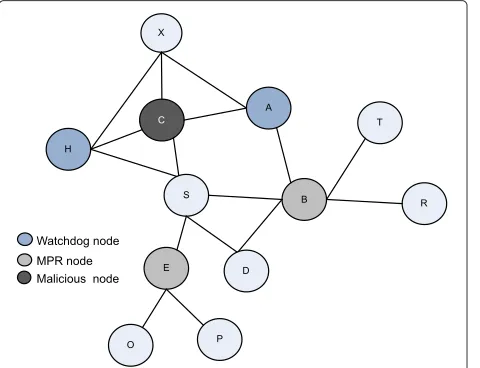
process of watchdog nodes are presented in Algorithm 2, which is a modified version of the relay node selection algorithm presented in [32]. An example scenario of the detailed working of the watchdog selection algorithm is presented below.
In the given scenario, node S discovers its neighbors through exchange of control messages and calculates the
N2(used as an input in Algorithm 2). From the setN1,
each evaluating nodeScomputes the relay node setR(S)
(lines 6–18) and the watchdog setW(S), having a trust value greater than the trust threshold (lines 20–26).R(S)
is the smallest possible subset ofN1(S)required to reach
all nodes inN2(S).
As an example, in Fig. 1,R(S) = {B,C,E}contains the
minimum number of one-hop neighbors of S required
to reach all two-hop neighbors ofS. Thereafter, nodeS
selects the watchdog set for each node present inR(S)=
{B,C,E}. To calculate the watchdog set for each node in theR(S), the nodeStakes the intersection of the one-hop neighbor setN1(S)and the one-hop neighbor set of each relay node.
NodeSbroadcasts theW(S)to the neighboring nodes by appending it in the periodic control messages along with R(S). This enables the neighboring nodes of S to check whether or not they have been selected as a watch-dog. By utilizing the broadcast information sent by the nodeS, each node builds the watchdog selector set. The watchdog selector set consists of all those nodes that
have selected node W as a watchdog. For example, as
reflected in Fig. 1, nodeSpopulates theW(S){A,H}for the relay nodeCby taking the intersection of setsN1(S) =
{A,B,C,D,E,H} and N1(C) = {A,S,H,X}. Thereafter, nodeSbroadcasts the watchdog set to inform both nodes
A and H that from now onward, these nodes have to
monitor nodeC.
4 Formal modeling and verification of the MATF Formal verification is the process verifying that algo-rithms work correctly with respect to some formal prop-erty [33]. Formally modeling systems helps to analyze the interconnection of components and processes and how the information is processed in the system [34]. Formal modeling provides valuable tools to design, evaluate, and
Fig. 1An example working scenario of the MATF
verify such protocols [35]. To verify the correctness of the MATF, we use HLPNs for the modeling and analysis [18]. HLPNs provide a mathematical representation and help to analyze the behavior and structural properties of the system.
To perform a formal verification of the MATF, the HLPN models are first translated into SMT-Lib [36] using the Z3 Solver [37]. Then, the correctness properties were identified and verified to observe the expected behavior of the models.
In this section, we present a brief overview of HLPNs and a formal verification of the MATF.
4.1 High-level Petri nets
Petri nets are used to model systems which are non-deterministic, distributed, and parallel in nature. HLPNs are a variation of conventional Petri nets. A HLPN
is a structure comprised of a seven-tuple, N =
(P,T,F,ϕ,R,L,M0). The meaning of each variable is
pro-vided in Table 1.
4.2 SMT-Lib and Z3 Solver
SMT is an area of automated deduction for checking the satisfiability of formulas over some theories of interest and has the roots from Boolean satisfiability solvers (SAT) [34]. The SMT-Lib is an international initiative that pro-vides a standard benchmarking platform that works on common input/output framework. In this work, we used Z3, a high-performance theorem solver and satisfiability checker developed by Microsoft Research [38].
4.3 Modeling and verification of the MATF
To model and verify the design of the MATF, the places
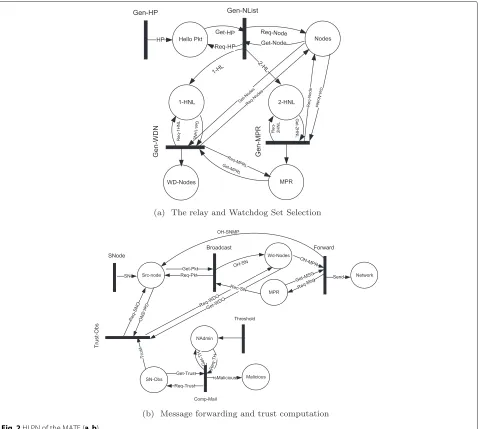
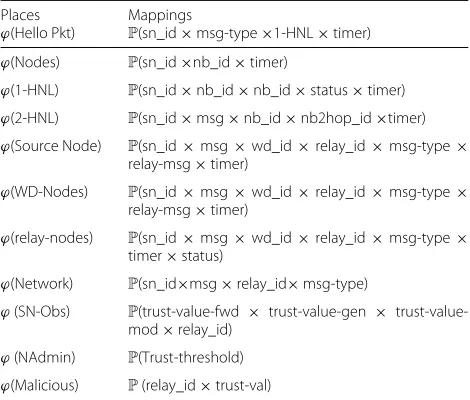
Pand the associated types need to be specified. The data type refers to a non-empty set of data items associated with aP. The data types used in the HLPN model of the MATF are described in Table 2. Figure 2a present the HLPN model for the relay and watchdog node selection
Table 1Variables and meaning
Variables Meanings
P A finite set of nodes, calledPlaces
T Set of transitions, that is,P∩T= ∅
F A set of directed edges called arcs, known as the flow relation, that is,F⊆(P×T)∪(T×P) ϕ A mapping function used to mapPto data types R A transition rule mappingT to predicate logic
formula, that is,R :T →Formula
L A label mapping F to labels, that is, L : F → Label
Table 2Data types and their descriptions
Types Description Types Description
sn_id Source node ID Status Message status
msg Message Trust values Trust observations
wd_id Watchdog node ID Trust_threshold Trust-threshold
relay_id Relay node ID Msg-type Message type
relay-msg Message sent by Timer TC packet timer relay node
in the MATF. Moreover, message forwarding, trust com-putation, and malicious node isolation are depicted in the HLPN model shown in Fig. 2b. As depicted in Fig. 2a, there are six places in relay and watchdog selection HPLN, whereas seven places in the HLPN model for trust
computation, as shown in Fig. 2b. The names of places and description are given in Table 3. The next step is to define the set of rules, pre-conditions, and post-conditions to map toT. The mapping of transition T to the processes used in the MATF, referred to as rules(R). After defin-ing the notations, we can now define formulas (pre- and post-conditions) to map on transitions in the following.
The set of transitionsT = {Nlist, WDN,
Gen-relay, Broadcast, Forward, Trust-obs, Comp-Mali}. The following are the rules used for modeling and verification. The rule R1 depicts the HELLO message process-ing. When the network is initialized, nodes exchange the HELLO messages with each other to discover the neighbors in the network. The HELLO message contains the list of one-hop neighbors of a node. On the basis of
Table 3Places and mappings of data types to the places
Places Mappings
ϕ(Hello Pkt) P(sn_id×msg-type×1-HNL×timer) ϕ(Nodes) P(sn_id×nb_id×timer)
ϕ(1-HNL) P(sn_id×nb_id×nb_id×status×timer) ϕ(2-HNL) P(sn_id×msg×nb_id×nb2hop_id×timer) ϕ(Source Node) P(sn_id×msg×wd_id×relay_id×msg-type×
relay-msg×timer)
ϕ(WD-Nodes) P(sn_id×msg×wd_id×relay_id×msg-type× relay-msg×timer)
ϕ(relay-nodes) P(sn_id×msg×wd_id×relay_id×msg-type× timer×status)
ϕ(Network) P(sn_id×msg×relay_id×msg-type)
ϕ(SN-Obs) P(trust-value-fwd × trust-value-gen × trust-value-mod×relay_id)
ϕ(NAdmin) P(Trust-threshold) ϕ(Malicious) P(relay_id×trust-val)
received HELLO messages, a node compute the one-hop and one-hop neighbors.
R(Gen-Nlist)= ∀hp∈HP,∀gn∈G−Node| ∀1hl∈1HL
|1hl[ 2] :=GenNeighbour hp,gn[ 1]∧1HL =1HL∪ gn[ 1] , 1hl[ 2]∧ ∀2hl∈2HL|2hl[ 2] :=Gen−2HN (hp, gn[ 1])∧2HL =2HL∪ {(gn[ 1] , 2hl[ 2])}
(R1)
After populating one-hop and two-hop list, watch-dog nodes and relay nodes are selected for monitoring and packet relaying purpose, respectively, as depicted in Algorithm 1. In rule R2, using the one-hop list, watch-dog nodes are selected. The nodes that are not relay nodes and in the one-hop list of the relay node and source node are selected as watchdog. Also, the set of relay nodes are selected from one-hop neighbor list to reach
two-hop neighbors. The transitionGen-WDN andGen-relay
is mapped to the following rules R2 and R3, respectively.
R(Gen-WDN)=∀g1∈G−1HL,∀mpl∈G−MPL,∀wdl
∈WDL,∀gn∈Gn|gn[ 1]∈/mpl−→wdl[ 1] :=mpl[ 1]∧
wdl[2] :=mpl[2]∧wdl[ 3] :=gn[ 1]∧WDL =WDL∪
{(wdl[ 1] ,wdl[ 2] ,wdl[ 3])}
(R2)
R(Gen-relay)= ∀g1∈G−1HL,∀g2∈G−2HL,∀gn∈ GN,∀mpl∈relay−L|Con g1[ 1]i:g1[1],gn[ 1] ,g2[ 1]>
Con g1[ 1]j:g1[1]∧j=i,gn[ 1]g2[ 1]
∨Con−iso g1[ 1] ,gn
[ 1] ,g2[ 1]=True−→ mpl[1] :=gn[ 1]∧mpl[ 2] :=g1 [ 1]∧relay−L =relay−L∪ {(mpl[ 1] ,mpl[ 2])}
(R3)
So far, the watchdog and the relay nodes are selected. Now, the source node generates a message and wants to broadcast it into the network. In rule R4, the same process is depicted, where the source node generates the message and in response the watchdog nodes overhear it and the respective relay node receives it.
R(Broadcast)= ∀m∈Msg,∀oh−sn∈OH−SN,∀rm∈ Rec−SN|oh−sn[ 1] :=m[ 1]∧oh−sn[ 2] :=m[ 2]∧oh− sn[ 4] :=m[ 4]∧oh−sn[ 5] :=m[ 5]∧OH−SN =OH− SN∪ {(oh−sn[ 1] ,oh−sn[ 2] ,oh−sn[ 3] ,oh−sn[ 4] ,
oh−sn[ 5] ,oh−sn[ 6] ,oh−sn[ 7])} ∧rm[ 1] :=m[ 1]∧
rm[ 2] :=m[ 2]∧rm[ 4] :=m[ 4]∧rm[ 5] :=m[ 5]∧Rec− SN =Rec−SN∪(rm[ 1] ,rm[ 2] ,rm[ 3] ,rm[ 4] ,rm[ 5] ,
rm[ 6] ,rm[ 7] ,rm[ 8])}
(R4)
The relay node forwards the message that it received from the source node. When the relay node forwards the message, the watchdog nodes and the source node overhear the message forwarded by the relay node. The same is depicted in rule R5. We compute the trust of the
relay nodes by (a) computing the number of messages
forwarded by the relay nodes by analyzing the overheard messages of source node and watchdog nodes,(b) check-ing the contents of the message forwarded by the relay node, and(c)by investigating if the relay node generate its own control messages. The computations are performed the same way as explained in Algorithm 1.
R(Forward)= ∀ohm∈OH−relay∀rem∈Get−Msg,∀f
∈Flood,∀ohsn∈OH−SNMP|rem[ 2]=NULL∧rem
[ 8]=Send()−→(f[ 1] :=rem[ 1]∧f[ 2] :=rem[ 2]∧f[ 3] :=rem[ 4]∧f[ 4] :=rem[ 5]∧Flood=Flood∪(f[ 1] ,f[ 2] ,
f[ 3] ,f[ 4])∧(ohm[ 1] :=rem[ 1]∧ohm[ 2] :=rem[ 2]∧
ohm[3] :=rem[3]∧ohm[ 4] :=rem[ 4]∧ohm[ 5] :=rem[ 5] ∧ohm[ 6] :=rem[ 6]∧ohm[ 7] :=rem[ 7]∧OH−relay = OH−relay∪(ohm[1] ,ohm[2] ,ohm[ 3] ,ohm[4] ,ohm[5] ,
ohm[ 6] ,ohm[7])ohsn[6] :=rem[ 2]∧OH−SNMP=OH
−SNMP∪{(ohsn[ 1] ,ohsn[ 2] ,ohsn[ 3] ,ohsn[ 4] ,ohsn[ 5] ,
ohsn[ 6] ,ohsn[ 7])})
(R5)
R(Trust-Obs)= ∀gsno∈Get−SNO,∀gwdo∈Get− WDO,∀t∈Trust|gsno[4]=gwdo[4]∧gsno[2]=gwdo[2] −→t[ 1](gsno[6])∪(gwdo[ 6])gsno[ 2]α∧Content(gsno
[ 2] ,gsno[ 6])=Content(gwdo[2] ,gwdo[6])−→t[ 2]β∧
gsno[ 5]=TC∧gwdo[ 5]=TC∧Gen−TC−Pack(gwdo
[ 4] ,gsno[ 4]) >gsno[ 7]−→t[ 3]γ ∧t[ 4] ,gsno[ 4]∧T = T∪ {(t[ 1] ,t[ 2] ,t[ 3] ,t[ 4])}
(R6)
R(Comp-Mali)= ∀gto∈Get−T,∀gth∈Get−Th∀ cm∈Comp−Mali|Sum(gto[ 1] ,vgto[ 2] ,gto[ 3]) <gth
−→cm[1] :=gto[4]∧cm[2] :=Sum(gto[1] ,gto[2] ,gto[3])
CM =CM∪(cm[ 1] ,cm[ 2])
(R7)
4.4 Verification of properties
In our analysis, we aim at verification of the following correctness properties.
Property 1: common neighbors of source nodeS and relay nodex having a trust greater than the trust threshold must be selected as watchdog nodes.
Property 2: second-hand information must be
considered from only those nodes which are designated as watchdog nodes.
Property 3: second-hand information is considered from only those nodes having a trust value greater than the trust threshold and whose trust deviation is less than the deviation threshold.
Property 4: A trust of a malicious nodeM misbehaving in the context of one of the trust attribute must be decremented as per the
specification of MATF.
4.5 Verification results
To perform the verification of the HLPN models using
Z3, we unroll the modelM and the formulaf
(proper-ties) that providesMk andfk, respectively. Moreover, the said formulas are then passed to Z3 to check ifMk |= fk (if the formulaf holds in the modelMup to the bound
k execution time). The solver performs the verification and provide the results as satisfiable(sat)or unsatisfiable (unsat). If the answer is sat, then the solver will gener-ate a counter example, which depicts the violation of the property or formulaf. Moreover, if the answer is unsat,
then formula or the property f holds in M up to the
boundk(in our casekis exec. time). In these verification results, we verify the properties mentioned previously.
It is worth mentioning here that in our formal verifica-tion results, we verify the correctness properties of the proposed scheme, not the performance of the proposed scheme (for performance evaluation results, please refer to the Section 5).
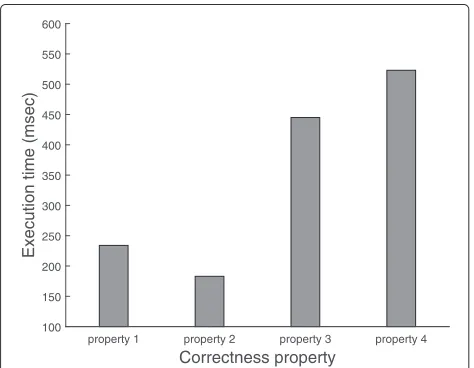
Due to high time-consuming process, execution time is an important metric to verify the properties of the MATF. Figure 3 depicts the time taken by the Z3 Solver to prove that the properties discussed previously in Subsection 4.4 hold in the model.
5 Experimental performance analysis
In this section, we evaluate the performance of MATF in comparison to the scheme proposed in [14], referred to as single attribute-based trust framework (SATF) in what follows. Network simulator 2 (NS-2)[19, 39] is used to implement and analyze the performance of the proposed MATF. For the simulation experiments, we have varied the mobility speed of the nodes between 1 and 10 m/s. For data traffic, 30 % of the total nodes in the network are selected as source-destination pairs (sessions), spread randomly over the network. Only 512-byte data packets are sent. The packet sending rates in each pair are varied to change the offered load in the network. All traffic ses-sions are established at random times near the beginning of the simulation run and stay active until the end. More-over, a very popular and commonly used mobility model, called random way point mobility model [40], is used for node mobility. In the aforementioned mobility model, each node selects a random destination and starts mov-ing with a randomly chosen speed (uniformly distributed between 0 and a predefined maximum speed).
The trust threshold value is 0.4 in this set of experiments [14], which is the maximum tolerated misbehavior for a node to be a part of the network [41]. A trust threshold
Correctness property
property 1 property 2 property 3 property 4
Execution time (msec)
100 150 200 250 300 350 400 450 500 550 600
value determines the trust level that a node has to main-tain to be a legitimate node. To handle high-dimensional parameter space, we define some commonly used simu-lation parameters, as stated in Table 4. The number of simulation experiments has been chosen sufficiently large in order to get 95 % confidence interval for the results.
5.1 Experimental adversarial model
In our adversarial model, the malicious node count is set to 10–30 % of the total nodes in the network. In order to evaluate the proposed scheme against the adversary nodes thoroughly, malicious nodes are selected randomly to keep their distribution uniform in the network. In our experiments, we simulated packet dropping attack by hav-ing malicious nodes dropphav-ing control and data packets randomly or selectively with 25 % probability. Moreover, malicious nodes are also misbehaving by launching the withholding attack against the legitimate nodes. In with-holding attack, misbehaving node does not generate con-trol traffic as per the specification of the routing protocol. Because of the aforementioned behavior of misbehaving nodes, legitimate nodes are unable to have a consistent and updated view of the network. Furthermore, number of malicious nodes exercise bad-mouthing and false praise attacks in collusion is varied from 10 to 50 % of the total nodes in the simulation scenarios.
5.2 Simulation results and analysis
We now discuss the results of the comparison between the MATF and the SATF in terms of several performance metrics.
5.2.1 Impact of trust deviation threshold
Trust deviation threshold means that second-hand infor-mation whose deviation from an evaluating node’s obser-vations is greater than the aforementioned threshold will be filtered out while computing the evaluated node trust-worthiness. To select the best optimal trust deviation
Table 4Simulation parameters
Simulation time 1000 s
Number of nodes 60
Number of malicious nodes 10–30%
Network size 1000×1000 m Transmission range 250 m
Max speed 1–10 m/s
Mobility model Random way point
Traffic type Constant bit rate (CBR)
Trust threshold 0.4
Deviation threshold 0.4
Energy model Generic energy model [44]
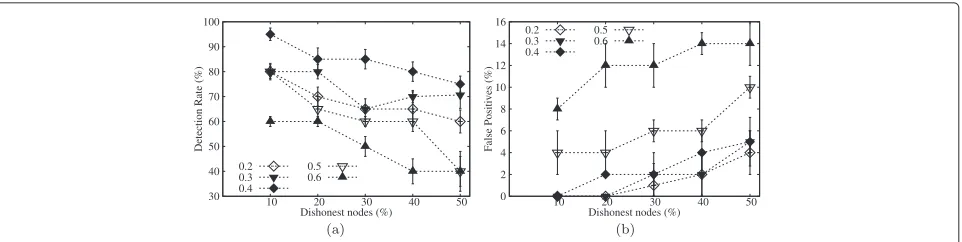
threshold to filter second-hand information, we simu-late the MATF for varying the deviation threshold with increasing number of dishonest nodes. For this set of sim-ulation, the mobility speed is set to 1–4 m/s. Dishonest nodes exercise the false praise and bad-mouthing attacks to show the impact on detection rate and false positives rate, respectively (Fig. 4).
Figure 5a, b illustrates the impact of increasing number of dishonest nodes on the false positive rate and detection rate under different trust deviation thresholds. It can be inferred from Fig. 5a that detection rate is first increasing up to the deviation threshold of 0.4 and then decreasing with increasing number of dishonest nodes. The reason is that with higher trust deviation threshold, false recom-mendations from bad-mouthing nodes are not filtered out during the trust computation of evaluated nodes, which provides more opportunities to misbehaving nodes to remain undetected.
Similarly, Fig. 5b shows the impact of varying trust devi-ation threshold for increasing number of dishonest nodes. It is obvious from the figure that with increasing trust deviation threshold, the false positives rate is also increas-ing. The reason is that with higher deviation threshold, such as 0.5 and 0.6, false recommendation from bad-mouthing nodes having deviation of 60 % are only filtered out which causes legitimate nodes as misbehaving nodes, hence more false positives rate.
It can be summarized from the above results that 0.4 is an optimal trust deviation threshold in terms of detection rate and false positives. It is worth mentioning here that we will use the trust deviation threshold of 0.4 for the rest of the simulation scenarios.
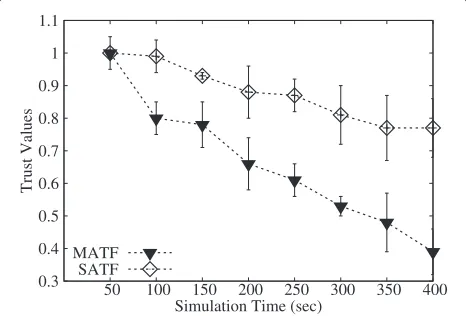
5.2.2 Trust values
Figure 4 shows the trust values computation of a some specific misbehaving node at different simulation time instances. As shown in the figure, the MATF decrements
0.3 0.4 0.5 0.6 0.7 0.8 0.9 1 1.1
50 100 150 200 250 300 350 400
Trust Values
Simulation Time (sec) MATF
SATF
30
Fig. 5Impact of trust deviation threshold on detection rate and false positive rate (a,b)
the trust in an expedite way of the misbehaving node to achieve the threshold because of multi-attribute and effi-cient dishonest recommendation filtration criteria, hence more informed decisions. The MATF evaluates the eval-uated node on the basis of different network functions, hence more informed and prompt decisions about the trustworthiness of nodes can be taken. However, in case of the SATF, the trust is computed slowly due to high boot-strapping time and data sparsity problem. The reason for this behavior is that evaluated nodes are observed in the context of data forwarding only. It can be inferred from Fig. 4 that the MATF efficiently overcomes the bootstrap-ping and data sparsity at the start-up of the network as compared to SATF.
5.2.3 Detection time and detection rate
Detection time refers to the time taken by the trust-based security scheme to detect and declare a misbehaving node as a malicious node. Similarly, malicious node detection rate is calculated as the percentage of malicious nodes detected among the total number of malicious nodes within the network.
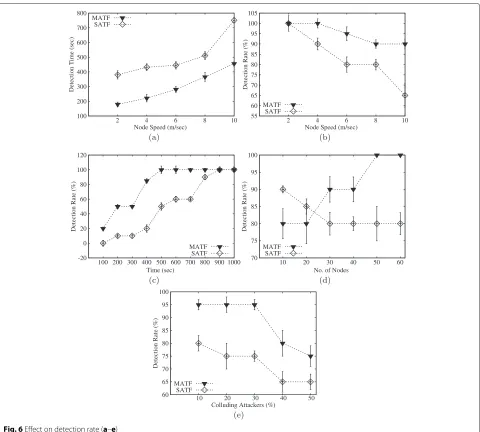
Figure 6a shows the malicious node detection time for increasing node speed in the MATF and the SATF. Afore-mentioned figure shows that the time required in case of the MATF for increasing node speed is smaller as compared to the SATF. The detection time required for misbehaving node detection in the SATF is almost double the MATF. The reason for this behavior is the slow trust building process as discussed in the Fig. 4 analysis. Over-all, the detection time is increasing for increasing node speed. This is because of the fact that for higher node speed, nodes have smaller time of interaction; hence, it takes time to build the trust under the high node mobility. Figure 6b shows the detection rate for increasing node speed. As shown in figure, detection rate is higher in case of the MATF. The reason is that in the MATF, the node’s trust is analyzed in multiple contexts, which expedite the detection rate. Similarly, Fig. 6c shows the malicious node detection rate with the simulation time. The figure shows that the percentage of the malicious node detection is
higher in case of the MATF as compared to the SATF. The detection rate is 100 % at time t = 500 s in the MATF, while half of the malicious nodes are detected in the case of the SATF.
Figure 6d illustrates the impact of increasing the num-ber of nodes on the detection rate while keeping the mobility fixed at 1–6 m/s. It can be inferred from the figure that there is a slight increase in the detection rate with increasing node density. This is due to the fact that under high node density, higher number of watchdogs will be available to observe the behavior of an evaluated node that leads to better detection rate.
The impact of colluding dishonest attackers on detec-tion rate is shown in Fig. 6e. As the figure shows, MATF scheme is able to keep the detection rate nearly about 90 % even in case of higher number of false praise nodes as compared to SATF. The reason is the implementation of an efficient trust deviation criteria, hence more confidant decisions. Due to efficient trust deviation criteria, recom-mendations from colluding dishonest attackers are filtered out and are not considered in the trust computation of an evaluated node.
5.2.4 False positive rate
The false positive rate is the ratio of the legitimate nodes declared as malicious to the total number of legitimate nodes.
100 200 300 400 500 600 700 800
2 4 6 8 10
Detection Time (sec)
Node Speed (m/sec) MATF
SATF
55 60 65 70 75 80 85 90 95 100 105
2 4 6 8 10
Detection Rate (%)
Node Speed (m/sec) MATF
SATF
-20 0 20 40 60 80 100 120
100 200 300 400 500 600 700 800 900 1000
Detection Rate (%)
Time (sec) MATF
SATF
70 75 80 85 90 95 100
10 20 30 40 50 60
Detection Rate (%)
No. of Nodes MATF
SATF
60 65 70 75 80 85 90 95 100
10 20 30 40 50
Detection Rate (%)
Colluding Attackers (%) MATF
SATF
Fig. 6Effect on detection rate (a–e)
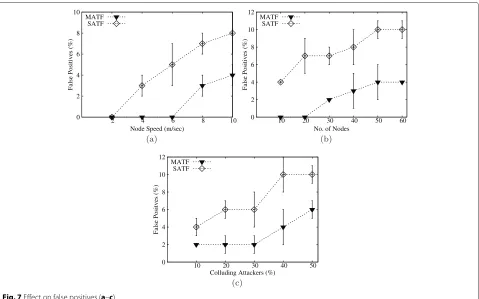
in the node speed, the false positives rate also increases. The aforementioned behavior is due to the fact that an evaluating node and the watchdog nodes cannot differ-entiate between intentional and unintentional malicious activities of a node. For example, even if a node fails to forward a packet because of the network conditions, it is regarded as a malicious activity by a node. As a result, under high node speed, the false positives rate increases.
Similarly, Fig. 7b shows the effect of increasing node density on false positive rate. The figure illustrates that for increasing node density, the false positive rate in case of the MATF is lower as compared to the SATF. The reason is that more legitimate nodes are selected as watch-dog, which provides accurate and precise information about the trustworthiness of the evaluated nodes and also because of using an efficient filtration criteria to filter the
dishonest recommendations. In case of the SATF, the false positive rate is increasing as the number of bad-mouthing and false praising nodes are also increasing, which causes a false trust estimation about the legitimate nodes.
Figure 7c shows the impact of dishonest colluding attackers on false positive rate. It is obvious from the figure that MATF withstands effectively against the increasing dishonest nodes in terms of false positives. The reason is the use of an efficient trust deviation criteria in the proposed scheme as previously discussed in the reasoning of Fig. 6e.
5.2.5 Packet delivery ratio
0 2 4 6 8 10
2 4 6 8 10
False Positives (%)
Node Speed (m/sec) MATF
SATF
0 2 4 6 8 10 12
10 20 30 40 50 60
False Positives (%)
No. of Nodes MATF
SATF
0 2 4 6 8 10 12
10 20 30 40 50
False Positves (%)
Colluding Attackers (%) MATF
SATF
Fig. 7Effect on false positives (a–c)
node count set to 20 % of the total number of deployed nodes, the control and data packet dropping and with-holding attacks are implemented. Figure 8a illustrates the effect of the mobility speed of the nodes on the PDR while keeping the data rate constant at 4 kbps. Figure 8a shows that the MATF has higher PDR as compared to the SATF as it isolates malicious nodes from the routing paths very earlier (as shown in Fig. 6c). Moreover, it can also be observed that the PDR decreases with increasing node speed. The reason for the aforementioned behavior is that at a higher node speed, the node drops packets due to the frequent link changes. These results illustrate that the
MATF eliminates the malicious nodes well in time from the network and improves the PDR by 10–12 % for varying mobility speeds of the nodes.
5.2.6 Packet loss rate
In this section, we present the packet loss analysis of the proposed MATF. Although the packet delivery ratio pro-vides the big picture of efficiency and effectiveness of any scheme, however, the reason to present the packet loss analysis in this paper is to show the effectiveness of the MATF scheme in terms of reducing the packet loss due to misbehaving nodes. As there are many reasons of packet
55 60 65 70 75 80 85 90
2 4 6 8 10
PDR (%)
Node Speed (m/sec) MATF
SATF
10 15 20 25 30 35 40
2 4 6 8 10
Packet loss rate (%)
Node Speed (m/sec) MATF
SATF
loss in MANETs, such as packet loss due to link errors, queue overflow, frequent link changes, and malicious drop [42, 43]. In these simulation results, we consider the packet loss that is only caused by the malicious node-dropping packets. Figure 8b shows the packet loss rate for the increasing node speed in the MATF and the SATF. The results show that the MATF has about 8–15 % less packet loss rate as compared to the SATF. The reason for this behavior is that misbehaving nodes are detected and isolated well in time on the basis of multi-attribute trust criteria. However, in case of the SATF, the misbe-having nodes are detected and isolated very late in the simulation (as shown in Fig. 6c), which provides more packet drop opportunities to the misbehaving nodes.
5.2.7 Energy consumption
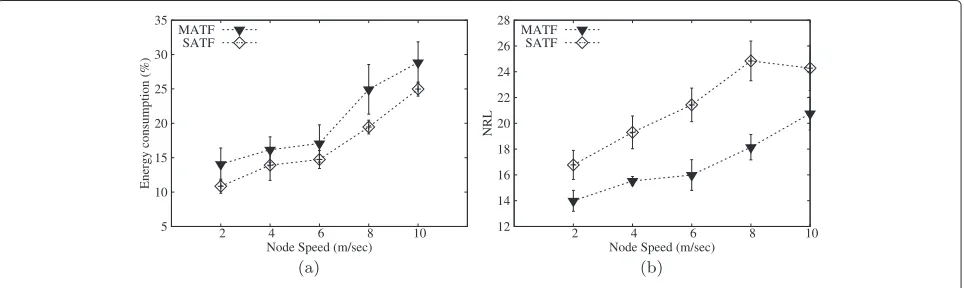
The major causes of the energy consumption in MANETs are the packet transmission and reception. To compute the energy consumed by the nodes in both the MATF and SATF schemes, we use the generic energy model sup-ported by NS-2. The generic energy model can estimate the consumption of energy for continuous and variable transmission power levels. The parameters we used are as follows: 100 J of initial energy, 0.05 W for transmis-sion, 0.02 W for reception, 0.01 W for idling, and 0.0 W when sleeping. It is worth mentioning that energy con-sumed is shown in percentage in these results, which is the total percentage energy consumption of the initial energy of a node. The energy consumption of the pro-posed MATF in comparison to the SATF is shown in Fig. 9a. As there is no extra message communication in the MATF in comparison to the SATF, the figure shows that energy consumption is almost equal to that of the SATF. A slight increase in the energy consumption in case of MATF is because of the nodes in MATF requiring some extra processing to compute the trust of the nodes on the basis of multi-attribute trust criteria. Moreover, the packet delivery ratio is higher and packet loss due to malicious nodes is lower in the MATF in comparison to the SATF,
which also causes more energy consumption as packets need to travel more longer paths in the network, hence more energy consumption at those nodes in the routing path.
5.2.8 Normalized routing load
Normalized routing load (NRL) is the ratio of the total number of control packets transmitted by the nodes to the total number of received data packets at the destina-tion nodes. It is used to evaluate the efficiency of a routing protocol.
Figure 9b illustrates that NRL is smaller in the MATF as compared to the SATF. The reason is the more packet delivery ratio per control packets in the MATF. As the SATF suffers from more packet loss as shown in the figure, control packets sent per data packet is higher, which causes higher NRL in the SATF. Overall, the routing over-head is increasing in both the schemes with an increase in the node speed. The reason for this behavior is that to maintain the routes under high node mobility, more control packets are transmitted.
6 Security analysis
In this section, we present the security analysis of the proposed MATF against the various attacks.
6.1 Security against bad-mouthing and false praise attack In the MATF, second-hand information is considered from only those nodes, which are designated as watchdog nodes, having trust value greater than the trust threshold, and trust deviation is less than the deviation thresh-old. Due to the aforementioned criteria for second-hand information, the MATF effectively withstands against the bad-mouthing and false praise attacks.
6.2 Security against selective misbehavior
A smart adversary node may misbehave selectively, such as drops data packets, while forwards control pack-ets. Depending upon the security requirements and the
5 10 15 20 25 30 35
2 4 6 8 10
Energy consumption (%)
Node Speed (m/sec) MATF
SATF
12 14 16 18 20 22 24 26 28
2 4 6 8 10
NRL
Node Speed (m/sec) MATF
SATF
privilege provided by the MATF, an evaluating node can selectively use smart misbehaving nodes to perform dif-ferent network functions. For example, if an adversary node misbehaves by dropping data packets only, then an evaluating node can use such a node for other network functions, such as control packet forwarding.
6.3 Security against colluding attackers
In the proposed scheme, an evaluating node uses the trust attributes based on local states and its own obser-vation; collusion attack is not much effective against the scheme. The only collusion attack that is possible against the scheme is the publication of false-praise and bad-mouthing information against the legitimate nodes. In the proposed MATF, efficient trust deviation cri-teria are used which filter such false-praise and bad-mouthing information, as discussed in Figs. 6e and 7c. Results presented in the aforementioned figures reveal that the proposed MATF scheme efficiently withstands against the colluding attackers up to 30 % of the total nodes.
7 Conclusion and future work
In this work, we proposed a scheme that is based on the multi-attribute trust criteria to minimize the boot-strapping time and to deal with the selective misbehav-ior. The proposed trust model augments the security of a MANET by enabling a node to identify and remove malicious nodes from the routing paths by overhear-ing transmission at multiple nodes (evaluatoverhear-ing node and watchdog nodes). The proposed security scheme not only provides a way to detect attacks and malicious behav-ior accurately and timely but also reduces the number of false positives by using the concept of multi-watchdogs. The proposed trust model is evaluated in the context of OLSR routing protocol. Moreover, to prove the cor-rectness of the proposed scheme, we also presented a formal verification of our proposed MATF using HLPN, SMT-Lib, and Z3 Solver. Comparison between the MATF and the SATF has shown that our proposed scheme has more efficiently detected malicious nodes. More-over, the MATF has shown promising results under high mobility speed of the nodes and frequent topology changes.
Simulation results show that the proposed trust model achieves 98–100 % detection rate of malicious nodes with only 1–2 % false positives. The proposed MATF has an improved packet delivery ratio in comparison to the SATF of about 90–75 and 80–65 %, respectively, in a network with malicious nodes.
We plan to extend our work by using the adaptive mechanism for the weight assignment to different trust attributes based on the run-time network conditions. Moreover, we will evaluate our proposed scheme as an
extension to some other reactive routing protocol like DSR to analyze the effect of underlying routing protocol.
Endnote
1The difference between the trust values of a
recom-mender node and an evaluating node about a particular evaluated node.
Acknowledgments
The work reported in this paper has been partially supported by the Higher Education Commission (HEC), Pakistan.
Competing interests
The authors declare that they have no competing interests.
Author details
1Department of Computer Sciences, COMSATS Institute of Information
Technology, Islamabad, Pakistan.2Department of Computer Sciences,
COMSATS Institute of Information Technology, Abbottabad, Pakistan.
Received: 20 April 2016 Accepted: 9 August 2016
References
1. S Zhao, A Aggarwal, S Liu, H Wu, inIEEE Wireless Communications and Networking Conference (WCNC2008). A secure routing protocol in proactive security approach for mobile ad-hoc networks (IEEE, Las Vegas, 2008), pp. 2627–2632. 10.1109/WCNC.2008.461
2. YC Hu, A Perrig, DB Johnson, Ariadne: A secure on-demand routing protocol for ad hoc networks. Wirel. Netw.11, 21–38 (2005)
3. P Papadimitratos, ZJ Haas, inIEEE Applications and the Internet Workshops. Secure link state routing for mobile ad hoc networks (IEEE, Orlando, 2003), pp. 379–383
4. MS Obaidat, I Woungang, SK Dhurandher, V Koo,A cryptography-based protocol against packet dropping and message tampering attacks on mobile ad hoc networks security and communication networks. (John Wiley & Sons, Ltd, Malden MA, 2014), pp. 376–384
5. T Zahariadis, P Trakadas, HC Leligou, S Maniatis, P Karkazis, A novel trust-aware geographical routing scheme for wireless sensor networks. Wirel. Pers. Commun.69(2), 805–826 (2013)
6. G Zhan, W Shi, J Deng, Design and implementation of TARF: a Trust-Aware Routing Framework for WSNs. IEEE Trans. Dependable Secure Comput.9(2), 184–197 (2012)
7. S Buchegger, JY Le Boudec, inProceedings of the 3rd ACM international symposium on Mobile ad hoc networking & computing. Performance analysis of the CONFIDANT protocol (ACM, New York, 2002), pp. 226–236 8. A Chakrabarti, V Parekh, A Ruia, inAdvances in Computer Science and
Information Technology.Networks and Communications (Springer). A trust based routing scheme for wireless sensor networks (Springer, Berlin Heidelberg, 2012), pp. 159–169
9. P Michiardi, R Molva, inAdvanced communications and multimedia security. Core: a collaborative reputation mechanism to enforce node cooperation in mobile ad hoc networks (Springer, USA, 2002), pp. 107–121
10. S Ganeriwal, LK Balzano, MB Srivastava, Reputation-based framework for high integrity sensor networks. ACM Trans. Sens. Netw. (TOSN).4(3), 15 (2008)
11. O Khalid, SU Khan, SA Madani, K Hayat, MI Khan, N MinAllah, J Kolodziej, L Wang, S Zeadally, D Chen, Comparative study of trust and reputation systems for wireless sensor networks. Secur. Commun. Netw.6(6), 669–688 (2013)
12. A Ahmed A, KA Bakar, MI Channa, K Haseeb, AW Khan, A survey on trust based detection and isolation of malicious nodes in ad hoc and sensor networks. Front. Comput. Sci.9(2), 280–296 (2015)
13. S Marti, TJ Giuli, K Lai, M Baker, inACM Proceedings of the 6th annual international conference on Mobile computing and networking. Mitigating routing misbehavior in mobile ad hoc networks (ACM, New York, 2000), pp. 255–265
15. FS Proto, A Detti, C Pisa, G Bianchi, inIEEE International Conference on Communications (ICC). A framework for packet-droppers mitigation in OLSR wireless community networks (IEEE, Kyoto, 2011), pp. 1–6 16. JM Robert, H Otrok, A Chriqi, RBC-OLSR: Reputation-based clustering
OLSR protocol for wireless ad hoc networks. Comput. Commun.35(4), 487–499 (2012)
17. D Zhang, CK Yeo, Distributed court system for intrusion detection in mobile ad hoc networks. Comput. Secur.30(8), 555–570 (2011) 18. SU Malik, SU Khan, Formal methods in LARGE-SCALE computing systems.
ITNOW.55(2), 52–53 (2013)
19. T Issariyakul, E Hossain,Introduction to network simulator NS2. (Springer Science & Business Media, USA, 2011)
20. S Tan, X Li, Q Dong, Trust based routing mechanism for securing OSLR-based MANET. Ad Hoc Netw.30, 84–98 (2015)
21. EM Shakshuki, N Kang, TR Sheltami, EAACK—a secure intrusion-detection system for MANETs. IEEE Trans. Ind. Electron.60(3), 1089–1098 (2013) 22. K Liu, J Deng, PK Varshney, K Balakrishnan, An acknowledgment-based
approach for the detection of routing misbehavior in MANETs. IEEE Trans. Mob. Comput.6(5), 536–550 (2007)
23. TR Sheltami, A Basabaa, EM Shakshuki, A3ACKs: adaptive three acknowledgments intrusion detection system for MANETs. J. Ambient Intell. Humanized Comput.5(4), 611–620 (2014)
24. P Gallagher, C Furlani, Digital signature standard (DSS). Federal Information Processing Standards Publications, volume FIPS (2013), 186–3 (2013)
25. RL Rivest, A Shamir, L Adleman, A method for obtaining digital signatures and public-key cryptosystems. Commun. ACM.26(1), 96–99 (1983) 26. S Bansal, M Baker, Observation-based cooperation enforcement in ad hoc
networks.Research Report cs.NI/0307012, Stanford University, 120-130 (2003)
27. X Li, Z Jia, P Zhang, R Zhang, H Wang, Trust-based on-demand multipath routing in mobile ad hoc networks. IET Inf. Secur.4(4), 212–232 (2010) 28. H Xia, Z Jia, X Li, L Ju, EH Sha, Trust prediction and trust-based source
routing in mobile ad hoc networks. Ad Hoc Netw.11(7), 2096–2114 (2013) 29. A Adnane, C Bidan, RT de Sousa, Trust-based security for the OLSR routing
protocol. Comput. Commun.36(10), 1159–1171 (2013) 30. A Adnane, inProceedings of the 2008 ACM symposium on Applied
computing. Autonomic trust reasoning enables misbehavior detection in OLSR (ACM, New York, 2008), pp. 2006–2013
31. D Kukreja, SK Dhurandher, BVR Reddy,Enhancing the Security of Dynamic Source Routing Protocol Using Energy Aware and Distributed Trust Mechanism in MANETs. Intelligent Distributed Computing. (Springer International Publishing, Springer Switzerland, 2015), pp. 83–94 32. R Abdellaoui, J Robert, in4th Conference on Security in Network
Architectures and Information Systems (SAR-SSI). Su-olsr: A new solution to thwart attacks against the olsr protocol, (Luchon, 2009), pp. 239–245 33. D Câmara, AA Loureiro, F Filali, inIEEE Global Telecommunications
Conference (GLOBECOM’07). Methodology for formal verification of routing protocols for ad hoc wireless networks (IEEE, Washington, 2007), pp. 705–709
34. SU Malik, SU Khan, SK Srinivasan, Modeling and analysis of state-of-the-art VM-based cloud management platforms. IEEE Trans. Cloud Comput.1(1), 1-1 (2013)
35. F Ghassemi, S Ahmadi, W Fokkink, A Movaghar,Model checking MANETs with arbitrary mobility, (2013), pp. 217–232
36. C C Barrett, A Stump, C Tinelli,The Satisfiability Modulo Theories Library (SMT-LIB), (2010). http://smtlib.cs.uiowa.edu/. Accessed 15 Jan 2016 37. L De Moura, N Bjørner, inTools and Algorithms for the Construction and
Analysis of Systems. Z3: An efficient SMT solver (Springer, Berlin Heidelberg, 2008), pp. 337–340
38. SU Malik, SK Srinivasan, SU Khan, L Wang, in12th International Conference on Scalable Computing and Communications (ScalCom). A methodology for OSPF routing protocol verification (IEEE, Changzhou, 2012) 39. P Whigham,The VINT project, the network simulator - ns-2. (University of
Otago, 2003), pp. 181–186. http://www.isi.edu/nsnam/ns/. Accessed 05 Jan 2016
40. J Broch, DA Maltz, DB Johnson, YC Hu, J Jetcheva, inProceedings of the 4th annual ACM/IEEE international conference on Mobile computing and networking. A performance comparison of multi-hop wireless ad hoc network routing protocols (ACM, New York, 1998), pp. 85–97
41. MS Khan, D Midi, MI Khan, E Bertino, inIEEE Trustcom/BigDataSE/ISPA, Vol.1. Adaptive trust threshold strategy for misbehaving node detection and isolation (IEEE, Helsinki, 2015), pp. 718–725
42. Z Wei, H Tang, FR Yu, P Mason, inIEEE Military Communications Conference (MILCOM). Trust establishment based on Bayesian networks for threat mitigation in mobile ad hoc networks (IEEE, Perundurai, 2014), pp. 171–177
43. Y Lu, Y Zhong, B Bhargava,Packet Loss in Mobile Ad Hoc Networks. (IEEE, Baltimore, 2003)
44. Technical Report CSD-TR 03-009. Department of Computer Science, Purdue University (2003). http://docs.lib.purdue.edu/cstech/1558/. Retrieved 26 Dec 2015.
Submit your manuscript to a
journal and benefi t from:
7Convenient online submission
7Rigorous peer review
7Immediate publication on acceptance
7Open access: articles freely available online
7High visibility within the fi eld
7Retaining the copyright to your article