• No results found

Experimental verification of numerical optimization of a plunger for glass pressing

N/A
N/A
Protected

Academic year: 2020

Share "Experimental verification of numerical optimization of a plunger for glass pressing"

Copied!
5
0
0

Loading.... (view fulltext now)

Full text

(1)

EXPERIMENTAL VERIFICATION OF NUMERICAL OPTIMIZATION OF

A PLUNGER FOR GLASS PRESSING

Petr SALA, Václav DVOÁK*

Abstract: The main aim of these experiments is to verify the results of numerical optimization described in [1], [2], [3] and [4]. The results of measuring the classical plunger with its drilled internal cavity and the optimized plunger with its sparked-out inner cavity and applied flow control body are presented in this article. The temperature distributions across both plunger surfaces are estimated by values measured at four points placed 5 millimetres under the plunger surfaces.

1. I

NTRODUCTION

Two main problems appear during glass pressing on the surface of a moulded piece. If the surface of the plunger is too hot at the moment of separation of the moulded piece and the plunger, then the glass melt adheres to the device and deformation of the moulded piece follows. Conversely, if the surface of the plunger is too cold, then small fire cracks appear on the surface of the moulded piece, which means poorer quality of production. For these reasons, it is convenient to achieve a constant distribution of temperature across the surface of the moulding device at the moment of separation of the plunger from the moulded piece.

2. F

ORMULATION OF THE

P

ROBLEM

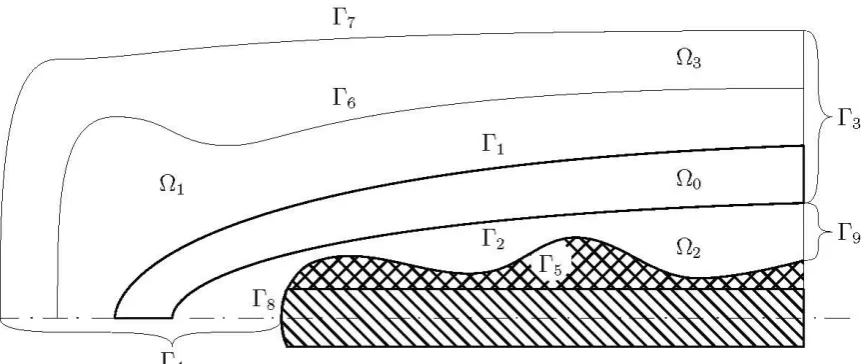
We consider the union of four planar regions ȳ ൌ ȳ׫ ȳ׫ ȳ׫ ȳ, which represents a planar cross section of the system mould, glass, plunger, canal of the plunger and flow control body.

Region ȳ represents the plunger, region a cooled glass piece, region the cooling canal inside the plunger, where cooling water flows, and region represents the mould. Furthermore, we denote as the boundary between plunger and moulded piece and as the boundary between plunger and plunger cavity Ǥ has a shape received as a result of the optimization problem described in [3]. We denote as part of the boundary connecting the system mould, moulded piece and plunger with presser, part of the axis of symmetry, part of the boundary formed by the outward surface of the flow control body, which has a shape which it received as a result of the second step of the optimization problem described in [4]. is the denotation for part of the boundary between moulded piece and mould and is the outward boundary of the mould, which is surrounded by an external environment.

*RNDr. Petr Sala, CSc., Technical University of Liberec, Department of Mathematics and Didactics of

Mathematics, Studentská 2, Liberec 1, 461 17, [email protected]

Doc. Ing. Václav Dvoák, Ph.D., Technical University of Liberec, Department of Power Engineering Equipment,

Studentská 2, Liberec 1, 461 17, [email protected]

(2)

denotes part of the boundary where cooling water comes into the cooling canal of the plunger, and part of the boundary where water exits.

In the regions (plunger) and (mould), the conduction of heat without an inner heat source is described by the equation

െ௞οߴ ൌ Ͳ . (1)

In the region (glass piece), we use the equation for the conduction of heat with inner heat source ݍ in the form

െ௞οߴ ൌ ݍଵ . (2)

In the region (plunger canal in which flows cooling water) the conduction of heat is described by the energy equation in the form

ܿ௩‰”ƒ†ߴǤ ࢛ െ௞οߴ ൌ ʹߥȁܦሺ࢛ሻȁଶ , (3)

where ߴ denotes temperature on the absolute temperature scale and ࢛is the velocity of flowing water satisfying the equation of continuity

†‹˜࢛ ൌ Ͳ (4) and Navier-Stokes equation in the form

࢛Ǥ ‰”ƒ†࢛ െఓο࢛ ൌ ࢌ െଵ‰”ƒ†݌ . (5) In the model we assume transit conditions for contact between two bodies, where one of them changes its mass because of the influence of solidification, on boundaries and , respectively, in the form

ሺ݇ଵడణడ௡భሻାെ ሺ݇଴డణడ௡బሻିൌ ߚଵ on ଵ (6)

and

ሺ݇ଵడణడ௡భሻାെ ሺ݇ଷడణడ௡యሻିൌ ߚ଺ on ଺Ǥ (7)

The boundary conditions of the third type for contact between a body and its environment at boundaries and , respectively, are

െሺ݇଴డణడ௡బሻିൌ ߙሺߴ଴ȁെ ߴଶȁሻ on ଶ (8)

and

െሺ݇ଷడణడ௡యሻିൌ ߙሺߴଷȁെ ߴସሻ on ଻, (9)

where ߴ denotes temperature in (݅ ൌ Ͳǡʹǡ͵) and ߴ the temperature of the environment.

(3)

In article [3] the problems of shape optimization were formulated, where the shape of boundary and , respectively, such that the cost functional

Աௌ

ଶሻ ൌצ ߴሺଶሻȁെ ܭ צ଴ǡ௥ǡଶ (10)

and

Ա௉

ହሻ ൌצ ߴሺହሻȁെ ܭ צ଴ǡ௥ǡ (11)

take the minimum value of the set of admissible design functions.

The experiment suggested itself as a result of the numerical results of optimization problems. The distribution of temperature in the classical plunger with a drilled internal cavity was compared with the distribution of temperature in the optimized plunger with its sparked-out inner cavity and applied flow control body. For details see the article of M. Starý [5], where the course of the experiment with a detailed description of the testing equipment are described.

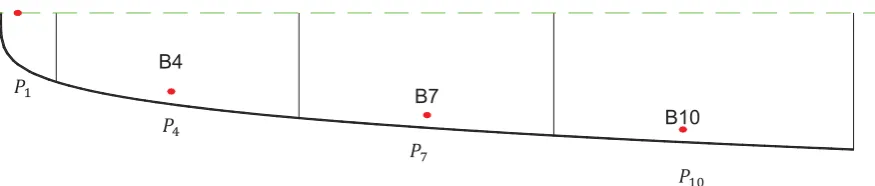
Measurements were evaluated at four points placed 5 millimetres below the surface. Point B1 is located on the lower end of the axis of the plunger (5mm below the surface), point B4 at a distance of 50 millimetres above a plane perpendicular to the plunger axis and level with the vertex, point B7 at a distance of 125 millimetres (from the aforementioned plane) and point B10 at a distance of 200 millimetres.

Fig. 2 Schema of the location of measurement points with areas corresponding to each point.

Surface corresponding to point ‹ ܲ ܲ ܲ ܲଵ଴ Total ܲ Area of corresponding surface [m2] 0,003 0,016 0,021 0,029 0,069 Tab. 1 Areas of surfaces corresponding to single measurement points.

The results of five measurements of the original plunger construction (Plunger I) and the results of five measurements of the plunger with the optimized cooling cavity and applied flow control body (Plunger II) are summarized in tab. 2. Stagnation temperatures after six hours at these points are in the first four lines, the range of measured temperatures is on the fifth line.

The average temperatures computed as a weighted arithmetical mean

ߴഥ ൌప ଵሺߴଵǤ ܲଵ൅ ߴସǤ ܲସ൅ ߴ଻Ǥ ܲ଻൅ ߴଵ଴Ǥ ܲଵ଴ሻ , (12)

where the weights are areas of surfaces corresponding to single measurement points (see fig. 2 and tab. 1), are on the sixth line of tab. 2.

The arithmetical mean of average temperatures from five measurements ۹ ൌσఱ೔సభణതതതഠ

ହ (13)

is introduced in the seventh line.

In the last line of tab. 2, the numerical approximation of cost functional (11) in the form Աா௫௣ൌ ሺߴ

஻ଵെ ܭሻଶǤ ܲଵ൅ ሺߴ஻ସെ ܭሻଶǤ ܲସ൅ ሺߴ஻଻െ ܭሻଶǤ ܲ଻൅ ሺߴ஻ଵ଴െ ܭሻଶǤ ܲଵ଴ (14)

is computed. B4

B7

B10 ܲଵ

ܲସ

ܲ଻

ܲଵ଴

(4)

Plunger I Plunger II

Experiment 1. 2. 3. 4. 5. 1. 2. 3. 4. 5.

ߴ஻ଵ [°C] 113,4 113,3 113,0 112,9 112,5 108,9 105,1 104,7 105,8 101,7

ߴ஻ସ [°C] 104,3 105,8 106,8 106,1 106,2 105,0 102,2 103,1 104,7 100,7

ߴ஻଻ [°C] 101,9 99,3 100,0 98,7 98,2 109,5 107,9 109,3 109,1 107,8

ߴ஻ଵ଴ [°C] 96,7 96,2 96,9 95,7 95,0 105,9 105,2 106,6 105,5 104,9

max [°C] 16,7 17,1 16,1 17,2 17,5 4,5 5,7 6,2 4,4 7,1

ߴഥన 100,8 100,1 100,8 99,8 99,3 106,9 105,3 106,5 106,4 104,7

۹ 100,2 106,0

Աா௫௣ 1,21 1,50 1,51 1,67 1,89 0,30 0,33 0,38 0,24 0,60

Tab. 2 Stagnation temperatures for 5 experiments for each plunger.

The main target of the conducted optimization was to achieve uniform temperature across the entire surface of the plunger.

We are testing the null hypothesis about the correspondence of mean values of the outputs of the cost functional of experimental data obtained from both plungers against the alternative, namely, that the mean value of the outputs of the cost functional on the optimized plunger is statistically significantly less than the mean value of the outputs of the cost functional from the original plunger. We denote μ1 the mean value of outputs of

the cost functional Աா௫௣ on plunger I and μ2 the mean value of outputsof Աா௫௣ on plunger

II.

A single tail test about the correspondence of mean values was used, so

H0 : μ1 = μ2 , (15)

H1 : μ1 > μ2 . (16)

Testing statistic

ܶ ൌ ԱതതതതതതതതିԱభಶೣ೛ തതതതതതതതమಶೣ೛

ඨሺ೙భషభሻǤܛభమశሺ೙మషభሻǤܛమమ

೙భశ೙మషమ ට೙భభା೙మభ

ൌ ͵ǡͻͺͷ͹, (17)

where Աതതതതതതா௫௣ and Աതതതതതതா௫௣, respectively, denote the arithmetical average of data from sample 1 and sample 2, n1 and n2 the size of sample 1 and sample 2,

s

12 and

s

22 the standard

deviation of data from sample 1 and sample 2.

3. C

ONCLUSION

The results allow us to reject the null hypothesis even at significance level =0,005. That means that we can say with 99,5% probability that the results obtained from plunger II are better than the results obtained from plunger I.

We can calculate a 95% confidence interval for the difference of mean values μ1 - μ2 in

the form (0,821; 1,514). This allows us to say that the mean value μ2 is about 0,821 less

than the mean value μ1 with a probability of 97,5%.

4. A

CKNOWLEDGEMENT

(5)

5. R

EFERENCES

[1] Sala P.: Modelling of heat flow in glass forming, Sborník z 16. Semináe, Moderní matematické metody v inženýrství, Dolní Lomná, 2007, pages 262-265 [2] Sala P.: Problem of shape optimization of cooling canal of the plunger in glass

forming, Sborník z 17. Semináe, Moderní matematické metody v inženýrství, Dolní Lomná, 2008, pages 177 – 181

[3] Sala P.: Shape optimization of area with cooling medium, Sborník z 18. Semináe, Moderní matematické metody v inženýrství, Dolní Lomná, 2009, pages 207 – 211

[4] Sala P., Dvoák V.: Shape optimization of axially symmetric through cooling canal, 25th conference with international participation Computational Mechanics

2009, Hrad Netiny, Czech Republic, ISBN 978-80-7043-824-4 (CD)

Figure

Fig. 1 Scheme of the system mould, glass piece, plunger, canal of plunger and flowcontrol body
Fig. 2 Schema of the location of measurement points with areas corresponding to each ��point.���������

References

Related documents

National Conference on Technical Vocational Education, Training and Skills Development: A Roadmap for Empowerment (Dec. 2008): Ministry of Human Resource Development, Department

• Follow up with your employer each reporting period to ensure your hours are reported on a regular basis?. • Discuss your progress with

In the present study, we observed conductivity enhancement and unique band bending at the interface of TMDC bilayer-based heterojunctions.. These heterojunctions were composed of WS 2

Commission’s current $10.700 million accounts receivable balance was referred to the Comptroller’s offset system for collection efforts and referred to the Attorney General’s office

Marie Laure Suites (Self Catering) Self Catering 14 Mr. Richard Naya Mahe Belombre 2516591 [email protected] 61 Metcalfe Villas Self Catering 6 Ms Loulou Metcalfe

The corona radiata consists of one or more layers of follicular cells that surround the zona pellucida, the polar body, and the secondary oocyte.. The corona radiata is dispersed

① ① Customer Customer Value Value ② ② Shareholder Shareholder Value Value ③ ③ Human Human Capital Value Capital Value Narrowly defined Narrowly defined corporate

What is the available evidence on whether Lean Startup (Build, Measure, Learn/Test, Learn, Adapt) methodology or Agile ways of working can lead to improved programme delivery and