Clinical Interventions in Aging
Dove
press
R e v I e w
open access to scientific and medical research
Open Access Full Text Article
errorless learning of everyday tasks in people
with dementia
Maartje Me de werd1,2,5
Daniëlle Boelen1–3
Marcel GM Olde Rikkert2,4
Roy PC Kessels1,2,4
1Radboud University Nijmegen Medical Centre, Department of Medical Psychology, 2Radboud University Nijmegen Medical Centre, Department of Geriatric Medicine and Radboud Alzheimer Centre, Nijmegen, 3Rehabilitation Medical Centre, Groot Klimmendaal, Arnhem, 4Radboud University Nijmegen, Donders Institute for Brain, Cognition and Behaviour, Nijmegen, 5vieCuri Hospital, Department of Medical Psychology, venlo, the Netherlands
Correspondence: Roy PC Kessels Radboud University Nijmegen Medical Centre, Department of Medical Psychology and Radboud Alzheimer Centre, PO Box 9101 (internal post 925), 6500 HB Nijmegen, the Netherlands Tel +312 4366 6196
email [email protected]
Abstract: Errorless learning (EL) is a principle used to teach new information or skills to people with cognitive impairment. In people with dementia, EL principles have mostly been studied in laboratory tasks that have little practical relevance for the participants concerned, yet show positive effects. This is the first paper to exclusively review the literature concerning the effects of EL on the performance of useful everyday tasks in people with dementia. The role of factors such as type of dementia, type of task, training intensity, EL elements, outcome measures, quality of experimental design, and follow-up are discussed. The results indicate that, compared with errorful learning (EF) or no treatment, EL is more effective in teaching adults with dementia a variety of meaningful daily tasks or skills, with gains being generally maintained at follow-up. The effectiveness of EL is highly relevant for clinical practice because it shows that individuals with dementia are still able to acquire meaningful skills and engage in worthwhile activities, which may potentially increase their autonomy and independence, and ultimately their quality of life, as well as reduce caregiver burden and professional dependency. Suggestions for future research are given, along with recommendations for effective EL-based training programs, with the aim of developing a clinical manual for professionals working in dementia care.
Keywords: dementia, implicit learning, occupational therapy, errorless learning, review, everyday activities
Introduction
In dementia, most notably dementia due to Alzheimer’s disease, memory impairments are among the most prominent cognitive deficits. These impairments predominantly affect episodic memory, with detrimental effects on daily life functioning for those suffering from the condition, inevitably severely compromising their autonomy and quality of life. If people with dementia can (re)learn relevant activities and skills, this may improve their sense of competence and foster their ability to (partly) maintain their independence, as well as reduce the burden on professional and nonprofessional caregivers.
Nonpharmacologic interventions, such as cognitive rehabilitation programs, that aim to facilitate performance and optimize the (re)learning of skills rather than restore the impaired function, have been found to be effective.1,2 Typically, in patients with
dementia, such therapies focus on maintaining quality of life despite the presence of deficits that may even progress over time.1,3,4 Existing cognitive rehabilitation programs
rely on structured feedback and repetition, as well as on the use of cognitive strategies and external aids, such as calendars or notebooks, to help optimize functioning. In their meta-analysis, Sitzer et al5 concluded that, in general, cognitive rehabilitation
Clinical Interventions in Aging downloaded from https://www.dovepress.com/ by 118.70.13.36 on 20-Aug-2020
For personal use only.
Number of times this article has been viewed
This article was published in the following Dove Press journal: Clinical Interventions in Aging
Dovepress
de werd et al
may be effective for improving learning, memory, executive functioning, performance of activities of daily living, general cognitive problems, and ameliorating depression in people with Alzheimer’s disease. Errorless learning (EL) is one such cognitive rehabilitation strategy that has been gaining interest over the last two decades in the field of dementia care.4
In rehabilitation, the principle of EL is used as an instructional method for individuals with compromised memory and executive functions and may involve any inter-vention aimed at reducing the number of errors throughout the various stages of learning. This error reduction may be achieved by any combination of graded tasks where the task at hand is broken down into small steps, immediate error correction, encouraging participants not to guess, model-ing the task steps, fadmodel-ing cues and prompts when steps are successfully performed (vanishing cues), or rehearsal of the retrieval of information that is taught with increasing time intervals (spaced retrieval).4 Terrace first introduced
EL in the early 1960s in an animal study.6 His experiment
involved the training of pigeons to discriminate between a red and a green key using both an EL and an errorful approach (EF), with learning in the EL condition resulting in superior memory performance. Because this implies that the reduction of errors facilitates the learning of behavior or skills, Baddeley7 put EL forward as a potential learning
aid to teach amnesic (new) information 30 years later, sug-gesting that EL addresses the (relatively) spared implicit memory functions in people with amnesia.4,8 The rationale
behind EL is that explicit memory is responsible for rec-ognizing and correcting the errors that are made during learning. In people with deficits in explicit memory, such as individuals with Alzheimer’s disease, these errors may not be recognized as such, and are therefore not corrected but instead implicitly consolidated into long-term memory. To investigate this hypothesis, Baddeley and Wilson8 compared
EF and EL using a word stem task in adults with memory impairments of mixed etiology (including dementia). Their amnesic participants showed significantly better learning and less forgetting in the EL condition.
Since then, EL has been used in interventions aimed at memory and executive deficits resulting from, among other causes, traumatic brain injury, Korsakoff’s syndrome, stroke, or schizophrenia,4,9–15 as well as in elderly
popula-tions with mild, moderate, and severe memory disorders (ie, dementia).4 Grandmaison and Simard16 reviewed various
memory stimulation and remediation programs for persons with Alzheimer’s disease and found the interventions that incorporated EL to be effective.
Most of the EL efficacy studies that have been reviewed so far used laboratory tasks, with positive effects being reported for controlled experimental manipulations in various patient samples. However, it remains unclear how well these results would convey to a more natural situa-tion (ie, clinical practice or the home) with tasks that bear true relevance to patients. Moreover, most studies did not investigate the long-term effects of EL in people with dementia.
The objective of this review therefore is to evaluate critically the effectiveness of EL in teaching people with dementia meaningful activities of daily living. These refer to all activities, tasks, or skills that have some relevance in everyday life of the individual patient that may enhance his or her autonomy. One should think of (re)learning the names of familiar people, (re)training leisure activities, and (re) gaining communication skills (eg, preparing to go out for a walk, learning to use an MP3 player, or writing an email). Also, we examine the longevity of the effects reported (ie, the follow-up results) and provide recommendations about the practical feasibility and application of EL in clinical practice.
Materials and methods
Potentially relevant studies were identified by searching the PubMed, PsychInfo, and Web of Science databases until April 12, 2013, using combinations of the search terms: “errorless learning”, “Alzheimer”, “dementia”, “everyday activities”, “daily life activities”, “everyday memory problems”, “everyday life functioning”, “skill learning”, and “everyday skills learning”. In addition, reference lists from the retrieved articles were screened to identify additional papers. The PsycBITE Internet site was also consulted. Articles were included for review if they met the following criteria:
1. The study sample(s) comprise(s) people with a diagnosis of dementia. Participants in the intervention studies have cognitive impairments resulting from neurodegenerative diseases, ie, a diagnosis of Alzheimer’s disease, semantic dementia, or vascular dementia. Participants fulfill either the criteria for dementia as outlined in the Diagnostic and Statistical Manual of Mental Disorder (DSM-IV-TR),17
or disease-specific criteria such as those for Alzheimer’s dementia as formulated by the National Institute of Neurological and Communicative Diseases and the Stroke-Alzheimer’s Disease and Related Disorders Asso-ciation,18 the criteria for vascular dementia adhered to
by the National Institute of Neurological Disorders and
Clinical Interventions in Aging downloaded from https://www.dovepress.com/ by 118.70.13.36 on 20-Aug-2020
Dovepress errorless learning in people with dementia
Stroke-Association Internationale pour la Recherche et l’Enseignement en Neurosciences,19 or criteria for
seman-tic dementia or frontotemporal dementia.20–22 In addition,
studies were included if diagnoses were based on historic information, neurologic examination, neuropsychologic assessment, and supported by findings on structural and functional imaging.
2. Tasks are relevant to daily life and meaningful to the participants. Intervention studies evaluate the effects of EL in tasks that are potentially useful for individuals with dementia to (re)learn, contributing to preservation or enhancing their autonomy.
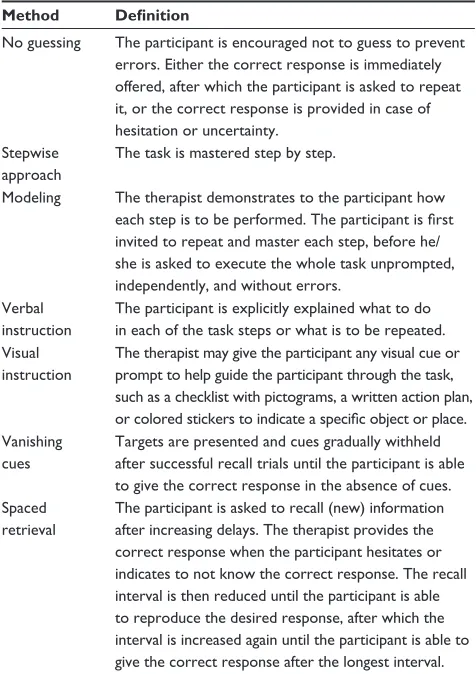
3. Error-reduction principles are applied. The intervention studies address the (re)learning of meaningful activities of daily living by means of EL. The actual application of EL principles shows a large variation in the literature and may include a combination of teaching principles, provided that the amount of errors made during the acquisition and/or retrieval phases of learning is kept to a minimum, or is prevented altogether. In Table 1, various error-reducing methods are presented.
4. Outcome measures are quantitative and pertain to func-tioning in daily life. The methodology comprises at least one quantitative outcome measure, eg, the number of correctly performed steps and/or the number of errors made during task performance.
5. The intervention studies are controlled. Studies eligible for review are either group studies with a control group or control condition, comparing EL with another type of learning (ie, EF) or no treatment, or single-case studies (eg, multiple-baseline design, reversal design, or case series). To examine the effectiveness of EL, the following study aspects were scrutinized:
• Type of dementia and severity, based on Mini-Mental State Examination scores (MMSE),23 subdivided into four
categories: minimal (MMSE>),23 mild (MMSE 18-23),
moderate (MMSE 10-17), and severe (MMSE<10).24,25
• Task type, eg, orientation tasks, familiar face-name associations, operating an electronic device or household appliance, and task novelty, ie, relearning previously known skills or acquiring new ones
• Training intensity in terms of duration and frequency of training sessions
• Training location, eg, at home, in the hospital, or in a residential or nursing home
• (Combinations of) EL elements applied in the intervention(s) evaluated
• Experimental design
• Outcome measures
• Effectiveness
• Maintenance of treatment gains at follow-up (ie, after training had stopped) and (number and nature of) refresher sessions, if provided.
Because samples were small (n , 12) in 24 of the 26 stud-ies reviewed and because the learning procedures varied con-siderably among studies, we performed a qualitative analysis of the evidence rather than a formal meta-analysis.
Results
A total of 26 studies reported in 16 research articles were included, each employing some form of EL in teaching patients with dementia activities that they found relevant and meaningful for their daily lives, using error-reduction principles, quantitative outcome measures, and controlled study designs. As one of these studies26 described the
follow-up assessment of a previous study by Clare et al,27
the results of that follow-up study are only described under the heading “Effectiveness and maintenance of treatment gains” and not in the remaining part of the
Table 1 error-reducing methods applied in the studies reviewed
Method Definition
No guessing The participant is encouraged not to guess to prevent errors. either the correct response is immediately offered, after which the participant is asked to repeat it, or the correct response is provided in case of hesitation or uncertainty.
Stepwise approach
The task is mastered step by step.
Modeling The therapist demonstrates to the participant how
each step is to be performed. The participant is first
invited to repeat and master each step, before he/ she is asked to execute the whole task unprompted, independently, and without errors.
verbal instruction
The participant is explicitly explained what to do in each of the task steps or what is to be repeated. visual
instruction
The therapist may give the participant any visual cue or prompt to help guide the participant through the task, such as a checklist with pictograms, a written action plan,
or colored stickers to indicate a specific object or place.
vanishing cues
Targets are presented and cues gradually withheld after successful recall trials until the participant is able to give the correct response in the absence of cues. Spaced
retrieval
The participant is asked to recall (new) information after increasing delays. The therapist provides the correct response when the participant hesitates or indicates to not know the correct response. The recall interval is then reduced until the participant is able to reproduce the desired response, after which the interval is increased again until the participant is able to give the correct response after the longest interval.
Clinical Interventions in Aging downloaded from https://www.dovepress.com/ by 118.70.13.36 on 20-Aug-2020
Dovepress
de werd et al
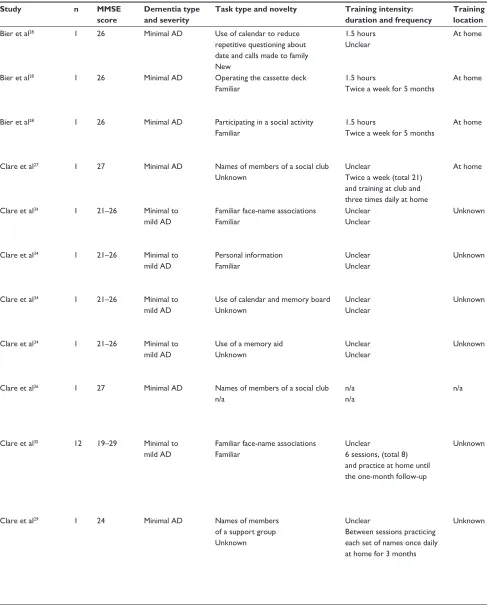
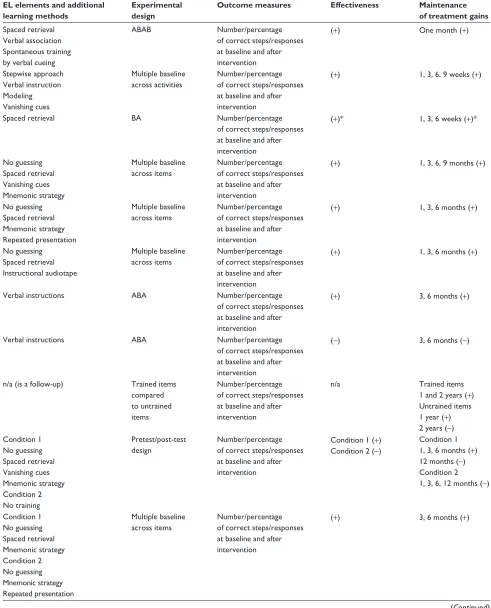
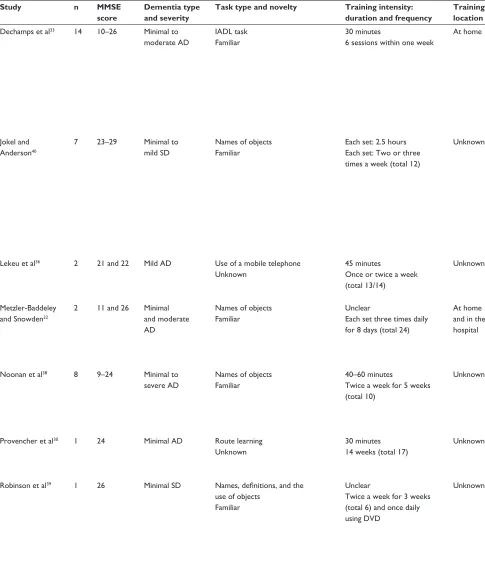
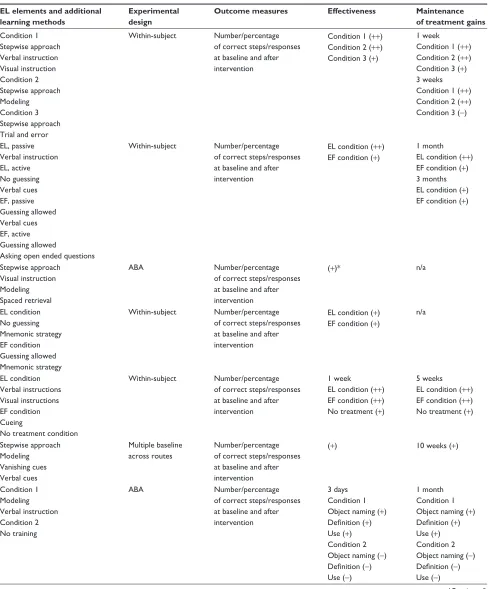
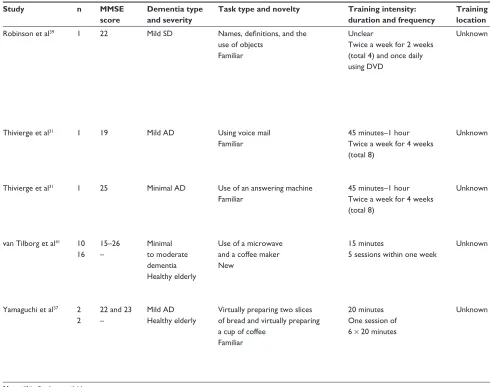
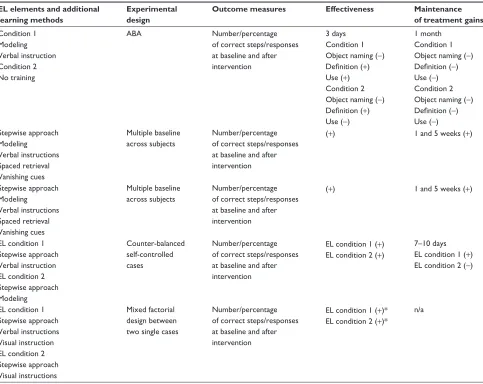
Table 2 Studies reviewed that compared the effectiveness of errorless learning and errorful learning or no treatment in people with dementia
Study n MMSE score
Dementia type and severity
Task type and novelty Training intensity: duration and frequency
Training location
EL elements and additional learning methods
Experimental design
Outcome measures Effectiveness Maintenance of treatment gains
Bier et al28 1 26 Minimal AD Use of calendar to reduce
repetitive questioning about date and calls made to family New
1.5 hours Unclear
At home Spaced retrieval
verbal association Spontaneous training by verbal cueing
ABAB Number/percentage
of correct steps/responses at baseline and after intervention
(+) One month (+)
Bier et al28 1 26 Minimal AD Operating the cassette deck
Familiar
1.5 hours
Twice a week for 5 months
At home Stepwise approach
verbal instruction Modeling vanishing cues
Multiple baseline across activities
Number/percentage of correct steps/responses at baseline and after intervention
(+) 1, 3, 6, 9 weeks (+)
Bier et al28 1 26 Minimal AD Participating in a social activity Familiar
1.5 hours
Twice a week for 5 months
At home Spaced retrieval BA Number/percentage
of correct steps/responses at baseline and after intervention
(+)* 1, 3, 6 weeks (+)*
Clare et al27 1 27 Minimal AD Names of members of a social club Unknown
Unclear
Twice a week (total 21) and training at club and three times daily at home
At home No guessing
Spaced retrieval vanishing cues Mnemonic strategy
Multiple baseline across items
Number/percentage of correct steps/responses at baseline and after intervention
(+) 1, 3, 6, 9 months (+)
Clare et al34 1 21–26 Minimal to
mild AD
Familiar face-name associations Familiar
Unclear Unclear
Unknown No guessing
Spaced retrieval Mnemonic strategy Repeated presentation
Multiple baseline across items
Number/percentage of correct steps/responses at baseline and after intervention
(+) 1, 3, 6 months (+)
Clare et al34 1 21–26 Minimal to
mild AD
Personal information Familiar
Unclear Unclear
Unknown No guessing
Spaced retrieval Instructional audiotape
Multiple baseline across items
Number/percentage of correct steps/responses at baseline and after intervention
(+) 1, 3, 6 months (+)
Clare et al34 1 21–26 Minimal to
mild AD
Use of calendar and memory board Unknown
Unclear Unclear
Unknown verbal instructions ABA Number/percentage
of correct steps/responses at baseline and after intervention
(+) 3, 6 months (+)
Clare et al34 1 21–26 Minimal to
mild AD
Use of a memory aid Unknown
Unclear Unclear
Unknown verbal instructions ABA Number/percentage
of correct steps/responses at baseline and after intervention
(-) 3, 6 months (-)
Clare et al26 1 27 Minimal AD Names of members of a social club n/a
n/a n/a
n/a n/a (is a follow-up) Trained items
compared to untrained items
Number/percentage of correct steps/responses at baseline and after intervention
n/a Trained items
1 and 2 years (+) Untrained items 1 year (+) 2 years (-) Clare et al35 12 19–29 Minimal to
mild AD
Familiar face-name associations Familiar
Unclear
6 sessions, (total 8) and practice at home until the one-month follow-up
Unknown Condition 1
No guessing Spaced retrieval vanishing cues Mnemonic strategy Condition 2 No training
Pretest/post-test design
Number/percentage of correct steps/responses at baseline and after intervention
Condition 1 (+) Condition 2 (-)
Condition 1 1, 3, 6 months (+) 12 months (-) Condition 2 1, 3, 6, 12 months (-)
Clare et al29 1 24 Minimal AD Names of members
of a support group Unknown
Unclear
Between sessions practicing each set of names once daily at home for 3 months
Unknown Condition 1
No guessing Spaced retrieval Mnemonic strategy Condition 2 No guessing Mnemonic strategy Repeated presentation
Multiple baseline across items
Number/percentage of correct steps/responses at baseline and after intervention
(+) 3, 6 months (+)
(Continued)
Clinical Interventions in Aging downloaded from https://www.dovepress.com/ by 118.70.13.36 on 20-Aug-2020
Dovepress errorless learning in people with dementia Table 2 Studies reviewed that compared the effectiveness of errorless learning and errorful learning or no treatment in people with
dementia
Study n MMSE score
Dementia type and severity
Task type and novelty Training intensity: duration and frequency
Training location
EL elements and additional learning methods
Experimental design
Outcome measures Effectiveness Maintenance of treatment gains
Bier et al28 1 26 Minimal AD Use of calendar to reduce
repetitive questioning about date and calls made to family New
1.5 hours Unclear
At home Spaced retrieval
verbal association Spontaneous training by verbal cueing
ABAB Number/percentage
of correct steps/responses at baseline and after intervention
(+) One month (+)
Bier et al28 1 26 Minimal AD Operating the cassette deck
Familiar
1.5 hours
Twice a week for 5 months
At home Stepwise approach
verbal instruction Modeling vanishing cues
Multiple baseline across activities
Number/percentage of correct steps/responses at baseline and after intervention
(+) 1, 3, 6, 9 weeks (+)
Bier et al28 1 26 Minimal AD Participating in a social activity Familiar
1.5 hours
Twice a week for 5 months
At home Spaced retrieval BA Number/percentage
of correct steps/responses at baseline and after intervention
(+)* 1, 3, 6 weeks (+)*
Clare et al27 1 27 Minimal AD Names of members of a social club Unknown
Unclear
Twice a week (total 21) and training at club and three times daily at home
At home No guessing
Spaced retrieval vanishing cues Mnemonic strategy
Multiple baseline across items
Number/percentage of correct steps/responses at baseline and after intervention
(+) 1, 3, 6, 9 months (+)
Clare et al34 1 21–26 Minimal to
mild AD
Familiar face-name associations Familiar
Unclear Unclear
Unknown No guessing
Spaced retrieval Mnemonic strategy Repeated presentation
Multiple baseline across items
Number/percentage of correct steps/responses at baseline and after intervention
(+) 1, 3, 6 months (+)
Clare et al34 1 21–26 Minimal to
mild AD
Personal information Familiar
Unclear Unclear
Unknown No guessing
Spaced retrieval Instructional audiotape
Multiple baseline across items
Number/percentage of correct steps/responses at baseline and after intervention
(+) 1, 3, 6 months (+)
Clare et al34 1 21–26 Minimal to
mild AD
Use of calendar and memory board Unknown
Unclear Unclear
Unknown verbal instructions ABA Number/percentage
of correct steps/responses at baseline and after intervention
(+) 3, 6 months (+)
Clare et al34 1 21–26 Minimal to
mild AD
Use of a memory aid Unknown
Unclear Unclear
Unknown verbal instructions ABA Number/percentage
of correct steps/responses at baseline and after intervention
(-) 3, 6 months (-)
Clare et al26 1 27 Minimal AD Names of members of a social club n/a
n/a n/a
n/a n/a (is a follow-up) Trained items
compared to untrained items
Number/percentage of correct steps/responses at baseline and after intervention
n/a Trained items
1 and 2 years (+) Untrained items 1 year (+) 2 years (-) Clare et al35 12 19–29 Minimal to
mild AD
Familiar face-name associations Familiar
Unclear
6 sessions, (total 8) and practice at home until the one-month follow-up
Unknown Condition 1
No guessing Spaced retrieval vanishing cues Mnemonic strategy Condition 2 No training
Pretest/post-test design
Number/percentage of correct steps/responses at baseline and after intervention
Condition 1 (+) Condition 2 (-)
Condition 1 1, 3, 6 months (+) 12 months (-) Condition 2 1, 3, 6, 12 months (-)
Clare et al29 1 24 Minimal AD Names of members
of a support group Unknown
Unclear
Between sessions practicing each set of names once daily at home for 3 months
Unknown Condition 1
No guessing Spaced retrieval Mnemonic strategy Condition 2 No guessing Mnemonic strategy Repeated presentation
Multiple baseline across items
Number/percentage of correct steps/responses at baseline and after intervention
(+) 3, 6 months (+)
(Continued)
Clinical Interventions in Aging downloaded from https://www.dovepress.com/ by 118.70.13.36 on 20-Aug-2020
Dovepress
de werd et al Table 2 (Continued)
Study n MMSE score
Dementia type and severity
Task type and novelty Training intensity: duration and frequency
Training location
EL elements and additional learning methods
Experimental design
Outcome measures Effectiveness Maintenance of treatment gains
Dechamps et al33 14 10–26 Minimal to moderate AD
IADL task Familiar
30 minutes
6 sessions within one week
At home Condition 1
Stepwise approach verbal instruction visual instruction Condition 2 Stepwise approach Modeling Condition 3 Stepwise approach Trial and error
within-subject Number/percentage of correct steps/responses at baseline and after intervention
Condition 1 (++) Condition 2 (++) Condition 3 (+)
1 week Condition 1 (++) Condition 2 (++) Condition 3 (+) 3 weeks Condition 1 (++) Condition 2 (++) Condition 3 (-)
Jokel and Anderson40
7 23–29 Minimal to
mild SD
Names of objects Familiar
each set: 2.5 hours each set: Two or three times a week (total 12)
Unknown eL, passive
verbal instruction eL, active No guessing verbal cues eF, passive Guessing allowed verbal cues eF, active Guessing allowed
Asking open ended questions
within-subject Number/percentage of correct steps/responses at baseline and after intervention
eL condition (++) eF condition (+)
1 month eL condition (++) eF condition (+) 3 months eL condition (+) eF condition (+)
Lekeu et al36 2 21 and 22 Mild AD Use of a mobile telephone Unknown
45 minutes
Once or twice a week (total 13/14)
Unknown Stepwise approach
visual instruction Modeling Spaced retrieval
ABA Number/percentage
of correct steps/responses at baseline and after intervention
(+)* n/a
Metzler-Baddeley and Snowden32
2 11 and 26 Minimal and moderate AD
Names of objects Familiar
Unclear
each set three times daily for 8 days (total 24)
At home and in the hospital
eL condition No guessing Mnemonic strategy eF condition Guessing allowed Mnemonic strategy
within-subject Number/percentage of correct steps/responses at baseline and after intervention
eL condition (+) eF condition (+)
n/a
Noonan et al38 8 9–24 Minimal to
severe AD
Names of objects Familiar
40–60 minutes
Twice a week for 5 weeks (total 10)
Unknown eL condition
verbal instructions visual instructions eF condition Cueing
No treatment condition
within-subject Number/percentage of correct steps/responses at baseline and after intervention
1 week eL condition (++) eF condition (++) No treatment (+)
5 weeks eL condition (++) eF condition (++) No treatment (+)
Provencher et al30 1 24 Minimal AD Route learning
Unknown
30 minutes 14 weeks (total 17)
Unknown Stepwise approach
Modeling vanishing cues verbal cues
Multiple baseline across routes
Number/percentage of correct steps/responses at baseline and after intervention
(+) 10 weeks (+)
Robinson et al39 1 26 Minimal SD Names, definitions, and the use of objects
Familiar
Unclear
Twice a week for 3 weeks (total 6) and once daily using DvD
Unknown Condition 1
Modeling verbal instruction Condition 2 No training
ABA Number/percentage
of correct steps/responses at baseline and after intervention
3 days Condition 1 Object naming (+)
Definition (+) Use (+) Condition 2 Object naming (-)
Definition (-) Use (-)
1 month Condition 1 Object naming (+)
Definition (+) Use (+) Condition 2 Object naming (-)
Definition (-) Use (-)
(Continued)
Clinical Interventions in Aging downloaded from https://www.dovepress.com/ by 118.70.13.36 on 20-Aug-2020
Dovepress errorless learning in people with dementia Table 2 (Continued)
Study n MMSE score
Dementia type and severity
Task type and novelty Training intensity: duration and frequency
Training location
EL elements and additional learning methods
Experimental design
Outcome measures Effectiveness Maintenance of treatment gains
Dechamps et al33 14 10–26 Minimal to moderate AD
IADL task Familiar
30 minutes
6 sessions within one week
At home Condition 1
Stepwise approach verbal instruction visual instruction Condition 2 Stepwise approach Modeling Condition 3 Stepwise approach Trial and error
within-subject Number/percentage of correct steps/responses at baseline and after intervention
Condition 1 (++) Condition 2 (++) Condition 3 (+)
1 week Condition 1 (++) Condition 2 (++) Condition 3 (+) 3 weeks Condition 1 (++) Condition 2 (++) Condition 3 (-)
Jokel and Anderson40
7 23–29 Minimal to
mild SD
Names of objects Familiar
each set: 2.5 hours each set: Two or three times a week (total 12)
Unknown eL, passive
verbal instruction eL, active No guessing verbal cues eF, passive Guessing allowed verbal cues eF, active Guessing allowed
Asking open ended questions
within-subject Number/percentage of correct steps/responses at baseline and after intervention
eL condition (++) eF condition (+)
1 month eL condition (++) eF condition (+) 3 months eL condition (+) eF condition (+)
Lekeu et al36 2 21 and 22 Mild AD Use of a mobile telephone Unknown
45 minutes
Once or twice a week (total 13/14)
Unknown Stepwise approach
visual instruction Modeling Spaced retrieval
ABA Number/percentage
of correct steps/responses at baseline and after intervention
(+)* n/a
Metzler-Baddeley and Snowden32
2 11 and 26 Minimal and moderate AD
Names of objects Familiar
Unclear
each set three times daily for 8 days (total 24)
At home and in the hospital
eL condition No guessing Mnemonic strategy eF condition Guessing allowed Mnemonic strategy
within-subject Number/percentage of correct steps/responses at baseline and after intervention
eL condition (+) eF condition (+)
n/a
Noonan et al38 8 9–24 Minimal to
severe AD
Names of objects Familiar
40–60 minutes
Twice a week for 5 weeks (total 10)
Unknown eL condition
verbal instructions visual instructions eF condition Cueing
No treatment condition
within-subject Number/percentage of correct steps/responses at baseline and after intervention
1 week eL condition (++) eF condition (++) No treatment (+)
5 weeks eL condition (++) eF condition (++) No treatment (+)
Provencher et al30 1 24 Minimal AD Route learning
Unknown
30 minutes 14 weeks (total 17)
Unknown Stepwise approach
Modeling vanishing cues verbal cues
Multiple baseline across routes
Number/percentage of correct steps/responses at baseline and after intervention
(+) 10 weeks (+)
Robinson et al39 1 26 Minimal SD Names, definitions, and the use of objects
Familiar
Unclear
Twice a week for 3 weeks (total 6) and once daily using DvD
Unknown Condition 1
Modeling verbal instruction Condition 2 No training
ABA Number/percentage
of correct steps/responses at baseline and after intervention
3 days Condition 1 Object naming (+)
Definition (+) Use (+) Condition 2 Object naming (-)
Definition (-) Use (-)
1 month Condition 1 Object naming (+)
Definition (+) Use (+) Condition 2 Object naming (-)
Definition (-) Use (-)
(Continued)
Clinical Interventions in Aging downloaded from https://www.dovepress.com/ by 118.70.13.36 on 20-Aug-2020
Dovepress
de werd et al Table 2 (Continued)
Study n MMSE score
Dementia type and severity
Task type and novelty Training intensity: duration and frequency
Training location
EL elements and additional learning methods
Experimental design
Outcome measures Effectiveness Maintenance of treatment gains
Robinson et al39 1 22 Mild SD Names, definitions, and the use of objects
Familiar
Unclear
Twice a week for 2 weeks (total 4) and once daily using DvD
Unknown Condition 1
Modeling verbal instruction Condition 2 No training
ABA Number/percentage
of correct steps/responses at baseline and after intervention
3 days Condition 1 Object naming (-)
Definition (+) Use (+) Condition 2 Object naming (-)
Definition (+) Use (-)
1 month Condition 1 Object naming (-)
Definition (-) Use (-) Condition 2 Object naming (-)
Definition (-) Use (-)
Thivierge et al31 1 19 Mild AD Using voice mail
Familiar
45 minutes–1 hour Twice a week for 4 weeks (total 8)
Unknown Stepwise approach
Modeling verbal instructions Spaced retrieval vanishing cues
Multiple baseline across subjects
Number/percentage of correct steps/responses at baseline and after intervention
(+) 1 and 5 weeks (+)
Thivierge et al31 1 25 Minimal AD Use of an answering machine Familiar
45 minutes–1 hour Twice a week for 4 weeks (total 8)
Unknown Stepwise approach
Modeling verbal instructions Spaced retrieval vanishing cues
Multiple baseline across subjects
Number/percentage of correct steps/responses at baseline and after intervention
(+) 1 and 5 weeks (+)
van Tilborg et al41 10 16
15–26 –
Minimal to moderate dementia Healthy elderly
Use of a microwave and a coffee maker New
15 minutes
5 sessions within one week
Unknown eL condition 1
Stepwise approach verbal instruction eL condition 2 Stepwise approach Modeling
Counter-balanced self-controlled cases
Number/percentage of correct steps/responses at baseline and after intervention
eL condition 1 (+) eL condition 2 (+)
7–10 days eL condition 1 (+) eL condition 2 (-)
Yamaguchi et al37 2 2
22 and 23 –
Mild AD Healthy elderly
virtually preparing two slices of bread and virtually preparing a cup of coffee
Familiar
20 minutes One session of 6 × 20 minutes
Unknown eL condition 1
Stepwise approach verbal instructions visual instruction eL condition 2 Stepwise approach visual instructions
Mixed factorial design between two single cases
Number/percentage of correct steps/responses at baseline and after intervention
eL condition 1 (+)* eL condition 2 (+)*
n/a
Note: *No P-values available.
Abbreviations: n, number of participants; IADL, instrumental activities of daily living; MMSe, Mini-Mental State examination; AD, Alzheimer dementia; SD, semantic dementia; eL, errorless learning; eF, errorful learning; n/a, not applicable; (+), significant effect; (++), significant effect versus baseline and other learning conditions; (-), nonsignificant effect.
Results section. Results for each of the studies are pre-sented in Table 2.
Dementia type and severity
In total, 70 (older) adults with dementia participated in the vari-ous intervention studies. Most of the participants had Alzheim-er’s disease (21 studies)27–38 and severity varied between minimal,
mild, and moderate. In three studies, participants had minimal to mild semantic dementia.39,40 In one study, the etiology of the
cognitive deficits was unknown for most patients due to the lack of biomarkers (with a high likelihood that the dementia in most of the participants resulted from Alzheimer’s disease).41
Task type and novelty
Most studies focused on teaching participants the use of devices such as a mobile phone, answering machine, coffee maker, or
microwave.28,31,33,34,36,41 Participants also practiced face-name
associations of familiar people, such as family members or members of a social club,27,29,34,35 and orientation skills,28,30,34
such as the use of a calendar and directions (routes). Relearning the names of everyday objects was practiced in six studies.32,38–40
Only six studies described in detail the grounds for selecting the particular activities, that is, after carefully interviewing the participant and his or her primary caregiver.27–29,33
In the majority of studies, the participants relearned familiar but forgotten tasks or information.28,31–35,37–40 In two
studies, novel tasks were learned,28,41 while seven studies
provided no information on this aspect.27,29,30,34,36
Training intensity and training location
Overall, the intensity of training varied considerably between the studies reviewed (see Table 2). The number and/or
dura-Clinical Interventions in Aging downloaded from https://www.dovepress.com/ by 118.70.13.36 on 20-Aug-2020
Dovepress errorless learning in people with dementia Table 2 (Continued)
Study n MMSE score
Dementia type and severity
Task type and novelty Training intensity: duration and frequency
Training location
EL elements and additional learning methods
Experimental design
Outcome measures Effectiveness Maintenance of treatment gains
Robinson et al39 1 22 Mild SD Names, definitions, and the use of objects
Familiar
Unclear
Twice a week for 2 weeks (total 4) and once daily using DvD
Unknown Condition 1
Modeling verbal instruction Condition 2 No training
ABA Number/percentage
of correct steps/responses at baseline and after intervention
3 days Condition 1 Object naming (-)
Definition (+) Use (+) Condition 2 Object naming (-)
Definition (+) Use (-)
1 month Condition 1 Object naming (-)
Definition (-) Use (-) Condition 2 Object naming (-)
Definition (-) Use (-)
Thivierge et al31 1 19 Mild AD Using voice mail
Familiar
45 minutes–1 hour Twice a week for 4 weeks (total 8)
Unknown Stepwise approach
Modeling verbal instructions Spaced retrieval vanishing cues
Multiple baseline across subjects
Number/percentage of correct steps/responses at baseline and after intervention
(+) 1 and 5 weeks (+)
Thivierge et al31 1 25 Minimal AD Use of an answering machine Familiar
45 minutes–1 hour Twice a week for 4 weeks (total 8)
Unknown Stepwise approach
Modeling verbal instructions Spaced retrieval vanishing cues
Multiple baseline across subjects
Number/percentage of correct steps/responses at baseline and after intervention
(+) 1 and 5 weeks (+)
van Tilborg et al41 10 16
15–26 –
Minimal to moderate dementia Healthy elderly
Use of a microwave and a coffee maker New
15 minutes
5 sessions within one week
Unknown eL condition 1
Stepwise approach verbal instruction eL condition 2 Stepwise approach Modeling
Counter-balanced self-controlled cases
Number/percentage of correct steps/responses at baseline and after intervention
eL condition 1 (+) eL condition 2 (+)
7–10 days eL condition 1 (+) eL condition 2 (-)
Yamaguchi et al37 2 2
22 and 23 –
Mild AD Healthy elderly
virtually preparing two slices of bread and virtually preparing a cup of coffee
Familiar
20 minutes One session of 6 × 20 minutes
Unknown eL condition 1
Stepwise approach verbal instructions visual instruction eL condition 2 Stepwise approach visual instructions
Mixed factorial design between two single cases
Number/percentage of correct steps/responses at baseline and after intervention
eL condition 1 (+)* eL condition 2 (+)*
n/a
Note: *No P-values available.
Abbreviations: n, number of participants; IADL, instrumental activities of daily living; MMSe, Mini-Mental State examination; AD, Alzheimer dementia; SD, semantic dementia; eL, errorless learning; eF, errorful learning; n/a, not applicable; (+), significant effect; (++), significant effect versus baseline and other learning conditions; (-), nonsignificant effect.
tion of training sessions was not always specified in all stud-ies.27–29,32,34,35,39 Half of the studies gave complete and detailed
information about their duration and frequency,28,30,31,33,36–38,40,41
while five did not provide any information on either aspect.29,34
In six studies, the duration of training was unclear.27,32,35,39
Training took place every week and in half of the studies at least twice a week,27,28,31,32,36,38–40 with sessions lasting between
30 minutes and 1.5 hours in most studies.28,30,31,33,36,38 However,
the total number of sessions varied among the tasks trained (see Table 2). In nine studies, training comprised fewer than ten sessions,31,33,35,37,39,41 while in ten studies, participants
attended ten sessions or more.27,28,30,32,36,38,40 Moreover, four
studies promoted additional practice in the home environ-ment,27,29,34,35 one by involving the spouse as a cotherapist32
and one by using a DVD of the therapy sessions.39 Most
studies did not mention where the training took place.29–31,34–41
Five studies explicitly mentioned that the training was per-formed at home,27,28,33 and in two studies, the training took
place both in the hospital and at home.32
errorless learning elements
EL can consist of a variety of instructions and task adap-tations, which in the intervention studies reviewed were combined in various ways: participants were encouraged not to guess the correct response,27,29,32,34,35,40 a stepwise
approach,28,30,31,33,36,41 the therapist modeled the task
steps,28,30,31,33,36,39,41 and finally, to guide task performance,
the therapist provided verbal instructions28,31,33,34,37–41 and
visual instructions (ie, a written action plan or/and pictures of the actions).33,36–38 In all studies, the EL elements were
used during the acquisition phase or during the repetition of the task steps.
Clinical Interventions in Aging downloaded from https://www.dovepress.com/ by 118.70.13.36 on 20-Aug-2020
Dovepress
de werd et al
To facilitate retrieval of task information and to rehearse action sequences, two other teaching techniques were fre-quently applied, ie, spaced retrieval and vanishing cues. Spaced retrieval was offered in 11 studies used in combination with visual instructions, a stepwise approach, verbal instruction, and/ or modeling.27–29,31,34–36 The vanishing cues method was applied
in six studies,27,28,30,31,35 with four using a combination of
vanish-ing cues and spaced retrieval,27,31,35 and four (also) combining
vanishing cues with modeling, verbal instruction, and a step-wise approach.28,30,31 In all these studies, cues were gradually
withheld in such a way that eventually participants were able to perform the tasks autonomously and unprompted.
Although EL aims to reduce errors during the acquisition and retrieval of information, errors may nevertheless occur during training. In these instances, the therapist should cor-rect the error immediately. Thus, in the case of the vanishing cues method, renewed cues were provided by the therapist when errors occurred.30,31,36 If errors occurred during spaced
retrieval, the correct answer was offered, after which the former (shorter) interval was reinstated28,29,31 or the interval
was reduced by half.27,35,36 Fourteen studies did not specify
whether or how errors were corrected28,32–34,37,38,40,41 and in
two studies no errors were made.39
experimental design and outcome
measures
As to experimental designs, we identified five group studies,33,35,38,40,41 with four comparing an EL approach with
a no-treatment condition, or an EF condition in a counterbal-anced within-subject design.33,35,38,40 Noonan et al38 applied
a within-subject design to compare EL with EF and a no-treatment condition, analyzing the data at group level and at participant level. In another study,41 between-groups and
within-group variances were computed in two conditions that will both be considered EL-type learning in this review. In ten articles, 20 single-case studies were described. Eight of these had multiple-baseline designs across items or behav-iors and across subjects.27–31,34 Six studies applied an ABA
design,34,36,39 one study an ABAB reversal design,28 and one
study a BA design.28 Two case studies examined the
perfor-mance of two patients in both an EL and an EF condition, with the order of learning conditions and the task trained in each condition being counterbalanced.32 Yamaguchi et al37
employed a multiple-case study design including two healthy elderly patients and two patients with Alzheimer’s disease. A single-case study with a multiple-baseline design has higher internal validity than a single-case study using a pre-to-post test design and thus provides more convincing evidence.
All studies used either the number or the percent-age of correctly executed steps as their primary outcome measure or the number of correct responses given at the baseline and post-intervention assessments.26–41 Twelve
studies27,28,30,31,33,36,40,41 reported the number of correct steps
executed or correct responses given during the intervention, while three studies scored every response according to the degree of assistance the participant required to perform the task independently.31,33
effectiveness and maintenance
of treatment gains
Seventeen of the 25 studies demonstrated a statistically significant superior effect of EL immediately after training compared with EF or a no-treatment condition.27–31,33–35,38–41
One of these studies obtained a significant group-level effect, with not all participants showing an EL benefit.35 Robinson
et al39 found that only some aspects of the tasks trained
culmi-nated in statistically significant effects. In five other studies, performance levels improved after EL, but no P-values were reported.28,36,37 Two studies found no differences between
EL and EF,32 and Clare et al34 found no beneficial effects of
EL. Taken together, evidence of a statistically significant superior effect of EL was reported in five group studies, eight multiple-baseline studies, one study using an ABAB design, and three studies using an ABA design.
To examine whether the EL effects were preserved over time, 20 of the 26 studies carried out follow-up evalua-tions, 17 of which showed maintenance of EL effects after one week up to 9 months (see Table 2).26–31,33–35,38,40,41 The
time span between the post-intervention and the follow-up assessments varied considerably, ie, between one and 3 weeks in seven studies,28,31,33,38,41 and one month or more
(with the longest follow-up interval lasting up to 2 years) in 18 studies.26–31,34,35,38–40 Some studies conducted repeated
follow-up assessments, eg, every 3 weeks28,33 or every
3 months.27,29,34,35,40
In 13 of the studies reporting positive follow-up results, participants did not continue to practice the tasks between intervention cessation and follow-up,26,28,30,31,33,34,38,40,41
although in two of these studies participants were exposed to the trained task every day (without actually retraining it),28,30
with Provencher et al30 recording a significant improvement
in performance over time. Comparing EL and EF, another study showed an advantage for EL after one month, but not after 3 months, although the overall gains were maintained to a significant degree.40 Van Tilborg et al41 found a sustained
EL effect for only one of the two tasks trained.
Clinical Interventions in Aging downloaded from https://www.dovepress.com/ by 118.70.13.36 on 20-Aug-2020
Dovepress errorless learning in people with dementia
In four studies, participants attended one or more refresher sessions during the follow-up interval, resulting in positive effects.27,29,31,35 In these refresher sessions, the task was practiced
again adhering to the EL procedure adopted during the interven-tion. Three of the four studies, however, failed to describe their number and duration in detail.27,29,35 One of the studies offering
refresher sessions even reported treatment effects 6 months after training.35 After one year performance had declined, remaining,
however, above baseline level. Regrettably, the study does not detail refresher training intensity.
Discussion
The results of our review of 26 studies applying principles of EL show that people with minimal to moderate dementias can (re)learn meaningful daily life skills or relevant knowledge using an error-reducing teaching approach. Five controlled group studies and 12 single-case studies obtained significantly superior effects using EL. Another five (preliminary) studies also reported benefits, but had not run statistical analyses on their data, rendering the conclusions as to EL effectiveness equivocal. Notably, a considerable number of the studies we reviewed included follow-up assessments, showing that effects were preserved over time, even weeks or months after the training had ended. Based on these findings, EL appears to be a promising principle to teaching (older) adults with compromised memory and executive functions due to neurodegenerative syndromes to (re)gain relevant daily life skills, fostering their confidence and self-reliance.
The results extend those reported in previous EL effi-cacy studies in which various patient populations learned to master different kinds of laboratory tasks, such as arbitrary face-name associations and word lists.8,42–44 Although, in their
review, Grandmaison and Simard16 had earlier shown that
cognitive rehabilitation programs for patients with dementia may benefit from error-reducing principles, the merit of the current review is that it demonstrates the beneficial effects of EL on meaningful, everyday tasks, thereby establishing its suitability and feasibility for implementation in clinical practice for dementia care. As also evident from our review, despite the progressive nature of dementias, the effects are long-lasting, being maintained for at least 1–3 weeks.
The mounting evidence that individuals with dementia are still able to acquire new, or regain forgotten skills and knowledge, is important for professionals working in demen-tia care, since errorless principles in training meaningful skills may offer new opportunities for interventions aimed at people with dementia. When patients are encouraged to (re) learn meaningful daily activities in the early stages of their
dementia, they may be enabled to step up their activity levels, fostering their sense of competence, potentially resulting in a higher degree of independence, and ultimately improving their quality of life.45 Moreover, it can help people with
dementia to function, with assistance and support, longer in their home environment. Furthermore, as the underlying principle of EL is preventing errors, this implies success for the patient in every training session, which helps create posi-tive memories during learning, furthering the consolidation and retrieval of information, and improving mood.46
The effectiveness of EL has been investigated and con-firmed in a multitude of tasks involving relevant daily life activities and skills, such as the use of electronic devices and household appliances, orientation skills, face-name associa-tions, and definitions and uses of objects. It has been suggested that EL is most successful in tasks that have an implicit pro-cedural learning aspect to them.13 However, our review shows
that EL is effective in both procedural and nonprocedural tasks. Further, EL benefits were found to be most pronounced in the early stage of the disease, when progression is relatively slow and impairments in other cognitive domains are still mild. Although the studies we reviewed did not explicitly include patients with mild cognitive impairment, MMSE scores for participants in the minimally severe groups show overlap with those typically found in individuals diagnosed with mild cogni-tive impairment.47 Thus, EL may also be effective in teaching
people with mild cognitive impairment relevant daily life skills, as some studies have already shown.48,49 This is
consis-tent with studies reporting large positive effects of EL in mild to moderate dementia,50,51 with smaller effects being reported
in severe dementia.44 This is likely due to a decline in other
nonmemory cognitive (eg, executive) functions in addition to a further decline in the memory domain. Nevertheless, future studies should examine whether EL may still be applicable in older adults with more severe dementias residing in nursing homes, given that some studies have reported positive effects in this population using selected tasks that were adjusted to the participants’ performance levels.33
Our results additionally show that despite the differences in etiology, EL is effective in both Alzheimer’s disease and semantic dementia. There are, of course, dementia-specific differences in memory dysfunction in that episodic memory is most impaired in Alzheimer’s disease, while semantic memory deficits are most prominent in semantic dementia. Thus, while patients with semantic dementia may have a better preserved episodic learning capacity, they may still benefit from EL. In the studies reviewed, the difference between the two dementia types predominantly lies in the
Clinical Interventions in Aging downloaded from https://www.dovepress.com/ by 118.70.13.36 on 20-Aug-2020
Dovepress
de werd et al
type of task being practiced. The study participants with semantic dementia mostly (re)learned nonprocedural tasks, whereas participants with Alzheimer’s disease trained both procedural and nonprocedural tasks.
Notwithstanding the success of EL in helping persons with dementia (re)engage in meaningful (daily) activities, the question remains as to how EL principles can best be applied in clinical practice. Some of our recommendations follow from the results of our review. Obviously, the essence of EL is creating a learning environment in which it becomes difficult or impossible for a person with dementia to make errors. Based on our findings, we pose that, depending on the activity or skill to be trained, a combination of several error-reduction principles is likely to be most effective. More specifically, modeling and verbal instruction, in combination with a stepwise approach, were shown to be beneficial in the acquisition of procedural tasks. The vanishing cues technique was used effectively to systematically decrease the degree of assistance during the acquisition phase of both procedural and nonprocedural tasks. Spaced retrieval was applied success-fully in tasks requiring acquisition of nonprocedural informa-tion, as in face-name associations, where asking people not to guess was also found to be relevant. Verbal instruction was applied in both procedural and nonprocedural tasks as well, where the therapist verbally guides clients through the task steps to prevent errors.
Training intensity also plays an important role in the success of EL. However, studies varied considerably in this respect, with not all studies providing detailed information. Training sessions were mostly delivered once or twice a week. Durations of each training session ranged from 20 minutes to 2.5 hours, with the number needed for successful task completion varying between six and 21 sessions. This diversity prevents firm conclusions from being drawn about the mini-mal intensity that is required for EL to produce a clinically relevant effect. Of course, training intensity also depends on dementia severity and the tasks to be (re)learned, as well as individual differences, eg, motivational or psychosocial factors and physical limitations. Individual training programs should therefore be tailored to each individual patient and the task at hand. Training may be based on goals rather than on a fixed number of sessions; for example, the patient needs to be able to perform the targeted activity three times successfully on two consecutive training days. One could consider involving the spouse or caregivers to support additional training in the patient’s home environment. Given that EL training is often laborious and time-consuming, a therapeutic role of family members or carers can also contribute to the cost-effectiveness
of the approach.27,29 Grandmaison and Simard16 concluded that
a dyadic approach, in which caregivers help the patient apply various memory and cognitive improvement strategies, is one of the most promising approaches to the cognitive rehabilitation of patients with Alzheimer’s disease. While EL enables family members or caregivers to engage actively and constructively in joint activities with their spouse or client, there is the risk that such a therapeutic role for family members or carers may potentially increase their care burden instead of reducing it.52
Care should be taken that health professionals remain the principal care provider guiding the actual learning process, where the caregiver can then help the patient train or maintain the newly learned skills in their home environment.
Because the studies we reviewed reported positive effects that were obtained in both institutional and domestic settings, they do not prompt specific recommendations on the optimal training site. However, it is known from studies in rehabilitation settings that in order to facilitate generaliza-tion, training locations and materials should bear as close a resemblance to the patients’ experience and daily life as possible.53 To our knowledge, no research has been done to
establish whether EL training at home yields better results than when training takes place elsewhere.
Recommendations for future
research
Our search of the relevant literature produced a notable number of single-case studies, most with experimental designs ensuring good internal validity. Nevertheless, to reliably establish the effects of EL, study designs affording higher internal validity need to be applied in larger popula-tion samples. The five group studies included in our review all employed a control condition and randomization, but the number of participants was still relatively small (n , 15). Clearly, randomized controlled trials with sufficiently large samples are required to replicate the current results. Also, such randomized controlled trials should not only study the efficacy of EL, but also its effectiveness (see, eg, Voigt-Radloff et al54). Given that learning deficits may differ
across dementia types due to different underlying etiologies and cognitive profiles, randomized controlled trials should include sufficiently large subsamples of different etiologies, allowing evaluation of EL effectiveness and applicability in the different types of dementias. They should also consider dementia severity to uncover at which stage of the disease EL is most effective. Moreover, it is important to examine systematically whether different types of tasks (procedural versus nonprocedural) benefit from different types or
Clinical Interventions in Aging downloaded from https://www.dovepress.com/ by 118.70.13.36 on 20-Aug-2020
Dovepress errorless learning in people with dementia
combinations of training principles, carefully specifying EL procedures and training intensity. Because these aspects were not always detailed in the papers we reviewed, we cannot make any recommendations in this respect. Evidently, future studies need to provide clear and detailed descriptions of the learning procedures employed, training intensity, duration and location(s), etiology, disease severity, and all other fac-tors that may influence learning effects. Finally, the various studies compared the magnitude of correct responses at baseline, during and after the intervention, and at follow-up. None assessed changes beyond the ones measured on the tasks or skills trained. To monitor patients’ overall level of (daily) functioning, observation rating scales from the field of occupational therapy could be used in addition to inventories gauging quality of life.
Conclusion
This review shows the effectiveness of EL in teaching people with different types of dementia meaningful activities of daily living. These learning gains are mostly maintained over a prolonged period of time, with or without refresher sessions. Positive effects are mostly studied and obtained in the early stages of dementia. Undeniably, people with dementia can still (re)acquire (some) useful skills and rel-evant daily life activities. Procedural tasks can best be trained using a stepwise approach, with the therapist modeling each step and providing verbal cues to guide the patient. Verbal instructions, spaced retrieval, and asking patients not to guess are most suitable for the acquisition of nonprocedural tasks. Vanishing cues are effective in steadily reducing the amount of help needed from the therapist and can be used in all task types. Training intensity and duration should be tailored to the needs of the individual patient and preferably take place in a familiar environment to facilitate acquisition.
EL helps build up activity levels, the motivation for undertaking new activities, and the sense of competence, which together may result in more autonomy, independence, and better quality of life for people with dementia. EL-based interventions provide health professionals with an opportunity to interact with their patients in a more positive way, focusing on residual abilities and learning capacities rather than deficits and decline. We hope that the insights gained from our review about the effectiveness and practical feasibility of EL can be used for developing a manual for clinical practice.
Acknowledgments
This research was supported by a grant from the Devon Foundation, the Netherlands. RPCK was supported by a
grant from the National Initiative Brain and Cognition (056-11-011) as part of the “The Healthy Brain, Program Cognitive Rehabilitation” pillar.
Disclosure
The authors report no conflicts of interest in this work.
References
1. Viola LF, Nunes PV, Yassuda MS, et al. Effects of a multidisciplinary cognitive rehabilitation program for patients with mild Alzheimer’s disease. Clinics (Sao Paulo). 2011;66(8):1395–1400.
2. De Vreese LP, Neri M, Fioravanti M, Belloi L, Zanetti O. Memory rehabilitation in Alzheimer’s disease: a review of progress. Int J Geriatr
Psychiatry. 2001;16(8):794–809.
3. Kurz A, Thone-Otto A, Cramer B, et al. CORDIAL: cognitive rehabilita-tion and cognitive-behavioral treatment for early dementia in Alzheimer disease: a multicenter, randomized, controlled trial. Alzheimer Dis Assoc
Disord. 2012;26(3):246–253.
4. Clare L, Jones RS. Errorless learning in the rehabilitation of memory impairment: a critical review. Neuropsychol Rev. 2008;18(1):1–23. 5. Sitzer DI, Twamley EW, Jeste DV. Cognitive training in Alzheimer’s
disease: a meta-analysis of the literature. Acta Psychiatr Scand. 2006;114(2):75–90.
6. Terrace HS. Discrimination learning with and without “errors”. J Exp
Anal Behav. 1963;6:1–27.
7. Baddeley AD. Implicit memory and errorless learning: a link between cognitive theory and neuropsychological rehabilitation? In: Squire L, Butters N, editors. Neuropsychology of Memory. 2nd ed. New York, NY: Guilford Press; US; 1992.
8. Baddeley A, Wilson BA. When implicit learning fails: Amnesia and the problem of error elimination. Neuropsychologia. 1994;32(1):53–68. 9. Wilson BA, Baddeley A, Evans J, Shiel A. Errorless learning in the
rehabilitation of memory-impaired people. Neuropsychol Rehabil. 1994;4(3):307–326.
10. Mount J, Pierce SR, Parker J, DiEgidio R, Woessner R, Spiegel L. Trial and error versus errorless learning of functional skills in patients with acute stroke. NeuroRehabilitation. 2007;22(2):123–132. 11. Middleton EL, Schwartz MF. Errorless learning in cognitive
rehabilitation: a critical review. Neuropsychol Rehabil. 2012;22(2): 138–168.
12. Komatsu S, Mimura M, Kato M, Wakamatsu N, Kashima H. Errorless and effortful processes involved in the learning of face-name associa-tions by patients with alcoholic Korsakoff’s syndrome. Neuropsychol
Rehabil. 2000;10(2):113–132.
13. Evans JJ, Wilson BA, Schuri U, et al. A comparison of “errorless” and “trial-and-error” learning methods for teaching individuals with acquired memory deficits. Neuropsychol Rehabil. 2000;10(1):67–101. 14. Kessels RPC, de Haan EH. Implicit learning in memory rehabilitation:
a meta-analysis on errorless learning and vanishing cues methods. J Clin
Exp Neuropsychol. 2003;25(6):805–814.
15. Mulholland CC, O’Donoghue D, Meenagh C, Rushe TM. Errorless learning and memory performance in schizophrenia. Psychiatry Res. 2008;159(1–2):180–188.
16. Grandmaison E, Simard M. A critical review of memory stimulation programs in Alzheimer’s disease. J Neuropsychiatry Clin Neurosci. 2003;15(2):130–144.
17. American Psychiatric Association. Diagnostic and Statistical Manual
of Mental Disorders, 4th ed, Text Revision. Washington, DC: American
Psychiatric Association; 2000.
18. McKhann GM, Knopman DS, Chertkow H, et al. The diagnosis of dementia due to Alzheimer’s disease: recommendations from the National Institute on Aging-Alzheimer’s Association workgroups on diagnostic guidelines for Alzheimer’s disease. Alzheimers Dement. 2011;7(3):263–269.
Clinical Interventions in Aging downloaded from https://www.dovepress.com/ by 118.70.13.36 on 20-Aug-2020