Available Online atwww.ijcsmc.com
International Journal of Computer Science and Mobile Computing
A Monthly Journal of Computer Science and Information Technology
ISSN 2320–088X
IJCSMC, Vol. 3, Issue. 7, July 2014, pg.771 – 777
RESEARCH ARTICLE
A Comparative Analysis on Backoff
Algorithms to Optimize Mobile Network
Shruti
1,
[email protected]
Student, Hindu College of Engineering
1Sonepat, Haryana
Vandna Madaan
2, [email protected]
Assistant Professor, Hindu College of Engineering
2Sonepat, Haryana
Abstract— As the congestion in the network increases, it increases the network delay and collision during the communication. To provide the reliable and effective communication in mobile network, physical parameters play an important role. One of important parameters is the congestion window property specification. There are number of existing backoff algorithms that perform the congestion window analysis on different vectors such as size, frequency, delay, sensing etc. In this paper, we present comparative analysis of some backoff algorithms proposed.
Keywords-Backoff Algorithm, MANET, Fibonacci, Logrithmic
I. INTRODUCTION
In Mobile network, the node specification is defined by a standard physical address. This standardization is provided by IEEE 80.2.11 called the physical layer specification for WLAN systems. These kinds of networks are limited to small area and provide high speed communication under the mobility. IEEE 802.11 is responsible to provide the access mechanism over the network under some coordination function. This access mechanism is based on CSMA/CA (Carrier Sensing Multiple Access/Collision Avoidance) mechanism. The standard is responsible to reduce the collision free communication under time bounded communication services. This communication services are controlled by DCF (Distributed Coordination Function).
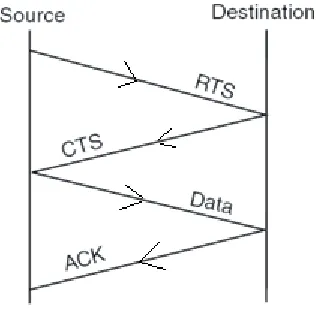
packet length. As the receiver node gets RTS, the Clear-to-Send (CTS) message is delivered as the positive response. After receiving this CTS message, the transmitting node performs the packet communication and as this packet is received by the destination node, ACK message is generated to ensure the successful communication. This handshaking mechanism is shown in figure 1.
Figure 1 : Four Way Handshaking (DCF)
Another associated communication mechanism is CSMA/CA that actually ensure the communication reliability. The working of this mechanism is based on "Listen Before Talk" scheme and shown in figure 2. According to this scheme, before performing the packet communication the channel sensing is performed to identify the idle channel stage so that specified DCF interframe space duration will be analyzed. If the medium is identified as "Busy", then the node has to wait to become the medium idle for the interframe space period. In such case, some random "Backoff Counter" is considered to identify the actual time count for which the node has to wait until the transmission is not initiated. During is interval, the medium stay idle and the nodes decreases the "backoff counter". The process is repeated till the counter not reaches to zero and as it reaches zero, the medium is identified as "ready" for packet transmission. Backoff timer is randomly uniformly choosen interval (0,CW-1).
Figure 2 : CSMA/CA Mechanism
Now during the communication, as the collision is identified, the CW size is doubled and this process is repeated till the CW size not reaches to CWMax. As the successful communication is performed, the CW size resets to initial value called CWMin. The communicating packet is discarded if after specific number of retries, no successful transmission is obtained.
function called EDCF (Enhanced Distribution Coordination Function. The improvement is here made in terms of prioritization on traffic categories(TC). This contention window is here defined by CWNew(TC)>=CWOld(TC)*2.
In this paper, We present the comparative analysis of different contention window optimization algorithm is defined. In this section, the basic handshaking communication mechanism is defined along with the exploration of CSMA/CA mechanism. In section II, the exploration to Contention window specification is defined under different scenarios. In section III, the description of few optimization methods along with comparative analysis is defined. In section IV, the conclusion obtained from the work is discussed.
II. CONTENTIONWINDOW
Physical protocol 802.11 along with DCF provides the Contention window based communication in wireless network. To perform this communication, the medium analysis is performed under the idle time analysis and busy channel analysis. This idle time analysis is performed using Backoff timer that counts the slot time to estimate the overall slot. According to the channel communication and capability random backoff timer is estimated. This backoff timer depends on slot time analysis. The equation of random backoff timer is given here under
BackoffTimer=Random()*SlotTime
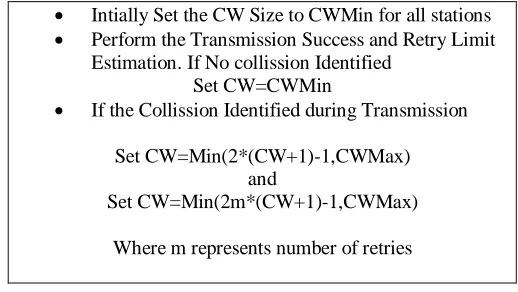
Here the random() function generates a random value from uniform distribution lies between 0 and CW. Here the CW is given by 2m-1 and CW lies between CWMin and CWMax. The Size adjustment of CW is given in steps shown in table 1
Table 1 : CW Size adjustment
Intially Set the CW Size to CWMin for all stations
Perform the Transmission Success and Retry Limit Estimation. If No collission Identified
Set CW=CWMin
If the Collission Identified during Transmission
Set CW=Min(2*(CW+1)-1,CWMax) and
Set CW=Min(2m*(CW+1)-1,CWMax)
Where m represents number of retries
Lot of work is already proposed by different researchers on the algorithmic approaches and schemes based on CW estimation and BEB algorithm. These algorithms includes online as well as offline algorithm that identify the relationship between the CW and the stations. The number of stations over the communication channel increases the probability of collision that itself reflect the size of contention window. Therefore, the requirement is there for the CW optimization so that the effective throughput will be obtained after monitoring the surrounding activities of CW specification. According to these specifications the CW adjustment is been performed. The analysis is here defined under the specification of throughput under changes in number of stations. Author[9] presented the effective analysis for the estimation of throughput and performance under the saturation analysis and by assuming the node limit in ideal channel condition. Author identified the optimal CW size identification under multiple vector analysis. Author focused the work on parameters that affects the size of contention window.
A work on CW resetting to improve the network performance and improvement to DEF algorithm was proposed by author[3]. Author defined a markov chain based probabilistic model to analyze the throughput under communication analysis. Author defined the linear increase and decrease in the algorithm so that the collision nodes will be identified effectively and the safe communication will be performed over the channel. Author defined a CW specification and estimation approach with the specification of active nodes in CW. Author defined the access method using RTS and CTS. The channel observation is defined by the author for parametric analysis so that the network computation will be obtained effectively.
III. COMPARISION BETWEEN DIFFERENT BACKOFF ALGORITHMS
The contention window specification and backoff algorithms are responsible for the performance for WLAN systems. This algorithm provides the protocol stack based specification so that the energy efficiency over the network will be improved. This algorithm improves the system under the access and flow control. There are number of available algorithms that provide the gain access to the medium and reduce the probability of collision. This backoff algorithm suffers from some limitation under the operation specification, contention window specification, failure identification etc. The window size increases the possibility of gain access over the channel. In this section, the comparative analysis of three main backoff algorithms is defined. These algorithms are Exponential Algorithm, Log-off Algorithm and Fibonacci Backoff Algorithm.
A) Fibonacci Backoff Algorithm
The concept of Fibonacci backoff algorithm is based on the specification of mathematical Fibonacci series. The Fibonacci rule is defined as
F(n)=F(n-1) + F(n-2)
Where n>=2
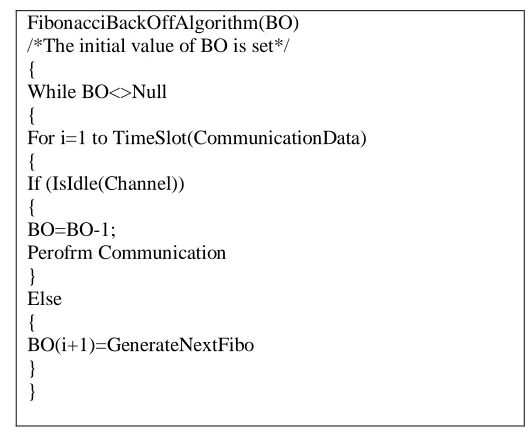
This specification of Fibonacci series is defined under the characteristic optimization. Based on the specific property analysis, the Fibonacci series is generated and from this series the successive term ratio analysis is obtained. The work is defined for certain number of terms along with convergence ration analysis with limit specification. The algorithm is defined for this contention window size specification along with large window estimation. The algorithmic approach defined by Fibonacci series algorithm is shown in table 2.
Table 2 : Fibonacci Series Specification
FibonacciBackOffAlgorithm(BO) /*The initial value of BO is set*/ {
While BO<>Null {
For i=1 to TimeSlot(CommunicationData) {
If (IsIdle(Channel)) {
BO=BO-1;
Perofrm Communication }
Else {
BO(i+1)=GenerateNextFibo }
}
contention window size based on the window size specification to the network. It gives the effective communication with limited resource utilization. This backoff algorithm is based on the concept of Fibonacci series called golden section. Based on the Fibonacci number, the contention window size is set and the small increment on the window size is performed. The estimation of the contention window size with each iteration is shown in figure 3
Figure 3 : Contention Window Estimation
Here figure 3 shows with each iteration the size of contention window is increased. But as the size reaches to the CWMax, no more increase in size is performed.
B) Logarithmic Backoff Algorithm
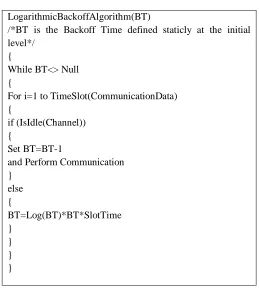
This algorithmic approach reduces the effect of random value in the distribution. The associated formula to the system is based on the previous window specific value and the slot time. The backoff algorithm is given here under
Table 3 : Logarithmic Contention Window Analysis
LogarithmicBackoffAlgorithm(BT)
/*BT is the Backoff Time defined staticly at the initial level*/
{
While BT<> Null {
For i=1 to TimeSlot(CommunicationData) {
if (IsIdle(Channel)) {
Set BT=BT-1
and Perform Communication }
else {
BT=Log(BT)*BT*SlotTime }
} } }
0 100 200 300
i=0i=1i=2i=3i=4i=5i=6i=7
C
WM
ax
Iterations
fibb
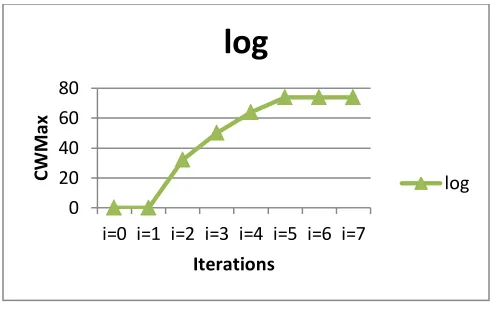
Figure 4: Contention Window Estimation
Here figure 4 is showing the contention window size estimation in case of logarithmic backoff algorithm. The figure shows the increase of size with each iteration. The size increase is here performed up to a limit after that the size will get constant.
IV CONCLUSION
In this paper, a comparative analysis on different backoff algorithms is provided in this paper. The analysis is here done under different contention window vectors such as size, frequency, bandwidth analysis etc. The paper has provided an effective selection of backoff algorithm so that network reliability will be improved and the delay rate will be reduced.
REFERENCES
[1] IEEE Std 802.11-1999, Part 11: Wireless LAN Medium Access Control (MAC) and Physical Layer (PHY)
Specifications, Std., Aug. 1999.
[2] IEEE Std 802.11b-1999, Part 11: Wireless LAN Medium Access Control (MAC) and Physical Layer (PHY) Specifications: High-speed Physical Layer Extension in the 2.4 GHz Band, Std., Sept. 1999.
[3] IEEE Std 802.11a-1999, Part 11: Wireless LAN Medium Access Control (MAC) and Physical Layer (PHY) Specifications: High-speed Physical Layer in the 5 GHz Band, Std., Sept. 1999.
[4] IEEE Std 802.11g-2003, Part 11: Wireless LAN Medium Access Control (MAC) and Physical Layer (PHY) Specifications: Further Higher Data Rate Extension in the 2.4 GHz Band, Std., June 2003.
[5] V. Barghavan, A. Demers, S. Shenker, and L. Zhang, “MACAW: a Media Access Protocol for Wireless LANs,” in Proc. SIGCOMM’94, Aug. 1994.
[6] N. O. Song, B. J. Kwak, J. Song, and L. E. Miller, “Enhancement of IEEE 802.11 Distributed Coordination Function with Exponential Increase Exponential Decrease Backoff Algorithm,” in Proc. VTC- Spring’03, New Orleans, Apr. 2003, pp. 2775–2778.
[7] P. K. V. J. Deng and Z. J. Haas, “A New Backoff Algorithm for the IEEE 802.11 Distributed Coordination Function,” in Proc. CNDS’04, San Diego, CA, USA, Jan. 2004.
[8] Q. Pang, S. C. Liew, J. Y. B. Lee, and V. C. M. Leung, “Performance Evaluation of An Adaptive Backoff Scheme for WLAN,” WCMC,vol. 4(8), pp. 867–879, Dec. 2004.
[9] I. Aad, Q. Ni, C. Barakat, and T. Turletti, “Enhancing IEEE 802.11 MAC in congested environments,” in Proc. ASWN’04, Boston, MA, Aug. 2004.
[10] F. Cali’, M. Conti, and E. Gregori, “Dynamic Tuning of the IEEE 802.11 Protocol,” IEEE/ACM Trans. Networking, vol. 8(6), pp. 785–799, Dec. 2000.
[11] D. Qiao and K. G. Shin, “UVMA: a simple enhancement to the IEEE 802.11 DCF,” in Proc. HICSS-36’03, Hawaii, Jan. 2003.
0 20 40 60 80
i=0 i=1 i=2 i=3 i=4 i=5 i=6 i=7
C
W
M
ax
Iterations
log
[12] G. Bianchi and I. Tinnirello, “Kalman Filter Estimation of the Number of Competing Terminals in an IEEE 802.11 Network,” in Proc. INFOCOM’03, San Francisco, California, USA, Apr. 2003.
[13] Y. Kwon, Y. Fang, and H. Latchman, “A Novel MAC Protocol with Fast Collision Resolution for Wireless LANs,” in Proc. INFOCOM’03,San Francisco, California, USA, Apr. 2003.
[14] M. Heusse, F. Rousseau, R. Guillier, and A. Duda, “Idle Sense: An Optimal Access Method for High Throughput and Fairness in Rate Diverse Wireless LANs,” in Proc. SIGCOMM’05, Philadelphia, Pennsylvania, USA, Aug. 2005.