International Journal of Computer Science and Mobile Computing
A Monthly Journal of Computer Science and Information Technology
ISSN 2320–088X
IMPACT FACTOR: 6.017
IJCSMC, Vol. 7, Issue. 4, April 2018, pg.153 – 165
Credit Analysis Tool System Application
Using Cobit 4.1 Method Approach
1
Mohammad Dirsza Safiro Asyari,
2Yaya Sudarya Triana
1,2
Faculty of Computer Science, Universitas Mercu uana, Indonesia
1
[email protected], 2 [email protected]
Abstract— The application of credit analysis is required by the Bank to achieve the objectives appropriately, successful in implementing in a timely manner. The application being audited has the objective of testing whether the control is in accordance with the procedure or not. Use of COBIT 4.1 as an appropriate guide to audit SABAK applications. Researchers use COBIT 4.1 to get the final audit results so that companies can find out the mistakes that occur in the application. In addition, the company can evaluate and improve the system that runs on a proposed system of researchers. Overall, SABAK gained level 4.1.
Keywords— Audit, COBIT 4.1, Credit Analys, Bank, Maturity Level
I. INTRODUCTION
The development of technology can grow rapidly due to the progress of culture and civilization levels in
humans, because the more advanced culture than the technology will continue to grow[1]. The development of
information technology especially in Indonesia is increasing rapidly with the modernization in the technology-based software to business activities run in each company as a medium of information, the information system that can help bring the message in real time to smooth business in each company. The role of the Information System is significant that of course must be balanced with the proper arrangements and management so possible losses may be avoided [2].
Based on the XYZ Annual Report in 2016, there are 4 types of operational performance of the operating segment. One of them is Medium Distribution by Sector. Many of the middle segments in question include, Industry, Trade, Agriculture, Business Services, Construction, Mining, and others listed in the report. By 2015, the total loan from all middle segments is 51,147 Milliar Rupiah. During the following year, the total loan from all segments was 61,330 billion rupiah. Loan growth in 2015 to 2016 was 19.99%[4].
The banks recognize the need for a system that can assist in the process of analyzing the financial aspects and risk profile of the prospective borrower, so that the analysis process can be done more quickly, accurately and consistently. Credit Analysis Tools System (SABAK) into a system that will be implemented in XYZ to answer this.
One way of controlling the information system is to audit the information system. Information system audit is conducted to find out how far the implementation of the system in accordance with the objectives and avoid fraud, so as to create good governance. To perform the information system audit process, the method used is the COBIT framework 4.1. The election of COBIT in this study is because it provides internationally accepted standards for technological management practices and references [5].
Inadequate management of the Credit Analysis System will impact on the low quality of service, the level of customer satisfaction, so that it can affect the stakeholders' trust in the institution. Thus, it is necessary to evaluate this SABAK application in order to provide the role of good information technology.
II. METHOD
Management of Academic Information System that is not well managed will affect the low quality of service, low level of customer satisfaction, so that it can affect the level of trust stakeholders of the institution[6]. The method used to find the best solution is COBIT 4.1 (Control Objectives for Information and Related Technology). COBIT is a set of documentation and guidance that leads to IT Governance and management that can help auditors, management, and users to bridge the divide between business risk, control needs, and technical problems that occur [7].
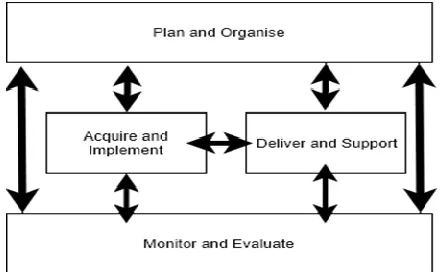
The COBIT framework is a collection of best practices and is generic, is used as a reference in determining the control objectives and IT processes required in IT management. The COBIT framework identifies 34 IT processes grouped into 4 main domains: Plan and Organize (PO), Acquire and Implement (AI), Deliver and Support (DS), and Monitor and Evaluate (ME) domains. Each domain has different characteristics [8].Furthermore, management will benefit in IT investing decisions along with infrastructure, strategic IT plan planning, choosing an information architecture and system procurement[9].
COBIT is divided into 4 main domains:
1) Plan and Organize (PO) - This domain covers strategy and tactics, and concerns the identification of the way IT can best contribute to the achievement of the business objectives. The realization of the strategic vision needs to be planned, communicated and managed for different perspectives. A proper organization as well as technological infrastructure should be put in place.
2) Acquire and Implement (AI) - To realize the IT strategy, IT solutions need to be identified, developed or acquired, as well as implemented and integrated into the business process. In addition, changes in and maintenance of existing systems are covered by this domain to make sure the solutions continue to meet business objectives.
3) Deliver and Support (DS) - This domain is concerned with the actual delivery of required services, which includes service delivery, management of security and continuity, service support for users, and management of data and operational facilities.
Fig 1 Main Domain of Cobit 4.1
The framework used in this study is based on the COBIT 4.1 framework
Fig. 2 COBIT Framework 4.1 [10]
The following Framework Descriptions will be applied to this research:
1) Business Goals Identification - This stage will be done Credit Risk analysis that exists in SABAK for a description of where the direction of this application will be addressed. Then the business goals are adjusted according to the views of the existing domain in COBIT 4.1
3) IT Process Identification - At this stage will be identified process, information technology that has been predetermined. At this stage the process of information technology will be obtained from the linkage between the information technology process that runs in the process of information technology based on COBIT 4.1 framework.
4) Control Objectives - Control Objectives are part of the details of the information technology process, where not all objective controls will be used in the information technology process.
5) Maturity Level - In the fifth stage of this study is the maturity level calculation, in accordance with the maturity model based on the COBIT framework 4.1.
Measurement of maturity level is set at COBIT for management level and enables managers to know how IT management and processes are in the organization so that it can be known at what level of management. The maturity model of COBIT is a tool used to measure how well IT management processes relate to internal IT controls that are also related to the organization's business objectives [9]. In general, the maturity level assessment range is described as follows:
1) Level 0 (non-existent) - The company has no management in a process, not even being able to assess what issues to consider. On this scale, it is important to evaluate the controls and serve as important findings.
2. Level 1 (initial level) The company has been aware of issues to consider. The company does not have standardized processes, but an informal process that tends to be applied individually on a case by case basis and in general (still reactive or in line with unannounced needs), the approach has not been well organized. On this scale, the probability of risk occurrence is not as large as 0 (zero) scale.
3. Level 2 (repeatable level) - The company already has a pattern for managing processes based on repeated experience that has been done before. However, the pattern has not been standardized and communicated, and there has been no formal training to every employee regarding the procedure so that the expertise of the expert staff is limited, in addition to the responsibility given entirely to the individual so that the possibility of irregularities may occur.
4. Level 3 (Defined level) - Management has succeeded in creating standard of management of related processes, and has been communicated, although not yet implemented in an integrated, but has been required in its implementation. The procedure is still simple and inadequate, has not got the evaluation process, so there is still the possibility of deviation.
5. Level 4 (Managed level) - The process has been closely monitored and evaluated as to the extent of compliance with the established procedures, and is able to take the necessary action if the existing process does not work properly. Various automated tools and systems are being used even if they are limited.
6. Level 5 (Optimized level) - The process has reached the level of Best Practices (best guidelines) due to continuous improvement and comparison with other companies. Information technology is used in running the workflow. Provide tools supporting the effectiveness and quality of processes that encourage corporate adaptation to the changes.
The Decision Support System (DSS) is interactive, computer-based systems and subsystems intended to help decision makers in using communication technologies, data, documents, knowledge and/or models to complete decision process tasks, explain in[11].
III. Result
Fig. 3 Credit Risk Management Ambit Optimist
A. Business Goals Identification
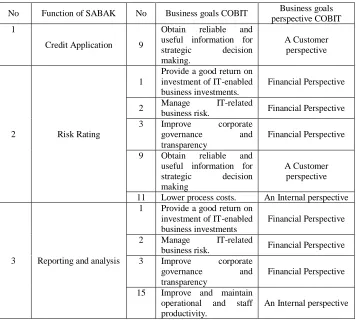
At this stage will be mapping between Business Goals SABAK with table from COBIT 4.1 to identify. Of the three concentrations of application functions, the following identification results obtained Business Goals:
Table I
Linking Business goals SABAK to COBIT 4.1 Business Goals
No Function of SABAK No Business goalsCOBIT Business goals perspective COBIT 1
Credit Application 9
Obtain reliable and useful information for strategic decision making.
A Customer perspective
2 Risk Rating
1
Provide a good return on investment of IT-enabled business investments.
Financial Perspective
2 Manage IT-related
business risk. Financial Perspective 3 Improve corporate
governance and transparency
Financial Perspective
9 Obtain reliable and useful information for strategic decision making
A Customer perspective
11 Lower process costs. An Internal perspective
3 Reporting and analysis
1 Provide a good return on investment of IT-enabled business investments
Financial Perspective
2 Manage IT-related
business risk. Financial Perspective 3 Improve corporate
governance and transparency
Financial Perspective
15 Improve and maintain operational and staff productivity.
An Internal perspective
B. IT Goals Identification
Table II
Identification of Business Goals of IT Goals
C. IT Process Identification
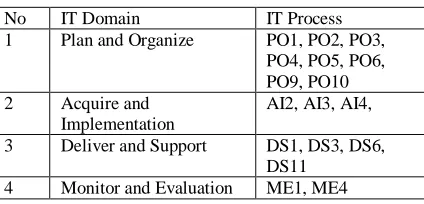
The next stage, establishing IT Process that is in line with COBIT. The following explanation of the IT Process has been identified and the selection of what domain will be used:
Table III. IT Process Identification
No IT Domain IT Process
1 Plan and Organize PO1, PO2, PO3, PO4, PO5, PO6, PO9, PO10 2 Acquire and
Implementation
AI2, AI3, AI4,
3 Deliver and Support DS1, DS3, DS6, DS11
4 Monitor and Evaluation ME1, ME4
D. Control Objectives
After the IT Process is identified, the scope of auditing SABAK applications uses the processes used in the auditing:
1) PO1 Defined a Strategic Plan
IT strategic planning is required to manage and direct all IT resources in line with the business strategy and priorities. For that then do the questions related to the cobit itself, as follows:
No IT Goals
2 Respond to governance requirement in line with board direction 4 Optimize the use of information
7 Acquire and maintain an integrated, standardized application systems
8 Acquire and maintain an integrated, standardized IT infrastructure
11 Ensure seamless integration of application in business process
12 Ensure transparency and understanding of IT cost, benefits, strategy, policies and service levels
13 Ensure proper use and performance of the application and technology solutions
14 Account for and protect all IT assets
15 Optimize the IT infrastructure, resources, and capabilities 17 Protect the achievement of IT objectives
18 Establish clarity of business impact of risk to IT service disruption or change 19 Ensure that critical and confidential information is withheld from those who
should not have access to it
20 Ensure the automated business transaction and information exchange can be trusted
21 Ensure that IT services and infrastructure can properly resist and recover from failures due to error, deliberate attack or disaster
22 Ensure minimum business impact in the event of an IT service disruption or change
PO1.1 IT Value Management
PO1.2 Business-IT Alignment
PO1.3 Assessment of Current Capability and Performance
PO1.4 IT Strategic Plan
PO1.5 IT Tactical Plans
PO1.6 IT Portfolio Management
2) PO2 Define the Information Architecture
This process improves the quality of management decision-making by ensuring that reliable and secure information is provided, and this allows the rationalization of information systems resources to adapt business strategy appropriately.
PO2.1 Enterprise Information Architecture Model
PO2.2 Enterprise Data Dictionary and Data Syntax Rules
PO2.3 Data Classification Scheme
PO2.4 Integrity Management
3) PO3 Determine Technological Direction
This process examines how technology is planned and what or how it is planned and also looks at what technology standards are.
PO3.1 Technological Direction Planning
PO3.2 Technology Infrastructure Plan
PO3.3 Monitor Future Trends and Regulations
PO3.4 Technology Standards
PO3.5 IT Architecture Board
4) PO4 Define the IT Processes, Organization andRelationships
An IT organization is defined by considering requirements for staff, skills, functions, accountability, authority, roles and responsibilities, and supervision. This organization is embedded into an IT process framework that ensures transparency and control as well as the involvement of senior executives and business management
PO4.1 IT Process Framework
PO4.2 IT Strategy Committee
PO4.3 IT Steering Committee
PO4.4 Organisational Placement of the IT Function
PO4.5 IT Organisational Structure
PO4.6 Establishment of Roles and Responsibilities
5) PO5 Management the IT Investment
PO5.1 Financial Management Framework
PO5.2 Prioritization Within IT Budget
PO5.3 IT Budgeting
PO5.4 Cost Management
PO5.5 Benefit Management
6) PO6 Communicate Management Aims and Direction
This process looks at how companies communicate between company policies and rules
PO6.1 IT Policy and Control Environment
PO6.2 Enterprise IT Risk and Control Framework
PO6.3 IT Policies Management
PO6.4 Policy, Standard and Procedures Rollout
PO6.5 Communication of IT Objectives and Direction
7) PO9 Assess and Manage IT Risks
The framework documents a common and agreed-upon level of IT risks, mitigation strategies and residual risks.
PO9.1 IT Risk Management Framework
PO9.2 Establishment of Risk Context
PO9.3 Event Identification
PO9.4 Risk Assessment
PO9.5 Risk Response
PO9.6 Maintenance and Monitoring of a Risk Action Plan
8) PO10 Manage Projects
This process is undertaken a defined project and program management approach applied to IT projects and facilitates stakeholder participation overseeing project risks and project progress
PO10.1 Program Management Framework
PO10.2 Project Management Framework
PO10.3 Project Management Approach
PO10.4 Stakeholder Commitment
PO10.5 Project Scope Statement
9) AI2 Acquire and Maintain Application Software
Applications are made available in line with business requirements. This process covers the design of the applications, the proper inclusion of application controls and security requirements, and the development and configuration in line with standards. This allows organizations to properly support business operations with the correct automated applications.
AI2.1 High-level Design
AI2.3 Application Control and Auditability
AI2.4 Application Security and Availability
AI2.7 Development of Application Software
10) AI3 Acquire and Maintain Technology Infrastructure
Provides the right platform for business applications in accordance with the IT architecture and defined technology standards
AI3.1 Technological Infrastructure Acquisition Plan
AI3.2 Infrastructure Resource Protection and Availability
AI3.3 Infrastructure Maintenance
AI3.4 Feasibility Test Environment
11) AI4 Enable Operation and Use
Knowledge of the new system is available. This process requires the production of documentation and manuals for users and IT, and provides training to ensure the proper use and operation of applications and infrastructure
AI4.1 Planning for Operational Solutions
AI4.2 Knowledge Transfer of Business Management
AI4.3 Knowledge Transfer to End Users
AI4.4 Knowledge Transfer to Operations and Support Staff
12) DS1 Define and Manage Service Levels
Effective communication between IT management and business customers regarding services required is enabled by a documented definition of and agreement on IT services and service levels. This process also includes monitoring and timely reporting to stakeholders on the accomplishment of service levels. This process enables alignment between IT services and the related business requirements.
DS1.1 Service Level Management Framework
DS1.2 Definition of Services
DS1.3 Service Level Agreements
DS1.4 Operating Level Agreements
DS1.5 Monitoring and Reporting of Service Level Achievements
13) DS3 Manage Performance and Capacity
The need to manage performance and capacity of IT resources requires a process to periodically review current performance and capacity of IT resources. This process includes forecasting future needs based on workload, storage and contingency requirements. This process provides assurance that information resources supporting business requirements are continually available.
14) DS6 Identify and Allocate Costs
The need for a fair and equitable system of allocating IT costs to the business requires accurate measurement of IT costs and agreed with business users on fair allocation. This process includes building and operating a system to capture, allocate and report IT costs to the users of services. A fair system of allocation enables the business to make more informed decisions regarding the use of IT services.
DS6.1 Definition of Services
DS6.2 IT Accounting
DS6.3 Cost Modelling and Charging
DS6.4 Cost Model Maintenance
15) DS11 Manage Data
Effective data management requires identifying data requirements. The data management process also includes the establishment of effective procedures to manage the media library, backup and recovery of data, and proper disposal of the media. Effective data management helps ensure the quality, timeliness and availability of business data.
DS11.1 Business Requirements for Data Management
DS11.2 Storage and Retention Arrangements
DS11.3 Media Library Management System
16) ME1 Monitor and Evaluate IT Performance
Effective IT performance management requires a monitoring process. This process includes defining relevant performance indicators, systematic and timely reporting of performance, and prompt acting upon deviations. Monitoring is needed to make sure that the right things are done and are in line with the set directions and policies
ME1.1 Monitoring Approach
ME1.2 Definition and Collection of Monitoring Data
ME1.3 Monitoring Method
ME1.4 Performance Assessment
17) ME4 Provide IT Governance
Establishing an effective governance framework includes defining organizational structures, processes, leadership, roles and responsibilities to ensure that enterprise IT investments are aligned and delivered in accordance with enterprise strategies and objectives.
ME4.1Establishment of the IT Governance Framework
ME4.4 Resource Management
ME4.5 Risk Management
ME4.6 Performance Measurement
E. Maturity Level
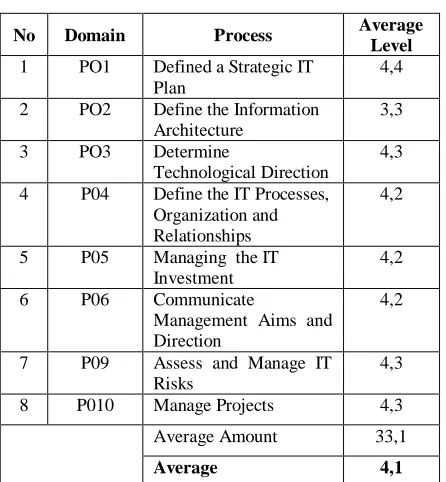
Table IV. Maturity Level of Domain Plan and Organize
No Domain Process Average
Level
1 PO1 Defined a Strategic IT Plan
4,4
2 PO2 Define the Information Architecture
3,3
3 PO3 Determine
Technological Direction
4,3
4 P04 Define the IT Processes, Organization and Relationships
4,2
5 P05 Managing the IT Investment
4,2
6 P06 Communicate
Management Aims and Direction
4,2
7 P09 Assess and Manage IT Risks
4,3
8 P010 Manage Projects 4,3
Average Amount 33,1
Average 4,1
In Table IV, it can be concluded that the average in the Plan and Organize domains is at level 4 (defined) which already has the best strategy, tactics, and identification contribution for the company
Table V Maturity Level of Acquire and Implement
No Domain Process Average
Level
1 AI2 Acquire and Maintain Application Software
4,1
2 AI3 Acquire and Maintain Technology
Infrastructure
4,2
3 AI4 Enable Operation and Use
4,2
Average Amount 12,4
Average 4,1
In Table V, it can be concluded that the average of Acquire and Implement domains is at level 4 (defined). That implementation is good enough.
Table VI. Maturity Level of Deliver and Support
No Domain Process Average
Level
1 DS1
Define and Manage Service Levels
4,2
2 DS3
Manage Performance and Capacity
4,1
3 DS6 Identify and
Allocate Costs 4,2
4 DS11 Manage Data 4,1
Average Amount 16,5
In Table VI, Deliver and Support obtains level 4. On the delivery or delivery aspects of IT is quite good.
Table VII. Maturity Level of Monitor and Evaluate
No Domain Process Average
Level
1 ME1 Monitor and Evaluate IT Performance
4,1
2 ME4 Provide IT Governance
4,0
Average Amount 8,1
Average 4,0
In Table VII, it can be concluded that the average in the Monitor and Evaluate domain is at level 4. In this domain will be emphasized to the importance of all information technology, processes need to be accessed periodically to maintain quality and conformity with predefined standards
Table VIII Overall Maturity Level 4 Domains
No Domain Average
Level
1 Plan and Organize 4,1
2 Acquire and Implement 4,1
3 Deliver and Support 4,1
4 Monitor and Evaluate 4,0
Average End Result 4,1
In Table VIII is the last result of the whole domain and it is concluded in this study that the end result is level 4.
IV. CONCLUSION
In the Plan and Organize, Acquire and Implement, and Deliver and support domains have the same value of 4.1. Monitor and Evaluate got a score of 4. From this research, it is concluded that SABAK is at level 4 (Managed). The process has been closely monitored and evaluated as to the extent of compliance with established procedures, and is able to take the necessary action if the existing process does not work properly. Various automated tools and systems are being used even if they are limited. SABAK is optimal to get level 4. But there is a weak domain among other domains. Namely PO2 Define the Information Architecture. An evaluation of the domain is required.
REFERENCES
[1] Sudarya, Yaya and Syahputri, Indah.,2018, Implementation Floyd-Warshall Algorithm for the Shortest Path of Garage,Issue 2, Vol.3
[2] Ranggadara, Indra and Prastiawan, Hendra, 2018, Strategy Implementing Continual Service Improvement with ITIL Framework at PT.Anabatic Technologies Tbk, Issue 2, Vol.5
[3] Amnah, 2014, Analisa Proses Audit Sistem Informasi Biro Manajemen Asset Dan Logistik Menggunakan Framework Cobit 4.1 Pada Institut Informatika Dan Bisnis Darmajaya Bandar Lampung
[4] XYZ ,2016, Laporan Tahunan XYZ 2016, Hal.15
[5] Momongan, Theodies Holy dan Wijaya, Agustinus Fritz, 2014,Audit Sistem Informasi Produksi Perusahaan Manufaktur Menggunakan COBIT 4.1
[7] Wella, Johan Setiawan, 2015, Audit Sistem Informasi Menggunakan Cobit 4.1 pada PT. Erajaya Swasembeda, Tbk.
[8] Satyareni, Diema Hernyka, Maharani, Fia, 2014, Audit Sistem Informasi Akademik Perguruan Tinggi PT.XYZ Menggunakan Kerangka Kerja Cobit 4.1
[9] I Putu Ade Ambara Putra , I Made Sukarsa , I Putu Agung Bayupati,Audit Ti Kinerja Manajemen Pt. X Dengan Frame Work Cobit 4.1, Lontar Komputer Vol.6 No.1 April 2015
[10] Zulkarnaen, Damar Rivaldi , Wahyudi, Rizki, and Wijanarko, Andik, 2017, Audit Sistem Informasi Pada Rumah Sakit Umum Daerah Banyumas Menggunakan Framework COBIT 4.1, Jurnal Pro Bisnis, Vol 10, No. 2.