Obliv-C: A Language for Extensible Data-Oblivious Computation
Samee Zahur
[email protected]
University of Virginia
David Evans
[email protected]
University of Virginia
Abstract
Many techniques for secure or private execution de-pend on executing programs in a data-oblivious way, where the same instructions execute independent of the private inputs which are kept in encrypted form throughout the computation. Designers of such com-putations today must either put substantial effort into constructing a circuit representation of their algorithm, or use a high-level language and lose the opportunity to make important optimizations or experiment with protocol variations. We show how extensibility can be improved by judiciously exposing the nature of data-oblivious computation. We introduce a new language that allows application developers to program secure computations without being experts in cryptography, while enabling programmers to create abstractions such as oblivious RAM and width-limited integers, or even new protocols without needing to modify the compiler. This paper explains the key language features that safely enable such extensibility and describes the simple implementation approach we use to ensure security properties are preserved.
1. Introduction
A protocol for secure computation allows two or more parties to collaboratively perform some computa-tion without revealing their own inputs. There are many generic protocols for secure computation, which can perform arbitrary computation on encrypted data [8, 18, 24, 34]. The way these generic protocols work is that the entire computation is first converted into adata-obliviousrepresentation, where the control flow of the program does not depend on the secret program inputs in any way. Such a program can be executed on encrypted data without leaking any information about intermediate results, since the control flow is the same for all executions and does not depend on the data.
A common data-oblivious program representation is a Boolean logic circuit: every logic gate (e.g., AND, OR) is specified before the secret inputs are even known. Another popular representation uses addition or multiplication gates that operate directly on finite field elements (instead of just Boolean values). Given a circuit that describes the desired computation, the protocol specifies how to execute the circuit without revealing any inputs or intermediate results.
While many previous languages and frameworks for secure computation have been developed (see Section 7), none are sufficiently expressive to allow programmers to implement even simple library ab-stractions. The reason is that these languages have been designed to provide traditional programming ab-stractions that hide the data-oblivious nature of se-cure computation from the programmer. Our approach provides high-level programming abstractions while exposing the essential data-oblivious nature of such computations.
Motivating Example.Consider this simple C example of a dynamically resized array:
DynVec∗vec = dynVecNew(); for(i = 0; i < n; i++) {
if(cond) {
dynVecAppend(vec,x); }
...
Implementing a library like this for standard compu-tation is trivial. TheDynVecobject just needs to keep track of the current size of the vector, and resize an internal buffer when more space is needed to complete an operation.
using a conditional write that depends on the value of
condspecified outside of the function.
This problem is exacerbated for more complex li-brary abstractions. For example, an ORAM structure that allows random access to a memory bank without revealing anything about the access pattern. On every read or write operation it needs to do things like network transfers, pseudo-random shuffling, and cryp-tographic operations. Defining a simple oramWrite()
function is problematic if we want to allow it to be called from inside a conditional block: the function needs to specify a whole series of operations, some of which need to be done conditionally while others are done unconditionally. Indeed, it is not clear how a traditional programming language could even be adapted to express the situations that commonly arise in data-oblivious computation.
Contributions. We show how a language can be designed to support extensible secure programming introducing control structures that expose the data-oblivious nature of secure computation. To make it easier for programmers to develop and reason about data-oblivious programs, we provide a type system that incorporates oblivious data.
Our Obliv-C language is a strict extension of C that supports all C features (includingstruct,typedef, pointers, recursive calls, and indirect function calls), along with new data types and control structures to support data-oblivious programs. Section 2 introduces our language and describes how its language constructs and type system support data-oblivious computation.
We describe the architecture of our Obliv-C com-piler in Section 6, showing that our language can be implemented on top of a traditional language and in a way that provides high confidence that security properties of the underlying protocol are preserved.
Obliv-C is designed to enable practitioners to more easily develop scalable secure protocols, and to allow researchers to easily implement and test new features or techniques by simply writing a new libraries rather than having to modify or build a new compiler. To demonstrate how our approach supports exploration at many levels, Section 4 shows how Obliv-C could be used to easily implement various library-based features including range-tracked integers, ORAM, and multi-threading that could not be done with existing languages, and Section 5 shows how Obliv-C supports experimentation with protocols.
2. Obliv-C
Obliv-C is a strict extension of C that provides data-oblivious programming constructs. Next, we provide
an overview of the design and philosophy behind the language. Section 2.2 presents a concrete example of an Obliv-C program. We provide details on the type system in Section 3. Our implementation compiles an Oliv-C program into standard C, as described in Section 6.
2.1. Overview
Obliv-C is designed to guarantee that all security properties provided by the underlying protocol are maintained, while exposing aspects of data-oblivious computation to the programmer. Our design emphases safety, guaranteeing that no information can be leaked by program executions (assuming the underlying pro-tocol is secure) while giving programmers enough control (including the ability to circumvent type rules) to do things that would not be possible with other high-level languages.
The main construct we introduce is an oblivious con-ditional. For example, consider the following statement wherexandyare secret data:
obliv if(x > y) x = y;
Since the truth value of thex > ycondition will not be known even at runtime, this code cannot be executed normally. Instead, every assignment inside the if state-ment will have to use “multiplexer” circuits in much the same way Boolean logic circuits use multiplexers to choose between two different values. We could translate this code into something like:
cond = (x > y);// 0 or 1 x = x + cond∗(y−x);
This removes any explicit control flow dependency on unknown values by using conditional assignments.
Obliv-C extends C in the following ways:
• Every basic data type (e.g., int, char, etc.) has anobliv-qualified counterpart (e.g.,obliv int, obliv char, etc.) which is represented using an encrypted value.
• Every if statement with a condition that depends on obliv-qualified data is explicitly indicated as obliv if. An obliv if statement executes in a way that prevents control dependencies from leaking the condition value.
These segments escape the type system, but do not risk any information leak, just the possibility that a program does not mean what the programmer intended.
Next, we walk through a simple example illustrating the general structure of Obliv-C programs and how the programmer uses it.
2.2. Millionaires’ Problem
Figure 1 shows an Obliv-C implementation of Yao’s classic millionaires’ problem [34]. It simply outputs which of two integers is greater (purportedly, to enable two millionaires to decide who should pay for dinner without disclosing their actual wealth).
When the program executes, both parties (in this protocol, although our design can support any number of parties) execute the same program. By convention, we will call them Alice (Party 1) and Bob (Party 2). Thea,b, andresvariables are declared using theobliv keyword to indicate that their values may depend on secret inputs.
The program obtains secret inputs using:
obliv intfeedOblivInt (intvalue,intp)
This function is executed synchronously by both par-ties to introduce the input into obliv int variables of the shared computation. It converts avaluefrom one of the parties (partyp) into a new cryptographicobliv int value that can no longer be deciphered by either party on its own. The value provided by the other party is simply ignored. Since both parties have their own copy of each variable each party can use themyinput field to hold their own inputs. Thus, in Figure 1, the first invocation of feedOblivInt() only reads Party 1’s copy ofmyinputinto the shared variablea, while the second one reads only from Party 2. These variables can still be manipulated using ordinary C operators, and even mixed with ordinaryints in expressions, but the results are allobliv-qualified and only accessible as encrypted values.
The only way any values derived from secret data can be converted back to a semantic value is by using arevealfunction, such as:
voidrevealOblivInt(int∗dest,obliv intsrc,intp)
When this function is invoked by both parties on the same variable src, the value is decrypted and stored into the integer pointed to bydest. Ifp == 0, all parties receive the result; otherwise pspecifies a single party who receives it. This ensures that only the values that both parties agree to reveal are actually revealed by the execution. The underlying protocol ensures that a
reveal function only succeeds if both parties provide consistent parameters to the function (e.g., it will fail if they provide different values forsrcor p).
To run the program, both the files in Figure 1 are compiled with the oblivcc command provided by our tool. It is a simple wrapper that provides a familiar command-line interface. It preprocesses any input file with an “.oc” extension to a plain C file before passing it on to gcc and links with additional runtime libraries required for Obliv-C code. Once compiled, the two parties simply execute the program with appropriate inputs like any other program: the end user does not need to know about Obliv-C or even need to install it separately.
typedef struct{ intmyinput; boolresult; } ProtocolIO;
voidmillionaire (void∗args);
(a) File “million.h”
#include<million.h> #include<obliv.oh>
voidmillionaire (void∗args) { ProtocolIO∗io = args; obliv inta, b;
obliv boolres = false;
a = feedOblivInt (io−>myinput, 1); b = feedOblivInt (io−>myinput, 2); obliv if(a < b) res = true;
revealOblivBool (&io−>result, res, 0); }
(b) File “million.oc”
#include<million.h>
intmain (intargc,char∗argv[]) { ProtocolDesc pd;
ProtocolIO io;
intp = (argv[1] == ’1’ ? 1 : 2); sscanf(argv[2], "%d", &io.myinput); // ... set up TCP connections
setCurrentParty (&pd, p);
execYaoProtocol (&pd, millionaire, &io); printf ("Result: %d\n", result);
// ... cleanup }
(c) File “million.c”
3. Type System
The Obliv-C type system builds from a traditional information-flow based type system [31] with two levels of security. Variables declared using obliv are considered sensitive, and the type system ensures that information from these variables never flows into the non-sensitive ones through either explicit data depen-dencies or implicit control dependepen-dencies.
We add several rules beyond standard information-flow to support data-oblivious computation. First, we want programmers to be able to easily estimate the relative computation cost of their code, and to help programmers avoid writing unscalable code. This is why, for instance, we do not allow pointers withobliv addresses, or loops directly using obliv conditions. Obliv-C provides other means for accomplishing the same goals which make the costs more explicit and controllable.
Second, we account for the fact that control flow is not actually sensitive in our system. Any apparent control dependency indicated by our obliv if struc-tures is not really a control dependency since it is implemented by converting it into a data dependency. Statements inside an obliv if become conditionally-executed statements that will be conditionally-executed regardless of whether the controlling condition is true or false, which which have no semantic effect when the condition is false. Control flow is always public information in our system. This is what ultimately allows us to define features such as unconditional segments, which are very useful in writing libraries.
The purpose of our type rules is different from the normal purpose of information-flow type systems. The security of theobliv values is enforced at runtime by cryptographic means: even inspecting memory dumps or network logs should not provide any useful in-formation. Hence, our type system is not used for preventing information leaks, it only exists to help the programmers avoid mistakes by providing compile time errors for code that would cause runtime errors or meaningless results. For example, this is legal Obliv-C code:
obliv intx; ...;inty =∗((int∗) &x);
Although our compiler will allow casts like this, the resulting code will not leak any information. At run-time, y will just contain gibberish bits of ciphertext. Obviously we do not recommend writing code like this, but it will not leak any information aboutx. The only way to reveal values is through the proper use ofreveal
family of functions on mutually agreed upon values. In true C fashion, we allow programmers to shoot
themselves in the foot, but provide a type system to help programmers avoid doing this accidentally.
3.1. Oblivious Data
The first four type rules explain how oblivious data is declared and used in programs.
Rule 1: Only basic C types (such as obliv int, obliv char, etc.) can be obliv-qualified. An obliv -qualified type represents a variable whose value may be unknown at runtime.
This excludes types such as structures, and pointers, although we do support structures with oblivfields or pointers to obliv variables. (Functions may be quali-fied with obliv, although it has a somewhat different purpose that we will discuss in Section 3.3.)
The following two rules provide a flow-sensitive type system that prevents sensitive data flowing into non-oblivvariables:
Rule 2: Any expression that combinesoblivvalues and non-obliv values results in anobliv value.
Rule 3: Non-obliv variables cannot be assigned to obliv values. Non-obliv values can be implicitly con-verted tooblivvalues and assigned toobliv variables. The next rule limits where obliv values can be used, primarily to encourage programmers to avoid surpris-ingly expensive operations:
Rule 4: Anoblivvalue may not be used as an array index, offset in pointer arithmetic, or as a shift amount in a bitwise shift expression. All other operators can freely mix both types of operands.
Note that we do allow ints to index into arrays of obliv ints, but not vice versa. Although we could have avoided Rule 4 and added support for oblivious array indexes using circuits such as full multiplexers, but they are notoriously slow in practice. Instead, we want to encourage developers to explicitly weigh the trade-offs between various other mechanisms of indirect access, such as those using circuit structures [35] or oblivious RAM (Section 4.2), all of which can be implemented as library modules in Obliv-C. Similarly, it is a deliberate decision to not support pointers whose addresses can be unknown at runtime. Such pointers would make it very easy to write inefficient programs that would need to multiplex over the entire heap at every pointer dereference.
3.2. Conditional Constructs
Rule 5: A condition expression of a traditional control structure (e.g.while,for,switch, etc.) may not be obliv. An if statement using obliv values must be explicitly marked asobliv if.
Theobliv if statement has the following syntax:
obliv if(cond) { ... } [else{ ... }]
Markingobliv if explicitly helps the programmer (and code readers), since it has implications both in the type system and in the runtime. Since the condition may not be known at runtime,boththe consequent and alternative branches will be executed (possibly using conditional instructions) no matter what the condition actually was. As a result, execution always incurs the runtime overhead of both branches.
An obliv if statement introduces an obliv context, where certain operations are restricted. Non-obliv vari-ables declared outside anoblivcontext cannot be mod-ified inside it. Locally declared non-obliv variables, however, can be modified since they are not visible outside theobliv context. This allows us to run loops insideobliv ifconstructs:
obliv if(cond) {
for(inti = 0; i < n; ++i) { // ...
} }
Without this exception for locally declared variables, we would not be able to modifyifor the loop counter. But here, this is not a problem since i will go out of scope once we exit the conditional branch. Thus, this exception for locally declared variables does not violate the requirements for data obliviousness.
As we explain in Section 3.3, this also allows us to safely invoke functions from inside an obliv if even if they modify some non-obliv variables. Our rules for preventing such control dependencies are slightly complex since we want them to work across function boundaries, without actually inlining functions.
The restriction on oblivious values in conditional expressions for other control structures appears dra-conian, but is consistent with our goals to provide programmers with a clear view of the costs of different programming constructs. The amount of computational resources used by a program, such as CPU time or memory usage, would leak information about the loop condition if the number of executions varies. Hence, loop conditions in secure programs must not depend on secret values. Instead, a data-oblivious program needs to impose a predetermined conservative upper limit to the number of iterations, and iterate that many times regardless of the condition. Within the loop body, we can use an obliv if statement to limit the effective
number of iterations. For example, if n is an obliv variable, the loop:
for(i = 0; i < n; i++) { ... }
could be rewritten as:
for(i = 0; i < MAX_BOUND; i++) { obliv if(i < n) { ... }
}
In practice, the restriction on oblivious values in loop conditions is necessary, because whatever a loop con-dition is, the parties executing it will have to somehow know when to terminate the loop. Which means, it can always be written in a way such that the condition is a non-oblivvalue.
3.3. Functions
Not all functions can be allowed inside obliv if, since they may modify non-oblivglobal variables. To handle this, we introduce a second family of functions calledoblivfunctions. These functions can be invoked from anywhere, but may not modify global non-obliv variables or invoke other non-oblivfunctions.
Here is an example of an oblivfunction:
voidwriteArray (obliv int∗arr,intsize,
obliv intindex,obliv intvalue)obliv{ for(inti = 0; i < size; ++i) {
obliv if(i == index) { arr[i] = value; }
} }
The obliv suffix after the parameters denotes that
writeArray is an can be called from inside a condi-tional context. The compiler checks the body of an obliv function indeed adheres to the restrictions on modifying global state.
As for writing to arrays at anoblivindex, note that we cannot do much better than this in general. The standard practice is to create a linear-sized multiplexer circuit to perform the write, which is essentially what
writeArraydoes. Each assignment inside the obliv ifis a conditional assignment (i.e., a multiplexer between old and new values), which is controlled by a different condition for each value ofi.
The type rules for oblivfunctions are:
Rule 6: Non-obliv functions may not be invoked from insideobliv if or other oblivfunctions.
3.4. Frozen State
The frozen qualifier allows us to safely pass vari-ables by reference and store them in structures, as well as to reason aboutobliv if contexts more precisely.
A frozen variable is similar to a const-qualified variable. The frozen qualifier follows the same rules for type propagation and conversion as const in C. This includes the fact that a frozen-qualified L-value cannot be modified, as expected. In addition to the standard C rules for const, the meaning of frozen is defined by the following four rules:
Rule 8: All non-obliv variables defined outside an obliv if become frozen-qualified inside it (as well as in the body of the associatedelseclause). Freezing an alreadyfrozen variable has no effect.
Rule 9: Similarly, all non-obliv global variables defined outside an obliv function become frozen in the body of the function.
Rule 10: Dereferencing any pointer of type T ∗frozen, for any type T, produces an L-value of typeT frozen.
Rule 11: On obliv data, frozen qualifiers are ignored.
The reason we had to introduce a new qualifier (along with Rule 10) instead of just reusingconstis that we frequently need to handle situations like this:
structValue {int∗p; } v;
obliv if(cond) {// v is frozen inside conditional context v−>p = 5;// error
}
Here, if we usedconstinstead,f−>pwould have been of type int∗const, which freezes only the pointer, not the referenced value. This is not what we want, since we need all variables reachable through pointers declared outside the conditional context to befrozen.
3.5. Unconditional Blocks
Obliv-C provides a way to escape the normal type rules by using an unconditional block:
∼obliv(varname) { ... }
This is only meaningful inside an obliv if or an oblivfunction, where code is running in a conditional context controlled by some oblivious condition. That condition is assigned to a new obliv bool variable namedvarname.
Code within an unconditional block may modify frozen variables:
Rule 12: Allfrozen qualifiers are ignored directly in the scope of an unconditional segment.
typedef struct{ obliv int∗arr; obliv intsz; intmaxsz; } Resizeable;
voidwriteArray (Resizeable∗r,obliv intindex, obliv intval)obliv;
// obliv function, may be called from inside obliv if
voidappend (Resizable∗r,obliv intval)obliv{
∼obliv(_c) {// condition unused here
r→arr = reallocateMem (r→arr, r→maxsz + 1); r→maxsz++;
}
writeArray (r, r→sz, val); r→sz++;
}
Figure 2: Example use of an unconditional block.
Code inside an unconditional block is executed uncon-ditionally. Note that this does not risk any information leak, however, since the code in the unconditional block always executes, regardless of the value of the oblivious condition that would normally control its execution.
An example of its use is shown in Figure 2, which shows part of the implementation of a simple resizable array. It is implemented as astructas shown at the top of the figure. While the current length of the array is unknown (since we might append() while inside an obliv if), we can still use an unconditional block to track a conservative upper bound of the length. We use this variable to allocate memory space for an extra element when it might be needed.
4. Extensible
Data-Oblivious
Program-ming
This section presents several examples of how the Obliv-C system supports extensible programming for data-oblivious computation. They highlight how hav-ing access to the full C language and libraries allows an Obliv-C programmer to add features to Obliv-C that would not possible in any other framework.
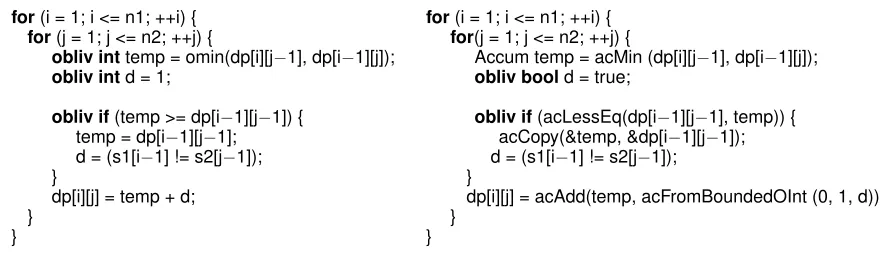
for(i = 1; i <= n1; ++i) { for(j = 1; j <= n2; ++j) {
obliv inttemp = omin(dp[i][j−1], dp[i−1][j]); obliv intd = 1;
obliv if(temp >= dp[i−1][j−1]) { temp = dp[i−1][j−1]; d = (s1[i−1] != s2[j−1]); }
dp[i][j] = temp + d; }
}
for(i = 1; i <= n1; ++i) { for(j = 1; j <= n2; ++j) {
Accum temp = acMin (dp[i][j−1], dp[i−1][j]); obliv boold = true;
obliv if(acLessEq(dp[i−1][j−1], temp)) { acCopy(&temp, &dp[i−1][j−1]); d = (s1[i−1] != s2[j−1]);
}
dp[i][j] = acAdd(temp, acFromBoundedOInt (0, 1, d)); }
}
Figure 3: Computing edit distance with ordinary integers, vs. range-tracked integers
threads can be integrated into Obliv-C to produce protocols with multithreading support, demonstrating some of the advantages of seamless integration with standard C.
4.1. Range-Tracked Integers
Programs often do not need full 32-bit wide integers for all their variables, so it is possible to make arith-metic operations cheaper by using integers of limited bit-width. This can achieve significant speedups for applications that use lots of small integers, for example when counting or accumulating values. Here, we show how to write a library to support range-tracked integers that automatically maintain a conservative upper bound for a value, and resize their bit-widths accordingly.
Figure 3 shows an example of how it may be used. The example we use is that of computing edit distance between two strings. If the strings are of lengthn, we know that the results can never exceedn, and can then use appropriate widths for each integer. As shown in Table 1, range-tracking integers can lead to significant performance improvements.
To implement this abstraction, we define the type
accumas astructwith fields for maintaining the actual value (which is oblivious, so not semantically known) and the conservatively-estimated maximum value:
typedef struct{
obliv unsignedvalue; unsignedmaxValue; } accum;
Note that maxValue is not obliv-qualified — it is a publicly known upper bound that depends on the program the two parties are executing, not on their private values. It must be public so both parties may calculate the width of the circuits needed for each
operation.1
Here is an example how a function operating on a range-tracked accumulator could be used:
accum x = ...;
obliv if(y > 0) { accumAddInt(&x, 1); ... }
Since we expect accumAddInt to be used insideobliv scopes, we need to make this function an obliv function. Moreover, we will not know, even at run-time, if the condition y > 0was actually satisfied. To hide the condition, the protocol will require executing
accumAddInt() regardless of the condition.
While the implementation can conditionally modify the oblivious value, x.value, the value of x.maxValue
must be conservatively adjusted regardless of the (un-known) condition. In other words, it is publicly known that the value might have increased, and so the upper bound has to increase accordingly.
Here is the implementation of accumAddInt:
voidaccumAddInt (accum∗dest,intx)obliv {
∼obliv(en) { dest→maxValue += x; }
intmask = (1<<width(dest→maxValue))−1; dest→value = (dest→value + x) & mask; }
We use an unconditional segment to unconditionally modify the upper bound. When the actual addition is performed, we mask out the higher-order bits beyond the current maximum size to zero. This clears out any ciphertext produced for the higher order bits by the carry-out bits of addition, and allows simple bit-level constant propagation to emit fewer gates during the later arithmetic operations. Functions for min, max, addition, and copying are implemented similarly.
At this point the reader might wonder why we are implementing something so simple in a library rather
than having it as built-in optimizations. Indeed, while we might add such optimizations to the compiler in the future, this example demonstrates that the programmer can go ahead and implement such optimizations as a high-level library without needing to modify the compiler. Further, even if range-tracking integers were provided by the compiler, there will always be special cases where the compiler will not be able to detect opportunities for optimization that are apparent to a programmer with understanding of deeper properties of the application. Compiler optimizations are not powerful enough to substitute for enhanced language expressiveness and control.
4.2. Oblivious RAM
While the previous section demonstrated an abstrac-tion that works with any bit-level protocol for secure computation, this section presents a more complex, but protocol-specific abstraction. A programmer who is willing to write an application in a way that is not protocol-agnostic can use Obliv-C to take advantage of specific functionalities available in the protocol of his choice without needing to modify the compiler.
Specifically, we show how a library can add ORAM functionalities to Yao’s garbled circuits designed for semi-honest adversaries. Implementations of such hy-brid ORAM-based protocols were first described by Gordon et al. [9].
The purpose of ORAM is to avoid the linear-time cost associated with naïve array lookups when the index depends on unknown data, and is thereforeobliv -qualified. There are many constructions of ORAM [29, 30], and Gordon et al. [9] describe how it can be integrated into secure computation, so we will not go into details here. The way it works is that a single access to one location gets converted into multiple accesses at random locations. These pseudo-random locations are then revealed to one (or both) parties, so that the corresponding data blocks can be read from some encrypted store and fed into the secure protocol. Once inside the garbled circuit, the data gets
decrypted, used, possibly shuffled, re-encrypted, and then written back. The encryption is randomized, so the same plaintext may have many different ciphertexts. The decrypted information never leaves the garbled circuit protocol, and the logical locations are always hidden. As a result, neither party is aware of which location is being accessed and when.
Library interface.We implemented the Path ORAM [30] protocol and a “naïve ORAM” that uses the linear-sized circuit. Very recently, SCORAM [32] was devel-oped specifically to be efficient in secure computation. While we have not yet implemented that, they do not have any fundamental difference and should be implementable in Obliv-C just as easily. We need to be able to support read/write operations while in anobliv context, or else it will not be a drop-in replacement for the naïve array operations. So our API defines the read/write functions with the following types:
voidoramRead (obliv bool∗dest,
Oram∗oram,obliv intind)obliv;
voidoramWrite (Oram∗oram,obliv intind, const obliv bool∗src)obliv;
Reads and writes always happen through blocks of pre-specified sizes, which also determines the size of obliv bool arrays dest and src. The obliv keyword at the end of the prototype indicates that they may be invoked inside obliv if blocks (either directly or through other functions). The way we have architected this library is that both kinds of ORAM implement the exact same interface, so we can perform reads and writes using the same functions. As far as user code is concerned, the only difference is in their initialization:
Oram∗naiveOramNew(inteltsize,inteltcount)obliv; Oram∗pathOramNew(inteltsize,inteltcount)obliv;
Both return the same type, so there is no need to change any other code to switch between ORAM implementations. The way we implemented this takes advantage of indirect function calls:
structOram {
inteltSize, eltCount;
100 x 100 characters 200 x 200 characters
Normal int Range-tracked Improvement Normal int Range-tracked Improvement
Total time 7.28 s 4.28 s 41.2% 23.19 s 12.04 s 48.08%
OT time 1.95 s 1.88 s — 1.98 s 1.94 s —
Gate execution time 5.33 s 2.40 s 55.0% 21.21 s 10.10 s 52.4%
Number of gates 1,669,010 668,429 60.0% 6,678,412 2,835,763 57.5%
void(∗read)(obliv bool∗,Oram∗,obliv int)obliv; void(∗write)(Oram∗,obliv int,const obliv bool∗)obliv; void(∗cleanup)(Oram∗)obliv;
void∗extra; };
Each type of ORAM sets these runtime hooks during initialization, keeping any construction-specific data in a structure pointed to by extra. Notice how the pointer types reflect the fact that they point to obliv -functions. This way, the compiler knows that calling them requires passing a hidden condition variable, and that it can be safely invoked from a conditional scope.
Naïve ORAM. While the implementation of a naïve ORAM is straightforward and inefficient, we use this opportunity to demonstrate how Obliv-C makes it easy to write a first prototype, while at the same time provides enough flexibility for the programmer to optimize heavily used functions.
Recall that Obliv-C does not allow obliv types to be directly used for indexing into an array, since the best way to do so depends on the application. So, to perform a write, we do the same thing circuit-based logic does: linearly scan every single element and update just the specified element. Here is the code for naiveOramWrite:
voidnaiveOramWrite(Oram∗oram,obliv intind, const obliv bool∗src)obliv {
obliv bool∗extra = oram−>extra−>storage;
for(inti = 0; i < oram−>eltCount; ++i) { obliv if(i == ind) {
copyBools(storage + i∗oram, src, oram−>eltSize); }
} }
We can improve this a little by using a decoder logic instead of doing full comparison at every index:
∼obliv(en) {
obliv bool∗flags = calloc (oram−>eltCount, sizeof(obliv bool)); decoder (flags, en, ind, oram−>eltCount); for(inti = 0; i < oram−>eltCount; ++i) {
obliv if(flags[i]) {
copyBools (storage + i∗oram, src, oram−>eltSize); }
}
free(flags); }
What the function decoder() does is that it fills flags
with all false values, except possibly a single true value at position ind. Even that value is set to false if it is not enabled with the inputenset to true. This reduces
the number of gates used in comparison fromn∗width to just n−1.
Finally, even though the indexindmay be unknown, it does not need to be. Often, through simple constant propagation, the program ends up invoking a write on a publicly known index at runtime, even though its compile-time type is obliv int. In such cases, the full loop is unnecessary, and we can just branch into a faster path:
if(isKnownInt(&i, index)) {
copyBools(storage + i∗oram, src, oram−>eltSize); }else{
∼obliv(en) {
obliv bool∗flags = ...
The function isKnownInt() is provided by Obliv-C. The way it works is that, if the value of the second parameter is known publicly,isKnownInt()returns true
and copies the known value into the first parameter as an ordinary integer. But if index is unknown (i.e., depends on any secret values), isKnownInt() returns false, andiis left unchanged.
This provides users with a robust, simple, and high-level interface for performing writes, while the library writer can use Obliv-C to still perform low-level circuit optimizations.
Path ORAM. Path ORAM is an efficient oblivious RAM design introduced by Stefanov et al. [30]. We also use the techniques from Dov Gordon et al. [9] to integrate it with Yao’s protocol. At this point, it should be clear how the design Obliv-C supports implementing an ORAM library by allowing functions to execute in conditional contexts. For example, we can write programs such as:
obliv if(cond) {
oramWrite(oram,index,value); }
This executes correctly even though the value ofcond
will be unknown at runtime. Internally, the function performs network transfers, pseudo-random shuffling, and extra cryptographic operations unconditionally, while the actual write is performed conditionally.
In implementing Path ORAM, it was particularly useful to be able to use any existing C library functions for networking and cryptography, something not pos-sible in other languages for secure computation. The best part is, the user of the function is still completely oblivious to all of this: all the user needs to know is that it allows random access in polylogarithmic time. A programmer can use such functions without any cryptographic background.
obliv unsignedocRandomOblivInt(void) {
obliv unsignedres = 0;
intp, pc = ocCurrentProto()−>partyCount; unsignedx;
gcry_randomize(&x,sizeof(x),
GCRY_STRONG_RANDOM); for(p = 1; p <= pc; ++p) {
res ^= feedOblivInt(x,p); }
returnres; }
Figure 4: Generating secret random integers.
for researchers experimenting with their own custom ORAM constructions or other special-purpose sub-protocols.
4.3. Generating Secret Randomness
Generating randomness is very common operation in cryptographic protocols. There are well known examples [3] of how being able to generate secret random numbers (unknown to any party) can lead to significantly faster computation. In this section we describe how we can generate such randomness in Obliv-C and can be used as an optimization strategy.
Figure 4 shows a possible implementation for gen-erating random integers. It just XORs random inputs from all parties, but does not reveal the result.
One example of its usefulness is the computation of modular inverses modulo a publicly known prime number, common in cryptography. Ordinarily, com-puting modular inverses require the extended Euclid’s algorithm, which involves Θ(n) divisions and multi-plications do be done securely in a circuit for n-bit numbers.
A faster approach would use secret randomness (similar to the techniques by Damgård et al. [3]). To computea−1modp, we first generate a secret random number r. We then securely compute armodp and reveal it to everyone. Masking by a secret randomness prevents any semantic information leak.
The parties can then locally compute x = (ar)−1modp, and use another secure multiplication obtain rx=r(ar)−1=a−1. Thus, we obtain the mod-ular inverse by using just two secure multiplications and inexpensive local computation. Similar techniques can also be used to find inverses of matrices and group elements.
We ran some experiments with 32-bit integers, and found that this technique reduces runtime for inverse
computation in semi-honest Yao protocols for 100 integers from 24.7 s to just 9.1 s.
This provides another demonstration of how simple Obliv-C library functions can allow users to easily write their own primitives that work seamlessly work with the rest of the language. No existing framework that provides a high-level language allows program-mers to invent such primitives and perform optimiza-tions.
Compatibility.This function would work in any pro-tocol any propro-tocol that supports input/output in the middle of a running protocol (e.g., semi-honest Yao as done here). However, other protocols such as the dual-execution version of Yao will not support this because it requires all outputs to be revealed at the very end (or else it risks leaking one bit of private inputs for each round of output).
4.4. Multithreading
Despite the prevalence of multicore processors to-day, no existing secure computation frameworks pro-vide full multithreading support.2The reason is simply that full support requires a fairly extensive library for managing threads and providing synchronization primitives. Instead, our Obliv-C design enables users to take advantage of existing C libraries. Compared to ordinary computation, however, for threading to provide useful parallelism, two-party protocols need coordination between threads of both parties.
We implemented some threading support library to help us write the dual-execution protocol (Section 5.2), but we did not implement a full thread-enabled Yao yet (i.e., we have not yet implemented a user-exposed
thread_create()function that can be launched during a protocol).
Implementing a protocol using multiple threads re-quires paying attention to three important properties, discussed below.
Network Channels. We need to set up separate TCP connections to avoid interference between data trans-fers for gates executing in different threads. We imple-mented a simple newsock=sockSplit(oldsock) function that creates a new TCP socket between parties that are already connected by an old socket. In particular, the server starts listening to a new unused port, sends the port number to the client using the old socket, after which the client connects. At this point, we can
voidobliv_mutex_lock(pthread_mutex_t∗m) { if(ocCurrentParty() != 1) {
recvDummy(1); }else{
pthread_mutex_lock(m);
for(inti = 2; i <= partyCount; ++i) sendDummy(i); }
}
Figure 5: Mutex implementation
use POSIX functions to create new threads and have each thread use a different socket so that they do not interfere.
Nonces. Any gate-specific nonce value must be care-fully chosen to avoid duplicates across threads. In case of Yao’s protocol, this is just the gate-specific “tweak” value, or serial number used in garbling. So, for instance, if we have two threads, we should make sure that one thread is only using even numbers while the other is using odd numbers, so that they do not accidentally use the same tweak and compromise security.
Synchronization. The final point is just a general concern for all multi-threaded programs, although we should take care to use synchronization that works in a distributed fashion. While there are many synchro-nization primitives that are useful in programs, we just discuss mutexes as an example of how they can be wrapped for our protocols. The challenge here is to make sure that the same thread wins the lock on all relevant parties (there could be more than two in some protocols).
Figure 5 shows one way to implement the mutex locking function. The idea here is that only one party keeps an actual mutex, while others wait on a network signal to know that it is safe to proceed. This way, only the thread that wins the lock for party 1 will actually proceed. The unlock function simply calls
pthread_mutex_unlock() for party 1, and does nothing for other parties. Note that this is probably not the most efficient way to implementat a mutex. If thread iis running ahead in party 1, it will win even though other parties are still catching up. It is possible that in the meantime, some other thread became ready for all parties, and could have executed. Our proposed im-plementation does not take this into account, although it is possible to fix that by using another round of communication.
voidexecDebugProtocol (ProtocolDesc∗pd,
protocol_run start,void∗arg) {
pd−>currentParty = ocCurrentPartyDefault; pd−>feedOblivInputs = dbgProtoFeedOblivInputs; pd−>revealOblivBits = dbgProtoRevealOblivBits; pd−>setBitAnd = dbgProtoSetBitAnd;
pd−>setBitOr = dbgProtoSetBitOr; pd−>setBitXor = dbgProtoSetBitXor; pd−>setBitNot = dbgProtoSetBitNot; pd−>flipBit = dbgProtoFlipBit; pd−>partyCount= 2;
currentProto = pd; start(arg); }
Figure 6: Implementation of the debug protocol
5. Implementing Protocols
So far we have focused on using Obliv-C with Yao’s garbled circuits protocol for semi-honest adver-saries. However, Obliv-C is designed to enable easy experimentation with any protocol that operates on individual bits for most of the computation (although other types may also be used for specific parts). This section presents two simple examples to illustrate how Obliv-C can be used to execute different protocols. Beyond these examples, there are many other protocols that could be implemented as functions for use with Obliv-C. This includes the cut-and-choose based proto-cols [19, 28], those in the LEGO family [6, 25], as well as those not using garbled circuits such as NNOB [24], Sharemind [2], and those based on the SPDZ family [4] (either as a full protocol restricted to Boolean gates, or as a sub-protocol for parts with many arithmetic operations). We have not yet implemented these other protocols for Obliv-C, but all of them execute in ways that fit well with our design.
5.1. Debugging Applications
The easiest way to discuss adding new protocols is to discuss one that performs no cryptography at all. All it does is that it provides a new func-tion execDebugProtocol() which replaces the usual
voiddbgProtoSetBitAnd(ProtocolDesc∗pd,
OblivBit∗dest,constOblivBit∗a,constOblivBit∗b) {
dest−>value = (a−>value && b−>value); }
Figure 7: Debugging protocol callback for an AND gate.
It is easy to write newexecProtocol()functions like this for launching custom protocols for use with Obliv-C. Implementing a new protocol is just a matter or defining functions for various protocol-level runtime hooks that we provide. These hooks are called do input, output, and compute a single Boolean logic gate. They simply call the user-provided Obliv-C callback func-tion. We have already defined the various operations in terms of Boolean logic gates, so to implement a new protocol we just need to provide new implementation of these operations.
For example, Figure 6 shows the implementation for
execDebugProtocol(). All of the first eight lines are simply setting callback functions that define various aspects of the protocol. Figure 7 shows how one of these callbacks could be implemented (our own imple-mentation also keeps track of stats such as gate count etc.).OblivBitis just a C struct that represents a single obliv bool value. For secure computation protocols, this function would also perform other initializations like setting up pseudo-random seeds and executing base OTs. After all the initializations, the last line simply invokes the Obliv-C function provided by the user as a parameter.
We also allow developers switch out TCP/IP with their own custom transport mechanism. For example, in our experience, we often did not want to have to worry about networking issues when writing code, especially when writing a new protocol. So, when running both parties locally on the same machine, we would just pipe the data through standard input and output. In fact, even when running over a network, we can just pipe over SSH. To support this, we also pro-vide hooks for the primitivesend()andrecv()functions used by various protocols, which can be replaced with arbitrary functions. This could also be used to easily inspect the network traffic for debugging purposes or to package transmissions to improve efficiency.
Note that implementing the new protocols did not require any changes to the Obliv-C compiler. In fact, the compiler does not even need to know which proto-col we are planning to execute: that can be determined later at runtime in themain()function written in C. This
design makes is very easy to conduct experiments that run the same benchmark with different protocols.
5.2. Dual Execution Protocol
Another protocol we have implemented for Obliv-C is thedual executionvariant of Yao’s protocol [21, 33]. It provides stronger security in that it allows at most one bit of private data to be leaked to a malicious ad-versary, but requires twice the total computation since the base Yao’s protocol is executed twice. Although there are even stronger protocols that provide complete privacy against malicious adversaries [8, 14, 17, 19, 24, 25, 28], they all require substantially more expensive techniques.
The basic idea for dual execution is to execute a secure computation by running Yao’s garbled circuits protocol twice, but having the parties swap roles for the two executions which are run simultaneously. This way, each party gets to be the circuit generator for one execution and the evaluator for the other one. The results of the executions are tested for equality to ensure that both circuits computed the same result. Changes to the application code needed to use dual execution are minimal. It is only necessary to swap out
execYaoProtocol()withexecDualexProtocol(), and have two TCP connections instead of just one, for which we provide convenient wrappers (this enables dual execution to use separate threads for circuit generation and execution that proceed in parallel).
This new function execDualexProtocol() works the same way as before, but this time it starts two threads before registering protocol-level hooks. It can now perform additional tasks like swapping roles for one thread and configuring each threat to use different TCP connections. The Obliv-C code to be executed is now launched once from each thread until it is time to perform output. During output, it needs to make sure that the output is only revealed to the evaluator side of each thread. At the same time, it accumulates a hash of the garbled wire labels, joins the two threads, performs an equality check, and returns an error to the user if the check failed.
Other rules involve input/output timing and thread-safety. Since dual execution uses two threads, care needs to be taken when using shared memory. Dual execution has a simple restriction: the computation needs to strictly follow the “input, then compute, then output” execution model. For a semi-honest protocol, it is perfectly acceptable to reveal outputs or feed additional inputs in the middle of the protocol, in-teracting with the protocol as it runs. This is not supported in the stronger protocol: in general, if we want a party to obtain an output, process it locally, and then feed it back, it is quite hard to ascertain if the data was tampered with. In theory, one could do zero knowledge proofs, but it usually is easier (and faster) to just execute the whole computation inside the secure computation protocol. Moreover, the possibility of early outputs opens the door for leaking additional information through selective failure attacks. This is a general theme for all protocols against stronger adversaries, not specific to Obliv-C, but an example of the kind of protocol-specific issue that must be adhered to when implementing applications with Obliv-C.
6. Implementation
The Obliv-C compiler is implemented as a modified version of CIL [23], which transforms Obliv-C code to plain C. Our source code is available under an open source license at<http://oblivc.org/>.
We make some changes to the CIL front-end parser to support the new language keywords and control structures. Some additional changes also were made to keep track of additional information such as the lexical depth at which a variable was declared (the default version of CIL discards this information order to simplify internal representation and processing).
Once the type-checker has completed successfully, code generation is straightforward. Figure 8 shows a simple example. An internal header file, “obliv_bits.h” is automatically included in the generated output files which provides the function prototypes and type dec-larations for the auto-generated function calls will be available during the later stages of compilation. The generated files can then be compiled normally by a standard C compiler (ouroblivccwrapper uses gccfor this).
Because of the way we implemented Obliv-C as a preprocessor on top of C, all of the normal C constructs are still available including structures, pointers, and indirect function calls. We also can trivially support separate compilation—two separate files can be inde-pendently transformed and then compiled and linked as usual. This allows us to have a feature-rich language
without having to design the whole development tool chain from scratch.
Implementing obliv types. The code generator re-places obliv types with corresponding types that are defined as C structs that represent the ciphertext for data bits, the operators get replaced with correspond-ing function calls. For example, the obliv int type is replaced with obliv_c_intwhich is defined as:
typedef struct{ OblivBit bits[32]; } obliv_c_int;
Operations involving obliv types are replaced with corresponding function calls implemented by the pro-vided library. For example, c = a + b is transformed into obliv_c_setAdd(&c, &a, &b).
Functions like obliv_c_setAdd()
obliv_c_setLessThan() are defined in a runtime library that is linked with the generated C files. These functions are all defined in terms of bit operations (e.g., AND, OR, NOT). The bit operations, in turn, are implemented in some protocol-specific way, which means these back-end functions are usually written in plain C. To change the protocol, all we need to do is provide new implementations of these operations (Section 5 presents an example).
Transforming conditional code. Code generation is done differently inside an obliv if or obliv function, since all assignments now must be done conditionally. To ensure that uninitialized garbage values to not interfere with conditional assignments, all local obliv variables are initialized to zero.
Nestedifconditions are handled byAND-ing the new condition with the current, enclosing one. Whenever an obliv function is called, the current condition simply gets passed in as a hidden parameter, so that the function can continue to perform proper conditional assignments. When an oblivfunction is called outside of any obliv scope (that is, not under the control of any condition), the hidden parameter is just set to
true, effectively making it unconditional. This is why oblivfunctions and non-oblivfunctions have different signatures in our language: internally, they accept different parameters. Similarly, Obliv-C supports two flavors of function pointers corresponding to these two flavors of functions. Thus, this transformation eventually removes all control dependencies related to obliv if structures.
None of these transformations interfere with the usual control structures of C (if,for,while, etc.). All behave as expected without any transformation. For example,
obliv if(cond) writeArray (arr, size, index);
voidmillionaire (void∗args) { ProtocolIO∗io = args; obliv inta, b;
obliv boolres = false;
a = feedOblivInt(io−>myinput, 1); b = feedOblivInt(io−>myinput, 2);
obliv if(a < b) res = true;
revealOblivBool(&io−>result, res, 0); }
(a)
voidmillionaire (void∗args) { ProtocolIO∗io = args; obliv_c_int a, b; obliv_c_bool res;
memset (&a, 0,sizeof(obliv_c_int)); memset (&b, 0,sizeof(obliv_c_int)); memset (&res, 0,sizeof(obliv_c_bool));
a = feedOblivInt(io−>myinput, 1); b = feedOblivInt(io−>myinput, 2);
obliv_c_bool cond;
obliv_c_setLessThan(&cond, &a, &b);
obliv_c_condAssign(&cond, &res, &obliv_c_true);
revealOblivBool(&io−>result, res, 0); }
(b)
Figure 8: Obliv-C code for the millionaires’ problem, before and after it is transformed to plain C by our compiler (reformatted for readability).
writeArray (cond, arr, size, index);
Something more complicated like:
obliv if(x < y) {
for(inti = 0; i < n; ++i) { if(i % 2 == 0) {
a[i] = b[i]; }
} }
compiles to:
obliv_c_setLessThan (&cond, &x, &y);
for(inti = 0; i < n; ++i) { if(i % 2 == 0) {
obliv_c_condAssign (&cond, &a[i], &b[i]); }
}
Note that the conditional assignment is needed only for obliv variables and ++i did not need any change. This works because any code that attempts to make problematic modifications to non-oblivvariables inside an obliv scope will be rejected in our type-checking phase. Moreover, the conditional assignment only uses the conditions of enclosingobliv ifs. We do not need to separately account for non-obliv conditions like i < n
or i % 2 == 0 since those control structures are not oblivious and will execute normally.
Since loops and function calls remain in code as is, we never need to unroll or inline them into full circuits for execution, unlike other systems [10, 20]. Hence, we can run programs involving billions of gates without worrying about running out of memory.
Memory management is not different in our system, since we still have full access to the usual C runtime li-brary functions (although sometimes protocol-specific restrictions can apply, as seen in Section 5).
The last new feature we need to support is uncon-ditional segments. Code written inside such a segment is simply rewritten as if it appeared outside any con-ditional context. Inside an unconcon-ditional segment, all code is executed unconditionally. Before this block is executed, however, the new variable of typeobliv bool is simply initialized with a copy of the current condi-tion so that it is available to the code in the body of this segment.
program would modify the variable regardless of the obliv condition (without branching). This emphasizes that our system relies on cryptography at runtime to provide security; the type rules are designed only to prevent programming mistakes.
7. Related Work
Many frameworks for secure computation have been published in recent years. Broadly speaking, they can be classified into two categories. First is the family of low-level frameworks that provide a library of cryptographic primitives that can be used to develop arbitrary protocols. Examples include FastGC [11], SCAPI [5], and L1 [27]. The advantage of using these frameworks is that they provide a high degree of customizability over the actual protocol execution. On the downside, however, users are generally expected to be experts either in cryptography, or in circuit structures, or both. The frameworks provide little or no type safety to prevent semantic errors, and it is difficult (or in some cases, impossible) to write applications in a way that it is portable across different protocols. In comparison, applications programmed in Obliv-C are fully portable across all protocols that work on Boolean circuits (unless they are written to deliberately use protocol-specific extensions). Moreover, the Obliv-C type system prevents accidental mistakes on the part of the programmer, without being so restrictive that it prevents programmers from writing useful functions.
The second family of frameworks entail high-level languages that try to completely abstract away the cryptographic parts, and allow the user to code in a spe-cial language as if it was ordinary programming. Ex-amples include include Fairplay [20], CMBC-GC [10], KSS [16], PCF [15], Wysteria [26] and PICCO [36]. Unlike Obliv-C, these languages provide little oppor-tunity for users to extend or alter protocols short of modifying the compiler directly. For example, none of these would allow a user to write custom ORAM protocols (since they manage all network traffic) or implement custom data structure libraries (since they manage all memory allocation) as we demonstrated was straightforward with Obliv-C. Some like Wysteria, though, provides very strong static type system that we do not — our type system is only intended to prevent mistakes, and relies on the underlying cryptography for security.
Thus, we consider Obliv-C to be somewhere in between the two previous families of secure computa-tion frameworks, obtaining the best of both worlds. It provides sufficient control to enable rich extensibility,
without requiring a programmer to design low-level circuits or understand the underlying cryptography.
Although our current implementation provides fairly good performance, it still does not incorporate all the optimizations that have been proposed recently. This includes using AES-NI instructions [1, 16] to garbled each gate, or OT-extension for malicious adversaries [13] (our current dual execution implementation does not use OT-extension). The design of Obliv-C makes it easy to incorporate those optimizations, and any newly discovered ones, without making any changes to the compiler.
Holzer et al. [10] attempted to leverage C in se-cure computation, but did not support most of the C language, while Obliv-C is a strict extension of C. Finally, since their approach generates a full circuit representation before actually executing it, it cannot scale to large circuits.
Finally, there are many other implementations that use a custom designed intermediate language to ad-dress memory issues such as PAL [22] and PCF [15]. These frameworks do not support custom sub-protocols the way we do. In this respect, they are closer to the other high-level languages that we have mentioned previously, since they abstract away the data-oblivious nature of computation and provide something closer to ordinary computation. Without a full static type system, they had to take draconian measures such as not allowing function calls within an if statement that depends on secret input, for example. This greatly limits the general applicability of these systems, and requires programmers to build applications in unnatu-ral and tool-specific ways.
8. Conclusion
References
[1] Mihir Bellare, Viet Tung Hoang, Sriram Keelveedhi, and Phillip Rogaway. Efficient Garbling from a Fixed-Key Block Cipher. InIEEE Symposium on Security and Privacy, 2013.
[2] Dan Bogdanov, Sven Laur, and Jan Willemson. Sharemind: A Framework for Fast Privacy-Preserving Computations. InEuropean Symposium on Research in Computer Security, 2008.
[3] Ivan Damgård, Matthias Fitzi, Eike Kiltz, Jesper Buus Nielsen, and Tomas Toft. Unconditionally Secure Constant-Rounds Multi-Party Computation for Equality, Comparison, Bits and Exponentiation. In Theory of Cryptography. 2006.
[4] Ivan Damgård, Valerio Pastro, Nigel Smart, and Sarah Zakarias. Multiparty Computation from Somewhat Homomorphic Encryption. InAdvances in Cryptology—CRYPTO. 2012.
[5] Yael Ejgenberg, Moriya Farbstein, Meital Levy, and Yehuda Lindell. SCAPI: The Secure Computation Application Programming Interface. IACR Cryptology ePrint Archive, 2012.
[6] Tore Kasper Frederiksen, Thomas Pelle Jakobsen, Jesper Buus Nielsen, Peter Sebastian Nordholt, and Claudio Orlandi. Minilego: Efficient Secure Two-Party Computation from General Assumptions. InAdvances in Cryptology—EUROCRYPT. 2013.
[7] Tore Kasper Frederiksen and Jesper Buus Nielsen. Fast and Maliciously Secure Two-party Computation using the GPU. InApplied Cryptography and Network Security, 2013.
[8] Shafi Goldwasser, Silvio M. Micali, and Avi Wigderson. How to Play Any Mental Game, or a Completeness Theorem for Protocols with an Honest Majority. In19thACM Symposium on Theory of Computing, 1987.
[9] S. Dov Gordon, Jonathan Katz, Vladimir Kolesnikov, Fernando Krell, Tal Malkin, Mariana Raykova, and Yevgeniy Vahlis. Secure Two-Party Computation in Sublinear (Amortized) Time. InACM Conference on Computer and Communications Security, 2012.
[10] Andreas Holzer, Martin Franz, Stefan Katzenbeisser, and Helmut Veith. Secure Two-Party Computations in ANSI C. InACM Conference on Computer and Communications Security. ACM, 2012.
[11] Yan Huang, David Evans, Jonathan Katz, and Lior Malka. Faster Secure Two-Party Computation Using Garbled Circuits. In20th USENIX Security Symposium, 2011.
[12] Nathaniel Husted, Steven Myers, Abhi Shelat, and Paul Grubbs. GPU and CPU Parallelization of Honest-but-Curious Secure Two-Party Computation.
InACM Annual Computer Security Applications Conference, 2013.
[13] Yuval Ishai, Joe Kilian, Kobbi Nissim, and Erez Petrank. Extending Oblivious Transfers Efficiently. In Advances in Cryptology—CRYPTO, 2003.
[14] Stanislaw Jarecki and Vitaly Shmatikov. Efficient Two-Party Secure Computation on Committed Inputs. InAdvances in Cryptology—EUROCRYPT, 2007.
[15] Ben Kreuter, Benjamin Mood, abhi shelat, and Kevin Butler. PCF: A Portable Circuit Format for Scalable Two-Party Secure Computation. In22nd USENIX Security Symposium, August 2013.
[16] Benjamin Kreuter, abhi shelat, and Chih-Hao Shen. Billion-Gate Secure Computation with Malicious Adversaries. In21st USENIX Security Symposium, 2012.
[17] Yehuda Lindell and Benny Pinkas. An Efficient Protocol for Secure Two-Party Computation in the Presence of Malicious Adversaries. InAdvances in Cryptology—EUROCRYPT. 2007.
[18] Yehuda Lindell and Benny Pinkas. A Proof of Security of Yaoâ ˘A ´Zs Protocol for Two-Party Computation. Journal of Cryptology, 22(2), 2009.
[19] Yehuda Lindell and Benny Pinkas. Secure Two-Party Computation via Cut-and-Choose Oblivious Transfer. Journal of Cryptology, 25(4), 2012.
[20] Dahlia Malkhi, Noam Nisan, Benny Pinkas, and Yaron Sella. Fairplay-Secure Two-Party Computation System. In12th USENIX Security Symposium, 2004.
[21] Payman Mohassel and Matthew Franklin. Efficiency Tradeoffs for Malicious Two-Party Computation. In Public Key Cryptography. 2006.
[22] Benjamin Mood, Lara Letaw, and Kevin Butler. Memory-efficient Garbled Circuit Generation for Mobile Devices. InFinancial Cryptography and Data Security. 2012.
[23] George C Necula, Scott McPeak, Shree P Rahul, and Westley Weimer. CIL: Intermediate Language and Tools for Analysis and Transformation of C Programs. InConference on Compiler Construction, 2002.
[24] Jesper Buus Nielsen, Peter Sebastian Nordholt, Claudio Orlandi, and Sai Sheshank Burra. A New Approach to Practical Active-Secure Two-Party Computation. Crypto ePrint Archive, 2011. http://eprint.iacr.org/2011/091.
[25] Jesper Buus Nielsen and Claudio Orlandi. LEGO for Two-Party Secure Computation. InTheory of Cryptography Conference, 2009.
[27] Axel Schropfer, Florian Kerschbaum, and Gunter Muller. L1 — an Intermediate Language for Mixed-Protocol Secure Computation. In35th IEEE Annual Computer Software and Applications Conference, 2011.
[28] abhi shelat and Chih-hao Shen. Two-Output Secure Computation with Malicious Adversaries. In Advances in Cryptology—EUROCRYPT, 2011.
[29] Elaine Shi, T-H Hubert Chan, Emil Stefanov, and Mingfei Li. Oblivious RAM with O((logN) 3) Worst-Case Cost. InAdvances in
Cryptology—ASIACRYPT. 2011.
[30] Emil Stefanov, Marten Van Dijk, Elaine Shi, Christopher Fletcher, Ling Ren, Xiangyao Yu, and Srinivas Devadas. Path ORAM: An Extremely Simple Oblivious RAM Protocol. InACM Conference on Computer and Communications Security, 2013.
[31] Dennis Volpano, Cynthia Irvine, and Geoffrey Smith. A Sound Type System for Secure Flow Analysis. Journal of Computer Security, 4(2), 1996.
[32] Xiao Shaun Wang, Yan Huang, TH Chan, Abhi Shelat, and Elaine Shi. Scoram: Oblivious ram for secure computation. InACM Conference on Computer and Communications Security. ACM.
[33] Yan Huang and Jonathan Katz and David Evans. Quid Pro Quo-tocols: Strengthening Semi-Honest Protocols with Dual Execution. In33rdIEEE Symposium on Security and Privacy, 2012.
[34] Andrew C. Yao. Protocols for Secure Computations. In23rd Symposium on Foundations of Computer Science, 1982.
[35] Samee Zahur and David Evans. Circuit Structures for Improving Efficiency of Security and Privacy Tools. In34th IEEE Symposium on Security and Privacy, 2013.
[36] Yihua Zhang, Aaron Steele, and Marina Blanton. PICCO: A General-Purpose Compiler for Private Distributed Computation. InACM Conference on Computer and Communications Security, 2013.
Appendix
Given the difficulty of formally describing the full C language as described in the ISO standard, we describe our rules using a simplified C language where intand bool are the only data types, along with their obliv counterparts. The only control structures areif,obliv if
andwhileloops. It includes functions, but we exclude
structures, pointers, arrays, and other complex features. We also restrict declarations so that they may each introduce only a single new variable.
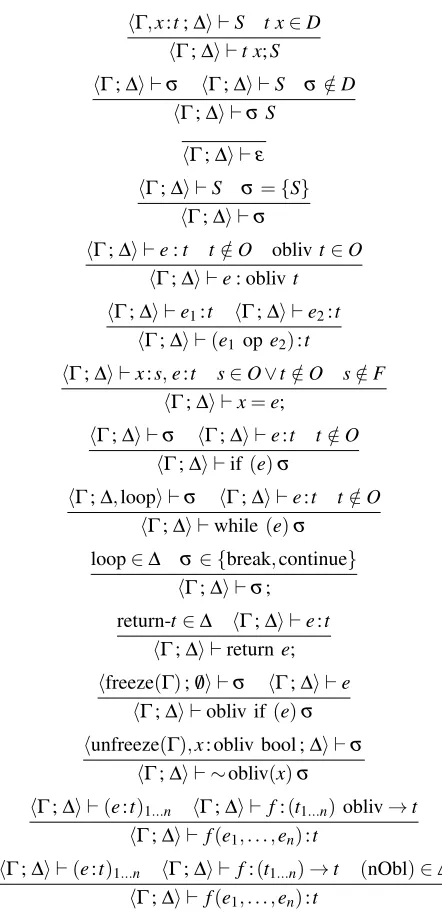
The rules are shown in Figure 10. The notations we use are given in Figure 9.
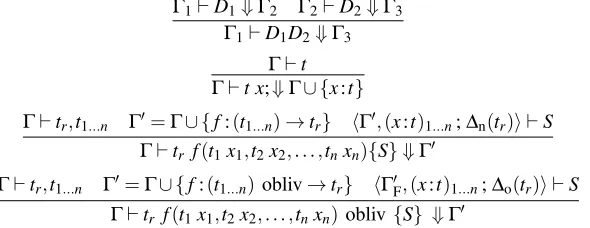
At the global level, we use a slightly different notation: Γ`D⇓Γ0 denotes the fact that that Dis a valid global definition underΓ, and it produces a new type environmentΓ0(we will skip rules for global dec-larations without accompanying definitions, but they are similar). These rules are shown in Figure 11. These simply specify the Γ and ∆ values with which each function body is processed. Additional notations used here:
∆n(t) ={return-t,nObl}
∆o(t) ={return-t}
Γ0F=freeze(Γ0)
While these rules just presented are enough to create the type-checker for our language, we also need the semantics of our constructs formally specified in order to prove any properties about not leaking information. In this case, we take an operational approach by specifying rewrite rules. These are shown in Figure 12. The function convert(c,code) takes in Obliv-C code and rewrites it to produce plain C code, assuming they need to be executed in the context of the condition c. For brevity, we provide a simplified version of these rules that just includes the interesting cases. After these transformations, an additional pass is made to replace the type names with C structures representing the obliv basic types.
At this point, it is easy to see that we never emit anything to convert an obliv variable to a non-obliv one at any point, and the generated code has no control dependecy on obliv data. This, along with the type system, proves that our language never leaks any data about obliv variables (other than by using reveal()
s,t are used for types
t1...n is a shorthand for the sequencet1, . . . ,tn
(t1...n)→t is the type of a function that takes narguments of types t1...n and returns at (t1...n)obliv→t is the type of the corresponding obliv function
eis for expressions.
f is for the name of a function. x,yfor variables
σ for a single statement,S for a sequence of statements, ε for the empty sequence
O={obliv int, obliv bool}
F={∀t∈/O: frozent}
Dis the set of all syntactically correct declarations Γis the current type mapping
∆⊆ {loop,nObl,∀t.return-t}holds information about the current set of allowed control flow operations.
hΓ;∆i `S means Sis a valid sequence of statements under hΓ;∆i hΓ;∆i `e:t meanseis a valid expression of typet underhΓ;∆i (x:t)1...n is a shorthand forx1:t1, . . . ,xn:tn
freeze(Γ) ={x: freeze(t)| ∀x:t∈Γ} freeze(t) = (frozent)ift∈/O,t ift∈O
unfreeze(t) =t0 ift= (frozent0)∈F,t otherwise. unfreeze(Γ)is analogous.
hΓ,x:t;∆i `S t x∈D
hΓ;∆i `t x;S
hΓ;∆i `σ hΓ;∆i `S σ∈/D
hΓ;∆i `σS
hΓ;∆i `ε
hΓ;∆i `S σ={S}
hΓ;∆i `σ
hΓ;∆i `e:t t∈/O oblivt∈O hΓ;∆i `e: oblivt
hΓ;∆i `e1:t hΓ;∆i `e2:t
hΓ;∆i `(e1ope2):t
hΓ;∆i `x:s,e:t s∈O∨t∈/O s∈/F hΓ;∆i `x=e;
hΓ;∆i `σ hΓ;∆i `e:t t∈/O hΓ;∆i `if (e)σ
hΓ;∆,loopi `σ hΓ;∆i `e:t t∈/O
hΓ;∆i `while (e)σ
loop∈∆ σ∈ {break,continue}
hΓ;∆i `σ;
return-t∈∆ hΓ;∆i `e:t
hΓ;∆i `returne;
hfreeze(Γ); /0i `σ hΓ;∆i `e
hΓ;∆i `obliv if(e)σ
hunfreeze(Γ),x: obliv bool ;∆i `σ
hΓ;∆i ` ∼obliv(x)σ
hΓ;∆i `(e:t)1...n hΓ;∆i ` f:(t1...n)obliv→t hΓ;∆i `f(e1, . . . ,en):t
hΓ;∆i `(e:t)1...n hΓ;∆i `f:(t1...n)→t (nObl)∈∆ hΓ;∆i `f(e1, . . . ,en):t
Γ1`D1⇓Γ2 Γ2`D2⇓Γ3
Γ1`D1D2⇓Γ3
Γ`t Γ`t x;⇓Γ∪ {x:t}
Γ`tr,t1...n Γ0=Γ∪ {f:(t1...n)→tr} hΓ0,(x:t)1...n;∆n(tr)i `S Γ`tr f(t1x1,t2x2, . . . ,tnxn){S} ⇓Γ0
Γ`tr,t1...n Γ0=Γ∪ {f:(t1...n)obliv→tr} hΓ0F,(x:t)1...n;∆o(tr)i `S Γ`tr f(t1x1,t2x2, . . . ,tnxn)obliv {S} ⇓Γ0
Figure 11: Rules for type checking global declarations.
convert(c,v1=v2;)≡
obliv_c_copy(&v1,&v2); ifcis statically true obliv_c_condAssign(&c,&v1,&v2); otherwise
convert(c1,obliv if(c2)B1 elseB2)≡convert(c1&c2,B1)convert(c1&!c2,B2)
convert(c,f(e1, . . . ,en);)≡
f(c,e1, . . . ,en); if f is an obliv function f(e1, . . . ,en); otherwise
convert(c,∼obliv(v)B)≡convert(true,obliv boolv=c;B) convertFunc(tr f(t1v1, . . . ,tnvn)obliv B)≡
tr f(c,t1v1, . . . ,tnvn)convert(c,B)wherecis fresh convertFunc(tr f(t1v1, . . . ,tnvn)B)≡
tr f(t1v1, . . . ,tnvn)convert(true,B)