The Multiplicative Complexity of Boolean Functions
on Four and Five Variables
Meltem S¨onmez Turan† ‡, Ren´e Peralta†
†
National Institute of Standards and Technology, Gaithersburg, MD [email protected], [email protected]
‡
Dakota Consulting Inc., Silver Spring, MD
Abstract. A generic way to design lightweight cryptographic primitives is to construct simple rounds using small nonlinear components such as 4x4 S-boxes and use these iteratively (e.g., PRESENT [1]
and SPONGENT [2]). In order to efficiently implement the primitive, efficient implementations of its internal components are needed. Multiplicative complexity of a function is the minimum number of
AND gates required to implement it by a circuit over the basis (AND, XOR, NOT). It is known that multiplicative complexity is exponential in the number of input bitsn. Thus it came as a surprise that circuits for all 65 536 functions on four bits were found which used at most three AND gates [3]. In
this paper, we verify this result and extend it to five-variable Boolean functions. We show that the multiplicative complexity of a Boolean function with five variables is at most four.
Keywords:Affine transformation, Boolean functions, Circuit complexity, Multiplicative complexity
1
Introduction
One of the important challenges in lightweight cryptography is to find efficient
implemen-tations of secure cryptographic primitives. Many attempts [4–7] have been done to improve
the efficiency of the block cipher AES, in order to fit the implementations in
resource-constrained devices. However, even the best implementations of AES are usually too big for
constrained devices. A generic way to design dedicated lightweight cryptographic primitives
is to construct simple rounds using small nonlinear components such as 4x4 S-boxes and
iterate (this is done in, for example, PRESENT [1] and SPONGENT [2]). In order to
ef-ficiently implement the primitive, efficient circuits for the internal components are needed. Efficiency of the implementations can be assessed using different metrics such as area, power,
and energy requirements. These metrics are strongly related to the number of logic gates
used to implement the primitive.
Gate complexity is defined as the minimum number of 2-input logic gates required to
implement the primitive in a circuit. Multiplicative complexity (MC) is another complexity
measure, which is defined as the minimum number of AND gates required to implement the
primitive by a circuit over the basis (AND, XOR, NOT), with an unlimited number of NOT
and XOR gates. This is the same as the number of multiplications needed for straight-line
Finding the gate complexity or the multiplicative complexity of a given function is
compu-tationally intractable, even for functions with a small number of variables. In 2006, Saarinen
[8] published the gate complexity distribution of 4-variable Boolean functions. In 2010, Boyar
et al. [9] proposed a two-stage heuristic method to minimize the gate complexity of Boolean
circuits. In the first state, the heuristics minimizes the number of AND gates required to
implement the circuit, and then in the second stage, the linear components are optimized.
Using this method, they constructed efficient circuits for the AES S-box over the basis (AND,
XOR, NOT).
Apart from possibly increasing the efficiency of the implementations, minimizing the
number of AND gates provides a tool for the cryptanalysis of the primitives. For example,
according to [10, 11], functions with low multiplicative complexity are more vulnerable to
algebraic attacks than those with high multiplicative complexity. This is an important ob-servation, as a function representation tends to hide its true multiplicative complexity (e.g.
consider a random polynomial on five variables over GF(2), it is hard to see how it could
possibly be computed using only four multiplications).
Also, a relationship between collision resistance of a hash function and multiplicative
complexity is provided in [12]. Courtois et al. [10] argued that minimizing the number of
AND gates is important to prevent against side channel attacks such as differential power
analysis. Finally, we point out that the number and position of AND gates in a circuit is the
main determinant of whether the function can be used in the context of protocols that use
homomorphic encryption.
Multiplicative complexity of a randomly selected n-variable Boolean function is at least
2n/2−O(n) [13]. Exhaustive study of the distribution of multiplicative complexity can only be done for very small values of n. In 2013, we were surprised to find circuits for all 65 536
functions on four bits which used at most three AND gates [3]. Boyar et al. [12] conjecture that some five-bit Boolean functions have multiplicative complexity five. It is shown in
[13] that there are at most 2k2+2k+2kn+n+1
many n-variable Boolean functions that can be
generated using k AND gates. This is a counting argument and it is not known how tight
it is. Using this bound, it is easy to see that there exist eight-bit Boolean functions with
multiplicative complexity of at least eight. So, it is an open question whether there exists
n-bit Boolean functions with multiplicative complexity n, for n = 5,6,7. Lower bounds are
extremely difficult: no specificn-variable function has yet been proven to have multiplicative
complexity larger than n−1 for any n.
In this paper, we focus on the multiplicative complexity of four and five-variable Boolean
functions. Using the fact that multiplicative complexity is affine invariant, we first provide
four-variable Boolean functions is at most three. Then, we extend the result for five-variable
Boolean functions and show that the conjecture given in [12] is false: any five-bit Boolean
functions can be implemented with at most four AND gates.
The organization of this paper is as follows. Section 2 provides definitions and some known
facts about Boolean functions, affine equivalence, and multiplicative complexity. Section 2 focuses on affine invariance of multiplicative complexity and provides results for four and
five-variable Boolean functions. Section 4 concludes the paper.
2
Preliminaries
2.1 Boolean Functions
LetF2 be the binary field. An n-variable Boolean functionf is a mapping from Fn2 toF2.
Let Bn be the set of n-variable Boolean functions. Note that |Bn|= 22
n
. Boolean functions
have various representations, some are canonical, some not so. The list of output values
for each n-bit input Tf = (f(0, . . . ,0), f(0, . . . ,0,1), . . . , f(1, . . . ,1)) is called the truth table
representation of f. The number of ones in Tf is called the Hamming weight of f, denoted
wt(f). TheHamming distance between two Boolean functions f, g ∈Bn, denoted d(f, g), is
wt(f+g). That is, the Hamming distance is the cardinality of the set{x∈Fn
2|f(x)6=g(x)}.
Boolean functions are also represented uniquely by the multivariate polynomial called
algebraic normal form (ANF)
f(x1, . . . , xn) =
X
u∈Fn2
auxu (1)
where xu = xu1 1 x
u2
2 · · ·xunn is a monomial composed of the variables for which ui = 1 and
au ∈F2. This is also called theZhegalkin polynomial of f. The degree of a Boolean function,
denoted df, is the degree of the highest-degree monomial in its ANF representation.
LetAn be the set ofn-variable affine functions, i.e., functions having degree at most one.
The nonlinearity of a Boolean function f, denoted Nf, is the minimum Hamming distance
of f to all affine functions, that is Nf = ming∈And(f, g). The nonlinearity of an n-variable
Boolean function is upper bounded by 2n−1−2n/2−1.
2.2 Affine Equivalence
Affine transformations of a function f allow for linear operations to inputs and output
of f. There are several definitions in the literature, and they are not all equivalent to each
Definition 1. An affine transformation from g tof in Bn is a mapping of the form f(x) =
g(Ax+a) +b·x+c, where
– A is a non-singular n×n matrix over F2;
– x, a are column vectors over F2;
– b is a row vector over F2; and
– c∈F2.
It is not hard to prove that this defines an equivalence relation on the set of n-variable
Boolean functions. Two functions f, g are affine equivalent if there exist affine
transforma-tions between them. Affine equivalent Boolean functransforma-tions are said to be in the same
equiva-lence class.
An algorithm to check whether two functions are equivalent is given in [15]. This
algo-rithm also outputs an affine transformation between the input functions, if one exists. The
equivalence classes can be constructed using exhaustive search for small values of n. For
ex-ample, the Boolean functions with three variables can be partitioned into three equivalence
classes, and a representative from each class can be given as{x1, x1x2 andx1x2x3}. The
clas-sification of five-variable Boolean functions was done in 1972 by Berlekamp and Welch [14].
Maiorana [16] proved that the number of classes in B6 is 150 357. This was independently
verified by Fuller [15] and by Braeken et al. [17]. For n = 7, Hou [18] determined that there
are 63 379 147 320 777 408 548 equivalence classes. Since the size ofBn is doubly exponential,
and each equivalence class can contain only an exponential number of functions, the number
of equivalence classes is asymptotically exponential in n (see Table 1).
Table 1.Number of equivalence classes for n ≤7 n |Bn| # of Equivalence Classes
3 28 3
4 216 8
5 232 48
6 264 150 357
7 2128 63 379 147 320 777 408 548 (this is between 265 and 266)
Some cryptographic measures such as nonlinearity, algebraic degree, and algebraic
im-munity remain unchanged after applying an affine transformation. Such measures are said
to be affine invariant [19]. Braeken et al. [17] studied the classification of Boolean functions
with respect to various cryptographic properties. Uyan [20] analyzed the Boolean functions
2.3 Multiplicative Complexity
The multiplicative complexity C∧(f) of a Boolean function is the minimum number of multiplications (AND-∧ gates) that are sufficient to evaluate the function over the basis (AND, XOR, NOT). The multiplicative complexity of functions having degree d is at least
d−1 [21]. This bound is called the degree bound. Calculating the multiplicative complexity of a randomly selected Boolean function is hard even for small values of n 1.
3
Multiplicative Complexity of Boolean Functions
Multiplicative complexity is invariant under affine transformations. Thus, to bound the
multiplicative complexity distribution ofn-bit Boolean functions, it is enough to bound the
multiplicative complexity of a single function from each equivalence class. Fuller presents an
algorithm to find a representative from each equivalence class [15]. Her method is practical
for values of n up to six.
In order to find a circuit for f ∈ Bn with a small number of AND gates, we use the
following approach.
1. Precomputation
(a) Using the algorithm given in [15], find a “simple” (e.g., one that has a small number
of monomials in its ANF) representative for each equivalence class in Bn.
(b) For each representative, find a circuit which is efficient with respect to multiplicative
complexity.
2. Find the equivalence class Cf of f.
3. Find the affine transformation fromf∗, the representative ofCf, tof using the algorithm
given in [15].
4. Apply the affine transformation to the circuit forf∗. This yields a circuit forf. The circuit will be efficient with respect to multiplicative complexity. Note that, if the circuit found
for f∗ is not optimal, this still yields an upper bound on the multiplicative complexity of f.
In the following subsections, we used this approach to bound the multiplicative
complex-ity of all Boolean functions on four and on five variables. The approach becomes impractical
as the number of variables increases due to the following reasons; (i) the number of
equiv-alence classes increases exponentially with the number of variables; (ii) finding an affine
transformation fromf∗ tof gets harder; and (iii) constructing circuits that are optimal with respect to multiplicative complexity gets harder.
1 Lest the reader think this easy, he/she may attempt to compute the functionf(x
1, x2, x3, x4, x5) =x1x2x3x4x5+
3.1 n= 4
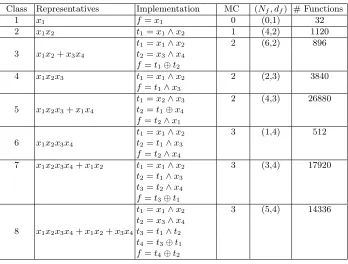
There are eight equivalence classes of B4, with representatives {x1, x1x2, x1x2 +x3x4,
x1x2x3, x1x2x3+x1x4,x1x2x3x4,x1x2x3x4+x1x2,x1x2x3x4+x1x2+x3x4}. The representatives
are simple enough that optimal (with respect to multiplicative complexity) circuits can be
easily constructed. Table 2 provides a circuit with optimal number of AND gates for each of
these representatives. The optimality of the circuits follows from the degree bound for seven
(out of eight) of the equivalence classes. For example, according to the degree bound, the
multiplicative complexity of x1x2x3x4+x1x2, is at least three. Optimality of the third class,
which is a sum of quadratic functions, cannot be verified by the degree bound. That two AND gates are needed seems obvious, as the two quadratic terms have no common variables. For a
formal proof, see Mirwald and Schnorr [22], which shows that the multiplicative complexity
of a quadratic function of the form Pk
i=1x2i−1x2i isk.
It is easy to find the equivalence class of a given function f ∈ B4 by checking the
nonlinearity and degree of f, since the nonlinearity and the degree pair (Nf, df) of the
representatives are distinct (See Table 2).
Table 2.Equivalence classes ofB4
Class Representatives Implementation MC (Nf, df) # Functions
1 x1 f=x1 0 (0,1) 32
2 x1x2 t1=x1∧x2 1 (4,2) 1120
t1=x1∧x2 2 (6,2) 896
3 x1x2+x3x4 t2=x3∧x4
f=t1⊕t2
4 x1x2x3 t1=x1∧x2 2 (2,3) 3840
f=t1∧x3
t1=x2∧x3 2 (4,3) 26880
5 x1x2x3+x1x4 t2=t1⊕x4
f=t2∧x1
t1=x1∧x2 3 (1,4) 512
6 x1x2x3x4 t2=t1∧x3
f=t2∧x4
7 x1x2x3x4+x1x2 t1=x1∧x2 3 (3,4) 17920
t2=t1∧x3
t3=t2∧x4
f=t3⊕t1
t1=x1∧x2 3 (5,4) 14336
t2=x3∧x4
8 x1x2x3x4+x1x2+x3x4t3=t1∧t2
t4=t3⊕t1
f=t4⊕t2
Example 1. Let f = 1 +x1 +x2 +x3 +x1x2 +x1x3 +x2x4 +x3x4 +x1x2x3 +x2x3x4 +
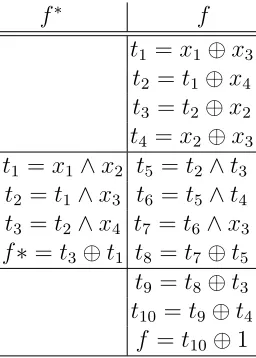
first need to find its equivalence class. Since (Nf,degree) = (3,4), f belongs to the seventh
equivalence class with representative f∗ = x1x2x3x4 +x1x2. Then, we need to obtain the
affine transformation between f and f∗. Using the algorithm in [15], the transformation is obtained as
f(x) =f∗(
1 0 1 1
1 1 1 1
0 1 1 0
1 0 1 0
x⊕(0 0 0 0))⊕(0 1 1 0)x⊕1. (2)
According to this transformation, input variables are transformed as follows;x1 →x1+x3+
x4,x2 →x1+x2+x3+x4,x3 →x2+x3, andx4 →x1+x3, and the affine shift is equivalent
to XORing x2+x3+ 1 tof. Given an efficient circuit forx1x2x3x4+x1x2, an efficient circuit
for f can be found as is shown in Table 3. The first four equations in the implementation of
f are due to the linear transformations of input variables, whereas the last three equations
corresponds to the affine shift.
Table 3.Optimal circuit for f in terms of number of AND gates.
f∗ f
t1 =x1⊕x3
t2 =t1⊕x4
t3 =t2⊕x2
t4 =x2⊕x3
t1 =x1∧x2 t5 =t2∧t3
t2 =t1∧x3 t6 =t5∧t4
t3 =t2∧x4 t7 =t6∧x3
f∗=t3⊕t1 t8 =t7⊕t5
t9 =t8⊕t3
t10 =t9⊕t4
f =t10⊕1
u t
3.2 n= 5
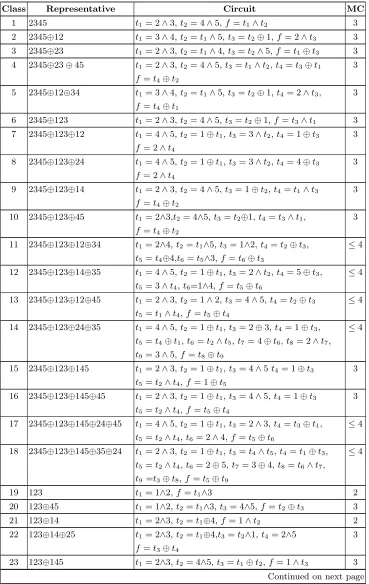
Berlekamp and Welsh [14] provided the representatives of the 48 equivalence classes for
n= 5. Table 5 in the Appendix provides the circuits to implement the representatives of each
equivalence class. Most of the representatives are simple enough that the optimal circuits
37, 44, 45, 46, 47, 48 are obtained using the heuristic provided in [23]. Optimality of thirty
circuits (out of 48) can be verified using the degree bound.
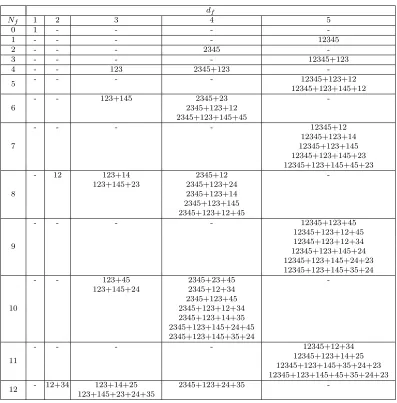
To find the equivalence class of a given function f ∈ B5, the nonlinearity and degree
of f can be utilized. Table 2 provides a classification of the equivalence classes based on
the nonlinearity of degrees. As seen from the table, for 10 of the equivalence classes, the
degree and nonlinearity uniquely determines the class representative. Moreover, checking
degree and nonlinearity of an input function significantly reduces the possible number of
equivalence classes.
Table 4.The distribution of equivalence classes ofB5 according to degree and nonlinearity. The functions are written in an abbreviated notation. For example, 123+145 indicates the representative of the formx1x2x3+x1x4x5.
df
Nf 1 2 3 4 5
0 1 - - -
-1 - - - - 12345
2 - - - 2345
-3 - - - - 12345+123
4 - - 123 2345+123
-5 - - - - 12345+123+12
12345+123+145+12
6
- - 123+145 2345+23
-2345+123+12 2345+123+145+45
7
- - - - 12345+12
12345+123+14 12345+123+145 12345+123+145+23 12345+123+145+45+23
8
- 12 123+14 2345+12
-123+145+23 2345+123+24 2345+123+14 2345+123+145 2345+123+12+45
9
- - - - 12345+123+45
12345+123+12+45 12345+123+12+34 12345+123+145+24 12345+123+145+24+23 12345+123+145+35+24
10
- - 123+45 2345+23+45
-123+145+24 2345+12+34 2345+123+45 2345+123+12+34 2345+123+14+35 2345+123+145+24+45 2345+123+145+35+24
11
- - - - 12345+12+34
12345+123+14+25 12345+123+145+35+24+23 12345+123+145+45+35+24+23
4
Conclusion
We studied the multiplicative complexity of Boolean functions with four and five
vari-ables. For four variables, we confirmed that the multiplicative complexity is at most three by producing circuits for a representative of each of the eight equivalence classes. We knew
this was true because one of us has posted circuits for all 216, each using at most three AND
gates [3]. Those circuits are also optimized for total number of gates: it turns out that no
more than seven XOR gates are needed by AND-optimal circuits.
For five variables, we disproved the conjecture that there exists Boolean functions with
multiplicative complexity five. We are in the process of extending this work to six-variable
Boolean functions. This will most likely require a computer proof, as there are 150 357
equivalence classes.
Acknowledgments
We thank C¸ a˘gda¸s C¸ alık, Joan Boyar, and Magnus Find for helpful discussions and
sugges-tions. We also thank our colleagues Yi-Kai Liu, Ray Perlner, Lily Chen, and the anonymous
reviewers for their useful comments.
References
1. Andrey Bogdanov, Lars R. Knudsen, Gregor Leander, Christof Paar, Axel Poschmann, Matthew J. B. Robshaw, Yannick Seurin, and C. Vikkelsoe. PRESENT: An Ultra-Lightweight Block Cipher. In Pascal Paillier and Ingrid
Verbauwhede, editors,CHES, volume 4727 ofLecture Notes in Computer Science, pages 450–466. Springer, 2007. 2. Andrey Bogdanov, Miroslav Knezevic, Gregor Leander, Deniz Toz, Kerem Varici, and Ingrid Verbauwhede.
SPONGENT: The Design Space of Lightweight Cryptographic Hashing. IEEE Trans. Computers, 62(10):2041– 2053, 2013.
3. Ren´e Peralta. Circuit minimization work, http://cs-www.cs.yale.edu/homes/peralta/circuitstuff/cmt.html, jan-uary 2014.
4. Martin Feldhofer, Johannes Wolkerstorfer, and Vincent Rijmen. AES implementation on a grain of sand.
Infor-mation Security, IEE Proceedings, 152(1):13 – 20, 2005.
5. Panu Hamalainen, Timo Alho, Marko Hannikainen, and Timo D. Hamalainen. Design and implementation of
low-area and low-power AES encryption hardware core. InProceedings of the 9th EUROMICRO Conference on Digital System Design, DSD ’06, pages 577–583, Washington, DC, USA, 2006. IEEE Computer Society. 6. Amir Moradi, Axel Poschmann, San Ling, Christof Paar, and Huaxiong Wang. Pushing the limits: A very
compact and a threshold implementation of AES. In Advances in Cryptology - EUROCRYPT 2011 - 30th
Annual International Conference on the Theory and Applications of Cryptographic Techniques, volume 6632 of Lecture Notes in Computer Science, page 69. Springer, 2011.
7. Joan Boyar and Rene Peralta. A small depth-16 circuit for the AES S-Box. In Dimitris Gritzalis, Steven Furnell, and Marianthi Theoharidou, editors,Information Security and Privacy Research, volume 376 ofIFIP Advances
in Information and Communication Technology, pages 287–298. Springer Berlin Heidelberg, 2012.
8. Markku-Juhani Olavi Saarinen. Chosen-IV statistical attacks on estream ciphers. In Manu Malek, Eduardo
9. Joan Boyar and Ren´e Peralta. A new combinational logic minimization technique with applications to cryptology. In Paola Festa, editor,SEA, volume 6049 ofLecture Notes in Computer Science, pages 178–189. Springer, 2010. 10. Nicolas Courtois, Daniel Hulme, and Theodosis Mourouzis. Solving circuit optimisation problems in cryptography
and cryptanalysis, 2011.
11. Nicolas Courtois, Daniel Hulme, and Theodosis Mourouzis. Multiplicative complexity and solving generalized
brent equations with SAT solvers. In COMPUTATION TOOLS 2012, The Third International Conference on Computational Logics, Algebras, Programming, Tools, and Benchmarking, pages 22–27, 2012.
12. Joan Boyar, Magnus Find, and Ren´e Peralta. Four measures of nonlinearity. In Paul G. Spirakis and Maria J.
Serna, editors,CIAC, volume 7878 ofLecture Notes in Computer Science, pages 61–72. Springer, 2013.
13. Joan Boyar, Ren´e Peralta, and Denis Pochuev. On the multiplicative complexity of Boolean functions over the
basis (∧,⊕, 1). Theor. Comput. Sci., 235(1):43–57, 2000.
14. Elwyn R. Berlekamp and Lloyd R. Welch. Weight distributions of the cosets of the (32, 6) Reed-Muller code. IEEE Transactions on Information Theory, 18(1):203–207, 1972.
15. Joanne Elizabeth Fuller.Analysis of affine equivalent boolean functions for cryptography. PhD thesis, Queensland University of Technology, 2003.
16. James A. Maiorana. A classification of the cosets of the Reed-Muller code R(1,6).Mathematics of Computation, 57(195):403–414, 1991.
17. An Braeken, Yuri L. Borissov, Svetla Nikova, and Bart Preneel. Classification of Boolean functions of 6 variables
or less with respect to some cryptographic properties. In Lu´ıs Caires, Giuseppe F. Italiano, Lu´ıs Monteiro, Catuscia Palamidessi, and Moti Yung, editors, ICALP, volume 3580 of Lecture Notes in Computer Science,
pages 324–334. Springer, 2005.
18. Xiang-Dong Hou. AGL (m, 2) acting on R (r, m)/R (s, m). Journal of Algebra, 171(3):927–938, 1995.
19. Claude Carlet. Boolean functions for cryptography and error correcting codes. In Y. Crama and P.L. Hammer,
editors,Boolean Models and Methods in Mathematics, Computer Science and Engineering, chapter 8. Cambridge Univ. Press, Cambridge, UK, 2010.
20. Erdener Uyan.Analysis of Boolean Functions with respect to Walsh Spectrum. PhD thesis, Middle East Technical University, 2013.
21. Claus-Peter Schnorr. The multiplicative complexity of Boolean functions. InAAECC, pages 45–58, 1988.
22. Roland Mirwald and Claus-Peter Schnorr. The multiplicative complexity of quadratic Boolean forms. Theor. Comput. Sci., 102(2):307–328, 1992.
Appendix
Table 5: Circuits forn= 5.
Class Representative Circuit MC
1 2345 t1= 2∧3,t2= 4∧5,f=t1∧t2 3
2 2345⊕12 t1= 3∧4,t2=t1∧5,t3=t2⊕1,f= 2∧t3 3
3 2345⊕23 t1= 2∧3,t2=t1∧4,t3=t2∧5,f=t1⊕t3 3
4 2345⊕23⊕45 t1= 2∧3,t2= 4∧5,t3=t1∧t2,t4=t3⊕t1 3
f=t4⊕t2
5 2345⊕12⊕34 t1= 3∧4,t2=t1∧5,t3=t2⊕1,t4 = 2∧t3, 3
f=t4⊕t1
6 2345⊕123 t1= 2∧3,t2= 4∧5,t3=t2⊕1,f=t3∧t1 3
7 2345⊕123⊕12 t1= 4∧5,t2= 1⊕t1,t3= 3∧t2,t4 = 1⊕t3 3
f= 2∧t4
8 2345⊕123⊕24 t1= 4∧5,t2= 1⊕t1,t3= 3∧t2,t4 = 4⊕t3 3
f= 2∧t4
9 2345⊕123⊕14 t1= 2∧3,t2= 4∧5,t3= 1⊕t2,t4=t1∧t3 3
f=t4⊕t2
10 2345⊕123⊕45 t1= 2∧3,t2= 4∧5,t3=t2⊕1,t4=t3∧t1, 3
f=t4⊕t2
11 2345⊕123⊕12⊕34 t1= 2∧4,t2=t1∧5,t3= 1∧2,t4=t2⊕t3, ≤4
t5=t4⊕4,t6=t5∧3,f=t6⊕t3
12 2345⊕123⊕14⊕35 t1= 4∧5,t2= 1⊕t1,t3= 2∧t2,t4 = 5⊕t3, ≤4
t5= 3∧t4,t6=1∧4,f=t5⊕t6
13 2345⊕123⊕12⊕45 t1= 2∧3,t2= 1∧2,t3= 4∧5,t4=t2⊕t3 ≤4
t5=t1∧t4,f=t5⊕t4
14 2345⊕123⊕24⊕35 t1= 4∧5,t2= 1⊕t1,t3= 2⊕3,t4= 1⊕t3, ≤4
t5=t4⊕t1,t6=t2∧t5,t7= 4⊕t6,t8= 2∧t7,
t9= 3∧5,f=t8⊕t9
15 2345⊕123⊕145 t1= 2∧3,t2= 1⊕t1,t3= 4∧5t4= 1⊕t3 3
t5=t2∧t4,f= 1⊕t5
16 2345⊕123⊕145⊕45 t1= 2∧3,t2= 1⊕t1,t3= 4∧5,t4= 1⊕t3 3
t5=t2∧t4,f=t5⊕t4
17 2345⊕123⊕145⊕24⊕45 t1= 4∧5,t2= 1⊕t1,t3= 2∧3,t4=t3⊕t1, ≤4
t5=t2∧t4,t6= 2∧4,f=t5⊕t6
18 2345⊕123⊕145⊕35⊕24 t1= 2∧3,t2= 1⊕t1,t3=t4∧t5,t4=t1⊕t3, ≤4
t5=t2∧t4,t6= 2⊕5,t7= 3⊕4,t8=t6∧t7,
t9=t3⊕t8,f=t5⊕t9
19 123 t1= 1∧2,f=t1∧3 2
20 123⊕45 t1= 1∧2,t2=t1∧3,t3= 4∧5,f=t2⊕t3 3
21 123⊕14 t1= 2∧3,t2=t1⊕4,f= 1∧t2 2
22 123⊕14⊕25 t1= 2∧3,t2=t1⊕4,t3=t2∧1,t4 = 2∧5 3
f=t3⊕t4
23 123⊕145 t1= 2∧3,t2= 4∧5,t3=t1⊕t2,f= 1∧t3 3
5 – continued from previous page
Class Representative Circuit MC
24 123⊕145⊕23 t1= 2∧3,t2= 4∧5,t3=t1⊕t2,t4= 1∧t3 3
f=t4⊕t1
25 123⊕145⊕24 t1= 2∧3,t2= 4∧5,t3=t1⊕t2,t4= 1∧t3 ≤4
t5= 2∧4,f=t4⊕t5
26 123⊕145⊕23⊕24⊕35 t1= 1∧5,t2= 2⊕t1,t3= 1⊕3,t4= 3∧t3 ≤4
t5= 4⊕t4,t6=t2∧t5,t7= 3∧5,f=t6⊕t7
27 12 f= 1∧2 1
28 12⊕34 t1= 1∧2,t2=3∧4,f=t1⊕t2 2
29 1 f=1 0
30 12345 t1= 1∧2,t2=t1∧3,t3 =t2∧4,f=t3∧5 4
31 12345⊕12 t1= 1∧2,t2=t1∧3,t3=t2∧4,t4=t3∧5 4
f=t4⊕t1
32 12345⊕12⊕34 t1= 1∧2,t2=3∧4,t3=t1∧t2,t4=t3∧5 4
t5=t4⊕t1,f=t5⊕t2
33 12345⊕123 t1= 1∧2,t2=t1∧3,t3=t2∧4,t4=t3∧5 4
f=t4⊕t2
34 12345⊕123⊕12 t1= 1∧2,t2=t1∧3,t3=t2∧4,t4=t3∧5 4
t5=t4⊕t1,f=t5⊕t2
35 12345⊕123⊕14 t1= 2∧3,t2= 1∧4,t3=t2∧5,t4=t3⊕1 4
t5=t1∧t4,f=t2⊕t5
36 12345⊕123⊕45 t1= 1∧2,t2=t1∧3,t3 = 4∧5,t4=t2∧t3 4
t5=t4⊕t2,f=t5⊕t3
37 12345⊕123⊕14⊕25 t1= 1⊕4,t2= 3∧t1,t3= 4⊕t2,t4= 3⊕4 4
t5= 2⊕t4,t6= 2∧5,t7= 3⊕t6,t8=t5∧t7
t9= 1⊕t8,t10=t3∧t9,f=t10⊕t6
38 12345⊕123⊕12⊕45 t1= 1∧2,t2=t1∧3,t3= 4∧5,t4=t2∧t3 4
t5=t4⊕t1,t6=t5⊕t2,f=t6⊕t3
39 12345⊕123⊕12⊕34 t1= 1∧2,t2= 4∧5,t3=t1∧t2,t4=t3⊕t1 4
t5=t4⊕4,t6=3∧t5,f=t1⊕t6
40 12345⊕123⊕145 t1= 2∧3,t2= 4∧5,t3=t1∧t2,t4=t1⊕t2 4
t5=t4⊕t3,f= 1∧t5
41 12345⊕123⊕145⊕12 t1= 2∧3,t2= 4∧5,t3=t1∧t2,t4=t1⊕t2 4
t5=t4⊕2,t6 =t5⊕t3,f= 1∧t6
42 12345⊕123⊕145⊕23 t1= 2∧3,t2= 4∧5,t3=t1∧t2,t4=t3⊕t1 4
t5=t4⊕t2,t6= 1∧t5,f=t6⊕t1
43 12345⊕123⊕145⊕45 t1= 2∧3,t2= 4∧5,t3=t1∧t2,t4=t3⊕t1 4 ⊕23 t5=t4⊕t2,t6= 1∧t5,t7=t6⊕t1,f=t7⊕t2
44 12345⊕123⊕145⊕24 t1= 2⊕3,t2= 1⊕t1,t3 = 3∧t2,t4= 4⊕t3 4
t5= 1∧4,t6= 5∧t5,t7= 2⊕t6,f=t4∧t7
45 12345⊕123⊕145⊕24 t1= 2∧3,t2= 3⊕4,t3= 1⊕t2,t4= 1∧5 4 ⊕23 t5= 2⊕t4,t6= 4∧t5,t7=t3⊕t6,t8=t1∧t7
f=t8⊕t6
46 12345⊕123⊕145⊕35⊕24 t1= 4⊕5,t2= 1⊕t1,t3 = 5∧t2,t4= 3⊕t3 4
t5= 2⊕3,t6= 4∧5,t7= 1⊕t6,t8= 2∧t7
5 – continued from previous page
Class Representative Circuit MC
t9=t1⊕t8,t10=t4∧t9,t11=t6⊕t3
f=t10⊕t11
47 12345⊕123⊕145⊕35⊕24 t1= 1⊕4,t2= 1∧t1,t3= 2⊕t2,t4= 4⊕5 4 ⊕23 t5= 1⊕3,t6= 2⊕3,t7= 1⊕t6,t8= 5∧t7
t9=t5⊕t8,t10= 3∧t9,t11=t4⊕t10
t12=t3∧t11,f=t12⊕t8
48 12345⊕123⊕145⊕45⊕35 t1= 2⊕4,t2= 2⊕3,t3= 2⊕5,t4=t2∧t3 4 ⊕24⊕23 t5=t1⊕t4,t6= 1⊕t3,t7= 4⊕5,t8=t2⊕t7
t9= 1⊕t8,t10= 1∧4,t11=t2⊕t10,t12=t9∧t11