COMPASS results on proton longitudinal spin
structure function g
1and quark fragmentation
functions
Fabienne Kunne1
1 IRFU, CEA Saclay, Université Paris-Saclay, France
On behalf of the COMPASS Collaboration
Abstract. We present a few recent highlights from the COMPASS experiment at CERN, related to the nucleon spin and structure: the proton spin structure function g1p(x) measured using 200 GeV polarized muons, together with a QCD fit of g1 world data; pion and kaon multiplicities in DIS in view of constraining quark fragmentation functions.
The statistical precision on g1p is improved by a factor of ~2 at low x. A re-evaluation of the Bjorken sum rule based on COMPASS data alone confirms its validation within 9% accuracy. An NLO QCD fit to g1 world data leads to a value of the quark spin contribution to the nucleon spin , between 0.26 and at Q2= 3 (GeV/c)2, the size of the uncertainty being driven by the unknown shape of the polarized parton distributions. The results on pion and kaon multiplicities produced in DIS of muons off an isoscalar target constitute an impressive data set of more than 400 points in and 400 in K, covering a large kinematical domain in (x, z, Q2), which will be used in future NLO QCD fits to extract quark fragmentation functions into and K. A LO fit is performed to extract the favoured and unfavoured quark fragmentation functions into pions.
1 Measurements of g
1pproton spin structure function at 200GeV
The 1/2 nucleon spin can be decomposed along the longitudinal projection as follows
1/2 = ½ + G + Lz, where represents the quark spin contribution,G the gluon spin
one and Lz the contribution from the orbital angular momenta of quarks and gluons. We
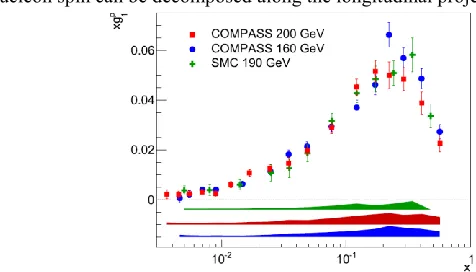
present here COMPASS results on the proton longitudinal spin structure function g1p(x) [1].
The measurements were performed using 200 GeV polarized muons from the CERN SPS (tertiary beam), scattered off a longitudinally polarized NH3 target [2]. Results [1] are
shown in Fig.1 together with previous results taken at 160 GeV [3] and earlier results from SMC [4]. The new data cover smaller x values, down to 0.0036. They improve the statistical precision of previous COMPASS data by a factor of about 2.
2 Test of the Bjorken Sum Rule
The Bjorken sum rule is a fundamental QCD prediction relating the difference of first moment of the proton and the neutron spin structure functions to the ratio of the axial-vector to axial-vector weak coupling constants gA/gV assuming SU(2) flavour symmetry. It can
be tested by combining the COMPASS proton [1] and deuteron [5] results to calculate the non-singlet spin structure function g1NS(x) = g1p(x) - g1n(x) , and compare its first moment
to the prediction.
Preliminary results for g1NS(x) are shown in Fig.2 left, and the corresponding truncated
integral values (integrated from the minimum x=xmin to 1), are shown versus xmin in Fig.2
right. The full integral corresponds to a value of gA/gV = 1.220 ± 0.053(stat) ± 0.095(syst).
Comparing this result [1] to the value obtained from neutron decay measurements, 1.2701 ± 0.0025 [6], we can say that the Bjorken sum rule is validated within 9% accuracy. The dominant uncertainty comes from systematic uncertainties on beam and target polarisation and target dilution factor (fraction of polarisable material in the target). Note that the data cover 94% of the contribution to the integral, a remarkable feature compared to other evaluations.
Fig. 2.Left: The nucleon non-singlet spin structure function g1NS vs x, measured from COMPASS p and d data. Right: truncated integral of g1NS from xmin to 1, vs xmin. The arrow shows the value extrapolated to xmin=0.
3 NLO QCD fit of g
1world data
The COMPASS g1p and g1d measurements are shown in Fig. 3 as a function of Q2 for
various x values, together with other world data. The COMPASS coverage is very significant in the low x and large Q2 regions. To extract quark and gluon helicity
distributions, we have performed a global NLO QCD fit to all these and existing neutron data. A functional form is assumed at an initial Q02 scale for the singlet, the triplet and the
1/2 = ½ + G + Lz, where represents the quark spin contribution,G the gluon spin
one and Lz the contribution from the orbital angular momenta of quarks and gluons. We
present here COMPASS results on the proton longitudinal spin structure function g1p(x) [1].
The measurements were performed using 200 GeV polarized muons from the CERN SPS (tertiary beam), scattered off a longitudinally polarized NH3 target [2]. Results [1] are
shown in Fig.1 together with previous results taken at 160 GeV [3] and earlier results from SMC [4]. The new data cover smaller x values, down to 0.0036. They improve the statistical precision of previous COMPASS data by a factor of about 2.
2 Test of the Bjorken Sum Rule
The Bjorken sum rule is a fundamental QCD prediction relating the difference of first moment of the proton and the neutron spin structure functions to the ratio of the axial-vector to axial-vector weak coupling constants gA/gV assuming SU(2) flavour symmetry. It can
be tested by combining the COMPASS proton [1] and deuteron [5] results to calculate the non-singlet spin structure function g1NS(x) = g1p(x) - g1n(x) , and compare its first moment
to the prediction.
Preliminary results for g1NS(x) are shown in Fig.2 left, and the corresponding truncated
integral values (integrated from the minimum x=xmin to 1), are shown versus xmin in Fig.2
right. The full integral corresponds to a value of gA/gV = 1.220 ± 0.053(stat) ± 0.095(syst).
Comparing this result [1] to the value obtained from neutron decay measurements, 1.2701 ± 0.0025 [6], we can say that the Bjorken sum rule is validated within 9% accuracy. The dominant uncertainty comes from systematic uncertainties on beam and target polarisation and target dilution factor (fraction of polarisable material in the target). Note that the data cover 94% of the contribution to the integral, a remarkable feature compared to other evaluations.
Fig. 2.Left: The nucleon non-singlet spin structure function g1NS vs x, measured from COMPASS p and d data. Right: truncated integral of g1NS from xmin to 1, vs xmin. The arrow shows the value extrapolated to xmin=0.
3 NLO QCD fit of g
1world data
The COMPASS g1p and g1d measurements are shown in Fig. 3 as a function of Q2 for
various x values, together with other world data. The COMPASS coverage is very significant in the low x and large Q2 regions. To extract quark and gluon helicity
distributions, we have performed a global NLO QCD fit to all these and existing neutron data. A functional form is assumed at an initial Q02 scale for the singlet, the triplet and the
octet SU(3) flavour combinations of the quark distributions as well as for the gluon
distribution. The first moments of the non
Fig. 3. World data on g1 proton (left) and deuteron (right) vs Q2, for various x. COMPASS data are in red. The dotted lines represent the solutions of a COMPASS global NLO QCD fit (see text)..
singlet distributions are fixed to the values of the axial-vector weak coupling constants measured in neutron and hyperon -decay. The x-Q2 evolution is made in the MS
factorisation scheme (program #1 taken from [7]). Depending on the choice of the functional forms at the initial Q02 scale, two classes of possible solutions are found. They
correspond to a positive and negativeG value and values in between are allowed. The value of , correlated to G, ranges between 0.26 and 0.36 at the same scale. The dominant uncertainty in the extraction comes from the choice of the functional forms chosen at the initial Q02 scale. Results for the two solutions are shown in Fig.4 at Q2 = 3
(GeV/c)2, with on top the quark singlet helicityqS(x) (the integral of which gives) and
Fig. 4. Top: Helicity distributions of the quarks (left) and the gluons (right) at 3 (GeV/c)2 in MS scheme [1]. Bottom: Helicity distributions per flavour. The solid and dashed lines correspond to the solutions with positive and negative G. Dark bands correspond to propagation of statistical errors, and the light bands to the combined statistical and systematic uncertainties (dominating and mainly attributed to choice of functional forms).
4 Measurement of
and K multiplicities in semi inclusive DIS
Parton fragmentation functions (FFs), like parton distribution functions (PDFs), are non-perturbative objects. They describe the hadronization of partons. The FFs are process independent and are used to describe the probability that a quark of flavor q fragments into a hadron of type h (Dqh). They are needed e.g. for the extraction of flavor dependent quark
helicity distributionsΔq(x) [8,9] from semi-inclusive polarized deep inelastic scattering. In particular, to access the strange quark polarization Δs from polarized SIDIS, the strange quark FF into kaon DsK is needed and it constitutes by far the largest contribution to the
uncertainty in the extraction. Data sensitive to FFs exist from e+e- and p p(bar) reactions,
but they are insufficient for a good flavor separation; they also lie at relatively too high Q2
values. This is why it was decided to measure charged hadron multiplicities in SIDIS with a high precision and a fine binning in several variables.
At leading order (LO), the hadron multiplicities M(x,Q2,z), defined as the mean number of
hadrons h produced in a semi inclusive deep inelastic scattering event p h X, are simply related to PDFs, q(x, Q2) (for flavour q), and quark FFs, D
qh(z,Q2):
(1)
Fig. 4. Top: Helicity distributions of the quarks (left) and the gluons (right) at 3 (GeV/c)2 in MS scheme [1]. Bottom: Helicity distributions per flavour. The solid and dashed lines correspond to the solutions with positive and negative G. Dark bands correspond to propagation of statistical errors, and the light bands to the combined statistical and systematic uncertainties (dominating and mainly attributed to choice of functional forms).
4 Measurement of
and K multiplicities in semi inclusive DIS
Parton fragmentation functions (FFs), like parton distribution functions (PDFs), are non-perturbative objects. They describe the hadronization of partons. The FFs are process independent and are used to describe the probability that a quark of flavor q fragments into a hadron of type h (Dqh). They are needed e.g. for the extraction of flavor dependent quark
helicity distributionsΔq(x) [8,9] from semi-inclusive polarized deep inelastic scattering. In particular, to access the strange quark polarization Δs from polarized SIDIS, the strange quark FF into kaon DsK is needed and it constitutes by far the largest contribution to the
uncertainty in the extraction. Data sensitive to FFs exist from e+e- and p p(bar) reactions,
but they are insufficient for a good flavor separation; they also lie at relatively too high Q2
values. This is why it was decided to measure charged hadron multiplicities in SIDIS with a high precision and a fine binning in several variables.
At leading order (LO), the hadron multiplicities M(x,Q2,z), defined as the mean number of
hadrons h produced in a semi inclusive deep inelastic scattering event p h X, are simply related to PDFs, q(x, Q2) (for flavour q), and quark FFs, D
qh(z,Q2):
(1)
(2)
where x is the Bjorken variable, i.e. the fraction of momentum carried by the struck quark, Q2 is the momentum transfer and z is the energy fraction taken by the hadron. C depends on
kinematics and eq is the quark fractional charge. Note that apart from the Q2 dependence,
PDFs depend upon x, while FFs depend upon z. This will be useful in the disentanglement of FFs from PDFs, while only the product of both is measured.
The [10] and K multiplicities [11] were measured using COMPASS SIDIS data taken in 2006 with an isoscalar target (6LiD). They were corrected by the value of the global
acceptance of the apparatus estimated in each (x, y, z) bin, where y is the lepton energy fraction carried by the virtual photon. The acceptance of the spectrometer was evaluated from a Monte Carlo simulation, comparing the number of generated and reconstructed events in the whole chain of analysis. For this study, the y variable is chosen instead of the
Q2 one, since Q2 is too much correlated to x. For the and K identification a RICH detector
is used. Additional corrections including RICH unfolding and radiative corrections were applied. As an illustration, final multiplicities for positive charge kaons are shown in Fig.5 in the three dimensional binning. Similar data were obtained for negative charge kaons, as well as for positive and negative charge pions.
Fig. 5.K+multiplicities [11] shown vs z for nine x ranges and 5 y ranges (for better visibility shifted vertically by a constant ). Statistical errors are small and hardly visible. The bands correspond to the total systematic uncertainty for the range 0.3 < y < 0.5.
Fig. 6. Sum of positive and negative charge hadron multiplicities integrated over z and plotted vs x.
COMPASS data (full points) are compared to HERMES ones (open points). The bands show the total systematic uncertainties.
5
Extraction of quark fragmentation functions into pions from a
LO fit to pion multiplicities
Starting from the equation (1) given at LO, FFs can be extracted once PDFs are taken from the literature. In each (x,y,z) bin, two equations are given by the + and - multiplicity
measured in that bin. We can extract two FFs, namely the favored and unfavored quark FFs into pions. They correspond to pion valance and sea quarks respectively, and are the two independent pion FFs left after applying isospin and charge symmetry relations between FFs, and assuming in addition that the strange quark FF is equal to the unfavored one. In order to use simultaneously all data measured at various Q2, a LO fit is performed. For this,
functional forms are chosen for the shape of the two FFs at an initial Q02 value, and the
DGLAP equations are used for the evolution to the measured Q2 of each data point. Results
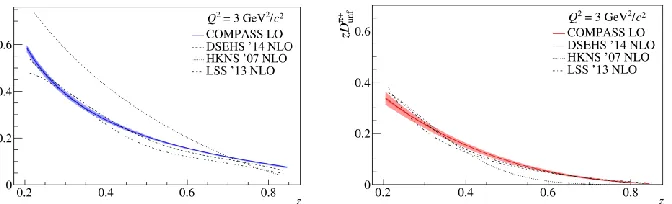
for the favored and unfavored quark FF into pions obtained from the fit of the pion multiplicities are shown in Fig.6. The statistical error band was obtained with a replica method, varying the data points within their error. Our result [10] is in fair agreement with fits realized at NLO on similar SIDIS data [13]. They differ, as expected from fits including only e+ e- data [7].
Fig. 6. Sum of positive and negative charge hadron multiplicities integrated over z and plotted vs x.
COMPASS data (full points) are compared to HERMES ones (open points). The bands show the total systematic uncertainties.
5
Extraction of quark fragmentation functions into pions from a
LO fit to pion multiplicities
Starting from the equation (1) given at LO, FFs can be extracted once PDFs are taken from the literature. In each (x,y,z) bin, two equations are given by the + and - multiplicity
measured in that bin. We can extract two FFs, namely the favored and unfavored quark FFs into pions. They correspond to pion valance and sea quarks respectively, and are the two independent pion FFs left after applying isospin and charge symmetry relations between FFs, and assuming in addition that the strange quark FF is equal to the unfavored one. In order to use simultaneously all data measured at various Q2, a LO fit is performed. For this,
functional forms are chosen for the shape of the two FFs at an initial Q02 value, and the
DGLAP equations are used for the evolution to the measured Q2 of each data point. Results
for the favored and unfavored quark FF into pions obtained from the fit of the pion multiplicities are shown in Fig.6. The statistical error band was obtained with a replica method, varying the data points within their error. Our result [10] is in fair agreement with fits realized at NLO on similar SIDIS data [13]. They differ, as expected from fits including only e+ e- data [7].
Fig. 6. Favored (left) and unfavored (right) quark fragmentation functions into pions extracted from a LO fit to COMPASS multiplicities [10].
6 Conclusion
Recent COMPASS results are show on the spin structure function g1p(x) measured using a
200 GeV polarized muon beam. They improve the statistical precision by a factor of ~2 at low x. A re-evaluation of the Bjorken sum rule based on COMPASS data alone confirms its validation within 9% accuracy. The NLO QCD fit was performed to g1 proton, deuteron
and neutron world data. It leads to a value of the quark spin contribution to the nucleon spin
, between 0.26 and 0.36 at Q2 = 3 (GeV/c)2. The rather large uncertainty comes
essentially from the unknown shape of the polarized parton distributions. The Bjorken sum rule was verified within 9% accuracy using COMPASS data alone, which cover 94% of the contribution to the integral, a remarkable fact compared to other measurements.
Precise results on pion and kaon multiplicities produced in DIS of muons off an isoscalar target were presented. They constitute an impressive data set covering a large kinematical domain, which will be used in future global NLO QCD fits to extract quark fragmentation functions into and K. A first LO fit was performed to extract the favoured and unfavored quark fragmentation functions into pions. Results agree with previous NLO fits which included a preliminary subset of the present data. The sum of positively and negatively charged hadron multiplicities integrated over z is found in significant disagreement with HERMES data, both for pions and kaons.
The results presented here were previously discussed in a preliminary form [15, 16]. More data on the spin structure function of the deuteron will soon be published by COMPASS, together with an update on the verification of the Bjorken sum rule [17].
References
1. COMPASS Collab., C.Adolph et al., PLB 753,18 (2016) 2. COMPASS Collab., P.Abbon el al., NIM A 517, 455 (2007). 3. COMPASS Collab., M. G. Alekseev et al., PLB 690, 466 (2010) 4. SMC Collab., B. Adeva et al., Phys. Rev. D 58, 11201 (1998) 5. COMPASS Collab., V. Alexakhin et al., PLB 647, 8 (2007)
6. J. Beringer et al.,, Particle Data Group, Phys. Rev. D86, 010001 (2012)
7. M. Hirai, S. Kumano, T.-H. Nagal and K. Sudoh, Phys. Rev. D 75,094009 (2007) 8. COMPASS Collab., M. G. Alekseev et al., Phys. Lett. B 693 (2010) 227
9. COMPASS Collab., M. G. Alekseev et al., Phys. Lett. B 680 (2009) 217
10. COMPASS Collab., C.Adolph et al., arXiv 1604.02695, Phys. Lett. B to be published 11. COMPASS Collab., C.Adolph et al., arXiv 1608.06760, subm. to Phys. Lett. B 12. HERMES Collab., A. Airapetian et al., Phys. Rev.D 89 (2014) 097101 13. D. de Florian, et al., Phys. Rev. D 91 (2015) 014035.
14. E. Leader et al., arXiv 1312.5200, Proceedings of DSPIN-13, Dubna, Russia (2013) 15. F. Kunne, Proceedings of SPIN2014, Int. Journal of Modern Physics A: Conf. Series
Vol. 40 (2016) 1660017
16. F. Kunne, Proceedings of SPIN2014, Int. Journal of Modern Physics A: Conf. Series Vol. 40 (2016) 1660027


![Fig. 4. Top: Helicity distributions of the quarks (left) and the gluons (right) at 3 (GeV/c)2 in MS scheme [1]](https://thumb-us.123doks.com/thumbv2/123dok_us/8068505.1345464/4.482.45.437.64.328/fig-helicity-distributions-quarks-left-gluons-right-scheme.webp)
![Fig. 5. total systematic uncertainty for the range 0.3 < y < 0.5.K+ multiplicities [11] shown vs z for nine x ranges and 5 y ranges (for better visibility shifted vertically by a constant )](https://thumb-us.123doks.com/thumbv2/123dok_us/8068505.1345464/5.482.61.424.287.471/systematic-uncertainty-multiplicities-ranges-visibility-shifted-vertically-constant.webp)