Text and Label Reading Using Robust Text
Localization
Shradha Chalikwar, A. B. Manwatkar, Sinu Nambiar
M.E Student, Dept of Computer Engineering, Indira College of Engineering and Management, Savitribai Phule Pune University, Maharashtra, India.
Assistant Professor, Dept. of Computer Engineering, Indira College of Engineering and Management, Savitribai Phule Pune University, Maharashtra, India.
Assistant Lecturer, Dept. of Computer Engineering, Indira College of Engineering and Management, Savitribai Phule Pune University, Maharashtra, India.
ABSTRACT: Currently in day to day life, in order to read the text label from packaged hand-held object for the blind person is very difficult, in market camera based product used for text reading framework for identifying the text. Text is localized by effective motion method to define ROI (Region of interest) in image by asking user to shake the object i.e. In ROI, text localization and recognition are conducted to obtain textual information. Different types of methods are used to localize the text for example: Mixture of Gaussian subtraction method, Adaboost model. Scope of the amendment is to achieve better accuracy in proposed algorithms. At present, SWT operator is being used to fine the value of stroke width for each image pixel. Operator is local and data dependent which makes it robust and fast.
KEYWORDS: Text localization, SWT, Edge Detection, ROI, Adaboost model.
I. INTRODUCTION
Consider an example from our day to day life, suppose removing text and sign, then how difficult it would be to get information; so it is an important aspect to make visually impaired people’s life easier. For visually impaired people, text reading is important aspect of their life which decides the quality of life. Identification of text from natural image is important for visually impaired person. Main aspect behind that to try and help those people who are suffering in their daily routine..
People with clear vision can use facilities like computer, internet and education soft-ware. However, for visually impaired people can have less access to any of these digital facility. As a result of this, they cannot enrich their knowledge with these advancement facilities. So it impacts economic, commercial, education ventures in the society. One of the way to shorten gap is to develop such system which is economical and facilitate them to communicate freely with widely used information infrastructure.
II. RELATED WORK
III.PROPOSED ALGORITHM
A. DESIGN CONSIDERATIONS:
Scene Capture.
Text Localization
Audio Output
B. DESCRIPTION OF THE PROPOSED ALGORITHM:
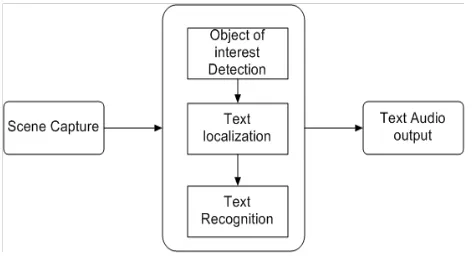
The scene seize component collects scenes containing objects of curiosity in the form of pix or video. In our proposed mannequin the camera hooked up to a pair of sunglasses. The information processing aspect is used for deploying our proposed algorithms, including, Object-of-interest detection to selectively extract the image of the object held by the user from the cluttered background or other neutral objects in the camera view. Text localization to obtain image regions containing text, and text recognition to transform.Image-based text information into readable codes. Text to audio conversion: once the audio output component is to inform the user of recognized text codes. Bluetooth earpiece with mini microphone is employed for speech output. In the propose work text detection and label reading using SWT (Stroke Width Transform) method and canny edge detection method.
Fig Proposed System Architecture
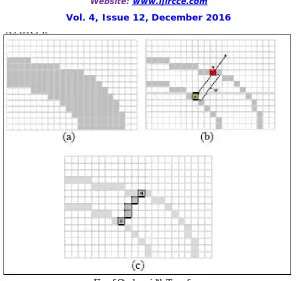
Stroke width Transform (SWT):-The Stroke Width Transform to be (SWT) is a local image operator which computes per pixel the width of the obviously stroke containing the pixel. The output of the SWT is an snapshot of measurement equal to the size of the enter image the place each element includes the width of the stroke associated with the pixel. In determine(a).Can outline a stroke to be a contiguous a part of an image that varieties a band of a almost steady width. It does now not expect to know the exact width of the stroke however as a substitute get better it. The preliminary price of every element of the SWT is ready to. As a way to get better strokes, first compute edges within the snapshot using canny area detector. After that, a gradient course dp of every e edge pixel p is considered fig of SWT. If p lies on a stroke boundary, then dp ought to be roughly perpendicular to the orientation of the stroke. Then follow the ray r=p+n*dp, n>0 until another edge pixel q is found. consider then the gradient direction dq at pixel q. If dq is roughly opposite todp(dq= -dp± π/6)element sof the SWT output image corresponding pixel along segment[p,q] is assign width |p-q| unless it already has a lower value.Otherwise, if the matching pixel q is not found, or if dqis not opposite to dp, the
Fig of Stroke width Transform
The SWT values more complex situations, like corners will not be true stroke widths after the first pass. Therefore it pass along each non discarded ray again, compute median SWT value m of all its pixels, and then set all the pixel of ray with SWT values above m to be equal to m
Fig of Example of SWT
2. Localization: The detected edges must be as close as possible to the actual edges.
3. No of responses: One actual part will have to now not result in a couple of detected aspect (one could argue that this is implicitly incorporated within the first requirement).
Canny edge Detector is perfect for a designated category of edges (often called step edges)it’s apparent from that an image of the gradient magnitudes in most cases indicate the edges quite certainly.
IV.PSEUDO CODE
To implement the text detection system uses two method are compared to the stroke orientation to stroke width transform and the edge distribution of pixel to canny edge detection. These two method were choose because of their generally good performance. They improve text detection performance and give better quality result. In that system is work focus on only text detection. For text to speech part using Microsoft lib.Following are the steps of algorithm.
1. Capture image of the hand held object by portable camera.
2. Image capturing exactly localize text on object by using SWT method. 3. After this, conversion of image into grey scale takes place.
5. Firstly it maps edges text by using canny edge detection algorithm. Canny edge detector returns the co-ordinates of the text area.
6. Using this co-ordinate, cropping the text region from the image takes place. 7. Hereafter text detector using ASPOSE library is applied.
8. These steps returns the letter identification. Then these letters are grouped together into text.
9. Detected word is given to the text to speed converter. Text to speech converter converts text into respective audio format
V. EXPERIMENTAL RESULTS
Text classification based on the Cascade-Ad-boost classifier plays an principal role in text area localization. To evaluate the effectiveness of the textual content classifier, It performed first on collection of images on the dataset of pattern patches, in which the patches containing textual content are positive samples and people without textual content are negative samples. Each patch was assigned a prediction rating by the text classifier; a better rating indicates a higher chance of textual content information.
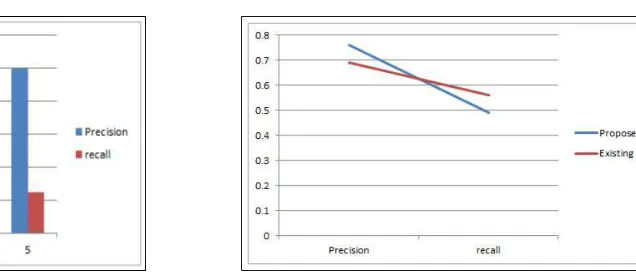
Fig of result of precision and recall of image data Fig of result analysis of existing & proposed sys. According to existing system experimental result propose system is gives better result as show in graph. This graph describes the sample images and recall value that indicate image accuracy in percentage
.
Method Precision Recall Our 0.76 0.49 Chueai 0.69 0.56 Hinnerk Beck 0.62 0.67 AlexChen 0.60 0.60 Fig of: Different method Result Table
In this system managed the Through utilizing the equal analysis measures as above experiments, existing procedure obtained precision 0.52, recall o.62, this dataset. In that utilizing ICDAR 2013 dataset the precision is diminish than that on the strong reading dataset.The photos in the person-captured dataset have slash resolutions and extra compact distribution of text information, in order that they generate low-first-rate area maps and text boundaries, which result in unsuitable spatial layouts and textual content constitution aspects.According to propose system method good result as compare other result. In the propose system using ICDAR 2015 dataset reading challenges refer. Precision value is 0.76 and recall value is 0.49.The stroke width transform (Text detection) graph shows the SWT text detection result.
VI.CONCLUSION AND FUTURE WORK
5. M SharmilaKumariAkshatha Local Features based Text Detection Techniques in Document Images.
6. X. Chen, J. Yang, J. Zhang, and A. Waibel, Automatic detection and recognition of signs from natural scenes,IEEETrans.Image Process.,vol. 13, no. 1, pp.8799, Jan.2004.
7. Anish Kumar J Assistive Text Reading System using Gradient and Stroke Orientation for Blind Person,
8. Advance Data Reports from the National Health Interview Survey (2008). International Workshop on Camera-Based Document Analysis and Recognition (CBDAR 2005, 2007, 2009, 2011). [Online]: Available: http://www.m.cs.osakafuu. ac.jp/cbdar2011
9. Shehzad Muhammad and Hanif, Lionel Prevost Text Detection and Localization in Complex Scene Images usin Constrained AdaBoost Algorithm Institute des Systems Intelligentset de Robotique, CNRS, UMR .
BIOGRAPHY