Electronic Theses and Dissertations Theses, Dissertations, and Major Papers
2013
Photograph type and content influences memory retrieval models
Photograph type and content influences memory retrieval models
that are too broad, too tight, or just right
that are too broad, too tight, or just right
Joanna Hessen Kayfitz
University of Windsor
Follow this and additional works at: https://scholar.uwindsor.ca/etd
Recommended Citation Recommended Citation
Hessen Kayfitz, Joanna, "Photograph type and content influences memory retrieval models that are too broad, too tight, or just right" (2013). Electronic Theses and Dissertations. 4946.
https://scholar.uwindsor.ca/etd/4946
This online database contains the full-text of PhD dissertations and Masters’ theses of University of Windsor students from 1954 forward. These documents are made available for personal study and research purposes only, in accordance with the Canadian Copyright Act and the Creative Commons license—CC BY-NC-ND (Attribution, Non-Commercial, No Derivative Works). Under this license, works must always be attributed to the copyright holder (original author), cannot be used for any commercial purposes, and may not be altered. Any other use would require the permission of the copyright holder. Students may inquire about withdrawing their dissertation and/or thesis from this database. For additional inquiries, please contact the repository administrator via email
Photograph type and content influences memory retrieval models that are too broad, too tight, or just right
by
Joanna K. Hessen Kayfitz University of Windsor
A Dissertation
Submitted to the Faculty of Graduate Studies through the Department of Psychology in Partial Fulfillment of the Requirements for
the Degree of Doctor of Philosophy at the University of Windsor
Windsor, Ontario, Canada 2013
AUTHOR’S DECLARATION OF ORIGINALITY
I hereby certify that I am the sole author of this thesis and that no part of this thesis has been published or submitted for publication.
I certify that, to the best of my knowledge, my thesis does not infringe upon anyone’s copyright nor violate any proprietary rights and that any ideas, techniques, quotations, or any other material from the work of other people included in my thesis, published or otherwise, are fully acknowledged in accordance with the standard referencing practices. Furthermore, to the extent that I have included copyrighted material that
surpasses the bounds of fair dealing within the meaning of the Canada Copyright Act, I certify that I have obtained a written permission from the copyright owner(s) to include such material(s) in my thesis and have included copies of such copyright clearances to my appendix.
ABSTRACT
Research to date suggests that non-event-specific photo/narrative pairings produce higher false memory rates than do event-specific photos. The former differ from the latter in that the former provide relevant imagery but omit the specific event to be recalled, thereby promoting novel imaginings and increasing the likelihood of false memories. Two studies sought to determine which type of photograph constitutes a superior retrieval cue. The first study explored the role of how the photograph was framed upon presentation. Thirty-six participants were randomly assigned to conditions as follows: 1) narrative alone, 2) narrative plus photograph introduced as having been taken during the event, and 3)
ACKNOWLEDGEMENTS
I am extremely fortunate to have many wonderful people in my life who have helped me along the way, and without whom the successful completion of this project would not have been possible. First and foremost, I would like to express my heartfelt gratitude to my research supervisor, Dr. Alan Scoboria. He truly epitomizes what it means to be a research mentor and genuinely takes care to create a unique zone of proximal development for his students. Despite being a busy clinician and researcher, he was always generous with his time and there was rarely an occasion when he was not readily available when his assistance was needed. Thank you so much, Alan, for the endless revisions, consultations, and pep talks along the way.
On a personal note, I would like to thank my parents, Jan and Zofia Hessen, for their love, support and encouragement. My parents have emphasized the importance of working hard for what I wanted to achieve, and were always front row and center to cheer me on. I also want to thank my husband, Adam Kayfitz, for his unwavering support throughout this project. It takes an exceptionally patient and loving soul to stand by a spouse caught up in the rigors of a dissertation, and I am blessed to have him in my life. I also want to thank my amazing friends for providing much-needed perspective, laughter, and cheerleading along this journey.
Finally, I would like to thank my research assistants for all of their wonderful work. Without their attention to detail, strong work ethic, and dedication, the data for this
TABLE OF CONTENTS
Page
AUTHOR’S DECLARATION OF ORIGINALITY iii
ABSTRACT iv
ACKNOWLEDGEMENTS vi
LIST OF TABLES x
LIST OF FIGURES xi
CHAPTER I Introduction 1
Distortion of True Memories 2
Creation of Entirely False Memories 3
False Narratives 5
False Photographs 6 False Narratives versus False Photographs 7 True Photographs as Assistive Cues 8 Common Factor: The Self 10 Self-Relevant Details in Narratives 12 Self-Relevant Details in Photographs 13 Metacognitive Operations Governing Acceptance and Rejection of Events 15 Metacognitive Beliefs 16 Autobiographical Beliefs 18 Metacognitive Monitoring Processes and the Self 19 Self-Schema Theory 20 Source Monitoring Framework 27 Summary and Common Factors 32
Implications for False Memory Formation 35 Summary of Current Knowledge and How to Proceed 43 Study 1 45
Hypotheses 47
Hypothesis 1 47
Hypothesis 2 47
Hypothesis 3 48 Study 2 49
Hypotheses 54
Hypothesis 1 54
Hypothesis 2 54
Participants and Setting 58
Design and Materials 58
Soliciting information from parents 58
Booklets 59
Creation of Conditions 59
Measures 60
ABMQ 60
Judges’ ratings 61
Memory Characteristics Questions 61
Procedure 62
III Study 1 Results 67
Judges’ ratings 67
Overall true image and memory formation 67
Overall false images and memories formed 67
False memory formation rates across groups 68
Autobiographical Belief and Memory Questionnaire (ABMQ) 74
Memory Characteristics Questionnaire (MCQ) 75
Participants’ guesses 75
Discussion 76
IV Study 2 Method 87
Participants and Setting 87
Design and Materials 87
Soliciting information from parents 87
Booklets 87
Creation of Conditions 87
Measures 88
Procedure 88
V Study 2 Results 91
Judges’ ratings 91
Overall images and memories formed 91
False memory formation rates across groups 91
Autobiographical Belief and Memory Questionnaire (ABMQ) 92
Memory Characteristics Questionnaire (MCQ) 93
Participants’ guesses 97
Discussion 97
VI GENERAL DISCUSSION 105
Role of frame of reference on memory retrieval model 105 Role of photograph content on memory retrieval model 107
Summary and implications 110
Limitations and future research 117
APPENDIX A: Sample Event-Specific/Non-Specific Doctored Photograph 138 APPENDIX B: Recruitment Message for Eligible Participants 139
APPENDIX C: Letter of Information for Parents 140
APPENDIX D: General Consent Form 142
APPENDIX E: Audio-taping Consent Form 145
APPENDIX F: Participant Debriefing 146
APPENDIX G: Debriefing Letter for Parents 147
APPENDIX H: Consent for Use of Data Post-Debriefing 149 APPENDIX I: Autobiographical Belief and Memory Questionnaire 150
APPENDIX J: Memory Characteristics Questions 153
APPENDIX K: Demographic Questions 154
TABLES Page
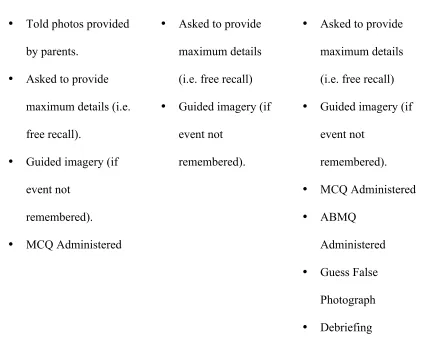
1 Timeline and content of the three interviews 66
2 Examples of transcripts falling into the No Images, Images only, or Memory categories
69
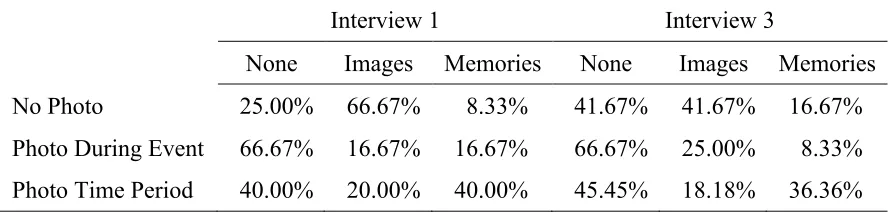
3 Percentage of image and memory formation per judge’s ratings by experimental condition and time
70
4 Percentage of image and memory formation for true events per judge’s ratings by experimental condition and time
72
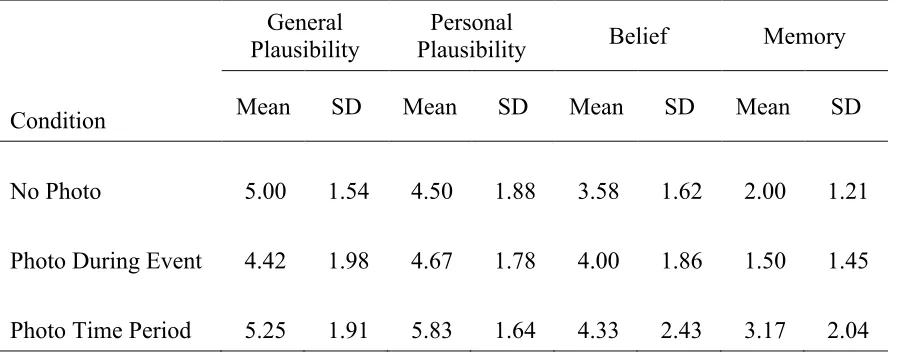
5 Means and standard deviation for all Autobiographical Belief and Memory Questionnaire (ABMQ) variables at Interview 3
77
6 Means and standard deviation for all Memory Characteristics Questionnaire (MCQ) variables at Interview 1 and Interview 3
79
7 Percentage of image and memory formation per judge’s ratings by
experimental condition and time – valid participants 94 8 Means and standard deviation for all Autobiographical Belief and
Memory Questionnaire (ABMQ) variables at Interview 3 – Valid participants
96
9 Means and standard deviation for all Memory Characteristics Questionnaire (MCQ) variables at Interview 1 and Interview 3
FIGURES Page
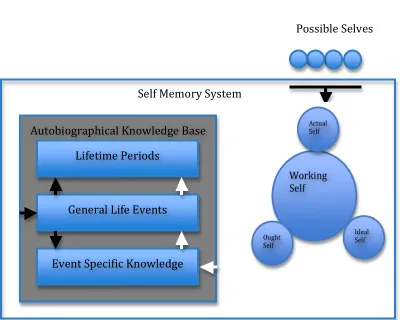
1 Schematic Representation of Self-Memory System 24
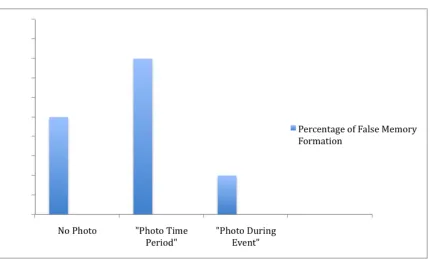
2 Predicted rate of false memory formation as a function of experimental condition
50
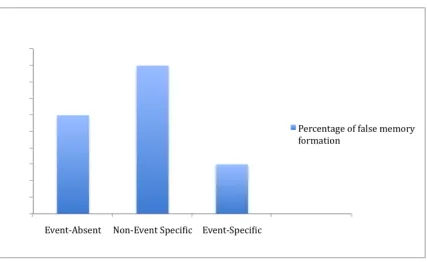
3 Predicted rate of false memory formation as a function of experimental condition
57
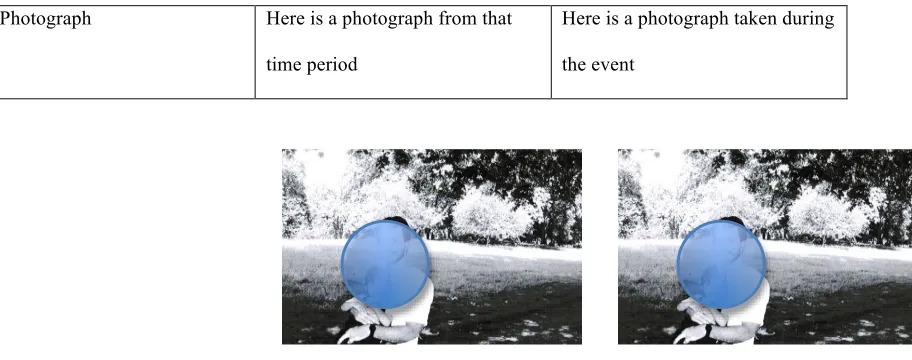
4 Illustration of the three experimental conditions in Study 1 63 5 Percentage of memory formation for false event per judges’ ratings by
experimental condition at Interview 3
71
6 Mean Autobiographical Belief and Memory Questionnaire (ABMQ)
Memory ratings at Interview 3 78
7 Illustration of the three experimental conditions in Study 2 90 8 Percentage of memory formation for false event per judge’s ratings by
experimental condition at Interview 3
CHAPTER I
Introduction
The topic of “false” or “implanted” memories has become ubiquitous in both the
psychology and criminal justice literature. The impetus for research in this area was
originally born out of concern over the general accuracy of memory - most infamously,
the accuracy of childhood memories of sexual abuse recovered during therapy. The
fallibility of memory stems from its underlying reconstructive nature, a concept first
introduced by Bartlett (1932) and elaborated upon by Neisser (1976). When one perceives
the world, the cognitive system does not preserve a snapshot representation of what is
perceived. Rather, a mental representation of the present experience is constructed. There
is a gap between present experience and subsequent remembering of same. Presumably,
something is stored. It follows, then, that remembering involves a degree of reactivation
of the previously activated network. However, this reactivation is not akin to reactivating
the exact same pattern as that present at the time of original perception. Remembering is
an act of creating a present reconstruction of past perceptual and reflective states. This
reconstructive process is not without error, in that some reorganization inevitably takes
place. We fill in gaps based on expectations and assumption about what likely occurred,
as informed, for example, by our general schematic knowledge. This process also can
involve the incorporation of entirely novel information such that the end product - the
memory – may not be a true reflection of the original perceptive state. Memory’s
susceptibility to change has given rise to a large body of research which can be divided
into two main streams: that involving distorted true memories and that involving
Distortion of True Memories
Prior research demonstrates that details within memories for true events can be
altered. In fact, even “flashbulb memories” (defined as vividly detailed memories of the
circumstances under which one first experienced a significant and emotionally
meaningful public or personal event; e.g., Challenger space shuttle disaster, 9/11 terrorist
attacks) often show inaccuracies as do “ordinary” memories (e.g. Neisser & Harsch,
1992, Talarico & Rubin, 2003). Nevertheless, there are elements of flashbulb memories
that are more likely to be accurate, such as contextual details about the event.
As such, even the most vividly experienced of memories are susceptible to decay
and interference effects. Regarding the decay theory of memory, it is proposed that
memory fades over time such that the original memory trace slowly disintegrates and is
increasingly less available for retrieval as a factor of time. According to Ebbinghaus’
classic research, the half-life of human memory is approximately one hour, absent regular
rehearsal (Ebbinghaus, Ruger & Bussenius, 1913). Another mechanism by which
memory can be altered is through interference. Interference theory suggests that new
information interacts with information formerly encoded such that learning is impaired.
Interference can be either proactive or retroactive (Jenkins & Dallenbach, 1924). The
former involves the forgetting of new information due to information provided before the
target event has occurred (e.g. remembering an event one way despite the provision of
new information that refutes the original memory), whereas the latter involves forgetting
due to information provided after the target event has occurred. In this case, the new (i.e.
post-event information) may merge and integrate with the original memory and alter or
inaccurate information.
When post-event information is inaccurate and relates to the original event, it is
termed “post-event misinformation”. When individuals incorporate the new
misinformation into their recall for the original event, this is termed the “misinformation
effect” (Wright, Self, and Justice, 2000; Loftus, 2007). In Loftus and Palmer’s (1974)
seminal misinformation study, participants viewed videotapes of car accidents and
estimated the speed with which the vehicles were traveling at impact. Speed estimates
were 20% higher when a strong verb such as “crashed” was presented while answering
questions after viewing the videotape, contrasted with weak verbs such as “contacted”.
Furthermore, when retested a week later, those questioned with “smashed” were more
than twice as likely to report seeing a broken headlight, even though there was no broken
headlight in the videotape.
The pernicious effects of misinformation have been repeatedly demonstrated in
the literature over the years (Loftus, 2007). Although it has been suggested that peripheral
details are easier to alter (Heath & Erickson, 1998), other studies have shown that it is
possible to alter memory for a central detail as well (Okado & Stark, 2005).
Creation of Entirely False Memories
However important in helping elucidate the mechanisms of what makes memory
fallible, research examining the distortion of true memories does not address the
fabrication of completely novel memories (Pezdek & Lam, 2007). As noted above,
distortion of true memories can occur naturally through reconstructive remembering
processes or can be induced. These processes involve the manipulation of details,
grounded in autobiographical reality, whereas false memories are not. The creation of
false memories involves a significantly greater degree of distortion, which can carry
consequences with greater implications.
Research into false memories was reinvigorated by the controversy over
recovered memories of alleged childhood sexual abuse that were purportedly recovered
during therapy, that appeared to in fact never have occurred. In some cases, individuals
who had initially reported recovered memories of abuse following psychotherapy later
withdrew their accusations (Schacter, 2001). Research examining the experiences of these
individuals noted that coming to form this false memory resulted in an identity shift such
that individuals came to partly define themselves survivors of childhood sexual abuse
(Lief & Fetkewitz, 1995). The subsequent realization that what had appeared to be an
autobiographical fact was actually untrue, especially one of such significance, not
surprisingly contributed to distress in many of those who retracted their abuse memory
claims. Moreover, the gap between the initial accusation and the withdrawal of the same
led to significant collateral damage in many cases (legal cases, damaged reputations and
careers of those falsely accused, destruction of families, and the like). That such
significant and life-altering memory distortions appeared to be possible prompted
researchers to examine the processes by which such claims could develop (de Riviera,
1997) as well as how they then came to be retracted (Ost, Vrij, Costall, & Bull, 2002).
Ethical considerations prohibit the experimental examination of how false
memories of childhood sexual abuse can be formed. However, Loftus & Pickrell (1995)
are credited with performing the first study to address this phenomenon, using the false
participants with 4 narratives describing events from their early childhood, all of which
were allegedly provided by the participants’ relatives (i.e. parents or older siblings).
Three of these events were true, whereas one was a false narrative about how the
participant had been lost in a shopping mall. Based on an interview with the relatives, a
booklet of events was generated and sent to participants, who were asked to write as
much as they could remember about each event description. Participants were then
interviewed twice. At the conclusion of the second interview, 29% of participants fully or
partially remembered having experienced this event (Loftus & Pickrell, 1995).
This methodological approach has since been termed the “familial-informant
false-narrative procedure” (Lindsay, Hagen, Read, Wade, & Garry, 2004), the
‘implantation procedure’ (Otgaar, Candel, Merkelbach & Wade, 2009), or more
colloquially the “lost in the shopping mall paradigm,” and has been employed in
numerous studies and with a large variety of target false events. Strange, Gerrie and
Garry (2005) found that collapsing across nine studies using false narratives alone, 33%
of adults came to remember aspects of a suggested false event.
False Narratives
Initial research into false memory formation has relied on the use of false
narratives allegedly provided by others (i.e. parents, relatives) to study how this
phenomenon occurs. Although clearly a powerful suggestive medium, a potential
criticism of using narratives is that individuals perceive, and thus remember, events
idiosyncratically. As such, they will describe them as occurring from their own
perspective, which dictates how and what aspects of the event are remembered (Ross,
differently. As French, Sutherland, and Garry (2006) aptly summarize: “What is
remembered does not equal what happened, and will vary for each person” (pp. 6). They
reported that siblings who were asked to independently recall details of a specific
common event overlapped on details only 24.7% of the time, thereby suggesting that the
remaining 75.3% from each perspective contained details that differed purportedly to
varying degrees.
As such, narratives are not an objective representation of fact. This can lead to
their authenticity being questioned, even in circumstances where the event in question is
actually true. Photographs, on the other hand, are rarely disputed. Even when we are
increasingly more aware of imaging software programs that can alter photographs, the
authenticity of our family photographs is rarely questioned - we just assume that they are
the real thing and the event depicted in the photo did in fact occur (Strange et al., 2005).
False Photographs
Wade, Garry, Read, and Lindsay (2002) extended the false memory research to
study the influence of doctored photographs, positing that such photographs may be more
effective in altering memory because of the trust placed therein as compared to a verbal
account. They argue that family photographs constitute compelling evidence that the
events depicted therein actually occurred. Furthermore, a photograph is full of rich
perceptual details, which may act as cues for remembering the event (Lindsay et al.,
2004). In order to test this, Wade et al. (2002) solicited four true photographs from
participants’ family, and doctored one of them to depict the participant with a parent in a
hot air balloon. Participants were interviewed three times over the course of a week and
and guided imagery and context reinstatement were employed to assist participants when
they experienced difficulty remembering. At the conclusion of the third interview, 20% of
participants formed complete memories of the false event and 33% formed images alone
(i.e. descriptions of images associated with the event that the participant did not appear to
experience as memories; Wade et al., 2002). It is notable that Loftus and Pickrell’s (1995)
definition of “partial” versus “full” remembering was very limited, and thus does not
allow for a precise comparison with Wade et al. (2002). However, it appears that 50% of
Wade et al.’s (2002) participants formed images or memories for the false event as
compared to 29% of Loftus and Pickrell’s (1995). This shows that doctored photographs
constitute a powerful suggestive cue – one that may appear to be superior to narratives.
False Narratives Versus False Photographs
Although Wade et al.’s (2002) results suggest that photographs may be more
effective at promoting false memories than are narratives, such a conclusion requires a
direct comparison of the two media. In order to do so, it is necessary to somehow equate
the two suggestive media, which is exactly what Garry and Wade (2005) attempted.
Using the hot-air balloon ride target event, the researchers gave half of their participants a
narrative describing the event whereas the second half received a photograph depicting
the event. At the conclusion of three interviews, approximately 32% of participants in the
photograph condition were judged as having a memory for the event and approximately
18% formed images alone. In the narrative condition, approximately 40% of participants
were judged as having a memory for the event and approximately 42% formed images
alone. Garry and Wade (2005) originally reported their findings as a composite of images
generated when comparing photographs to narratives (50% versus 82% respectively).
Although a larger percentage of false memory formation occurred in the narrative
condition as compared to the photograph condition, the difference (40% versus 32%) is
not as practically meaningful. Nevertheless, it is striking that the percentage of imagery
formation found in the narrative condition was double the percentage of imagery
formation found in the photograph condition.
To explain the inconsistency of these finding with Wade et al.’s (2002) theoretical
assertion that photographs trump narratives due to their vivid visual characteristics, Garry
and Wade (2005) proposed that photographs impose constraints on the development of
the type of fluent processing associated with remembering relative to narratives. The
ambiguity of narratives allows individuals to generate their own details to flesh out their
mental image for an event, whereas photographs limit the flexibility to freely imagine
idiosyncratic details. Certain details depicted in the photograph may limit the recollection
of other details, as well as the way in which the details depicted can be visualized, owing
to the need to maintain consistency with the details as depicted in the photo. As such,
photos may impose stronger limitations on finding matching information in memory,
thereby increasing the likelihood that a false event will be rejected.
True Photographs as Assistive Cues
However, deeming all photographs to be more memory-constraining as compared
to narratives may be premature. As Strange et al (2005) point out, most individuals would
not likely encounter a doctored photograph showing them engaging in something that
they never did or being somewhere they had never been. Indeed, this may be why
possible. This raises the question, is it necessary to alter or otherwise falsify a photograph
such that it depicts a specific target event in order for it to be an influential agent of false
memory creation? After all, individuals sometimes turn to picture evidence for cues to
help themselves remember - even in the absence of an exact photograph depicting the
event to be remembered. Moreover, Lindsay et al (2004) observed that some memory
recovery techniques encourage individuals to consult family photo albums to aid in
recalling unremembered childhood events.
Lindsay et al. (2004) conducted a study to explore whether individuals would be
more likely to endorse memory for a false event if they were shown a relevant picture to
assist in their recall. In order to encourage participants to remember a false event, the
authors employed the standard narrative paradigm described above with some
modifications. First, the target false event was a childhood prank wherein participants
allegedly got into trouble for having put a toy in their teacher’s desk, which is arguably a
more common (and likely more believable) event than is a hot air balloon ride. Second,
participants were interviewed two times instead of three. Finally, all participants were
presented with three narratives (two true and one false). However, one half of the
participants also received a class photograph from the time period that the events were
drawn from purportedly to help them remember. The results showed that 65.2% of
participants in the narrative plus photograph condition were judged as having memories
and 13% were judged as having images. Of those in the narrative alone condition, 22.7%
were judged as having memories and 27% were judged as having images. Lindsay et al.
(2004) argued the false narrative provides the suggestion whereas the photograph
form a false memory. Accordingly, not only can photographs operate as powerful
facilitative devices, this study provides compelling evidence that they do not necessarily
need to depict the target event to exert their influence in promoting false memories
(Strange et al., 2005).
The idea that understanding information contained within a narrative can be
enhanced by also presenting a photograph was first introduced by Bransford & Johnson
(1972). In their study, they presented all participants with a story that was quite abstract
and senseless, and half received a photograph to accompany the story. Those who heard
only the story reported lower comprehension and remembered less of the story content.
Those who received the accompanying photograph, on the other hand, reported higher
comprehension ratings and remembered more of the story. The authors suggested that the
photograph helped the participants create a context within which to comprehend the story.
A necessary proviso is that in order to be helpful as comprehension aides, pictures must
be relevant and related to the narrative, otherwise recall is curtailed (Harp & Mayer,
1997).
Common Factor: The Self
Therefore, despite the debate regarding their relative superiority, narratives, true
photographs and doctored photographs all have emerged as powerful retrieval cues (i.e.
prompts used to induce the retrieval of memory) for inducing false memories. The
manner in which these media have been employed in the literature thus far has been fairly
consistent, thereby facilitating the above-mentioned comparisons between them in order
to determine which results in the highest false memory formation rate. In all studies to
photographs) were provided by the participants’ parents; 2) the use of guided imagery to
help promote remembering; 3) the normalization of forgetting, with the rationale that one
has not thought of the events presented in a very long time; and relatedly, 4) the
development of the expectation that memories can be retrieved (by virtue of the previous
two points). The respective roles of these factors in false memory formation have been
empirically demonstrated. Scoboria, Wysman, and Otgaar (2012) have highlighted the importance of source credibility as a critical component of false belief formation.
Moreover, imagination and guided imagery are components of “repeated elicitation of the content” (Mazzoni & Kirsch, 2002), a processes routinely employed to facilitate
“remembering” in the false memory literature. These strategies, when employed in
combination with factors that increase autobiographical belief (prevalence information,
forgetting rationale; Scoboria et al; 2006), augment the likelihood that false memories
will be formed (e.g. Hyman & Pentland, 1996), and thereby constitute a “recipe” for false
memory formation.
Although each type of suggestive medium is distinct from the others, a common
factor among all three is the presence of some kind of self-relevant detail. In the literature
to date, one key detail is the participant themselves, which is arguably the most influential
self-relevant detail. There is consensus in the literature about the strong relationship
between the self and autobiographical memory (Conway & Pleydell-Pearce, 2000).
Moreover, the inherent self-referential nature of autobiographical memories is a key
feature in distinguishing these types of memories from other types of memory and
long-term knowledge stores (Brewer, 1986). In long-terms of the suggestive media used in false
narrative form and when either photograph type is used, the subject is visually depicted
therein.
Self-Relevant Details in Narratives
The impact of self-relevant details within the false memory context was first
investigated by Desjardins and Scoboria (2007). The authors considered the wide
variability of false memory formation rates in the literature, and posited that in addition to
the influence of event plausibility (Pezdek, Blandon-Gitlin & Gabbay, 2006), the widely
varying number and type of details contained in narratives across studies likely played a
role as well. Desjardins and Scoboria (2007) argued that in some studies, the narratives
contained information idiosyncratic to the participant (e.g., the name of the participant’s
hometown, name of a family member), while in other studies, such self-relevant details
were absent. They reported that studies which included self-relevant details tended to
evidence higher false memory formation rates (about 70%) vs. lower memory rates
(about 33%) in other false memory studies cited previously. Accordingly, Desjardins and
Scoboria (2007) hypothesized that the presence of self-relevant details influence false
memory formation.
To examine this hypothesis, Desjardins and Scoboria (2007) employed Garry and
Wade’s (2005) methodology, and Lindsay et al.’s (2004) false narrative. The latter was
tailored to vary the inclusion of self-relevant details (“your friend Suzy”, versus “a
friend”), specific details (defined as “elements of the narrative that could be removed
without altering the general script;” which included “revolting slime toy” versus “a toy”),
both, or neither. They found that the inclusion of self-relevant information produced
did not include such information (36.4%). Furthermore, subjective memory ratings were
significantly greater when self-relevant information was included in false narratives.
There was no effect found for the inclusion of highly specific details.
A possible explanation for these findings is that self-relevant details serve to
promote fluency of processing, a concept related to Jacoby and Dallas’ (1981)
attributional view of memory and later elaborated by Whittlesea’s (1993) fluency
attribution hypothesis. According to this view, fluent (i.e. rapid) processing of stimuli is
misinterpreted as familiarity that indicates having experienced said stimulus in the past.
This theory was later modified to posit that it is surprising fluency of processing that
elicits feelings of familiarity. These feelings result from a discrepancy between expected
versus experienced processing fluency (discrepancy attribution hypothesis; Whittlesea &
Williams, 1998). Therefore, by promoting feelings of familiarity which become
misattributed to the false event, self-relevant details may facilitate the endorsement of the
false event. The absence of self-relevant details provides sufficient latitude for individuals
to elaborate on the stimulus provided. However, given that fluency of processing is less
likely to occur under such conditions, research to date suggests that false memory
formation rates are comparatively not as high (Desjardins & Scoboria, 2007).
Self-Relevant Details in Photographs
Hessen-Kayfitz and Scoboria (2012) extended the work by Desjardins and
Scoboria (2007) by exploring the effects of fluency promoting and fluency inhibiting
details on memories when presented in doctored photographs. Employing the same
fluency-impeding details, both, or neither. The goal was to determine which combination
of photographic details created an optimal environment to foster false memory formation
In the study, parents of participants provided childhood photographs, and one
photograph was used to create an image of the participant posing in a hot air balloon with
one of their parents. The image of the hot air balloon was held constant, and fluency
promotion was manipulated by either clearly showing the participant and their parent (a
fluency promoting detail) or by obscuring them from view using a lens-flare effect.
Fluency impediment was manipulated by either having a neutral background or a
background with a lighthouse among some shrubs (an impeding detail). The results
revealed that including fluency promoting details, while omitting fluency impeding
details (e.g. clear view of participant and parent while omitting the lighthouse in the
background), created a more optimal environment for false memory formation, in that the
highest subjective memory ratings were found in this condition. Fluency-promotion alone
showed no direct influence on memories by way of main effects, in contrast to Desjardins
and Scoboria’s (2007) findings as outlined above.
Hessen-Kayfitz and Scoboria (2012) proposed that that details presented in
photographs are more conspicuous (as compared to narratives), and thus harder to dismiss
or attenuate when trying to remember an event. Accordingly, fluency promoting details
may have a lesser effect when presented in a photographic medium than in a narrative
medium. For example, when a person hears “[you] and [your mother] in a hot air
balloon”, [your mother], being a self-relevant detail, is fluency promoting, and they can
imagine their mother in many different ways. When shown a picture of themselves and
that is unfamiliar, or the mother may be dressed in a way that is not familiar to the
individual. Thus, the photographically depicted fluency-promoting detail loses some of its
power in that it restricts what is searched for in memory to the specific details depicted
(e.g. memories of “mom with that particular haircut, wearing that outfit,” as opposed to
just “mom”).
Metacognitive Operations Governing Acceptance and Rejection of Events
The idea that a fluency promoting detail is less powerful when presented in
photograph versus narrative form may be more of a contextual artifact than a feature of
the detail itself. That is to say, doctored photographs and false narratives both imply a
very specific context in which the fluency promoting detail is presented (i.e. the event
occurred as described and should thus be remembered in this manner). False narratives,
however, allow more room for cognitive maneuvering where the details are concerned
than do doctored photographs. In doing so, false narratives permit more contextual
flexibility such that fluency promoting details can exert greater power. The individual
trying to recall the event is thus afforded greater latitude to use those fluency promoting
details as a springboard to generating additional fluency promoting details with which to
generate a mental product suitable enough to be labeled as a memory. The doctored
photographs used in studies to date, on the other hand, provide a visual representation of
the suggested event. If the photograph is intended to be accepted as an accurate
representation of the event - which it is - then the implied expectation is that the event
should be remembered as depicted, and that each detail of the photograph should be
remembered as depicted. If any memory that happens to be elicited in response to the
accepted as true. Put another way, the threshold for event acceptance is higher such that
the end result is an inability to make a decision about the occurrence of the event (i.e.
neither acceptance nor rejection).
Metacognitive Beliefs
Judgments about the past occurrence of an event involve a complex metacognitive
decision-making process which Mazzoni and Kirsch (2002) proposed is comprised of two
factors: 1) information available about the event at the moment of making a decision
about its occurrence; and 2) metacognitive beliefs that individuals hold regarding
memory. Considering the first factor using the hot air balloon ride event, examples of
information held by individuals include knowledge of having gone to amusement parks as
a child, having gone on scary rides, having been with their parents during activities done
when young, and the like. Referencing the second factor, individuals hold certain beliefs
about memory, such as that memories fade over time (Cornoldi, 1998), that it is not
possible to remember events that occurred very early in life, that events experienced in
life are encoded and stored somewhere in memory, that encoded information can be
retrieved with some effort, and that memory retrieval can be assisted with cues.
Mazzoni and Kirsch (2002) contend that determining whether an event occurred
involves attempting to generate a mental representation, which is then evaluated
according to one’s metacognitive beliefs about the qualitative aspects of memories (i.e.
contextual, semantic, affective, perceptual, and information about cognitive operations;
Johnson, Hashtroudi, and Lindsay, 1993). They also include less specific qualities such as
familiarity and specificity (Johsnon, Raye, Mitchell, & Ankudowich, 2011). The degree
will be deemed to be a memory. The threshold for this judgment process is flexible,
which is advantageous as it allows for the retrieval of memories encoded at various levels
of quality and specificity. If the criteria were rigid, many memories would be lost to us
given that attempts to remember them could never satisfy very strict threshold criteria.
However, a byproduct of this flexibility is the probability of false memories occurring, as
will be discussed in greater depth below.
The discussion above concerns processes that occur when some kind of
event-consistent mental product is generated. Mazzoni and Kirsch (2002) propose that when an
adequate mental product cannot be generated, people must decide whether the absence of
memory is diagnostic of the event not having occurred (Strack & Bless, 1994). This
occurs via inference, and is based on at least three metacognitive beliefs; 1) the more time
that has elapsed between encoding and retrieval increases the likelihood of forgetting, so
not having a sufficiently good mental product in such a case would not be diagnostic of
non-occurrence; 2) events that occurred early in life (i.e. before the offset of childhood
amnesia) also are likely to be forgotten; and 3) the more distinctive the event, the more
likely it is to be remembered, whereas less distinctive events are less likely to be
remembered. Therefore, not remembering an event that is deemed to be rare or unusual in
some way may suggest that the event did not actually occur.
Mazzoni and Kirsch (2002) contend that if lack of memory is considered to be
diagnostic of the event not having occurred, then the decision that the event did not occur
can be made without needing to consider any further information. If, on the other hand,
lack of memory is not diagnostic of non-occurrence, the decision about whether or not the
evaluation of any additional available information, such as information that has been
provided to aid in decision making (i.e. information provided by an experimenter in a
study or by a family member).
Thus, new information can alter both the way in which an event is remembered, as
well as impact the final decision regarding event occurrence - a key step in the creation of
false autobiographical beliefs (Mazzoni & Kirsch, 2002; Scoboria, Mazzoni, Kirsch &
Relyea, 2004). In the case of infrequent events (e.g. hot air balloon rides), individuals
might judge the event as having a low likelihood of being true. However, increasing the
perception of the plausibility of an event (e.g., through the provision of prevalence
information; Mazzoni, Loftus & Kirsch, 2001; Scoboria et al. 2006) also should increase
belief in the event having occurred, as has been empirically demonstrated (see Mazzoni &
Kirsch, 2002 for a review).
Autobiographical Beliefs
Once a false autobiographical belief has been created, Mazzoni and Kirsch propose
that proceeding to the development of a false memory involves two factors acting in
concert: 1) changes in the threshold criterion according to which mental products are
evaluated as to the degree to which they constitute a memory, and 2) the development of
higher quality mental products related to the target event. Both factors are critical in
producing a decision that one remembers an event. The key role that beliefs play is that
they influence the threshold criterion. As noted above, this threshold is flexible and can
be reduced if belief in the event is increased. This reduction in the threshold enhances the
likelihood that mental products will be deemed as good enough to constitute memories.
the content” (Mazzoni & Kirsch, 2002) which occurs during imagination,
context-reinstatement, and guided imagery - all processes routinely employed to facilitate
“remembering” in the false memory literature. These methods, when employed in
combination with factors that increase belief (prevalence information, forgetting
rationale; Scoboria et al; 2006), augment the likelihood that false memories will be
formed (e.g. Hyman & Pentland, 1996).
To return to the findings of Hessen-Kayfitz and Scoboria (2012), the vivid and
specific retrieval cue presented (i.e. the doctored photograph containing the
fluency-promoting details) may have created a highly stringent criterion against which to compare
the mental products generated in response to it. In other words, the threshold for event
acceptance was made to be higher by this particular photograph. The fluency-promoting
details in this case are less powerful as they limit the ability to freely imagine an event
and enhance the quality of the mental product generated in response to the cue. As such,
according to the Mazzoni and Kirsch (2002) model, the provision of information (i.e. that
photographs were provided by parents, the rationale normalizing the forgetting of
childhood events, and the like) may have sufficiently raised belief such that the event was
not rejected. However, the two factors that might translate elevated false belief into false
memory (decreasing threshold criterion and/or developing higher quality mental
products) may not have occurred optimally.
Metacognitive Monitoring Processes and The Self
Overall, the process of accessing, retrieving and evaluating information obtained
from an autobiographical memory search depends on a series of metacognitive
(e.g. Burgess & Shallice 1996; Koriat, Goldsmith & Pansky, 2000; Johnson et al., 1993;
Johnson et al., 2011).
Additionally, as mentioned above, the importance of the relationship between
autobiographical memory and the self is endorsed by a number of researchers in the area
of autobiographical memory. Two theories that encompass both concepts (metacognitive
monitoring processes and the self) in relation to one another are self-schema theory
(Conway & Pleydell-Pearce, 2000) and source monitoring theory (Johnson, Hashtroudi &
Lindsay, 1993). Each theory, as well as the idiosyncratic ways in which retrieval cues
contribute to false memory formation, within each, will be discussed in turn.
Self-Schema Theory
Conway and Pleydell-Pearce’s (2000) self-schema theory is a model adapted from
the work of Markus and Ruvolo (1989) and Markus and Nurius (1986), which introduces
the concept of a self-memory system (SMS) in which autobiographical memory is
constructed. The SMS is comprised of an autobiographical knowledge base (a multilevel
store of information about the self; see below for further detail) as well as the working
self concept. Referencing the latter, the authors propose that long-term memory
representations of different aspects of the “self’ form into sets of self-schemas. Only a
subset of these schemas are active at any given time. Currently active schemas comprise
the working self, which is a constantly changing view of the self and what it may become.
Conway and Pleydell-Pearce (2000) reference Higgins’ (1987) theory of the self which
posits that there are three domains of the self: 1) the actual self (representations of
attributes that one actually possesses); 2) the ideal self (representations of attributes one
should possess). Discrepancies between these three dimensions of the self give rise to
negative emotional experiences. Higgins (1987) emphasized that memories which
suggest discrepancies between the actual self and the ought and ideal selves are the most
affect-laden, and are accompanied motivation to reduce this negative affect. The central
goal of the working self is to reduce discrepancies, and thus plays a critical role in the
encoding of autobiographical knowledge and the construction of memories during
remembering. The cues representing the innocuous false events employed in the literature
do not contribute to the same intense and destabilizing affective states associated with
more fundamental discrepancies (e.g. discrepant morals and values). However, the
features of self-discrepancy theory espoused by the SMS suggest that a sufficient degree
of intrapersonal tension and discomfort is triggered when an individual is presented with
a cue suggestive of an autobiographical event that they do not immediately remember.
This negative affect, in turn, gives rise to a motivation to reduce the discrepancy.
The discrepancy-reducing goal of the working self functions as a negative
feedback mechanism, complete with an input, a standard for comparison, and output
(Austin & Vancouver, 1996). If a discrepancy is detected between the input and the
standard, the output is modified accordingly so as to reduce this discrepancy and
associated negative feelings. Two ways in which this modification is accomplished are
attempts at justification (labeling the input that is resulting in these dissonant feelings as
an exception to the norm) or attempts at outweighing (finding multiple examples of
consonant autobiographical events so that the single dissonant input is outweighed). This
is consistent with Leon Festinger’s theory of cognitive dissonance, which states that
beliefs, or to modify existing ones, so as to reduce the amount of dissonance therein
(Festinger, 1957).
The goals of the working self are posited to play a key role in regulating cognitive
stability. They are also integral in both the encoding and the retrieval of autobiographical
knowledge, which is classified into three broad levels in Conway’s model: lifetime
periods, general events (which are further divided into repeated events and specific
events), and event-specific knowledge (ESK; see Fig. 1).
These knowledge levels are organized in a hierarchical fashion (Barsalou, 1988).
For example, various details within ESK (i.e. wedding dress, reciting vows, signing a
marriage license) are organized as part of a specific general event (i.e. wedding day),
which is in turn part of a lifetime period (e.g. graduate school versus entry into
professional life). When a stable pattern of activation occurs across each of these
autobiographical knowledge areas, this is termed an autobiographical memory. The three
levels of autobiographical knowledge moderate the construction of autobiographical
memories. These levels limit which area of the knowledge base a given cue can access.
Central control processes that moderate access to and output from the autobiographical
knowledge base also limit autobiographical memory construction. This is done in
accordance with the working self concept’s goal of maintaining cognitive consonance. In
order to do so, the working self acts as a “gate keeper” of sorts by dictating the generation
of memory retrieval models with specific parameters which either facilitate or impede
access to the autobiographical knowledge base. So, for example, if an
externally-presented retrieval cue is dissonant with current goals of the self (i.e. does not “fit” into
access to the autobiographical knowledge base, and the likelihood of the successful
retrieval of an autobiographical memory product is decreased.
Conway and Pleydell-Pearce (2000) originally conceptualized the Self-Memory
System (SMS) as being comprised of the autobiographical memory base and the working
self concept. The theory was later modified to include an integrated “long term self”,
which includes the autobiographical knowledge base and the “conceptual self” (Conway,
Singer & Tagini, 2004). The latter can be thought of as a collection of abstract versions of
the self in the context of different episodic experiences, as well as versions of possible
selves (ostensibly influenced by personal desires for the self as well as societal influences
on what the self should be). Despite this adjustment to the SMS, the basic components are
nevertheless the same. Namely, the working self (a currently active subset of
self-schemas) initiates a retrieval model to access the autobiographical knowledge base
(which is now housed in the new “long term self”), doing so self”), doing so according to
a set of goals, the most prominent of which is to reduce discrepancies between the
possible selves (which is a component of the new “conceptual self”).
As such, the SMS can be conceptualized as a central control centre which
generates patterns of activation which represent specific memories, either through
generative or direct retrieval (Conway, 1996). The first search strategy (generative
retrieval) consists of a iterative three stage process as follows: 1) elaboration of a memory
search cue and the establishment of verification criteria; 2) matching the cue to patterns
of activation in the autobiographical knowledge base (i.e. memories); and 3) accessed
memories are compared to the verification criteria wherein only knowledge that is not
Figure 1. Schematic Representation of Self-Memory System (Conway & Pleydell-Pearce,
verification criteria are satisfied, and can be conceptualized as a discrepancy-reducing
negative feedback loop (Conway & Pleydell-Pearce, 2000). The verification criteria thus
serve as a metacognitive monitoring process that evaluates the retrieval products to
ensure that the requisite threshold has been met in order to deem the product to be a
memory.
This elaborate retrieval process can be by-passed if a cue is sufficient to elicit a
stable pattern of activation in the autobiographical knowledge base at the level of ESK
(see white arrow, Fig. 1). The stable pattern of activation suggests congruence with the
autobiographical knowledge base. As such, the working self concept does not need to
engage in the discrepancy-reducing cue-elaboration phase of generated retrieval, and a
less onerous direct search strategy can be employed instead. According to Conway and
Pleydell-Pearce (2000), ESK is most strongly associated with imagery. Moreover, its
activation may trigger autonoetic consciousness (a sense of recollectively experiencing
the past or “mental time travel”) which is a key component in episodic remembering
(Tulving, 1983) and gives the individual that sense of rapidly activated information about
the qualitative characteristics of a retrieval product. According to this logic then, if such a
highly specific cue designed to access the autobiographical knowledge base and elicit an
activation pattern at its most detailed level (i.e. ESK) fails to induce imagery or
autonoetic processing where such induction is clearly expected, then it stands to reason
that such a failure results in the termination of the retrieval process and the memory
search is deemed to have failed. In other words, cues designed to access ESK are held to
the highest congruence standard: either a stable pattern of activation must occur, or the
base. Moreover, the formation of an activation pattern in the first place is quite tenuous,
depends on the specificity of the cue, and how that cue is processed with reference to its
ability to activate ESK (Conway and Pleydell-Pearce, 2000).
Given the framework of the SMS model and its retrieval processes, what
constitutes the “ideal” retrieval cue? Although cues that tap into the autobiographical
knowledge base at the level of ESK may seem like optimal choices for retrieving a
memory, Conway (1996) states that general events are actually the preferred level of
entry into the knowledge base when attempting to bring about recall of an event. Entry at
this level has the advantage of allowing the individual to access a collection of candidate
general events rather than be limited to one. Moreover, although individuals have “fast
access” to lifetime period and general event knowledge (Burgess & Shallice, 2000), when
individuals are given a retrieval cue and prompted to retrieve a memory, the retrieval
model generated by the working self is such that initial retrieval attempts are made at the
level of general event knowledge (see black arrow, Fig. 1).
Conversely, cues that are designed to access autobiographical knowledge at the
level of ESK limit the individual in that spreading activation moves from that specific
point in ESK and activates a single general event and then a single lifetime period. For
example, when attempting to cue an individual to retrieve a memory of taking a hot air
balloon ride at an amusement park at the age of six, a cue at the ESK level might be to
show a picture of the specific hot air balloon, which then may activate the single general
event (going on a hot air balloon ride) situated within a single lifetime period (six years of
age). This works well if the specific ESK cue hits the mark, as a stable activation pattern
in a memory (Conway & Pleydell-Pearce, 2000). But if the specific ESK cue fails to
activate knowledge at that level and must attempt to activate knowledge at the next level
in the hierarchy (specific general event of going to that particular amusement park and
taking a hot air balloon ride), the spread of activation may be too diffuse to generate a
stable and focused enough pattern of autobiographical knowledge activation that can be
deemed to constitute a memory (Conway & Pleydell-Pearce, 2000).
A cue at the general event knowledge level, on the other hand, might be a picture
of a non-specific amusement park, which will purportedly activate a collection of general
events (various trips to amusement parks). Given the relative ambiguity of this cue (as
compared to an ESK-level cue), the retrieval strategy employed will be generative
retrieval, which as described above results in the iterative generation of retrieval products
until the verification criteria are satisfied and the requisite threshold has been met in order
to deem the product to be a memory. In sum, it is the nature of the cue provided that
dictates the type of retrieval model generated. It is here that errors may occur via the
intentional provision of misleading or entirely false retrieval cues, which in turn can
result in false memory formation. Exactly how this occurs will be discussed in detail,
following the review of the second key theory.
Source Monitoring Framework
Johnson, Hashtroudi, and Lindsay’s (1993) Source Monitoring Theory (SMF)
conceptualizes memory as being a result of the cognitive processes that comprise our
daily experiences (Lindsay, 2008). The very process of encoding an experience is filtered
by our perceptions, attitudes, and interpretations of the situation. This view suggests that
flexible decision criteria and judgment processes at retrieval, coupled with the qualities of
the mental representation, determine whether or not a memory will be accurately
attributed to its origin or not. The meaning of the information, the physical surroundings,
the emotions at the time, are all included in this memory by-product which can be used to
provide cues about the source of the information. Thinking about experiences reactivates
them according to the same attitudes and expectations present at encoding. Thus,
memories are a combination of actual experience as well as imagery, fantasy and
inference (Bransford & Johnson, 1973).
According to SMF, remembering is inferential: It involves processes through
which attributions are made about the origins of mental experiences. Mental components
such as images, emotions, perceptions, and thoughts are attributed to a source (Johnson,
Hashtroudi & Lindsay, 1993). This source attribution is aided by a variety of cues, such
as environmental cues or qualitative and quantitative cues from memory (Nash, Wade, &
Lindsay, 2009). Cues are critical in that they have the capacity to revive many different
features of a previously experienced event. Some may evoke a great deal of emotion
whereas others may evoke more perceptual information. Which specific features a cue
evokes depends on various factors. One such factor is the very nature of the cue itself,
according to the principle of Transfer Appropriate Processing (or Encoding Specificity;
Tulving & Thompson, 1973), which posits that the best retrieval cues are ones that match
the conditions present at encoding. According to the source monitoring framework,
various perceptual features of events (e.g. visual, auditory) are processed by different
neural networks in the brain, which are then consolidated into an integrated memory
autobiographical memory (Newcombe, Lloyd & Ratliff, 2007). Binding, in turn, is key to
the autonoetic (i.e. mental time travel, or the ability to mentally place ourselves in the
past) quality of remembering described above. The stronger the binding of event
fragments, the more likely it is that a large number of these fragments will be retrieved,
such that the event will be re-experienced as vivid and coherent memory in response to a
cue. Retrieving a personally-experienced event from memory is thought to elicit
autonoetic consciousness (i.e. as if one has traveled back in time and can reflect upon
their experience). A cue may trigger a particular feature of a past event, although the
extent to which the entire event (i.e. a collection of composite features) is revived as a
concrete memory depends on how well the constituent features have been bound together.
Reflecting on a newly experienced event (i.e. engaging in elaborative encoding)
strengthens binding and consolidates the memory for that event (Wixted, 2004).
Moreover, SMF posits that the act of memory retrieval itself results in memory traces of
that instance of retrieval - a kind of “meta-remembering.” Memory cues, however,
rarely serve to retrieve a single event memory but rather a whole multitude of events that
share features/episodic information triggered by (or related to) the cue that retrieved them
(Lindsay, 2008). Furthermore, abstract knowledge, expectations, scripts and schemas are
also evoked. These multiple episodes combine with general knowledge in order to
pinpoint the specific memorial information that is sought. This enhances the efficiency of
the system, because if the only way that a specific memory could be retrieved is by
providing a specific cue, there would be no point of retrieval because the cue itself would
constitute the sought after memory (Lindsay, 2008).
monitoring framework addresses the process by which individuals discriminate memories
of externally generated information (i.e. perceived events) versus internally generated
information (i.e. imagined events). Overall, monitoring of source is the result of
evaluative processes by which the various characteristics of a mental experience are
weighed and attributed to a specific origin, or source. The most important characteristics
used in attributing source of memories include perceptual (sensory) information,
contextual (place and time) information, semantic detail, affective information, and
cognitive operations (the experience of organizing, elaborating, retrieving and identifying
a given memory) that occur during encoding.
According to Johnson, Hashtroudi, and Lindsay (1993), mental experiences differ
on several clearly defined dimensions. Namely, memories that originate from external
experiences contain richer perceptual detail, more contextual detail, more semantic detail,
and more affective detail. Conversely, memories that originate from imagination and
from thinking about the perceived event contain more details about the cognitive
processes that took place to generate them (i.e. thinking about thinking about the
memory). The metacognitive evaluation processes that occur when judging the source of
a memory take advantage of these inherent differences.
Source monitoring can occur in a heuristic manner (i.e. takes place quite rapidly
and non-deliberatively) based on the characteristics of the mental experiences that are
activated (Johnson et al., 1993). If the characteristics are consistent with those of true
perceptual experiences, the mental experience will be judged to be a memory. Source
monitoring can also involve slower, systematic (conscious) reasoning processes, which
material from memory with which to verify the source of the original mental
representation. For example, a vivid memory of flying unaided is likely to be attributed as
being a fantasy rather than a true recollection of a past experience, on account of
knowledge that flying is impossible (Lindsay, 2008) Research has shown that individuals
hold sets of beliefs about memory from a very early age (Cornoldi, Gobbo & Mazzoni,
1990), which include beliefs that information encoded and stored in memory can be
retrieved and that this retrieval takes effort but that it can be assisted with the provision of
retrieval cues (Mazzoni & Kirsch, 2002).
Which judgment process is activated is largely a factor of retrieval context and
cues provided, cost of error, and amount of distraction at the time of encoding (Johnson,
1993). In informal contexts where memory accuracy is not paramount, judgment
processes and evaluative criteria will be lower. Additionally, situations where one either
already believes or wants to believe that the event occurred will yield more liberal
judgment criteria. It is under these circumstances that the risk for source monitoring
errors is high. If motivation to remember an event is high, the liberal judgment criteria
can result in the conclusion that something was experienced, when in fact it may only
have been imagined. As Conway (2005) put it when discussing his work with
confabulating frontal lobe patients, “experiencing one’s fantasies as memories is clearly
maladaptive, but it may nonetheless constitute an effective strategy for maintaining
coherence.” That is to say, if there is a motivation to remember something as being a true
memory rather than the product of imagination, source monitoring errors can be a useful
tool employed by the working self to maintain coherence.
source attribution. They also require setting criteria for making judgments and then for
comparing retrieval products with these criteria (Lindsay, 2008). Each process will have
its own sets of criteria. For example, according to the more rapid heuristic processes, the
criteria for judging a retrieval product to be a memory for a real event (versus an
imagined one) may be that it has to contain more perceptual, contextual, semantic, or
affective information, rather than information on cognitive operations. Additionally, each
type of information may be assigned a weight that is used to determine source. For
example, perceptual information may be assigned a higher weight for a recent event
versus a more temporally distant event (Lindsay, 2008). The more systematic controlled
processes, on the other hand, may involve judgment criteria that consider (and delimit)
the degree of inconsistency that a retrieval product can have with what is known
(Johnson, Hashtroudi & Lindsay, 1993). Put another way, episodic information that
results from retrieval processes must be sufficiently consistent with information contained
in an individuals’ autobiographical knowledge base in order for the source to be deemed
to be an actually experienced event. Finally, in addition to the qualitative characteristics
of the images generated by a retrieval cue, individuals may use the degree to which a
mental experience is familiar to them - the greater degree of familiarity and ease with
which a mental experience comes to mind (i.e. fluency of processing) is seen as
consistent with a real memory (Nash, Wade & Brewer, 2009).
Summary and Common Factors
Conway and Pleydell-Pearce (2000) propose a self memory system in which the
autobiographical knowledge base is reciprocally engaged with the working self such that,
is the initial cue - the stimulus that serves as the initial prompt to commence the retrieval
process - as this is the piece of information on which all subsequent elaboration and
verification is based. Johnson, Hashtroudi, and Lindsay (1993) propose a framework,
which suggests that remembering is based on an inferential process wherein mental
products are attributed to a particular source based on key qualitative characteristics. This
typically occurs automatically, although more systematic process exists for instances
where the heuristic processes fail to satisfactorily label a source.
These two models share some important similarities in terms of how they
conceptualize memory retrieval. First, both models encompass two pathways of retrieval,
one that is more direct and rapid whereas the other is more analytic, deliberate and
systematic. With reference to the latter (slower, more deliberate) retrieval process, both
the Self-Memory System (SMS) and the Source Monitoring Framework (SMF) endorse
the use of criteria according to which retrieval products are evaluated. In terms of SMF,
the criteria are based on key memory characteristics (i.e. perceptual, semantic, contextual,
affective, or cognitive-operational information) and serve to aide in evaluating the source
of the mental product. This evaluation stage is impacted by motivation. If one is
motivated to conclude that something is a memory, the evaluation criteria may be relaxed
to maximize the possibility of such a conclusion. This is done to maximize coherence – a
central goal of the working self. In terms of SMS, these criteria are generated based on
information held in the autobiographical knowledge base, and serve to ensure that
retrieval products are not dissonant with the goals of the working self. Additionally, there
are general criteria as to what mental states are representative of a real memory (e.g.