A Review on Different types of Deployment
Models in Cloud Computing
K E Narayana, Sailesh Kumar, Dr.K.Jayashree
Assistant Professor, Dept. of C.S.E, Indira Institute of Engineering and Technology, India Final year student, Dept. of C.S.E, Indira Institute of Engineering and Technology, India
Associate Professor, Dept. of C.S.E, Rajalakshmi Engineering College, India
ABSTRACT: Cloud computing is one of the emergent domains in which remote resources are used on the basis of demand, even without the physical infrastructure at the client end. In cloud computing, the actual resources are installed and deployed at remote locations consists of a shared pool of flexibly reconfigurable computing resources. Networks, servers, storage, applications and services can be rapidly deployed with minimal management input or service provider interaction.The services it provides include Infrastructure-As-A-Servcie(IaaS),Platform-As-A-Service(PaaS),Software-As-A-Service(SaaS).Every organization whether it’s small, mid-sized or big, wants to adapt this cutting edge technology for its business purpose. Cloud computing provides four different deployment models, like private, public, hybrid and community clouds. This paper aims at discussing these four deployment models, All the four models are defined, discussed and compared with the benefits and pitfalls, thus giving you a clear idea, which model to adopt for your organizations.
KEYWORDS: Cloud Computing, IaaS, PaaS, SaaS, VM, public, private, and hybrid
I. INTRODUCTION
The idea of cloud computing is based on a very fundamental principal of 'reusability of IT capabilities'. The divergence that cloud computing brings compared to traditional concepts of “grid computing”, “distributed computing”, “utility computing”. The aspects of personal life and work are moving towards the concept of availability of everything on the internet. Using this trend the very big web based companies like Google and Amazon came with a model namely “Cloud Computing” the sharing of web infrastructure to deal with the internet data storage, scalability and computation. Cloud computing has been defined by US National Institute of Standards and Technology (NIST) as “a model for enabling convenient, on-demand network access to a shared pool of configurable computing resources (e.g., networks, servers, storage, applications, and services) that can be rapidly provisioned and released with minimal management effort or cloud provider interaction”. Services can be scaled larger or smaller and use of a service is measured and customers are billed accordingly.
A. CHARACTERISTICS OF CLOUD COMPUTING
The Cloud Computing lists five essential characteristics,missing any one of these means a service cannot be considered as Cloud Computing.
1. On-demand self-service. A consumer can unilaterally provision computing capabilities, such as server time and network storage, without requiring human interaction with each service provider.
ISSN(Online): 2320-9801
ISSN (Print): 2320-9798
I
nternational
J
ournal of
I
nnovative
R
esearch in
C
omputer
and
C
ommunication
E
ngineering
(An ISO 3297: 2007 Certified Organization) Website:www.ijircce.com
Vol. 5, Issue 2, February 2017
4. Rapid elasticity. Capabilities can be elastically provisioned and released automatically in some cases, to scale rapidly outward and inward commensurate with demand.
5. Measured service. Cloud systems automatically control and optimize resource use by leveraging a metering capability at some level of abstraction appropriate to the type of service (e.g., storage, processing, bandwidth, and active user accounts). Typically this is done on a pay-per-use or charge-per-use basis.
B. BACKBONE TECHNOLOGIES IN CLOUD COMPUTING
1.2.1Virtualization
Virtualization is the major technology that works with cloud computing. An actual cloud is implemented with the use of virtualization technology. In cloud computing, dynamic virtual machines are created to provide access to actual infrastructure to an end user or developer at another remote location.A virtual machine or VM is the software implementation of any computing device, machine or computer that executes the series of instructions or programs as a physical (actual) machine. When a user or developer works on a VM, the resources, including all programs installed on the remote machine, are accessible using a specific set of protocols. Here, for the end user of the cloud service, the VM acts like the actual machine.
1.2.2 Prominent virtualization software
Prominent virtualization software on Windows and Linux host OSs are:
Windows as the host OS
VMware Workstation (any guest OS)
Virtual Box (any guest OS)
Hyper-V (any guest OS)
Linux as the host OS
VMware Workstation
Microsoft Virtual PC
VMLite Workstation
VirtualBox
Xen
A hypervisor or virtual machine monitor (VMM) is a piece of computer software, firmware or hardware that creates and runs virtual machines. A computer on which a hypervisor is running one or more virtual machines is defined as a host machine. Each virtual machine is called a guest machine. The hypervisor presents the guest OSs with a virtual operating platform and manages their execution. Multiple instances of a variety of OSs may share virtualized hardware resources.
II. CLOUD COMPUTING SERVICE MODELS
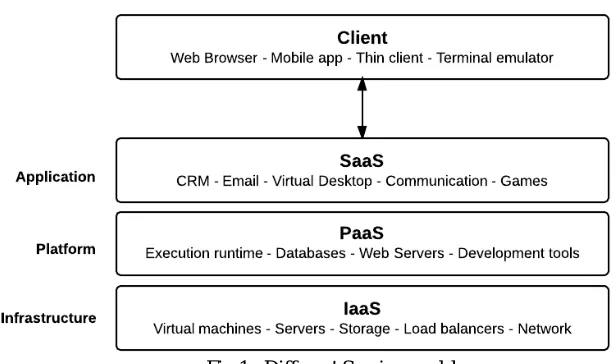
The three basic delivery models for cloud computing are given below.
1. Infrastructure-as-a-Service(IaaS): It provides the infrastructure (computing platform), resources and tools (servers, storage, network, etc) to build an application environment. Amazon's EC2 is an example of an IaaS. 2. Platform-as-a-Service (PaaS): It provides the computing platform as well as solution stack for consumers to
develop their own applications and host their own data. Google Apps is one of the major PaaS providers.
Fig 1: Different Service models
III. CLOUD COMPUTING DEPLOYMENT MODELS
There are four types of cloud Deployment models identified by NIST. 1. Private cloud
2. Public cloud 3. Hybrid cloud 4. Community cloud.
A. PRIVATE CLOUD
It is also known as Internal Cloud; involves a distinct and secure cloud based environment in which only the specified client can operate. It permits only the authorized users, and gives the organization greater and direct control over their data.The private cloud model is closer to the more traditional model of individual local access networks (LANs) used in the past by enterprise but with the added advantages of virtualization.
There are two variations to a private cloud:
1.On-premise Private Cloud: On-premise private clouds, also known as internal clouds are hosted within one’s own data center. This model provides a more standardized process and protection, but is limited in aspects of size and scalability.This is best suited for applications which require complete control and configurability of the infrastructure and security.
ISSN(Online): 2320-9801
ISSN (Print): 2320-9798
I
nternational
J
ournal of
I
nnovative
R
esearch in
C
omputer
and
C
ommunication
E
ngineering
(An ISO 3297: 2007 Certified Organization) Website:www.ijircce.com
Vol. 5, Issue 2, February 2017
Fig: 2 Structure of Private Cloud
3.1.1 Features of private cloud:
Higher security and privacy: Using private cloud technique such as distinct pools of resources with access
restricted to connections made from behind one organization’s firewall, dedicated leased lines and/or on-site internal hosting - can ensure that operations are kept out of the reach of prying eyes.
More control: As a private cloud is only accessible by a single organization, that organization will have the
ability to configure and manage it inline with their needs to achieve a tailored network solution.
Cost and energy efficiency: Implementing a private cloud can improve the allocation of resources within an
organization by ensuring that the availability of resources to individual departments.
Improved reliability: Resources like servers, networks etc. are hosted internally, the creation of virtualized
operating environments means that the network is more resilient to individual failures across the physical infrastructure
Cloud bursting;This service allows the provider to switch certain non-sensitive functions to a public cloud to
free up more space in the private cloud for the sensitive functions that require it
Examples of Private cloud 1.Eucalyptus
2. Ubuntu Enterprise Cloud 3. Amazon VPC
4. VMware Cloud Infrastructure Suite 5. Microsoft ECI data Center
B. PUBLIC CLOUD
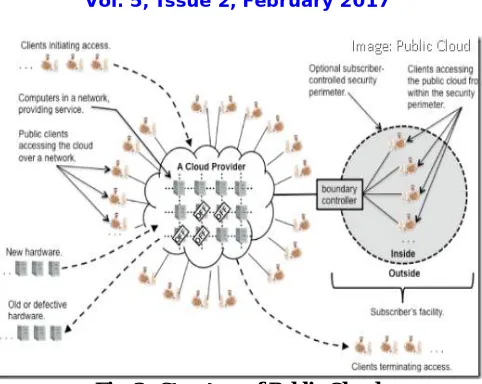
Fig. 3: Structure of Public Cloud
3.2.1 Features of public cloud:
The public model offers the following features and benefits:
1. Ultimate scalability: Cloud resources are available on demand from the public clouds. Vast pools of resource so
that the applications that run on them can respond seamlessly to fluctuations in activity.
2.Cost effective: Public clouds bring together greater levels of resource and benefit from the largest economies of
scale. The centralized operation and management of the underlying resources is shared across all of the subsequent cloud services while components, such as servers, require less bespoke configuration.
3. Utility style costing: Public cloud services often employ a pay-as-you-go charging model whereby the consumer will
be able to access the resource they need, and then only pay for what they use; therefore avoiding wasted capacity
4.Reliability: The sheer number of servers and networks involved in creating a public cloud and the redundancy
configurations mean that if one physical component fails, the cloud service would still run unaffected on the remaining components.
5. Flexibility: Businesses can even integrate their public cloud services with private clouds, where they need to perform
sensitive business functions, to create hybrid clouds.
6. Location independence: The availability of public cloud services through an internet connection ensures that the
services are available wherever the client is located.
3.2.2 Examples of Public cloud
1. Google App Engine 2. Microsoft Window Azure 3. IBM smart cloud
4. Amazon EC2
C. HYBRID CLOUD
A hybrid cloud is an integrated cloud service utilizing both private and public clouds to perform distinct functions within the same organization. It permits the user to increase the capacity or the capability by aggregation, assimilation or customization with another cloud package / service. In a hybrid cloud, the resources are managed and provided either in-house or by external providers. Hybrid cloud models can be implemented in a number of ways:
ISSN(Online): 2320-9801
ISSN (Print): 2320-9798
I
nternational
J
ournal of
I
nnovative
R
esearch in
C
omputer
and
C
ommunication
E
ngineering
(An ISO 3297: 2007 Certified Organization) Website:www.ijircce.com
Vol. 5, Issue 2, February 2017
Fig 4: Structure of Hybrid Cloud
3.3.1Features of hybrid cloud
Some of the characteristics of hybrid clouds are:
1.Optimal utilization: The available server resources in typical data centres are actually used from 5-20%. Hence, servers are mostly idle - generating unnecessary costs. Hybrid clouds can increase server utilization by scaling out to public resources to handle crowds.
2.Data centre consolidation: To cope for worst-case scenarios, a private cloud only needs resources in average cases. The option to burst out allows server consolidation and hence resulting in reduction of operating costs which includes the costs for hardware, power, cooling, maintenance, and administration.
3.Risk transfer: “the risk of misestimating workload is shifted to the cloud vendor from the service operator”. Most of the cloud providers have service level agreements which ensure an uptime of more than 99.9% per year,
4.Availability:The high availability in the corporate data centre is difficult and expensive, because it requires redundancy, backups, and geographic dissemination. In a hybrid cloud environment, the public cloud can scale up or take over operations completely if the company’s data centre is unavailable due to failures or Distributed Denial of Service (DDoS) attacks.
3.3.2 Hybrid cloud service providers:
Microsoft Hybrid Cloud (Azure)
VMware Hybrid Cloud
Amazon Web Services (AWS) Cloud
Rackspace Hybrid Cloud
EMC Hybrid Cloud
HP Hybrid Cloud
D. COMMUNITY CLOUD
Cost of setting up a communal cloud versus individual private cloud can be cheaper due to the division of costs among all participants.
Management of the community cloud can be outsourced to a cloud provider. The advantage here is that the provider would be an impartial third party that is bound by contract and that has no preference to any of the clients involved other than what is contractually mandated
Tools residing in the community cloud can be used to leverage the information stored to serve consumers and the supply chain, such as return tracking and just-in-time production and distribution.
Drawbacks of community cloud:
Costs higher than public cloud.
Fixed amount of bandwidth and data storage is shared among all community members.
The concept of community cloud is still in its infancy, but picking up rapidly among start-ups and small and medium term businesses.
IV. CONCLUSION
Cloud computing is an emerging technology which introduced itself as a service oriented technology. It is working on the principle of on demand service and scalability. It is providing services in many ways including software, platform and infrastructure and making the users free of installing and administering these services. Organizations willing to adapt cloud model for their enterprise often feel confused, which model will fit best for their business for more profitability and scalability. This communication defined cloud computing, highlighted all the service models of cloud computing and discussed the features of public, private, hybrid and community cloud computing. On the other hand private cloud is secure, but costly, Hybrid cloud is a mixture of public and private cloud where insensitive data and sensitive data in the public cloud. Similarly a community cloud falls between public and private cloud, as some organizations get together and form a separate private cloud of their own, called a community cloud.
REFERENCES
[1] Gartner(2012) Cloud Computing . Retrived April 15,2012 from http://www.gartner.com/technology/it-glossary/cloud omputing.jsp
[2] Rhoton,J.(2011). Common definition. Cloud Computing Explained: Second edition.Recursive Press, Us.
[3] Grance,T.,Mell,P.(2009) The NIST Definition of cloud computing. Retrieved march15, 2012 from http://www.nist.gov/itl/cloud/upload/cloud-def-v15.pdf
[4] S. Roschke, F. Cheng and C. Meinel, ―Intrusion Detection in the Cloud,‖ In: Eighth IEEE International Conference on Dependable, Autonomic and Secure Computing, 2009.
[5] A. Marinos and G. Briscoe, ―Community cloud computing,‖ In: Cloud Computing (pp. 472-484). Springer Berlin Heidelberg, 2009.
[6] X. G. Condori, ―Community cloud computing,‖Revista de InformaciónTeconologaí Y Sociedad, 70-72, 2013.
[7] Thecaseforcloud Website [Online]. Available: http://thecaseforcloud.blogspot.in/2011/11/innovation-community-clouds-part- 2.html.
[8] G. Lewis, ―Basics about cloud computing,‖ Software Engineering Institute Carniege Mellon University, Pittsburgh, 2010. [9] W. Jansen and T. Grance, ―Guidelines on security and privacy in public cloud computing, NIST special publication 800-144, 2011.