Data Security of Network Communication
Using Distributed Firewall in WSN
R.Karthikeyan MCA.,M. Phil., 1, K.Vetrivel, 2, E.Vinithkumar., 3, M.Tamil4
Assistant Professor, Department. of MCA, Gnanamani College of Technology, Namakkal, India1
PG Scholar, Department. of MCA, Gnanamani College of Technology, Namakkal, India2
PG Scholar, Department. of MCA, Gnanamani College of Technology, Namakkal, India3
PG Scholar, Department. of MCA, Gnanamani College of Technology, Namakkal, India4
ABSTRACT: The firewall is some over the central applied sciences permitting high-level access control in conformity with organization networks. Packet matching of firewalls includes matching of dense fields beyond the TCP and IP lot header. At least 5 fields (protocol number, supply and destination IP addresses, and ports) are involved within the decision which governance applies in accordance with a fond packet. With available bandwidth growing rapidly, very efficient matching algorithms need after be deployed into present day firewalls after insure that the firewall does no longer grow to be a bottleneck Since firewalls necessity in imitation of filter whole the site visitors crossing the community perimeter, those should stand capable in accordance with sustain a very high throughput, and hazard becoming a bottleneck. Thus, algorithms beside computational geometry may stand applied. In this bill we consider a ace algorithm that we adapted in accordance with the firewall domain. We call the resulting algorithm “Geometric Efficient Matching” (GEM). The GEM algorithm enjoys a logarithmic matching period performance. However, the algorithm’s theoretical worst-case space complexity is O (n4) because of a rule-base together with n rules. This delivery note analyzes security challenges of wireless sensor networks yet summarizes key issues as need to keep solved for achieving the advert hoc security. It gives an overview on the current ruler of solutions concerning such solution problems as much proof routing, prevention of denial-of-service or answer management service. We also present partial proof strategies according to attain safety in wireless sensor networks. Finally we present our integrated approach in imitation of securing sensor networks.
KEYWORDS: Network Communication, Network-level security and protection, Wireless Sensor Networks
I. INTRODUCTION
The firewall is one of the central technologies allowing high level access control to organization networks. Packet matching in firewalls involves matching on many fields from the TCP and IP packet header. At least five fields (protocol number, source and destination IP addresses, and ports) are involved in the decision which rule applies to a given packet. With available bandwidth increasing rapidly, very efficient matching algorithms need to be deployed in modern firewalls to ensure that the firewall does not become a bottleneck. Modern firewalls all use “first match” semantics: The firewall rules are numbered from 1 to n, and the firewall applies the policy (e.g., pass or drop) associated with the first rule that matches a given packet.
Firewall packet matching is reminiscent of the well studied router packet matching problem. However, there are several crucial differences which make the problems quite different.
First, unlike firewalls, routers use “longest prefix match” semantics. Next, the firewall matching problem is 4 or 5 dimensional, whereas router matching is usually 1 or 2 dimensional: A router typically matches
II. LITERATURE REVIEW
Wireless Sensor Network is broadly used in many areas including security surveillance. In Wireless Sensor Network, sensor networks are placed randomly and also in grid depending on the methodology used to deploy the network. As sensor nodes uses energy from batteries for sensing the data and transmitting data it consumes the energy for these operations. Avoiding energy consumption in sensor nodes is hot topic in today’s era and also a challenging task, many protocols and algorithms are used to avoid energy consumption as the batteries in Wireless Sensor Network are non replaceable. In this paper we made a detailed survey on the recent issues in Wireless Sensor Networks and discussed various problems with respect to different scenarios as well as different methods. a simple two-branch transmit diversity scheme. Using two transmit antennas and one receive antenna the scheme provides the same diversity order as maximal-ratio receiver combining (MRRC) with one transmit antenna, and two receive antennas. It is also shown that the scheme may easily be generalized to two transmit antennas and M receive antennas to provide a diversity order of 2M. The new scheme does not require any bandwidth expansion any feedback from the receiver to the transmitter and its computation complexity is similar to MRRC. The two uniploar OFDM techniques for optical wireless communications: asymmetric clipped optical OFDM (ACO-OFDM) and Flip-OFDM. Both techniques can be used to compensate multipath distortion effects in optical wireless channels. However, ACO-OFDM has been widely studied in the literature, while the performance of Flip-OFDM has never been investigated. In this paper, we conduct the performance analysis of Flip-OFDM and propose additional modification to the original scheme in order to compare the performance of both techniques. Finally, it is shown by simulation that both techniques have the same performance but different hardware complexities. In particular, for slow fading channels, Flip-OFDM offers 50% saving in hardware complexity over ACO-OFDM at the receiver.
III. EXISTING SYSTEM
Existing algorithms implement the “longest prefix match” semantics, using several different approaches. The IPL algorithm, which is based on results, divides the search space into elementary intervals by different prefixes for each dimension, and finds the best (longest) match for each such interval. Firewall statefulness is commonly implemented by two separate search mechanisms: (i) a slow algorithm that implements the “first match” semantics and compares a packet to all the rules, and (ii) a fast state lookup mechanism that checks whether a packet belongs to an existing open flow. In many firewalls, the slow algorithm is a naive linear search of the rule-base, while the state lookup mechanism uses a hash-table or a search-tree.
3.1 DISADVANTAGES OF EXISTING SYSTEM
There is no secure when the packet sending. Firewall not used before Time consuming is high.
IV. PROPOSED SYSTEM
In the field of computational geometry, proposed an algorithm which solves the point location problem for n
non-overlapping d-dimensional hyper-rectangles, with a linear space requirement and O ((log n) (d−1)) search time. In
our case, we have overlapping d-dimensional hyper-rectangles, since firewall rules can, and often do, overlap each other making rules overlap is the method firewall administrators use to implement intersection and difference operations on sets of IP addresses or port numbers. These overlapping hyper-rectangles can be decomposed into non-overlapping hyper-rectangles however, a moment’s reflection shows that the number of resulting non-non-overlapping hyper-rectangles is (nd), thus the worst case complexity for firewall rules is no better than that of GEM.
4.1 ADVANTAGES OF PROPOSED SYSTEM:
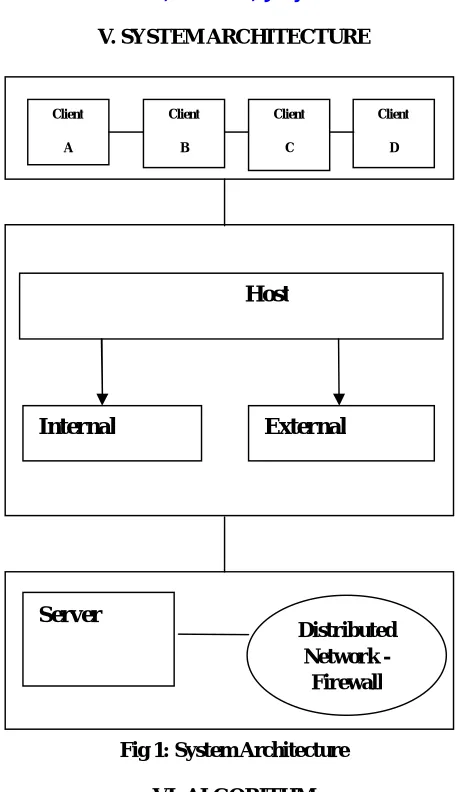
Client
A
Client
B
Client
C
Client
D
Internal External
Host
Server
Distributed Network -
Firewall V. SYSTEM ARCHITECTURE
Fig 1: System Architecture
VI. ALGORITHM
6.1 GEOMETRIC EFFICIENT MATCHING ALGORITHM
The firewall packet matching problem finds the first rule that matches a given packet on one or more fields from its header. Every rule consists of set of ranges [li, ri] for i = 1. . . d, where each range corresponds to the i-th field
in a packet header. The field values are in 0 ≤ li, ri ≤ Ui, where Ui = 232 − 1 for IP addresses, Ui = 65535 for port
numbers, and Ui = 255 for ICMP message type or code. Table 1 lists the header fields we use (the port fields can double as the message type and code for ICMP packets). For notation convenience later on, we assign each of these fields a number.
6.1.1 The Sub-Division of Space
In one dimension, each rule defines one range, which divides space into at most 3 parts. It is easy to see that n
possibly overlapping rules define a subdivision of one-dimensional space into at most (2n − 1) simple ranges. To each
simple range we can assign the number of the winner rule. This is the first rule which covers the simple range.
In d-dimensions, we pick one of the axes and project all the rules onto that axis, which gives us a reduction to
the previous one-dimension case, with a subdivision of the one dimension into at most (2n − 1) simple ranges. The
difference is that each simple range corresponds to a set of rules in (d − 1) dimensions, called active rules. We continue
thus for a 4-dimensional space algorithm we have 4 levels of subdivisions. The last level is exactly a one-dimensional case—among all the active rules, only the winner rule matters.
At this point we have a subdivision of d-dimensional space into simple hyper-rectangles, each corresponding to single winning rule. In Section 2.4 we shall see how to efficiently create this subdivision of d-dimensional space, and how it translates into an efficient structure.
6.2.2 Dealing with the Protocol Field
Before delving into the details of the search data structure, we first consider the protocol header field. The protocol field is different from the other four fields: very few of the 256 possible values are in use, and it makes little sense to define a numerical “range” of protocol values. This intrusion is validated by the data gathered from real firewalls: The only values we saw in the protocol field in actual firewall rules were those of specific protocols, plus t he wildcard, but never a non-trivial range.
Thus, the GEM algorithm only deals with single values in the protocol field, with special treatment for rules with as a protocol. We preprocess the firewall rules into categories, by protocol, and build a separate search data structure for each protocol (including a data structure for the protocol). The actual geometric search algorithm only deals with 4 fields.
Now, a packet can only belong to one protocol but it is also affected by protocol rules. Thus every packet needs to be searched twice: once in its own protocol's data structure, and once in the structure. Each search yields a candidate winner rule.3 we take the action determined by the candidate with the lower number.
6.3.3. Firewall Rule-Base Statistics
To get a better understanding of what real-life firewall rule - bases look like, we gathered statistics from firewall rule-bases that were analyzed by the Lumeta (now AlgoSec) Firewall Analyzer. The statistics are based on 19 rule-bases from enterprise firewalls (Cisco PIX and Check Point FireWall-1).
Collected during 2001 and 2002. The rule-bases came from a variety of corporations from the financial, telecommunications, automotive, and pharmaceutical industries. We analyzed a total of 8434 rules.
It shows the distribution of protocols in the rules we analyzed. The data shows that 75% of rules from typical firewall rule-bases match TCP, and a total of 93% match TCP, UDP or ICMP. Of these the most important is clearly TCP. Therefore, we concentrate on these protocols in the rest of paper. In our problem context, these protocols are the most difficult for evaluation since they imply a 4-dimensional space.
The same table shows the distribution of TCP source and destination port numbers. The source port number is rarely specified: 98% of the rules have a wildcard `*' in the source port. This makes sense because both PIX and FireWall-1 are stateful firewalls that do not need to perform source-port filtering to allow return traffic through the firewall and source port data is generally unreliable because it is usually under the control of the attacker.
On the other hand, the TCP destination port is usually specified precisely. The vast majority of rules specified a single port number, but 4% allowed a range of ports, and the ranges tended to be quite large. Common ranges are “all high ports” (1024–65535) and “X11 ports” (6000-6003). The single port numbers we encountered were distributed among some 200 numbers, the most popular of which are shown in Table 2: these correspond to the HTTP, FTP, Telnet, HTTPS, HTTP-Proxy, and NetBIOS services.
VII. CONCLUSION
We have seen that the GEM algorithm is an efficient and practical algorithm for firewall packet matching. We implemented it successfully in the Linux kernel, and tested its packet-matching speeds on live traffic with realistic large rule-bases. GEM's matching speed is far better than the naive linear search, and it is able to increase the throughput of literals by an order of magnitude. On rule-bases generated according to realistic statistics, GEM's space complexity is well within the capabilities of modern hardware. Thus we believe that GEM may be a good candidate for use in firewall matching engines.
and traffic load. Furthermore, it would be interesting to do this comparison with real rule-bases, in addition to synthetic Perimeter-model rules. We leave such a “bake-off” for future work. As for GEM itself, we would like to explore the algorithm's behavior when using more than 4 fields, e.g., matching on the TCP flags, Meta data, interfaces, etc. The main questions are: Another direction to pursue is how GEM would perform with of IPv6, in which IP addresses have 128 bits.
REFERENCES
1. R.Karthikeyan,”A Survey on Sensor Networks” in the International Journal for Research & Development in Technology Volume 7, Issue 1, Jan 2017, Page No:71-77.
2. R.Karthikeyan, & et all “Web Based Honeypots Network”,in the International journal for Research & Development in Technology.Volume 7.Issue 2 ,Jan 2017,Page No.:67-73 ISSN:2349-3585.
3. R.Karthikeyan, & et all,“A Simple Transmit Diversity Technique for Wireless Communication”,in the International journal for Engineering and Techniques. Volume 3. Issue 1, Feb 2017, Page No.:56-61 ISSN:2395-1303.
4. R.Karthikeyan, & et all “Strategy of Trible – E on Solving Trojan Defense in Cyber Crime Cases”, International journal for Research & Development in Technology.Volume 7.Issue 1 ,Jan 2017,Page No.:167-171.
5. R.Karthikeyan, & et all”Advanced Honey Pot Architecture for Network Threats Quantification” in the international journal of Engineering and Techniques, Volume 3 Issue 2, March 2017, ISSN:2395-1303, PP No.:92-96.
6. R.Karthikeyan, & et all ”Estimating Driving Behavior by a smart phone” in the international journal of Engineering and Techniques, Volume 3 Issue 2, March 2017, ISSN:2395-1303,PP No.:84-91.
7. R.Karthikeyan, & et all ”SAMI: Service- Based Arbitrated Multi-Tier Infrastructure for Cloud Computing” in the international journal for Research & Development in Technology, Volume 7 Issue 2, Jan 2017,ISSN(0):2349-3585, Pg.no:98-102
8. R.Karthikeyan, & et all ”FLIP-OFDM for Optical Wireless Communications” in the international journal of Engineering and Techniques, Volume 3 Issue 1, Jan - Feb 2017, ISSN:2395-1303,PP No.:115-120.
9. R.Karthikeyan, & et all ”Application Optimization in Mobile Cloud Computing” in the international journal of Engineering and Techniques, Volume 3 Issue 1, Jan - Feb 2017, ISSN:2395-1303,PP No.:121-125.
10. R.Karthikeyan, & et all ”The Sybil Attack” in the international journal of Engineering and Techniques, Volume 3 Issue 3, May - Jun 2017, ISSN:2395-1303,PP No.:121-125.
11. R.Karthikeyan, & et all ”Securing WMN Using Hybrid Honeypot System” in the international journal of Engineering and Techniques, Volume 3 Issue 3, May - Jun 2017, ISSN:2395-1303,PP No.:121-125.
12. R.Karthikeyan, & et all”Automated Predictive big data analytics using Ontology based Semantics” in the international journal of Engineering and Techniques, Volume 3 Issue 3, May – Jun 2017, ISSN: 2395-1303,PP No.:77-81.
13. R.Karthikeyan, & et all ”A Survey of logical Models for OLAP databases” in the international journal of Engineering and Techniques, Volume 3 Issue 3, May - Jun 2017, ISSN:2395-1303,PP No.:171-181.
14. R.Karthikeyan, & et all ”A Client Solution for Mitigating Cross Site Scripting Attacks” in the international journal of Engineering Science & Computing, Volume7,Issue6, June 2017, ISSN(0):2361-3361,PP No.:13063-13067.
15. R.Karthikeyan, & et all ”A Condensation Based Approach to Privacy Preserving Data Mining” in the international journal of Engineering Science & Computing, Volume7,Issue6, June 2017, ISSN(0):2361-3361,PP No.:13185-13189.
16. R.Karthikeyan, & et all ”Biometric for Mobile Security” in the international journal of Engineering Science & Computing, Volume7,Issue6, June 2017, ISSN(0):2361-3361,PP No.:13552-13555.
17. R.Karthikeyan, & et all ”Data Mining on Parallel Database Systems” in the international journal of Engineering Science & Computing, Volume7,Issue7, July 2017, ISSN(0):2361-3361,PP No.:13922-13927.
18. R.Karthikeyan, & et all ”Ant Colony System for Graph Coloring Problem” in the international journal of Engineering Science & Computing, Volume7,Issue7, July 2017, ISSN(0):2361-3361,PP No.:14120-14125.
19. R.Karthikeyan, & et all ”Classification of Peer –To- Peer Architectures and Applications” in the international journal of Engineering Science & Computing, Volume7,Issue8, Aug 2017, ISSN(0):2361-3361,PP No.:14394-14397.
20. R.Karthikeyan, & et all ”Mobile Banking Services” in the international journal of Engineering Science & Computing, Volume7,Issue7, July 2017, ISSN(0):2361-3361,PP No.:14357-14361.
21. R.Karthikeyan, & et all ”Neural Networks for Shortest Path Computation and Routing in Computer Networks” in the international journal of Engineering and Techniques, Volume 3 Issue 4, Aug 2017, ISSN:2395-1303,PP No.:86-91.
22. R.Karthikeyan, & et all ”An Sight into Virtual Techniques Private Networks & IP Tunneling” in the international journal of Engineering and Techniques, Volume 3 Issue 4, Aug 2017, ISSN:2395-1303,PP No.:129-133.
BIOGRAPHY
1. R.KARTHIKEYAN
Assistant Professor,
Department of Computer Application
Gnanamani College of Technology Namakkal (Dt),
2. K.VETRIVEL
PG Scholar
Department of Computer Application Gnanamani College of Technology Namakkal (Dt),
3. E.VINITHKUMAR
PG Scholar
Department of Computer Application Gnanamani College of Technology Namakkal (Dt),
4. M.TAMIL
PG Scholar