ISSN(Online): 2320-9801
ISSN (Print): 2320-9798
I
nternational
J
ournal of
I
nnovative
R
esearch in
C
omputer
and
C
ommunication
E
ngineering
(An ISO 3297: 2007 Certified Organization)
Vol. 4, Issue 10, October 2016
Artificial Intelligence based Personal
Assistant
Aman Sansowa 1, Mitwa Palkhiwala 2, Anurag Das 3
B. Tech Student, Department of Electronics and Communication Engineering, Indus Institute of Technology and
Engineering, Indus University, Gujarat, India 1
B. Tech Graduate, Department of Electronics and Communication Engineering, Indus Institute of Technology and
Engineering, Indus University, Gujarat, India 2,3
ABSTRACT: The objective of this paper is to present an intelligent system that can be used to answer the questions asked to it based on android smart phone. It can be very useful to people who are depressed and alone as they can find a companion in it just like a human being. It can also be useful for other applications such as asking it to show a particular video or search something from Google for you. Remote operation is achieved by any smart-phone/Tablet etc., with Android OS, upon a GUI (Graphical User Interface) based touch screen operation. In order to achieve this, Android application act as transmitter, which sends commands to the receiver where LCD is connected as the output device.
KEYWORDS:Speech Recognition, Assistive Device, Artificial Intelligence, Android App, Internet, Bluetooth.
I. INTRODUCTION
The objective of this paper is to present an intelligent system that can be used to answer the questions asked to it based on Android Smart Phone. It can be very useful to people who are depressed and alone as they can find a companion in it just like a human being. It can also be useful for other applications such as
A video can be played directly by asking in the application on YouTube without even opening the application of YouTube.
A person can find the location of any place from the current location without even opening the application of Google maps.
A person can stay updated about the latest happenings in the world. All the latest news are shown by just asking the application for the current news.
A person can get recipe of any kind of food by asking it in the application.
A person can dial a call by asking to call a particular person without dialling his number manually.
It also answers the questions asked to it directly on the connected LCD. This can be used as a companion for lonely or elderly people who feel left out.
As the system uses Bluetooth module [3], operating over frequency of 2.4 GHz, it can link digital devices within a range of 10 m (expandable to 100 m, by increasing the transmitted power) at the speed of 1 Mbps. To operate this system, the Android Smart Phone must also be connected to an Internet Connection to access the questions based on Internet applications such as YouTube [8], Google news [9], Google maps [10] and others of that kind.
II. RELATEDWORK
ISSN(Online): 2320-9801
ISSN (Print): 2320-9798
I
nternational
J
ournal of
I
nnovative
R
esearch in
C
omputer
and
C
ommunication
E
ngineering
(An ISO 3297: 2007 Certified Organization)
Vol. 4, Issue 10, October 2016
has the feature to reply back to the user. On the other side, when a person needs to surf about something, he/she can ask for it in the app by clicking on ‘Talk to me’ button provided in the App.
III. DESIGN
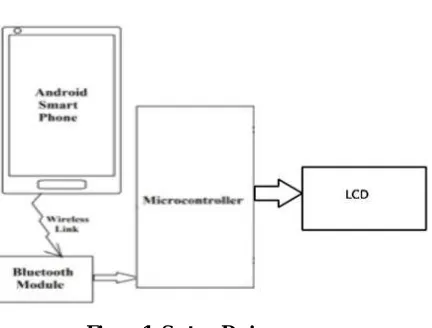
Figure 1: System Design
ISSN(Online): 2320-9801
ISSN (Print): 2320-9798
I
nternational
J
ournal of
I
nnovative
R
esearch in
C
omputer
and
C
ommunication
E
ngineering
(An ISO 3297: 2007 Certified Organization)
Vol. 4, Issue 10, October 2016
‘Not sure? Click here’. In that case, the user gets to surf from the internet. In this way, the system works to decrease the efforts of the user by speaking directly in the app and also can find a companion in it just like a human being as the system answers the questions asked to it and talks to the user just like a buddy. The circuit of the assistive device consists of a LCD, potentiometer, Arduino Uno and a Bluetooth module (HC-05) as shown in the Figure 3.
Figure 3: Circuit Diagram of the assistive device[5] [6] [7]
IV. RESULTS
ISSN(Online): 2320-9801
ISSN (Print): 2320-9798
I
nternational
J
ournal of
I
nnovative
R
esearch in
C
omputer
and
C
ommunication
E
ngineering
(An ISO 3297: 2007 Certified Organization)
Vol. 4, Issue 10, October 2016
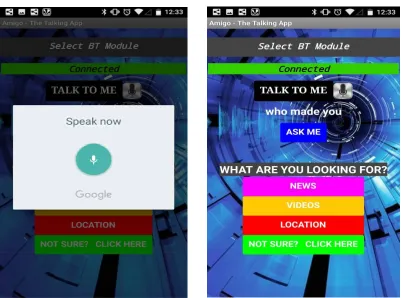
Figure 5: Screenshots of Working App
Figure 4 shows the hardware of assistive device and Figure 5 represents the screenshots of the working App. As shown above, when the user clicks on ‘Talk to me’ button, the windows saying ‘Speak now’ pops up[4]. The user needs to speak while the window catches the words of the user. Once the words are detected, the spoken words are shown in the app in the form of text and the answer for the asked question can be seen on the hardware in the LCD. If the user needs an answer from the Internet, he might use the buttons given for various purposes such as looking for news, videos, location etc.
V. CONCLUSION
ISSN(Online): 2320-9801
ISSN (Print): 2320-9798
I
nternational
J
ournal of
I
nnovative
R
esearch in
C
omputer
and
C
ommunication
E
ngineering
(An ISO 3297: 2007 Certified Organization)
Vol. 4, Issue 10, October 2016
6. "Bluetooth Tutorial 1". Arduinobasics.blogspot.in. N.p., 2016. Web. 28 Oct. 2016. [online] Available at: http://arduinobasics.blogspot.in/2013/01/arduino-basics-bluetooth-tutorial.html
7. "Arduino - Serial". Arduino.cc. N.p., 2016. Web. 28 Oct. 2016. [online] Available at: https://www.arduino.cc/en/Reference/Serial 8. "YouTube". Youtube.com. N.p., 2016. Web. 28 Oct. 2016. [online] Available at: https://www.youtube.com
9. "Google News". News.google.co.in. N.p., 2016. Web. 28 Oct. 2016. [online] Available at: https://news.google.co.in 10. "Google Maps". Google Maps. N.p., 2016. Web. 28 Oct. 2016. [online] Available at: https://www.google.com/maps
BIOGRAPHY
Aman Sansowa
He is pursuing his B.Tech degree in Electronics & Communication Engineering. He is currently in final year of his B.Tech degree. His special interests are in the field of Computer Science and Artificial Intelligence.
Mitwa Palkhiwala
She has completed her B.Tech in Electronics & Communication Engineering in June 2016. She has done various academic projects based on Artificial Intelligence and Embedded Systems. She has special interests in the field of Embedded Systems, Artificial Intelligence, Robotics and Computer Science.
Anurag Das
![Figure 3: Circuit Diagram of the assistive device[5] [6] [7]](https://thumb-us.123doks.com/thumbv2/123dok_us/1429139.1175388/3.595.98.491.467.631/figure-circuit-diagram-assistive-device.webp)