ABSTRACT
KIM, PAUL YOUNGHOON. Exploring Age-Related Differences in Prospective
Exploring Age-Related Differences in Prospective Memory Inside and Outside of the Lab
by
Paul Younghoon Kim
A thesis submitted to the Graduate Faculty of North Carolina State University
in partial fulfillment of the requirements for the Degree of
Master of Science
Psychology
Raleigh, North Carolina 2009
APPROVED BY:
________________________ ________________________ Slater E. Newman James W. Kalat
ii
DEDICATION
iii
BIOGRAPHY
Paul Younghoon Kim was born on September 20, 1981 in Raleigh, North Carolina at 6:00pm. He looked almost exactly like his older brother as a baby that his mother asked why is Peter here. In 1986, Paul entered Stough Elementary School. He was apprehensive at first, but got used to school life quickly. However in the summer of 1989, his mother, brother Peter, he, and a friend of the family were involved in a car accident. He sustained the most injuries, having lost the left dominant side of his brain. He lay in a coma for four and a half months in a bed at Lenox Baker Children’s Hospital. Miraculously, he opened his eyes.
The next several months were hard on the family. Paul, his mother, and a nurse aide would travel to Lenox Baker every morning, so Paul could have his dose of rehabilitation while his father went to work and Peter went to school. After a time, Paul went back to school, only losing one year.
He could not speak for two years, though he passed every grade. He climbed and entered Martin Middle School in 1993 and entered Athens Drive High School in 1996. Finally reaching the status of college student in Fall 2000 at North Carolina State University and majored in psychology. He graduated at the top of his class and the top of the whole university in Spring 2005 with honors (summa cum laude).
A break interspersed his eventual acceptance into graduate school at North Carolina State University in the program of human factors and ergonomics in Fall 2007.
iv
attended and presented a poster of the so-called manuscript at 2007 North Carolina Cognition Conference, as well as submitted his first collection of poems.
v
ACKNOWLEDGEMENTS
I would like to thank Dr. Christopher B. Mayhorn for being my adviser, mentor, and chair on this committee, giving me insight, wisdom, and experience on this process and other matters. I appreciate Dr. Slater E. Newman and Dr. James W. Kalat for being on this
vi
TABLE OF CONTENTS
LIST OF TABLES... viii
LIST OF FIGURES ... ix
Chapter 1 Introduction... 1
Different Types of Prospective Memory Tasks ... 5
Task Interruption... 7
Age-Related Performance Differences ... 12
Laboratory vs. Naturalistic Methods... 16
Purpose of this Study ... 20
Empirical Questions... 21
Research Hypotheses ... 22
Chapter 2 Method Participants... 23
Experimental Design... 23
Materials/Apparatus... 24
Procedure ... 24
Chapter 3 Results... 28
Post Hoc Tests... 29
Regression Analyses ... 30
Summary of Results... 33
Chapter 4 Discussion ... 35
Limitations ... 41
Conclusion ... 42
REFERENCES ... 44
APPENDICES ... 60
Appendix A... 61
Appendix B ... 63
Appendix C ... 65
Appendix D... 70
Appendix E ... 72
Appendix F... 74
vii
Appendix H... 93
Appendix I ... 100
Appendix J ... 102
Appendix K... 104
viii
LIST OF TABLES
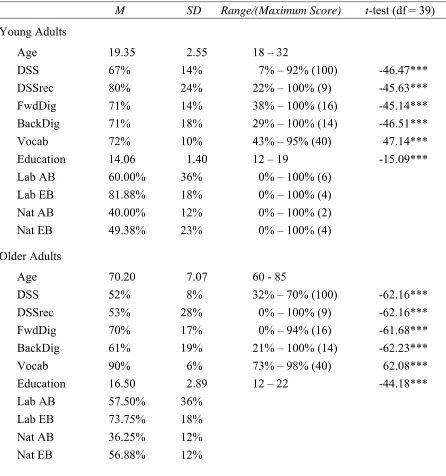
Table 1 Descriptive Statistics for Young Adults and Older Adults... 51 Table 2 Familiarity of Floor Plan of Crabtree Valley Mall (n = 80) ... 52 Table 3 Backward Elimination Multiple Regression Analysis for Predictor Variables
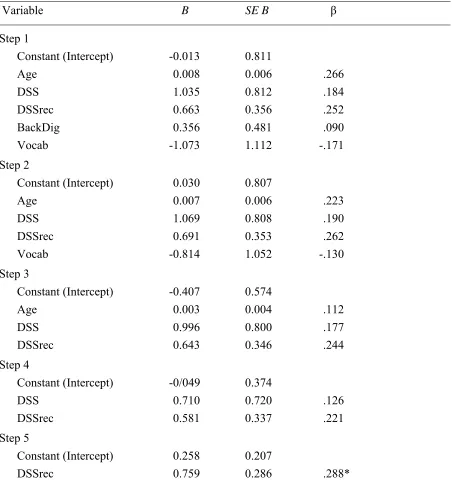
on Laboratory Activity-Based Task... 53 Table 4 Backward Elimination Multiple Regression Analysis for Predictor Variables
on Naturalistic Activity-Based Task... 54 Table 5 Backward Elimination Multiple Regression Analysis (young age) for
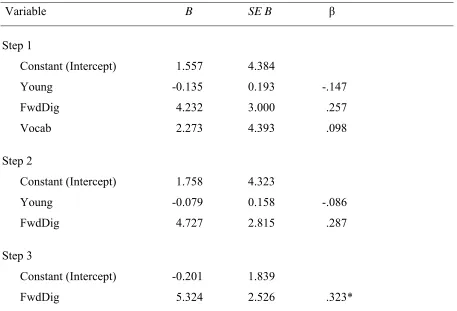
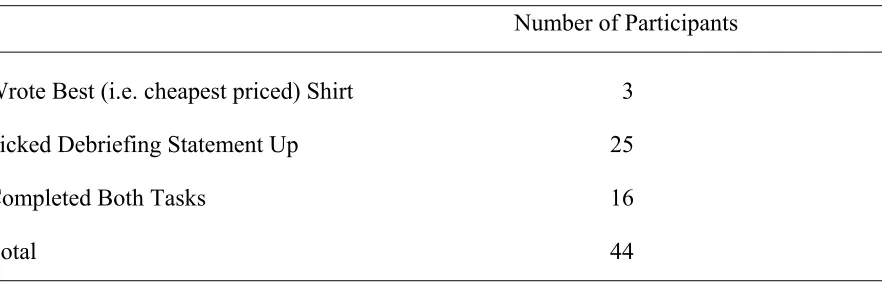
Predictor Variables on Lab Activity-Based Task ... 55 Table 6 Completion of either One or Both of the Naturalistic Activity-Based Tasks
ix
LIST OF FIGURES
Figure 1. Completion rates (%) at the laboratory and naturalistic settings for
PROSPECTIVE MEMORY 1
Chapter 1
Introduction
Much of the memory literature has investigated the topic of retrospective memory
which refers to remembering past information such as telephone numbers or addresses. By
contrast, the focus of the present research is on prospective memory. Prospective memory is
essential because it refers to one’s ability to remember and execute intentions in the future. If
a young adult forgets an intention such as picking up milk at the grocery store on the way
home from school, then he or she might be considered irresponsible. However, if an older
individual forgets an intention such as remembering the appointment of going to the internal
medicine doctor at 3 pm, the social attribution is much different. For instance, the older adult
might simply be considered forgetful due to a “senior moment” or he or she might face a
much more uncharitable judgment of senility (cf. Meacham, 1982; Sinnott, 1986).
In contrast with the backward-looking perspective of retrospective memory,
prospective memory is forward-looking (Marsh, Hancock, & Hicks, 2002). While the former
differs from the latter, prospective memory contains both retrospective as well as prospective
components. The retrospective component includes remembering the content of the intention
such as remembering a message and the specific friend who should receive it. The
prospective component, in turn, is to notice the opportune time to act upon the intention in
the right context or situation as well as retrieving the necessary cue, whether salient or not,
PROSPECTIVE MEMORY 2
the friend, and then giving the content of the message to him or her (Einstein & McDaniel,
1996; Glisky, 1996; Uttl, 2006).
In the next few paragraphs, the relationship between prospective memory and other
cognitive abilities such as attention, planning, and working memory will be explored. As the
previous example illustrates, prospective memory is related to attention because “attention
can be likened to a spotlight that enhances the efficiency of detection of events within its
beam” (Posner, Snyder, & Davidson, 1980, pp. 172). Detecting a target stimulus is a task that
is necessary in recognizing and identifying salient cues within a sea of potential distracters.
Once the prospective cue is identified, it triggers an impulse to perform the prospective
intention.
In a related study, Hicks, Cook, and Marsh (2005) found in two experiments that the
size of the letter strings (i.e. focal attention) did not add any salience in cue detection.
However, when the periphery of the attention manipulation (i.e. nonfocal attention) changed
from a small border to a large border around the letter string, cue detection increased
significantly.
The finding that intentionality can be delayed until it is needed suggests that the
planning is also associated with prospective memory performance. Planning might be
conceptualized as the effortful work of being prepared for some task or intention in the
future. Two planning methods that have been investigated in this context are time-keeping
(Rabbitt, 1996) and means-end analysis (Kreutzer, Leonard, & Flavell, 1975). Time-keeping
mostly requires the use of a clock or timer to schedule planned activities. However when
PROSPECTIVE MEMORY 3
cues) for “time-cued prospective memory” such as an expert cook “observing the critical
changes in the ingredients as they are simmering, thus using the cooking process itself as a
reliable clock” (Rabbitt, 1996, pp. 242). The other method which is often associated with
problem solving, means-end analysis, requires seeing the initial state and the eventual
outcome, and systematically planning how to accomplish the task. One example of such a
task involved requiring groups of children in kindergarten, first, third, and fifth grades to
remember to bring skates to school on the following day (Kreutzer, Leonard, & Flavell,
1975). Results suggested that the older kids were more likely to use means-end analysis than
younger children such that they reported a variety of mnemonic efforts such as placing the
skates at the door to remind them or writing a note about the upcoming task and placing it on
the child’s dresser (Kreutzer, Leonard, & Flavell, 1975).
Because prospective memory tasks often occur in complex situations where multiple
tasks are ongoing, working memory is also related to the completion of the prospective
memory task. For example, when the primary task involves a low working memory load,
then prospective memory is not affected. However previous research by Kidder, Park,
Hertzog, and Morrell (1997) suggests that high working memory load associated with a
complex primary task will decrease the likelihood of successful prospective memory
performance. In their study, Kidder et al. (1997) recruited adult participants (both young and
older) to participate in an experiment where they had to view words on a computer screen
and recall the last two or three words (different working memory load conditions). The
prospective memory task was to identify when the background changed (manipulated by one
PROSPECTIVE MEMORY 4
words) working memory load and low prospective memory load (one target background),
both age groups’ performances were at or near ceiling level. However, when the condition
involved high (three words) working memory load and high prospective memory load (three
target backgrounds), age differences appeared. The young age group performed the task near
ceiling level (but had a lower overall score than the low load condition); the older age group
was differentially affected by the load manipulations. Interestingly, these results seem to
conflict with the previous hypotheses of Einstein and McDaniel (1990; 1996) that suggest
that there should be minimal age effects in prospective memory tasks reliant on external cues
(Kidder, Park, Hertzog, & Morrell, 1997).
Marsh and Hicks (1998) also conducted a series of experiments, varying the type of
working memory through the use of high vs. low vs. no load conditions. They concluded that
prospective memory performance suffered when working memory tasks emphasized the
involvement of the executive control and/or the visuospatial sketchpad. However when
manipulating the articulatory loop component of working memory, it seemed that it did not
involve the executive control, allowing prospective memory to have no adverse effect. For
the experiments, performance on the prospective memory task was worst in the high load
condition whereas prospective performance during the low load condition was similar to that
of no load condition.
From these studies, it is apparent that the situational context where a prospective
intention is formed is very important because various combinations of cognitive processes
are being engaged during different tasks. For this reason, the nature of prospective memory
PROSPECTIVE MEMORY 5
conceptualize how performance might vary, the following sections will address the different
types of prospective memory tasks that have been studied in the past. Topics to be addressed
include: performance differences between time- and event-based intentions, task interruption,
age effects, and finally the different methodologies utilized to study prospective memory.
Different Types of Prospective Memory Tasks
One early classification of prospective memory tasks categorized intentions as either
pulses or steps (Ellis, 1987). Pulses have a high personal importance factor requiring frequent
monitoring, a narrow window of opportunity, specificity of time, and less flexibility such as
remembering the doctor’s appointment at 3:00 pm. However, steps have a wider window of
opportunity, more flexibility, and less frequent monitoring such as booking a holiday resort.
In turn, steps are less likely to involve the use of memory aids to remember intentions, and
are fulfilled when appropriate within a wide time period; pulses are externally remembered
because of the personal importance of the intention and must be executed within a narrow
time frame. Writing intentions down in a diary is good and beneficial for remembering pulses
(Ellis, 1987).
Harris (1984) uses the terms “simple” and “compound” activities as steps and pulses,
respectively. “Simple” activities occur when one thing is done before or after another activity
and requires monitoring of the activity to be interrupted. On the other hand, “compound”
activities or appointments require monitoring of a process external to the interrupted activity.
He proposes a test-wait-test-exit (TWTE) model to describe how people approach
PROSPECTIVE MEMORY 6
period for an appropriate response to be issued in which the information of a test provides
(Harris & Wilkins, 1982).
Another way to distinguish intentions is to classify them as “habitual remembering”
and “episodic remembering” (Meacham, & Leiman, 1975). “Habitual remembering” refers to
routine activities performed daily such as brushing your teeth before bed. “Episodic
remembering” refers to more infrequent activities that occur on an irregular basis. These
effects require reminding to remember such as stopping at the grocery store to buy milk on
the way home (Meacham, & Leiman, 1975).
More recently, Einstein and colleagues have theorized that prospective memory can
be divided into two different types of intentions: event- and time-based intentions (Craik,
1986; Einstein, Holland, McDaniel, & Guynn, 1992; Einstein & McDaniel, 1990; 1996;
Einstein, McDaniel, Richardson, Guynn, & Cunfer, 1995). An additional third type,
activity-based intentions, is a much more recent theoretical contribution to the literature(Kim &
Mayhorn, 2008; Kvavilashvili & Ellis, 1996). Activity- and event-based intentions have an
external cue that signals the participant to remember and complete the intention that the
participant has such as remembering to give a message to a friend when seeing him or her.
Time-based intentions, however, rely on the specificity of time or within a specified time
period, and use self-initiated retrieval processes where remembering is accomplished without
the use of external cues (Craik, 1986; Einstein et al., 1992; Einstein & McDaniel, 1996;
Marsh & Hicks, 1998).
Another difference between time- and event-based intentions is their reliance on
PROSPECTIVE MEMORY 7
has been shown that time-based intentions require memory for temporal information, time
estimation, strategic planning, environmental monitoring, and divided attention. However,
event-based intentions lack a temporal memory component or time estimation, may require
minimal strategic planning, and involve less divided attention because the cue is embedded
within a primary task (Glisky, 1996).
Task Interruption
One notable distinction among the three types of intentions is whether or not there is
task interruption. Task interruption occurs when people are busily engaged in an activity and
unexpectedly or purposely (dealing with laboratory studies) they are interrupted with the
activity they are working on (Mäntylä & Sgaramella, 1997; Schiffman & Greist-Bousquet,
1992). When they recollect their thoughts and remember their intention; most of the time,
they remember uncompleted intentions (Marsh, Hicks, & Bink, 1998; Speier, Vessey, &
Valacich, 2003). The earliest account of this was the 1927 article, “Das Behalten erledigter
und unerledigter Handlungen” (On Completed and Uncompleted Tasks). Bluma Zeigarnik,
the author of this article, found that tasks that were interrupted were more likely to be
remembered by adults (90% of the time) than completed ones. Children, in general, only
remembered interrupted tasks. This is now called the Zeigarnik effect (Reeve, Cole, & Olson,
1986; Zeigarnik, 2007; Zeigarnik, 1967). However, these results appear to contradict findings
from a later study conducted by Kvavilashvili, Messer, and Ebdon (2001) where task
interruption during an ongoing task had an adverse effect upon children’s prospective
memory. The recommendation they propose is to allow children to complete a task fully
PROSPECTIVE MEMORY 8
of four experiments that when participants were interrupted while engaged in a task
simulation scenario, their resumption lags took longer when the interruption lasted 6 and 8
seconds rather than the 2 and 4 seconds they used in the first two experiments during which
time there was no activity going on.
While event- and time-based intentions include an interruption during remembering
and execution of a planned intention such as stopping on the way home to grab milk at the
grocery store (event-based) or an appointment at 3:00 pm (time-based), activity-based
intentions show no sign of interruption. They (activity-based) are intentions that follow after
finishing an ongoing activity and before beginning another activity (Kvavilashvili & Ellis,
1996).
Activity-based intentions are said to be less demanding than either time- or
event-based [intentions] because the external cue is the end of an ongoing activity and does not
require an interruption of the activity (Kvavilashvili & Ellis, 1996; Shum, Ungvari, Tang, &
Leung, 2004). However, the research is scarce about utilizing activity-based intentions alone
or in conjunction with the other types of prospective memory tasks. It seems that the only
research studies that have investigated activity-based intentions published to date have been
conducted to evaluate special populations such as traumatic brain injury participants (Shum,
Valentine, & Cutmore, 1999), schizophrenic patients (Shum, Ungvari, Tang, & Leung,
2004), or stroke patients (Brooks, Rose, Potter, Jayawardena, & Morling, 2004) against
control participants for clinical and rehabilitative purposes. Of the three studies, two (Shum,
Valentine, & Cutmore, 1999) and (Shum, Ungvari, Tang, & Leung, 2004) concluded that
PROSPECTIVE MEMORY 9
intentions. The performance of event-based task followed after the performance of
activity-based task and lastly, the performance of time-activity-based task. However, the special groups did
worse than the control groups as predicted by the researchers. The study by Shum, Valentine,
and Cutmore (1999) yielded data that made the direct comparison of the activity-based tasks
with the event- and time-based tasks inappropriate. In a 2 x 2 mixed model design, time- and
event-based tasks were systematically manipulated in an effort to compare the two groups of
traumatic brain injury and controls. Unfortunately, the activity-based tasks involved a
separate dependent variable requiring the participants to make three separate responses: (1)
remember to write their cumulative percentage on the whiteboard using a pen at the end of
testing session, (2) turn off the computer monitor, and (3) turn off the testing in progress light
before leaving the room. The event- and time-based tasks required participants to telephone
the second author, who was in an adjacent room, whenever the target word, “prime minister”
came on the screen as well as every five minutes, respectively. There were 5 times to
telephone the experimenter for each of the two prospective memory tasks. Qualitatively, the
performance of activity-based tasks was better than the performances of event- and
time-based tasks. The study by Shum et al. (2004) systematically differentiated the capabilities of
schizophrenic patients and controls on prospective memory. For the time-based task, the
participant had to contact the research assistant using an intercom to inform him or her of the
participant’s correct cumulative score on the general-knowledge task every five minutes. For
the event-based task, participants had to contact the research assistant via the intercom
whenever the participants saw the word, “police” during the ongoing, general-knowledge,
PROSPECTIVE MEMORY 10
and the activity-based task was for them to press the spacebar to contact the research
assistant to reactivate the computer. There were five times to respond for the three
prospective memory tasks and the ongoing task was for 25 min. The other study by Brooks,
Rose, Potter, Jayawardena, and Morling (2004) used a virtual environment to examine the
prospective memory capabilities of stroke patients and controls. They discovered an unusual
finding. The stroke patients’ group performed better on the time-based task than on the
event- and activity-based tasks. A possible explanation for this trend may be that stroke
patients’ inability to perform tasks in the future is attributable to an inability to multitask. Or,
it may be that the time-based task was relatively short (instructing the experimenter to press a
button on the clock in the hall at exactly 5 minute intervals) and was not realistic during the
ongoing virtual environment activity because they continually rehearsed the prospective task.
However, the control group performed the best on event-based tasks, followed by
activity-based tasks, and lastly time-activity-based tasks (Brooks, Rose, Potter, Jayawardena, & Morling,
2004).
Related to the Zeigarnik effect and task interruption is the concept of cue
distinctiveness. Cue distinctiveness and unfamiliarity are attributes that make a target cue
more effective than another target cue that utilizes familiar attributes because the unfamiliar
cue is separable from a mass of background objects such that people are reminded to
remember their intentions and execute them. Several studies have shown that when cues are
unfamiliar and distinctive, participants remember the intention longer and for longer periods
PROSPECTIVE MEMORY 11
Experiment 2; Li, Ding, & Zhang, 2005; Mäntylä & Nilsson, 1988; McDaniel & Einstein,
1993, Experiment 2).
To explain these differences in how people process distinctive and indistinctive cues,
it might be informative to consider the intention superiority effect. The intention superiority
effect states that planned intentions yet to be performed have a higher level of activation and
accessibility than other intentions (Goschke & Kuhl, 1993; Marsh, Hicks, & Bink, 1998;
Marsh, Hicks, & Watson, 2002; Penningroth, 2005). Previous research suggests that
intentions that are about to be performed in the future persist at a heightened level of
activation than those associated with more neutral information (Marsh, Hicks, & Bink, 1998).
However, when the prospective intention was completed, the response was slower when the
contents of the intention were recalled than when neutral information was recalled. It seems
that after the to-be-performed intention is completed, the intention is displaced by more
pressing intentions yet to be performed or for neutral information. Goschke and Kuhl (1996)
found similar results in a series of experiments on implicit memory. Here, participants were
asked to read words in neutral and prospective scripts and remember them for a later recall
test. The participants unexpectedly received a word-fragment test. Their task was to fill in the
blanks with the first word that came to mind. The results showed that when the participants
had to perform the task later on, they remembered the prospective memory words
exceedingly better than the neutral words. Similar trends were observed when the researchers
used blocking (having distracter task, preventing rehearsal of the neutral and prospective
words) and imagery (visualizing the neutral and prospective words in the mind) conditions,
PROSPECTIVE MEMORY 12
Another related factor that might influence the heightened activation of intentions or
the Zeigarnik-like effects of prospective memory is intrinsic motivation. Research by Reeve,
Cole, and Olson (1986) has shown that when participants are interrupted prior to completing
a puzzle, the salience of the Zeigarnik effect is evident. However when participants are
complemented with competent, self-efficacious performance feedback opposed to
incompetent, self-efficacious performance feedback, they will reengage in a puzzle even
though the puzzle has been completed before which suggests that the performance feedback
overpowered the heightened activation attributed to the Zeigarnik effect (Reeve, Cole, &
Olson, 1986).
Age-Related Performance Differences
Children. Because many of the cognitive processes related to the execution of
prospective memory tasks are subject to individual differences such as chronological age, it
seems imperative that age differences in prospective memory be considered. A study by
Ceci and Bronfenbrenner (1985) showed that young children have the capability to perform
strategic time-monitoring by checking a clock more frequently as the time of the intended
action approaches. Specifically, children’s time monitoring takes on a U-shaped pattern such
that initial clock-checking is frequent as children synchronize their internal clocks. Once
synchronized, children display a slower rate of clock checking in the middle phase of the
study. Lastly, as the target time approaches, children display an increased rate of clock–
checking. In this particular study, the prospective task was time-based in that children were
required to remove cupcakes from an oven after 30 minutes of baking. During the waiting
PROSPECTIVE MEMORY 13
time-monitoring strategy was shown to be more prevalent in a familiar setting such as at
home than in an unfamiliar setting such as in a university laboratory. Although the U-shaped
pattern of clock checking was clearly defined, the majority of the children failed to
effectively complete the prospective task because they did not take the cupcakes out of the
oven on time due to lapses in temporal judgment (Ceci & Bronfenbrenner, 1985).
Older Adults. While prospective memory is important at all stages of development.
It might be argued that prospective memory is particularly important at the other end of the
age spectrum: older adulthood. Consider that preserved prospective memory skills are
necessary to maintain a successful and independent lifestyle in old age (Kvavilashvili, &
Fisher, 2007).
In the following paragraphs, a review of the research will show differences in time-
and event-based prospective memory between young and older adults. It will also show
discrepancies in the findings relating to event-based prospective memory. From previous
research with children that investigated time monitoring as a component of prospective
remembering, a U-shaped curve was found to be associated with accurate monitoring (Ceci et
al., 1985). Interestingly, time monitoring investigations of younger adults and older adults
(Einstein et al., 1995, Experiment 1) have revealed that young adults monitor time efficiently
(a J-shaped curve) as the target time approaches yet older adults displayed weak or
detrimental patterns of time-monitoring (a low backward L-shaped curve). While this
previous study identifies a number of factors that contribute to age-related decrements in
time-based tasks, results from Einstein et al. (1995, Experiment 2) showed that young adults
PROSPECTIVE MEMORY 14
postulate that these event-based results illustrate a Noticing + Search procedure where the
first phase is to notice the target cue because of familiarity or perceptual fluency (automatic
processing) and then have directed search (controlled processing) to find the meaning and
context of the target cue (Einstein & McDaniel, 1996).
Contrary to the findings that performance on event-based tasks are age-invariant, Uttl
(2006) did find age-related differences in visual and auditory event-based prospective
memory. The results showed that the younger participants (age range: 18-22 years old)
performed better on both tasks than the older participants (age range: 49-95 years old). Uttl
(2006) proposed that the age-related difference is attributable to cognitive and processing
declines in the older participants. However, it might be argued that the difference in the age
range of the older participants compared to that of the young participants might have biased
the results.
Given these disparate findings, the mixed nature of the relationship between
chronological age and prospective memory performance are apparent (Kvavilashvili, &
Fisher, 2007). Some laboratory studies (e.g. Einstein & McDaniel, 1990; Einstein, McDaniel,
Richardson, Guynn, & Cunfer, 1995; Rendell & Thomson, 1999, Experiment 3; Uttl, 2006)
have shown that there are age-related differences in prospective memory between young and
older participants, with younger participants performing better than older ones on time- and
event-based prospective memory tasks. However, this pattern of age-related decrements
across task type are contradicted by other findings which indicate that there are age-related
differences in the event-based task (e.g. Rendell & Thomson, 1999; Uttl, 2006), or minimal
PROSPECTIVE MEMORY 15
Einstein et al., 1995). These different patterns of results are further complicated when testing
venue varies. When studies are taken out of the laboratory into the naturalistic setting,
researchers often find that older participants consistently outperform younger participants in
both event- and time-based prospective memory tasks that are embedded in the course of
everyday activities (Harris, 1984; Kvavilashvili, & Fisher, 2007; Maylor, 1993b).
For example, Kvavilashvili and Fisher (2007, Study 2) found that both younger and
older participants monitored the time efficiently (J-shaped curve) for the naturalistic
time-based task during a one-week period. Participants were to call the experimenter at an
appointed time on the designated Sunday. There were no significant age differences, but still
a higher percentage of older than younger individuals called in on time.
Possible explanations for these naturalistic findings might be that older adults
perform better because of higher intrinsic motivation (i.e., a vested interest in completing the
task) and task characteristics such as familiar efforts to increase cognitive support by older
participants when they are faced with performing routine tasks. However, there was no
evidence that older participants were more motivated than their younger counterparts in this
study (Kvavilashvili, & Fisher, 2007). In a related study, Rendell and Thomson (1999,
Experiments 1 & 2), discount motivation as a likely explanation because they used the same
young and older participants (both were motivated) in both experiments and showed that
older participants had superior performance compared to that of their younger counterparts
on the time-based naturalistic prospective memory tasks. The demand of the task also may
not be a factor because the researchers (Rendell & Thomson, 1999, Experiments 1 & 2)
PROSPECTIVE MEMORY 16
participants’ superior performance compared to that of the younger participants. It seems that
the most plausible explanation is the familiarity of the setting.
Laboratory vs. Naturalistic Methods
Most of the studies that have investigated prospective memory have been conducted
in the relatively sterile environment of the laboratory (e.g. Einstein et al., 1992; Einstein,
McDaniel, Richardson, Guynn, & Cunfer, 1995). The required task is to perform a future
action that is embedded within another laboratory task, preferably a retrospective memory
task (Rendell & Thomson, 1999) such as remembering to ask for a red pen to draw a circle
(Dobbs & Rule, 1987), remembering to ask for a hidden belonging, remembering to give a
message (Zelinski, Gilewski, & Anthony-Bergstone, 1990), pressing a particular key on a
computer keyboard when a target word appears (Einstein et al., 1992; Einstein & McDaniel,
1990; Park, Hertzog, Kidder, Morrell, & Mayhorn, 1997), or circling the trial number
whenever a face having a beard or wearing glasses appears during a “famous people naming
task” (Maylor, 1993a; Maylor, 1996; Rendell & Thomson, 1999). The strength of this
approach is that researchers can impose experimental control in an effort to isolate variables
of interest and minimize the effects of extraneous or confounding variables. Indeed, it has
been argued that “the laboratory tradition is strong in method and rich in theory” (Winograd,
1988, pp. 19). With these benefits of laboratory investigation come related limitations that
leave the research open to criticism. For instance, the ecological validity of lab-based
prospective memory tasks is often questioned because the intentions being measured belong
to the experimenter (not the participants) and the distracting task is often superfluous or
PROSPECTIVE MEMORY 17
lab seems not to be congruent to everyday intentions because the prospective tasks in the lab
are repetitions of the same task (Marsh, Hicks, & Landau, 1998) and the lab environment is
still lacking because of the ecological validity of the setting. Efforts to study prospective
memory outside the confines of the laboratory have been termed the ecological approach.
Such efforts promise to add to the richness of the prospective memory literature (Winograd,
1988) by exploring how people remember to accomplish their own intentions even though a
portion of experimental control is sacrificed (Marsh, Hicks, & Landau, 1998).
There have been several studies that have been conducted outside of the laboratory to
investigate people’s naturalistic prospective memory performance (e.g., Devolder, Brigham, &
Pressley, 1990; Harris, 1980; Intons-Peterson, & Fournier, 1986; Marsh, Hicks, & Landau,
1998; Meacham, & Leiman, 1975; Park, & Kidder, 1996; Park, Morrell, Frieske, & Kincaid,
1992; Poon, 1985; Schaffer, & Poon, 1982; West, 1988). Most of these studies utilize
self-reports, measures of medication adherence, mailing postcards on certain days, telephoning on
specified days, or diary methods (Cohen, 1989). One of the earliest accounts is that of
Meacham and Leiman (1975) where participants were asked to mail postcards on specific
dates ranging from 16 or 32 days later. At the end, the researchers asked how the participants
remembered to mail the postcards. The majority of the participants reported using external
retrieval cues such as checking calendars or leaving cards in a conspicuous location. Very
few used purely cognitive abilities (internal cues).
A more recent study using the ecological approach was Marsh, Hicks, and Landau
(1998) who conducted three experiments outside the laboratory using diary data collected
PROSPECTIVE MEMORY 18
remembered, students were classified as either recorders or non-recorders. Recorders used
external cues such as calendars and planners to remember intentions whereas non-recorders
did not use any type of external cue, but they reported rehearsing their intentions mentally
several times a day. In general, students described six categories of intentions: a)
commitments and appointments (e.g., a dentist appointment), b) intentions to commit (e.g.,
calling to establish an appointment), c) intentions to complete (e.g., having to return
something or to borrow something from a friend), d) intentions to study (e.g., doing
homework), e) intentions to communicate (e.g., writing, telephoning, e-mailing, or sending a
letter), and f) miscellaneous intentions (e.g., taking medicine or feeding a friend’s pet).
Results from the first experiment revealed a number of reasons why planned intentions were
not completed. Participants reported that prospective intentions were often forgotten,
reprioritized, canceled, or were impossible for the six categories of plans. The most
frequently reported reason for not completing an intention was termed “reprioritization”
whereby intentions were organized according to subjective importance such that some
intentions were placed “on hold” while other more important intentions were completed.
The second and third experiments focused on students’ use of external cues to prompt
the retrieval of intentions. In the second experiment, the researchers provided a green neon
wristband such that half of the recorders and half of the non-recorders’ had access to a
retrieval cue to remind them to review their intentions daily. The four conditions were
recorders without band, recorders with band, non-recorders without band, and non-recorders
with band. Results indicated that wearing a wristband enhanced participants’ efforts to
PROSPECTIVE MEMORY 19
experiment, the experimenters manipulated access to the participants’ own use of external
cues such that half of the recorders did not have access to their daily planners and half of the
recorders were required to use planners. Findings indicated that giving planners to
non-recorders lessened the number of intentions forgotten because of the added assistance of
writing intentions down.
A more recent investigation (Kim & Mayhorn, 2008) investigated the three types of
intentions (time-, event-, and activity-based) in the lab and naturalistic settings. In the lab, the
participants were required to answer ninety trivia questions, embedded were the three types
of prospective memory tasks: time-based, write initials every 3 minutes; event-based, circle
answer whenever question about telephone comes up; and activity-based, write name after
finishing a block of 15 questions. The results showed a statistically significant difference in
performance between the time-based task and the event-based task as well as between the
time-based task and the activity-based task in the lab. However, performance on the activity-
and event-based tasks did not vary significantly from one another in the lab. In the
naturalistic setting, participants were required to write their daily intentions down in a diary
and whether they completed the intentions. The results showed no significant difference
among the three types of naturalistic intentions. However, this study illustrated that
time-based tasks seemed to be reliant on the context whereas event- and activity-time-based tasks did
not. In the lab context, the performance of the activity-based task was the best and in the
naturalistic context, the performance of event-based intentions was the best. These
PROSPECTIVE MEMORY 20
needed to determine how performances on event-based and activity-based tasks vary under
different experimental circumstances.
To this end, another goal of the current research is to investigate how patterns of
prospective memory performance vary between the naturalistic and laboratory setting. One
difficulty with making this type of direct comparison between the task types, the age
variable, and contexts is that a number of extraneous factors are not equated between task
types, the age variable, or across context. For instance, non-cognitive factors such as the
perceived importance of the task (Kvavilashvili, 1987) or the incentive or motivation to
perform the task (Meacham & Singer, 1977) might influence naturalistic performance but not
lab performance. Given these potential theoretical shortcomings, the current research will
utilize an exploratory examination of the relationships between the various types of tasks,
young versus older individuals, and contexts for expository purposes. Should different
patterns of performance emerge by task type, by the age variable, or by context, this
information should be informative to other researchers interested in memory research.
Purpose of this Study
Because there is a clear distinction between event- and time-based intentions, the
investigator has excluded time-based intentions. It is on the basis that previous research (Kim
& Mayhorn, 2008) suggests that time-based intentions rely heavily on context between
laboratory and real world settings while event- and activity-based intentions do not. What is
much less well understood is the distinction between event-based and activity-based tasks.
Thus, the current study focused on investigating the characteristics of event- and
PROSPECTIVE MEMORY 21
Furthermore, the current work supplemented what was known about the performance
of laboratory tasks by including a naturalistic testing component. This naturalistic
component might be conceptualized as including an ecologically valid setting where
participants had to complete prospective memory tasks (a more thorough description is
detailed in the Procedure of the Method Section).
Given inconsistent results from previous research that investigated age differences in
prospective memory, it was unclear whether participants (both young and older)performed
better on activity-based intentions than event-based intentionsin both settings because of the
lack of an interruption (Kvavilashvili & Ellis, 1996). For this reason, special emphasis was
placed on examining the patterns of performance across the age variable with task type for
the two distinct contexts of lab versus naturalistic environment.
Empirical Questions
Overall there is a difference between young and older individuals in prospective
memory, but how much and how different are the two types of tasks, really? And if demand
of the tasks is not a factor, as Rendell and Thomson (1999) reported, is familiarity the
primary explanation? Likewise, how do the Zeigarnik effect and cue distinctiveness influence
execution of intentions (Li, Ding, & Zhang, 2005; Einstein & McDaniel, 1990, Experiment 2;
PROSPECTIVE MEMORY 22
Research Hypotheses
H1 - The first hypothesis predicted that performance of the activity-based task will outperform the event-based task in the laboratory and naturalistic environments
(Kvavilashvili & Ellis, 1996) for both young and older adults.
H2 - The second hypothesis was that the young adult group outperformed the older adult group in both activity- and event-based tasks in the lab (Kvavilashvili & Ellis,
1996).
H3 – The third hypothesis was that the performance in the naturalistic setting should
exceed the performance in the lab (Kim & Mayhorn, 2008).
H4 – The fourth hypothesis was that the older age group outperformed the young age group in the naturalistic (mall) setting, consistent with the results of Rendell and
PROSPECTIVE MEMORY 23
Chapter 2
Method
Participants
Eighty people participated in this experiment. Forty (14 young males, 26 young
females, M = 19.35, SD = 2.55, range = 18 – 32) came from the student participant pool at
N.C. State University. They were enrolled in introductory psychology classes and were
recruited to fulfill their class research requirement. The rest came from an established list of
older individuals (22 older males, 18 older females, M = 70.20, SD = 7.07, range = 60 – 85),
who have participated in research at the NCSU Psychology Department. Young adults
received course credit for completing the experiment (3 credits for the lab section and 3
credits for the field section) along with $5 to compensate them for travel to the naturalistic
portion of the study. However, 11 young adults did not come and participate in the field
section. Older adults received $10.00 each for participating in the lab segment of the
experiment, plus $10.00 each for the field segment of the study. Five older adults did not
participate in the field section.
Experiment Design
The design was a 2 (age group: young and older) x 2 (context: laboratory and
ecologically valid setting) x 2 (intention type: activity- and event-based) mixed model. The
between-participant variable was age groups: young and older adults. The second was a
within-participant variable consisting of two different contexts: one being a controlled
laboratory setting and the other being an ecologically valid naturalistic setting. The third was
PROSPECTIVE MEMORY 24
intention types: activity- and event-based. The dependent variable of interest was the task
performance as measured by the number of completed intentions for each combination of
age, context, and task type converted later into percentage correct.
Materials / Apparatus
A laptop computer (Dell Inspiron 2600) and a projector were used to present
experimental stimuli via PowerPoint slides. Ninety trivia questions chosen from various
popular press books and specialty websites were presented, one question per slide, to the
participants. An example is illustrated in Appendix A.
Trivia questions were organized into six blocks of 15 items.Each block of questions
was answered on a separate page of the answer sheet provided to the participants. To assess
event-based intentions, participants were asked to circle an answer that was associated with
the topic of telephones. The telephone-related questions were #11, #23, #44, and #67 of the
ninety-question presentation slideshow. To assess activity-based intentions, participants were
instructed to write “yes” or “no” as to whether there was a question related to telephone
following the completion of each block of questions. If participants incorrectly marked a
“non-telephone” question during the event-based task or incorrectly marked “yes or “no” for
the activity-based task, then their scores were counted as incorrect. Also participants were
instructed to remove their wristwatches at the beginning of the lab section.
Procedure
Participants were tested in small groups (n = 2-4) in experimental sessions that lasted
approximately 90 minutes for the portion completed in the laboratory (see Appendix B for
PROSPECTIVE MEMORY 25
young and older participants were present. After the participants signed the consent forms
(Appendix C), they filled out a demographics questionnaire which asked about gender, age,
ethnicity, and years of education (Appendix D). Then they were tested for perceptual speed
(digit symbol substitution test), working memory (forward/backward digit span test), verbal
comprehension (vocabulary) and measure of inhibition (Stroop test) using Wechsler Adult
Intelligence Scale III, Shipley Institute of Living Scale, and Stroop Color and Word Test: A
manual for Clinical and Experimental Uses (Golden, 1978; Shipley, 1986; Wechsler, 1997).
All participants were seated at tables, spaced out so that the likelihood of observing the work
of others was reduced, and were facing the experimenter and the projector screen. Prior to
answering the ninety trivia questions, the participants were provided with written task
instructions that describe how to complete each of the two types of intention (see Appendix
E). After answering any questions posed by participants and taking away the instruction
sheets, the experimenter instructed the participants to begin answering the ninety trivia
questions which were projected on the screen (see Appendix F for the ninety questions and
answers). Each question was projected for 20 seconds. Each block of questions lasted 5
minutes, and there were no stoppages between blocks. Participants were instructed not to flip
back or revisit previous pages once a block had been completed. While working on the
questions, participants had to remember to draw a circle around the answer when a question
about “telephone” came up (event-based) and write “yes” or “no” as to whether there had
been a telephone question present after completing each block of questions at the bottom of
the page (activity-based). The total density of prospective target times/cues was 4 and 6,
PROSPECTIVE MEMORY 26
At the end of the laboratory session,the participants were instructed to remember to
come to a mall on one particular Saturday (range: 2 to 23 days later). Once they came to
Crabtree Valley Mall on that particular Saturday beginning at 10:30 am, the participants were
instructed to act like “secret shoppers” and to go to four different stores, checking men’s
shirts. They had to look at the displayed mannequin or part (i.e. torso) of a mannequin
wearing the shirt and write down on a piece of paper the store and the price of the displayed
shirt, one shirt at each of the four different locations. Each shirt was distinguished by a
specific color and type (see Appendix H). The retail display rotation of the men’s shirt
stimulus occurred weekly, so updating required weekly trips around the mall prior to the
participants’ arrival to accomplish the task. This was the naturalistic event-based task
because the participants were cued by the sight of the mannequin displaying a male shirt. The
instructions for this task and the activity-based task in the mall were stated in Appendix G.
Following that and after returning the pieces of paper to the experimenter, they were to
complete a short questionnaire (distracter task) designed to assess each person’s prior
shopping experience at Crabtree Valley Mall and familiarity with the floor plan (Appendix I).
On the back of the completed questionnaire, the participants were to write down the store that
had the shirt of the best value and price among the four shirts they investigated. The
participants had to return the completed questionnaires to a box labeled “RETURN HERE”
(boldface) and pick up a debriefing statement (see Appendix L) before leaving the mall. This
was the naturalistic activity-based task because these actions are to occur following the
completion of the questionnaire. The instructions regarding the completion of the
PROSPECTIVE MEMORY 27
dispersed to accomplish the naturalistic event-based task. There were one to eight
participants at the mall at a time, 80 participants for a total of 19 times. The investigator was
located in the same spot in the mall, for all the conditions. It was at a rectangular table on the
second level of the mall in the Pavilion (Food Court) next to the NC Sports & Gifts on the
southwest from the origin (rectangular table), the GameStop next to that store, Robek’s Juice
southeast from the origin, and the toy horse/toy automobiles next to that. A confederate
(undergraduate assistant) was assigned a similar location on the lower mall level such that
four participants were run on both mall levels simultaneously where one participant was sent
in each direction away from the experimenter and confederate. A starting strategy was
implemented to control for the likelihood that participants would follow one another during
the naturalistic tasks, one participant was sent in each direction with a five-minute head start
before the next participant was allowed to begin.
The pilot study that the researcher ran had been very insightful as well as discussion
with one confederate student afterwards. Revisions to the naturalistic setting instructions
(included in Appendix G) explicitly referred to two stores that were located on the first level
PROSPECTIVE MEMORY 28
Chapter 3
Results
The experiment measured the completion of intentions by younger and older
participants inside and outside of the laboratory. A 2 x 2 x 2 mixed model analysis of
variance was used to analyze the age factor with the different contexts across the different
types of intentions (activity-based vs. event-based). Alpha levels for all statistical analyses
were set at .05. Descriptive statistics for both young and older adults are presented in Table 1
and Table 2. Table 6 shows how many participants completed either one or both of the
naturalistic activity-based tasks. For the older individuals, there were 12 who only picked the
debriefing statement up, 1 who wrote the best shirt, and 8 who completed both tasks.
Results revealed a main effect of task type; F(1, 78) = 13.70, p < .001, η² = .15
(Power = 0.10) (Faul, Erdfelder, Lang, & Buchner, 2007) rejecting H1, and in turn, refuting the claim by Kvavilashvili and Ellis (1996). The event-based tasks performed better than the
activity-based tasks (mean difference = 0.48) in both contexts.
Analysis did not reveal a main effect of age such that H2 was not supported. Young participants did perform better than their older counterparts across task type in the lab setting
but not significantly; F(1, 78) = 0.09, ns, η² = .001 (Power = 0.05) (Faul, Erdfelder, Lang, &
Buchner, 2007).
There was a main effect of context but it did not support H3. All the participants
regardless of age performed better in the lab than in the naturalistic setting; F(1, 78) = 89.80,
PROSPECTIVE MEMORY 29
difference was 1.88. This finding was different from the results reported by Kim and
Mayhorn (2008).
The 2-way interaction between age and experimental context was not significant;
thus, results failed to support H4. The older age group did perform better on the event- but not the activity-based tasks than their younger counterparts in the naturalistic setting (Kim &
Mayhorn, 2008).
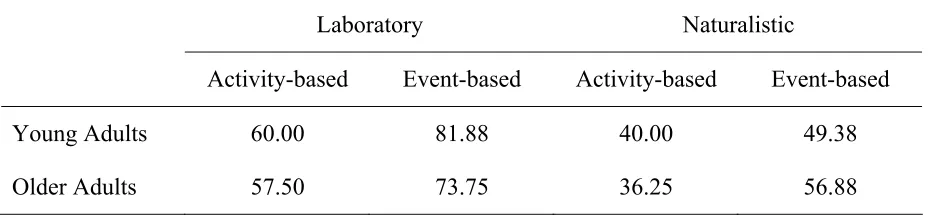
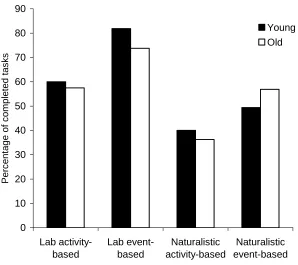
Figure 1 shows the percentage correct for the number of completed intentions across
experimental conditions for the two different groups (younger and older participants) and
Table 8 shows the means of the different task type and context combinations in percentage.
Post Hoc Tests
The investigator then conducted several post hoc tests to determine whether there
were any significant simple effects among the young and older adults, task types, and
contexts.
Paired-samples t-tests were utilized to test the simple effects of task type and age
within each context. There was no statistical difference between young adults’ performance
of the activity-based task and the event-based task performed in the laboratory. However,
there was a marginally significant effect for the older adults such that they were more likely
to successfully complete the event-based task rather than the activity-based task in the lab:
t(39) = -7.03, p = .067. Examination of the pattern of task performance in the naturalistic
setting showed significant effects for both young and older adults such that both age groups
were more successful at performing event-based than activity-based tasks; t(39) = -6.21, p <
PROSPECTIVE MEMORY 30
A second set of follow-up tests were conducted for the task type and age components
across context. A significant effect was found for the activity-based tasks such that young
adults were more successful at performing these tasks in the lab rather than the naturalistic
setting; t(39) = 7.66, p < .001. A similar result indicated that young adults were also more
likely to successfully complete event-based tasks in the lab rather than in the naturalistic
setting, t(39) = 4.46, p < .001. The data from the older adults also displayed significant
effects such that their performance was better in the lab for both activity- and event-based
tasks; t(39) = 7.16, p < .001 and t(39) = 2.22, p < .05, respectively.
Regression Analyses
Based on zero-order correlations, multiple regression analyses were conducted to
determine how age, perceptual speed, working memory, vocabulary, and the measure of
inhibition scores influence performance on the various task type and experimental context
combinations. As this set of analyses was largely exploratory, it was inappropriate to
formulate directional hypotheses.
Almost all predictor variables were inter-correlated with the exception of the Stroop
test score and working memory (Forward Digit Span) task. Given these correlation results,
every variable was included in the backward elimination multiple regression analyses except
the Forward Digit Span task and the Stroop test score. However, there was a significant
correlation between the Forward Digit Span task and the Backward Digit Span task in
PROSPECTIVE MEMORY 31
The only predictor variable that showed statistical significance for the activity-based
task in the laboratory setting was the Backward Digit Span task (Step 5: β = .29, p < .01).
Table 3 illustrates the backward elimination multiple regression analysis.
There were no statistically significant predictors for the event-based task in the
laboratory setting. The R²values were .050 for Step 1, .049 for Step 2, .048 for Step 3, .045
for Step 4, and .039 for Step 5.
The predictor variable (recall of the symbols of the Digit Symbol Substitution Test)
was significant for the naturalistic activity-based task only from Step 5 (Step 5: β = .29, p =
.01). Table 4 illustrates the backward elimination multiple regression analysis.
There were no statistically significant predictor variables for the naturalistic
event-based task. The R²values were .029 for Step 1, .029 for Step 2, .027 for Step 3, .026 for Step
4, and .025 for Step 5.
A second set of multiple regression analyses was conducted on the two distinct age
groups for the various task type and experimental context combinations. As this set of
analyses was also largely exploratory, it was again inappropriate to formulate directional
hypotheses.
For the young group, Forward Digit Span task and vocabulary were significantly
correlated with young age. Forward Digit Span task was the only significant predictor of
young adults’ performance on the lab activity-based task in Step 3. Table 5 shows the
PROSPECTIVE MEMORY 32
There were no statistically significant predictor variables (i.e. young age, Forward
Digit Span task, and vocabulary) to report for the lab event-based task. The R² values were
.083 for Step 1; .078 for Step 2; and .072 for Step 3.
There were no statistically significant predictor variables (i.e. young age, Forward
Digit Span task, and vocabulary) to report for the naturalistic activity-based task. The R²
values were .022 for Step 1; .021 for Step 2; and .014 for Step 3.
There were no statistically significant predictor variables (i.e. young age, Forward
Digit Span task, and vocabulary) to report for the naturalistic event-based task. The R² values
were .018 for Step 1; .017 for Step 2; and .012 for Step 3.
For the older group, there were no statistically significant correlations with older age.
Still, the investigator did a regression analysis for the laboratory activity-based task with the
only predictor variable, older age. Older age was a significant predictor of the older adults’
performance on the lab activity-based task (B = -0.113, SE B = 0.048, β = -.355, p < .05). The
R² value was .126.
Older age was a marginally significant predictor variable of older adults’ performance
on the lab event-based task (B = -0.058, SE B = .029, β = -.312, p = .05). The R² value was
.097.
The older age variable was a significant predictor for older adults’ performance on
the naturalistic activity-based task (B = -0.039, SE B = 0.017, β = -.355, p < .05). The R²
value was .126.
There was no statistically significant predictor variable (i.e. older age) to report for
PROSPECTIVE MEMORY 33
Summary of Results
In sum, there were two significant main effects (i.e. task type and context) in this
experiment, though both showed the opposite pattern from what had been hypothesized. The
other main effect (i.e. age: young and older) was not present nor was the 2-way interaction
between task type and context. Post hoc tests (follow-up paired samples t–tests for task type
and age within context)did not show any statistically significant effect for the lab activity-
and event-based tasks for young adults. A marginally significant effect (p < .07) was found
for older adults such that completing the event-based task was easier than completing the
activity-based task in the laboratory. There were significant effects for both age groups in the
naturalistic setting such that participants completed event-based tasks more often than the
activity-based tasks. Another set of follow-up testswas conducted to examine simple effects
of task type and age across context. There were more significant effects favoring the
completion of the event- and activity-based tasks in the laboratory condition than in the
naturalistic condition for both young and older adults, respectively. The predictor variables
utilized for the regression analyses for the performances of activity- and event based tasks
were age (as a continuous variable), Digit Symbol Substitution Test, recall of the symbols of
the Digit Symbol Substitution Test, Backward Digit Span task, and vocabulary in both
laboratory and naturalistic settings. When analyses were done separately for the young and
older groups, the predictor variables were different. For the young group, the predictor
variables were young age, Forward Digit Span task, and vocabulary in the lab and naturalistic
settings. For the older group, no predictor variables significantly correlated with one another.
PROSPECTIVE MEMORY 34
variable in the lab and naturalistic settings. Older age was found to be significant in both
PROSPECTIVE MEMORY 35
Chapter 4
Discussion
None of the four hypotheses were supported. As stated the first hypothesis was the
prediction that the performance of activity-based tasks would outperform the performance of
event-based tasks (Kvavilashvili & Ellis, 1996) for both groups in both settings. However,
event-based intentions were generally performed better than activity-based ones, overall,
rejecting H1. The second hypothesis predicted that young adults would outperform their older counterparts in both lab activity- and event-based tasks (Kvavilashvili & Ellis, 1996). There
was no significant difference between the two age groups, not rejecting H2. It seems that both groups were motivated enough to do well on the tasks. The third hypothesis predicted that the
performance in the naturalistic setting would exceed that of the performance in the lab (Kim
& Mayhorn, 2008). The performance in the laboratory setting of the experiment was found to
be better than the performance in the naturalistic setting, not supporting H3. The fourth hypothesis predicted that the older adults would outperform their younger counterparts in the
naturalistic setting (Rendell & Thomson 1999).The young participants performed better on
both tasks than their older counterparts in both contexts, except for the naturalistic
event-based task which the older adults performed better (discussed later).
Activity-based intentions did not show a superior performance over event-based
intentions. Looking at Figure 1, the performance of activity-based tasks was below that of
the performance of event-based tasks in both conditions (60.0% for young participants and
57.5% for older participants in lab activity-based tasks; 81.9% and 73.8% in lab event-based
PROSPECTIVE MEMORY 36
naturalistic event-based tasks, respectively). Results from a previous study (Kim & Mayhorn,
2008) showed a contradiction; they found activity-based tasks to be performed the best in the
laboratory and event-based tasks best in the naturalistic setting. Discrepancy is evident
because in this experiment, event-based tasks were best in both laboratory and naturalistic
settings. It is, perhaps, unusual because the time interval for the lab distracter task (90 trivia
question slides) was 20 seconds long, enough time to do the activity-based task after
finishing the block of questions. Perhaps, as Altmann and Trafton (2007) suggest,
participants had slower reengagement times when there was no activity going on for 6 and 8
seconds (i.e. staring at a blank screen) in the tank simulation scenario, possibly due to lack of
cue availability, alertness, or arousal and this made the activity-based task more difficult.
Further research needs to be done to explain this discrepancy in the literature. An alternate
explanation might be the dimensions of the tasks selected. The event-based tasks in both
laboratory and naturalistic settings had a more active role (i.e. circling answer when
telephone question came up in lab and searching for men’s shirts in naturalistic setting) and
could be remembered more than the more passive activity-based tasks (i.e. writing “yes” or
“no” whether there was telephone question in lab and putting completed questionnaire in box
as well as picking debriefing statement up in naturalistic setting).
Contrary to the findings by Rendell and Thomson (1999) that older adults have
superior prospective memory performance in the real world than young adults and that
demand of the task is not a factor, this experiment showed that older adults fared well in the
naturalistic setting’s event-based task compared with the young participants but did not in the
PROSPECTIVE MEMORY 37
event-based task than their younger counterparts was that in this experiment, participants
could write down the descriptions of the men’s clothes on a piece of paper and go around the
mall to look for them. They always had the piece of paper to remind them of what to look
for. In this way, having a short or long delay did not matter. In the same way, pilots use
note-taking (as prospective cues) after listening to air traffic control (ATC) messages and
repeating them back again (Morrow et al., 2003; Morrow et al., 2005). Also, it could be
argued that the event-based task in the mall was less artificial than the activity-based task
because it was a familiar shopping task. Thus, older adults may have been able to
compensate for any cognitive shortcomings by utilizing their experience using the “shopping
list” as a cue. However for the naturalistic activity-based task, a delay from doing the
event-based task might have had an adverse effect in remembering and completing the
activity-based task (cf. Johansson, Andersson, & Rönnberg, 2000 in which they found performance
on time-based tasks to be superior than to the event-based tasks in a naturalistic setting). It
also signaled that the demand of the prospective memory tasks was a factor in the mall
setting, familiarity with the area not so much. The reason is that the majority of the
participants were not familiar with the floor plan of Crabtree Valley Mall and that they
visited Crabtree Valley Mall rarely (see Table 2; Appendix K shows results from a few
participants familiar with the floor plan). Other extraneous factors that may have contributed
to these results include the variability of time, noise level, distraction, and level of crowd. For
the laboratory setting, as predicted, the young participants did better than their older