1
DEVELOPMENT OF CAMERA CALIBRATION SOFTWARE USING BUNDLE ADJUSTMENT METHOD
Ahmad Mujib Mashhuri & Anuar Ahmad, Department of Geoinformatics
Faculty of Geoinformation Science and Engineering, Universiti Teknologi Malaysia,
81310 Skudai, Johor, Malaysia
Email : [email protected] , [email protected]
Abstract
In close range photogrammetry, different types of camera such as compact digital camera, SLR digital camera and digital video camera can be used to capture the object of interest and determine the coordinates of the object. These cameras need to be calibrated in order to produce accurate results, hence, they need to be calibrated. The production of software for the purpose of camera calibration is not new. Many camera calibration software based on bundle adjustment method have been produced and available in the market. In this study, in-house bundle adjustment software is developed for the purpose of teaching and learning and understanding the concept of camera calibration. In the developed software, bundle adjustment method is adopted since it is a flexible method and can be used for many purposes such as calibration, resection, triangulation and others. This software uses the bottom up approach. Most of the existing bundle adjustment software provides the functions required to perform certain task. The developed software can assist the user in understanding the concept of bundle adjustment for camera calibration and all the functions in the software. This software is still under development and at early stage.
Keywords: Close range photogrammetry, digital camera, camera calibration, bundle adjustment
1.0 Introduction
Close range photogrammetry is a method that can be used to capture images from the ground using metric or non-metric cameras. According to Wolf (1983), the term close range photogrametry is used when the image of the object is captured in the range from the camera to the object is less than 300 meter. Another definition for the close range photogrametry is that the range between the object and the camera is less then 100 meter. In close range photogrammetry, the camera used can handle by hand or attached on the any suitable platform. At the early stage of close range photogrametry, it is used for the purpose of topographic mapping and even during the same time airplane was developed, the popularity of the close range photogrammetry is still strong (Clarke 1999). The products of close range photogrammetry include the shape, color, size, position and angle of the object.
2
distortion (k1,k2 and k3) and tangential lens distortion (p1 and p2). There are two types of abberation that
occured in the lens, namely radial lens distortion and tangential lens distortion.
There are two different types of camera that can be used for close range photogrammetry application which are known as metric camera and also non-metric camera. For metric camera, this type of camera is specially developed for close range photogrammetry application. It has stable internal orientation but this makes the cost of this type of camera is expensive. Non-metric camera is a normal camera that is used for recreation purpose or professional photographic. This camera type of camera does not has stable internal orientation parameter and the parameters tend to change from time to time. Example of non-metric camera is the SLR (Single Lens Reflex) and compact camera. This camera is manufactured not for high accuracy measurement. The distinct different of metric camera and non-metric camera is that there are fiducial marks in the metric camera.
Today close range photogrammetry application not only used for topographic mapping application but it also can be used for various or diversified applications. These include the different fields such as medical, industrial, architecture, forensic and etc. Close range photogrammetry become very popular because it has the advantage of non-contact measurement (i.e measurement can be done without direct contact with the object). For accurate measurement, any type of camera used in close range photogrammetry need to be calibrated. The need for calibrating camera is very important and the calibration software should be capable to calibrate both metric camera and non-metric camera. In this stusy, a camera calibration software will be developed for the purpose of calibrating any type of camera and for the purpose of education.
2.0 Camera
2.1 Metric Camera
Different from aerial photogrammetry, the camera used in close range photogrammetry is much easier to handle since it is light weight and can be used for different applications. With this characteristic the camera can be operated by using hand or placed it on different type of platform. Today non-metric camera become very popularity for close range photogrammetetric application compared to metric camera due to the less cost for the camera. However, the disadvantage of using non-metric camera is due to the unstable internal orientation parameters.
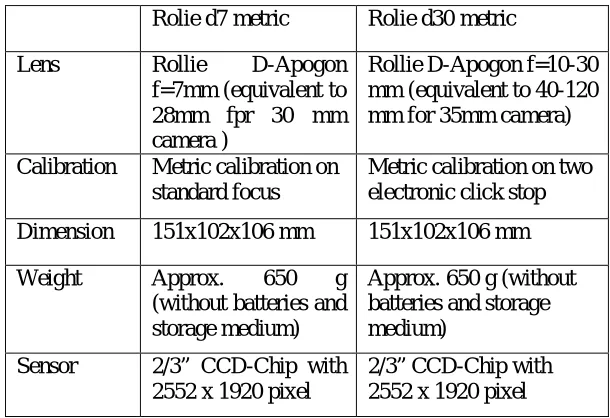
As mentioned in Scetion 1.0, metric camera was developed especially for close range photogrametry purpose and with the ability to capture image for high accuracy measurement. This type of camera is classified as the camera with highly stable internal orientation parameters, costly, very low lens distortion and developed specially for this application. Examples of metric camera that can be used for close range photogrammetric application are shown in Figure 1. Table 1 shows the specification of the metric cameras.
3
Rollie d7 metric Rollie d30 metric
Figure 1: Example of metric camera for close range photogrammetric applications
Table 1: Specification of metric camera
Rolie d7 metric Rolie d30 metric
Lens Rollie D-Apogon
f=7mm (equivalent to 28mm fpr 30 mm camera )
Rollie D-Apogon f=10-30 mm (equivalent to 40-120 mm for 35mm camera)
Calibration Metric calibration on standard focus
Metric calibration on two electronic click stop
Dimension 151x102x106 mm 151x102x106 mm
Weight Approx. 650 g
(without batteries and storage medium)
Approx. 650 g (without batteries and storage medium)
Sensor 2/3” CCD-Chip with
2552 x 1920 pixel
2/3” CCD-Chip with 2552 x 1920 pixel
2.2 Digital SLR and compact camera
4
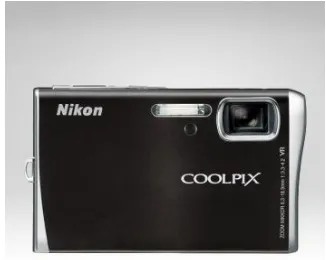
Nikon D60 SLR Digital Camera Nikon CoolPix S52 Slim Digital Camera
Figure 2: Example of non-metric camera
Table 2: Specification of non-metric camera
Nikon D60 SLR Digital Camera Nikon CoolPix S52 Slim Digital Camera
Extraordinary 10.2-Megapixel DX-format Nikon Picture Quality: Nikon's high-performance, 10.2-megapixel DX-format CCD imaging sensor and exclusive EXPEED image processing concept provide added cropping freedom and the ability to make larger prints.
Includes AF-S DX NIKKOR 18-55mm f/3.5-5.6G VR (Vibration Reduction) Image Stabilization Lens: NIKKOR lenses are famous for breathtaking sharpness and faithful color. With Nikon's fast, accurate autofocus and Vibration Reduction (VR) image stabilization technology built in, pictures are even sharper, free from blur caused by camera shake when shooting hand-held.
Fast Startup and Split-Second Shutter Response: With fast startup and split-second shutter response, the D60 eliminates the frustration of shutter delay, capturing moments that other cameras miss.
Shoot Continuously at up to 3 Frames per Second: Capture sports action, precious moments and fleeting expressions at up to 3 frames per second, for as many as 100 consecutive JPEG images.
Active Dust Reduction System with Airflow Control: Nikon's Active Dust Reduction System activates automatically, along with Airflow Control technology to reduce the amount of dust that reaches the sensor.
9.0 Megapixels for stunning prints as large as 16 x 20 inches. Plenty of sharp resolution to capture the finest details, crop creatively and produce incredible enlargements.
3x Optical Zoom-NIKKOR (38-114mm) Lens provides exceptional pictures. This lens is built on a proud heritage of producing precision camera optics that deliver superb color and razor-sharp results.
New EXPEED image processor ensures high-quality pictures with stunning color and sharpness. Nikon’s
comprehensive digital imaging processing concept incorporates the know-how and the technologies acquired throughout our long history of photographic and digital imaging development. EXPEED is custom-tuned for COOLPIX and renders natural-looking pictures of incredible quality and quick response so you will not miss that special moment.
Optical Vibration Reduction Image Stabilization compensates for camera shake to prevent blur and produce clearer, sharper results in lower light or unsteady conditions. In addition, the benefit of Nikon’s VR system extends to faster framing on the monitor and smoother action when using the movie mode.
5
3.0 Test Field
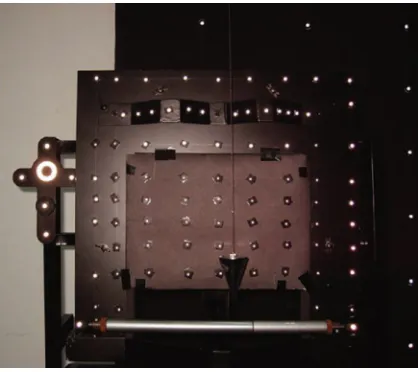
Test field is one of the main important parts of camera calibration. Without test field camera calibration cannot be performed. Usually test field are developed according to the needs of the study. In this study, a simple test field is used where it comprise of 30 to 70 points with approximate XYZ coordinates. All the points are marked with retro reflective target and a scale bar is also used in the test field. The scale bar is used to provide scale to the captured digital images. Figure 3 shows an example of simple test field.
Figure 3: An example of a test field
4.0 Camera calibration
In close range photogrammetry, accurate measurement can be obtained by acquiring convergent photograph or images and the camera used must be calibrated. If camera calibration is not carried out then the results are not reliable. There are several objectives for camera calibration as follows (Atkinson, 1996):
1. Evaluation of the performance of a lens
2. Evaluation of the stability of a lens
3. Determination of the optical and geometric parameters of lens
4. Determination of the optical and geometrical parameters of a lens-camera system
5. Determination of the optical and geometric parameters of an imaging data acquisition system
6
concept of additional parameters estimation. Thus, self-calibration is just one particular technique for estimating and compensating systematic error among others.
The concept of self-calibration which can be explained if single frame camera data processed, for instant in CCD camera application, the geometric sensor model is that perspective projection, leading to the so called bundle adjustment method. The bundle adjustment method is considered as the most flexible, general and accurate sensor model. Long time before it became standard procedure in aerial photogrammetry it was used in variety of close range photogrammetric applications.
5.0 Software Development
To develop flexible and reliable software that can be used to calibrate both metric camera and non-metric camera the method adopted is the bundle block adjustment. The bundle adjustment provides a simultaneous determination of all system parameters along with estimates of the precision and reliability of the extracted calibration parameters. One of the traditional implements to wider application of self-calibrating bundle adjustment outside the phogrammetry community has been the perception that the computation of initial parameters approximations for the iterative least-squares solution is somehow ‘difficult’. This is certainly no longer the case. As will be referred to later, self-calibration via the bundle adjustment can be fully automatic process require nothing more than images recorded in a suitable multi station geometry, an initial guess of the focal length (and it can be guess), and image identification coded target which form the object point array .
The software developed is base on the bottom-up method. This method is design for the project planning for the software development to create the sub system part by part before this part will be combine together and be one complete package software. This will give more advantage for the creator to develop each part with more detail, but this method have a little disadvantage because if the development for each sub system is too detail then it will take much longer time and more time is required to complete the development of the software and indirectly increase the cost due to time delay.
For this study, the software will be separated in to several sub system that commonly appear in commercial available software in the market such as follows:
1. Storage
2. Image reader/convert coordinate
3. Image matching / digitizer
4. Camera calibration
5. Statistical results
7
Compare to the available camera calibration software in the market, this type of software was developed with the method of ‘black box’ that is the user do not know what is happening behind the software. The approach of ‘black box’ software will prevent the user from knowing what happen including the statistical calculation done in the software itself. The user only knows how to click and put some parameter and the software will do everything then the results will appear on the screen. Perhaps this approach is suitable for commercial because the user does not need to know what happen but they only need the results. Different for the academic purpose or in this case, research in every part of the software will be useful for study in order to understand and develop or upgrade the available software to get a better result in the future.
The rational of the software development is that it will give a really good opportunity for each student and also researcher to study and understand the block bundle adjustment method that is adopted in the software to calibrate camera. Hopefully this software will give enough capability to calibrate any types of camera. This software will use block bundle adjustment for the following reasons:
Flexibility: bundle adjustment gracefully handle a very wide variety of different 3D feature and camera type (point, line, curve, surface, exotic camera) scene types (including dynamic and articulated model, sconce constrains), information sources (2D features, intensities, 3D information, priors) and error models (including robust one). It has no problem with missing data.
Accuracy: bundle adjustment give precise and easily interpreted results because it uses accurate statistical error models and supports a sound, well-developed quality control methodology
Efficiency: mature bundle algorithms are comparatively efficient on very large problems. They use economical and rapidly convergent numerical methods and make near-optimal use of problem sparseness.
6.0 Conclusion
The development of the camera calibration software is still in progress. It is hope that after completion of the software, it can be used for teaching the concept of bundle adjustment more clearly and student can understand the concept of bundle adjustment in a better way for camera calibration. With the ability as a ‘white box’ the software can be easily upgraded by any student to become more reliable and efficient to face the challenge of camera calibration in the future. This software can be improved to be better software and at the same time the user can learn how to do programming and how to apply block bundle adjustment for camera calibration.
Bibliography
Anuar Ahmad (2005). ”Analisis ke atas prestasi kamera digital kompak untuk aplikasi fotogrametri jarak dekat. ” PhD Thesis, Universiti Teknologi Malaysia
8
Behan, A. and Moss, R., (2006). “Close-Range Photogrammetric Measurement and 3D Modelling for Irish Medieval Architectural Studies, The 7th International Symposium on Virtual Reality, Archaeology and Cultural Heritage VAST (2006)
Atkinson, K.B (1996). “Close range photogrammetry and machine vision.” Whittles publishing, UK.
Ahn, S.J., Warnecke, H.J. & Kotowsikis, R. (1999). “Systemic Geometric Image Measurement Errors of Circular Object Target: Mathematic Formulation and Correction.” The Photogrammetric Record. 16(93): 485-502
Clarke, T.A., (1994). “ An Analysis of the Properties of the targets use in digital close range photogrammetry measurement.” Videometrics III.SPIE Vol. 2350: 251-262
Clarke, T.A (1999). “ The Development of Camera Calibration Methods and Models.” The Photogrammetric Rrecord, 16(91): 51-66
Dirk, H., Rieke-Zapp and Nearing, M. A., (2005). “Digital close range photogrammetry for measurement of soil erosion.” The Photogrammetric Record, 20(109): 69–87
Fazli Abdul Rahman (2006). ”Analisa Terhadap Rekabentuk Bingkai Kalibrasi Bagi Kamera Digital untuk Fotogrametri Jarak Dekat.” Thesis Sarjana, Universiti Teknologi Malaysia.
Anuar Ahmad and Zulkarnaini Mat Amin (1998). ”Unsur-unsur Fotogrammetri Dengan Pentafsiran Foto Udara dan Penderian Jauh.” Penerbit UTM, Universiti Teknologi Malaysia