University of Windsor University of Windsor
Scholarship at UWindsor
Scholarship at UWindsor
Electronic Theses and Dissertations Theses, Dissertations, and Major Papers
2010
Second language proficiency: Self-report vs. objective measures
Second language proficiency: Self-report vs. objective measures
and relationship with sentential priming in the processing of
and relationship with sentential priming in the processing of
interlingual homographs.
interlingual homographs.
Jordan Urlacher
University of Windsor
Follow this and additional works at: https://scholar.uwindsor.ca/etd
Recommended Citation Recommended Citation
Urlacher, Jordan, "Second language proficiency: Self-report vs. objective measures and relationship with sentential priming in the processing of interlingual homographs." (2010). Electronic Theses and
Dissertations. 44.
https://scholar.uwindsor.ca/etd/44
This online database contains the full-text of PhD dissertations and Masters’ theses of University of Windsor students from 1954 forward. These documents are made available for personal study and research purposes only, in accordance with the Canadian Copyright Act and the Creative Commons license—CC BY-NC-ND (Attribution, Non-Commercial, No Derivative Works). Under this license, works must always be attributed to the copyright holder (original author), cannot be used for any commercial purposes, and may not be altered. Any other use would require the permission of the copyright holder. Students may inquire about withdrawing their dissertation and/or thesis from this database. For additional inquiries, please contact the repository administrator via email
Second language proficiency: Self-report vs. objective measures and relationship with sentential priming in the processing of interlingual homographs.
by
Jordan Urlacher
A Thesis
Submitted to the Faculty of Graduate Studies through Psychology
in Partial Fulfillment of the Requirements for the Degree of Master of Psychology at the
University of Windsor
Windsor, Ontario, Canada
2010
Second language proficiency: Self-report vs. objective measures and relationship with sentential priming in the processing of interlingual homographs.
by
Jordan Urlacher
APPROVED BY:
______________________________________________ Dr. Tanja Collet-Najem
French
______________________________________________ Dr. Joseph Casey
Psychology
______________________________________________ Dr. Anne Baird, Advisor
Psychology
______________________________________________ Dr. Kenneth Hart Chair of Defense
iii
DECLARATION OF ORIGINALITY
I hereby certify that I am the sole author of this thesis and that no part of this thesis has been published or submitted for publication.
I certify that, to the best of my knowledge, my thesis does not infringe upon anyone’s copyright nor violate any proprietary rights and that any ideas, techniques, quotations, or any other material from the work of other people included in my thesis, published or otherwise, are fully acknowledged in accordance with the standard referencing practices. Furthermore, to the extent that I have included copyrighted material that surpasses the bounds of fair dealing within the meaning of the Canada Copyright Act, I certify that I have obtained a written permission from the copyright owner(s) to include such material(s) in my thesis and have included copies of such copyright clearances to my appendix.
iv ABSTRACT
Bilingual lexical access is apparently exhaustive: representations from both languages are activated when reading in either language. This study investigated the roles of proficiency and word frequency in bilingual processing using interlingual homographs – words with identical orthography across two languages but different meanings.
Semantic representations from both languages should be activated, resulting in inhibition of the incorrect meaning. Participants read sentences ending with homographs in their second language, French, and a lexical decision followed. Some stimuli were translations of English homograph meanings to French; lingering semantic inhibition was expected to influence reaction time to these stimuli.
v
ACKNOWLEDGEMENTS
First and foremost, I would like to thank my advisor, Dr. Anne Baird, for her guidance and support in the completion of this thesis. Her detailed and insightful feedback through draft after draft helped shape and refine this document, as well as my research and writing skills. I also have to thank my committee members, Dr. Joe Casey and Dr. Tanja Collet-Najem for their valuable suggestions along the way. Their input during my proposal meeting and comments on earlier drafts of my thesis helped improve my research methodology, not to mention my grammar (in both English and French).
Thanks to my parents for supporting my extended and occasionally expensive forays into higher education, and to the rest of my family for their non-financial support. I would not be where I am today without my family, and I certainly would not have done research on bilingualism if they had not had the foresight to put me in a French
Immersion school program at an early age. I also owe a debt of gratitude my fellow students in the University of Windsor Clinical Psychology program for being there when I needed academic guidance, statistical consultation, dinner company or just a
sympathetic ear.
vi
TABLE OF CONTENTS
DECLARATION OF ORIGINALITY ... iii
ABSTRACT ... iv
ACKNOWLEDGEMENTS ... v
LIST OF TABLES ... viii
LIST OF FIGURES ... x
CHAPTER I. INTRODUCTION General Introduction ... 1
A Note Regarding Terminology ... 3
II. REVIEW OF LITERATURE Monolingual Processing of Ambiguous Words in Isolation ... 5
Processing of Interlingual Homographs in Isolation ... 7
The Bilingual Interactive Activation Model ... 12
Monolingual Processing of Ambiguous Words in Sentential Context ... 13
Theories of Word Activation in Sentence Context ... 19
Bilingual Processing of Interlingual Homographs in Sentential Context ... 21
Processing of Cognate Words in Unilingual Sentences ... 32
Objective Assessment of Language Proficiency in Bilinguals ... 36
Self-Reported Language Proficiency in Bilinguals ... 37
III. DESIGN AND METHODOLOGY The Present Study ... 40
Hypotheses ... 42
Participants ... 43
Materials... 44
Procedures ... 52
Statistical Analyses ... 54
IV. ANALYSIS OF RESULTS Sample Characteristics ... 57
vii
Correlations ... 62
Preliminary Analyses – Order of Lexical Decision Item Administration ... 64
Hypothesis 1: Reaction Time Effects ... 66
Hypothesis 1: Reaction Time Effects – Additional Analyses ... 69
Hypothesis 2: Error Rate Effects ... 72
Hypothesis 2: Error Rate Effects – Additional Analyses ... 74
Hypothesis 3: Relationship Between Self-Reported and Objectively-Measured Proficiency – Main Analysis ... 77
Hypothesis 3: Relationship Between Self-Reported and Objectively-Measured Proficiency – Additional Analysis ... 78
V. DISCUSSION Summary ... 80
The Influence of Stimulus Type and L2 Proficiency on Reaction Time ... 81
The Influence of Stimulus Type and L2 Proficiency on Error Rate .. 83
The Role of L2 Proficiency in Bilingual Processing Across Studies ... 83
The Influence of L1 and L2 Homograph Frequency on Reaction Time and Error Rate ... 84
Comparison with Conklin’s (2005) Results ... 86
Self-reported vs. Objectively-measured L2 Proficiency ... 86
Proficiency and Bilingual Language Processing ... 87
Neural Correlates of Bilingualism ... 89
Limitations of the Present Study ... 91
Strengths of the Present Study ... 92
Future Directions... 92
APPENDICES A: Glossary of Terms ... 94
B: Online Recruitment Ads ... 97
C: Consent Forms... 99
D: Selected Materials Used in Study ... 105
REFERENCES ... 108
viii
LIST OF TABLES
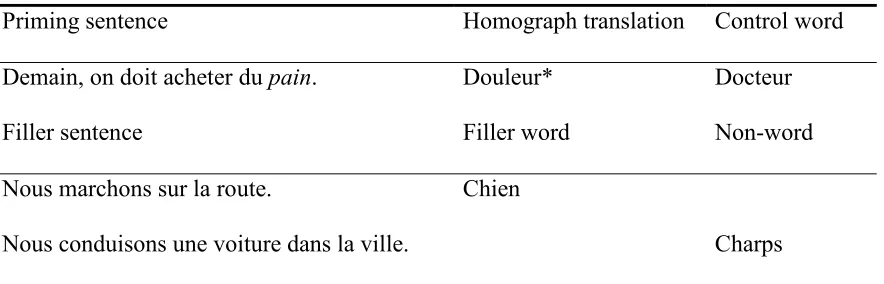
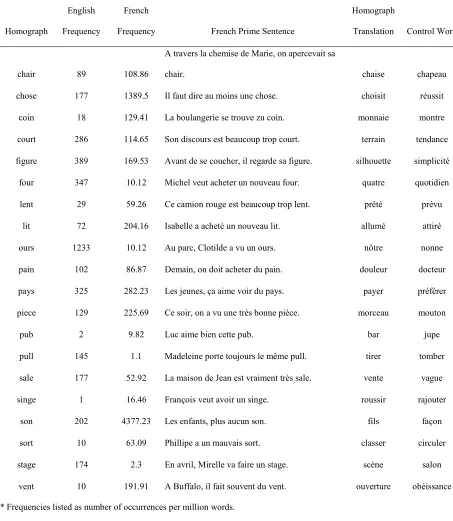
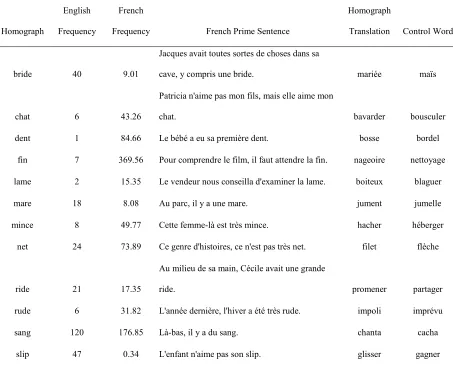
TABLE 1:EXAMPLES OF STIMULI USED IN LEXICAL DECISION TASK ... 49 TABLE 2:STIMULI OF INTEREST RETAINED IN ANALYSIS ... 50 TABLE 3:STIMULI OF INTEREST EXCLUDED FROM ANALYSIS ... 51 TABLE 4:SAMPLE CHARACTERISTICS WITH P-VALUES FOR T-TESTS BETWEEN HIGH AND
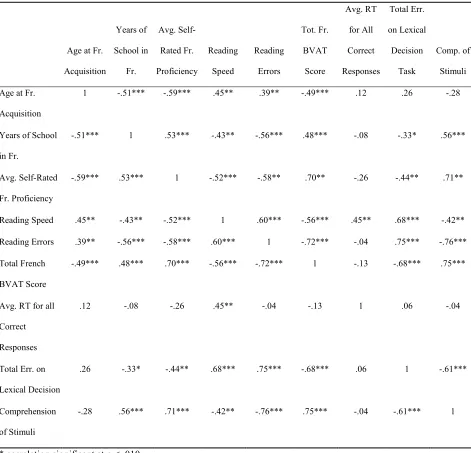
LOW PROFICIENCY GROUPS ... 58 TABLE 5:CORRELATIONS BETWEEN DEMOGRAPHIC,LEAP-Q,BVAT,LEXICAL DECISION,
AND STIMULUS VERIFICATION TASK VARIABLES (N =46) ... 63 TABLE 6:ANOVARESULTS FOR REACTION TIME BY QUARTER OF TASK (N =46) ... 65 TABLE 7:ANOVARESULTS FOR ERROR RATE BY QUARTER OF TASK (N =46) ... 66 TABLE 8:ANOVARESULTS FOR REACTION TIME BY STIMULUS TYPE AND FRENCH (L2)
PROFICIENCY (N =40) ... 68 TABLE 9:ANOVARESULTS FOR REACTION TIME BY STIMULUS TYPE,FRENCH (L2)
HOMOGRAPH FREQUENCY, AND FRENCH (L2)PROFICIENCY (N =39) ... 70 TABLE 10:ANOVARESULTS FOR REACTION TIME BY STIMULUS TYPE,ENGLISH (L1)
HOMOGRAPH FREQUENCY, AND FRENCH (L2)PROFICIENCY (N =37) ... 72 TABLE 11:ANOVARESULTS FOR ERROR RATE BY STIMULUS TYPE AND FRENCH (L2)
PROFICIENCY (N =46) ... 73 TABLE 12:ANOVARESULTS FOR ERROR RATE BY STIMULUS TYPE,FRENCH (L2)
HOMOGRAPH FREQUENCY, AND FRENCH (L2)PROFIIENCY (N =40) ... 76 TABLE 13:ANOVARESULTS FOR ERROR RATE BY STIMULUS TYPE,ENGLISH (L1)
ix
TABLE 14:STEPWISE REGRESSION RESULTS FOR TOTAL BVATFRENCH SCORE PREDICTED
x LIST OF FIGURES
FIGURE 1:BVATTOTAL FRENCH SCORE FOR EACH PARTICIPANT BY PROFICIENCY GROUP
FOR ENTIRE SAMPLE ... 61 FIGURE 2:BVATTOTAL FRENCH SCORE FOR EACH PARTICIPANT BY PROFICIENCY GROUP
WITH MIDDLE OF DISTRIBUTION REMOVED ... 61 FIGURE 3:MEAN RAW REACTION TIME BY QUARTER OF TASK ... 65 FIGURE 4:MEAN RAW REACTION TIME BY STIMULUS TYPE AND FRENCH (L2)
1 CHAPTER I INTRODUCTION General Introduction
Recent worldwide estimates suggest that the number of individuals who are fluent in multiple languages (bilinguals or multilinguals) greatly exceeds the number of
individuals who speak and understand only one language (monolinguals) (Tucker, 1999). Research regarding the manner in which bilinguals process language is very important in that it contributes to the development of theories and models of language representation and it also may assist in improving methods of second language teaching and learning. For example, findings in past studies (e.g., Jiménez, García, & Pearson, 1995) have led some to suggest that bilingual children should be encouraged to draw on knowledge of their first language when they encounter an unknown word in their second language. Bilingual children have also been observed to display better cognitive flexibility and inhibitory control abilities than their monolingual peers (Bialystok & Viswanathan, 2009), and research in the area of bilingual language processing could contribute to greater understanding of this phenomenon.
2
processing of control words (matched controls or simply controls) which have only one semantic representation and have a similar frequency of occurrence to the ambiguous words that are being studied. Control words are often also similar to the ambiguous words in terms of first letter and part of speech. A frequency of occurrence of a word (frequency) refers to an estimation of how often it is used in day-to-day speech. For instance, the word the has a far higher frequency of occurrence than the word quincunx.
Word frequency estimations are usually based on analyses of books, films, and other media which involve the use of many words.
A number of studies have also been undertaken in order to determine how bilingual individuals process interlingual homographs, which are words with the same orthography but different semantic and phonological representations in two languages (e.g., pain, which in English means an unpleasant sensation resulting from physical harm and in French means bread). Other studies have investigated the processing of cognates, words that share the same orthography and meaning (and sometimes, but not always, phonology) across two languages (e.g., danger, which conveys a sense of hazard in both English and French). However, most of these studies have investigated the processing of words in isolation, and relatively little research has been conducted regarding the
3
The background section of this proposal will provide a review of previous
literature regarding the processing of ambiguous words, as well as information about self-report and objective measures of language proficiency. It will be structured in such a way that research regarding more basic language processing will be presented initially and then a discussion of studies involving more complex linguistic processing. First, a summary of research involving the processing of monolingual ambiguous words (e.g., homographs and homonyms) and bilingual ambiguous words (e.g., interlingual
homographs) in isolation will be presented. Second, a sampling of studies investigating the processing of monolingual ambiguous words in sentences will follow. Theories addressing the processing of ambiguous words in the context of sentences will be
reviewed. Third, the predominant theoretical model of bilingual language processing will be described and explained. Fourth, more recent work regarding the processing of
interlingual homographs in the context of sentences will be presented. Fifth and lastly, some promising measures of self-reported and objectively measured language proficiency will be detailed.
A Note Regarding Terminology
In linguistics literature, the term homonym refers to any word which has two meanings (Collet-Najem, personal communication, January 29, 2010), and homonyms are subdivided into homographs, in which both meanings are spelled the same but not necessarily pronounced the same way (e.g., bear/bear or dove/dove), and homophones, in which both meanings are pronounced the same but not necessarily spelled the same way (e.g., bear/bare or bear/bear). In psychology literature, however, the term homonym
4
5 CHAPTER II
REVIEW OF LITERATURE Monolingual Processing of Ambiguous Words in Isolation
The processing of ambiguous words in isolation by monolinguals has been investigated in a number of studies. The main goal of these investigations has been to determine whether all of the semantic representations of a given word are exhaustively activated when it is viewed, or whether representations are selectively activated. Results predominantly agree with an exhaustive access model. For instance, Gottlob, Goldinger, Stone, and Van Orden (1999) elicited faster reaction times for homonyms with multiple distinct meanings than control words in naming (read each word out loud) and lexical decision (decide whether a given letter string is a word or a non-word) tasks, but found that reaction times were slower for homographs in those same tasks. The difference in reaction times between these two types of ambiguous stimuli was interpreted to mean that multiple semantic representations result in facilitation of processing, whereas multiple semantic and phonological representations cause inhibition as a result of increased
competition. These phenomena were noted to be consistent with an exhaustive processing model in which all semantic representations of a given word are activated before the correct one is chosen.
Hino and Lupker (1996) examined the effect of frequency on the processing of homonyms which had either two distinct low-frequency meanings or two high-frequency meanings in both naming and lexical decision tasks. For instance, both meanings of perch
6
good) are quite commonly used. The researchers found that low-frequency homonyms elicited faster reaction times than unambiguous control words on the naming task, but that the high-frequency homonyms did not. However, in the lexical decision task, both groups of homonyms produced faster responses than controls. As with the results of the Gottlob et al. (1999) study, this was thought to suggest a facilitation effect of multiple meanings on semantic activation.
Rodd, Gaskell, and Marslen-Wilson further explored the homonym facilitation effect in a 2002 study. These researchers divided homonym stimuli based on whether they had multiple unrelated semantic representations (e.g., bass the species of fish vs.
bass low frequency tones) or multiple similar senses in that the meanings were related but conveyed slightly different information (e.g., getan A as in to receive a good mark vs. get scared as in to become frightened). Rodd et al. found that both lexical decision and naming times were faster to control words with one meaning compared to those with multiple meanings, but that words with more than one sense produced faster times than those with multiple, unrelated meanings or control words. Once again, this was
interpreted to mean that competition between multiple distinct semantic representations of a word slows processing. In this case, however, it was demonstrated that multiple related semantic representations may actually result in faster processing.
7
participants and stimuli suggest that multiple semantic representations of an ambiguous word are activated when it is viewed in isolation. When meanings are unrelated or multiple phonological representations are also activated, as in homographs, additional competition occurs and recognition of ambiguous stimuli is slowed.
Processing of Interlingual Homographs in Isolation
Studies similar to those undertaken with monolingual subjects also have been conducted with bilingual stimuli and participants. One area of research concerns the processing of interlingual homographs, otherwise known as homographic non-cognates
or false friends. These are words which have the same orthography in two languages, but different distinct meanings in each language. As with the processing of ambiguous words in monolinguals, research in this area has largely focused on whether activation of these words is language-specific or exhaustive. The aforementioned review conducted by Altarriba and Gianico (2003) suggested that the majority of the literature is in favour of an exhaustive access model, but that the native-language (L1) representation of a homograph tends to be activated first, followed by the second-language (L2)
representation. The researchers also noted that the frequency of word meanings across both languages plays a role in their processing.
8
activation of semantic representations in both languages speeded responses to cognates, whereas the Dutch representations for interlingual homographs were inhibited and did not influence reaction times. They proposed that this may have occurred because participants thought they were engaging in an exclusively English task and thus suppressed Dutch representations. In a follow-up study, the researchers added Dutch filler words to the stimulus set in an attempt to increase the baseline activation of the L1 lexicon. English was still the target language, meaning that participants were only to respond yes to
English words and not Dutch words. With this modification, slower lexical decision times were recorded to interlingual homographs than to control words.
9
required responses to both English and Dutch stimuli, since responses to either language were correct the interlingual homographs were identified more quickly as they were represented in both languages. The effects of task demands on bilingual language processing were later explored in further detail by others (e.g., de Groot, Delmar, & Lupker, 2000; Dijkstra, Timmermans, & Schriefers, 2000).
A novel study regarding the processing of interlingual homographs was conducted by de Groot, Delmaar, and Lupker in 2000. This study consisted of three experiments - a translation recognition task and two lexical decision tasks. In the translation recognition task subjects had to identify whether two words, one in Dutch and one in English, had equivalent meanings. Procedurally, the first of the two lexical decision experiments replicated Dijkstra et al.’s (1998) first lexical decision task, although in this case it was administered in two sections – once with L1 Dutch as the target language and once with L2 English as the target language. As in Dijkstra’s first experiment, participants were told to respond yes only to words in the language in which they were being tested – not those in the other language. The second lexical decision experiment undertaken by de Groot et al. used the same procedures as their first but in this case some of the stimuli which required a no response were real words in the non-target language. This modification was thought to force the subjects to function in a language-specific mode in order to avoid false positives.
In the translation recognition task, responses were slower to interlingual
10
by de Groot and colleagues (2000), but only in the first section when subjects were tested in Dutch. In the second lexical decision task a large, frequency-dependent inhibitory effect was demonstrated for homographs regardless of whether subjects were tested in Dutch or English. de Groot et al. suggested that the results of the first lexical decision task were somewhat counterintuitive, as they had predicted a greater level of homograph inhibition would occur when processing in L2 than in L1 due to the subjects’ lower levels of English familiarity. They noted that the slowest reaction times across all experiments were observed when homographs with a low frequency in Dutch but a high frequency in English were presented. Based on the discrepancy in response patterns between the Dutch task and the English task in the first lexical decision task, the researchers suggested that the effect observed in this task was due to certain subjects choosing to perform in a “language neutral” (p. 412) manner on the Dutch portion of the stimulus set, although this was difficult to substantiate. Overall, they concluded that language access in bilinguals is non-selective.
Dijkstra, Timmermans, and Schriefers (2000) undertook a go/no-go task with L1 Dutch participants with English L2 in order to investigate the processing of interlingual homographs with varying levels of frequency. In one experiment, the subjects were to respond yes if the word presented was English, and in the other they were to respond yes
11
In addition to studies regarding the semantic representations of interlingual homographs, some research has also been carried out on the activation of the phonological representations of interlingual homographs. Jared and Szucs (2002)
performed one such study on native French speakers with L2 English and native English speakers with L2 French. The homograph stimuli used for both language groups in this study were low frequency words in L1and high frequency in L2, and the experiment required that participants first read aloud a block of English words, then a filler block of French words, and finally another block of English words. Error rates
(mispronunciations) and response latencies (reading time) were the dependent variables in this study. In the first English block, French L2 and English L2 participants made more errors on homographs than non-ambiguous control words, but English L2 participants also demonstrated slower response latencies to homographs. During the second English block, both groups committed a greater number of errors and had slower response times to homograph stimuli – this was attributed to increased expectancy of French words induced by the filler task. Jared and Szucs interpreted their results to mean that, as with semantic activation, phonological activation in bilingual processing can be language specific or exhaustive, depending on task demands, the pattern of language acquisition of the individual being tested, and whether there is a high level of activation from L2. They also suggested that the phonological competition, which occurs in interlingual
12
These studies, among others, demonstrate exhaustive activation of interlingual homographs in bilingual processing. However, the extent of activation appears to be influenced by task demands and homograph frequency in both languages.
The Bilingual Interactive Activation Model
Although both language-selective (e.g., Scarborough et al., 1984) and fully exhaustive (e.g., Beauvillain & Grainger, 1987) theories of bilingual language processing have been proposed, at present the Bilingual Interactive Activation (BIA) model (Dijkstra & Van Heuven, 1998; Van Heuven, Dijkstra, & Grainger, 1998) and its successor, the BIA+ (Dijkstra & Van Heuven, 2002) appear to be the predominant theories. The BIA+ is a model of bilingual word activation in which the activation of appropriate
representations occurs chiefly through bottom-up processing with some top-down influences. This model involves a number of levels of processing and accounts for both selective and exhaustive effects.
13
representations. Overall, however, it is the similarity of a given letter string to the internal lexical representations that determines which word is activated, not language
membership.
The BIA+ model also includes a task/decision system which explains the effects of task demand on bilingual processing. This system optimizes a bilingual person’s language activation for the task at hand; for instance, if a task is being performed in only one language, processing occurs in a more selective manner and the non-target language is inhibited. However, if the task involves both of a bilingual’s languages, they will both be activated during processing.
An example of how the BIA+ model would process an interlingual homograph follows. The example given is for a bilingual person for whom L1 is English and L2 is French. If this person sees the word pain while reading in French, it is first recognized at the sublexical and orthographic levels, and activation then spreads to the phonological and semantic levels. Since the orthography is consistent with representations in both English and French, phonological and semantic representations from both languages are activated and competition occurs. Frequency favours the more familiar L1 representation; however, the task/decision system recognizes that the context in which the word occurs is French. Thus, the overall level of activation for French representations increases, while English representations are inhibited. This allows for more language-selective processing, and the correct, French interpretation is selected.
Monolingual Processing of Ambiguous Words in Sentential Context
14
representations occurs. However, words are rarely processed outside of sentences in real-life situations, and thus it is important to study how they are processed in context.
Some of the earliest research conducted with ambiguous words in context was undertaken by Swinney (1979) and Tanenhaus, Leiman, and Seidenberg (1979). Their studies investigated the processing of ambiguous words in sentential context by having subjects listen to sentences which contained a homonym and then engage in a lexical decision or naming task. The lexical decision or naming task occurred either immediately after they heard the homonym (Swinney, 1979) or after a 200ms delay (Tanenhaus et al., 1979). Although the frequencies of the homonym meanings in these studies were
relatively balanced, the sentence contexts were biased toward one meaning. These studies demonstrated priming for multiple homonym meanings immediately after the homonym and after a brief delay, but found that following a longer delay only the appropriate meaning was facilitated.
15
frequency of a particular representation of an ambiguous word and the context in which it is displayed can influence whether activation is exhaustive or selective for the given representation.
In an eye-tracking study conducted by Duffy, Morris, and Rayner (1988), participants read sentences containing homonyms that either had meanings with similar frequencies (balanced homonyms) or one dominant and one subordinate meaning (unbalanced homonyms). Sentences included contextual information which suggested one of the two meanings of the homonym, and this clarifying context or contextual prime occurred either before or after the homonym in the sentence. When the contextual prime occurred after a balanced homonym, longer fixation times were recorded for the
homonym than for a control word. This was interpreted to mean that when context does not suggest a meaning, representations are exhaustively activated resulting in competition and slower processing. However, when the contextual prime occurred after an
unbalanced homonym, fixation times were not significantly different for homonyms than controls. The experimenters suggested that this was because only the higher frequency representation was activated in this case and thus no competition occurred.
16
it became available at the same time as the dominant meaning, which would have otherwise been activated earlier, and this resulted in competition. They concluded that both frequency of representations and sentence context are important in the processing of ambiguous stimuli.
A similar study was undertaken by Folk and Morris (1995). However, this study included homograph stimuli as well as homonyms. Their study replicated the findings of Duffy et al. (1988) with regard to homonyms, but a different pattern of results was observed when homographs were used. When the sentence context suggesting a meaning occurred after the homograph rather than before (e.g., a bear is an animal vs. my
favourite animal is a bear), longer fixation times were recorded at the homograph than at a control word (e.g., animal in the previous two examples) in the same sentence. Folk and Morris suggested that this occurred because in addition to two different semantic
representations (as with homonyms), homographs also have multiple distinct
phonological representations and these phonological representations compete regardless of the relative frequencies of the corresponding semantic representations. When the disambiguating sentence context occurred before a homograph and suggested the
subordinate meaning, longer fixation times were recorded for the homographs. However, fixation times were shorter with pre-homograph contextual suggestions relative to post-homograph suggestions. Folk and Morris concluded that both representations of a homograph are always activated, but that context has some mediating effect on this phenomenon.
17
meanings on the processing of homonyms. High constraint passages were designed to strongly suggest one meaning of a homonym (e.g., the butler got the jelly, then he prepared the toast – jelly is thought to be strongly associated with one meaning of toast), whereas weakly biased passages were less suggestive of the target meaning (e.g., he went to the kitchen to get some toast – kitchen is related to two different meanings of toast). Martin and colleagues’ first experiment employed a moving window paradigm in which words were presented one at a time on a computer screen, with a new word appearing after the subject read the current word and pressed a button. When high constraint sentences were presented, no influence of frequency was observed: homonyms were processed at an equal rate regardless of whether the high or low frequency meaning had been suggested. This was thought to mean that when the context is strong enough, activation is selective and not frequency dependent. However, when sentences only gave a weak suggestion of meaning, reading times were faster when the dominant meaning was suggested than when the subordinate meaning was suggested. Martin et al. took this to mean that when a high frequency meaning was suggested by a weak context, only the appropriate representation was activated, whereas when a low-frequency meaning was suggested under the same conditions, activation was exhaustive as the weak context was not enough to overcome the frequency bias.
18
when the sentences “The custodian fixed the problem. She inserted the bulb into the empty socket” were presented, either a related probe word (e.g., light) or an unrelated probe word (e.g., tavern) would immediately follow the homonym bulb. Despite the change in experimental design, similar results were obtained. When a highly constraining sentence was presented, responses to probe words related to the appropriate meaning were named more quickly than control probes which were not related to the meaning (facilitation). Response times for probes which were semantically related to the incorrect homonym meaning were no different from those to controls. As in their first study, Martin et al. interpreted this as an indication that, with strong context, activation is selective. When low constraint sentences suggesting subordinate homonym meanings were presented, probe words related to either homonym meaning elicited faster responses than control words (a facilitation effect). Conversely, when sentences weakly suggested the dominant meaning, only probes relating to the high frequency meaning were
facilitated. Once again, Martin et al. demonstrated that homonym meanings were exhaustively activated when a low frequency meaning was suggested, but that only the high frequency meaning was activated when it was suggested by the sentence context.
19
slowly than homonyms under all conditions due to competition at the phonological as well as at the semantic level.
Theories of Word Activation in Sentence Context
A number of theoretical models regarding word recognition in sentence context have been proposed. Onifer and Swinney (1981) suggested an exhaustive theory, in which lexical access is always exhaustive, regardless of sentence context or word
frequency. Context only becomes relevant after all representations of an ambiguous word have been initially activated. The ordered search theory posited by Hogaboam and Perfitti (1975) stated that when an ambiguous word is encountered, its representations are activated one at a time, beginning with the most frequent, and this process continues until a context-appropriate representation is selected. As with the exhaustive theory, context only becomes involved after lexical representations are activated. However, these models are not compatible with the results of a number of studies, including those detailed above, which have demonstrated that frequency and context are involved in the selection of an appropriate word representation.
A number of experimenters have proposed a reordered access model in which all representations of a word begin to be activated at the same time, but the speed of
20
reordered access model also states that context may facilitate the activation of appropriate representations, but that it does not inhibit inappropriate representations.
Duffy et al. (1988) suggested that competition between the representations of an ambiguous word can take place either at the point of initial access, or following initial access when context comes into play, and that this competition results in longer reading or reaction times to ambiguous words. In the event that context is neutral and all
meanings are of balanced frequency, particularly high levels of competition will be observed. Rayner and his colleagues (1999) stated that the strength of a given context can influence processing, and described a situation akin to that observed in the Martin et al. (1999) study, detailed in the previous section. If context weakly suggests a subordinate meaning, the dominant meaning still is activated, resulting in competition. However, if the context is sufficiently constraining, only the appropriate meaning will activate regardless of frequency. Duffy et al. (1988) described the reordered access model in terms of frequency and context factors building up evidence for the varying
representations of a word, and specified that the interpretation which had the strongest amount of evidence would be selected. When the evidence is equivalent across
representations, competition occurs and selection is slowed.
21
present). Both frequency and strength of context are thought of as continuous variables, and it is posited that when context is weak, the influence of frequency becomes more important, whereas when context is strong, frequency plays less of a role. Although all semantic representations of an ambiguous word are activated to some extent, the level of activation is thought to be contingent on the aforementioned factors. The work of Martin et al. (1999) as described above can be explained by both the reordered access and context-sensitive models. When a dominant meaning is supported by weak context, only the dominant representation is activated. However, when a subordinate meaning is
supported by weak context, both representations activate resulting in longer reading times for the ambiguous word and facilitation of probe words relating to both meanings. When the contextual suggestion is highly constraining, only the appropriate representation is selected, as evidenced by the lack of discrepancy between reading times for dominant and subordinate meanings, and facilitation of probes relating only to the appropriate meaning.
Bilingual Processing of Interlingual Homographs in Sentential Context
Compared to the body of research regarding monolingual processing of ambiguous words in sentential context, there is a relatively small amount of similar research with bilinguals. Altarriba and Gianico (2003) described one of the first studies of this nature, which was undertaken by Altarriba, Carlo, and Kroll in 1992. These
researchers performed a study with native Spanish speakers with L2 English which investigated the processing of English and Spanish sentences ending with
22
English meaning was appropriate and also a sentence such as “The play reached its fin” where the Spanish meaning was correct but the language context was not. In this study, subjects were required to read aloud a target word at the end of each sentence, and this word was either an interlingual homograph or a control word matched for frequency. Slower reading times were observed in conditions where the meaning was appropriate but the language was not (as in the second sentence above) relative to those where both the meaning and language were appropriate (as in the first sentence). The researchers discovered that, when language context was appropriate, the time taken to read an interlingual homograph in L1 was no greater than the time taken to read a control word; however, the time taken to read an interlingual homograph in L2 was greater even when the rest of the sentence was also in L2 English. This pattern of results was interpreted to mean that words may be processed in a language-selective manner when strong
expectations are built up in a particular language, but in an exhaustive manner when the situation is ambiguous.
23
and total fixation times when the final word in a highly constraining sentence was presented in the non-target language, Spanish, than when it was presented in the target language, English. Altarriba et al. suggested that this occurred because the English sentence context built up an expectation for a specific English word. Even though the meaning of the Spanish word was appropriate, it was in the wrong language, and thus it was examined in more depth, as indicated by the longer fixation times. In contrast, when low constraint sentences were utilized, no difference in fixation times was noted when the final word was in English or Spanish, possibly because less expectation was induced. Altarriba et al. (1996) conducted a follow-up study with essentially the same procedures but presented the words in each sentence one-at-a-time in a rapid serial visual
presentation (RSVP) format and asked participants to name a capitalized target word. A similar pattern of results was observed with these alterations.
Elston-Güttler, Paulmann, and Kotz (2005a) performed several experiments regarding bilinguals’ processing of ambiguous words in sentences. Working with native German speakers in L2 English, they investigated how translations of German homonyms were processed. Two different types of homonyms were used in this study: half of them had two unambiguous English translations, and the other half had two English
translations of which one was an ambiguous word in its own right. An example of the latter word type would be the German word zoll, which translates to inch and duty in English – duty also has two different meanings. The experimenters examined the
24
to the scalp. In the single-word condition, participants engaged in a lexical decision task in which the target words were English translations of one meaning of a German
homonym. These targets were preceded with either an unrelated control word, or a translation of the other meaning of the German homograph. For example, the German word kiefer has two meanings which can be translated to jaw and pine in English, so the target word jaw would be preceded by pine in the homonym translation pairs and by an unrelated word such as boat in the control pairs.
In the sentence condition, Elston-Güttler et al. (2005a) used the same homonyms and translations, but the prime was presented at the end of a contextually-appropriate sentence before the target word. For instance, in the stimulus pairings of interest, the sentence “The candy stuck together his jaw” would be followed by its homonym
translation pair pine. The researchers posited that an inhibitory effect would be observed in the homonym translation pairs, as the two English meanings associated with the German homonym would complete with each other for activation. Such an effect would be observed in ERP data through the production of certain amplitudes (N200), which are associated with response inhibition, and through slower reaction time to homonym pairs than control pairs. These predictions were confirmed to some extent: increased N200 amplitudes and slower reaction times on the lexical decision task were observed in low-proficiency L2 learners when words were presented in isolation or in sentences.
However, participants with high proficiency in English showed slower reaction times but no increase in N200 amplitudes when words were presented in isolation, and no effects on either measure were noted when the primes were presented in sentences. The
25
block out influences from L1 and suggested that efficient function of the BIA+ task/decision system may be one component of this ability.
Elston-Güttler, Gunter, and Koytz (2005b) conducted another study with native German speakers in which participants were presented with English (L2) sentences that were missing their final word. Once the participant pushed a key indicating that they had read the incomplete sentence, the final word appeared on the screen. The final words were either interlingual homographs which were contextually appropriate in the English sentences, or contextually-appropriate non-homograph words. These words served as primes for subsequent target words that were translations of the German meaning of the homograph into English. For example, in homograph translation items the incomplete sentence “The woman gave her friend a pretty…” would be followed by the interlingual homograph gift as a prime for the target word, which was the English translation of the German meaning of gift: poison. In the control version of the example sentence, shell
would be presented as a prime for the same homograph translation. Elston-Güttler et al. also tested for priming effects by presenting the homograph and the target translation in a lexical decision task without the preceding sentence. In this task, participants were told that all of the words would be in English. When the homograph stimuli were presented in isolation, the homograph stimuli (e.g., gift) always primed translations of their L1
meanings (e.g., poison), which suggested exhaustive access to both languages. Before engaging in the sentence context task, subjects viewed a short film in either English or German; this was intended to raise the level of baseline activation for the language heard in the film. When the German film was presented first, priming of the homograph
26
effect was only observed during the first half of the task. Elston-Güttler and her
colleagues theorized that as the task went on, participants eventually “zoomed in” (p. 68) to L2 and the influence of L1 was eliminated. Subjects who viewed the English film demonstrated no homograph priming at any point in the task. The researchers suggested that the combination of English sentence context and the increased baseline English activation resulting from the previously viewed film caused such strong L2 activation that the influence of L1 was essentially eliminated.
Although Elston-Güttler et al. (2005b) stated that their results support some degree of interaction between languages in the processing of interlingual homographs; they proposed that this phenomenon is sensitive to top-down influences. The top-down aspects of homograph processing were thought to be accounted for by the BIA+
task/decision system. In their study, the effects of this system were demonstrated through the fact that the language of the pre-task film affected lexical decision results early in the task and that response patterns changed over time as the subjects became accustomed to the lexical decision task. Elston-Güttler et al. suggested that although the task/decision and word identification components of the BIA+ are supposed to operate independently, they may work in unison during certain situations causing the language access system which is essentially exhaustive to become language-selective.
27
words with the same orthography and one shared semantic representation between
languages, but one or more other unshared representations (e.g., band meaning a group of people in English and banda meaning the same in Spanish). Schwartz also examined the role of phonological similarity or dissimilarity in cognates across the two languages. Sentences used in her experiments were either strongly biased toward one meaning of the target word or neutral, and were presented one word at a time in RSVP format. Subjects were instructed to read a capitalized target word out loud.
In one experiment conducted by Schwartz and Kroll (2006), native Spanish speakers with intermediate English skills demonstrated faster oral reading for phonologically similar cognates compared to control words in both neutral and
constraining sentences. No difference was observed between interlingual homographs and control words in terms of reading time for the native Spanish speakers with intermediate English proficiency. However, more errors were committed by native Spanish speakers with high English proficiency in the oral reading of homographs relative to control words. When native English speakers were tested in Spanish in a second experiment, intermediate proficiency subjects demonstrated faster naming of words which were partial cognates, but only when the sentences were biased toward an unshared meaning. Although Schwartz and Kroll interpreted the findings of their experiments to mean that bilinguals activate all representations of ambiguous words regardless of context, the lack of further significant findings in both of these experiments challenges this interpretation.
28
experiments investigated the manner in which semantic representations of a homograph from one language impact processing in the other language while taking into account a number of factors. Her first and second studies concerned the effects of biased or
unbiased sentence context on the processing of interlingual homographs in L1 and L2. In Experiment 1, native French speakers with high English proficiency read English
sentences ending with interlingual homographs and subsequently performed a lexical decision on either a translation of the English meaning of the homograph into French or a control word matched for frequency, length, part of speech, and first letter. For instance, if the prime sentence ended with lit, which means bed in French, the homograph
translation probe would be allumé, which conveys the same meaning as lit in English. The sentences were either biased to suggest the English meaning of the homograph (e.g., “The candles on the cake were lit”) or neutral.
29
the strong suggestion of the English meaning prevented the French representation from becoming fully activated, and thus there was no competition from or resulting inhibition to the French semantic representation. Since the French representation was not inhibited, responses to the English homograph translations with the same meaning were performed at a similar rate to control words.
30
sentences in Experiment 1, and language of study in Experiment 2. The BIA+ model of bilingual language processing is one such model.
Conklin’s third and fourth experiments investigated the roles of word frequency and second language proficiency in the processing of interlingual homographs in a sentential context. Experiment 3 involved native French speakers with high English proficiency, whereas Experiment 4 was undertaken with native English speakers who had intermediate French proficiency. In Experiment 3, participants were subjected to a lexical decision task with identical procedures to those used in Experiments 1 and 2, and all sentences and stimuli were in their L2. Unbiased sentences were used in these two
studies. In order to assess the effect of word frequency on processing, the 32 homographs were split into four groups: the 16 words with the highest rates of occurrence in English or French based on databases of language information were classed as high frequency, whereas the other 16 homographs in each language were defined as low frequency. The results of Experiment 3 suggested that words with high L1 frequency influenced
processing in L2, resulting in slower reaction times, whereas low frequency L1 words did not have an effect on reaction time. When a second analysis of the same data was
31
Experiment 4 (Conklin, 2005) was conducted with essentially the same methodology as Experiment 3, with the exception that, a French L2 stimulus set was employed. A higher proportion of false negative responses, in which words were
incorrectly classified as non-words, were noted in this portion of the study relative to the other three experiments, and thus the error rates were subject to statistical analysis. Word frequency was observed to have a significant effect on error rate; more false negatives were committed on homographs that were low in L2 frequency than those rated as higher frequency. This effect was attributed to a relatively low level of French familiarity in the intermediate proficiency participants. Analysis of correct response times with relation to L1 (English) frequency showed that responses to French translations of homographs that were high frequency in English were slower than those to their matched controls, but no such effect was noted for low frequency homographs. Additional analyses were carried out with relation to L2 French frequency. In these analyses, a main effect of word type (homograph vs. control) was noted, but no effect of L2 frequency on reaction time was observed. These results were thought to suggest that interlingual homographs that are high frequency in L1 influence L2 processing in intermediate proficiency bilinguals, but interlingual homographs that are low frequency in L1 do not have such an effect. L2 frequency did not appear to have an impact on processing in individuals with
intermediate L2 proficiency. Once again, these results were viewed as consistent with an exhaustive activation model of bilingual sentence processing, although the effect
32
The only notable difference between the findings of Experiments 3 and 4 was that L2 frequency affected lexical decision time in the higher proficiency group, as it does in monolinguals (Conklin, 2005), but not in the intermediate proficiency group, where it instead affected accuracy. Conklin suggested that this phenomenon occurred due to the fact that all L2 words have a relatively low frequency for intermediate proficiency bilinguals. A combination of the BIA+ model and the reordered access and/or context sensitive models was proposed to account for the pattern of results observed in these four experiments. Conklin also proposed that the top-down processes involved in sentence comprehension and the bottom-up processes of lexical activation may interact in determining which representation of an interlingual homograph is activated.
Processing of Cognate Words in Unilingual Sentences
Recent work regarding the processing of cognates in sentential context has been conducted by Duyck, Van Assche, Drieghe, and Hartsuiker (2007). These researchers argued that because Altarriba et al. (1996) employed mixed language sentences in their study, it was not possible to use their results to comment on how bilinguals process ambiguous words in a unilingual sentence context. As such, Duyck et al. (2007) designed a study intended to verify whether unilingual sentence context would eliminate activation in the non-target language during recognition of words within the sentence. They
33
In the second part of their study, Duyck and his colleagues (2007) presented English sentences ending with cognate or near-cognate words, and subjects were asked to perform a lexical decision on the sentence-ending target. The sentences were presented in RSVP format in order to prevent the subjects from translating them into their native language during the experiment. In another experiment, they used similar techniques and stimuli but placed the target words in the middle of modified sentences and utilized an eye-tracking paradigm to monitor how reading time was affected by cognates/near-cognates. Low-constraint sentences were used in this study in order to prevent subjects from having semantic expectations relating to the target words.
A cognate facilitation effect was observed on the lexical decision task, in that cognate words were recognized more quickly than controls. However, this effect was stronger for identical cognates than for near-cognates. Duyck et al. (2007) proposed that these results support an exhaustive model of bilingual processing. The results of the eye-tracking study indicated a cognate facilitation effect for identical cognates but not for near-cognates. It was suggested that sentence context eliminated the cognate facilitation effect which had previously been observed when near-cognates were presented in isolation because they did not induce as much cross-language activation due to their slightly differing orthography. Identical cognates, however, induced so much cross-language activation that the effect was not eliminated. Duyck et al. also noted that their eye-tracking study demonstrated that the facilitation effect for cognates occurred very early in visual word recognition, as it was observed in the first fixation time.
34
constraining sentences in their L2 (English). One word was missing in each sentence, and a series of dashes was shown in its place. In one experimental condition, participants were required to perform a lexical decision task on either a cognate or control word either of which would have been appropriate in the blank space, or a non-word, whereas in another condition they were to perform a translation task with the target word or a
control. When highly constrained sentences were presented, the cognate facilitation effect observed in other studies was eliminated in lexical decisions and decreased in the
translation task. However, weakly constraining sentences did not influence cognate facilitation. Van Hell and de Groot’s interpretation of their results was consistent with Conklin’s (2005) suggestion that sentence comprehension processes (top-down) and lexical activation processes (bottom-up) interact, but they asserted that highly constraining sentence contexts result in selective activation of only one language.
A recent study by Libben and Titone (2009) investigated the activation of words in sentence context with an eye-movement-tracking paradigm. They also examined the effect of L2 proficiency. Native French speakers read sentences in their L2 (English) which contained either cognates, interlingual homographs, or matched controls. The sentences had either a high or a low level of constraint suggesting the correct English meaning of the target word. Libben and Titone discovered that both early-stage
35
exhaustive access was found in late-stage measures. No effect of L2 proficiency was noted with regard to homograph interference, but less cognate facilitation was observed in individuals who had more developed L2 abilities.
Based on their results, Libben and Titone (2009) suggested that lexical activation in bilinguals is initially non-selective, but that highly constraining contexts cause a rapid shift toward the appropriate representation in later stages of comprehension. These researchers stated that although the BIA+ model is able to explain how highly
constraining sentences eliminate homograph inhibition through semantic feedback to the orthographic level, the model cannot account for reduced cognate facilitation. They suggested that this effect may be due to the fact that the highly constraining sentences were so biased toward a particular word that no further facilitation was possible.
To summarize, although highly constraining semantic contexts in sentences appear to induce language-selective processing of ambiguous words in bilinguals, the mere act of reading in a given language is not sufficient to produce immediate selective processing of that language. In less constrained or neutral settings, however, activation and language processing seem to be more extensive in nature. The effects of L2
proficiency on the processing of ambiguous words have not been studied extensively. When the degree of proficiency in L2 has been evaluated, results have varied (e.g., Conklin, 2005; Schwartz & Kroll, 2006; Libben & Titone, 2009). Therefore the assessment of L2 proficiency and the relationship between L2 proficiency and
interlingual homograph processing appears to warrant further investigation. The value of such an investigation hinges on accurate and thorough assessment of language
36
Objective Assessment of Language Proficiency in Bilinguals
In monolingual studies regarding language processing, it is generally assumed that all participants have similar levels of proficiency, even though this is probably untrue. A similar and equally erroneous assumption is sometimes made with regard to bilinguals. Grosjean (1985) defined bilingualism as the regular use of two or more languages and notes that a bilingual’s language proficiency is not equivalent to the combined proficiency of monolinguals in each language. Each bilingual person will have a slightly different language configuration depending on a number of factors. As a result of this, Grosjean argued that it is impossible to measure a bilingual person’s language proficiency by simply testing them in one language, nor by adding together the results of tests in each language. He noted that overall language ability would be underestimated if only one language was tested, and that summing the results of tests in both languages could cause an overestimation, as there is likely some overlap between the two lexicons.
37 Self-Reported Language Proficiency in Bilinguals
Although many studies of bilingual language processing employ self-rating questionnaires to assess language proficiency, these vary from study to study and there is no accepted standard. Marian, Blumenfeld, and Kaushanskaya (2007) noted that although most prior studies regarding the self-assessment of language ability in bilinguals
employed questionnaires which asked subjects about their language proficiency and their language history, the questionnaires differed in a number of ways. The distinction
between language proficiency, language dominance, and language preference was not taken into account, behavioural tasks used to assess concurrent validity were limited or ignored entirely, and the questions and scales which were employed varied across studies. They attempted to remedy this problem by developing and validating a new language questionnaire, the Language Experience and Proficiency Questionnaire (LEAP-Q).
38
depending on the languages being assessed and the tasks which are used in the assessment.
Marian et al. (2007) discovered that exposure to friends speaking L2 and learning L2 from family were the best predictors of rated L2 proficiency. Predictors of self-rated proficiency levels were found to be more varied for L2 than for L1. For example, length of time spent in a country where people primarily speak the subject’s L1 predicted L1 ratings of speaking, oral comprehension, and reading comprehension, whereas the age when the subject started to read in L2 predicted L2 reading comprehension ratings, but exposure to L2 from friends and family best predicted L2 speaking ratings. In a study investigating the criterion validity of the LEAP-Q, Marian et al. (2007) found that the best predictors of subjects’ performance on objective measures of language ability such as language subtests of the Woodcock-Johnson battery and the Peabody Picture
Vocabulary Test were the dimensions on which they had rated themselves as being least proficient. Reading proficiency was the most accurate predictor of L1 performance, whereas speaking ability was the best predictor of L2 performance. Correlations between self report data and objective measures tended to be stronger for L2 than L1; however, this was likely due to a limited range of ratings and test scores for L1.
In summary, Marian et al. stated that the combination of language history
39
efficient than obtaining large amounts of historical data. However, they added that certain historical information could increase the accuracy of predictions of language ability. Marian et al. recommended that the LEAP-Q be administered to a number of bilingual samples with different language backgrounds and configurations in order to validate the factor structure and utility as a measure of proficiency.
Conklin (2005) also investigated the relationship between self-reported
proficiency and language ability as measured by objective means. Self-ratings of reading ability were significantly correlated with reading time on sentence stimuli presented in her lexical decision task, as well as performance on a reading comprehension test. Reading ability as measured by the questionnaire also correlated significantly with accuracy in the lexical decision task; those who rated themselves higher in reading skills made fewer false positive errors to non-word stimuli and fewer false negative responses to stimuli which were actual words than those who rated their reading skills lower. Self-rated speaking ability, writing ability, and oral comprehension ability also correlated significantly with reading times and lexical decision accuracy; conversely, there was no significant relationship between these ratings and performance on the reading
comprehension task. Although Conklin stated that she administered a vocabulary test to participants in her studies as an additional measure of proficiency, correlations between this test and self-report measures of language ability were not reported.
In short, promising objective and self-report measures of language
proficiency in bilingual individuals have been developed but not extensively studied. Use of these measures may enhance understanding of the processing of interlingual
40 CHAPTER III
DESIGN AND METHODOLOGY The Present Study
A great deal of research has been undertaken regarding the processing of ambiguous words in monolingual and bilingual individuals. In some studies, the ambiguous stimuli have been presented in isolation, whereas in others they have been integrated into sentences in order to provide a context. The main goal of these
experiments has been to determine whether all representations of a given ambiguous word are activated when it is viewed, or whether the activation is restricted to the most appropriate representation. The current dominant model of bilingual word processing (BIA+) posits that activation is generally extensive but that it is moderated by a number of factors, including sentence context, task demands, word frequency, and language proficiency. However, only a small number of experiments in the bilingual literature have investigated the roles of word frequency and proficiency in the processing of ambiguous words, and thus further investigation is warranted in order to determine whether the BIA+ model can adequately account for the effects of these variables or whether this model must be refined or replaced. Furthermore, proficiency has been inconsistently measured and poorly defined across experiments. As such, this study employed an empirically validated language proficiency questionnaire and a standardized test of bilingual language ability in order to ensure that these variables were accurately represented.
41
the presentation of entire sentences to the participants in her study by correctly stating that having them view sentences one word at a time in a RSVP paradigm is not consistent with how people read naturally, this method has potential drawbacks. With a RSVP presentation, each participant sees each component of the sentence for a uniform length of time and the subsequent probe item is displayed at a set rate. When subjects are
permitted to read a full sentence at their own pace, the rates at which they do so will vary, and this could result in varying levels of lexical activation. For instance, if someone takes a particularly long time to read a sentence or scans back to the beginning to re-read a given sentence, the semantic activation relating to the sentence-ending interlingual
homograph could dissipate and this would influence the results of the forthcoming lexical decision. A similar problem could arise if there is a long pause between the moment that a participant finishes reading a sentence and the moment they choose to hit the space bar to continue. Furthermore, Conklin did not provide details regarding latency following the pressing of the space bar. If the probe stimulus appeared immediately thereafter, the act of having to move one’s hand to the space bar and back to the yes/no response keys could have influenced that person’s reaction time.
42
Fabbro found that neural representation of grammar differed based on a participant’s pattern of language acquisition. In addition, Conklin’s choice to use bilinguals from different geographical regions and cultures is a potential source for error; the experience of learning English as a native French speaker in Canada is no doubt quite different from that of learning French as a second language in the U.S. Based on these factors, it would seem prudent to investigate the performance of bilinguals from one area who have the same L1 and L2 configuration but different levels of proficiency, as opposed to those with different patterns of L1 and L2 in addition to varying proficiency.
Hypotheses
First, it was predicted that lower proficiency participants would experience a greater level of interference from L1 representations of interlingual homograph meanings than higher proficiency participants, due to the relative lack of L2 representations in the neural networks of participants with less proficiency in L2. That is, a greater discrepancy in reaction time between homograph translations and control words was expected for the lower proficiency group than the higher proficiency group. Although such an effect was not observed in Conklin’s (2005) study, this may have been due to methodological issues that will not influence the current experiment, such as her presentation of entire sentences at once and her use of bilingual subjects with different configurations of language
acquisition.
43
for non-words than those with a greater degree of familiarity due to their relative lack of experience with the language.
Third, with regard to the relationship between responses to the self-report LEAP-Q and objective measures of proficiency, based on the results of past research, it was expected that participants’ self-ratings would correlate moderately with their psychometrically measured language abilities. However, a greater discrepancy between ratings and measured abilities was expected for lower proficiency participants, who may have been less aware of the limits of their French skills than more experienced and fluent French speakers.
Participants
The participants for this study were drawn from the University of Windsor psychology undergraduate participant pool. Refer to Appendix B for the recruitment ads posted on the participant pool website. Participants received research credits which could be applied toward their grades in undergraduate psychology courses as compensation for their time. Given that a relatively high percentage of Windsor residents (9%) reported fluency in both French and English (Statistics Canada, 2006), it was expected that finding an adequate sample would not be problematic. Ninety-four participants recruited based on having some degree of French fluency engaged in a screening session in which they completed the LEAP-Q so that their French language abilities could be estimated. Seventy-one participants whose average self-rated French proficiency exceeded 5/10 were contacted to return for a follow-up session (refer to following section for an
44
contacted, 52 participants returned to complete the testing session. Based on the
procedures used in similar studies and power analyses conducted with G*Power version 3.0 for Windows Vista (Faul, Erdfeder, Lang, & Buchner, 2007), approximately 40 were required for the follow-up session – 20 per language proficiency group, and thus the sample obtained was adequate. Individuals who were fluent in languages other than French and English were not included in the sample due to potential interference from their other language(s).
Materials
To measure self-reported proficiency, participants were administered the LEAP-Q developed by Martin et al. (2007), available online at the Northwestern University School of Communication Bilingualism and Psycholinguistics Laboratory website. This