LAU CHEE YONG
A thesis submitted in fulfilment of the requirements for the award of the degree of Doctor of Philosophy (Biomedical Engineering)
Faculty of Biosciences and Medical Engineering Universiti Teknologi Malaysia
Dedicated to my mum and dad,
my brother and sisters,
ACKNOWLEDGEMENT
First of all, I would like to thank my supervisor in this PhD study which is Dr Tan Tian Swee. He has given me a lot of chances and guidance in completing and fulfilling this study. He is the one who always provide me advices whenever I have problem in my research.
I also wish to deliver my heartiest gratitute to my supervisor and mentor, Profesor Simon King and Dr Oliver Watts during my attachment in project Simple4all at Centre of Speech Technology Research (CSTR) in Informatic Forum, University of Edinburgh, United Kingdom. Professor Simon King has guided me throughout the attachment in Edinburgh and Dr Oliver Watts has helped me in solving a lot of technical problem especially in Active Learning and and given me a lot of attentive care in my research.
Besides, I would like to thank my fabulous laboratory mate and they are Lum Kin Yun, Gan Hong Seng, Nizam Mazenan and Leong Kah Meng. They have given me a plenty of mental support and made me had a great time in my laboratory time.
ABSTRACT
ABSTRAK
TABLE OF CONTENTS
CHAPTER TITLE PAGE
DECLARATION ii
DEDICATION iii
ACKNOWLEDGEMENT iv
ABSTRACT v
ABSTRAK vi
TABLE OF CONTENTS vii
LIST OF TABLES xii
LIST OF FIGURES xv
LIST OF ABBREVIATIONS xvii
LIST OF APPENDICES xviii
1 INTRODUCTION 1
1.1 Background Study 1
1.2 Problem Statement 3
1.3 Objectives 4
1.4 Scope of the Study 5
1.5 Thesis Organization 6
2 LITERATURE REVIEW 8
2.1 Introduction 8
2.2 Malay Language Review 8
2.3 History of Speech Synthesizer 9
2.3.1 The Source Filter Theory and Formant
Synthesis 10
2.3.2 Articulatory Synthesis 13
2.3.3 Linear Prediction Coefficient (LPC)
Syn-thesis 13
2.3.4 Pitch Synchronous Overlap-Add
2.3.5 Unit Selection Method 15 2.3.6 Statistical Parametric Speech Synthesis 17 2.3.7 Comparison Between Unit Selection and
Statistical Parametric Speech Synthesis 19 2.4 Statistical Parametric Speech Synthesis System
Overview 21
2.4.1 Introduction of Statistical Parametric
Speech Synthesis 21
2.4.2 Hidden Markov Model (HMM) 22
2.4.2.1 Definition 22
2.4.3 Front End Processing 24
2.4.3.1 Linguistic Label 25
2.4.4 Speech Training 27
2.4.4.1 Speech Training and Modelling
Speech Parameter using HMM 28 2.4.4.2 Learning of Observation using
Expectation-Maximization
Al-gorithm 30
2.4.4.3 F0 Generation 31
2.4.4.4 Multi Space Probability
Distri-bution 32
2.4.4.5 Hidden Markov Model with Multi Space Probability
Distri-bution 34
2.4.4.6 F0 Modeling using Multi Space
Probability Distribution 35 2.4.4.7 Delta and Delta-Delta 36 2.4.4.8 State Duration Modeling 40 2.4.4.9 Data Scarcity Problem 42
2.4.5 Speech Synthesis 44
2.4.5.1 Viterbi Algorithm to Estimate Best Transition Sequence of
HMM 45
2.4.5.2 Definition and Theory 45
2.4.5.3 Summary of Theory 48
2.4.5.4 Advantages of Viterbi
Algo-rithm 49
2.4.5.5 Speech Waveform Rendering 50
2.6 Usage of a Speech Synthesizer 52
2.7 Evaluation of Synthetic Speech 55
2.7.1 Objective Measure 55
2.7.2 Subjective Measure 56
2.7.2.1 Naturalness Test 56
2.7.3 Intelligibility 57
2.7.3.1 Isolated-Word Test 57
2.7.3.2 Sentence-Level Test 58
2.7.3.3 Comprehension Test 58
2.8 Testing Significant Difference of Two Results 59 2.8.1 Statistical Significance Tests 60
3 METHODOLOGY 62
3.1 Introduction 62
3.2 Studio Database Construction 63
3.3 Speech Synthesizer using Found Data 65
3.3.1 The Source 66
3.3.2 Found Data Implementation 67
3.3.2.1 Speaker Diarization 67
3.3.2.2 Lightly Supervised Gaussian Mixture Model (GMM) Voice
Activity Detection (VAD) 69 3.3.2.3 Extra Silence Delimiter 71 3.4 Speech Synthesizer using Feedforward Neural
Network with Back-Propagation to Enhance
Intel-ligibility 73
3.4.1 Introduction to Feedforward Neural
Net-work with Back-Propagation 73
3.4.2 System Setup 78
3.5 Speech Synthesizer using Active Learning to
Enhance Intelligibility 80
3.5.1 Introduction of Active Learning 80
3.5.2 Query-by-Bagging (QBB) 81
3.6 Front End Processing 84
3.7 Speech Training 85
3.8 Speech Synthesis 86
3.9 Evaluation 87
3.9.1 Naturalness 87
3.9.3 Latin Square Design 88
4 RESULT AND DISCUSSION 90
4.1 Introduction 90
4.2 Listening Test of Speech Synthesizer using Found
Data 90
4.2.1 Naturalness and Intelligibility Test Result
in Found Data Experiment 90
4.2.2 Footprint of the System in Found Data
Experiment 93
4.2.3 Discussion for Found Data Experiment 94 4.3 Listening Test of Speech Synthesizer
Employ-ing Feedforward Neural Network with
Back-Propagation (FNN-BP) 95
4.3.1 The Accuracy of the Classifiers Trained
by FNN-BP 95
4.3.2 Listening Test for Naturalness and
Intelli-gibility in FNN-BP Experiment 96 4.3.2.1 Naturalness Test Result for
FNN-BP Experiment 97
4.3.2.2 Intelligibility Test Result for
FNN-BP Experiment 98
4.3.2.3 Wilcoxon Signed-Rank Test for Studio Data in Intelligibility
Test for FNN-BP Experiment 99 4.3.2.4 Wilcoxon Signed-Rank Test for
Found Data in Intelligibility
Test for FNN-BP Experiment 100 4.3.3 Footprint of the Synthesizers in FNN-BP
experiment 101
4.3.4 Discussion for FNN-BP Experiment 103 4.4 Listening Test of Speech Synthesizer Employing
Active Learning 104
4.4.1 The Accuracy of Classifiers Trained by
Active Learning 104
4.4.2 Combining User’s Feedback in Active
Learning 107
4.4.3 Listening Test for Naturalness and
4.4.3.1 Naturalness Test Result for
Active Learning Experiment 109 4.4.3.2 Intelligibility Test Result for
Active Learning Experiment 109 4.4.3.3 Wilcoxon Signed-Rank Test for
Studio Data in Intelligibility Test for Active Learning
Exper-iment 111
4.4.3.4 Wilcoxon Signed-Rank Test for Found Data in Intelligibility Test For Active Learning
Exper-iment 112
4.4.4 Footprint of the Synthesizers in Active
Learning Experiment 113
4.4.5 Discussion for Active Learning
Experi-ment 114
4.4.6 Comparison Between Active Learning and Feedforward Neural Network with
Back-Propagation in this Study 116 4.5 Benchmark with Other Speech Synthesizers 116
4.5.1 Naturalness 117
4.5.2 Intelligibility 118
5 CONCLUSION AND FUTURE WORK 120
5.1 Conclusions 120
5.2 Contributions 121
5.3 Future Works 122
REFERENCES 124
LIST OF TABLES
TABLE NO. TITLE PAGE
2.1 Comparison between Unit Selection and Statistical
Paramet-ric Speech Synthesis 21
2.2 List of synthesis unit (phoneme and letter) in Malay language 26 3.1 Word coverage according to frequency of occurrence 64 3.2 Top 10 Malay words with highest frequency of occurrence 64
3.3 The patterns trained in this study 78
3.4 Letter to number dictionary in this study 79
3.5 The input pattern for training classifiers 79
3.6 SUS structure and its example 88
3.7 Latin square design 89
4.1 Stimuli created for listening test in found data experiment 91 4.2 Naturalness test result for found data experiment 92 4.3 Intelligibility test result in detail for found data experiment 93 4.4 Footprint of the synthesizer in found data experiment 93
4.5 Experiment result for Case e-é 95
4.6 The training and testing accuracy for Case g-j and Case i-í
using optimal setting 96
4.7 Listening test setting of FNN with BP experiment 96 4.8 Naturalness test result for FNN with BP experiment 97 4.9 Intelligibility test result in detail for FNN-BP experiment 98 4.10 Summary of correct and incorrect polyphones perceived by
listeners for all stimuli for FNN-BP experiment 99 4.11 Descriptive statistics of Wilcoxon Signed-Rank Test for
studio data in intelligibility test for FNN-BP experiment 99 4.12 Rank information of Wilcoxon Signed-Rank Test for studio
data in intelligibility test for FNN-BP experiment 100 4.13 Test statistics of Wilcoxon Signed-Rank Test for studio data
in intelligibility test for FNN-BP experiment 100 4.14 Descriptive statistics of Wilcoxon Signed-Rank Test for
4.15 Rank information of Wilcoxon Signed-Rank Test for found
data in intelligibility test for FNN-BP experiment 101 4.16 Test statistics of Wilcoxon Signed-Rank Test for found data
in intelligibility test for FNN-BP experiment 101 4.17 Footprint of the synthesizer (studio data) in FNN-BP
experiment 102
4.18 Footprint of the synthesizer (found data) in FNN-BP
experiment 102
4.19 Classifier accuracy of Active Learning versus Random
Sampling 105
4.20 Sets of stimuli in listening test for Active Learning
experiment 108
4.21 Naturalness test result for Active Learning experiment 109 4.22 Intelligibility test result in detail for Active Learning
experiment 110
4.23 Summary of correct and incorrect polyphones perceived by
listeners for all stimuli for Active Learning experiment 110 4.24 Descriptive statistics of Wilcoxon Signed-Rank Test for
studio data in intelligibility test for Active Learning
experiment 111
4.25 Rank information of Wilcoxon Signed-Rank Test for studio
data in intelligibility test for Active Learning experiment 111 4.26 Test statistics of Wilcoxon Signed-Rank Test for studio data
in intelligibility test for Active Learning experiment 111 4.27 Descriptive statistics of Wilcoxon Signed-Rank Test for
found data in intelligibility test for Active Learning
experiment 112
4.28 Rank information of Wilcoxon Signed-Rank Test for found
data in intelligibility test for Active Learning experiment 112 4.29 Test statistics of Wilcoxon Signed-Rank Test for found data
in intelligibility test for Active Learning experiment 113 4.30 Footprint of the synthesizer (studio data) in Active Learning
experiment 113
4.31 Footprint of the synthesizer (found data) in Active Learning
experiment 114
4.32 Comparison between Active Learning and Feedforward
4.35 Naturalness Test result in this study 117 4.36 Intelligibility Test result in Tan’s work (Tan, 2009) 118 4.37 Intelligibility Test result in Lim’s work (Lim, 2013) 119
LIST OF FIGURES
FIGURE NO. TITLE PAGE
1.1 Mapping of procedures in this study 5
2.1 History of speech synthesis technology (Iida, 2002) 10 2.2 The structure of source formant theory (Furui, 1974) 11 2.3 Cascade type formant synthesizer (Lemmetty, 1999) 12 2.4 Parallel type formant synthesizer (Lemmetty, 1999) 12 2.5 Increase and decrease in pitch in PSOLA synthesizer
(Lemmetty, 1999) 14
2.6 Concatenation and target cost (Hunt and Black, 1996) 16
2.7 Illustration of Unit Selection method 17
2.8 Statistical Parametric Speech Synthesis framework (Zen et
al., 2009) 18
2.9 Basic structure of Hidden Markov Model (HMM) 23
2.10 Vocoder and Statistical Parametric Speech Synthesis 24 2.11 Letter to sound rule based on phoneme and grapheme (letter) 27
2.12 F0 modeling of a speech waveform 32
2.13 Multi space probability distribution and its observation 33 2.14 Hidden Markov Model with multi space probability
distribution 35
2.15 Observation vector of spectral and F0 parameter 36
2.16 The relationship betweenotandct 37
2.17 Static and dynamic parameter generation 39
2.18 Spectrum with and without dynamic features (Masukoet al.,
1996) 40
2.19 State duration modeling 42
2.20 The process of decision tree clustering 44
2.21 A trellis constructed using HMM 46
2.22 State with maximum partial probability 47
2.23 Back tracking to find optimal path in Viterbi algorithm 48 2.24 Speech synthesis process using Mel Log Spectrum
3.1 Flow of methodology 63 3.2 Block diagram of proposed speech synthesizer in this section 66 3.3 Screenshot of http://free-islamic-lectures.com 67
3.4 The flow of speech diarization 69
3.5 Lightly supervised GMM VAD for speech alignment 71 3.6 Manually mark up silence region for first 10 minutes speech
data 71
3.7 Silence delimiter process flowchart 72
3.8 Waveforms with and without silence delimiter 73
3.9 Flowchart of Back-Propagation process 76
3.11 The speech synthesizer framework incorporated with FNN
with BP 77
3.10 A single hidden layer FNN 77
3.12 Process of Active Learning 81
3.13 Block diagram of Active Learning process 83
3.14 Block diagram of speech training process 85
3.15 Speech synthesis process (Zenet al., 2009) 86
4.1 Graph of naturalness test result in found data experiment 92 4.2 Graph of naturalness test result for FNN with BP experiment 98 4.3 Active Learning vs Random Sampling in Case e-é 105 4.4 Active Learning vs Random Sampling in Case g-j 106 4.5 Active Learning vs Random Sampling in Case i-í 106 4.6 Active Learning result by volunteers, single user and Random
Sampling 107
LIST OF ABBREVIATIONS
AL - Active Learning
BIC - Bayesian Information Criterion
BP - Back-Propagation
CVC - Consonant Vowel Consonant
CV - Consonant Vowel
DRT - Diagnostic Rhyme Test
EM - Expectation-Maximization
FNN - Feedforward Neural Network
GMM - Gaussian Mixture model
HMM - Hidden Markov Model
HTK - Hidden Markov model Toolkit
LLR - Log Likelihood Ratio
MFCC - Mel-frequency Cepstral Coefficient
MOS - Mean Opinion Score
MRT - Modified Rhyme Test
PDF - Probability Distribution Function
QBB - Query-by-Bagging
QBC - Query-by-Committee
SM - Standard Malay
STRAIGHT - Speech Transformation and Representation using - Adaptive Interpolation of weiGHTed spectrum SUS - Semantically Unpredictable Sentences
VAD - Voice Activity Detection
LIST OF APPENDICES
APPENDIX TITLE PAGE
A Feedforward Neural Network with Back-Propagation Module 134
B Active Learning Module 139
C Decision Tree Questions 157
INTRODUCTION
1.1 Background Study
Speech synthesis is a method of converting written text into spoken speech (Sproatet al., 1995; Dutoit and Stylianou, 2003; Dutoit, 1997). This process is also known as Text-to-Speech (TTS) generation. It is a reversion of speech recognition (Rabiner, 1989) which recognizes speech and transcribes the speech into text. From time to time, the evolution of speech synthesis has made speech synthesizers robust and reliable in handling many applications such as telephony services, screen readers for the blind or visually impaired, navigation systems and many more (Lemmetty, 1999). For medical purposes, this technique could provide a substitute for mute people to communicate with other people. A famous example of a person with a speech disability is the theoretical physicist Stephen Hawking (Larsen, 2005). He is almost entirely paralyzed and uses synthetic speech to communicate with others. In order to build a high quality speech synthesizer, the development should take care of the following aspects:
1. Naturalness (Taylor, 2009). People are sensitive to speech, not only by the words spoken but how the person speaks. Mechanical or robotic synthetic voices are annoying and irritating after a long time listening to that type of voice. Therefore, one of the goals for a speech synthesizer is to generate natural sounding speech.
3. Able to produce novel speech(Taylor, 2009). Normally the quality of speech synthesizers depend on the condition of the training data. The way to design and produce a high quality training database is highly sophisticated. However, a good speech synthesizer should be able to speak any novel words beyond the training data. It is less practical if the speech synthesizer is only able to speak utterances within the training corpus. Moreover, the uttered novel words should also be natural and intelligible to listeners.
In short, a speech synthesis system should be efficient, be able to produce intelligible speech, and sound natural for novel words (Tabet and Boughazi, 2011).
With the improvement of computer technology nowadays, speech synthesis has evolved from knowledge-based into data-based (Black et al., 2007). Speech synthesizer can be built from a sufficient amount of human speech data. One of the example of data-based speech synthesizers is Statistical Parametric Speech Synthesis. It is a data-based speech synthesis method and it has gained more and more attentions recently. It models the data of parametric representations of natural speech and generates similar sounding speech segments during synthesis. This is in contradiction to the Unit Selection method (Conkie, 1999) which keeps the speech data unmodified and generating synthetic voices using natural speech data. However, experiments have shown that the synthetic voice generated using the Statistical Parametric Speech Synthesis method is natural and intelligible. In the Blizzard Challenge 2005 (Bennett and Christina, 2005) and 2006 (Clark et al., 2006), a common speech database was provided to participants to build synthetic voices. The results showed that the synthetic speech generated using the Statistical Parametric Speech Synthesis method was preferred due to its naturalness. The synthetic speech was intelligible and understandable to the listeners and it was proven using the Word Error Rate (WER) score (Zechner and Waibel, 2000). This result has shown that Statistical Parametric Speech Synthesis is capable to synthesize good quality speech.
Besides, Statistical Parametric Speech Synthesis also offers several advantages which increases its flexibility and extends speech technology:
2. The Statistical Parametric Speech Synthesis method stores the statistical data of the acoustic model whereas the Unit Selection method stores real speech segments. Therefore, the Statistical Parametric Speech Synthesis method can achieve a smaller footprint than the Unit Selection method. For example, the footprint of voices of Nitech HMM-Based Speech Synthesis System in Blizzard Challenge 2005 is less than 2MB (Zenet al.,2007).
3. The Statistical Parametric Speech Synthesis method is more robust than the Unit Selection method. This is because the real speech database of the Unit Selection method may suffer from noise and fluctuation disturbances due to the recording surroundings and the recording of a real human’s speech may not practically cover all the phonetic possibilities. However, research has shown that Statistical Parametric Speech Synthesis method can resolve these problems (Yamagishiet al., 2008).
4. The representation of speech in the Statistical Parametric Speech Synthesis method is statistical data of the spectrum, duration and excitation. Therefore these parameters can be separately modified and monitored.
5. The voice characteristics, emotions and speaking styles of synthetic speech can be transformed into Statistical Parametric Speech Synthesis. This is the key flexibility of this method. The transformation can be done by utilizing adaptation (Masukoet al., 1997), eigenvoice (Kuhnet al., 2000), interpolation (Yoshimura et al., 1997) and multiple regression (Miyanagaet al., 2004).
6. Statistical Parametric Speech Synthesis uses statistical principles that are defined in mathematical frameworks. The tuning parameters are lesser than the Unit Selection method which requires manual tuning and settings for various control.
1.2 Problem Statement
In order to build a reliable speech synthesizer especially targeted to Malaysian, the following problems should be considered.
sophisticated and cumbersome. It involves gathering words from sources, constructing suitable scripts which includes all the phonemes in the Malay language, the recording of scripts and the recording of sessions should be conducted in a high quality recording studio. It is expensive to construct a real speech database over a long period of time.
3. Conventionally, to build a speech synthesizer requires the knowledge of language expert to precisely draw the boundary of every phoneme because phonemes are the basic synthesis unit for a speech synthesizer. However, consulting a language expert adds extra workload and it is expensive to do so. 4. The intelligibility of synthetic speech is the main concern in every speech
synthesizer. Most of the speech synthesizers might face the problem of low intelligibility especially in synthesizing words which are not found in database.
The aim of this research is to solve the aforementioned problems and create a reliable Malay speech synthesizer. Several techniques have been applied to resolve the problems and it will be explained in Chapter 3 and 4.
1.3 Objectives
This study is aiming to solve the related problems in building a speech synthesizer. Therefore, the objectives are:
1. To build a Malay speech synthesizer with a low footprint (data size).
2. To alleviate the problem of preparing database in Statistical Parametric Speech Synthesis System by including free data harvested online.
3. To exclude the dependency of linguist in building speech synthesizer.
4. To improve the synthetic speech intelligibility using Active Learning (AL) and Feedforward Neural Network (FNN) with Back-Propagation (BP) while the same amount of training data was used.
Gather words from various source.
Composing script for recording. Recording of
speech.
Find alternative source.
Refine alternative source.
Speech training using real speech database.
Speech synthesis using statistical data extracted from real speech database.
Subjective listening test by volunteers. Compute
naturalness test scores.
Compute Word Error Rate (WER) for intelligibility test.
Compare the performance using studio data and found data.
Database
construction Speech generation Result verification
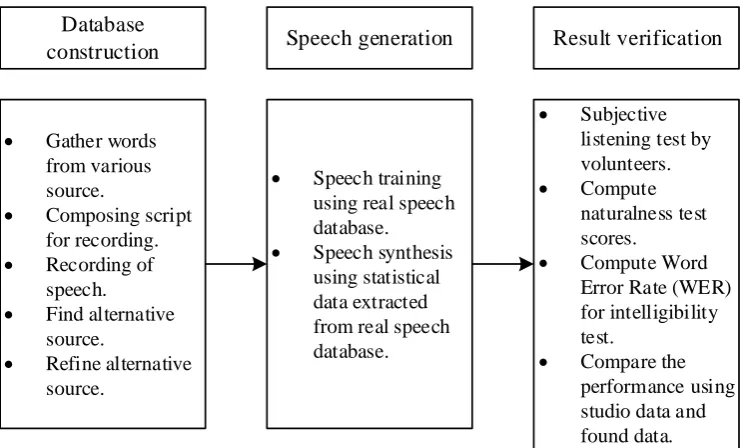
Figure 1.1: Mapping of procedures in this study
1.4 Scope of the Study
This study follows several scopes and they are:
1. The Malay speaking style used in this study is Standard Malay (SM) (Seman and Jusoff, 2008) which is the usual Malay speaking style spoken by Malaysians. No other accents like Kelantan Malay, Ulu Muar Malay and so on were used throughout this study. The reason Standard Malay is going to be used is to make the speech synthesizer suitable to be used in almost every area of speech, for example, speech rehabilitation, education, or any speech emitting devices like computer and smart phones. Standard Malay is also easily understandable by almost every Malaysian.
3. The free training data harvested online is clear in pronunciation, low in background noise and no overlapped with any other voices or music.
4. The synthetic speech synthesized in this study would be in normal reading style. No any other voice tone would be incurred like happy, sad or angry emotions.
1.5 Thesis Organization
Chapter 1 briefly introduced the background of the study. It gave a basic overview on speech synthesis technologies and briefly talked about the state-of-the-art Statistical Parametric Speech Synthesis. It also presented the problem statements, objective and the scope of this study.
Chapter 2 provided a literature review of this study. It included a basic overview on the Malay language. The history of the speech synthesizer was introduced in this chapter in a timeline fashion. Comparisons between state of the art speech synthesizers were also discussed. A decision was made on which type of speech synthesizer was used in this research and the reasons. The technical review on statistical parametric speech synthesizer which was used in this thesis was presented from the basic model applied in this method until how it produces synthetic speech sounds. A brief discussion on how speech synthesizer can help people was presented within this chapter. The evaluation methods available were overviewed and only one evaluation approach was selected based on the suitability and effectiveness. How the result was statistically compared was also introduced in this chapter.
Chapter 3 is the Methodology used in this study. It involved how the training database was constructed, how the free source was obtained online, how the modifications were done to the found data, how the Artificial Intelligence techniques (Feedforward Neural Network with Back Propagation and Active Learning) was applied, how the front end processing was conducted, how the speech training and speech synthesis works, and how the listening test was carried out to test the quality of synthetic speech.
Neural Network with Back Propagation and Active Learning. The total footprint or total file size of the speech synthesizers was displayed in detail. The significant difference test result was also calculated and compared and this chapter was concluded with discussions for all the experiments and benchmark with other Malay speech synthesizers.
Abe, N. and Mamitsuka, H. (1998). Query learning strategies using boosting and bagging. InProc. International Conference on Machine Learning. 1–9. Abraham, A. (2005). Artificial Neural Networks. Wiley Online Library.
Alias, F., Formiga, L. and Llora, X. (2011). Efficient and reliable perceptual weight tuning for unit-selection text-to-speech synthesis based on active interactive genetic algorithms: A proof-of-concept. Speech Communication. 53(5), 786–800.
Allen, J., Hunnicutt, M. S., Klatt, D. H., Armstrong, R. C. and Pisoni, D. B. (1987). From text to speech: the MITalk system. Cambridge University Press. Alman, D. H. and Ningfang, L. (2002). Overtraining in back-propagation neural networks: A CRT color calibration example.Color Research & Application. 27(2), 122–125.
Ballard, K. J. (2001). Response generalization in Apraxia of speech treatments: taking another look.Journal of Communication Disorders. 34(1-2), 3–20. Barra-Chicote, R., Yamagishi, J., King, S., Montero, J. M. and Macias-Guarasa, J.
(2010). Analysis of statistical parametric and unit selection speech synthesis systems applied to emotional speech. Speech Communication. 52(5), 394– 404.
Bebis, G. and Georgiopoulos, M. (1994). Feed-forward neural networks. Potentials, IEEE. 13(4), 27–31.
Bennett, C. L. (2005). Large scale evaluation of corpus-based synthesizers: results and lessons from the blizzard challenge 2005. In Interspeech. 105– 108.
Benoit, C., Grice, M. and Hazan, V. (1996). The SUS test: A method for the assessment of text-to-speech synthesis intelligibility using Semantically Unpredictable Sentences.Speech Communication. 18(4), 381–392.
Communication and Technology (EUROSPEECH). 581–584.
Black, A. W., Zen, H. and Tokuda, K. (2007). Statistical parametric speech synthesis. InIEEE International Conference on Acoustics, Speech and Signal Processing (ICASSP), 2007, vol. 4. IV–1229.
Borman, S. (2004). The expectation maximization algorithm: A short tutorial. Technical report.
Bray, J. H. and Maxwell, S. E. (1985). Multivariate Analysis of Variance. 54. Sage.
Breiman, L. (1996). Bagging predictor.Machine Learning. 24, 123–140.
Breuer, S. and Abresch, J. (2004). Phoxsy: multi-phone segments for unit selection speech synthesis. InInterspeech.
Cannito, M. P., Chorna, L. B., Kahane, J. C. and Dworkin, J. P. (2014). Influence of Consonant Voicing Characteristics on Sentence Production in Abductor Versus Adductor Spasmodic Dysphonia.Journal of Voice. 28(3), 394–e13. Chapelle, O., Scholkopf, B. and Zien, A. (2006).Semi-supervised learning. vol. 2.
MIT press Cambridge.
Clark, R., Richmond, K., Strom, V. and King, S. (2006). Multisyn Voices for the Blizzard Challenge 2006. InProc. Blizzard Challenge Workshop (Interspeech Satellite). Pittsburgh, USA.
Clark, R. A. J., Richmond, K. and King, S. (2007). Multisyn: Open-domain unit selection for the Festival speech synthesis system. Speech Communication. 49(4), 317–330.
Cohn, D. A., Ghahramani, Z. and Jordan, M. I. (1996). Active learning with statistical models.Journal of Artificial Intelligence Research. 4, 129–145. Collins, J. T. (1998). Malay, world language: a short history. Dewan Bahasa dan
Pustaka.
Conkie, A. (1999). Robust unit selection system for speech synthesis. In137th Meeting of the Acoustical Society of America. 978.
Dayhoff, J. E. and DeLeo, J. M. (2001). Artificial Neural Networks. Cancer. 91(S8), 1615–1635.
Deller, J. R., Proakis, J. G. and Hansen, J. H. L. (1993).Discrete-Time Processing of Speech Signals. Macmillan, New York.
Society. Series B (Methodological). 39(1), 1–38.
Demuth, H., Beale, M. and Hagan, M. (2008). Neural Network Toolbox User’s Guide. Math Works.
Donovan, R. E. (1996). Trainable Speech Synthesis. Ph.D. Thesis. Cambridge University Engineering Department.
Dutoit, T. (1997). An Introduction to Text-to-Speech Synthesis. vol. 3. Springer. Dutoit, T. and Stylianou, Y. (2003). Handbook of Computational Linguistics.
Oxford University Press.
Dwyer, K. and Kondrak, G. (2009). Reducing the Annotation Effort for Letter-to-phoneme Conversion. In Proceedings of the Joint Conference of the 47th Annual Meeting of the ACL and the 4th International Joint Conference on Natural Language Processing of the AFNLP: Volume 1. ACL ’09. Stroudsburg, PA, USA: Association for Computational Linguistics, 127–135. Efron, B. (1969). Student’s t-test under symmetry conditions. Journal of the
American Statistical Association. 64(328), 1278–1302.
Ekpenyong, M., Urua, E.-A., Watts, O., King, S. and Yamagishi, J. (2014). Statistical parametric speech synthesis for Ibibio.Speech Communication. 56, 243–251.
Enderby, P. (2013). Chapter 22 - Disorders of communication: Dysarthria, Elsevier, vol. 110. 273–281.
Forney, J., G.D. (1973). The viterbi algorithm.Proceedings of the IEEE. 61(3), 268–278.
Freund, Y. H., Seung, S., Shamir, E. and Tishby, N. (1997). Selective sampling using the query by committee algorithm.Machine Learning. 28, 133–168. Furui, S. (1974). An analysis of long-term variation of feature parameters
of speech and its application to talker recognition. Electronics and Communications in Japan. 57(12), 34–42.
Gardiner, C. W. (1985).Handbook of stochastic methods. vol. 3. Springer, Berlin. Gimenez de los Galanes, F. M., Savoji, M. H. and Pardo, J. M. (1994). New algorithm for spectral smoothing and envelope modification for LP-PSOLA synthesis. IEEE International Conference on Acoustic, Speech, and Signal Processing, 573–576.
and Sons, Inc.
Hansen, J. H. and Clements, M. A. (1991). Constrained iterative speech enhancement with application to speech recognition. IEEE Transactions on Signal processing. 39(4), 795–805.
Hecht-Nielsen, R. (1989). Theory of the backpropagation neural network. In International Joint Conference on Neural Networks (IJCNN), 1989. 593–605.
Heiga, Z., Tomoki, T., Nakamura, M. and Tokuda, K. (2007). Details of the Nitech HMM-based speech synthesis system for the Blizzard Challenge 2005.IEICE Transactions on Information and Systems. 90(1), 325–333.
Hill, D. and Preucil, M. (1973). Control of an analog speech synthesieer by a time-shared digital computer. InProc. 7th AICA Congress, Prague, vol. 1. House, A. S., Williams, C., Hecker, M. H. and Kryter, K. D. (2005).
Psychoacoustic speech tests: A modified rhyme test.Journal of the Acoustical Society of America. 35(11), 1899–1899.
Hugh-Munier, C. M., Scherer, K. R., Lehmann, W. and Scherer, U. (1997). Coping strategies, personality, and voice quality in patients with vocal fold nodules and polyps.Journal of Voice. 11(4), 452–461.
Hunt, A. J. and Black, A. W. (1996). Unit selection in a concatenative speech synthesis system using a large speech database. In IEEE International Conference on Acoustics, Speech, and Signal Processing (ICASSP), 1996, vol. 1. 373–376.
Iida, A. (2002). A study on Corpus-based Speech Synthesis with Emotion. Ph.D. Thesis. University of Keio, Japan.
Imai, S., Sumita, K. and Furuichi, C. (1983). Mel log spectrum approximation (MLSA) filter for speech synthesis.Electronic and Communication in Japan, 10–18.
Iversen, G. R. and Norpoth, H. (1987). Analysis of variance. 1. Sage.
Juang, B. H. and Rabiner, L. R. (1991). Hidden Markov Model for Speech Recognition.Technometrics. 33, 251–272.
Karaiskos, V., King, S., Clark, R. A. J. and Mayo, C. (2008). The Blizzard Challenge 2008. InProc. Blizzard Challenge Workshop. September. Brisbane, Australia.
Kawahara, H., Morise, M., Takahashi, T., Nisimura, R., Banno, H. and Irino, T. (2008). A unified approach for F0 extraction and aperiodicity estimation based on a temporally stable power spectral representation. InISCA Tutorial and Research Workshop (ITRW) on Speech Analysis and Processing for Knowledge Discovery. Aalborg. 4–6.
Kempler, D. and Lancker, D. V. (2002). Effect of Speech Task on Intelligibility in Dysarthria: A Case Study of Parkinson’s Disease. Brain and Language. 80(3), 449–464.
Klatt, D. H. (1987). Review of Text-to-Speech Conversion for English.Journal of the Acoustical Society of America. 82, 737–793.
Kuhn, R., Junqua, J.-C., Nguyen, P. and Niedzielski, N. (2000). Rapid speaker adaptation in eigenvoice space. IEEE Transactions on Speech and Audio Processing. 8(6), 695–707.
Kumar, G. H., Ravishankar, M., Nagabushan, P. and Anami, B. S. (2006). Hidden Markov model-based approach for generation of Pitman shorthand language symbols for consonants and vowels from spoken English. Sadhana. 31(3), 277–290.
Laganaro, M., Croisier, M., Bagou, O. and Assal, F. (2012). Progressive apraxia of speech as a window into the study of speech planning processes. Cortex. 48(8), 963–971.
Larsen, K. (2005). Stephen Hawking: a biography. Greenwood Publishing Group.
Lemmetty, S. (1999). Review of speech synthesis technology. Ph.D. Thesis. Helsinki University of Technology.
Lim, Y. C. (2013). Optimization of Unit Selection Algorithm for Malay Speech Synthesis System. Ph.D. Thesis.
Lim, Y. C., Tan, T. S., Shaikh Salleh, S. H. and Ling, D. K. (2012). Application of Genetic Algorithm in unit selection for Malay speech synthesis system. Expert Systems with Applications. 39(5), 5376–5383.
Lorenzo-Trueba, J., Watts, O., Barra-Chicote, R., Yamagishi, J., King, S. and Montero, J. M. (2012). Simple4all proposals for the albayzin evaluations in speech synthesis. InProc. Iberspeech 2012.
(ICASSP).
Mantel, N. (1963). Chi-square tests with one degree of freedom; extensions of the Mantel-Haenszel procedure.Journal of the American Statistical Association. 58(303), 690–700.
Marreiros, A. C., Daunizeau, J., Kiebel, S. J. and Friston, K. J. (2008). Population dynamics: Variance and the sigmoid activation function.NeuroImage. 42(1), 147 – 157.
Masuko, T., Tokuda, K., Kobayashi, T. and Imai, S. (1996). Speech synthesis using HMMs with dynamic features. In IEEE International Conference on Acoustics, Speech, and Signal Processing (ICASSP), 1996, vol. 1. 389–392.
Masuko, T., Tokuda, K., Kobayashi, T. and Imai, S. (1997). Voice characteristics conversion for HMM-based speech synthesis system. In IEEE International Conference on Acoustics, Speech, and Signal Processing (ICASSP), 1997, vol. 3. 1611–1614.
Meister, S. (1978). The diagnostic rhyme test (DRT): An Air Force implementation. Technical report. DTIC Document.
Meron, Y. and Hirose, K. (1999). Efficient weight training for selection based synthesis. In European Conference on Speech Communication and Technology (EUROSPEECH).
Miyanaga, K., Masuko, T. and Kobayashi, T. (2004). A style control technique for HMM-based speech synthesis. In Proc. International Conference on Spoken Language Processing (ICSLP), vol. 4.
Moulines, E. and Charpentier, F. (1990). Pitch-synchronous waveform processing techniques for text-to-speech synthesis using diphones. Speech Communication. 9, 453–467.
Peach, R. K. and Tonkovich, J. D. (2004). Phonemic characteristics of apraxia of speech resulting from subcortical hemorrhage. Journal of Communication Disorders. 37(1), 77–90.
Pearson, V. A. H. (1995). Speech and language therapy: Is it effective? Public Health. 109, 143–153.
Rabiner, L. (1989). A tutorial on hidden Markov models and selected applications in speech recognition.Proceedings of the IEEE. 77(2), 257–286.
Rabiner, L. R. and Juang, B.-H. (1993). Fundamentals of speech recognition. vol. 14. PTR Prentice Hall Englewood Cliffs.
Riedi, M. P. (1998). Controlling Segmental Duration in Speech Synthesis System. Ph.D. Thesis. Swiss Federal Institude of Technology Zurich.
Rosner, B., Glynn, R. J. and Lee, M.-L. T. (2006). The Wilcoxon signed rank test for paired comparisons of clustered data.Biometrics. 62(1), 185–192.
Rutten, P., Coorman, G., Fackrell, J. and Van Coile, B. (2000). Issues in Corpus Based Speech Synthesis. IEEE Seminar on State of the art in speech synthesis, 1–7.
Saito, S. and Kazuo (1985). Fundamentals of Speech Signal Processing. Academic Press (New York).
Sang-Jin, K., Jong-Jin, K. and Minsoo, H. (2006). HMM-based Korean speech synthesis system for hand-held devices.Consumer Electronics, IEEE Transactions on. 52(4), 1384–1390.
Santen, J. P. H. v., Olive, J. P., Sproat, R. and Hirschberg, J. (1997). Progress in Speech Synthesis. Springer-Verlag New York, Inc. USA.
Schroeder, M. R. (1993). A brief history of synthetic speech. Speech Communication. 13, 231–237.
Seman, N. and Jusoff, K. (2008). Acoustic pronunciation variations modeling for standard Malay speech recognition.Computer and Information Science. 1(4), P112.
Sinclair, M. and King, S. (2013). Where are the challenges in speaker diarization? In IEEE International Conference on Acoustics, Speech and Signal Processing (ICASSP), 2013. May. Vancouver, British Columbia, USA.
Spencer, K. A. and Rogers, M. A. (2005). Speech motor programming in hypokinetic and ataxic dysarthria.Brain and Language. 94(3), 347–366. Sproat, R. W. and Olive, J. P. (1995). Text-to-Speech Synthesis. vol. 74. Wiley
Online Library.
Stan, A., Bell, P. and King, S. (2012). A grapheme-based method for automatic alignment of speech and text data. InSLT. 286–290.
synthesis (RSS) corpus: Building a high quality HMM-based speech synthesis system using a high sampling rate.Speech Communication. 53(3), 442–450. Swee, T. T. and Salleh, S. H. S. (2008). Corpus-based Malay text-to-speech
synthesis system. In 14th Asia-Pacific Conference on Communications (APCC), 2008. 1–5.
Tabachnick, B. G., Fidell, L. S.et al.(2001). Using multivariate statistics. Allyn and Bacon Boston.
Tabet, Y. and Boughazi, M. (2011). Speech synthesis techniques. A survey. In7th International Workshop on Systems, Signal Processing and their Applications (WOSSPA), 2011. 67–70.
Tadmor, U. (2007). Grammatical borrowing in Indonesian.Empirical Approaches to Language Typology. 38, 301.
Tan, T. S. (2009). Corpus-based Malay Text to Speech System. Ph.D. Thesis. Taylor, P. (2009). Text-to-Speech Synthesis. Cambridge University Press.
Taylor, P., Black, A. W. and Caley, R. (2002). The Festival Speech Synthesis System: System Documentation Edition 1.4. Technical report. Human Communication Research Centre.
Teoh, B. S. (1994). The Sound System of Malay Revisited. Dewan Bahasa dan Pustaka, Ministry of Education, Malaysia.
Thierry, D. (1993). High Quality Text-to-Speech Synthesis of the French Language. Ph.D. Thesis. Faculte Polytechnique de Mons.
Toda, T., Kawai, H. and Tsuzaki, M. (2004). Optimizing sub-cost functions for segment selection based on perceptual evaluations in concatenative speech synthesis. InIEEE International Conference on Acoustics, Speech, and Signal Processing (ICASSP), 2004, vol. 1. I–657.
Tokuda, K., Heiga, Z. and Black, A. W. (2002a). An HMM-based speech synthesis system applied to English. InIEEE Workshop on Speech Synthesis. 227–230.
Tokuda, K., Masuko, T., Miyazaki, N. and Kobayashi, T. (2002b). Multispace probability distribution HMM.IEICE Trans. Inform. Systems, 455–464. Tokuda, K., Yoshimura, T., Masuko, T., Kobayashi, T. and Kitamura, T. (2000).
Triola, M. F. (2010). Bayes’ Theorem.Elementary Statistics. 11.
Vergin, R., O’shaughnessy, D. and Farhat, A. (1999). Generalized mel frequency cepstral coefficients for large-vocabulary speaker-independent continuous-speech recognition.IEEE Transactions on Speech and Audio Processing. 7(5), 525–532.
Viswanathan, M. and Viswanathan, M. (2005). Measuring speech quality for text-to-speech systems: development and assessment of a modified mean opinion score (MOS) scale.Computer Speech & Language. 19(1), 55–83.
Watts, O. (2012). Unsupervised Learning for Text-to-Speech Synthesis. Ph.D. Thesis. University of Edinburgh.
Watts, O., Stan, A., Clark, R., Mamiya, Y., Giurgiu, M., Yamagishi, J. and King, S. (2013). Unsupervised and lightly-supervised learning for rapid construction of TTS systems in multiple languages from ’found’ data: evaluation and analysis. In 8th ISCA Workshop on Speech Synthesis. August. Barcelona, Spain, 121–126.
Wildt, A. R. and Ahtola, O. (1978). Analysis of covariance. Sage Publications Beverly Hills, CA.
Wouters, J. (2001). Analysis and Synthesis of Degree of Articulation. Ph.D. Thesis. Katholieke Universiteit Leuven (KUL), Belgium.
Yamagishi, J. (2006). An introduction to hmm-based speech synthesis. Technical report. Technical report, Tokyo Institute of Technology.
Yamagishi, J., Ling, Z. and King, S. (2008). Robustness of HMM-based Speech Synthesis. In Proc. Interspeech 2008. September. Brisbane, Australia, 581– 584.
Yap, M. J., Liow, S. J. R., Jalil, S. B. and Faizal, S. S. B. (2010). The Malay Lexicon Project: A database of lexical statistics for 9,592 words. Behavior research methods. 42(4), 992–1003.
Yelken, K., Gultekin, E., Guven, M., Eyibilen, A. and Aladag, I. (2010). Impairment of Voice Quality in Paradoxical Vocal Fold Motion Dysfunction. Journal of Voice. 24(6), 724–727.
Yoshimura, T., Tokuda, K., Masuko, T., Kobayashi, T. and Kitamura, T. (1997). Speaker interpolation in HMM-based speech synthesis system. In European Conference on Speech Communication and Technology (EUROSPEECH).
Conference on Spoken Language Processing (ICSLP).
Yoshimura, T., Tokuda, K., Masuko, T., Kobayashi, T. and Kitamura, T. (1999). Simultaneous modeling of spectrum, pitch and duration in HMM-based speech synthesis. InProc. European Conference on Speech Communication and Technology (EUROSPEECH). 2347–2350.
Young, S., Evermann, G., Gales, M., Hain, T., Kershaw, D., Liu, X. A., Moore, G., Odell, J., Ollason, D., Povey, D., Valtchev, V. and Woodland, P. (2009). The HTK Book Version 3.4.
Yu, X., Efe, M. O. and Kaynak, O. (2002). A general backpropagation algorithm for feedforward neural networks learning. IEEE Transactions on Neural Networks. 13(1), 251–254.
Zechner, K. and Waibel, A. (2000). Minimizing word error rate in textual summaries of spoken language. In Proceedings of the 1st North American chapter of the Association for Computational Linguistics conference. Association for Computational Linguistics, 186–193.
Zen, H., Nose, T., Yamagishi, J., Sako, S., Masuko, T., Black, A. and Tokuda, K. (2007). The HMM-based speech synthesis system (HTS) version 2.0. In Proceedings of the 6th International Speech Communication Association Workshop on Speech Synthesis. 294–299.
Zen, H., Tokuda, K. and Black, A. W. (2009). Statistical parametric speech synthesis.Speech Communication. 51(11), 1039–1064.