Cloud-
B
ased fundamental Laboratory for
Network Security
Nikita Mandavgane
P.G. Student, Dept. of Computer Science Engineering, Jagdamba College of Engineering, Yavatmal, India
ABSTRACT: Now a days computer network security are important. Existing laboratory solutions usually require vital effort to build, configure, and preserve and often do not support reconfigure ability, flexibility, and scalability. This paper presents a virtual laboratory education platform called V-Lab that provides a confidential experimental environment for hands-on experiments using virtualization technologies The system can be strongly accessed through Open VPN, and students can slightly control the virtual machines (VMs) and perform the new tasks. The V-Lab platform also offers an interactive Web GUI for resource organization and a social site for knowledge contribution. using a flexible and configurable design, V-Lab integrates educational models into curriculum design and provides a progressive learning path with a series of experiments for network security education. The valuation demonstrates that the platform and curriculum have produced excellent results and it helps student understand and build up computer security knowledge to solve the problems. Index Terms—Collaborative learning, network security, virtual laboratory.
KEYWORDS:Collaborative learning, network security, virtual laboratory. I. INTRODUCTION
Hand on experiments are important when educating network security specialists. However, it is complicated for computer security education pace with rapidly changing computer security issues to mimic real-world scenarios in a contained environment. This paper presents an new cloud-based virtual laboratory platform called V-Lab that utilizes open-source virtualization technologies such as Xen and KVM, and software defined networking (SDN) solutions such as Open Flow switches to construct a scalable, and restricted experimental environment for network security education. The design of V-Lab is based on our previous work with the following improved features:
1) a Web portal for user-centric resource management with knowledge sharing
2) a reconfigurable networking environment with the flexibility to mimic various real-world computer networks; 3) a mutual laboratory environment with resource sharing and access control;
4) contained network security experimental environment providing fanatical virtual machines virtual networks to students;
II. RELATED WORK
This section categorizes a few existing virtual laboratories for hands-on experiments.
1) Virtual Application Laboratories: This type of laboratory uses in desktop virtualization, in which the simulation and problem solving are restricted by predefined algorithms of the underlying software. Additionally, hands-on laboratories do not usually allow students to keep application data on remote servers, and as a result, this may require students to finish an experiment in a single session
2) Shared-Host Laboratories: These laboratories are built on a fixed pool of computers with remote desktop accesses. Each computer can support several students logged in concurrently. However, a host is usually shared between multiple simultaneous users at same time, which restricts the shared host to be used for different purposes. Moreover, the shared system may support load balancing or may not provide sufficient isolation to prevent potential performance and security issues among users.
amanagement portal which creates virtual resources customized for each user. Moreover, VMs are usually running on common desktops or laptops, and they cannot support complicated multi-VM networking environments.
4) Multi-VM Laboratories: These laboratories provide multiple VMs that can either run in the cloud [25] or on a student’s PC [24]. The multi-VM environment allows students to construct complex system configurations for experiments. However, these laboratories may not provide flexible networking, sufficient isolation, or reconfiguration capacities. Usually, these features are needed to perform network security experiments. Moreover, these systems often do not support isolated interserver communication, and thus require all VMs to reside within one physical server.
5) Multi-VM and Multinetwork Laboratories: These laboratories fully utilize the virtualization capacities of cloud virtualization capabilities to provide dedicated and contained experimental environment with multiple VMs and multiple virtual networks. The system offers a Web-based management portal for instructors and students to manage and create virtual resources in a user-friendly fashion. The virtual resources can be reconfigured throughout the course to introduce new experiments.
III. SYSTEM ARCHITECTURE
Fig1 . V-Lab system architecture.
A. Overview
The overview of the V-Lab system architecture is shown in Fig Currently, the physical V-Lab system consists of a cluster cloud servers with a high-performance capabilities and virtualization support, an HP OpenFlow switch, an array of iSCSI storage area network (SAN) servers that provide VM storage and backup redundancy, and uninterrupted power supply system can be capable of 10h of battery time for the whole system. The system allows up to 1000 VMs running various operating systems from Windows XP/7/Server to Ubuntu/CentOS/Redhat. The descriptions for each component follow.
B. V-Lab web portal
devices. Once the configuration is complete, it can be submitted to the back-end virtual resource engine also allow enrolled students to perform experiments
Fig. 2. Experimental environment for BNCE. Fig. 3. Experimental environment for man-in-the-middle attack
C. V-Lab Back End
The major components of the V-Lab back-end systems are established based on Xen Cloud Platform (XCP) and Open- Stack. Both XCP and Open Stack are open-source virtual computing platforms. The V-Lab platform allows students to work with special kernels of the VMs running in the cloud system. The system also uses open virtual switches (OVS) over common routing encapsulation from side to side Open Flow protocols with a network controller, e.g., a NOX/POX network controller to provide secluded virtual networking experiments. The back end also contains various internal services for administration and management purposes.
IV. V-LAB STUDIES
A. Teaching I: Basic Network Configuration Experiments (BNCE) With Knowledge Learning and Sharing In the Teaching I phase, the V-Lab curriculum offers a series of experiments that cover a wide range of basic networking knowledge, such as using SSH and VNC to access remote hosts,configuring IP addresses, subdividing networks, using networkcommands such as Ping and Ifconfig, and configuring Webservers, DNS servers, and IPTables rules. In these experiments,a student is provided with three VMs interconnected with twovirtual networks, as shown in Fig. 2. After each experiment, alab teaching assistant (TA) can login remotely to each student’senvironment to perform grading, without requiring the studentand the TA to be physically present in the laboratory. This flexiblegrading process allows TAs to manage their TA hours moreefficiently and focus on answering questions and debuggingthe students’ systems remotely. When the student encountersa problem during the experiment, the TA can remotely loginand see the screen of the student’s VMs. Using the V-Labembedded peer-to-peer video conferencing capability, the TAand the student can work on the lab experiments remotelywithout needing to meet in person.
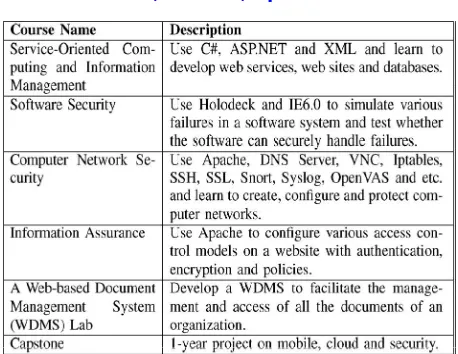
Table (A) COURSES USING V-LAB
more complex networking security problems, such as SSL-stripbasedMITM attack , IPTables-based packet filtering, and Snort-based intrusion detection. For each experiment, the V-Lab system dynamically changes the current experimental. environment by adding new VMs and VLANs to fit new requirements. In addition to discussing the knowledge base of the experiment, instructors also need to give students a comprehensive lecture about the problem at hand, such as the various attack or defense mechanisms, with appropriate references. To gain a good grade for the experiment, students must not only achieve the expected results, but also write a report presenting the techniques and applications used in the experiment. Hands-on experiments can greatly expand students’ knowledge. For instance, instructors can show that an MITM attack can only happen within a client network by assigning a new
VM on the server’s network and allowing students to attempt the MITM attack with the new VM. Experiments in Teaching II usually blend multiple levels of networking knowledge and thus are good test beds for practicing and exploration.
C. Teaching III: Advanced Network Security Experiments (ANSE) With Researches and Creativities The Teaching III phase allows students to collaborate on research into real-world network system design. Students also learn how to follow a requirement-driven industrial design and development process and to construct the system with evaluation, attack model, and risk analysis. For example, some researchconducted in V-Lab was published in
V. RESULTS AND DISCUSSIONS
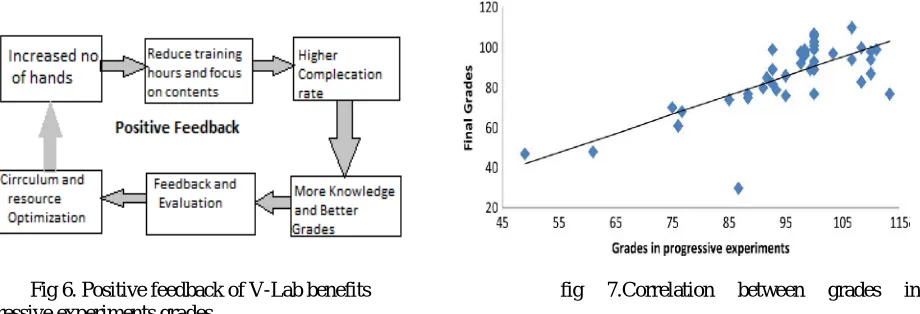
V-Lab has hosted 2892 VMs to serve 604 graduate and 530 undergraduate students across COURSES USING V-LAB six computer science and engineering courses (as shown in Table in over 20 hands-on experiments. Two types of student surveys were collected from 212 of a total of 278 students, for a participation rate of 76.3%. The first survey evaluated the experiment elements and the second one focused on each teaching phase with satisfactory results. Compared to the same set of courses for each semester year since 2009, the V-Lab curriculum and resources helped produce more hands-on experiments reduced training hours and resulted in a higher completion rate.
Table (B) V-LAB Experiment Survey Result
Fig 6. Positive feedback of V-Lab benefits fig 7.Correlation between grades in progressive experiments grades.
The results also showed a The paper progressive experiments also affect their grades Both grades were on a range from 0 to 100 plus a 20-point bonus. The Pearson connection on these two sets of data is 0.72 and is statistically significant at the 0.01 level. Thus, students who performed better in progressive experiments also get better grades with 99% confidence.
VI. CONCLUSION AND FUTURE WORK
REFERENCES
[1] Le. Xu, Dijiang Huang “cloud based virtual laboratory for network security education” Senior Member, IEEE, and wei-Tek, Member,IEEE aug 2014
[2] P. Baumgartner and F. I. Hagen, “The Zen art of teaching communication and interactions in education,” in Proc. Interactive Conf. Comput. nAided Learning, 2004, pp. 1–18.
[3] D. Ramalingam, “Practicing computer hardware configuration and network installation in a virtual laboratory environment: A case study,” in Proc. 37th Annu. Frontiers Educ. Conf., 2007, pp. F3G-21–F3G-24.
[4] Y. Liu, L. Zhang, and F. Jiao, “Teaching computer networking experiment in the realistic network laboratory,” in Proc. Int. Conf. Comput. Intell. Softw. Eng., Dec. 2009.
[5] T. A. Yang and T. A. Nguyen, “Network security development process: A framework for teaching network security courses,” J. Comput. Small Coll., vol. 21, pp. 203–209, April 2006
.[6] Rochester Institute of Technology (RIT), Rochester, NY, USA, “Rochester Institute of Technology (RIT) NSSA Labs,” Apr. 2012 [Online]. Available: http://www.rit.edu/gccis/computingsecurity/
[7] L. DeLooze, P.McKean, J. Mostow, andC. Graig, “Incorporating simulation into the computer security classroom,” in Proc. 34th Annu. Frontiers Educ. Conf., Oct. 2004, vol. 3, pp. S1F/13–S1F/18.
[8] Y. Tateiwa, K. Kurachi, J. Zhang, T. Yasuda, and S. Yokoi, “LiNeS: Virtual network environment for network administrator education,” in Proc. 3rd Int. Conf. Innov. Comput. Inf. Control, Jun. 2008, pp. 1–4.
[9] A. Ferrero and V. Piuri, “A simulation tool for virtual laboratory experiments in a www environment,” in Proc. IEEE Instrum.Meas. Technol. Conf., 1998, pp. 102–107.
[10] State University of New York, Geneseo, NY, USA, “State University of New York Geneseo Virtual Computer Lab,” Apr. 2012 [Online]. Available: http://www.geneseo.edu/cit/virtual_computer_labs
[11] ASU, Tempe, AZ, USA, “ASU My Apps,” Apr. 2012 [Online]. Available: http://www.asu.edu/myapps
[12] Duke University, Durham, NC, USA, “Duke University Virtual Computing Lab,” Apr. 2012 [Online]. Available: http://oit.duke.edu/compprint/
labs/vcl/index.php
BIOGRAPHY