
PUBLIC PRIVATE PARTNERSHIPS-
RISK MANAGEMENT IN ENGINEERING
INFRASTRUCTURE PROJECTS
By
D.V.G. DEVAN
Dissertation
Submitted in partial fulfilment of the requirements
for the degree
MAGISTER PHILOSOPHIAE
In
ENGINEERING MANAGEMENT
In the
FACULTY OF ENGINEERING AND THE BUILT
ENVIRONMENT
At the
UNIVERSITY OF JOHANNESBURG
SUPERVISOR: PROFESSOR L. PRETORIUS
JOHANNESBURG
TY OF JoHA
2006 -06- 2 2
PREFACE
"South Africa is proudly amongst the leading countries in the world in the law, policy and systems we have established for public private partnerships. Our public service delivery record has been enriched through PPPs in recent years, and our PPP project pipeline continues to grow, both in numbers and in the innovative
value-for-money solutions it contains."
TABLE OF CONTENTS
TOPIC
ACRONYMS AND SCHEDULE OF FIGURES AND TABLES ABSTRACT AND RESEARCH OBJECTIVES
PAGE 5 6 CHAPTER 1 -OVERVIEW OF PUBLIC PRIVATE PARTNERSHIPS 9
1.1 BACKGROUND 9
1.2 DEFINITION OF PUBLIC PRIVATE PARTNERSHIPS 10
1.3 PARTIES INVOLVED IN A PPP 11
1.4 FEATURES OF PPP 13
1.5 BENEFITS OF PPP 14
1.6 SUMMARY 16
CHAPTER 2 -THE PPP PROJECT LIFE CYCLE AND
ITS ASSOCIATED RISKS 17
2.1 BACKGROUND 17
2.2 RESPONSIBILITIES AND RISKS DURING PPP
PROJECT LIFE CYCLE 18
2.3 STAGES IN A PPP PROJECT LIFE CYCLE 18
2.4 ASSESSING DESIGN, CONSTRUCTION
AND COMMISSIONING RISK 19
2.5 PRIORITISATION OF RISKS BY PPP PARTICIPANTS 23
2.6 SUMMARY 24
CHAPTER 3 -RISK MANAGEMENT 25
3.1 BACKGROUND 25
3.2 RISK IDENTIFICATION 26
3.3 RISK IDENTIFICATION METHODS 33
3.4 SUMMARY 38
CHAPTER 4 -RISK EVALUATION 39
4.1 BACKGROUND 39
4.2 TYPES OF RISK EVALUATION 40
4.3 ASSESSING THE PROBABILITY OF RISKS 41
4.4 ASSESSING THE IMPACT OF RISKS 41
4.5 RISK ASSESSMENT STRATEGIES 41
4.6 RISK MITIGATION 46
4.7 THE ROLE OF ATTITUDES IN RISK MITIGATION 50
4.8 SUMMARY 50
CHAPTER 5 - RESEARCH OF OPINIONS FROM
STAKEHOLDERS PREVIOUSLY INVOLVED IN PPP 52
5.1 BACKGROUND 52
5.2 COMMENTS FROM NIGEL LOWE 52
5.3 INVESTIGATION AT GLASGOW CALEDONIAN UNIVERSITY
ON RISK MANAGEMENT IN PPPS 53
5.4 COMMENTS FROM ELECTRONIC DISCUSSION FORUM
-CANCELLATION OF PPP PROJECTS 56
5.4 SUMMARY 59
CHAPTER 6 - CONCLUSION AND RECOMMENDATIONS 60
ACRONYMS
PPP - PUBLIC PRIVATE PARTNERSHIPS SPV - SPECIAL PURPOSE VEHICLE
APOPS - ASSET PROCUREMENT AND OPERATIONS SYSTEMS FM - FACILITIES MANAGEMENT
IE - INDEPENDENT ENGINEER IT - INDEPENDENT TESTER
DTI - DEPARTMENT OF TRADE AND INDUSTRY JV - JOINT VENTURE
PMI - PROJECT MANAGEMENT INSTITUTE
FIGURES AND TABLES
FIGURE 1.1 - ORGANOGRAM OF CONTRACTUAL RELATIONSHIPS OF
PARTIES IN A PPP PROJECT
TABLE 2.1 - RANKING OF PPP RISKS BY CONTRACTORS, CLIENTS
AND LENDERS
FIGURE 3.1 - THE RISK MANAGEMENT PROCESS
TABLE 4.1 - RISK ASSESSMENT CLASSIFICATION
ABSTRACT AND RESEARCH OBJECTIVES
Economic growth and the provision ofpsieci_u_BIe—iftf.rastr_uctu-re are highly interrelated. Infrastructure- plays a_critical—r-ol.e_i.n_p_comot-i.n-g economic gro_wth_lbrough enhancing p_r_o_d.u_ati.vity, improving comp-gifiTieness, reducing poverty, linking people and organisations together through telecommunications and contributing to environmental sustainability. Population growth and rapid urbanisation have placed enormous pressure on existing infrastructure, thus presenting a daunting challenge to governments worldwide[1].
The scope of global demographic, public health and safety needs, as well as economic development goals, translates into infrastructure requirements far in excess of currently available financing resources. While the degree of this funding backlog differs from country to country, it extends from the poorest to the richest of nations. This is true even in the United States, which enjoys the full benefits of decentralized government responsibility and an extensive domestic debt market. Recognition of this funding gap has resulted in a nearly universal acceptance that the private sector can and should play a larger role in the financing of infrastructure in partnership with the public sector [35].
The 1990s saw a revolution in the provision of infrastructure services as governments worldwide turned to the private sector for financing and management expertise. In developing countries in 1990 —2001, nearly 2,500 infrastructure projects involved private participation, attracting investment commitments of US750 billion [40].
South Africa has an estimated infrastructure backlog of R 170.7 billion [3]. In addition there is increasing demand for much-needed new and improved infrastructure such as water supply and sanitation systems, affordable housing and electricity supply, health care facilities, schools, roads, tourism infrastructure, airports and harbour facilities, to name but a few [4].
With the private sector organisations having a large pool of sources from which they can seek funding from both local and international financial markets and the government having fragmented expertise over different state departments, debilitating red tape and bureaucracy, more pressing needs for funding elsewhere and inability to roll out projects, private sector involvement in infrastructure provision has been widely considered and implemented as a preferred method of financing infrastructure provision. This collaboration between public and private sectors is crucial in order to increase the
sources of funding available for infrastructure and reduce the pressure on fiscal budgets.
This has resulted in an increased collaboration between the public and private sectors in order to meet a country's infrastructure requirements. Consequently, the Public Private Partnership (PPP) procurement method of undertaking large infrastructure projects is becoming a realistic option. An appropriate current example of this collaboration between the public and private sectors is the new Gautrain Rapid Rail project being undertaken by the Gauteng Provincial Government.
The PPP method of procurement impacts on Engineers and Project Managers in the Built environment field in many ways. It changes the way they are appointed, their roles and responsibilities, the constraints and parameters of their design and the commercial aspects of project managing these projects.
The involvement of the private sector in public sector infrastructure delivery has long been debated, with attempts at privatisation and deregulation being partially successful. There is now a global shift towards the PPP model [34].
RESEARCH OBJECTIVES
The research objectives of this dissertation, therefore, are to conduct an extensive literature search of information and documentation on this topic to be able to:
Appreciate the fundamentals of this relatively new method of
procurement for the large and complex engineering
infrastructure projects
Present the experiences of stakeholders having worked on PPP projects in other countries that have been using this method of procurement longer than South Africa
Identify the unique risks that vest in this method of procurement so that, as practitioners in the Built Environment, we are more prepared to identify, assess and mitigate these risks.
The research presented in this paper is a result of an extensive literature search from various textbooks, journals, articles, web-sites and discussions with professionals from the Built Environment regarding the topic at hand. It must be noted that, as the PPP method of procurement is in its nascent stages in relation to other forms,
This dissertation paper is structured as follows:-
There is an initial overview of Public Private Partnerships encompassing the definition of PPPs, the different parties involved, their unique features and benefits. Thereafter the PPP Project Life Cycle, including the different roles and responsibilities of the different parties through the Project Life Cycle is discussed. Thereafter, a detailed analysis of risk management is undertaken with specific references to risk identification, risk evaluation and risk mitigation, against the backdrop of a PPP project. The next section consists of comments and observations from international stakeholders with experience in PPPs. The dissertation paper is then concluded with a set of recommendations.
CHAPTER 1 - OVERVIEW OF PUBLIC PRIVATE
PARTNERSHIPS
1.1 BACKGROUND
Economic growth and the provision of adequate infrastructure are highly interrelated. Infrastructure plays a critical role in promoting economic__gtomith„ through enhancing productivity, improving comTrelltiveness, redicing—pOvei-ty; linking07641e_ and orggnis-aficins together th-Fou4h— te-leCciiiifilui-aCations and contributing to eiwironmen-tar guSetairiability.- Population growth and rapid urbanisation have placed enormous pressure on existing infrastructure, thus presenting a daunting challenge to governments worldwide. [1]
Most infrastructure expenditure in developing countries has been funded directly from the fiscal budgets. However, several factors such as macroeconomic instability and growing investment requirements (particularly following the debt crisis of the 1980s), have shown that public financing is volatile and, in many countries, rarely meets crucial infrastructure expenditure requirements in a timely and adequate manner [2].
Private sector organisations on the other hand, have a large pool of sources from which they can seek funding from both local and international financial markets. Governments may not have access to, or the capacity to access, all these sources of funding. As a result, private sector involvement in infrastructure provision has been widely considered and implemented as a preferred method of financing infrastructure provision. This collaboration between public and private sectors is crucial in order to increase the sources of funding available for infrastructure and reduce the pressure on fiscal budgets [1].
South Africa has an estimated infrastructure backlog of R 170.7 billion [3]. In addition there is increasing demand for much-needed new and improved infrastructure such as water supply and sanitation systems, affordable housing and electricity supply, health care facilities, schools, roads, tourism infrastructure, airports and harbour facilities, to name but a few [4].
In addition, fragmented expertise over different state departments, debilitating red tape and bureaucracy, more pressing needs for funding elsewhere and inability to roll out projects are only some of the factors contributing to the government's inability to deliver basic services. This problem is not unique to South Africa.
In view of these factors, the government is constantly seeking alternative methods of financing new infrastructure and maintenance of existing engineering infrastructure assets.
The involvement of the private sector in public sector infrastructure delivery has long been debated, with attempts at privatisation and deregulation being partially successful. There is now a global shift towards the PPP model [38].
1.2 DEFINITION OF A PUBLIC PRIVATE PARTNERSHIP
Although it is difficult to accurately define, a Public Private Partnership (PPP) is essentially a contractual arrangement between a public_sector_entity dii:d170-for-pfolit private sector concern, where the cqntracting parties contribute _their eXteilit-e .and -reS-6-urces to deliver a _TS th, • 1-b--i-c—s—e•Wrde—bTLit iiiTV a te:SeEldr to -deliTe-r-ffibize---effectively the service or infrastructufe.The Canadian Council for Public Private Partnerships (1998) defines a PPP as a co-operative venture between the public and private sectors, built on the experti-se breath partner that bestmeets clearly
d~fine~
public needsthrough the appropriate allocation of resources, risk§—rria rewards [41].The South African National Treasury defines a PPP as " A contract between a public sector institution and a private party, in whichthe private party assumes substantial firianbial, techhidarand operational risk in the design, financing, building and operation of a project".
A good working definition for a public-private partnership would include three points:-
these partnerships involve at least one private for- profit organization and at least one not for profit or public organization.
the partners have some shared objectives for the creation of social value, often for the disadvantaged populations.
the core partners agree to share both efforts and benefits.
PPPs are diverse in many respects with the number of partners involved, the kinds of organizations involved, the funding levels and funding sources, the objectives for the partnerships and the organizational structures of the partnerships varying according to the project.
Examples of such projects undertaken in South Africa include the N3 Toll Road between Johannesburg and Durban, the first privately
operated Mangaung Maximum Security Prison in Bloemfontein and the soon to be constructed Gautrain Rapid Rail Link between Johannesburg and Pretoria.
1.3 PARTIES INVOLVED IN THE PPP
The following entities are typically parties to a PPP: A government department acting as the Client
A government department acting as Agent to the Client department
A Special Purpose Vehicle (SPV) consisting of a group of private sector corporate entities coming together specifically to design, build and operate the facility
A financial institution that provides the private sector with financial support
A construction sub-contractor that designs and builds the facility An operations sub-contractor that operates the facility
A facilities management sub-contractor that maintains the facility
Generally, a Government department, realising that there is a need for a service to be rendered and for large capital infrastructure to be built, and realising the various constraints it currently is beset with, advertises for private entities to present a proposal of how they would be able to construct the infrastructure and service required. There would be an appropriate Government department representing the interests of the Client Government departments interests, for example the Department of Public Works acted as Agent on behalf of the Department of Correctional Services in the Mangaung Prison project. This Agency then appoints professionals from the legal, financial, technical and operational fields to advise it and prepare the necessary documentation and output specifications for interested parties to respond to.
Interested entities then partner one another and form a Special Purpose Vehicle (SPV) and submit their respective proposal in response to the output specifications.
The choice of a preferred bidder is made after a comprehensive process, after which the winning bidder contracts with the Government department to undertake the project.
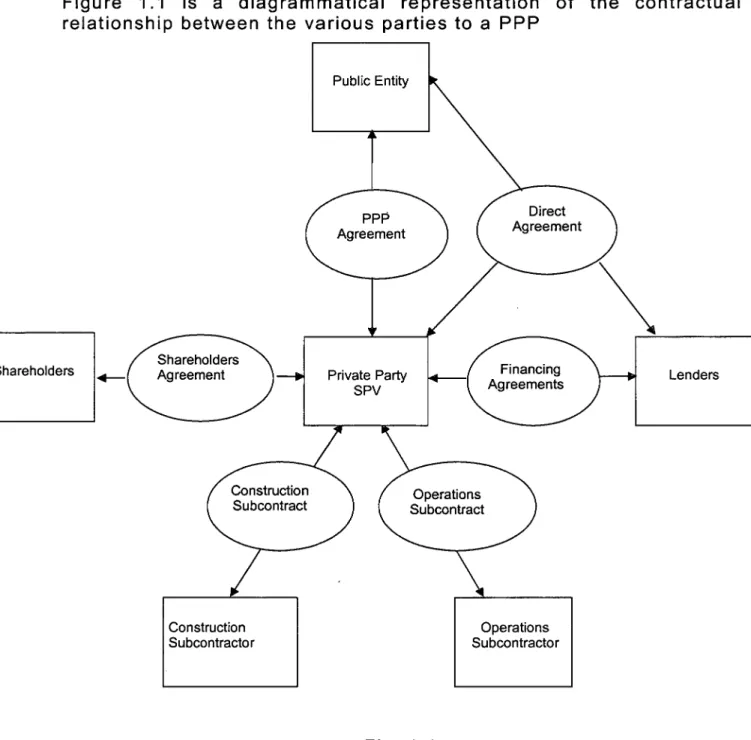
The SPV and would comprise a party to design and build the facilities and a party to operate and maintain the facility. A new entity in the form of a SPV is generally the preferred way of contracting with government as the risk is negotiated between the government and a
Direct Agreement PPP
Agreement
Shareholders Agreement Shareholders 41- Construction Subcontract Construction Subcontractor Operations Subcontract Operations Subcontractor Fig. 1.1 Private Party SPV Financing Agreements Lenders Public Entity
single private entity. The SPV has legal recourse back to Government through the conditions of the contract.
It is the private SPV that employs the services of professionals from the Built Environment to undertake the feasibility of the project, the design and specifications of the project, the construction and maintenance of the project. The appointment of the professionals is generally on a sub-contract basis where the engineering services are subcontracted out to the SPV.
Figure 1.1 is a diagrammatical representation of the contractual relationship between the various parties to a PPP
ORGANOGRAM OF CONTRACTUAL RELATIONSHIPS OF
PARTIES IN A PPP PROJECT [42]
1.4 FEATURES OF A PPP
A PPP is effectively a partnership between the public sector and the private sector and in attempting to obtain an appreciation of a PPP, it is useful to explore the features of a partnership.
Peters (1998) [5] identified five general defining ,,Jeatures of partnerships:
1.4.1 A PPP involves two or more actors at least one of which is public and another from the private sector.
1.4.2 In a PPP, each participant is a principal. Each of the parties are capable of bargaining on their own behalf, rather than to refer back to other sources of authority. In some instances the public sector has to set up a special agency capable of entering into partnerships before collaboration becomes possible [6]. An example of this is when the South African Government was undertaking the PPP for its first priv -ately operated prisons, it established a special government agency, APOPS, to partner the private sector through the project.
1.4.3 The partners establish an enduring and stable relationship. There is a continuing relationship, the parameters of which are negotiated among the members from the outset [7].
1.4.4 Each of the parties brings something to the partnership [8]. Therefore for the partnership to be genuine, each will have to transfer something,. either material or immaterial to the partnership. The transfer of material resources (money or land, etc.) is rather obvious [9]. The transfer of other resources, such as authority and any other symbolic values [10], can constitute a less obvious form of partnership.
1.4.5 The partnership implies that there is some shared responsibility for the outcomes and activities [8]. This differs from other relationships between the public and the private sectors in which the public sector retains control over policy decisions after receiving the advice of organisations in the private sector. In contrast, actual partnerships produce mutual shared responsibility, which can make accountability for these decisions difficult to ascertain.
When the public and private entities first come together, there are generally different perceptions of each other, where the private firms are seen to be primarily seeking future profits and markets through partnerships, or to be seeking control over the agendas of public organisations, or to be using donations to claim tax deductions for financial reasons. The private sector enters the partnership with the
perception of having a superior skills and resource base in comparison to the public sector.
In as much as private firms are primarily profit seeking organizations, the realisation that their effective participation by adding value to the better interests of the public at large soon allays the initial hostilities and the tensions are soon replaced by increasing rapprochement and positive encouragement. A chief factor encouraging these partnerships is that neither side alone can achieve its specific goals and only through positive collaboration can certain key infrastructure problems be solved.
Constructing an effective partnership among diverse organizations is hard work. Partnerships face seven organizational challenges, what Austin (2000) [12] calls the seven Cs, which are:
Clarity of purpose
Congruency of mission, strategy and values Creation of value
Connection with purpose and people Communication between partners Continual learning
Commitment to the partnership
Of particular importance is the challenge of creating value. To assure a sustainable collaboration, the value created must be useful to society, and value must flow to all partners. In addition, creating a partnership is a continual learning process, with the potential for unexpected lessons.
1 . 5 BENEFITS OF PPP
Generally, it is becoming more and more accepted that the PPP procurement method has definite benefits to both the public and private sector.
Below are the salient points extracted from a detailed analysis of potential benefits of PPP as listed in a report from the Nova Scotia Government (NS 2000 — Review of Public Private Partnerships): [11] 1.5.1 Enhance the government's capacity to develop integrated
solutions
PPPs provide government an opportunity to undertake larger projects that previously would have been broken up into smaller projects under conventional procurement methods. This allows
government to ensure an integrated solution to larger social and public needs and issues.
1.5.2 Facilitate creative and innovate approaches
The PPP process allows private designers and engineers to produce innovate solutions to the problems presented by public services as this method of procurement does not depend on a detailed definition of input specifications but rather a set of performance and output specifications. The private bidders are then allowed to compete on a basis of their ability to develop unique creative approaches to the delivery of the required project.
1.5.3 Reduce the cost to implement the project
A PPP procurement approach offers the potential benefit of reducing costs, often significantly, or delivering higher quality for the same cost, both for the design and build phase and for the operations phase. Research undertaken by Arthur Anderson and Enterprise LSE (2000), claimed that the average saving resulting from a PPP is 17% [41]. The cost reductions can be attributed to synergies, economies of scale and reductions in life-cycle costs [11].
1.5.4 Reduce the time to implement the project
The primary reason for a reduction in the time in the implementation of PPP projects is because the design and construction processes are undertaken concurrently rather than sequentially, and with the design being the responsibility of the private sector SPV, the temptation to make ongoing design changes to the project design is discouraged in the PPP process. These changes can easily cause delays and cost overruns. These projects generally include incentives that reward the private party for on-time completion and the PPP process generally reduces the number of times a Government project goes out to tender, where if the public sector undertook a large infrastructure project, the typical procurement process will entail the project being broken down into smaller packages and spread over different departments and financial years with the initiation of each phase being tied to a multi-year capital plan.
1.5.5 The transfer of certain risks to the private project partner
A fundamental aspect of the PPP method of procurement is that a considerable amount of risk is transferred from the public sector to the private sector. These risks include the design, construction and operational risks (both cost and performance)
1.5.6 Attract larger, potentially more sophisticated, bidders to the project
The huge commercial potential vested in these PPP projects resulting from the sheer size of the project, the length of the concession period and the greater exposure to a public market creates an extremely competitive environment for the larger and more sophisticated bidders. This context also encourages and motivates bidders to propose new and more attractive terms for the deal.
1.5.7 Access skills, experience and technology
As a partnership is formed between the public and private sector entities when a PPP project is undertaken, Governments are able to gain new skills, technology and knowledge as a result of the extensive interaction and involvement in all aspects of the project. This interaction allows Government to expand their expertise and knowledge base beyond their normal procurement and development systems and be exposed to new and innovative methods. Government entities are also exposed to the commercial aspects of a project through their involvement in the decision-making process during the PPP project.
1.6 SUMMARY
The increasing pressure on government to deliver large infrastructure projects due to, amongst other factors, economic and population growth, and the increasing pressure on government to utilize the public funds it has at its disposal for other more pressing public social needs have resulted in the government seeking respite from the private sector to partner them in the delivery of the services desperately required. The distinct features and benefits described above of the PPP method of procurement have enabled the PPP method to consistently grow into the preferred method of procurement for government for the larger infrastructure projects.
The PPP method also has distinct and unique risks and responsibilities associated with it and the actual implications of those risks and responsibilities to the professionals in the Built Environment in the implementation of this method is discussed at length in the subsequent chapters.
CHAPTER 2 - THE PPP PROJECT LIFE CYCLE
AND THE ASSOCIATED RISKS
2.1 BACKGROUND
The Project Management Institute (PMI) has defined a project as "a temporary endeavour undertaken to create a unique product or service" [33]. Temporary means that every project has a definite beginning and a definite end. Unique means that the product or service is different in some distinguishing way from all other products or services. For many organizations, projects are a means to respond to those requests that cannot be addressed within the organization's normal operational limits [38].
A project is usually a one-time activity with a well-defined set of desired end results. It can be divided into subtasks that must be accomplished in order to achieve the project goals. The project is complex enough that the sub-tasks require careful co-ordination and control in terms of timing, precedence, cost, and performance. Often, the project itself must be co-ordinated with other projects being carried out by the same parent organisation [33].
In relation to the definitions above, the actual way in which construction projects are managed may not change significantly in a PPP setting and if a project has a particular design and method statement, then two construction contractors can very easily produce two construction projects with relatively similar outcomes.
The primary distinguishing characteristic between a PPP construction product and a non-PPP product is the procurement procedure. However the risks in a particular PPP project are higher than if that same project were not done via PPP. The reason being that the scope of responsibilities of the participants in a PPP project are higher than in non-PPP projects [13]. There is a significant transfer of design and operational and commercial risk from the public sector to the private sector
In essence, the private sector partners in a project undertake to design, build, finance and operate facilities to achieve the objectives of a client with respect to service delivery. To achieve these objectives, the private sector entity forms a Special Purpose Vehicle (SPV), which then contracts with other private sector organizations for the design, construction, operation and maintenance of the facilities required to provide the public service. This effectively results in a significant portion of the project risks being transferred to the SPV, who then further routes the different risks to the appropriate private entity within the SPV.
2.2 RESPONSIBILITIES AND RISKS DURING PPP
PROJECT LIFE CYCLE
The extent of the roles and responsibilities of both public and private sectors could vary in different PPP projects. However, the public sector always retains responsibility for the deciding of the nature of services to be provided, the quality and performance standards of these services to be attained, and taking corrective action if performance falls below expectation [16]. However, within the SPV, the different private entities have varying responsibilities and subsequent risks through the project life cycle and each one of these private parties will view the project risks with different objectives. The SPV mitigates the possible consequences of design, construction and commissioning risks by apportioning elements of the risk to its design and construction sub-contractors through their indemnity insurers. The design and construction sub-consultants undertake works of which they are familiar with and are used to dealing with the consequential risks.
Notwithstanding this cascading down of risks, the SPV retains the primary liability for the particular risk under the contract with Government. If a risk eventuates, the SPV will seek to meet the costs by calling on the professional indemnities of the sub-contractors.
Although design and construction risk is essentially borne by the Private Party, materialised risk events impact on Government in the form of delays or interruptions to service and/or less efficient service. In these circumstances, it is in the interests of all parties to actively manage risks. However, Government needs to be careful not to become overly involved in the management of risks and in doing so, assume risks allocated to the Private Party [39].
2.3 STAGES IN A PPP PROJECT LIFE CYCLE
The PPP project cycle consists of the following stages:Inception Feasibility Study Procurement Development Delivery Exit 0
.41
lbo c
Pv
,o rOjgt,
4-royl St‘,1-0 v: 01,7cWithin these stages are the design, construction, operational and maintenance phases which involve the Built Environment professionals.
2.3.1 The Design stage
As the output specifications are provided by the public sector Client, the responsibility of the design of all aspects of the facility required to provide the public service lies with the private sector partner. It is this specific aspect of PPP that allows the private sector to, produce innovative and economically efficient systems to provide the public service. This responsibility gives rise to a set of risks that the private sector entities would not have been exposed to in a conventional procurement contract with a public sector entity. Typical sources of risk attributable to design include incomplete and delayed drawings. These sources of risk are not the responsibility of the Client under a PPP contract.
2.3.2 The Construction stage
Since the public sector specifies the public service to be provided in terms of an output specification, the private sector has the latitude to introduce innovative ways to construct the required facility. Thus construction facilities serve as a means to an end towards delivering the clients' expected services. This leeway, which contrasts with traditional construction procurement, allows bidders to innovate in designing any needed facilities that will enhance the provision of services. This construction aspect is high risk [17].
2.3.3 The Operational/ Facilities Management stage
Facilities management (FM) is of great importance and prominence in PPP projects. Even at inception stages, sponsors are expected to consider the life-cycle cost commitments of a project [18]. As service contracts in PPP schemes are of long durations, an element of uncertainty will always surround FM in PPP deals. This consists of a relatively low-risk utility aspect [17].
2.4 ASSESSING DESIGN, CONSTRUCTION AND
COMMISSIONING RISK
The greatest risks of PPP projects occur at the later part of construction and early part of operation of the facility [17].
Design, construction and commissioning risk is the risk that the design, construction or commissioning of the facility or certain elements of each of these processes, are carried out or not carried out in a way which results in adverse cost and/or service delivery consequences. The consequences if the risk materializes may include
delays and/or cost increases in the design, construction and commissioning phases, or design or construction flaws which may render the infrastructure inadequate for effective service delivery, either immediately or over time [39].
Under the conventional approach, the Government usually appoints professionals to design a facility according to a set a input specifications and the Government would then appoint a Construction company to construct the facility with the design professionals monitoring the works on behalf the Government to ensure that the construction and installation is as per the design drawings and specifications. Payments are then made to both the design professionals and the Contractor at various stages of completion. In addition, the Contractor usually does not have an ongoing responsibility to maintain or service the facility.
In the PPP method of procurement, the private sector entities, which include the design professionals and the construction sub-contractor, usually incur substantial up-front design and construction costs to develop the facility. Any unanticipated increase in these costs, whether through delay or otherwise has to be borne by the private sector and, may have a significant impact on the financial outcomes of the project and/or the delivery of services.
Although there are some similarities between the development obligations imposed on the Private Party in a PPP contract and the builder in a public procurement, there are likely to be critical differences. As noted earlier, under the PPP policy, Government is not necessarily procuring the asset but focusing on the services delivered through it. This means that:
Government makes no payment during the design and construction period;
The scope for Government-initiated change to design and construction processes is likely to be limited;
Government rights during design, construction and
commissioning are likely to focus on reporting and monitoring rather than the broader rights exercised under a design and construct contract;
Commercial acceptance' is likely to take the place of 'practical completion', i.e. acceptance by Government that service delivery (to agreed service standards) from a technically complete facility can begin and, therefore, so can payment of service charges; and
If there are defects, correction of these during a specified 'defects liability' period are likely to be less relevant to Government, as payment will most likely be abated if the
service falls short of the specified outputs as a result of the defects [39].
With respect to commissioning, completion of works generally occurs when the capital works and service outputs are tested under the full range of operating environments (i.e. commissioning and operational commissioning) indicating that the facility is in a position to deliver the full set of services in accordance with the output specification. A Certificate of Completion is issued to formally accept the condition of the construction and installation of the services at the facility.
A significant dilemma facing the public sector is the objectivity and authenticity of the testing and commissioning undertaken by professionals that are employed by the private sector. The South African government have employed the services of an Independent Engineer (IE) to oversee this process during the testing and commissioning at the first privately operated prison in Bloemfontein that was procured through the PPP method. The IE is an independent organization of professionals representing all the relevant disciplines of the Built Environment who engage with the professionals from the private sector and review their designs and physically witness the testing and commissioning process and issue a certificate of acceptance.
When the new Head Offices for the Department of Trade and Industry was procured through the PPP method, an Independent tester (IT) was appointed to conduct the independent reviews and inspections. The IT was jointly appointed by the private and public sector entities. Design, construction and commissioning risk is implicitly allocated to the Private Party by the nature of a PPP project. If Government imposes detailed obligations on the Private Party relating to the design, construction and commissioning of a project, the risk allocation to the Private Party is jeopardized, as is the Private Party's ability to make decisions about how best to manage these risks. Government will most likely not assume or in any way share design, construction and commissioning risk with the Private Party, unless it is a risk associated with a Government-initiated design or construction change, or a discriminatory act or omission by Government which is not in accordance with a Government law, regulation or policy (that has previously been advised to the Private Party) during the design and construction process [39].
2.4.1 Unintentional design risk assumption
The public sector ensures that the financial consequences resulting from delays in design or construction or of any failure to meet the agreed standards rests squarely with the private sector party by:
Confirming upfront the price to be paid for the services to be delivered and agreeing to make payment only once the service is delivered to the satisfaction of the public party;
Contractually ensuring that the circumstances in which the contract term may be extended is exceptional; and
Ensuring that there is a mechanism in the contract to address the issue of agreed damages for late delivery.
It can be difficult for Government to maintain the balance between communicating its needs by clearly specifying service outputs, and standing back from direct involvement in the design and construction process so that it does not intentionally assume design and construction risk [39]. This is especially so if the services delivered under the contract are accommodation services providing the functional space from which Government itself will deliver core services. Unless Government clearly conveys its functional requirements for particular areas, the contract may not succeed in delivering the accommodation services to the level or suitability necessary to ensure efficient delivery of core services from the facility. Government needs to secure a level of confidence in the suitability of the design to meet the outputs specified, so as to avoid making the allocation of design risk to the Private Party ineffective. The onus of ensuring that the design is capable of delivering the specified outputs must remain with the Private Party. It is imperative that no action taken by Government can be construed as offering assurances as to the efficacy of a design and so discharge the onus on the Private Party [39].
2.4.2 Unproven Technology
One of the key features of a PPP project is the fact that it offers the private party entity the opportunity for innovative solutions. This innovation brings with it the possibility that the new systems may not be able to deliver as expected or may need to be adjusted and refined. Although the risks resulting from this innovation falls primarily on the Private Party, the public sector also bear the risks that full service provision will not be achieved according to stipulated output specifications and timeframes.
2.4.3 Keeping Pace with Technological Change
The concession period of a PPP project is generally 20 years or more. This exceptionally long project life requires that the design and construction of the facility and its systems must be able to adapt to the changes in technology over time. The private party has to manage the obsolescence and operational risks associated with technical innovation.
2.5 PRIORITISATION OF RISKS BY PPP PARTICIPANTS
Akintoye et al [22] surveyed both Clients and Contractors in the UK and found that government has a mistaken belief that the private sector willingly accepts risks. The interviewees further suggested that government should be considered as a party that could also bear more risks associated with PPP projects. Scores in Table 2.1 show that different PPP participants prioritise project risks differently. For example, the Private party ranks the design risk as their first priority risk while the Government rank design risk at number 5 and believe that commissioning risk is their highest priority.RANKING OF PPP RISKS BY CONTRACTORS,
CLIENTS AND LENDERS
RISKS RANKING OF RISKS
CONTRACTORS CLIENTS LENDERS ALL
Design risk 1 5 10 1
Construction cost risk 2 6 6 2
Performance risk 4 2 8 3
Risk of delay 7 3 7 4
risk of cost overrun 3 9 3 5
Commissioning risk 17 1 5 6
Volume risk 8 10 2 7
Risk of operating/ maintenance cost
9 4 13 8
Payment risk 10 14 1 9
Tendering cost risk 6 17 9 10
Contractual risk 5 11 15 11
Legal risk 11 19 12 12
Market risk 14 16 11 13
Residual value risk 16 12 14 14
Planning risk 13 18 19 15
Environmental risk 15 8 23 16
Safety risk 21 7 20 17
Financial risk 12 22 18 18
Credit risk 25 24 4 19
Possible change in government 20 20 16 20
Project life risk 19 13 26 21
Changes in international legislation 24 15 22 22 Development risk 18 21 24 23 Banker's risk 23 26 17 24 Debt risk 22 25 21 25
Land purchase risk 26 23 25 26
2.6 SUMMARY
Under the PPP method of procurement, Government is responsible defining the nature of the public services to be rendered through a clear set of output specifications. The private party is responsible for the design, finance, operations and maintenance of the facility. The associated risks pertaining to these areas of responsibility are borne squarely by the private party. This represents a significant amount of risk being transferred from the public sector entity to the private party and requires a comprehensive risk management strategy to ensure that the consequences of these risks are minimized, if not totally eliminated. These risk management strategies are discussed in the following chapters.
CHAPTER 3 RISK MANAGEMENT
3.1 BACKGROUND
Risk management seeks to identify, prevent, contain and mitigate risks in the interests of a project [39]. The risk management must be ongoing throughout the life cycle of the project and needs to be an iterative process, with a continual search for solutions, assessing of solutions and reassessing the risks. The risk management process consists of 5 main stages:
Risk identification and comprehension Seeking risk mitigating solutions
Appraise new or residual risks Evaluate or price risks
Risk monitoring and control
The process begins with the understanding and identifying of the risks inherent in the various areas of responsibility in the project. Risk mitigating solutions are drawn up and if the risks are successfully eliminated by these solutions, then there is nothing to evaluate. If, however, solutions are found to counter these risks as opposed to totally eliminate these risks, then the cost implications of the mitigating solutions should be evaluated.
The results of the evaluation should be fed back to the identification and comprehension stage to reappraise the new risk profile of the project. Some risk mitigating solutions result in a new set of risks, which must in turn must be evaluated and assessed from the beginning of the process by identifying and comprehending the risks and then following the process through. The strong possibility of secondary risks emanating from risk mitigating solutions reinforces the need for the risk management process to be an iterative one and not discrete phases of identification, evaluation and mitigation. This iterative process of risk management is illustrated in Figure 3.1.
RISK IDENTIFICATION AND COMPREHENSION SEEK FOR RISK-MITIGATING SOLUTIONS APPRAISE NEW OR RESIDUAL RISKS -10
*N
T EVALUATE OR PRICE RISKS RISK MONITORING AND CONTROLFIGURE 3.1 THE RISK MANAGEMENT PROCESS [adapted from 13]
3.2 RISK IDENTIFICATION
The first step in the risk management process is the identification and comprehension of the risks in a PPP project. Effectively PPP participants look at risks in the different phases of their projects: conception, inception, design, construction, commissioning, operations and termination. The sponsors, by their disposition, look at two principal risk issues:
who bears the increase in cost and
who bears the consequences of time delays in the project.
The following have been listed as possible risks in PPP schemes [20]: Site Acquisition (possibility of obtaining the wrong land, or the right land at the wrong price)
Availability
Feasibility studies (failure to identify key downsides with the intended project)
Acquiring planning approval (unusual delays could arise, or permission may be denied for ill-defined schemes)
Design (the technical solution may be unworkable or inefficient) Construction (there could be cost and / or time overruns, as well as poorly constructed solutions
Commissioning (may be delayed due to several unmet targets) Operating risks (including maintenance, malfunctions and delays)
Demand (revenue) risk and its change may render facilities under utilized
Occupation and usage risks over time could overstretch the capability limits of resources
Obsolescence / technology risk could render a scheme unfruitful Residual value risk (achieving a high standard of facilities/ services at the end of the concession period can be difficult) Economic risks (including fall in revenue, financiers pulling out, etc)
Legislative / regulation risks (eg. Future planning regulations, health and safety features, etc may affect the project adversely Taxation risks (change in taxes / laws)
Bid process being complicated, long and costly
Political (government support for projects may not be forthcoming
Corruption
Consortium structure (partners may be mismatched)
Local partners (could pose interface problems or could use different systems and procedures
Project management ability (may be inadequate for the present task)
Existing infrastructure
Financing (foreign exchange)
Force Majure (circumstances beyond one's control)
Market competition (could erode the potential gains of the projects)
Revenue tariffs (may be lower than projections)
Project Performance (may be lower than projections) Foreign exchange
Inflation
Financing risks
Below is a discussion of some of the key risks listed above: 3.2.1 Availability:
The facility comprising the structures, buildings and systems that are to be installed by the SPV have to be in a state of completion that allows the public sector to render the service it intended.
3.2.2 Commissioning:
Commissioning of the works has to be suitably planned so that the extent and timing of the commissioning takes place as planned. For example, there has to be power available to ensure that the commissioning takes place at the programmed time. The extent of the commissioning has to be of an intensity that ensures the professionals are satisfied that the installations of the works are as per specifications.
3.2.3 Construction:
In most PPP projects, the construction works are sub-let by the SPV to the construction sub-contractor. This is usually done under a fixed-price contract. Historically construction projects are beset by time and cost overruns. In addition quality standards, health and safety issues remain of paramount concern. These concerns are not automatically removed from PPP schemes and the default of the sub- contractor can tarnish the reputation of the SPV in its bid to win further contracts.
3.2.4 Credit:
As PPP schemes revolve around non-recourse financing, the different entities within the SPV need to be reputable to be able to obtain the financing required for the project.
3.2.5 Cost:
A PPP project generally involves a concession period of 20 to 30 years. The public sector entity agrees an up-front price for the services and the challenge for the private party is to deliver the output specification to the required performance within the cost assumptions made at the outset of the transaction. So the private sector has to deliver the building to cost and to time and then it has got to provide the underlying services within the building to within the cost of repair and maintenance for a facility. Although the costs used by the SPV are generally index linked, the risk of predicting the cost of repair and maintenance over 25 to 30 years is carried by the SPV.
3.2.6 Demand:
In most PPP projects, the risk of demand for the services rests with the public sector. The public sector has to ensure that the size of the facility and the range of services it is purchasing is in line with the current demand with the appropriate flexibility built in for future growth. Thus, for example, in a prison project, the SPV will not be concerned if all the cells are filled or not, as the risk will rest with the public sector to provide the prisoners to occupy the prison. In the two PPP prison projects in South Africa, the Government pays the SPV an amount for making a bed available for a prisoner. The risk of making the space available is that of the SPV, as highlighted in item 3.2.1 above. However the onus of providing the prisoners is that of the public sector.
3.2.7 Demographic changes:
Closely related to the risk of demand is the risk of demographic changes resulting from, for example, an increase in population size or changes in public usage patterns. Demographic changes may also trigger off environmental risks.
3.2.8 Design:
This is a fundamental risk to the private party as all the risks attributable to the design of the facility is transferred over to the private party. The inability of the government representatives to fully understand design concepts and the fact that the public sector have to produce a comprehensive set of output
specifications to inform the design compounds this risk. For example, the quality, size, aesthetics, etc for facilities are usually not fully comprehended by the public sector representatives until after construction has commenced when it is impossible or very expensive to change.
3.2.9. Environment:
The impact of facilities and operating systems supporting the facility needs to be carefully considered as the responsibility is along term one as the private entity not only build the facility, but also operates and maintains the facility for a long period of time.
3.2.10. Finance
The PPP project financial model is established and calculated upfront in a project and the effects of interest rates and inflation in the long term need to be considered. The risk of fluctuation and variance of these key economic fundamentals pose a high risk to the private entity.
3.2.11. Land:
The responsibility of acquiring the land is a primary concern in a PPP project. After that who takes the risk that the land does not have antiquities on it, or is it going to be subject to subsidence? Added to these, the location of the land becomes vital as it also affects the acceptability of the project by those nearby it [17]. 3.2.12. Legislative changes:
Changes to the laws, regulations, and ordinances governing a country, province or city are an important factor because PPP deals are comprised of a complex collection of individual contracts. These contracts are negotiated and priced at a specific point in time and under a particular set of legislation and changes to the legislation can expose the SPV to additional costs.
3.2.13. Legal:
These are different from legislative risks and deal with whether the parties contracting to the PPP are actually authorized and empowered to do so.
3.2.14. Market:
This concerns the risk that the private entities that comprise the SPV are familiar with the market or industry from which the
public services are rendered. For example, facilities management companies that do not have the experience in the maintenance and operations of hospitals should not bid for those projects.
3.2.15.0peration:
The risk that the facility will operate within cost and within the constraints of the concession agreement is probably the most significant risk and subsumes other miniature risks like security, energy consumption, welfare, communications, etc.
3.2.16. Performance:
The SPV have an obligation to deliver the service stipulated by the public sector and if the service is not provided in accordance with the specification, the SPV could be penalized. 3.2.17. Planning permission:
This can permit or deny a scheme. Planning permission must be obtained before a project can proceed in full. As a consequence of planning permission delays, PPP projects could be delayed to the point where they become non-viable. Social risk can have an impact on planning permission. If a notice needs to be served, or people have to be displaced and compensated, or wayleaves are involved in the project, then securing planning permission may be delayed [17].
3.2.18. Political:
The risk of political instability or interference can affect projects.
3.2.19. Residual value:
The risk that private sector sees in residual value is that the road, hospital or whatever meets an agreed specification for a period of time after it has been handed back to the client. For example, a road typically needs at least 10 years worth of life left in it when it is handed back. There is therefore a residual specification risk. The SPV must determine how much to expend in order to ensure that the facility is at a particular quality level when it is handed back to the client [17].
3.2.20. Social issues:
This risk pertains to sections of the community opposing the project. This opposition could manifest itself in vandalism of the facility. Social risk is an issue that must be considered in a PPP
scheme early in the project life with extensive communication and engagement with community stakeholders to ensure that the project is socially acceptable and that there should not be any adverse consequence of the project.
3.2.21. Specification:
This is a function of the design. The public sector normally states their requirements for a PPP project in terms of an output specification. The private sector is then responsible for designing the facility and its systems to achieve the detailed needs of the public sector. The design and specifications have to be correct and adequate in order to meet the specifications of the client and to fully satisfy the client. In addition, the specifications must meet health and safety and other statutory requirements. All of this risk is transferred to the private sector.
3.2.22. Sponsor:
The level of commitment of the sponsors to the transaction and their ability to make decisions could pose a risk to the PPP project whereby a lack of commitment or delays in making decisions could delay or even abort a PPP project. Equity funding can be withheld if the sponsors are not seen to be willing and committed.
3.2.23.Technical:
The effective and efficient functioning of equipment, materials, processes in accordance with the design and specifications is paramount especially in a hospital setting, for instance, where technical risks are primary, as theatre and other medical equipment have to operate effectively.
3.2.24. Technological obsolescence:
The rapid pace at which technology undergoes changes almost makes it a certainty that the technology underpinning a certain service will become obsolete. The private sector entity has to ensure that the systems in place can be upgraded or changed to embrace the latest technology without adversely affecting the public service being offered. Most public sector clients expect to improve the level of their services and to keep pace with advances in the global market.
3.2.25. Time:
This concerns the delays in the PPP project that could result from adverse weather, delays in decision-making by the client, change of mind by the authorities, strikes by the construction workers, etc.
3.2.26. Volume:
Although this is closely related to demand risk, volume risk is about capacity, while demand risk is associated more clearly with usage. For example, on a road, there is traffic volume risk that must be forecast. In this case the road must be designed to sustain the number and types of vehicles that will use it. The demand risk on the road will pertain to whether the road is actually used by vehicles or not. Volume risk thus feeds back directly into the design [17].
The public sector party has the greater burden of risk identification because of the very nature of PPP procurement where the client's project documentation includes a risk matrix. The documentation will usually also set out a list of those risks which the public sector is prepared to take. The public sector will also identify those risks it feels the private sector should bear and those to be shared between the two sectors.
The onus then rests with the private sector to either accept the client's proposition or negotiate on the re-allocation of some risks. However, the spirit of co-operation prevails in PPP projects, and so some private sector consortia find themselves identifying all the possible risks that could beset the project, especially those that had been eliminated in the client's risk matrix. The private sector entities usually have a greater experience and exposure to their specific areas of expertise and are able to produce a more comprehensive list of key risks as opposed to the Government representatives.
There are different avenues through which an organization can identify risks [24]. Given that the risks facing a PPP project are many, different ways may be used to identify them.
3.3.
RISK IDENTIFICATION METHODS
The following methods of risk identification as identified by Chinyio et al [13] are discussed below:
3.3.1 Risk Identification through use of Personal and Corporate experience
If an organization or consortium embarks on a PPP scheme without having done one before, it will face so many types of risks that it might be difficult to understand them all. Even after some risks have been identified, it is sometimes difficult to know what to do with them. However, experience acquired over time makes it relatively easier to identify the key risks facing the project. In this regard, a policy of dwelling in one or a few sectors is inadvertently helpful to risk assessment. For example, utility organizations that have been involved in water treatment will find it easier to identify the risks facing PPP waste management scheme because the core functions are not significantly different from what they are used to doing [13]. Apart from familiarity, specialization and experience also enable organizations to build databases, which can be used to draw insight for risk management. Databases serve as an information resource for diverse things like construction methodology, method statements, defect analysis, patterns of traffic, costs and prices. Checklists and risk matrices can also be developed from databases for future use. Also, through reviews of previous projects, there are some elements such as experience gained from a previous project that are useful to determine how to deal with current risks. While forming consortia, the constituent organizations scrutinize their potential partners to check for, inter alia, their level of experience and how it combines with theirs [13].
3.3.2 Risk Identification through Safety Reviews
The systematic and thorough review of similar previous projects can provide valuable information and insight into what risks exist in the forthcoming PPP project. These reviews can be done on both on the projects that have been undertaken in-house by the organization or on projects undertaken by other public or private organizations wherever possible. These reviews are specifically aimed at identifying health and safety risks that can beset a project of a similar nature and involves a retrospective evaluation of what went wrong in the previous projects, what were the corrective actions taken and how safety standards were achieved in projects under study.
3.3.3 Risk Identification through Intuitive Insights
Intuition plays a big part in risk identification. When you have got a risk like a potential change in law, there is nothing that will tell you definitely whether the law will change or not. You have to take a view of the future, and make provisions for it at the onset, so to some extent intuition is helpful to risk identification. Innovation is
encouraged in PPP projects, and experience may fail to identify what could go wrong with an innovative product. Intuition is readily available for pinpointing the long-term implications of innovative solutions [13].
3.3.4 Risk Identification through Brainstorming
The use of brainstorming workshops where all the relevant stakeholders gather around a table and share their expertise and insights in identifying possible risks can prove very effective if the workshops are structured and properly controlled. The use of `collective intelligence can often assist to unravel complex issues. The brainstorming workshops can also be used to produce solutions and risk mitigating strategies to the risks identified. These workshops should be an ongoing exercise through the project life cycle in line with the iterative process of identifying a risk, seeking risk mitigating solutions, appraising the residual risks, evaluating or pricing the risks and then reassessing the risks.
3.3.5 Risk Identification through Site Visits
The importance of site visits is the same for both PPP projects and projects procured conventionally. Site visits need to be undertaken by both the private sector and private sector parties. These visits enables the parties to identify issues such as site accessibility, wayleaves requirements, ground hazards, etc. The existing site conditions have to be appreciated by both parties as it impacts on the final agreed price paid for the services rendered. An example of this is the PPP project for the new Head Offices for the Department of Trade and Industry (DTI), where part of the site chosen for the new Head Offices was an old filling station site and had diesel and petrol tanks underground that where leaking over time resulting in both unstable geological conditions as well as a major environmental risk. The resolution of that risk impacted on the final agreed price.
3.3.6 Risk Identification through the use of Organisation Charts
The sheer size of PPP projects generally dictate that construction companies form Joint Ventures (JV) to be able to deliver the project in the time frames stipulated. The use of organisational charts can be very useful for assessing the personnel required to complete the project and the possible risks in terms of skills availability, experience of the available resources and competence of personnel available within an organization or set of organizations for a project, thus serving as a useful tool to identify bottlenecks and oversupply of resources for the forthcoming project. The organizational charts can
also help to identify risks associated with the way the different organizations would work together, each with their unique work ethics and culture, specifically in terms of communication styles, management style, reporting styles etc. If the construction companies have worked together previously in a similar JV, organizational charts allow the partners to undertake a re-appraisal of their employees which will cast a light on their new employees and their effect on the company profile.
3.3.7 Risk Identification through the use of Flowcharts
Flow charts can be used to show the movement of building materials until they are placed on a concrete floor or component in a building. By depicting flows this way, it makes it easy to spot the processors (concrete mixer or other machinery) that can go wrong [13].
Flow charts can also be used to determine the number and capability of personnel needed to be at various locations along the line of flow. This flowchart system enables the private parties to identify the risks posed by employees, like absenteeism, mistakes, etc. The ability to identify these risks is particularly important as the penalties imposed on the consortium for non-delivery is severe and the need to understand and suitably plan and resource the different activities is critical in PPP schemes.
3.3.8 Risk Identification through Research. Interviews and Surveys
In situations where the abovementioned techniques may not offer sufficient insight into some risks because of a lack of suitable information, the use of researches, surveys and interviews are useful in obtaining valuable insight and information. This method is particularly relevant for making enquiries when trying to understand the risks posed by social and community interests. An example of this is the effects of the proposed new Gautrain project on the residents and communities through which the rapid rail will pass and affect. Researches, interviews and surveys are also useful tools for risk identification when the project is being undertaken in a geographical location where none of the parties have worked before. Useful information with respect to the planning procedures, approvals from authorities, supply of bulk services and other attributes and factors that are unique to that location can be obtained and the relevant risks identified
Research is vital where refurbishment works are involved, or where existing facilities will be utilized. Latent defects may be present in such buildings. Any organization going into such a contract will have
to price the risks on the basis that rectifying latent will cost them more money. Before such organizations signs the contract it should conduct a full intrusive survey of the property, where the opinion of surveyors and other consultants should be obtained [13].
3.3.9 Risk Identification through the Analysis of
Assumptions
A whole PPP project will be based on a series of assumptions. The design especially is often based on assumptions, when information on the client's requirements is not fully certain. An organization will have to continually go back to check these assumptions in the light of emerging information. It will also need to check whether the assumptions pose a real threat to the project. It is thus worthwhile to catalogue the assumptions that have been made in the course of a project's development, and to revisit them regularly [13].
3.3.10 Risk Identification through Consultation of Experts An SPV consists of different organizations with expertise in their own specific fields. The in-house expertise of these organizations generally is insufficient to assess the risks that relate to the SPV as a whole. In such circumstances, the use of external experts needs to be sought. These experts need to possess the relevant experience and expertise to be able to identify risks that the individual entities would not have been able to identify.
Consulting experts in the course of risk assessment is like an extension of the use of experience. Different experts specialize in different subjects and have the built-up experience that goes with their vocation. So, by using consultants, a consortium is acknowledging that they are not experienced in a particular subject, and that consultants know better and will be engaged to assist. For example, a traffic forecasting company was hired by one consortium, to help evaluate and explain the traffic risks facing a motorway project. Likewise an environmental company might be used to assess the environmental risks in a project. One trait of a PPP project is that the consortia always has to hire a lot of experts, for example legal, financial, design, environmental, planning, etc. Such consultations ensure that many risks are inadvertently identified and mitigated before the construction is embarked upon [13].
3.4. SUMMARY
Risk identification is very crucial because if the risks facing a project cannot be determined soon enough, then any or some of the risks can materialize at any time in the life of a project and interfere with the achievement of the project's objectives.
Risk identification is not a task that should be approached casually, even by the most experienced organizations. Adequate time and effort needs to be set aside to undertake the exercise of risk identification and the process has to occur throughout the project life cycle at regular intervals because new risks can often emerge, and risks which were previously minor could suddenly become key issues in a project.
The use of suitable methods to identify the risks is also crucial to the success of the PPP project. As illustrated earlier in Figure 3.1, the effective identification of the key risks that beset a PPP project is the first step in the risk management process and the following step of the evaluation and assessment of these risks is discussed in the next chapter.
![FIGURE 3.1 THE RISK MANAGEMENT PROCESS [adapted from 13]](https://thumb-us.123doks.com/thumbv2/123dok_us/1686902.2732931/26.861.108.726.109.463/figure-risk-management-process-adapted.webp)
![TABLE 4.1. RISK ASSESSMENT CLASSIFICATION [13]](https://thumb-us.123doks.com/thumbv2/123dok_us/1686902.2732931/40.861.92.805.618.971/table-risk-assessment-classification.webp)