Fecha de recepción: 21-10-2005 Fecha de aceptación: 12-11-2005
ABSTRACT
Although we know there exists a sim-ple approach to solve the circularity between value and the discount rate, known as the Adjusted Present Va-lue proposed by Myers, 1974, it see-ms that practitioners still rely on the traditional Weighted Average Cost of Capital, WACC approach of weig-hting the cost of debt, Kd and the cost of equity, Ke and discounting the Free Cash Flow, FCF. We show how to sol-ve circularity when calculating value with the free cash flow, FCF and the WACC. As a result of the solution we arrive at a known solution when we assume the discount rate of the tax
THERE EXISTS CIRCULARITY BETWEEN
WACC AND VALUE? ANOTHER
SOLUTION.
Ignacio Vélez–Pareja
Politécnico Grancolombiano Bogotá, Colombia [email protected]Julián Benavides-Franco
ICESI Cali, Colombia [email protected]savings as Ke, the cost of unlevered equity: the capital cash flow, CCF dis-counted at Ku. When assuming Kd as the discount rate for the tax sa-vings, we find an expression for cal-culating value that does not implies circularity. We do this for a single period and for N periods.
KEY WORDS
Firm valuation, cost of capital, cash flows, free cash flow, capital cash flow, WACC, circularity
JEL CLASSIFICATION
INTRODUCTION
Although we know there exists a sim-ple approach to solve the circularity between value and the discount rate, known as the Adjusted Present Va-lue proposed by Myers, 1974, it see-ms that practitioners still rely on the traditional Weighted Average Cost of Capital, WACC approach of weig-hting the cost of debt, Kd and the cost of equity, Ke and discounting the Free Cash Flow, FCF. We show how to sol-ve circularity when calculating value with the free cash flow, FCF and the WACC. As a result of the solution we arrive at a known solution when we assume the discount rate of the tax savings as Ke, the cost of unlevered equity: the capital cash flow, CCF dis-counted at Ku. When assuming Kd as the discount rate for the tax sa-vings, we find an expression for cal-culating value that does not implies circularity. We do this for a single period and for N periods.
The typical solution for solving the circularity between value and WACC is to activate the option for iteration in a modern spreadsheet (Vélez-Pa-reja and Tham, 2000,
Tham and Vélez-Pareja, 2004, and Vélez-Pareja and Tham, 2005). However, this approach seems to be not easy to apply. We have examined the analytical solution of this problem and found what is known well befo-re: when discounting with the proper discount rate the CCF will give iden-tical answer to the calculation of va-lue with the FCF discounted at the weighted average cost of capital, WACC.
THE PRACTICAL SOLUTION OF CIRCULARITY
The solution of circularity is very sim-ple. This problem can be easily sol-ved: in the Excel spreadsheet select Tools, then select Options, and the-re, select the tab Calculate and tick the option Iterations. Done this, the formulas for WACC and Ke, (the cost of the levered equity), that imply cir-cularity, can be constructed. (See, Vélez-Pareja and Tham, 2000 and 2005, Tham and Vélez-Pareja, 2004). The analytical solution is simple as well.
AN ANALYTICAL SOLUTION FOR CIRCULARITY
Modigliani and Miller (1958 and 1963), in illuminating and seminal works defined the relationship bet-ween cash flows and values. These are the free cash flow, FCF, the cash flow to debt, CFD, the cash flow to equity, CFE, the tax savings, TS and the capital cash flow1 and their
co-rresponding values. These relations-hips are:
FCF + TS = CFD + CFE = CCF (1a)
Where VLis the levered value of the
firm, VUnis the unlevered value of the
firm, VTS is the value of TS, D is the market value of debt and E is the market value of equity.
In Taggart, 1991, Tham and Velez-Pareja, 2002 and 2004, Vélez-Pareja and Burbano-Pérez, 2003 and 2005 it is shown the general formulation for the WACC and the Ke, as follows 1. The Capital Cash Flow, CCF, is the essence of the original Modigliani and Miller proposal in 1958; however,
it was popularized by Ruback, 2000.
1. The general expression for the WACC for the free cash flow, FCF, is
(2a)
A particular and special case of (2a) is the traditional expression for WACC:
Wheresis the discount rate for the TS and Ku is the unlevered cost of equity.
2. For discounting the Capital Cash Flow CCF, (CFD + CFE = FCF + TS), we use the general formulation for WACCCCF.
(3a)
Depending on the assumption for the discount rate for the tax savings s, we have the WACC for the CCF as follows:
Fors = Kd, the cost of debt
Fors = Ku
(3c) WACCCCF = Ku
3. If we use CFE we should discount it with (in this case we have to add the value of debt to obtain the total value)
(5)
We have for a single period: (6)
USING A GENERAL EXPRESSION FOR WACC
If we replace equation (2a) into equa-tion (6) we find: (2b) (3b) (7a) (7b) (7c) (7d) (7e) Single periodo
This expression is just (see equation (3a))
USING THE TRADITIONAL AND SPECIAL EXPRESSION FOR WACC If we replace (2b) in (6) and replace Ke for its general expression (5) we have
Replacing Ke in (9a) with (5) we have
Again, this expression is the value of the CCF and the discount rate is (3). In both cases we find circularity again. In order to solve it we depart from (9h)
And with the circularity fully solved we have for each case, for s = Kd
This means that when solving the circularity and assuming s= Kd we need to “adjust” the CCF by (Ku1-Kd1) V0TS.
THE N-PERIOD CASE
There is a recursive equation to calculate the present value of a cash flow for any discount rate:
Replacing (2a) into (12) we have,
Whens =Ku
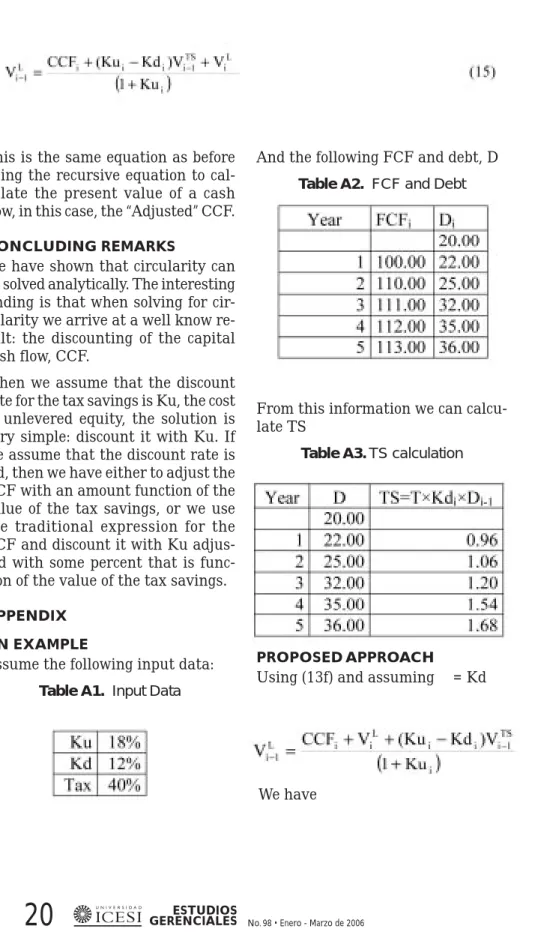
And this is the recursive equation to calculate the present value of a cash flow (in this case with the CCF and Ku as discount rate).
This is the same equation as before using the recursive equation to cal-culate the present value of a cash flow, in this case, the “Adjusted” CCF. CONCLUDING REMARKS
We have shown that circularity can be solved analytically. The interesting finding is that when solving for cir-cularity we arrive at a well know re-sult: the discounting of the capital cash flow, CCF.
When we assume that the discount rate for the tax savings is Ku, the cost of unlevered equity, the solution is very simple: discount it with Ku. If we assume that the discount rate is Kd, then we have either to adjust the CCF with an amount function of the value of the tax savings, or we use the traditional expression for the CCF and discount it with Ku adjus-ted with some percent that is func-tion of the value of the tax savings. APPENDIX
AN EXAMPLE
Assume the following input data:
Table A1. Input Data
And the following FCF and debt, D
Table A2. FCF and Debt
From this information we can calcu-late TS
Table A3. TS calculation
PROPOSED APPROACH
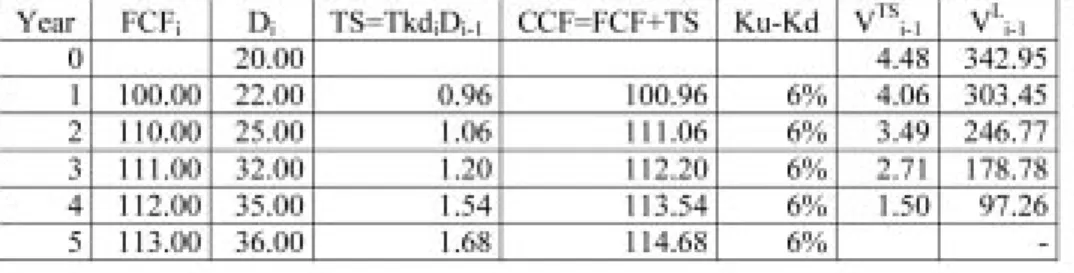
Using (13f) and assuming s = Kd
Table A4. Alternative solution of circularity
THE APV METHOD
Using the Adjusted Present Value, APV we have
Table A5. Solution with the APV Method
PRACTICAL SOLUTION OF CIRCULARITY
Finally using the practical solution for perpetuity we have Temporal solution for WACC = 0%
Table A6a. Temporary solution of value calculation (using practical approach to
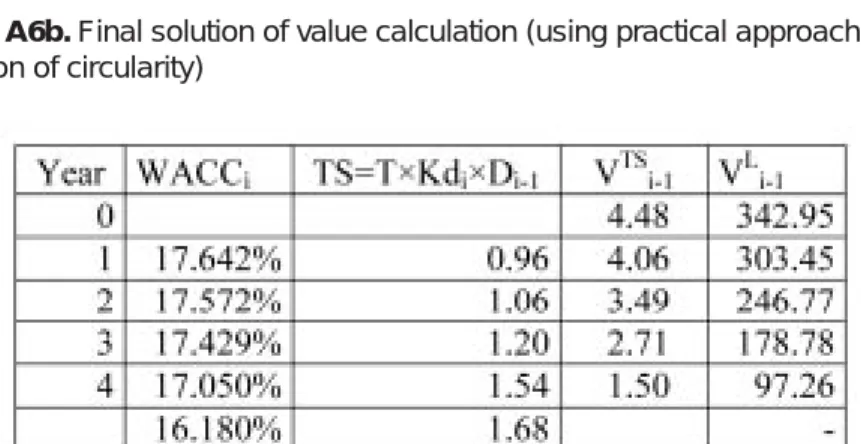
Observe that this is not the final solution because we are using WACC = 0%. Now, introducing the general formulation (2a) for WACCFCFand solving the
circularity, we have
Table A6b. Final solution of value calculation (using practical approach to the
solution of circularity)
As can be seen, the circularity can be solved not only with the practical me-thod, but using formulation (13f).
Observe as well that we do not need to set any target leverage. The approach allows for non constant leverage that is the usual situation in reality.
REFERENCES
Modigliani, Franco y Merton H. Miller, 1958, The Cost of Capital, Corpo-ration Taxes and the Theory of In-vestment, The American Economic Review. Vol XLVIII, pp 261- 297 Modigliani, Franco y Merton H. Miller,
1959, The Cost of Capital, Corpo-ration Finance, and the Theory of Investment: Reply, The American Economic Review, XLIX, pp. 524-527.
Modigliani, Franco y Merton H. Miller, 1963, Corporate Income Taxes and the Cost of Capital: A Correction, The American Economic Review. Vol LIII, pp 433-443.
Myers, Stewart C, 1974, “Interactions of Corporate Financing and Invest-ment Decisions: Implications for Capital Budgeting”, Journal of Finance, 29, Marzo, pp 1-25. Taggart, Jr, Robert A., 1991, Consistent
Valuation Cost of Capital Expres-sions with Corporate and Personal Taxes, Financial Management, Autumn, pp. 8-20.
Tham, Joseph and Vélez-Pareja, Ignacio, 2002, An Embarrassment of Riches: Winning Ways to Value with the WACC. Working Paper en SSRN, Social Science Research Network, h t t p : / / p a p e r s . s s r n . c o m / s o l 3 / papers.cfm?abstract_id=352180.
Tham, Joseph and Vélez-Pareja, Ignacio, 2004a, Principles of Cash Flow Valuation. An Integrated Market Approach, Academic Press. Vélez-Pareja, Ignacio and Joseph Tham, “A Note on the Weighted Average Cost of Capital WACC,” Social Science Research Network, 2000
Vélez-Pareja, Ignacio and Burbano-Pérez, Antonio, 2003, “A Practical Guide for Consistency in Valuation: Cash Flows, Terminal Value and Cost of Capital” (November 9, 2003). http://ssrn.com/abstract=466721 Vélez-Pareja, Ignacio and
Burbano-Pérez, Antonio, 2005, Consistency in Valuation: A
Practical Guide
Vélez-Pareja, Ignacio and Joseph Tham, 2005, Proper Solution of Circularity in the Interactions of Corporate Financing and Invest-ment Decisions: A Reply to the Fi-nancing Present Value Approach, Working Paper en SSRN, Social Science Research Network, http:// p a p e r s . s s r n . c o m / s o l 3 / papers.cfm?abstract_id=653222. Forthcoming in Management Re-search News, Vol 28, No. 7, 2005.