Why Won’t You Change Your Mind? Knowledge of Operational Patterns
Hinders Learning and Performance on Equations
Nicole M. McNeil and Martha W. Alibali
University of Wisconsin – MadisonThis study examined whether knowledge of arithmetic contributes to difficulties with equations. In Experiment 1, children (ages 7 – 11) completed tasks to assess their adherence to 3 operational patterns prevalent in arith-metic: (a) the strategy of performing all given operations on all given numbers, (b) the ‘‘operations5answer’’ problem structure, and (c) the concept that the equal sign means ‘‘the total.’’ Next, children received a lesson on equations; then, they solved a set of equations. There was a negative relationship between adherence to the operational patterns and learning. In Experiment 2, undergraduates’ knowledge of the operational patterns was activated or not. Students whose knowledge was activated did not perform as well on equations. Results suggest that early-learned patterns constrain future learning and performance.
A central issue in the study of cognitive develop-ment is how change occurs (Siegler, 2000). Research addressing this issue has yielded beautifully detailed accounts of the path, rate, breadth, and variability of cognitive change (e.g., Adolph, 1997; Dixon & Ban-gert, 2002; Gershkoff-Stowe, 2002; Siegler, 1989; Siegler & Stern, 1998). However, some ways of thinking resist change, even after substantial amounts of training or instruction. Indeed, some domains of knowledge (e.g., mathematics, science, foreign language) are so difficult to learn that many people fail to achieve basic competence, even after years of schooling. Consequently, any theory of learning must explain not only how people change, but also why people resist change. We examined change resistance in the domain of mathematics, focusing on children’s difficulties learning about mathematical equations.
An equation is any mathematical statement that uses the equal sign to indicate that two mathematical expressions are (or are defined to be) equivalent.
Many studies have shown that elementary school children (ages 7 – 11) have difficulties solving equa-tions, especially equations with operations on both sides of the equal sign (e.g., 71415571__; Car-penter, Franke, & Levi, 2003; Perry, Church, & Gol-din-Meadow, 1988). In the absence of instruction, approximately 75% of third- through fifth-grade children in schools with traditional mathematics curricula solve such equations incorrectly (Alibali, 1999; McNeil & Alibali, 2000). Even after receiving instruction, children have limited transfer and poor retention of correct strategies (Alibali, 1999; McNeil & Alibali, 2000; Perry, 1991; Rittle-Johnson & Alibali, 1999). Children also judge equality statements with operations on both sides of the equal sign (e.g., 3145512) as incorrect, nonsensical, or false (Ba-roody & Ginsburg, 1983; Behr, Erlwanger, & Nichols, 1980; Carpenter et al., 2003).
The mechanisms underlying children’s difficulties with equations and the ultimate emergence of correct strategies are not well understood. Many theories suggest that difficulties are due to something that children lack. For example, children between ages 7 and 11 are said to lack domain-general logical structures, such as the ability to coordinate rela-tionships of equivalence or to view an operation as an object (Piaget & Szeminska, 1941/1995; Sfard & Linchevski, 1994). Children are also said to lack a mature working memory system, whether working memory is defined in terms of total capacity (Cowan, Nugent, Elliot, Ponomarev, & Saults, 1999; Pascual-Leone, 1970), efficiency (Case, Kurland, & Goldberg, 1982), or processing speed (Hulme, Thomson, Muir, r2005 by the Society for Research in Child Development, Inc. All rights reserved. 0009-3920/2005/7604-0009
This research was supported by a Marian Schwartz Fellowship in Experimental Psychology and an APA Dissertation Award to N. M. McNeil and by National Science Foundation Grant BCS-0096129 to M. W. Alibali. The research would not have been pos-sible without the support of the administrators, parents, and stu-dents in the Madison Metropolitan School District, Edgewood School, and Our Redeemer Schools in Madison, Wisconsin, and Sacred Hearts School in Sun Prairie, Wisconsin. We thank Jenny Saffran, Colleen Moore, Julia Evans, and the members of the Cognitive Development Research Group at the University of Wisconsin for helpful discussions about the study. We also thank Jerry Haeffel for comments on previous versions of the paper.
Correspondence concerning this article should be addressed to Nicole McNeil, who is now at Yale University PACE Center, P.O. Box 208358, New Haven, CT 06520-8358. Electronic mail may be sent to [email protected]
& Lawrence, 1984; Kail & Park, 1994; Kail & Salt-house, 1994). Children are also said to lack profi-ciency with basic arithmetic operations, which is assumed to be necessary for advanced thinking and problem solving in mathematics (Anderson, 2002; Haverty, 1999; Kotovsky, Hayes, & Simon, 1985). Thus, according to several prevailing accounts, equation-learning difficulties are due to something that children lack.
In contrast to this focus on what children lack, some scientists (e.g., Flege, Yeni Komshian, & Liu, 1999; Kuhl, 2000; McNeil & Alibali, 2002, 2004; Schauble, 1990; Zevin & Seidenberg, 2002) have considered the role of existing knowledge in learning difficulties. The general theoretical claim is that early learning constrains later learning. This view is de-rived from classic approaches to cognition and per-ception that focus on top-down processes (e.g., Bruner, 1957; Rumelhart, 1980; Tolman, 1948). Con-temporary theorists (e.g., Zevin & Seidenberg, 2002) explain the effects in terms of entrenchment of early-learned patterns. According to this view, the patterns with which people initially gain experience become entrenched, and learning difficulties arise when to-be-learned information overlaps with, but does not map directly onto, entrenched patterns.
Within this framework, we propose the change-resistance account of children’s equation-learning difficulties. This account posits that children’s equation-learning difficulties are due, at least in part, to their early and elongated experience with arithmetic op-erations (McNeil & Alibali, 2002). According to this view, excessive practice with arithmetic operations hinders subsequent learning of more complex equations. Thus, in contrast to accounts that focus on what children lack, the change-resistance account focuses on what children have.
Children’s early mathematics experience in the United States is dominated by arithmetic operations (Baroody & Ginsburg, 1983; Beaton et al., 1996; McNeil et al., 2004; Valverde & Schmidt, 1997). Children encounter the same operational patterns repeatedly, virtually without exception (Seo & Ginsburg, 2003). As a result, children’s internal rep-resentations of these patterns gain strength, and children develop what Hatano (1988) termed ‘‘rou-tine expertise’’ with arithmetic operations. Children are proficient at applying what they have learned (patterns and procedures), but they may not under-stand the concepts that underlie what they have learned (Hatano, 1988). As a result, children apply their knowledge of the operational patterns inflexi-bly and do not generate new strategies when they encounter novel equations.
We argue that children learn three operational patterns that ultimately hinder their ability to learn more complex equations. First, children learn the equation-solving strategy ‘‘perform all given opera-tions on all given numbers.’’ For example, when presented with a typical addition problem such as 21314155__ , children add all the numbers and put the total, 14, in the blank (McNeil & Alibali, 2000; Perry et al., 1988). Second, children learn a percep-tual pattern related to the structure of equations, namely the ‘‘operations5answer’’ structure (McNeil & Alibali, 2004; see also Seo & Ginsburg, 2003). In a typical addition problem such as 21314155__ , the numbers and operations are to the left of the equal sign, and the answer blank is to the right. Third, children learn a particular concept of the equal sign. Specifically, they infer that the equal sign means ‘‘the total’’ (McNeil & Alibali, in press; see also Baroody & Ginsburg, 1983; Behr et al. 1980; Kieran, 1981). Note that our use of the term operational differs from the Piagetian use of the term. We refer to these patterns as operational patterns because children learn them from their experience with arithmetic operations.
The change-resistance account holds that the en-trenchment of operational patterns contributes to children’s difficulties with equations. When children encounter novel equations, their representations of the operational patterns are activated, and these representations control attention, determine what is encoded, and influence how information is inter-preted. This view is compatible with accounts of how knowledge influences attention and performance in other domains (Bruner, 1957; Chase & Simon, 1973; Chi, 1978; Knoblich, Ohlsson, Haider, & Rhenius, 1999; Knoblich, Ohlsson, & Raney, 2001; Samuelson, 2001). However, it challenges accounts of problem solving that imply that children need more practice with arithmetic operations to solve complex equa-tions successfully (e.g., Anderson, 2002; Anderson, Reder, Lynne, & Lebiere, 1996; Haverty, 1999; Ko-tovsky et al., 1985).
Entrenchment accounts such as the change-resistance account are closely related to the classic phenomenon of mental set, in which a familiar, well-practiced approach to solving a problem can inter-fere with subsequent problem solving (Luchins, 1942; Wiley, 1998). Luchins (1942) illustrated this phenomenon in his famous water jar experiments. After solving a set of problems using a multistep strategy, participants failed to use an efficient, single-step strategy on a similar problem. The more prob-lems solved with the multistep strategy, the more likely participants were to use the multistep strategy on the single-step problem.
The change-resistance account goes beyond Lu-chins’s (1942) work in three ways. First, it posits that mental sets can be constructed and applied not only within a single problem-solving experience, as in Luchins’s experiments, but also over the course of development (McNeil & Alibali, 2000). Children’s knowledge of operational patterns is constructed over the course of elementary school, and children may apply that knowledge any time they encounter an equation. Second, the change-resistance account argues that mental sets are applied not only at the expense of efficiency, as in Luchins’s experiments, but also at the expense of correctness (McNeil & Alibali, 2004). Children may adhere to their knowl-edge of operational patterns even when it does not lead to correct solutions. Third, the change-resistance account suggests that mental sets can interfere not only with performance, as in Luchins’s experiments, but also with learning. We argue that knowledge of operational patterns hinders children’s ability to learn from instruction on novel equations.
The change-resistance account is also compatible with claims that strategy variability is an impetus for cognitive change (e.g., Alibali, 1999; Alibali & Gol-din-Meadow, 1993; Siegler, 1989, 1994). Indeed, it seems likely that entrenchment and strategy varia-bility are negatively correlated. The more experience and practice a child has with a particular strategy, the more entrenched that strategy will be, and the less likely the child will be to exhibit strategy varia-bility across problems. For example, as children gain experience with the operation of addition, they proceed from using a variety of addition strategies to relying primarily on a single strategyFretrieval (Shrager & Siegler, 1998; Siegler, 1987).
However, it is important to bear in mind that less variability does not necessarily mean deeper en-trenchment. Consider an example from McNeil and Alibali (2000). Children were presented with an equation such as 71415571__ and instructed to solve it using the grouping strategy (i.e., cancel the two 7s and add 415). Immediately afterward, chil-dren were presented with a set of similar equations, and most children used the grouping strategy to solve all of them. Two weeks later, children were again presented with a set of similar equations, but this time, many children did not use the grouping strategy. In this example, children did not display strategy variability after learning the grouping strat-egy, but the grouping strategy was not entrenched. Thus, although entrenchment and lack of variability may be related, they are not synonymous. Because the change-resistance account focuses specifically on the role of entrenched knowledge in learning and
performance difficulties, we controlled for potential effects of strategy variability in the present work.
Past work supports the view that entrenched knowledge of operational patterns contributes to difficulties with equations. Elementary school chil-dren (ages 7 – 11) have been shown to adhere to the operational patterns when they encounter novel equations. For example, when asked to solve equa-tions such as 71415571__, most children adhere to the strategy of performing all given operations on all given numbers (i.e., the add-all strategy in this context) and put 23 in the blank (McNeil & Alibali, 2000, 2002, 2004). When asked to reconstruct the equation after viewing it briefly, many children ad-here to the ‘‘operations5answer’’ problem structure and write 71415175__ (McNeil & Alibali, 2002, 2004). When asked to define the equal sign, many children adhere to the operational equal sign concept and say, ‘‘It means the total the total’’ (McNeil & Alibali, in press). Thus, there are data to suggest that children’s performance on novel equations suffers because they adhere to the operational patterns.
The change-resistance account predicts not only that children will adhere to the operational patterns when they encounter novel equations, but also that children’s adherence to the operational patterns contributes to their learning difficulties. However, the role of change resistance in learning has yet to be tested. No evidence has addressed whether knowl-edge of the operational patterns hinders children’s ability to learn from instruction on equations.
Equally important, although past work has dem-onstrated a relationship between adherence to the operational patterns and poor performance on equations such as 71415571__, all of the evidence has been correlational. The change-resistance ac-count posits that adherence to the operational pat-terns causes poor performance on equations. Understanding the causes of poor performance is important because of the potential role of perform-ance in learning and cognitive change (e.g., Sophian, 1997). Each time a problem is solved, the results may feed back to influence the solver’s knowledge about that class of problems (e.g., McClelland, 1995; Shra-ger & Siegler, 1998). Thus, understanding the causes of poor performance on equations may reveal the roots of children’s equation-learning difficulties.
In this article we present two experiments de-signed to test the relationship between knowledge of operational patterns and difficulties with equations. In the first experiment, we used an individual dif-ferences approach to investigate whether children’s adherence to the operational patterns influences whether they learn from instruction on equations.
This experiment is the first to investigate the rela-tionship between knowledge of arithmetic opera-tions and difficulties learning about equaopera-tions. In the second experiment, we tested the potential causal link between knowledge of operational patterns and difficulties solving equations. We did so by activat-ing participants’ knowledge of the operational patterns and assessing their equation-solving performance. Again, it is important to note that many theories (and educators) argue that practice and proficiency with basic arithmetic operations is the key to improving children’s achievement on complex equations. According to this view, activat-ing people’s knowledge of arithmetic operations should facilitate equation-solving performance.
Experiment 1
The purpose of Experiment 1 was to investigate the relationship between amount of adherence to the operational patterns and likelihood of learning from a lesson on equations. To this end, we first measured individual differences in adherence to the opera-tional patterns. Then, we gave children one of four brief lessons on equations. The lessons were based on those used in previous research (Alibali, McNeil, & Perrott, 1998; Rittle-Johnson & Alibali, 1999) that have been shown to remedy children’s adherence to the operational perceptual pattern (i.e., ‘‘operations5 answer’’ problem structure) and the operational concept of the equal sign (i.e., the equal sign means ‘‘the total’’). Finally, we examined which (if any) children learned from the brief lessons by testing their equation-solving performance. We operation-alized learning as the ability to used the knowledge gained from the lessons to generate new strategies for solving equations. The change-resistance account posits that children who adhere most to the opera-tional patterns should be least likely to generate new equation-solving strategies.
Method Participants
Participants were 91 children ranging in age from 7 years 10 months to 11 years 2 months (M59 years 2 months). Children were recruited from six schools (three public, three parochial) in the greater Madi-son, Wisconsin, area. The targeted schools spanned a broad range of socioeconomic levels as indicated by the percentage of children receiving free or reduced lunch in the three public schools (57%, 25%, and 11%). Because the purpose of the experiment was to
predict individual differences in learning, 24 chil-dren (Mage59 years 5 months) were excluded from the sample because they solved at least one of the equations on the equation-solving measure (de-scribed later) correctly before the lesson. Of the 24 children who solved at least one of the equations correctly before the lesson, 1 (4%) was from the public school with the lowest socioeconomic status, 8 (33%) were from the public school with intermediate socioeconomic status, and 9 (37.5%) were from the public school with the highest socioeconomic status. The remaining 6 were from the three parochial schools.
The final sample consisted of 67 children (29 boys, 38 girls; 6 African American, 61 Caucasian) ranging in age from 7 years 10 months to 11 years 2 months (M age59 years 0 months) who solved a set of equations with operations on both sides of the equal sign incorrectly before the lesson. It is important to note that children in this age range are very familiar with the operation of addition. Most children can solve addition problems correctly (with the use of informal strategies) when they enter kindergarten around the age of 5 (Geary & Burlingham-Dubree, 1989; Siegler & Shrager, 1984), and after children enter formal schooling, they receive a great deal of practice with the operation of addition. Thus, it is reasonable to assume that the children in this study were experienced addition problem solvers.
Measures
Equation solving. The equation-solving measure consisted of three equations with operations on both sides of the equal sign (e.g., 71415571__). We chose equations of this type because past work has shown that children (ages 7 – 11) find such equations difficult (e.g., McNeil & Alibali, 2004). The experi-menter placed each equation on an easel and said, ‘‘Try to solve the problem as best as you can, and then put your answer in the blank.’’ After children wrote their solutions, the experimenter said, ‘‘Can you tell me how you gotx?’’ (withxsymbolizing the solution). After explaining each solution, children were asked to rate how certain they were about their ‘‘way of doing the problem’’ on a 7-point scale that ranged from 1 (it’s definitely wrong) to 7 (it’s definitely right), with 4 (I’m not sure if it’s right or wrong) as the midpoint.
Problem structure. Two tasks made up the problem structure measure. The first was taken from Rittle-Johnson and Alibali (1999). Children were asked to reconstruct three equations with operations on both sides of the equal sign after viewing each for 5 s. The
second task was a recognition version of the first task; it also contained three equations with opera-tions on both sides of the equal sign. Before viewing each equation, children were given a sheet of paper face down with seven equations on it. One of the equations on the sheet matched the equation that children would be shown. The other six equations depicted errors that children typically make when reconstructing equations with operations on both sides of the equal sign, including the ‘‘operations5 answer’’ foil (e.g., for the equation 71415571__, the ‘‘operations5answer’’ foil would be 71415175__). After viewing an equation for 5 s, children were instructed to turn the sheet of paper over, find the problem they just saw, and circle it. Children repeated this process for all three equa-tions.
Equal sign definition. Two tasks made up the equal sign definition measure. Both were taken from Rittle-Johnson and Alibali (1999). In the first task, the ex-perimenter presented an equation with operations on both sides and pointed to the equal sign as she said, ‘‘I want you to tell me what you think this math symbol means.’’ In the second task, children were asked to rate the ‘‘smartness’’ of six fictitious stu-dents’ definitions as ‘‘not so smart,’’ ‘‘kind of smart,’’ or ‘‘very smart.’’ The definitions were: ‘‘the answer to the problem,’’ ‘‘repeat the numbers,’’ ‘‘the end of the problem,’’ ‘‘something is equal to another thing,’’ ‘‘two amounts are the same,’’ and ‘‘the total.’’ Procedure
Children participated individually in one video-taped session conducted by a female experimenter in a quiet room during school hours. Children first completed the equation-solving measure, followed by the problem structure and equal sign definition measures in random order. Then, children were randomly assigned to one of four brief lesson con-ditions in a 2 (problem structure lesson or no prob-lem structure lesson)2 (equal sign concept lesson or no equal sign concept lesson) factorial design. During the intervention, children in all four condi-tions were presented with an equation with the correct solution in the blank (6141756111). In the control condition, children were shown the correctly solved equation and told that it was a correctly solved equation. They were encouraged to think about the correctly solved equation for 1 min. Chil-dren in the other three conditions were also pre-sented with the correctly solved equation, told that it was a correctly solved equation, and encouraged to think about it. In addition, children who received the
problem structure lesson were told to ‘‘notice where the equal sign is in the problem,’’ and they were asked to point to the equal sign (cf. Alibali et al., 1998). Children who received the equal sign concept lesson were told to ‘‘notice that the equal sign means that the things on one side of it have to be the same amount as the things on the other side of it,’’ and they were asked to repeat the definition (cf. Rittle-Johnson & Alibali, 1999). All of the lessons were brief, lasting a total of 1 min (timed with a timer). After the lesson, there was a manipulation check in which children completed the problem structure and equal sign definition measures in random order. The manipulation check was followed by the equation-solving measure. Finally, children solved four transfer problems, two that differed from the equa-tions on the equation-solving measure in terms of the position of the blank (e.g., 615185__18) and two that differed in that they did not include a repeated addend (e.g., 41317551__).
Coding
Equation solving. Strategies on the equation-solv-ing measure were coded usequation-solv-ing the system developed by Perry et al. (1988). Strategies were assigned based on children’s problem solutions and verbal expla-nations. The most common strategy was the add-all strategy (e.g., for 71415571__ , writing 23 in the blank and saying ‘‘I added up all the numbers’’). The add-all strategy was used on 87% of equations before the lesson. Children rarely used other incorrect strategies: Three percent of the equations were solved using the carry strategy (e.g., writing 4 in the blank and saying ‘‘There was a 4 here, so I put 4’’), 8% were solved using the add-to-equal-sign strategy (e.g., writing 16 in the blank and saying ‘‘I added seven plus four plus five’’), and 2% were solved using other idiosyncratic strategies. Age was not correlated with use of the add-all strategy before the lesson (r5.097,p5.45).
Children’s certainty ratings about their way of doing the problem were used to categorize children according to whether they thought they used a cor-rect strategy. Recall that certainty ratings were made using a scale that ranged from 1 (it’s definitely wrong) to 7 (it’s definitely right), with 4 (I’m not sure if it’s right or wrong) as the midpoint. Age was not correlated with average certainty rating (r5 .082,p5.53).
Problem structure. Children’s reconstructions were coded using a system developed by McNeil and Alibali (2004). Each reconstruction was examined for conceptual errors. Conceptual errors involve inac-curate reconstructions of the problem structure, such
as omitting the equal sign or one of the plus signs (e.g., for the equation 71415571__, writing 7141557__). Cases in which the right addend was omitted altogether and cases in which equations were converted to the traditional ‘‘operations5 answer’’ problem structure were also classified as conceptual errors. Errors in reconstructing the par-ticular numbers or order of numbers were not con-sidered conceptual errors (e.g., for the problem 71415571__, writing 41715571__). Recon-structions were coded as correct if they were free of conceptual errors. On the recognition task, each of the three responses was scored as correct or incorrect based on whether children circled the correct equa-tion on the sheet provided. Performance on the recall and recognition tasks was correlated (r5.60, po.001).
Equal sign definitions. Children’s definitions were coded according to a system developed by McNeil and Alibali (in press). Definitions were first coded as relational (e.g., ‘‘two amounts are the same’’) or not. Definitions that were not relational were further ex-amined for whether they conveyed an arithmetic operation such as addition (e.g., ‘‘the total’’) or not (e.g., ‘‘the end of the problem’’). None of the children gave a relational definition before the brief lesson. Children’s ratings of the fictitious students’ defini-tions of the equal sign were converted to numerical scores. Two points were given for ‘‘very smart’’ rat-ings, 1 point was given for ‘‘kind of smart’’ ratrat-ings, and 0 points were given for ‘‘not so smart’’ ratings. As a manipulation check, the average rating for the incorrect definitions was subtracted from the aver-age rating for the relational definitions to yield a difference score. A positive difference score in this case indicates that relational definitions such as ‘‘two amounts are the same’’ and ‘‘something is equal to another thing’’ were rated as smarter than less so-phisticated definitions. On the whole, children’s definitions and ratings were compatible with one another. For example, only 5 children rated the def-initionthe totalas ‘‘not so smart,’’ and none of these 5
children expressed the idea of adding, totaling, or summing in their own definitions.
Adherence to the operational patterns. We assessed children’s adherence to the three operational pat-terns on the prelesson measures. On the equation-solving measure, children were coded as adhering to the operational strategy if they (a) used the add-all strategy on at least two of three equations (see Table 1) and (b) gave the add-all strategy an average cer-tainty rating greater than 4 (on the 7-point scale). Recall that ratings of 4 or less indicate that children do not think their strategy is correct. Children who use the add-all strategy, but do not rate it as correct, are likely operating according to a back-up strategy rather than an entrenched pattern (see Siegler, 1983). On the problem structure measure, children were coded as adhering to the operational pattern if they showed evidence of converting at least two equa-tions to typical addition problems (on either the re-construction task or the recognition task; see Table 1). Recall that children exhibited a variety of incorrect ways of thinking on the problem structure measure, only one of which involved converting the equations to typical addition problems. On the equal sign definition measure, children were coded as adhering to the operational pattern if they showed evidence of thinking that the equal sign represents an arithmetic operation, such as addition. Children could show this in one of two ways. First, they could express the idea of adding, totaling, or summing in the defini-tions they provided (see Table 1). Or, alternatively, they could rate the definitionthe totalas very smart. Recall that none of the children gave a relational definition of the equal sign before the lesson. To es-tablish reliability in evaluating adherence to the op-erational patterns, a second coder recoded the data for 10 participants. Reliability was 100%.
Children were assigned a score based on the number of prelesson measures (out of three) on which they adhered to the operational patterns. Thus, children’s operational pattern scores ranged from 0 to 3. The number of measures on which the Table 1
Examples of Responses on Each Measure That Would Be Coded as Adhering or Not Adhering to the Operational Patterns for the Equation 71415571__
Code Problem solving (solution k explanation) Problem structure Equal sign definition Adheres 23 k ‘‘I added them all up.’’ 71415175__ ‘‘Add up all those together.’’ Adheres 22 k ‘‘I added 7 plus 4 plus 5 plus 7.’’ 71415175 ‘‘The total of the problem.’’ Does not adhere 4 k ‘‘There was a 4 here, so I put 4.’’ 71415575__ ‘‘What the problem is.’’
Does not adhere 1 k ‘‘I just guessed.’’ 714155 17__ ‘‘It’s like where you end the problem.’’ Note. All responses are incorrect.
pattern was exhibited was considered to reflect the extent of entrenchment of children’s knowledge of the operational patterns (i.e., 3 reflects the greatest entrenchment).
Table 1 presents examples of responses that would and would not be coded as adhering to the opera-tional patterns for each measure. It is important to emphasize that all children solved the problems in-correctly before the brief lesson, regardless of whether they adhered to the operational patterns. Moreover, there is no reason to believe that the thinking of children who do not adhere to the op-erational patterns is closer to correct than is the thinking of children who do adhere to the opera-tional patterns. For example, a child who writes1in the blank when presented with the equation 81716581__ is just as wrong as a child who writes 29 in the blank. Similarly, a child who reconstructs the equation 31415531__ as 314155 13 __ is just as wrong as a child who reconstructs the equa-tion as 31415135__. Thus, outside of the change-resistance account, there is no reason to expect learning differences between children who do or do not adhere to the operational patterns.
Results and Discussion Manipulation Check
We examined children’s performance on the prob-lem structure and equal sign definition measures both before and after the lessons. Our goal was to determine whether the brief lessons provided chil-dren with new, correct ways of thinking about the problem structure and the concept of the equal sign. A 2 (problem structure lesson or no problem struc-ture lesson)2 (equal sign concept lesson or no equal sign concept lesson) analysis of covariance (ANCOVA) was performed with age (in days) as a covariate and pre- to post-lesson change in number correct on the problem structure measure as the de-pendent variable. As expected, the analysis revealed a significant main effect for the problem structure lesson, F(1, 63)54.14, p5.04, Z2
p¼:068. Children who received the problem structure lesson improved their performance on the problem structure measure after the lesson (M51.78,SD51.31) more than did children who did not receive the problem structure lesson (M51.00, SD51.65). None of the other ef-fects was significant (all Fso1). A similar 22 ANCOVA was performed with pre- to post-lesson change in difference score on the smartness ratings portion of the equal sign definition measure as the dependent variable. Recall that a positive difference
score indicates that children rated relational defini-tions such as ‘‘two amounts are the same’’ as smarter than less sophisticated definitions such as ‘‘the end of the problem.’’ As expected, the analysis revealed a significant main effect for equal sign concept lesson, F(1, 63)531.41, po.001, Z2p ¼:35. Children who re-ceived the equal sign concept lesson improved their smartness ratings after the lesson (M50.89, SD50.86) more than did children who did not re-ceive the equal sign concept lesson (M50.08, SD50.50). None of the other effects was significant; for the main effect of problem structure lesson, F(1, 63)51.61,p5.21; all otherFso1.
The manipulation checks indicate that, as in pre-vious work (Alibali et al., 1998; Rittle-Johnson & Alibali, 1999), the brief lessons imparted the in-tended information about equations. Children were, in general, able to take in the information in its specific form. The main question, however, is whether children really learned from the lessons. That is, did they use the knowledge gained from the brief lessons to generate new strategies for solving equations? Furthermore, did they generate correct problem-solving strategies?
Effects of Adherence to the Operational Patterns
Recall that all children solved the equations in-correctly before the brief lesson. Furthermore, chil-dren’s operational pattern score (0 – 3) was independent of instruction condition (Fs for main effects and interactiono1). Our main question was whether children’s adherence to the operational patterns influenced strategy change after the brief lessons. To foreshadow the results, the lessons themselves did not predict changes in strategy use. This is not surprising, given that (a) all four of the lesson conditions provided at least some new, correct information about the equations that children could use in constructing correct equation-solving strate-gies, and (b) we predicted individual differences in learning based on the extent to which children ad-hered to the operational patterns before the lessons. Consistent with prior work (e.g., Alibali, 1999; Alibali et al., 1998), children were classified as gen-erating a strategy if they solved any of the postlesson equations using a different strategy than they had used to solve the prelesson equations. However, it is important to note that we cannot be entirely certain that children actually generated new strategies after the lesson. It is possible that children had the strat-egies in their repertoires before the lesson but did not use them until after the lesson. We use the term generate for conciseness throughout this article, but
we acknowledge that it is possible that our findings reflect changes in children’s strategy choices rather than strategy generation.
We used logistic regression to examine the rela-tionship between operational pattern score (0 – 3) and strategy generation (generate or not). Recall that the change-resistance account predicts a negative linear relationship between operational pattern cat-egory and strategy generation. We also included the two lesson conditions (problem structure lesson and equal sign concept lesson) and their interaction, as well as age (in days) as predictors in the model.
As predicted by the change-resistance account, there was a significant negative linear relationship between operational pattern score (0 – 3) and strategy generation (generate or not) when controlling for the other predictors in the model,^b¼ 1:15,z5 2.66, Wald (1, N567)57.09,p5.008. None of the other predictors was significant (problem structure lesson: ^
b¼ 1:38, z51.63; equal sign concept lesson: ^
b¼ 0:94, z5 1.13; interaction of lesson condi-tions:^b¼1:29,z51.09; age:b^¼0:002,z51.58).
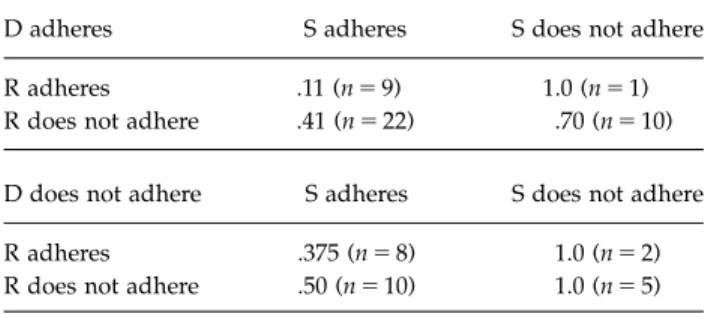
Figure 1 displays the relationship between oper-ational pattern score and the proportion of children who generated a strategy after the brief lesson. The model estimates that the odds of generating a strat-egy decrease by 3.15 for each unit increase in ad-herence to the operational patterns. Thus, the odds of strategy generation are nearly 9.5 times lower for children who adhere to all three operational patterns than for children who do not adhere to any of the operational patterns. Very few (1 of 9) children who adhered to the operational patterns on all three measures generated a strategy after the lesson, whereas all (5 of 5) children who did not adhere to the operational patterns on any of the measures did. Such a high proportion of strategy generation by children who did not adhere to the operational pat-terns is surprising, given that the lessons lasted for only 1 min. A moderate proportion of children who adhered to the operational patterns on one or two measures generated a strategy (14 of 22 and 13 of 31, respectively). Again, all children used incorrect strategies before the intervention; therefore, it was adherence to the operational patterns per se that was associated with strategy generation after the lessons. More detailed information about the relationship between adherence to the operational patterns and strategy generation is presented in Table 2, which displays the number of children who adhered to the operational patterns on each of the three measures, along with the proportion of children in each cell who generated a strategy. On the whole, children who adhered to the operational pattern on a given
measure were less likely than children who did not adhere to the operational pattern on that measure to generate a strategy (equal sign definition: Ms5.55 vs. .72; problem solving: Ms5.35 vs. .92; problem structure:Ms5.62 vs. .65).
We next examined whether children generated correct strategies after the lesson. Children were classified as generating a correct strategy if they solved any of the three postlesson equations using a correct strategy. For example, children would be classified as generating a correct strategy for the equation 71415571__ if they put the solution9in the blank and said that they added 4 plus 5 to get 9. We used logistic regression to examine the rela-tionship between operational pattern score (0 – 3) and use of a correct strategy (correct or not). The predictor variables in the model were identical to those used in the previous logistic regression model. As predicted by the change-resistance account, there was a significant negative linear relationship be-tween operational pattern score (0 – 3) and use of a correct strategy (correct or not) when controlling for
0 0.25 0.5 0.75 1 0 1 2 3
Operational Pattern Score
Proportion of Children
Figure 1. Proportion of children who used a new strategy after the lesson as a function of operational pattern score.
Table 2
Proportion of Children in Each of the Possible Combinations of Opera-tional Pattern Adherence on the Equal Sign Definition Measure (D), the Equation-Solving Measure (S), and the Problem-Structure Measure (R) Who Generated a Strategy After the Lesson
D adheres S adheres S does not adhere
R adheres .11 (n59) 1.0 (n51)
R does not adhere .41 (n522) .70 (n510) D does not adhere S adheres S does not adhere R adheres .375 (n58) 1.0 (n52) R does not adhere .50 (n510) 1.0 (n55)
the other predictors in the model, ^b¼ 0:92, z5 2.34, Wald (1,N567)55.47, p5.02. Figure 2 displays the relationship between operational pat-tern score (0 – 3) and the proportion of children who used a correct strategy after the brief lesson. The model estimates that the odds of using a correct strategy decrease by 2.52 for each unit increase in adherence to the operational patterns. Thus, the odds of using a correct strategy are more than 7.5 times lower for children who adhere to all three opera-tional patterns than for children who do not adhere to any of the operational patterns. None of the other predictors was significant (problem structure lesson: ^
b¼1:10,z51.34; equal sign concept lesson:b^¼0:15, z50.67; interaction of lesson conditions: ^b¼ 1:34, z5 1.17; age:b^ < :001,z50.18). Thus, as predict-ed by the change-resistance account, there was a significant negative linear relationship between ad-herence to the operational patterns and whether children used a correct strategy after receiving a brief lesson.
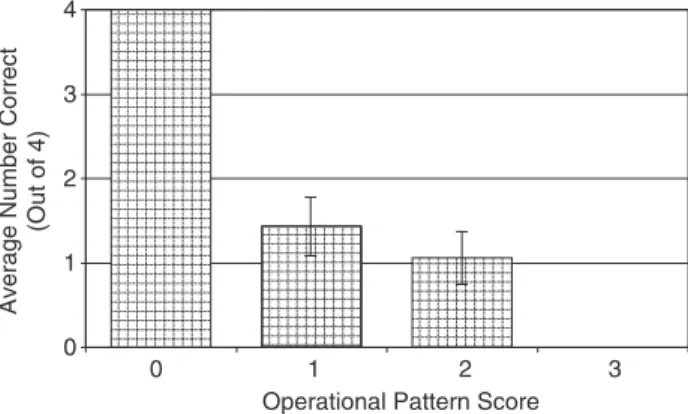
Finally, we used linear regression to examine the relationship between operational pattern score (0 – 3) and performance on the transfer problems. The predictor variables in the model were identical to those used in the previous logistic regression mod-els. The dependent variable was number of correctly solved transfer problems (out of 4). As shown in Figure 3, there was a significant negative linear re-lationship between operational pattern score and transfer performance when controlling for the other predictors in the model, ^b¼ 0:94, z5 3.56, p5.001. The effect of problem structure lesson was marginal,b^¼0:98,z51.74,p5.09, and none of the other predictors was significant (equal sign concept lesson: b^¼0:90, z51.63; interaction of lesson con-ditions: b^¼ 0:86, z5 1.06; age: ^b¼:0004, z50.4). Thus, consistent with the previous analyses,
adherence to the operational patterns was negatively associated with performance on equations after a brief lesson.
Do These Effects Hold When Controlling for Strategy Variability?
It is, of course, possible that the relations de-scribed thus far depend not on entrenchment of the operational patterns per se, but on strategy varia-bility, which may be confounded with entrenchment. Many past studies have documented relations be-tween strategy variability and learning; therefore, it is important to examine whether the relations be-tween adherence to the operational patterns and learning hold even when controlling for strategy variability.
Only 7% of children (5 of 67) displayed variability in their problem-solving strategies on the experi-mental pretest; therefore, it was not possible to ex-amine directly the relation between adherence to the operational patterns and strategy variability in this sample. One possible reason for the low level of variability observed in this experiment is that the equation-solving measure was limited to equations with the blank in final position (e.g., 31415531__). McNeil and Alibali (2004) showed that equations of this type are particularly difficult for children. An-other reason may be the task instructions (i.e., ‘‘Try to solve the problem as best as you can, and then put your answer in the blank’’). The instruction to put an ‘‘answer’’ may have led children to use the add-all strategy.
Although we could not examine relations between adherence to the operational patterns and strategy variability, it was possible to examine whether the relations between adherence to the operational
0 0.25 0.5 0.75 1 0 1 2 3
Operational Pattern Score
Proportion of Children
Figure 2. Proportion of children who used a correct strategy after the lesson as a function of operational pattern score.
0 1 2 3 4 0 1 2 3
Operational Pattern Score
Average Number Correct
(Out of 4)
Figure 3. Average number of transfer problems solved correctly (out of 4) as a function of operational pattern score.
patterns and learning held in the subsample of children who did not display strategy variability (i.e., children who used the same strategy to solve all three pretest problems, n562). Indeed, for this subsample, there was a significant negative linear relationship between operational pattern score (0 – 3) and strategy generation (generate or not) when controlling for the other predictors in the model, ^
b¼ 1:06, z5 2.35, Wald (1, N562)55.52, p5.02. Additionally, there was a significant negative linear relationship between operational pattern score and use of a correct strategy (correct or not) when controlling for the other predictors in the model, ^
b¼ 0:84, z5 1.94, Wald (1, N562)53.75, p5.05. Finally, there was a significant negative lin-ear relationship between operational pattern score and transfer performance, (b^¼ 0:87, z5 3.05, p5.004). Thus, the findings from the subsample were consistent with those from the full sample. Summary
The results of Experiment 1 support the change-resistance account. As children’s adherence to the operational patterns increased, the odds of learning from a brief lesson on equations decreased. Children who did not adhere to any of the operational pat-terns were most likely to generate a correct strategy for solving the equations after a lesson. Findings corroborate the predicted relationship between chil-dren’s knowledge of arithmetic operations and equation-learning difficulties. However, Experiment 1 used a correlational design. Individual differences before a lesson on equations predicted who would and would not learn from the lesson. It would be more convincing to demonstrate that knowledge of the operational patterns per se causes difficulties with equations. Thus, in Experiment 2, we activated participants’ knowledge of the operational patterns and examined effects on equation-solving perform-ance.
Experiment 2
The change-resistance account predicts that equa-tion-solving performance should be worse when knowledge of the operational patterns is activated. To test this prediction, we compared the equation-solving performance of participants whose knowl-edge of operational patterns was activated with participants whose knowledge of operational pat-terns was not activated. We believed it would be imprudent to activate (and consequently strengthen) elementary school children’s knowledge of the
op-erational patterns because they have not yet learned to solve equations correctly with operations on both sides of the equal sign. Therefore, in Experiment 2 we chose to work with undergraduate participants. Because undergraduates already know how to solve the equations, any effects of knowledge activation would likely be ephemeral. Given the obvious dif-ferences between undergraduates and elementary school children, we acknowledge that we cannot be certain that the same processes are at work in the two groups. However, evidence for a causal link between knowledge of the operational patterns and difficul-ties with equations in undergraduates would help build a case for the change-resistance account. Pre-vailing theories of problem solving (Anderson, 2002; Anderson et al., 1996; Haverty, 1999; Kotovsky et al., 1985)Fas well as traditional educational practic-esFpredict that equation-solving performance should be facilitated when knowledge of arithmetic operations is activated, but the change-resistance account predicts the opposite.
Method Participants
Twenty-eight undergraduates participated; 4 were excluded because of experimenter error. The final sample consisted of 24 undergraduates (8 men, 16 women; 1 African American, 21 Caucasian, 2 His-panic) from the University of Wisconsin – Madison Introductory Psychology participant pool. Partici-pants received one extra credit point toward their Introduction to Psychology grade for their partici-pation.
The mathematics experience of undergraduates in the participant pool varies widely. However, the minimum mathematics experience required for ad-mission to the University is one algebra course, one geometry course, and one advanced math course (e.g., advanced algebra, trigonometry, calculus). The average math ACT score reported by undergradu-ates who have participated in similar experiments in our lab is 27 (approximately the 89th percentile; ACT Inc., 2005).
Apparatus
Stimuli were presented on iMac G4 computers (17-in. screen, standard keyboard) using the Psy-Scope 1.2.5 interactive graphic system for experi-mental design and control (Cohen, MacWhinney, Flatt, & Provost, 1993).
Procedure
Participants were seated at computers in indi-vidual cubicles. The session had two main phases: an activation phase and an equation-solving phase. The purpose of the activation phase was to activate par-ticipants’ knowledge of the operational patterns experimentally. Consequently, in contrast to Experi-ment 1, we had control over whether participants’ knowledge of the operational patterns was activated. Participants were randomly assigned either to an experimental condition, in which their knowledge of all three operational patterns was activated, or to a control condition, in which their knowledge of the operational patterns was not activated. The condi-tions were designed to parallel the extreme opera-tional pattern categories from Experiment 1 (i.e., adherence to the operational patterns on 3 measures and adherence to the operational patterns on 0 measures).
Activation Phase
During the activation phase, participants were presented with 24 trials in which they were shown a target followed by a set of five stimuli. For each stimulus, participants’ goal was to indicate whether it matched some aspect of the target by pressing one of two keys labeled YES and NO on the keyboard. Each stimulus appeared on the screen until partici-pants made their decision. In both the experimental and control conditions, there were 8 trials of per-ceptual pattern activation, 8 trials of concept activa-tion, and 8 trials of strategy activaactiva-tion, each of which is described here.
Perceptual pattern activation. To activate knowl-edge of the ‘‘operations5answer’’ perceptual pat-tern, participants in the experimental condition were presented with a target equation (e.g., 37516595__) followed by five stimulus equations randomly se-lected from a set of equations (e.g., 37516595__, 9816735__, 121291175__, 817115195__). Participants’ goal was to decide whether each of the five stimulus equations matched the target equation. Both the target equation and the stimulus equations adhered to the traditional ‘‘operations5answer’’ problem structure. Participants in the control con-dition were presented with nonsense letter patterns (e.g., XxxX, Cccc, and RrXc) instead of equations.
Concept activation. To activate knowledge of the operational concept of addition, participants in the experimental condition were presented with a target word (e.g., Total) followed by five stimulus words randomly selected from a set of words (e.g., Total,
Plus, Sum, Add). Participants’ goal was to decide whether each of the five stimulus words matched the target word. Both the target word and the stimulus words were chosen to activate knowledge of the operation of addition. Participants in the control condition were presented with neutral words (e.g., Party, Tea, House) instead of words designed to ac-tivate knowledge of the operation of addition.
Strategy activation. To activate knowledge of the operational strategy of adding numbers together, participants in the experimental condition were presented with a target number (e.g., 16) followed by five addend pairs randomly selected from a set of addend pairs (e.g., 8 and 8, 10 and 5, 2 and 6, 20 and 20). Participants’ goal was to decide whether each of the addend pairs summed to the target number. This task was designed to activate the strategy of adding numbers together. Participants in the control condi-tion were presented with colors as targets (e.g., or-ange) and color pairs as stimulus pairs (e.g., red and yellow, red and white) instead of numbers and ad-dend pairs. Participants’ goal was to decide whether the color pairs, when mixed together, yielded the target color.
Equation-Solving Phase
Immediately following the activation phase, there was an equation-solving phase in which participants solved two typical addition problems (e.g., 51713155__) followed by eight equations with operations on both sides of the equal sign (e.g., 71415571__). Before each equation was present-ed, participants’ gaze was directed to the center of the screen at the location where the equation would be presented. The equations were displayed in the center of the computer screen for a brief period (M51500 ms). Each equation was approximately 5 mm tall and 50 mm wide. After each equation was presented, participants were instructed to write the solution on a provided answer sheet. After recording each answer, participants pressed a key on the key-board to move on to the next equation.
Coding
Participants’ equation-solving strategies were coded using the system developed by Perry et al. (1988). Strategies were assigned based on partici-pants’ solutions. Solutions were coded as reflecting a particular strategy as long as they were within1 of the solution that would result from that strategy. We were interested in participants’ use of correct strat-egies and in their use of the add-all strategy. Recall
that the add-all strategy is commonly used by ele-mentary school children who have not received in-struction on equations or on the concept of mathematical equivalence.
Results and Discussion
Participants’ performance on the two typical ad-dition problems (e.g., 51713155__) was good and did not differ between conditions. Two participants (one in each condition) did not use a correct strategy on one of the two typical addition problems; all others used a correct strategy on both typical addi-tion problems.
Figure 4 presents a frequency plot of the number of correct strategies used on the equations with op-erations on both sides of the equal sign (out of 8). Specifically, the figure displays the number of par-ticipants who used 0 correct strategies, 1 correct strategy, 2 correct strategies, and so on, up to 8 cor-rect strategies. Performance on the equations was good overall and not normally distributed, with 67% of the participants using a correct strategy on either seven (n56) or all eight (n510) equations. Given the potential ceiling effects, a parametric analysis was unwarranted; therefore, we categorized partici-pants into two groups based on the natural, balanced separation in the dataFthose who used a correct strategy on at least seven of eight equations (n516) and those who used a correct strategy on fewer than seven equations (n58). We then used a nonpara-metric analysis to examine the effects of operational pattern activation.
As predicted, participants whose knowledge of the operational patterns was activated were less likely than participants whose knowledge was not activated to use a correct strategy on at least seven of eight equations,w2(1,N524)56.75,p5.009. Of the 12 participants in the control condition, 11 (92%) used a correct strategy on at least seven of the eight equations. Of the 12 participants in the experimental condition, only 5 (42%) used a correct strategy on at least seven of the eight equations. This result is consistent with the results of Experiment 1 and supports the predictions of the change-resistance account. When people’s knowledge of the opera-tional patterns is activated, they are more likely to have difficulties with equations. The result chal-lenges theories of mathematics learning that hold that knowledge of arithmetic operations should fa-cilitate performance on more complex equations. It also challenges the intuitive hypothesis that people who are primed with mathematical tasks will
per-form better on subsequent math problems than people who are primed with nonmathematical tasks. Participants in the control group performed non-mathematical tasks and subsequently performed better than participants in the experimental group on mathematical equations.
The change-resistance account predicts that equation-solving performance suffers when knowl-edge of the operational patterns is activated because knowledge of the operational patterns controls at-tention, determines what gets encoded, and influ-ences how information is interpreted. Thus, when participants’ knowledge of the operational patterns is activated, they should be more likely to view equations operationally and adhere to the opera-tional, add-all strategy (e.g., 7141557123) in solving equations. Indeed, whether participants ever used the add-all strategy was contingent on condi-tion, w2(1, N524)56.32, p5.01. None of the 12 participants in the control condition ever used the add-all strategy, not even on one equation, whereas 5 of 12 participants (42%) in the experimental condi-tion used the add-all strategy at least once. In fact, all 5 participants in the experimental condition who used the add-all strategy used it more than once (M53.8 of 8 equations). Use of the add-all strategy accounted for 49% of the incorrect strategies used by participants in the experimental condition. Thus, when undergraduates’ knowledge of the operational patterns is activated, they tend to resemble elemen-tary school children and solve equations by adding all the numbers.
The results of Experiment 2 provide additional support for the change-resistance account. Partici-pants who had their knowledge of the three opera-tional patterns activated did not perform well on equations, and they were likely to err by adding all
0 2 4 6 8 10 12 0 1 2 3 4 5 6 7 8
Number of Correct Strategies
Frequency
(Number of Participants)
Figure 4. Frequency plot of the number of correct strategies used on the equations with operations on both sides of the equal sign (out of 8).
the numbers. In contrast, participants who did not have any of the three operational patterns activated performed well on equations and were unlikely to add all the numbers. Although these results are consistent with the change-resistance account, two caveats should be noted when making direct com-parisons between Experiment 1 and Experiment 2. First, elementary school children and undergradu-ates differ on several dimensions, including age and experience with math. Second, there were procedural differences between the two experiments, including method of presenting the equations (easel vs. com-puter) and amount of time each equation was pre-sented (no time restriction vs. brief presentation). Despite these limitations, however, results of Exper-iment 2 help build the case for the change-resistance account by establishing a casual link between acti-vation of the operational patterns and difficulties solving equations.
General Discussion
The experiments presented in this article tested whether knowledge of arithmetic operations con-tributes to difficulties with equations. In Experiment 1, children’s adherence to three operational patterns that commonly occur in arithmetic was negatively associated with the likelihood of learning from a brief lesson on equations. In Experiment 2, partici-pants whose knowledge of the three operational patterns was activated were less likely than partici-pants whose knowledge was not activated to per-form well on equations. These findings support the change-resistance account and suggest that knowl-edge of arithmetic operations hinders performance on and learning of equations. We believe that these findings have important theoretical and educational implications, as discussed next. However, it is im-portant to note that it would be premature to gen-eralize the results to classroom learning, given that many aspects of our experiments were far removed from typical classroom settings.
The change-resistance account focuses on what children have, and thus, places substantial weight on the current state of the cognitive system. This differs from accounts of children’s learning difficulties that focus on what children lack. Accounts that focus on what children lack generally assume that the cogni-tive system is moving, steadily or in spurts, toward some common adult state (Kessen, 1984). Each period of immature development is seen as the adult state minus something. In turn, the research strategy has been to start with what is known about the adult state and work backward in hopes of discovering
mecha-nisms that give rise to the adult state. This strategy may be effective for understanding well-defined problems in the laboratory; however, cognitive de-velopment is not a well-defined problem. Different processes can lead to the same end state, and the same processes can lead to different end states. Thus, although end states provide an inventory of poten-tials for development, they do little to inform our understanding of the processes that create them.
The change-resistance account argues that to un-derstand learning and cognitive development, it may not be necessary or even desirable to specify an end state. Instead, development can be viewed as a suc-cession of attempts to preserve the current state in the face of an external impetus for change. As Kuo (1976) eloquently argued, the study of development is not about endpoints, but potentials. Scientists who start with the current state in mind can hypothesize about potential subsequent states and experimen-tally examine conditions under which desired future states can be achieved from the current state. The goal of this research strategy, then, is to uncover the mechanisms that drive the cognitive systemFboth mechanisms of change and mechanisms of change resistance.
One mechanism of change resistance in children’s mathematical development may be entrenched knowledge of operational patterns. We suggest that knowledge of operational patterns should be most entrenched between third and fifth grades. Before third grade, children are just starting to learn about arithmetic operations; therefore, their knowledge of operational patterns is weak. Between third and fifth grades, children continue practicing arithmetic pro-cedures, and their knowledge of operational patterns becomes stronger and more robust. As a result, they inflexibly apply their knowledge of the operational patterns and are unable to invent new strategies (i.e., resist change) when presented with novel equations (cf. Hatano, 1988). This leads to the unintuitive pre-diction, which we are currently testing, that first- and second-grade children may be more likely than third- through fifth-grade children to solve equations with operations on both sides correctly. After fifth grade, children are introduced to prealgebra; there-fore, the operational patterns begin to lose their predictive power, and children’s representations of these patterns decrease in strength.
The present results contribute to the growing body of evidence suggesting that prior knowledge can be detrimental in some situations (Adelson, 1984; Bruner & Postman, 1949; Flege, Frieda, & Nozawa, 1997; Gray & Fu, 2001; Knoblich et al., 1999; Kuhl, 2000; Wiley, 1998). These findings present a paradox
because knowledge is often cited as something that facilitates learning (Rittle-Johnson, Siegler, & Alibali, 2001), memory (Chase & Simon, 1973; Chi, 1978), and problem solving (Larkin, 1983). Indeed, familiar pro-verbs such as ‘‘knowledge is power’’ highlight that people intuitively think knowledge is a good thing. Because knowledge is typically beneficial, situations in which knowledge hinders performanceFlike the those described in this articleFprovide a unique window into how the cognitive system works.
The present study also extends past research about strategy variability as a predictor of cognitive change. The results shed light on why some indi-viduals with low strategy variability nevertheless changeFnamely, because their existing strategies are not entrenched. People may use an incorrect strategy consistently, not because it is entrenched but because they cannot think of any other way to solve the problem. They may know that their existing strategy is incorrect, but they may not have the knowledge necessary to construct a new strategy. Unlike people who are entrenched in a particular strategy, these individuals may be highly receptive to instruction. When they encounter new information, they may readily incorporate that information into their knowledge base and abandon their incorrect strategy in favor of a new strategy. More broadly, the present work highlights the need for research to address directly the relations among variability, en-trenchment, and learning.
Perhaps the most surprising finding of the present research was that undergraduates could be made to perform like elementary school children. When un-dergraduates’ knowledge of the operational patterns was activated in Experiment 2, some started solving fairly straightforward equations (e.g., 714155 71__) by adding all the numbers. This strategy is often used by children who have not yet received instruction on such equations (McNeil & Alibali, 2000). We argue that this finding is a testament to the power of early learning. Equations such as 714155 71__ would typically be trivial for college students,
who have years of experience with algebraic equa-tions. Nonetheless, after just a few minutes of ex-posure to the operational patterns that they learned many years previously, their performance on such equations suffered. These results are consistent with other studies that demonstrate the power of indi-viduals’ initial associations in a wide variety of do-mains (e.g., infants’ spatial memory, Munakata, McClelland, Johnson, & Siegler, 1997; Spencer, Smith, & Thelen, 2001; children’s strategies for solving sci-ence and mathematics problems, Schauble, 1990; Siegler & Stern, 1998; adults learning a second
lan-guage, Best, McRoberts, & Goodell, 2001; Flege et al., 1999; nonhuman animals’ latent inhibition and spontaneous recovery, Bouton, Nelson, & Rosas, 1999; Tolman, 1948). Results also converge with other studies showing that undergraduates sometimes use less advanced strategies for solving math problems than might be expected (e.g., Clement, Lochhead, & Monk, 1981; LeFevre, Smith-Chant, Hiscock, Daley, & Morris, 2003; Rosnick, 1981).
Although it is tempting to assume that the un-derlying processes responsible for undergraduates’ difficulties in Experiment 2 are the same as the processes responsible for children’s difficulties in Experiment 1, one cannot be certain that this is the case. The age- and experience-related differences between the two participant groups, as well as the procedural differences between the two experiments, discourage us from making strong claims about the similarities between the two cases. Instead, we argue that Experiment 2 should be viewed primarily as an existence proof that knowledge of the operational patterns hinders performance on equations. Taken together with the results of Experiment 1, this sug-gests that knowledge of arithmetic operations (as currently taught in the United States) may contribute to difficulties with learning of and performance on equations.
In practical terms, the present findings challenge some traditional educational practices. In most schools in the United States, children learn arith-metic operations for many years before reaching al-gebra and being formally introduced to equations and the concept of mathematical equivalence. This instructional strategy makes sense in the context of accounts that attribute children’s difficulties with equations to something that children lack. The ar-gument is as follows: If elementary school children lack the necessary domain-general logical structures or working memory resources for understanding complex equations, why should teachers waste val-uable class time trying to teach something that chil-dren are not ‘‘developmentally ready’’ to learn? Instead, teachers should focus on teaching some-thing children are capable of learningFarithmetic operations. Similarly, if children’s difficulties with equations are due to their lack of proficiency with arithmetic operations, it makes sense for children to spend years practicing arithmetic operations before moving onto complex equations. However, this in-structional strategy makes less sense within the context of the change-resistance account, which ar-gues that children’s knowledge of the operational patterns becomes entrenched through years of practice with arithmetic operations, and as a result,
children’s ability to learn about more complex equations suffers. According to this view, it would make more sense to start teaching children about complex equations as early as possibleFbefore knowledge of the operational patterns becomes en-trenched. Along these lines, many mathematics ed-ucation researchers have argued for the ‘‘algebra-fication’’ of elementary school mathematics (Blanton & Kaput, 2003; Bodanskii, 1991; Carpenter et al., 2003; Carraher, Schliemann, & Brizuela, 2001).
Although the present findings lead us to question some educational practices that are common in the United States, we must be cautious about our con-clusions. It would be premature for us to conclude that knowledge of arithmetic operations hinders the learning of children in classroom settings. Although the results of Experiment 1 hint in that direction, the jury is still out. Indeed, our experiments do not rule out the possibility that children need even more practice with arithmetic operations before progress-ing to algebra. It may be that the relationship be-tween practice with arithmetic and performance on equations is U-shaped, with an intermediate level of arithmetic proficiency being most detrimental (cf. Dowker, Flood, Griffiths, Harriss, & Hook, 1996). We argue that third- through fifth-grade children de-velop routine expertise with arithmetic operations, and this leads them to apply their knowledge of operational patterns inflexibly (cf. Hatano, 1988). With even more practice, however, children may eventually develop adaptive expertise and exhibit the creativity and flexibility of true experts (Dowker, 1992; Hatano, 1988). We are currently investigating the causal link between knowledge of arithmetic operations and mathematics learning difficulties in classroom settings.
We contend that change resistance extends beyond the domain of mathematics. Indeed, it may be a fundamental characteristic of the cognitive system. It is manifested in a wide variety of domains, including science (Schauble, 1990) and foreign language (Kuhl, 2000). Thus, any general theory of learning and cog-nitive development needs to address not only mech-anisms of change but also mechmech-anisms of change resistance.
References
ACT Inc. (2005).National ranks for test scores and composite score [online]. Available from http://www.actstudent. org/scores/norms1.html
Adelson, B. (1984). When novices surpass experts: The difficulty of a task may increase with expertise.Journal of Experimental Psychology: Learning, Memory, and Cognition, 10, 483 – 495.
Adolph, K. E. (1997). Learning in the development of infant locomotion.Monographs of the Society for Research in Child Development, 62(Serial No. 251).
Alibali, M. W. (1999). How children change their minds: Strategy change can be gradual or abrupt.Developmental Psychology,35, 127 – 145.
Alibali, M. W., & Goldin-Meadow, S. (1993). Gesture-speech mismatch and mechanisms of learning: What the hands reveal about a child’s state of mind. Cognitive Psychology,25, 468 – 523.
Alibali, M. W., McNeil, N. M., & Perrott, M. A. (1998). What makes children change their minds? Changes in en-coding lead to changes in strategy selection. In M. A. Gernsbacher & S. Derry (Eds.), Proceedings of the Twen-tieth Annual Conference of the Cognitive Science Society(pp. 36 – 41) Mahwah, NJ: Erlbaum.
Anderson, J. R. (2002). Spanning seven orders of magni-tude: A challenge for cognitive modeling.Cognitive Sci-ence,26, 85 – 112.
Anderson, J. R., Reder, L. M., & Lebiere, C. (1996). Working memory: Activation limitations on retrieval. Cognitive Psychology,30, 221 – 256.
Baroody, A. J., & Ginsburg, H. P. (1983). The effects of in-struction on children’s understanding of the ‘‘equals’’ sign.Elementary School Journal,84, 199 – 212.
Beaton, A. E., Mullis, I. V. S., Martin, M. O., Gonzalez, E. J., Kelly, D. L., & Smith, T. A. (1996). Mathematics achieve-ment in the middle school years: IEA’s Third International Mathematics and Science Study (TIMSS). Chestnut Hill, MA: Boston College.
Behr, M., Erlwanger, S., & Nichols, E. (1980). How children view the equal sign.Mathematics Teaching,92, 13 – 15. Best, C. T., McRoberts, G. W., & Goodell, E. (2001).
Dis-crimination of non-native consonant contrasts varying in perceptual assimilation to the listener’s native pho-nological system. Journal of the Acoustical Society of America,109, 775 – 794.
Blanton, M., & Kaput, J. (2003). Developing elementary teachers’ ‘‘algebra eyes and ears.’’ Teaching Children Mathematics,10, 70 – 77.
Bodanskii, F. (1991). The formation of an algebraic method of problem solving in primary school children. In V. Davydov (Ed.), Soviet studies in mathematics education (Vol. 6, pp. 275 – 338). Reston, VA: National Council of Teachers of Mathematics (NCTM).
Bouton, M. E., Nelson, J. B., & Rosas, J. M. (1999). Stimulus generalization, context change, and forgetting. Psycho-logical Bulletin,125, 171 – 186.
Bruner, J. S. (1957). On perceptual readiness.Psychological Review,2, 123 – 152.
Bruner, J. S., & Postman, L. (1949). On the perception of incon-gruity: A paradigm.Journal of Personality,18, 206 – 223. Case, R., Kurland, M., & Goldberg, J. (1982). Operational
efficiency and the growth of short-term memory span. Journal of Experimental Child Psychology,33, 386 – 404. Carpenter, T. P., Franke, M. L., & Levi, L. (2003).Thinking
Mathematically: Integrating arithmetic and algebra in ele-mentary school. Portsmouth, NH: Heinemann.