An Evaluation of an After-School Program’s Effectiveness in Preventing Juvenile Delinquency and Substance Use: A Test of the Social
Development Model
Flavia J. Rivera and Timothy A. McCorry , Buffalo State College
While the consensus of research indicates that after-school programs are, and have been, successful in preventing delinquency and substance use, studies assessing the impact of particular strategies are rare. The purpose of this research is to assess the effectiveness of an after-school program in preventing delinquency using the social development model (SDM) as a main guideline for data collection. Specifically, we administered a survey to 23 adolescents ages 12-24 at Asarese-Matters Neighborhood Community Center in Buffalo, NY. The participant’s perceptions on the programs offered at the center were measured according to the SDM main constructs: 1) opportunities for involvement, 2) skills for involvement, and 3) reinforcement of the involvement. The main finding is that adolescents who report having more opportunities at their after-school program also reported less involvement in delinquency and substance use.
INTRODUCTION
There are many challenges facing children and adolescents living in low-income, inner city neighborhoods in the United States. In particular, research has indicated that these neighborhoods are often beset by high rates of poverty, which can exacerbate the problem of gangs, drug trafficking and violence
(Osofsky 1997; Roffman, Pagano, and Hirsh 2001). As a result, children and adolescents growing up in these neighborhoods are seen as being at an
increased risk of engaging in acts of delinquency and substance use (O’Donnell, Hawkins and Abbot 1995).
To address this problem, government and education officials have
provided financial support for prevention programs which target inner city youth (Gottfredson, Cross and Soule 2007). In particular, the Task Force on Youth Development and Community Programs concluded that low income children and adolescents who had little or no supervision in the hours after school posed a considerable risk for getting involved in dangerous or illegal activities (Task-Force on Youth Development and Community Programs, 1992; Hawkins, Catalano and
Miller 1992; Sickmund, Synder and Poe-Yamagata 1996, 1997; Gottfredson, Gottfredson, and Weisman 2001). In addition, large scale empirical studies demonstrated the value of after-school programs, concluding that providing after-school activities for adolescents drastically reduced the opportunity of committing a crime or engaging in substance use during the critical after-school time period. (Smith & Kennedy 1991; LoSciuto, Hilbert, Fox, Porcellini, and Lamphear 1999).
However, even though the benefits of these programs are beginning to be understood, we still know little about the reasons why these programs are
effective in preventing delinquency and substance use (Gottfredson et al. 2007). Most of the prior research has assumed that the mere presence of participation in after-school programs is the key to their success (Roffman et al. 2001). In particular, after-school programs’ effectiveness has been generally assessed by emphasizing participation rates and procedural compliance, rather than
meaningful measures of adolescents’ experiences as to why they are involved in the program and their perceptions of their attachments to the program and staff. Thus, to date we still know little about the specific elements of a program that may make it successful along any particular dimension (Orlandi and Cole 1992;
Royse 1998; Schinke, Roffman, Pagano, and Hirsh 2001; Gottfredson et al. 2007).
Recently, an integrated approach has emerged to fill this gap in the literature and to a present a possible explanation for the effectiveness of after-school programs in preventing delinquency and substance use. Specifically, the Social Development Model (SDM), which was originally proposed by Catalano and Hawkins (1996), integrates key features of differential association, social learning theory, and is an extension of social control theory (Weis and Hawkins 1981; Hawkins and Weis 1985; Elliot et al. 1985; Messner, Marvin, and Liska 1989; Catalano and Hawkins 1996). In the next section, we will discuss the key elements of this model.
THE SOCIAL DEVELOPMENT MODEL
Overall, the social development model captures essential elements of past theories in criminology to describe the protective factors in preventing
delinquency. First, the social development model draws on differential association theory (Cressey 1953, Matsueda 1982, 1988; Sutherland 1973; Sutherland and Cressey 1970) which posits that delinquency like many other behaviors is learned in interaction with other persons of communication within intimate personal groups. According to this theory, a person is more likely to become delinquent if exposed to the preponderance of persons favorable to violations of the law relative to those unfavorable to violations of the law. Overall, the differential association theory is the process by which an individual aligns himself or herself with the group that controls the individual’s major source of reinforcement, particularly the peer group and family.
Second, the social development model draws on the primary proposition found in social learning theory. Overall, social learning theory suggests that all behavior, whether pro-social or anti-social criminal behavior, including violence, is learned through imitation or modeling (Akers 1977; Akers et al. 1979; Bandura 1973, 1977; Burgess and Akers 1966; Conge 1976, 1980; Krohn et al. 1980). Imitation is the duplication of a particular behavior by an individual after viewing another individual who had performed the same behavior. Two explanations have been offered to explain why imitation occurs. First, an individual who imitates does so because he or she has been variously reinforced by viewing another individual engaging in a particular behavior and viewing that individual being rewarded. Second, an individual who imitates does so because the imitated behavior was directly reinforced (Akers 1973).
In addition, social learning states that the strength of deviant behavior is a direct function of the amount, frequency, and probability of its reinforcement (Akers 1985). Specifically, Akers deduced four independent variables to explain any deviant behavior: (1) the extent of an individual’s imitation of admired models, (2) the extent of an individual’s definitions regarding deviant behaviors,
(3) the extent of an individual’s differential association, and (4) the extent of an individual’s differential reinforcement. Thus, the main idea of social learning theory is similar to differential theory, that behaviors are primarily learned in small groups or contexts, but adds the idea that behaviors persist through the reinforcement of behaviors through a process of rewards or punishments.
Also, the social development model draws on social control theory, or social bonding theory, which was originally proposed by Hirschi (1969) to explain the causes of delinquency. While differential association and social learning theories focus on the factors motivated individuals to violate laws, Hirschi’s social control theory took an opposite approach by focusing on the factors that
prevented individuals from violating laws.
Specifically, Hirschi (1969) conceptualized that the key method of control was the level of bonds an individual had to conventional society. He argued that the only reason people conform to the rules of society is because of bonds they have with either person(s) or institution(s) that promote conformity. Thus, Hirschi (1969) hypothesized four components of pro-social bonds: (1)
attachment, (2) commitments, (3) involvement (4) and belief, which all provide strong protection against delinquency. Therefore, when adolescents are bonded to persons or institutions (i.e. after-school programs) that support conformity, they are less likely to engage in anti-social behaviors.
THE SOCIAL DEVELOPMENT MODEL’S MAIN CONSTRUCTS
In line with these three perspectives, the social development model (SDM) integrates key features of these past theories to more fully describe casual and mediating processes hypothesized to predict behavior over the course of
development (Catalano and Hawkins 1996; Hawkins and Weis 1985; Hawkins 1981). Drawing most heavily from social control theory, the social development model asserts that bonds to pro-social others inhibits delinquency and problem behaviors. The key assumption in the social development model is that
involvement, the individual will not be able to establish a bond within that social unit (Hawkins and Lishner 1987).
In addition, the theory adds to social control theory elements of differential association and social learning theories. Specifically, the social development model identifies the three factors that are essential in establishing social bonds and for learning to occur: perceived opportunities for involvement, degree of involvement with staff, and reinforcement for the involvement
(Catalano and Hawkins 1996; Hawkins et al. 1992; Hawkins and Lishner 1987; O’Donnell et at. 1995). Briefly, perceived opportunity for involvement refers to the youth’s potential to interact with staff and others through programs,
activities, and clubs. The degree of involvement refer to the intensity of interaction with staff which allow youth to establish and maintain social relationships, as well as learn pro-social skills. Finally, reinforcement for involvement refers to rewards and incentives presented to youth for initiating and maintaining involvement with programs and staff (Hawkins and Lishner 1987).
EMPIRICAL SUPPORT FOR THE SDM MODEL
Like social control theory, there is widespread empirical support for the social development model (Williams, Ayer, Abbot, Hawkins, & Catalano 1999), and its usefulness has been demonstrated by its ability to explain variation in delinquency and substance use in children and adolescents (see O’Donnell et al. 1995; Catalano et al. 1996; Ayers et al. 1999; Catalano et al. 1999; Herrenkohl et al. 2001; Huang et al. 2001; Lonczak et al. 2001; Brown et al. 2005). For example, in their longitudinal study, Brown et al. (2005) found the social
development model to be effective in providing an explanatory framework for the progression of anti-social behavior in children and adolescents. Using structural equation modeling, they found that four of the seven structural pathways
examined to measure pro-social and anti-social behaviors were partially or totally mediated by SDM constructs. Similarly, Huang et al. (2001) used the SDM
constructs to predict violent behavior among adolescents, and concluded that the model adequately predicted violence at age 18 and mediates much of the effect of prior violence. With regards to substance use, Catalano et al. (1996)
examined the utility of the social development model constructs measured at age 13-14 to predict 17-18 substance use. Results confirmed the hypothesized
relationship between pro-social bonding and 17-18 year old substance use. The analyses suggested that pro-social bonds might change slowly through
experiences of opportunities, involvement and rewards.
While there is strong support emerging for the SDM as an explanation of deviant behavior to date, there have been few studies which have used the SDM to assess the effectiveness of an after-school program. Therefore, the purpose of this study is to assess the effectiveness of an after-school program in preventing delinquency and substance use utilizing the social development model (SDM) as a main guideline for data collection. Specifically, in this study, we will utilize the SDM ain constructs to answer whether adolescents who report having more opportunities at their after-school program will also report less involvement in delinquency and substance use. The three main hypotheses are:
1. Do adolescents who report having more perceived opportunities at Asarese-Matters also report less involvement in delinquency and substance use?
2. Do adolescents who report a higher degree of interaction with staff at Asarese-Matters report less involvement in delinquency and substance use?
3. Do adolescents who report receiving incentives for initiating and maintaining involvement in program activities at Asarese-Matters, also report less involvement in delinquency and substance use?
RESEARCH METHODOLOGY
The answers to these questions require the sampling of adolescents who participate in an after-school program. In this section, we will discuss the study
site, as well as the sampling procedures, sample characteristics, the survey, measurement of key variables, as well as my strategy for data analysis.
THE STUDY SITE
The Asarese-Matters Recreation Center, at 50 Rees Street in Buffalo, New York, was first opened on April, 24, 1989. The center was built with the purpose of providing a safe place for after-school youth recreation. The center’s hours of operations are Monday through Friday from 2 p.m. to 5:30 p.m. and from 7 p.m. to 9 p.m.
The center is managed and supported by the Erie County Department of Parks and Recreation; however Erie County currently provides only limited funding for the implementation of activities and maintenance of the building. In general, the Asarese-Matters’ recreational programs and activities are supervised by only two paid staff members. To supplement the existing staff and programs, Buffalo’s State College students work as volunteers and interns, and have limited responsibilities which include some supervision and implementation of programs and activities at Asarese-Matters. On an average day, there are approximately 40-50 adolescents who regularly attend the center.
SAMPLING PROCEDURES
In this study, we collected data from a non-probability, convenient sample of 23 adolescents, ages 12-24, who participate in programs at the
Asarese-Matters Recreation Center. For this study, all participants, signed a participant consent form, and all of the parents of youth age 12 to 17 participating at
Aserese-Matters gave parental consent for their child to participate in the study.
SAMPLE CHARACTERISTICS
The demographic characteristics of the 23 respondents who participated in the study reveal that the average age of the participants was 16 (See Table 1).
The breakdowns for gender and race indicate overall higher participation rates of males (65.2%), and higher rates of participation among African-Americans
(73.9%), with 13.0% Hispanic, and 13.0% self-identified as “Other.”
In terms of family structure, only 39 % of the respondents reported living within a household with both a mother and father. The majority of respondents lived with either “mother only” (21.7%), lived with “guardians” (21.7%), lived with “mother and friend” (4.3%), lived “on their own, with no guardian” (4.3%), or lived in an “other” type of arrangement not specified on the survey (8.7%). In addition, the average number of children living in the respondent’s households was 6.40. Moreover, the respondents reported that a higher percentage of mothers were employed (40.0%), either full-time (25.0%) or part-time (15.0%), while the respondents reported that only 36.4 percent of their fathers were working either full-time (27.3%) or part-time (9.1%), and the 34.8% of the adolescents, themselves, worked after school either full-time or part-time.
In terms of involvement at the Asarese-Matters Recreation Center, the respondents attend the center an average of 3.78 days per week, and stayed at the center for an average of 5.04 hours a day. The respondents in this sample have participated in an average of 3.27 programs at the center, which include basketball, hockey, swimming, art projects, and a girls’ night. In terms of their involvement in acts of delinquency and substance use (see table for operational definitions), 87% of the respondents reported having engaged in at least one act of delinquency in the past year, while 68.2% reported having used a substance in the past year.
TABLE 1. Characteristics of the Sample
Variable Description
Age (Mean) 16.16
Gender (% male) 65.20
(% Hispanic/Latino) 13.00
(% Other) 13.00
Family Structure
(% Living with Mother and Father) 39.10 (% Living with Mother Only) 21.70 (% Living with Guardians) 21.70 (% Living on their own, with no Guardians) 4.30 (% Other) 8.70 Number of Children in Household (Mean) 6.40 Mother’s Employment Status
(% working full-time) 25.00 (% working part-time) 15.00 Father’s Employment Status
(% working full-time) 27.30 (% working part-time) 9.10 Respondent’s Employment Status
(% working either full- or part-time) 34.80
Involvement at the Asarese-Matters Rec. Center
(Mean Number of programs attended) 3.27 (Mean Number of days per week) 3.78 (Mean Number of hours per day) 5.04
Involvement in Self-Reported Delinquency (% engaging in at least one act in past year) 87.00
Involvement in Substance Use
perceptions of involvement in activities and staff at the center. All participants were given a raffle ticket upon completion of their questionnaire which allowed them to have a chance of winning an Ipod mp3 player.
OPERATIONAL DEFINITIONS OF INDEPENDENT VARIABLES
Youths’ perceptions of the program were measured according to the SDM main constructs: 1) perceived opportunities for involvement, 2) degree of
involvement with staff, and 3) reinforcement of the involvement. Participants were asked to rate their level of agreement with various statements on a 5 point Likert-Type scale (i.e. always, most of the time, about half of the time,
sometimes, never, hardly ever) (See Table 2).
Table 2. Operational Definition of the SDM Main Constructs_
1) Operation Definition of Perceived Opportunities for Involvement “I feel there are a lot of opportunities for me at Asarese-Matters?”
Always
Most of the time
About half of the time
Sometimes
Never, hardly ever
2) Operation Definition of Degree of Involvement
“How often do you interact with the staff at Asarese-Matters?
Always
Most of the time
About half of the time
Sometimes
Never, hardly ever
3) Operational Definition of Reinforcement of the Involvement.
How often are you recognized for participating in clubs and activities at Asarese-Matters?
Always
Most of the time
About half of the time
Sometimes
OPERATIONAL DEFINITIONS OF DEPENDENT VARIABLES
Estimates of the prevalence of delinquency were based on standard delinquency measures which included nine questions that asked how frequently they sold drugs, drew graffiti on a building, stole something valued under $5, between $5 and $50, and over $50, whether the respondents stole a car or took their parents’ care without permission, hit or beat someone, or destroyed
property in the last year (See Table 3).
Table 3. Operational Definition of Delinquency Questions Included in Delinquency Scale:
During the past year, how many times, if ever, have you sold drugs? During the past year, how many times, if ever, have you stolen things worth less than $5 (by shop lifting or other means)
During the past year, how many times, if ever, have you stolen things worth between $5 and $50 by other means
During the past year, how many times, if ever, have you stolen things worth over $50 by other means
During the past year, how many times, if ever, have you drawn graffiti, written things, or drew pictures on buildings or other property (without the owner’s permission)
During the past year, how many times, if ever, have you taken a family member’s car for a ride without permission?
During the past year, how many times, if ever, have you taken a car belonging to someone you didn’t know for a ride without the owner’s permission
During the past year, how many times, if ever, have you banged up something that didn’t belong to you on purpose?
How many times in the past year have you hit someone with the idea of seriously hurting them?
Estimates of the prevalence of substance use were based on five questions that asked about the use of alcohol, marijuana, cigarettes, cocaine/crack, amphetamines, or steroids (See Table 4). Specifically, the respondents answered whether they had engaged in the behavior, never, once or twice, once every other month, once a month, every week, and nearly every day.
Table 4. Operational Definition of Substance Use
Questions Included in Substance Use Scale:
During the last year, about often, if ever, have you been drunk or high on alcohol?
During the past year, about how often, if ever, have you used marijuana or hashish?
(Hash, hash oil)
During the past year how often have you smoke cigarettes or other tobacco?
During the past year, about how often, if ever, have you use cocaine or crack?
During the past year, about how often, if ever, have you taken
amphetamines on your own? --- That is, without a doctor telling you to take them?
During the past year, about how often, if ever, have you taken steroids?
STRATEGY FOR DATA ANALYSIS
In the following results section, we will analyze whether the main
measures of the social development model are correlated with delinquency and substance use outcomes as indicated in previous research. The variables were collapsed into dichotomous categories reflecting the presence or absence of delinquency or substance use, and high or low involvement with the programs
and staff (i.e. high Involvement=always, most of the time) in order to accommodate the small sample size available for the data analysis.
RESULTS
In the following section, we will present the results of the three main hypotheses of the study. As stated, the three main hypotheses are:
1. Do adolescents who report having more opportunities at Asarese-Matters also report less involvement in delinquency and substance use?
2. Do adolescents who report higher interaction with staff at Asarese-Matters report less involvement in delinquency and substance use? 3. Do adolescents who report receiving incentives for initiating and
maintaining involvement in program activities at Asarese-Matters, also report less involvement in delinquency and substance use?
HYPOTHESIS 1
In a test of the first hypothesis, the data suggests that those participants who perceive more opportunities for involvement at Asarese-Matters Recreation Center are less likely to commit acts of delinquency (See Table 5). Specifically, among the youth who reported that there were opportunities at the Center either always or most of the time, 19% said that they had never committed an act of delinquency, whereas 100% of those that felt that there were opportunities only about half the time, sometimes or never, reported having engaged in an act of delinquency in the past year.
TABLE 5. Opportunity for Involvement Involvement
in delinquency High involvement Low involvement Total
No delinquency 19% (3 ) 0% (0) 13% (3) At least 1 act of
delinquency 81.3% (13) 100% (7) 87% (20)
total 100% (16) 100% (7 100% (23)
In terms of substance use, among the youth who reported that there were opportunities at Aserese-Matters either always or most of the time, 46.7% said that they never used any substance, whereas 100% of those that felt that there were opportunities only about half of the time, sometimes or never, reported having used substances in the past year (see table 5A). Thus the preliminary data suggest that those who perceive more opportunities for
involvement at Asarese-Matters are less likely to be involved in delinquency, and even less likely to engage in substance use.
TABLE 5A. Opportunity for Involvement Levels of substance
use High involvement Low involvement Total
No substance use 46.7% (7) 0% (0) 13% (7) used substances at
least 1 53.3% (8) 100% (7) 87% (15) total 100% (15) 100% (7) 100% (22)
HYPOTHESIS 2
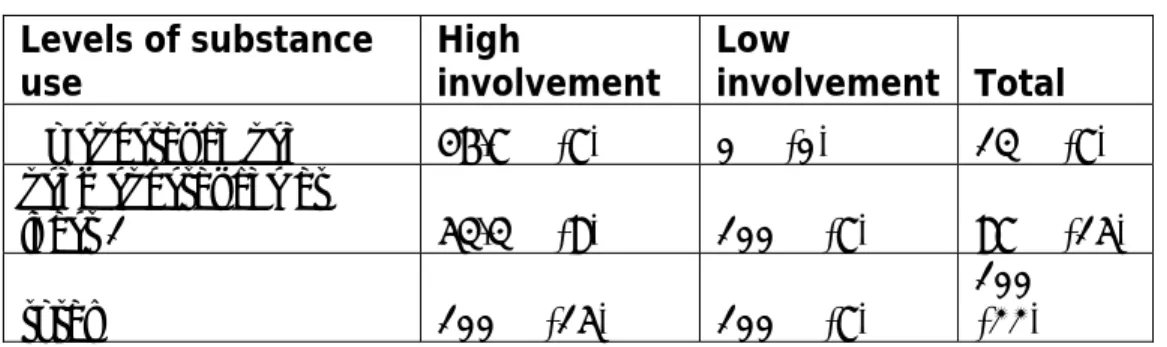
In the second hypothesis, the preliminary data suggest that those who have higher levels of interaction with staff at Asarese-Matters are less likely to commit acts of delinquency. Specifically, among the youth who reported that they interacted with the staff at Asarese-Matters either always or most of the time, 16% said that they had never committed an act of delinquency, whereas 100% of those that interacted only about half the time, sometimes or never, reported having engaged in an act of delinquency in the past year (see table 6).
TABLE 6. Staff Interaction Involvement
in delinquency High involvement Low involvement Total
At least 1 act of
delinquency 82 % (16) 100% (4) 87% (20) total 100% (19) 100% (4) 100% (23)
With regards to substance use, among youth who reported that they interacted with the staff at Aserese-Matters Recreation Center either always or most of the time, 38.9% said that they had never used substances, whereas 100% of those that interacted only about half of the time, sometimes or never, reported having used any substances in the past year (see table 6A). Thus, the preliminary data suggests that those who are interacting with staff at Asarese-Matters are also less likely to be involved in delinquency, and even less likely to use substances.
TABLE 6A. Staff Interaction Level of substance
use High involvement Low involvement Total
No drug use 38.9% (7) 0% (0) 31.8% (7) used substances at
least 1 61% 11) 100% (4) 68.2% (15) total 100% (18) 100% (4) 100% (22)
HYPOTHESIS 3
In testing the third hypothesis, these preliminary data also suggest that those who report being recognized for participating with staff at Asarese-Matters are less likely to commit acts of delinquency. Among the youth who reported that they were recognized for participating in clubs and activities at Asarese-Matters either always or most of the time, 18% said that they had never committed an act of delinquency, whereas 92% of those who reported being recognized for participating only about half the time, sometimes or never, reported having engaged in an act of delinquency in the past year (see table 7).
TABLE 7. Recognition/Rewards
Involvement in
delinquency High involvement Low involvement Total
No delinquency 18 % (2) 8.3% (1) 13% (3) At least 1 act of
delinquency 82% (9) 92% (11) 87% (20) total 100% (11) 100% (12) 100% (23)
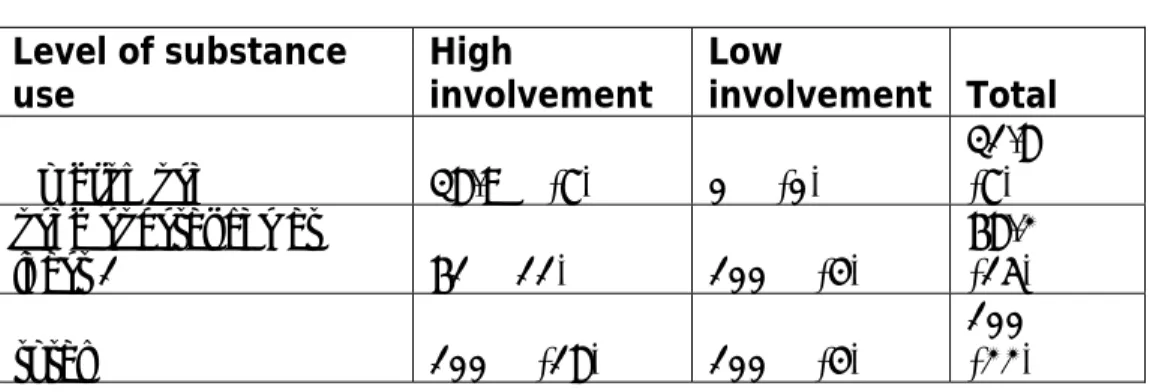
In terms of substance use, among youth who reported that they were recognized for participating in clubs and activities at Aserese-Matters either always or most of the time, 40% said that they had never used any substances, whereas 75% of those who reported being recognized for participating only about half of the time, sometimes or never, reported having used any substances in the past year (see table 7A). Thus these preliminary data also suggests that those who report being recognized for participating in the activities at Aserese-Matters are less likely to engage in delinquency, and even less likely to use substances.
TABLE 7A. Recognition/Rewards
Level of substance
use High involvement Low involvement Total
No drug use 40% (4) 25% (3) 31.8% (7) Used substances at
least 1 60% 6) 75% (9) 68.2% (15) total 100% (10) 100% (12) 100% (22)
DISCUSSION
In sum, the purpose of this research was to assess the effectiveness of an after-school program in preventing delinquency and substance use using the social development model (SDM) as a main guideline for data collection. Drawing most heavily from social control theory, the social development model asserts that bonds to pro-social others inhibits delinquency and problem behaviors. Specifically, the social development model identifies the three factors that are
essential in establishing social bonds: opportunities for involvement, skills for involvement, and reinforcement for the involvement (Catalano & Hawkins 1996; Hawkins et al. 1992; Hawkins and Lishner 1987; O’Donnell et at. 1995).
The main finding of this preliminary study is that adolescents who report having more opportunities at their after-school program also reported less involvement in delinquency, and even less involvement in substance use. These trends discussed in this study suggest that after-school programs, and
interactions with staff may play a role in the prevention of delinquency, and especially substance use.
However, it should be noted that this research study has a few limitations. First, while the findings are highly suggestive, the use of a small, convenient sample is case specific, and doesn’t allow us to generalize to the larger
population (Frazier 1978). In addition, because of the small sample, the use of multivariate analysis, which could control for other salient factors that could influence adolescent participation in delinquency and substance use, is precluded.
Second, another limitation of this study is that serious offenses, such as murder, forcible rape, and armed robbery, were not the focus of this study (See Hagan et al. 1990; Blackwell 2000). While this is indeed a limitation of this study, it is important to point out that given the infrequency of serious forms of
delinquency, in relation to common forms of delinquency, an assessment of more serious forms of delinquency would require either an exceptionally large sample, or a sample that was heavily stratified on the basis of known serious juvenile offenders.
Third, we still know little about the causal relationships posited by the SDM model, because this study, as well as others, has relied on cross-sectional, questionnaire or survey methodologies. Researchers have pointed out that cross-sectional, data are inappropriate for testing what are explicitly processes over time (see Messner and Krohn 1990). Thus, more detailed longitudinal and qualitative data on the effectiveness of after-school programs in preventing
delinquency and substance use are still needed.
In conclusion, future research is needed to assess and compare the types of after-school programs that are most effective in preventing delinquency and substance use. As Gottfredson et al. state:
After-school programs are diverse in their content and structure. Identifying the distinguishing characteristics of successful versus unsuccessful after-school programs may help guide research and practice as educators and
community leaders design programs intended to support pro-social development for youths at risk of delinquent behavior. (2007:292-293)
In particular, this type of comparative research could have implications for public policy makers, and help to determine which types of community centers are best at assisting adolescent children who face a wide variety of challenges and
influences in their everyday lives (Dimitriadis 2003; Gottfredson et al. 2007). However, given these limitations, the findings and recommendations of this preliminary study are best viewed as exploratory in nature.
Reference Akers, R.L.
1973. Deviant Behavior: A Social Learning Approach. CA: Wadsworth
Publishing Company, Inc.
1977. Deviant Behavior: A Social Learning Approach. 2nd Ed. Belmont, Calif.: Wadsworth.
Akers, R.L., Krohn, M.D, Lanza-Kaduce, L. & Redosevich, M.
1979. “Social learning and deviant
behavior: A specific test of a general theory.” Am. Sociol. Rev. 44: 636-655.
Akers, R. L., & Cochran, J.K.
1985. “Adolescent marijuana use: A test of three theories of deviant behavior.” Deviant Behavior 6: 323-346
Ayers, C.D., Williams, J.H., Hawkins, J.D., Peterson, P.L., Catalano, R.F, & Abbot, R.D. 1999. “Assessing correlates of onset,
escalation and resistance of delinquent behavior.” Journal of Quantitative Criminology 15: 277-307.
Bandura, A.
1973. Agression: A Social Learning Analysis, Englewood Cliffs, N.J.: Prentice Hall.
1977. “Self-efficacy: Toward a unifying theory of behavioral change.” Psychological Review 84: 191-215. Brown, C.E., Catalano, R.F., Fleming, C.B., Haggerty, K.P., Abbot, R.D., Cortes, R.R., & Park, J.
2005. “Mediator effects in the social development model: An examination
of the constituent theories.” Criminal Behavior and Mental Health. 15(4):221-235. Burgess R.L., & Akers, R.L. 1966. “A differential association-
reinforcement theory of criminal behavior.” Social Problems 4:128-147.
Catalano, R.F., Hawkins, J.D.
1996. The Social Development Model: A Theory of Anti-Social Behavior in J. David Hawkins (ed), Delinquency and Crime: Current Theories: New York: Cambridge University Press. Catalano, R.F, Kosterman, R., Hawkins, J.D., Newcomb, M.D., & Abbot, R.D.
1996. “Modeling the etiology of adolescent substance use: A test of the social development model.” Journal of Drug Issues: Empirical Validity of Theories of Drug Abuse 26: 429-455.
Catalano, R.F., Oxford, M.L., Hararchi, T.W., Abbott, R.D., & Haggerty, K.P.
1999. “A rest of the social development model to predict problem behavior during elementary school period.” Criminal Behavior Mental Health 9: 39-59
Conger, R.D.
1976. “Social control and social learning models of delinquent behavior: A synthesis.” Criminology 14: 17-40 1980. Juvenile Delinquency: Behavior
Restraint for Behavior Facilitation. In Hirschi, T. & Gottfredson, M. (eds.). Understanding Crime. Beverly Hills, Calif.: Sage.
Cressey, D.B.
1953. Other People’s Money. New York: The Free Press.
Dimitriadis, G.
2003. Friendship, Cliques, and Gangs: Young Black Men Coming of Age in Urban America. New York: Teachers College Press. Elliot, D.S., Huizinga, D., & Ageton, S. 1985. Explaining Delinquency and Drug
Use. Beverly Hills, Calif.: Sage. Gottfredson, D.C., Cross A., and Soule D.A. 2007. Distinguishing Characteristics of
Effective and Ineffective After-school Programs to Prevent Delinquency and Victimization. Criminology & Public Policy 6 (2): 289-318.
Gottfredson, D.C., Gottfredson, G.D., & Weisman S.A.
2001. “The timing of delinquent behavior and its implications for asps.” Criminology & Public Policy 1: 61-80.
Hawkins, J.D., Catalano, R.F., & Miller, J.Y. 1992. Risk and Protective Factors for
Alcohol and Other Drug Problems in Adolescence and Early Adulthood: Implications for Substance Abuse Prevention. Psychological Bulletin
112, 64,105.
Hawkins, J.D., & Weis, J.G.
1985. “The social development model: An integrated approach to delinquency prevention.” Journal of Primary Prevention 6: 73-97.
Hawkins, J.D., & Lishner, D.
1987. Etiology and Prevention of Anti-social Behavior in Children and
Adolescents. In D.H Crowell, I.M. Evans, and C.R., O’Donnell (eds), Childhood Aggression and Violence: Sources of Influence Prevention and Control (pp. 263-282). New York: Plenum.
Herrenkohl, T. I., Huang, B., Kosterman, R., Hawkins, J.D., Catalano, R.F., & Smith, B.H. 2001. “A comparison of the social
development processes leading to violent behavior in late adolescence for childhood initiators and
adolescent initiators of violence.” J. Res. Crime Delinq. 38: 45-63. Hirschi, T.
1969. Causes of Delinquency. Berkeley: University of California press. Huang, B., Kosterman, R., Catalano, J.D., Hawkins, J.D, & Abbott, D.R.
2001. “Modeling mediation in the etiology of violent behavior in adolescence: A test of the social development model.” Journal of Criminology 39(1): 75-107.
Krohn, M.D, & Massey, J.L.
1980. “Social control and delinquent behavior: An examination of the elements of the social bond.” Sociological Quarterly 21: 259-543. Lonczak, H.S., Huang, B., Catalano, R.F. Hawkins, J.D., Hill, K.G., Abbott, R.D., et al. 2001. “The social predictors of adolescent alcohol misuse: A test of the social development model.” J. Stud. Alcohol 62:179-189.
LoSciuto, L., Hilbert, S.M., Fox, M.M., Porcellini, L.L., Lanphear, A.
1999. “Youth development project.” Journal of Early Adolescence 19: 488-507.
Matsueda, R.l.
1982. “Testing control theory and differential association: A causal modeling approach.” American Sociological Review 47: 489-504. 1988. “The current state of differential
association theory.” Crime and Delinquency 34:277-306. Matza, D.
1969. Becoming Deviant. Englewood Cliffs, N.J.: Prentice Hall.
Messner, S.F, Marvin D.K., Liska A.E. 1989. Theoretical Integration in the Study
of Deviance and Crime: Problems and Prospects. Albany: State University of New York press.
O’Donnell, J., Hawkins, J.D., & Abbott, R.D.
1995. “Predicting serious delinquency and substance use among aggressive boys.” Journal of Consulting and Clinical Psychology 63: 529-537.
Osofsky, J.
1997. “Children and youth violence: An overview of the issues.” In J. Osofsky (Ed.), Children in a violent society (pp.3-8) New York: Guilford Press.
Roffman, J.G., Pagano, E. M., Hirsch, J.B.
2001. “Youth functioning and experiences in inner-city after-school programs among age, gender and race groups.” Journal of Child and Family Studies 10(4): 85-100.
Sickmund, M., Snyder, H., & Poe-Yamagata, E.
1997. Juvenile Offenders and Victims: 1996 Update on Violence.
Washington D.C.: Office of Juvenile Justice and Delinquency Prevention.
Schinke, P., Orlandi, M., Cole, K. 1992. “Boys and Girls Clubs in public
housing developments: Prevention services for youth at risk.” Journal of Community Psychology, OSAP special issue.
Smith, C., Kennedy, S.D.
1991. Final Impact Evaluation of the Friendly Peersuation Program for Girls Incorporated. New York: Girls Incorporated.
Snyder, H., Sickmund, M., & Poe-Yamagata, E.
1996. Juvenile Offenders and Victims: 1996 Update on Violence.
Washington D.C.: Office of Juvenile Justice and Delinquency Prevention. Sutherland, E. H.
1973. Development of the Theory (private paper published posthumously). In Karl, F. Schuessler (ed.), Edwin Sutherland on Analyzing Crime.
Chicago, Illinois: University of Chicago press.
Sutherland, E. H, Cressey, D.R.
1970. Criminology. 9th Ed. New York: Lippincott.
Task Force on Youth Development and Community Programs.
1992. A Matter of Time: Risk and Opportunity in the Non-school Hours. New York: Carnegie Corporation.
Weis, J. G., Hawkins, J.D.
1981. Preventing delinquency. National Center for Assessment of Delinquent Behavior and its Prevention and National Institute for Juvenile Justice and Delinquency Prevention (U.S). Washington, D.C.: US Department of Justice Office of Juvenile Justice and Delinquency Prevention, National Institute for Juvenile Justice and Delinquency Prevention.