Collaborative Project Governance and Scorecard Techniques for Successful Inter-firm Systems Integration
Klaus Niebecker & Eng Chew
University of Technology, Sydney, Australia
Abstract
Inter-firm systems integration (e.g. supply chain systems) is required to enable partnering firms to co-create products or services. Each firm has their own strategy and IT governance model for guiding their systems and project portfolio management. In a partnership of two or more companies, collaborative IT governance needs to assure that all firms are able to follow a common strategy and objectives, which are aligned with the individual strategies and goals. However, how can we measure the status of collaborative objectives and execute their alignment with individual strategies? For a successful inter-firm system integration project, the paper introduces a collaborative IT governance model based on the CobiT framework with an associated Collaborative Project Scorecard (CPS) concept to monitor the execution of the SI program more effectively. The paper also identifies relevant success criteria that improve the performance of inter-firm system integration by evaluating the results of a case study in the automotive industry.
Results of the research are derived from workshops, surveys, and interviews conducted at an OEM and supplier site in the USA where the CPS concept has been implemented. Based on these results and our experience with cross-company project organisations we extend the CobiT framework for improved collaborative project governance in accordance with the theory of the controlled-flexibility framework for virtual integration of a supply chain as an open system.
By adopting the CPS concept for an inter-firm system integration project, the transparency of the current project status is improved and advanced forecasting of the four scorecard perspectives is achieved by not only using lagging but also leading indicators. Indicators relevant to measure alignment and success criteria such as trust, responsiveness, or flexibility are identified and validated by a case example. Furthermore, it can be shown that certain criteria have a long-term impact on the performance of a strategic partnership.
The collaborative IT governance model provides guidance to the inter-firm system integration (SI) program and at the same time remains consistent with and integrates seamlessly with both firms’ internal IT governance models. The developed and proposed methodology goes beyond the borders of traditional inter-firm system management and enhances the performance of system integration by a concept that monitors and visualises the interdependency of common objectives and that creates trust among the team members. More case
Page 2 of 26 studies and research are required to further validate the proposed collaborative IT governance model and to identify additional criteria for performance improvement capabilities within collaborative project governance.
Keywords: IT governance, collaborative project management, collaborative project scorecard, Balanced Scorecard, inter-firm SI program, inter-firm system integration, collaborative project governance.
Page 3 of 26
1
IntroductionThe integration of systems across the border of organisations has become an essential part of today’s business environment. Due to increasing collaboration in product development and manufacturing, firms require access to information and data that goes beyond their conventional information technology (IT) systems. In the automotive industry, for example, the manufacturers and suppliers increasingly have to work together to stay competitive on the international market. Due to a difficult economic situation and high competition, the project structures have changed to a complex network where a significant part of the value creation moved towards a number of project partners (Niebecker, 2009). These suppliers were mainly independent but they had to form strategic alliances and partnerships to survive these developments. Therefore, decentralised and cross-company project management has become and will become more important in the product development of automotive projects (Kurek, 2004) and consequentially the support of these projects by IT solutions and project governance frameworks. In the past collaboration between manufacturers and suppliers created misunderstandings and severe conflicts as the power of several OEMs can lead to mistrust in the partnership. Different cultures need to be considered and bridged by open communication, fair negotiations and a commonly agreed framework that supports the definition of project goals. Relevant stakeholders are often not integrated in the process of project objectives definition or the tender documents. A common understanding of the product and its feasibility between the project partners differs frequently. Moreover, a common vision of the automobile project often does not exist (Pander and Wagner, 2005).
Under these circumstances project governance becomes a central discipline to increase the performance within networked project organisations. Cross-company projects need to be governed collaboratively and with a mutual understanding of the agreed governance principles, and therefore, collaborative project governance demands a framework that is supported by IT as “information technology has become crucial in the support, sustainability, and growth of the businesses. This persuasive use of technology has created a critical dependency on IT that calls for a specific focus on IT governance (Chew and Gottschalk, 2009, p. 315).” IT governance incorporates organisational structures, leadership and processes to ensure an organisation’s sustainability and the ability to extend its strategy and objectives (Grembergen, Haes, & Guldentops, 2004), so it has a strong impact on the benefits that are received from IT investments.
In a dynamic, uncertain, and fast changing environment such as supply chain management, flexibility is one of the major challenges to manufacturers (Wang
et al., 2006). Based on a controlled-flexibility framework of virtual supply chain integration, the CobiT framework (IT Governance Institute, 2007) can be applied to a cross-company project environment and associated with the Collaborative Project Scorecard (Niebecker, 2009) to improve communication, mutual goal
Page 4 of 26 understanding, and performance during the planning, monitoring and control phase of the projects. The objective of this paper is to demonstrate how the Collaborative Project Scorecard can support inter-firm project governance by being associated with an IT governance model based on the CobiT framework. In Section 1 the CobiT framework and the Collaborative Project Scorecard are briefly illustrated and relevant literature discussed. Section 2 proposes how the concept of the Collaborative Project Scorecard may interact with the CobiT framework for an inter-firm application, and Section 3 includes results of a case study in the automotive industry where a CPS was developed and implemented for the launch and change management of a collaborative project between an OEM and a major supplier. As a result, the need for an inter-firm system integration framework such as the inter-firm application of the CobiT framework is identified. In the conclusion (Section 4) the preliminary results are summarised and the next research steps required to fully specify and implement the inter-firm framework are discussed.
1.1 Strategy and controlled flexibility in cross-company project environments
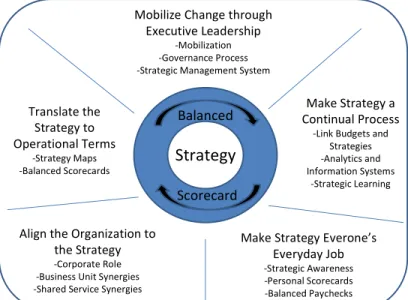
Kaplan and Norton (2001) identified that organisations have difficulties in implementing well-formulated strategies and that the execution of strategy is more important than the quality of the strategy itself. They demonstrated that the Balanced Scorecard can help organisations to overcome difficulties in executing their strategy and they defined five principles that characterise an organisation as strategy focused. They also argued that the Balanced Scorecard is a means to align and focus resources on strategy, such as the executive team, business units, human resources, information technology, and budgets as well as capital investments. The five principles of a strategy focused organisation are “translate the strategy to operational terms”, “align the organisation to the strategy”, “make strategy everyone’s everyday job”, “make strategy a continual process”, “mobilise change through executive leadership”, and are further described in Figure 1.
Page 5 of 26
Balanced
Strategy
Scorecard Mobilize Change through
Executive Leadership
-Mobilization -Governance Process -Strategic Management System
Make Strategy a Continual Process
-Link Budgets and Strategies -Analytics and Information Systems -Strategic Learning Translate the Strategy to Operational Terms -Strategy Maps -Balanced Scorecards
Align the Organization to the Strategy
-Corporate Role -Business Unit Synergies -Shared Service Synergies
Make Strategy Everone’s Everyday Job
-Strategic Awareness -Personal Scorecards -Balanced Paychecks
Figure 1: The principles of a strategy focused organisation (Kaplan and Norton, 2001, p. 9)
Based on Kaplan and Norton’s theory, a cross-company project environment faces a similar situation in defining a common strategy and the difficulty to translate the strategy in operational terms and to align their project objectives with the individual and collaborative business strategies. In a supply chain context, the need of a manufacturer to stay flexible in terms of product flexibility, volume flexibility, mix flexibility, launch flexibility and responsiveness to target markets becomes especially important in an environment of uncertainty. In an open system the manufacturer aims to manage uncertainty as an input from its environment as the environment has an impact on the company’s strategy (Wang et al, 2006).
According to Wang et al (2006, p.44), the “manufacturer can be viewed not only as a controlled system but also as an autonomous system, framing a dual control perspective”. By resisting or adapting to the threats from the environment, the manufacturer aims to increase its flexibility. However, the supply chain tries to eliminate environmental disturbances to “create new orders” and is, therefore, an autonomous system. Figure 2 shows the controlled-flexibility framework of a supply chain.
Page 6 of 26 Figure 2: Controlled-flexibility framework of a supply chain
(Wang et al, 2006, p. 45)
In the context of the controlled-flexibility framework, virtual integration is defined by the extent to which two project partners use IT to implement two key aspects of vertical coordination and control in the supply chain (collaborative operation execution and collaborative process planning and control (Morash and Clinton, 1998). Collaborative operation execution implies how IT can support operations between two partners in a supply chain, for example, in purchasing, logistics, manufacturing, development, or research. Collaborative process planning and control refers to the extent how IT facilitates collaborative performance control and decision making. Wang et al (2006) argue that with improved control and feedback mechanisms that are implemented by IT, the project partners can achieve greater inter-firm collaboration. Therefore, virtual integration enhances process control and the manageability of demand volatility and is a strategic approach to control the impact of environmental uncertainty by inter-firm coordination, control and information processing.
1.2 IT governance and the CobiT framework
The IT governance standard ISO 38500 is a guide to improve the effectiveness, efficiency, and acceptable use of IT with respect to management and decision processes by relating information and communication services used by an organisation. The Calder-Moir framework provides information how existing IT frameworks, standards, and best practice guidance of the ISO 38500 can be used most effectively. It categorises these standards and frameworks according to their applicability. Whereas the Balanced Scorecard can be used for performance improvements in IT strategy, business strategy, and risk, conformance and compliance, the CobiT framework has a focus on operations (business operations, IT operations, and IT asset management). Therefore, the association of the Balanced Scorecard and CobiT framework becomes essential to monitor and control the execution of strategies during operation.
Page 7 of 26 1.2.1 Introduction to the CobiT IT governance framework
The CobiT framework supports the enterprise in taking advantage of its information and facilitates maximising its benefits and gaining competitive advantage by linking business goals to IT goals providing metrics and maturity models to measure the progress and status of the objectives. The CobiT framework aims to provide information so that the firm can achieve its objectives. It also helps to identify the relevant key performance indicators to be able to make decisions on value, risk and control quickly and focuses on strategic alignment, value delivery, resource management, risk management, and performance measurement.
Performance measurement in the context of monitoring strategy implementation, project completion, resource usage, process performance and service delivery is typically executed using a Balanced Scorecard. The CobiT products consist of three levels to support executive management and boards, business and IT management, and governance, assurance, control and security professions. The components of the CobiT interrelate in such a way that business goals can be achieved with the support of IT. IT goals are aligned with business objectives by providing correct information to the business. On the other hand, the business goals must be clearly translated into the relevant IT process requirements.
1.2.2 Achieving enterprise strategy through IT
The CobiT framework gives advice how an enterprise can execute its strategy by translating it into business goals for IT and how to create enterprise architecture for IT with the support of IT scorecards. For an inter-firm system integration project, this is where the collaborative project scorecard application comes into effect. The enterprise strategy is translated by the business department into objectives that enable IT to define business goals or initiatives for IT that clearly lead to a definition of individual IT objectives. On the basis of these objectives IT can define resources and capabilities, which are part of the enterprise architecture for IT and required to execute the enterprise IT strategy. Monitoring of the aligned goals is essential for the success and is usually achieved by using metrics defined in an IT scorecard. Figure 3 illustrates the process that describes the steps to achieve enterprise strategy according to the CobiT framework.
Page 8 of 26 Figure 3: Defining IT Goals and Enterprise Architecture for IT (Source: CobiT) Four domains are part of the CobiT process model that define IT activities generically. They are “plan and organise” that provides direction to solution delivery and service delivery, “acquire and implement” that provides solutions and passes them to be turned into services, “deliver and support” that receives solutions and makes them useable for end users, and “monitor and evaluate” that monitors all relevant processes and ensures that the direction given is pursued. In the following, this paper focuses on the domains “plan and organise” and “monitor and evaluate” as the application of the project scorecard has its greatest performance impact on these project phases (Niebecker, 2009). Using leading indicators in a project scorecard (or IT project scorecard) supports the detection of problems before they occur or before it is too late to take efficient corrective action. It needs also to be assured that IT performance can be linked back to the original defined business goals, and that confidentiality and integrity are adequately chosen to maintain information security within the organisation. The CobiT framework defines 34 IT processes that are linked to the business and IT goals.
1.3 The Collaborative Project Scorecard
A recent study in the automotive industry lead to the conclusion that a strategic scorecard method based on the Balanced Scorecard concept by Kaplan and Norton is capable to improve cross-company project management and reduce existing difficulties in typical product development collaboration, such as communication or collaborative risk management (Niebecker, 2009). A common definition of project goals, leading and lagging indicators to measure the status, and defining corrective action are core elements of the Collaborative Project Scorecard concept. The concept is derived from business strategies for an improved alignment of project goals with business objectives. A project impact analysis facilitates the development of project strategy maps to increase transparency of goal impact
Page 9 of 26 interdependencies. An IT implementation is likely to improve the sustainability of the CPS concept and it may increase the user friendliness by providing a transparent platform that enables the user to quickly access relevant and actual information and data. This reduces the effort to exchange multiple documents by e-mail. The following sections give an overview of the CPS methodology and previous research results.
1.3.1 Fundamentals of the Collaborative Project Scorecard
The Balanced Scorecard (BSC) (Kaplan and Norton, 1996) was developed as a business management system that aligns vision and strategies with operational goals. Business goals are categorised into four perspectives: financial, customer, internal, and learning and growth perspective. Each perspective includes objectives, measures, targets, and initiatives that translate a company’s vision and strategy into action (Kaplan and Norton, 1996). The implementation of strategies and business goals is often realised by initiatives or projects on a multi or single project management level. For example, it was demonstrated that the monitoring and control of project strategies and goals with a Project Scorecard (PSC) on the basis of the Balanced Scorecard framework can improve performance of project teams (Norrie and Walker, 2004).
A recent study (Horvath and Partners, 2005) investigated experience and satisfaction with the Balanced Scorecard concept in 120 companies in Germany, Austria, and Switzerland. According to this study, the BSC has a positive impact on turnover and results, as well as on various non-financial measures such as quality and customer satisfaction. Moreover, the study found that a firm’s competence in
implementing the strategies was considered key for its commercial success..
Traditionally, the primary function of scorecards, “cockpits”, “dashboards” and “traffic lights”, has been to provide a means for succinctly presenting data related to project time, budget and quality. It is generally thought that such scorecards are in some cases suitable for performance evaluation that focuses on financial performance indicators. Norrie and Walker (2004) is one of several studies that explore the application of the Balanced Scorecard approach for project teams to monitor operational performance. They conclude that management performance can be improved by monitoring and controlling project activities more effectively, and suggested that the Balanced Scorecard can improve project management effectiveness. One reason for this is that it is thought that the BSC can facilitate communication between internal and external project stakeholders. Norrie (2006) further investigates the BSC approach for strategic project selection, and finds that using a strategic scoring approach can enhance management’s understanding of a project portfolio, and improve their ability to optimising a project portfolio. Stewart and Mohamed (2001) study the Balanced Scorecard for information technology (IT) and information system (IS) performance evaluation in the construction industry, and conclude that the BSC framework is useful to for evaluate IT performance. Stewart et al. (2007) apply the same model, and find that “firms which provide reliable IT-systems that are well-supported and user-friendly will achieve higher IT-induced performance improvement in the operational,
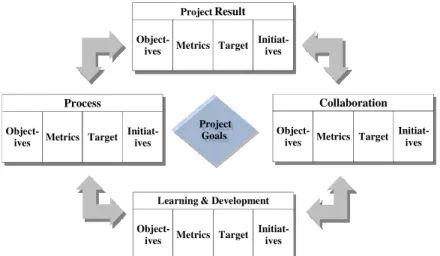
Page 10 of 26 strategic competitiveness and benefits perspectives” (p. 517). Horvath (2003) notes that, at that time, the BSC had been applied only to single organisation. He discusses the potential for the application of the BSC to distributed organisations, and suggests that alterations to the BSC are required if it is to be applied to a collaborative network or organisations. It was proposed that a new form of scorecard intended for cross-company teams might focus not only on processes and results, but also on collaboration and collaborative learning, innovation and development. The result was the Collaborative Project Scorecard (CPS) (Niebecker
et al, 2008a). Figure 4 shows how considerations emphasising learning and collaborative aspects were included in the CPS.
Project Result
Object-ives Metrics Target
Initiat-ives
Collaboration
Object-ives Metrics Target
Initiat-ives Process
Object-ives Metrics Target
Initiat-ives
Learning & Development
Object-ives Metrics Target
Initiat-ives Project
Goals
Figure 4: The Collaborative Project Scorecard (Niebecker et al., 2008a) The incorporation of non-financial collaboration-related measures such as team learning, satisfaction and trust enables the project leaders of a collaborative undertaking to manage short- and long-term team dynamics factors not only during the current project but also in future projects.
One of the challenges is to align a CPS with each company’s strategies. This can be especially problematic, given that some companies have “private” strategies that differ from the strategies that are released to the public. One model for handling this is that team members in each company may individually draw from their own company’s higher level goals or “business scorecards” in the drafting of “shared” project goals. However, the collaborative project team, as a team, has the primary responsibility for arriving at the CPS. In this way, the CPS draws from, but stands independently of, each company’s individual goals, as shown in Figure 5.
Page 11 of 26 Figure 5: The CPS may reflect, but stand independently of, the goals of each
company (Niebecker et al., 2008b, p. 2).
1.3.2 Impact matrix and strategy maps
To describe the strategy of a business, a strategy map facilitates the visualisation of the cause and effect relationships between business objectives (Kaplan and Norton, 1996). To identify and illustrate these relationships of a project, the concept of a strategy map can be modified and, e.g., applied to a product development project. The project strategy map (PSM) is an important element of the strategic management of organisations and projects, and the measurement of historical performance and future prospects based on leading and lagging indicators for all functional areas is required for an “alignment of all parts of the organisation” (Durrani et al., 2000, p. 120). These indicators can be categorised as controllable, uncontrollable, active, and passive variables (Raschke, 2007).
A useful method is the impact matrix analysis and uses a two dimensional matrix that includes all key performance indicators (KPIs) horizontally and vertically. A number from a scale of 0 to 3 describes whether a certain KPI has no (0) impact or strong (3) influence on another KPI. The vertical sum of the numbers describes a KPI activity by an active sum, whereas the passivity can be described horizontally by a passive sum. The product of the active sum (AS) and passive sum (PS) is P (P=ASxPS), whereas Q is the quotient of the two sums times hundred (Q=ASx100/PS). KPIs with high values of Q are active variables that have great impact on other variables. At the same time those variables are barely impacted by other KPIs. KPIs on the other hand with low values of Q are rather success variables as they cannot be controlled efficiently and are of passive character. KPIs with high values of P are critical variables as they strongly influence but are also strongly controlled by other KPIs. An impact matrix relates each project variable or performance indicator with the other variables in regard to its impact intensity on those variables (Niebecker et al., 2008a).
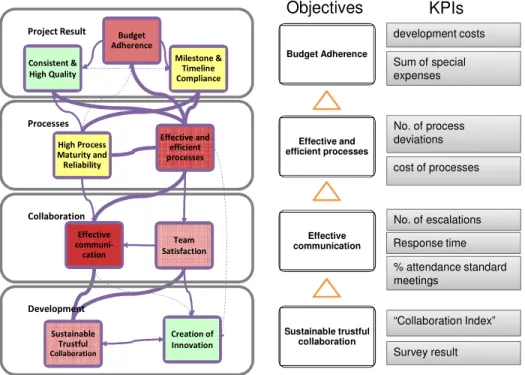
Page 12 of 26 In a collaborative or inter-firm project the strategy map can be developed based on a collaborative project impact matrix (CPIM) that uses the framework and perspectives of a CPS. The result is a collaborative project strategy map (CPSM) that visualises the relevant interdependencies of common and shared goals. The CPSM is a graphical representation of the CPIM. An example of a CPSM is shown in Error! Reference source not found. 6.
Sustainable trustful collaboration Effective communication Effective and efficient processes Budget Adherence Objectives No. of escalations % attendance standard meetings “Collaboration Index” Survey result No. of process deviations KPIs cost of processes development costs Sum of special expenses Response time Development Project Result Collaboration Processes Team Satisfaction Sustainable Trustful Collaboration Consistent & High Quality Effective and efficient processes Effective communi-cation High Process Maturity and Reliability Milestone & Timeline Compliance Budget Adherence Creation of Innovation
Figure 6: Example of a collaborative project strategy map (Niebecker, 2009) Similar to the project impact matrix the CPIM consists of indicators with respect to their perspectives. The project strategy map is an important element of the strategic management of organisations and projects, and the measurement of historical performance and future prospects based on leading and lagging indicators for all functional areas is required for an “alignment of all parts of the organisation” (Durrani et al., 2000, p. 120). These indicators can be categorised as controllable, uncontrollable, active, and passive variables (Raschke, 2007). The first step to build the strategy map is to define the drivers based on at least two or more KPIs. Interdependencies of the KPIs are then evaluated with the impact matrix analysis. As an example, the driver “employee satisfaction” may be controlled by the “rate of employee fluctuation” and “overtime”, whereas the “rate of employee fluctuation” also influences the driver “customer satisfaction”. Leading and lagging indicators can be identified by evaluating their interdependencies.
Page 13 of 26
2
Inter-firm IT governance using the Balanced Scorecard
The support of IT governance with a Balanced Scorecard has become a common practice within enterprises and with the development of the Collaborative Project Scorecard together with the increasing demand to integrate IT systems across the border of enterprises (inter-firm SI), there is an increasing demand to adapt conventional IT governance frameworks to enable efficient and effective inter-firm operations. This section illustrates how the CPS can be associated with the CobiT framework for inter-firm system integration.
2.1 The CPS and the inter-firm CobiT framework application
For an inter-firm application of the CobiT framework, several aspects of the principles have to be adapted and applied to a cross-company approach of the processes. However, there is no need to change the core of the framework as enterprise strategy is still achieved using the same process steps. In an inter-firm context, the enterprise strategy becomes a collaborative strategy of the involved firms with a common vision for short and long term strategic objectives. The four domains “plan and organise”, “acquire and implement”, “deliver and support”, and “monitor and evaluate” become part of a common process with distributed resources and clearly defined responsibilities. When developing an IT scorecard (refer to Figure 3 in Section 1) to monitor and control the execution of a joint initiative or project, the Collaborative Project Scorecard can support the partners to achieve their short and long term objectives and so their collaborative strategies.
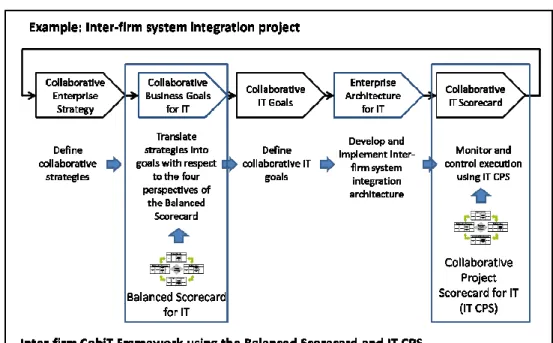
When executing the inter-firm CobiT framework, careful consideration has to be taken when it comes to the exchange of sensitive information that may have an impact on intellectual property. Although, the future of innovation lies in collaborative research and innovation creation (Hofmann et al., 2007), the aspects of property rights or information protection need to be clearly discussed in advance. Collaborative business or IT goals are only a shared part of the individual goals of each firm and when designing the enterprise architecture for system integration, it has to be assured that only data and information relevant to the inter-firm project team can be accessed by pre-defined users with a specific role. It is essential that the partner firms identify a collaborative enterprise strategy to enable the identification of collaborative business goals for IT. These can then be translated into collaborative IT goals that are relevant for a successful development and implementation of an inter-firm system integration architecture, which can be monitored and controlled using an IT CPS. Figure 7 shows the modified steps towards a successful inter-firm system integration project as an example.
Page 14 of 26 Figure 7: Process steps according to proposed inter-firm CobiT Framework In an inter-firm system integration project, the partners can operate by creating an inter-firm CobiT framework. Their individual IT governance and project governance framework (e.g., CobiT) can be associated with a Collaborative Project IT Scorecard (IT CPS). If both partners use a CobiT framework for IT governance and follow the process steps in Figure 7, the inter-firm CobiT framework is developed and monitored and controlled on a project level by the IT CPS. Figure 8 illustrates the organisational integration of the inter-firm CobiT framework.
Figure 8: A proposed inter-firm system integration framework derived from the inter-firm CobiT framework.
The next section shows how a CPS was developed and implemented between an automotive OEM and one of his major suppliers for a chosen collaborative project. The case study identifies the need for an inter-firm system integration framework such as shown in Figure 8 above.
Page 15 of 26
3
Automotive case study (OEM-supplier project)
A case study at an OEM site in the USA was chosen to evaluate previous results regarding the application of the CPS from workshops in Germany and several surveys that were sent to automotive OEMs and suppliers in the US, Germany and Japan. The CPS was developed and implemented within the scope of an OEM-supplier research project. The use case of the CPS had a focus on the delivery of the wire harness for the BMW X3 in South Carolina during the launch and change management phase. An IT concept and a prototype of the enterprise architecture was designed, implemented and tested in cooperation with a global software developer in the US.
3.1 The CPS for automotive supply chain management
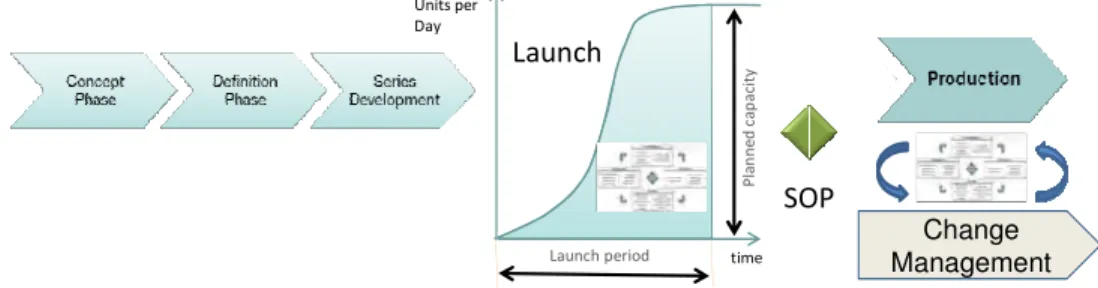
The development of the CPS takes place in the concept and definition phase where project objectives and measures are defined for the subsequent phases. As objectives differ significantly from phase to phase it was important to focus on one or two phases only to limit the scope of the case study. The series development of the wire harness was already in progress for the chosen vehicle project, therefore, the launch and production phase that includes a continuous change management were selected. Figure 9Error! Reference source not found. shows the launch management phase that starts after the series development and before the SOP. During the production phase a continuous change management is required that can be monitored and controlled with a CPS.
Units per Day
Launch period time
P la n ne d c a p a ci ty SOP Change Management Launch
Figure 9: Launch and change management phase
Considering the main logistic processes at the OEM plant in South Carolina, close collaboration with all involved project partners is a critical success factor of a failure-free and uninterrupted production of a series vehicle. Especially, for the launch of a new car, the challenge of an efficiently coordinated project requires advanced management tools. All relevant data and processes have to be clarified and have to be made transparent on each side of the project partnership.
During the launch phase the vehicles are built under series conditions. An important characteristic of this phase is the verification that all parts of the car can be produced, delivered, and assembled under the agreed conditions. The volume of parts in the determined quality delivered in the right time to the right place. A new
Page 16 of 26 product launch is especially critical if the following criteria of the planned production process features apply:
• New production plant, production facilities, tools, technologies, materials. • New developments, complex units.
• New production location, production re-location. • New processes, high-risk processes.
At the plant of the OEM the launch duration takes usually about three months. In this research project the launch period is defined as the timeframe between the first activities in the OEM production plant until the SOP. Typical tasks of the operational launch management are concentrated on the launch phase and include the development of an open points list (LOP), list of missing parts, quality reports, and daily management meetings. Strategic launch management is not limited to the launch period only but it deals with all activities in the run-up to the launch, which are necessary to call attention on deficiencies of the product maturity and includes the monitoring of the milestones adherence in particular.
The expectations of the OEM towards its supplier are:
• To achieve process capability and guarantee for all characteristics that affect customer requirements.
• To furnish proof that the manufacturing process is able to produce the required numbers at the required quality level with the planned staffing and machine capacities.
• Proof that the process chain is able to achieve the required quality.
Before the research project was initiated several interviews with managers from the supplier and OEM addressed the identification of typical difficulties and challenges during the launch process. Some of them are:
• Demand for continuous reduction of the launch time and timely and efficient communication.
• Synchronisation of the start-ups of production all over the supply network. • Scheduling variance and unpredictability for logistical planning.
• Quality variances and variance of planned and short-term demand. • Availability of parts and change management.
• Insecure production processes.
The geometry of the wire harness requires a continuous change management during the whole product life cycle. Each relocation of a component and module in particular in a vehicle results in an adjustment of the harness design. Most of the changes and requirements are made at the main branch of the OEM and also of the supplier in Germany. The situation of a global information exchange and material flow demands for advanced communication management and collaboration strategies to provide constantly consistent and actual data.
Page 17 of 26 3.1.1 CPS development process
In two individual workshops at the OEM and supplier’s site, project strategies and objectives were discussed and documented in a Strategic Project Scorecard and later in a Project Scorecard. This helped the project teams to be prepared for a common workshop with their partner firm. Common objectives should then be derived from their own defined project objectives. The workshops also helped to reflect upon the objectives the project partner may want to achieve and, therefore, reduced the risk that internal conflicts may arise on the day of the CPS workshop. The 13 representatives of both organisations originated from the departments of procurement, sales, quality, logistics, and management. The positions of the associates were from the functions of management (42%), project management (25%), and indirect functions (33%). The average number of years of experience in project management was 5.4 years. The representatives of both companies came to the workshop with an understanding of their own company strategy and with their particular collaboration tactic in mind. Given the strategies of both companies, it was possible to identify similar principles and a collaborative vision:
“Along with our partner, we want to cultivate a trustful relationship to collaboratively adapt our value creation network to market demands efficiently, sustainably and with utmost flexibility for an enduring economic success and, therefore, for an increased customer value”.
The vision represents the strategic core of the project partnership and all project objectives should address the core. Based on the commonly defined vision, the typical goals in a collaborative project were identified and categorised according to the strategic collaborative scorecard structure and perspectives (Error! Reference source not found. 10).
Page 18 of 26 Figure 10: The strategic collaborative scorecard
The results of the launch management CPS are shown in the appendix.
3.1.2 CPS success criteria and limitations
The following conclusion of the case study is based on the interviews and statements of the project members after the workshop.
Generally, the CPS supports the creation of mutual trust within the partnership and creates transparency with respect to agreements on objectives, responsibilities, processes, the actual performance and the success of collaboration. Therefore, it contributes to the avoidance and reduction of complexity in the project environment. It can serve as the basis for an incentive system and for an enhanced supplier selection system on the basis of continuous benchmarking. It discloses cause and effect dependencies of common goals and uncovers conflicts of concurrent objectives in project partnerships. The CPS also provides a forecasting solution through its related tools, e.g. the Project Impact Matrix and Strategy Map. By understanding coherences of the goal related network, leading indicators can be identified. Their impact can be preventive in the future by initiating counter measures timely. The concept also reduces the risk of projects through an integrated countermeasure and risk management and serves as basis for a cross-company and continuous improvement process.
The CPS concept quantifies the subjective perception of a mature and trustful collaboration and transforms it into measurable hard facts by supporting a holistic view over supplier selection. However, there is resistance that needs to be overcome. The introduction of a new collaboration wide controlling system creates resistance not only within the cross-company team of an OEM but also within the
Page 19 of 26 project members of a supplier unwilling to apply the concept. The key to success is to convince upper management of both partners and to demonstrate that the benefits may be overshadowed by the limitations and efforts. Project members who are strongly involved with operational tasks often ignore the impact of a strategic tool. In the contrary, they consider a new strategic tool as mere additional effort until they understand its impact.
Benefits of the CPS methodology identified by project members of the OEM and supplier in the USA are that it opens up opportunities for collaboration improvements and aligns the whole team to the agreed common goals. It improves communication between the OEM and supplier, and the clarification of dependencies between goals facilitates the identification of cost lead factors. That holds team members accountable to their cost targets. Defining common goals could avoid mistakes and unnecessary tasks. On the other hand, it is difficult to find KPIs for what we do and to translate soft facts in measurable hard facts. The installation and maintenance of an IT system could be difficult and the training of project members to use and maintain the new system leads to additional effort. Key to success will be a regular ongoing review of agreed goals, measures and corrective action.
3.2 Inter-firm system integration using the CPS
The enterprise system architecture that supports the inter-firm CobiT framework and CPS application for supply chain management should provide a collaboration platform that is connected with all suppliers involved in the project and that is capable to send and receive project relevant data and information. Consequently, the concept had to be implemented on a server-based computer system. To select an appropriate software tool, the first step was to identify the requirements based on the workshop results. The visualisation of project data with an IT solution is a common monitoring instrument but it can also enable the transfer of responsibility from top management to the project team.
3.2.1 Success criteria of inter-firm system integration with a CPS
A basic requirement of a software based CPS solution is its ability to connect to a consistent database that contains all data to evaluate the actual and future project status based on forecasts and trend analyses. Automated processes ensure the maintenance of the database and a connection of existing databases within the company is a prerequisite to provide an owner of a KPI with consistent and actual data.
The following requirements are relevant for a successful CPS system implementation:
• Visualisation of project data using scorecards and dashboards.
• Definition of KPIs that can be re-used in other scorecards and dashboards. • Connection to all other relevant data bases within the organisation (e.g.,
Page 20 of 26
• Visualisation of a Strategy Map based on project objectives defined in the scorecards.
• Definition of interdependencies between KPIs and objectives based on the Strategy Map.
• Definition of target values and corridors for each KPI. • Connecting multiple KPIs to one objective.
• Easy creation of charts and figures for project analysis.
• Illustration and calculation of forecasts based on trend analysis (e.g., milestone trend analysis, earned value method).
• Linking counter measures to KPIs and project objectives.
• Rights management: each user has different rights to access only user relevant data.
• Scalability of scorecards: creation of portfolio and program scorecards based on the company BSC and further creation of project scorecards aligned with portfolio scorecards.
• Reporting system that produces adjustable and scalable management reports and automated sending of these reports (e.g., by e-mail).
• Workflow capability.
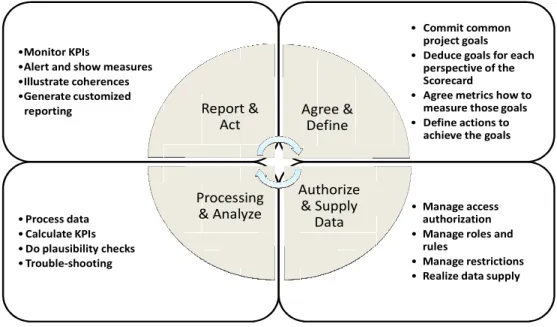
Figure 11 shows the requirements of the workflow capability.
•Process data •Calculate KPIs •Do plausibility checks •Trouble-shooting • Manage access authorization • Manage roles and
rules
• Manage restrictions • Realize data supply •Monitor KPIs
•Alert and show measures •Illustrate coherences •Generate customized
reporting
• Commit common
project goals • Deduce goals for each
perspective of the Scorecard
• Agree metrics how to measure those goals • Define actions to
achieve the goals
Report & Act Agree & Define Authorize & Supply Data Processing & Analyze
Figure 11: Workflow capacity requirements
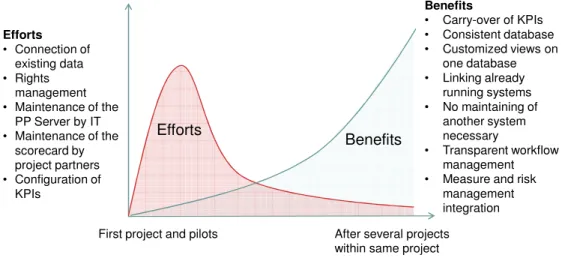
The CPS workshop participants rated the application of an IT implementation as beneficial and some even as a key to success. However, it is essential that the solution does not create overhead work and does not duplicate existing reporting and monitoring systems. Consequently, there is a challenge in the IT community to develop a tool that finds broad acceptance in daily project management operations. There is a higher effort in the beginning of the implementation process as the connection to all databases needs to be established, rights management defined and KPIs created. Some long-term benefits are the possibility to carry-over KPIs
Page 21 of 26 and rely on consistent databases as well as a transparent workflow management. The efforts and benefits are shown in Figure 12 and based on the experience and appraisal of the workshop members.
Efforts • Connection of existing data • Rights management • Maintenance of the PP Server by IT • Maintenance of the scorecard by project partners • Configuration of KPIs Benefits • Carry-over of KPIs • Consistent database • Customized views on one database • Linking already running systems • No maintaining of another system necessary • Transparent workflow management • Measure and risk
management integration Efforts
Benefits
First project and pilots After several projects
within same project partnership
Figure 12: Efforts and benefits of inter-firm system integration using a CPS 3.2.2 The need for an inter-firm supply chain SI framework
The automotive case study has shown the complexity of an inter-firm supply chain SI project and identified benefits and limitations of a CPS application. As each firm typically adopts individual processes difficulties arise when these firms have to integrate their systems for collaborative projects or strategic alliances. A critical problem during the system implementation is a lack of clear responsibilities and ownership of the IT processes. A fully specified framework such as the inter-firm CobiT framework associated with the CPS could have given guidance to the assignment of these responsibilities. When it came to the definition and establishment of IT security, concerns arose from an unclear understanding of the IT process map as this was only partially available. Additionally, there were misunderstandings derived from a missing common language. These difficulties can be reduced by providing a platform for both partners that clarifies responsibilities, language, and a benchmarking of the established IT processes. The development and implementation of an IT solution would have also benefited from a predefined process map that clearly describes the common workflow processes to ensure efficient and secure information exchange, for example, regarding to reporting and performance assessment. The inter-firm CobiT framework also provides support to achieve an agreement on common strategies enabled by IT and the subsequent steps of defining IT goals and an enterprise architecture for IT that uses an IT CPS for monitoring and control of the collaborative IT goals (as shown in Figure 7).
The inter-firm CobiT framework would also support the objectives for a tighter supply chain collaboration identified by Wang (2006) with respect to IT-enabled supply chain management excellence. With commonly agreed methods and processes for an inter-firm system integration program, the collaboration
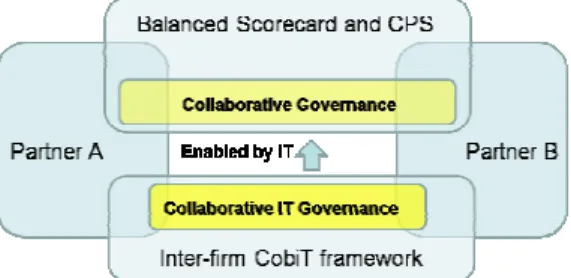
Page 22 of 26 flexibility and supplier responsiveness is likely to be improved as virtual integration enables the firms to substitute ownership with partnership and support a tighter collaborative operation execution and process planning and control. Supported by IT, this allows operations in more uncertain environments with higher responsiveness, flexibility and resulting cost advantages within the controlled-flexibility framework as shown in Figure 2. Based on the results of the automotive case study and Wang’s (2006) research, the inter-firm CobiT framework aims to improve the performance of supply chain management and its correspondent governance and project governance by supporting the relevant collaborative methods and processes with an IT framework (as shown in the following figure and based on Figure 8).
Figure 13: Improving supply chain excellence by collaborative IT governance Not only OEM-supplier projects need to find more efficient and effective ways to improve the performance of the supply chain but also in other partnerships such as joint ventures or acquisition projects such as recently found in the airline industry when complex information systems need to be integrated (e.g., Lufthansa and Austrian Airlines). A common framework such as the proposed framework (Figure 8) may support the firms to manage their SI program more efficiently. Recent activities in the automotive industry have also identified the demand for frameworks supporting inter-firm system integration. The ProSTEP iViP Association in Germany, for example, has developed a reference model together with several OEMS, suppliers, system vendors, and Universities that provides a framework for communication, task, and time management (ProSTEP iViP, 2007a). Next to the reference model, the project group developed a data exchange model that defines the data objects that can be used to exchange project management information between different project management systems related to the reference model (Prostep iViP, 2007b). However, it is important that firms do not radically need to adopt entirely new frameworks in a collaborative supply chain project or partnership as this implies high efforts and the handling of resistance to change. One of the reasons why the inter-firm application of the CobiT framework is likely to be accepted is that it is already well-known and widely adopted on an international level (IT Governance Institute, 2009). The application of and association with the CPS is a first step that enables organisations to achieve common objectives and align their enterprise strategies with both firms goals.
4
Conclusion
Inter-firm IT governance frameworks support firms to efficiently manage their cross-company operations by establishing commonly agreed processes that contribute to a mutual understanding of project objectives and their alignment
Page 23 of 26 with each firm’s strategy. In this paper we propose an inter-firm application of the CobiT framework associated with a Collaborative Scorecard that focuses on the monitoring and control of the execution of the successful achievement of IT goals.
The CPS has been conceptually developed and implemented through an automotive case study. This has been a developmental process that leads to the identification of the need for framework supporting supply chain SI programs. This need is justified by the difficulties that came up during the implementation of the IT solution within the automotive case study and the results of Wang’s research on virtual integration theory (Wang et al., 2006). Section 3.2.2 addresses the demand for an firm SI framework and its requirements. The paper proposes an inter-firm CobiT framework that is associated with a CPS. Main aspects are that the inter-firm CobiT framework provides guidance on a clear definition and assignment of responsibilities and ownership of the IT processes and their benchmarking. It also reduces misunderstandings by defining a common language and it supports the alignment of enterprise strategies with IT goals both firms as shown in Figure 7. The capability of the framework to virtually integrate partners increases their manufacturing flexibility by creating a platform that is able to substitute ownership with partnership and that has a cost advantage impact on the supply chain by an increased supplier responsiveness.
Additionally, the concept aims to ensure strategic alignment with the objectives of each firm. However, to fully specify and implement the inter-firm framework, case studies and further research is necessary for an entire understanding and evaluation of its impact on inter-firm supply chain management performance.
References
Chew E. K and Gottschalk, P. (2009), “Information Technology Strategy and Management: Best Practices”, IGI Global Publishing, Hershey, PA.
Durrani, T., Forbes, S. and Carrie, A. (2000), ”Extending the balanced scorecard for technology strategy development. Engineering Management Society”, Proceedings of the 2000 IEEE, pp. 120-125.
Grembergen, W. V., Haes, S. D., and Guldentops, E., (2004), “Structures, processes and relational mechanisms for IT governance.” In W. V. Grembergen (Ed.) Strategies for information technology governance (pp 1-36). Idea Group Publishing, Hershey, PA.
Hofmann, J., Rollwagen, I. and Schneider, S. (2007), “Deutschland im Jahr 2020 – Neue Herausforderungen für ein Land auf Expedition“, Aktuelle Themen 382, Deutsche Bank Research, Frankfurt.
Page 24 of 26 Horvath, P. (2003), “X-Engineering – Ohne Balanced Scorcard und Performance Measurement nicht wirksam”, Controlling, Edition 07/08 2003, Verlage C.H. Beck, Vahlen, Germany.
IT Governance Institute (2007), “CobiT 4.1 Excerpt”, IT Governance Institute, USA (http://www.isaca.org).
Kaplan, R. and Norton, D. (1996), “Translating strategy into action: the balanced scorecard”, Boston, Massachusetts, USA, Harvard Business School Press.
Kaplan, R. and Norton, D. (2001), “The strategy focused organisation – how balanced scorecard companies thrive in the new business environment”, Harvard Business School Press, Boston, USA.
Kurek, R. (2004), “Erfolgsstrategien für Automobilzulieferer – Wirksames Management in einem dynamischen Umfeld“, Berlin, Springer.
Morash, E. and Clinton, S. (1998), “Supply chain integration: customer value through collaborative closeness versus operational excellence”, Journal of Marketing Theory and Practice, vol. 6, no. 4, pp.104-120.
Niebecker, K., Eager, D. and Kubitza, K. (2008a), “Improving cross-company project management performance with a collaborative project scorecard”, International Journal of Managing Projects in Business, Emerald Group Publishing Limited, vol. 1, no. 3, p. 368-386.
Niebecker K., Eager, D., Wagner, R. and Kubitza, K. (2008b), “Efficient project management and performance assessment of cross-company projects with a collaborative project scorecard, Proceedings of the IPMA World Congress, 9th-12th November 2008, International Project Management Association, Rome, Italy. Niebecker, K. (2009), “Collaborative and cross-company project management within the automotive industry using the Balanced Scorecard”, PhD thesis, Faculty of Engineering and IT, University of Technology, Sydney.
Norrie, J. and Walker, D. (2004), “A balanced scorecard approach to project management leadership”, Project Management Journal, PMI, vol. 35 no. 4, pp. 47-56.
Pander, S. and Wagner R. (2005), “Unternehmensübergreifende Zusammenarbeit in der Automobilentwicklung – durch erfahrungsgeleitete Kooperation die Grenzen der Planbarkeit überwinden“, Mering, Rainer Hampp Verlag.
ProSTEP iViP (2007a), “Collaborative project management reference model”, PSI 1-1 Version 2.0, Darmstadt, ProSTEP iViP Association (http://www.prostep.org). ProSTEP iViP (2007b), ”Recommendation data exchange Model”, PSI 1-2 Version 1.0, Darmstadt, ProSTEP iViP Association (http://www.prostep.org).
Page 25 of 26 Raschke, R. (2007), “Vernetztes Denken im Projektmanagement“, Projektmanagement Aktuell, Third Edition, Germany.
Stewart, R. (2007), “IT enhanced project information management in construction: Pathways to improved performance and strategic competitiveness”, Automation in Construction, vol. 16, pp. 511-517.
Stewart, R. and Mohamed, S. (2001), “Utilizing the balanced scorecard for IT/IS performance evaluation in construction”, Construction Innovation, vol. 1, pp. 147-163.
Wang, E., Tai, J., Wei, H. (2006), “A virtual integration theory of improved supply-chain performance”, Journal of Management Information Systems, vol. 23, no.2, pp. 41-64.
Appendix
Project ResultsObjectives Metrics Corrective Action
cost Avoidance total cost per unit per phase analysis of the root costs
< budget target Budget reports -
budget adherence tracking per launch phase
budget delta (part price, logistic costs, dev. costs, tooling costs)
-
series revenue PPMs, Customer Satisfaction no revenue profitability -
alternative processes
meet target volume on time number of late cars / total cars fish bone analysis
escalation rules ppm
complain reports high parts quality
warranty
quality escalation process Checkpoints (Quality)
Project results launch management CPS Collaborative Processes
Objectives Metrics Corrective Action
SE team for information sharing
start-up reporting; actual vs. planned against milestone
checklist
technical date at current level for launch process
Page 26 of 26 part availability by
milestone
part availability for project phase - responsibility matrix process documentation transparency of processes and interfaces
surveys (regular basis)
workshops revision tracking clear premises at project
start frequency of changes in premises GAMS effective and efficient
common processes
adherence to defined landscape regular review of processes/
effectiveness
checklists regular reviews
mutual common risk evaluation process
timeline -
Processes launch management CPS
Collaboration
Objectives Metrics Corrective Action
integration of demand schedules into SE Team meetings
weekly confirmation of latest demands
inclusion in SE Team Meeting Minutes
efficient communication percentage attendance escalation process
fast problem resolution number of overdue open points -
team satisfaction regular feedback/ surveys -
involvement in pilot production (transparency)
checklist travel to pilot location/
hands-on Collaboration launch management CPS
Learning & Development
Objectives Metrics Corrective Action
trustful collaboration quarterly survey escalation team workshop
technical releases complete before build phase
number of releases by deadline -
100% virtual development prior to plant activities
-
synchronisation timeline (incl. supplier)
latest synchronisation run incentive plan, percentage of
Page 27 of 26
creation of innovation number of new ideas/
suggestions implemented
installation of a suggestion box
savings/ improvement benefits incentive program