Lawrence H. Goulder
Ian W. H. Parry
Roberton C. Williams III
Dallas Burtraw
Discussion Paper 98-22 March 1998 1616 P Street, NW Washington, DC 20036 Telephone 202-328-5000 Fax 202-939-3460© 1998 Resources for the Future. All rights reserved. No portion of this paper may be reproduced without permission of the authors.
Discussion papers are research materials circulated by their authors for purposes of information and discussion. They have not undergone formal peer review or the editorial treatment accorded RFF books and other publications.
Lawrence H. Goulder, Ian W. H. Parry, Roberton C. Williams III, and Dallas Burtraw
Abstract
This paper employs analytical and numerical general equilibrium models to examine the costs of achieving pollution reductions under a range of environmental policy instruments in a second-best setting with pre-existing factor taxes. We compare the costs and overall efficiency impacts of emissions taxes, emissions quotas, fuels taxes, performance standards, and mandated technologies, and explore how costs change with the magnitude of pre-existing taxes and the extent of pollution abatement.
We find that the presence of distortionary taxes raises the costs of pollution abatement under each instrument relative to its costs in a first-best world. This extra cost is an increasing function of the magnitude of pre-existing tax rates. For plausible values of pre-existing tax rates and other parameters, the cost increase for all policies is substantial (35 percent or more). The impact of pre-existing taxes is particularly large for non-auctioned emissions quotas: here the cost increase can be several hundred percent. Earlier work on instrument choice has emphasized the potential reduction in compliance cost achievable by converting fixed emissions quotas into tradable emissions permits. Our results indicate that the regulator's decision whether to auction or grandfather emissions rights can have equally important cost impacts. Similarly, the choice as to how to recycle revenues from environmentally motivated taxes (whether to return the revenues in lump-sum fashion or via cuts in marginal tax rates) can be as important to cost as the decision whether the tax takes the form of an emissions tax or fuel tax, particularly when modest emissions reductions are involved.
In both first- and second-best settings, the cost differences across instruments depend importantly on the extent of pollution abatement under consideration. Total abatement costs differ markedly at low levels of abatement. Strikingly, for all instruments except the fuel tax these costs converge to the same value as abatement levels approach 100 percent
Key Words: general equilibrium efficiency analysis, environmental instrument choice, second-best regulation
A. Model Assumptions ... 3
B. Emissions Tax ... 5
C. Emissions Quota ... 7
D. Fuel Tax ... 8
E. Command-and-Control Policies ... 9
F. The Cost Impact of Pre-Existing Taxes ... 10
1. Emissions Tax ... 11
2. Emissions Quota ... 12
3. Fuel Tax ... 12
4. Technology Mandate ... 12
5. Summary ... 13
3. The Numerical Model ... 13
A. Model Structure ... 14
1. Household Behavior ... 14
2. Firm Behavior ... 14
3. Government Policy ... 15
4. Equilibrium Conditions ... 16
B. Data and Parameters ... 16
4. Numerical Results ... 18
A. First-Best Costs ... 18
B. The Significance of Pre-Existing Taxes ... 20
C. Alternative Scenarios ... 22
D. Efficiency Impacts ... 23
E. Further Sensitivity Analysis ... 24
5. Conclusions ... 26
References ... 28
Appendix A ... 31
Appendix B ... 36
List of Tables and Figures
Table 1 Determinants of Primary Costs by Policy ... 6Table 2 Benchmarks Data for the Numerical Model ... 17
Table 3 Sensitivity Analysis ... 25
Figure 1 Determinants of Second-Best Effects ... 7
Lawrence H. Goulder, Ian W. H. Parry,
Roberton C. Williams III, and Dallas Burtraw1
1. INTRODUCTION
Environmental policy makers often must choose among alternative instruments for reducing emissions of pollution. A number of considerations affect this choice, including
administrative ease, the costs of monitoring and enforcement, the probability distribution of policy errors in the face of uncertainty, effects on the distribution of income, and political feasibility.2
In recent years another important consideration has emerged: namely, the implications of pre-existing distortionary taxes (such as income, payroll, and sales taxes) for the costs of pollution abatement under various instruments. The potential importance of pre-existing taxes to environmental policy has been suggested by recent analyses of environmentally-motivated taxes in a second-best setting. This work has shown that pre-existing factor (income) taxes tend to raise the costs of environmental tax initiatives, even when the revenues from environmental taxes are used to finance cuts in factor taxes.3 A related insight is that the optimal environmental tax rate in a second-best setting with distortionary taxes is typically lower than in a first-best world.4
Some recent studies have examined the implications of pre-existing taxes for the choice between environmental taxes and other environmental policy instruments.5 Parry (1997) has employed an analytical model to investigate the choice between pollution taxes and quotas in the presence of distortionary taxes. Goulder, Parry and Burtraw (1997) and Parry, Williams, and Goulder (1996) have used analytical and numerical general equilibrium
1 Lawrence H. Goulder, Stanford University, Resources for the Future, and NBER; Ian W. H. Parry, Energy and Natural Resources Division, Resources for the Future; Roberton C. Williams III, Stanford University; Dallas Burtraw, Quality of the Environment Division, Resources for the Future. The authors gratefully acknowledge helpful comments from Jesse David, Don Fullerton, Koshy Mathai, Robert Stavins, Michael Toman and participants in the August 1997 NBER Summer Institute Workshop on Public Policy and the Environment. We also thank the National Science Foundation (Grants SBR-9310362 and SBR-9613458) and Environmental Protection Agency (Grant R825313-01) for financial support.
2 An extensive literature examines how these considerations might influence instrument choice. See, for example, Hahn (1986), Nichols (1984), Stavins (1991), and Weitzman (1974).
3 See, for example, Bovenberg and de Mooij (1994), Parry (1995), Oates (1995), and Goulder (1995a, 1995b). 4 See, for example, Bovenberg and van der Ploeg (1994), Parry (1995), and Bovenberg and Goulder (1996). 5 Previously, Ballard and Medema (1993) examined instrument choice in a second-best setting, employing a numerical general equilibrium model to evaluate the efficiency impacts of pollution taxes and subsidies to pollution-abatement. They demonstrated that pollution taxes are generally more efficient than abatement subsidies. The difference is in part attributable to the pollution tax's ability to raise revenue that can be used to reduce marginal rates of existing taxes. This fiscal issue is reflected in the revenue-recycling effect discussed below.
models to explore this choice. These studies show that the presence of distortionary taxes raises the costs of both pollution taxes and pollution quotas, and raises the costs of (non-auctioned) quotas disproportionately. The latter two studies indicate that the extent to which pre-existing taxes put quotas at a disadvantage depends importantly on the extent of pollution abatement: at incremental amounts of abatement, the quota's relative disadvantage is largest, and at 100 percent abatement, its relative disadvantage disappears.
Two welfare effects underlie these results. By driving up the price of (polluting) goods relative to leisure, environmental taxes and quotas tend to compound the factor-market distortions created by pre-existing taxes, thereby producing a negative welfare impact termed the tax-interaction effect. At the same time, environmental taxes whose revenues are recycled through cuts in marginal tax rates reduce the distortions caused by the pre-existing taxes, which contributes to a positive welfare impact. This revenue-recycling effect partly offsets the tax-interaction effect. While both taxes and quotas produce the costly tax-interaction effect, (non-auctioned) quotas cannot exploit the revenue-recycling effect. These studies show that the quota's inability to exploit the revenue-recycling effect puts the quota policy at a disadvantage relative to environmental taxes. Indeed, the failure to enjoy the
revenue-recycling effect may reverse the sign of the overall efficiency impact (i.e., net benefits)!6 In this connection, Parry, Williams, and Goulder (1996) estimate that reducing carbon emissions through carbon quotas will be efficiency-reducing if the marginal environmental benefits from carbon abatement are below $25 per ton.
A recent paper by Fullerton and Metcalf (1997) expands the domain of instrument choice by considering not only taxes and quotas but also a "technology restriction" policy (that is, a policy that constrains the ratio of emissions to labor input).7 Using an analytical model that examines the impacts of initial, incremental pollution abatement, the authors find that incremental abatement involves zero cost under the technology restriction policy, but involves strictly positive costs under the pollution quota. Their paper relates the cost difference to scarcity rents -- the quota generates scarcity rents while the technology
restriction does not. This result is consistent with the fact that for incremental abatement, the pollution quota produces a sizeable (non-infinitesimal) tax-interaction effect, while the technology restriction does not.
The present paper builds on prior work by considering a wide range of alternative policy instruments and examining both incremental and large amounts of pollution abatement. Using a consistent analytical and numerical general equilibrium framework, we examine
6 Of course, new sources of revenues may be used in ways other than to cut marginal rates of existing taxes. They may be used, for example, to increase government spending, to finance lump-sum tax reductions or transfers, or to reduce the budget deficit. (For a public choice perspective on this see Becker and Mulligan, 1997.) These different methods of recycling the revenues can have very different efficiency consequences. In the case where emissions tax revenues are returned as lump-sum tax cuts, the revenue-recycling effect does not materialize and there is no offset to the tax-interaction effect.
7 They also consider a policy that subsidizes all goods in the economy other than a polluting good. In their model this is formally equivalent to a tax on the polluting good.
emissions taxes, emissions quotas, fuels taxes, performance standards, and mandated technologies. Our focus is on how the costs and overall efficiency impacts of the different instruments are affected by pre-existing taxes and the extent of pollution abatement. We abstract from some other considerations that may affect instrument choice, such as
heterogeneity in firms' abatement cost schedules and information problems faced by regulators. We find that the presence of distortionary taxes raises the costs of pollution abatement under each instrument relative to its costs in a first-best world. This extra cost is directly related to the magnitude of pre-existing tax rates, and for plausible pre-existing tax rates and parameters the cost increase is substantial (35 percent or more). The impact of pre-existing taxes is particularly large for (non-auctioned) emissions quotas, where the cost increase can be several hundred percent. The cost differences across instruments depend importantly on the extent of pollution abatement under consideration: while abatement costs differ
substantially at low levels of abatement, costs for all policies except the fuel tax converge to the same value as the level of abatement approaches 100 percent. We discuss the overall efficiency implications of these results under a range of scenarios for environmental benefits.
Our results have some important implications for policy. Economists have long argued that tradable emissions permits and emissions taxes are more cost-effective than performance standards, technology mandates, and other traditional forms of regulation (see, for example, Cropper and Oates, 1992). These arguments have had an important influence on policy making in recent years. For example, a (non-auctioned) tradable emissions program was implemented in 1990 to reduce sulfur emissions, and a similar program is being proposed to reduce U.S. carbon emissions. Our results suggest that tradable emissions permits will only produce substantial cost savings over performance standards or technology mandates if the permits are auctioned rather than given out free and the revenues used to cut other taxes.
The paper is organized as follows. Section 2 presents an analytical model that reveals the different efficiency impacts of the policy instruments. This model is extended in later sections to introduce more realism and gauge the empirical importance of these differences in efficiency. Section 3 presents the extended model, which is solved numerically. Section 4 provides results from simulations with the extended model. The final section offers conclusions.
2. THE ANALYTICAL MODEL
This section uses an analytical model to compare the gross costs of environmental policy instruments in the presence of distortionary taxes. Subsections A-E lay out the model assumptions and discuss the general equilibrium impacts of the different policy instruments. Subsection F examines the extent to which pre-existing tax distortions magnify the costs under the different policies.
A. Model Assumptions
We develop a static model in which a representative household enjoys utility from a polluting consumption good (X), a non-polluting consumption good (Y) and non-market time
or leisure. Leisure is equal to the household time endowment (L) less labor supply (L). Emissions (E) from producing X cause environmental damages in the form of reduced consumer utility. The household utility function is given by:
(
X,Y,L L)
(E)u
U = − −φ (2.1)
u(.) is utility from non-environmental goods and is quasi-concave. φ(.) is disutility from waste
emissions and is weakly convex. The separability restriction in (2.1) implies that the demands for X and Y and the supply of labor do not vary with changes in E.8
X and Y are produced by competitive firms using labor, which is the only factor of
production.9 We assume the marginal product of labor is constant in each industry, and
normalize output to imply marginal products (and a wage rate) of unity. This normalization implies that the unit cost of producing X or Y is unity.
Firms can reduce waste emissions per unit of output by utilizing abatement equipment or purchasing abatement services. We assume that such equipment or services are produced directly from labor.10 Emissions per unit of X are e0 – a, where e0 is baseline emissions per unit (that is, emissions per unit in the absence of regulation) and a is the reduction in per-unit emissions from utilizing abatement equipment or services. Economy-wide emissions, E, are therefore equal to (e0 – a)X. Thus, total emissions fall as a result of reduced production of X (the output-substitution effect) and increased abatement activity (the abatement effect).
The total cost (C) of abatement activity to the firm is given by:
( )
a Xc
C = (2.2)
where c(a) is a convex function representing the per-unit cost of abatement activity.11
The government levies a proportional tax of tL on labor earnings, regulates emissions, and provides a fixed lump-sum transfer G to households. We assume government budget balance; any revenue consequences of environmental policies are offset by adjusting tL.
The household budget constraint is:
8 Relaxing this assumption would complicate the tax-interaction effect discussed below. If leisure is a relatively strong (weak) substitute for environmental quality, and consumption a relatively weak (strong) one, this effect is weakened (strengthened). There is little empirical evidence concerning the relative ease of substitution between leisure, overall consumption, and environmental quality. Under these circumstances it seems reasonable to assume separability, which implies that changes in environmental quality do not affect the relative attractiveness of consumption and leisure. For a discussion of the significance of the separability assumption, see Espinosa and Smith (1995).
9 In an extended model that considered other primary factors (such as capital), our quantitative results would vary to the extent that pre-existing taxes on these factors differed and the environmental policy imposed a different burden on these factors. However, the efficiency effects emphasized here would remain and the qualitative insights would not change.
10 Examples of abatement equipment and services are electrostatic scrubbers that trap air pollutants, and treatments to reduce the toxicity of water pollutants. In the static model employed here, abatement expenditure on durable equipment represents the amortized cost of this equipment.
11 Thus, it is increasingly costly to achieve successive reductions in the emissions rate. This is a typical empirical finding.
G L t Y X pX + =(1− L) + (2.3)
where pX is the demand price of X (equal to unity in the absence of regulation). Households choose X, Y and L to maximize utility (2.1) subject to the budget constraint (2.3), taking environmental damages as given. From the resulting first-order conditions and (2.3) we obtain the uncompensated demand and labor supply functions:
(
pX,1 tL)
;X − Y
(
pX,1−tL)
; L(
pX,1−tL)
. (2.4) Substituting these equations into (2.1) gives the indirect utility function:) ( ) 1 , (p t E v V = X − L −φ (2.5)
For the moment, we focus on the gross efficiency costs of environmental policies. This cost is the monetary equivalent of the negative of the change in the value v(.); it is a gross concept in that it does not include the environment-related impacts on indirect utility from changes in φ(.). Define:
L L L L t L t L t L t M ∂ ∂ ∂ ∂ + − ≡ (2.6)
This is the (partial equilibrium) efficiency cost from raising an additional dollar of labor tax revenue, or marginal excess burden of taxation. The numerator is the efficiency loss from an incremental increase in tL. This equals the wedge between the gross wage (equal to the value marginal product of labor) and the net wage (equal to the marginal social cost of labor in terms of foregone leisure), multiplied by the reduction in labor supply. The denominator is marginal labor tax revenue (from differentiating tLL).
With this framework we can now analyze the gross efficiency cost of various
environmental policies. In subsections B-F below we provide and interpret key equations that decompose the efficiency cost of each policy. Complete derivations are provided in
Appendix A.
B. Emissions Tax (with revenues returned through cuts in distortionary tax rates)
Consider a revenue-neutral tax of tE imposed on emissions, with revenues from this tax employed to finance cuts in the distortionary tax, tL. The government budget constraint is:
t EE +t LL =G (2.7B)
that is, revenues from the emissions tax and (reduced) labor tax exactly finance the given level of government spending.
The profit per unit of X is
{
1 c(a) t (e0 a)}
and in equilibrium profits are zero. The emissions tax raises the marginal cost (and thus the price) of X because it induces firms to incur abatement costs c(a) and because it exacts a tax payment of tE(e0 −a). Firms choose a, the emissions abatement per unit of X, to maximize profits. This gives the first- order condition:
) (a
c
tE = ′ (2.9)
Equation (2.9) states that abatement activity occurs until the marginal abatement cost per unit of X equals the emissions tax rate. Equations (2.4) and 2.8) imply E = E(tE , tL ).
We now consider an incremental, revenue-neutral increase in tE. The gross efficiency cost of this policy can be expressed as (see Appendix A):
= − E dt dv λ 1
( )
4 4 3 4 4 2 1 A E dW X dt da a c ′(
)
4 4 4 3 4 4 4 2 1 O E E dW a e t dt dX − − + 0 4 4 3 4 4 2 1 R E E W dt dE t E M ∂ + − 4 4 4 4 3 4 4 4 4 2 1 I E X X L W dt dp p L t M ∂ ∂ ∂ − + +(1 ) (2.10B)where λ is the marginal utility of income. The first two terms on the right-hand side together comprise the primary cost of this policy. The term labeled dWA represents the cost from the
abatement effect. This is the efficiency cost associated with firms' expenditure on abatement
activities to reduce the emissions-output ratio. The term labeled dWO represents the cost from the output-substitution effect. This is the efficiency cost associated with households' responding to the higher price of X induced by the emissions tax by substituting away from X to other goods and leisure. This effect equals the reduction in consumption of X multiplied by the increase in marginal production cost of X caused by the emissions tax. (In the
expanded model of Section III, which includes intermediate inputs, a third effect -- the
input-substitution effect -- also applies.)
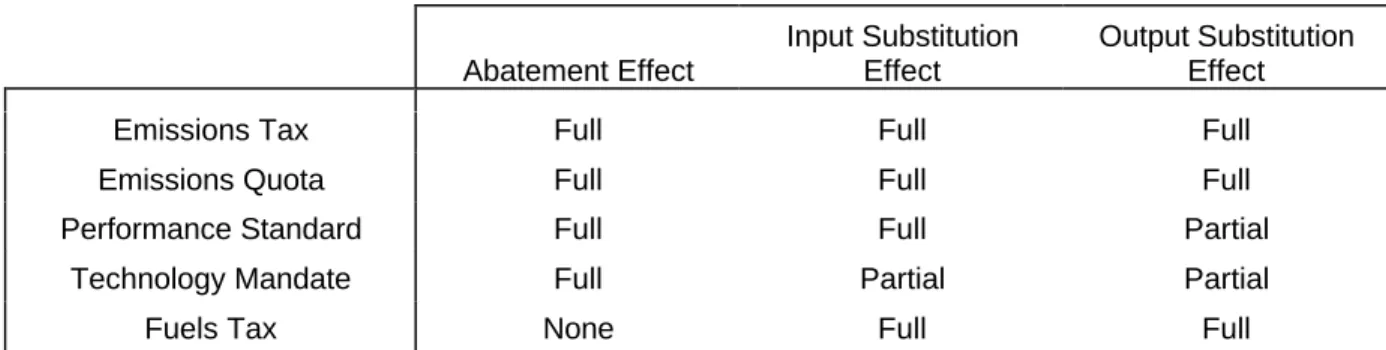
Table 1 summarizes the extent to which these effects are utilized under the emissions tax and other policies. The emissions tax exploits all of these effects "fully" in the sense that it induces the most cost-effective level of adjustment along each of these dimensions. As discussed below, under the other policies some of the dimensions are exploited either partially or not at all, which implies higher primary costs to achieve given abatement targets.
Table 1. Determinants of Primary Costs by Policy
Abatement Effect
Input Substitution Effect
Output Substitution Effect
Emissions Tax Full Full Full
Emissions Quota Full Full Full
Performance Standard Full Full Partial
Technology Mandate Full Partial Partial
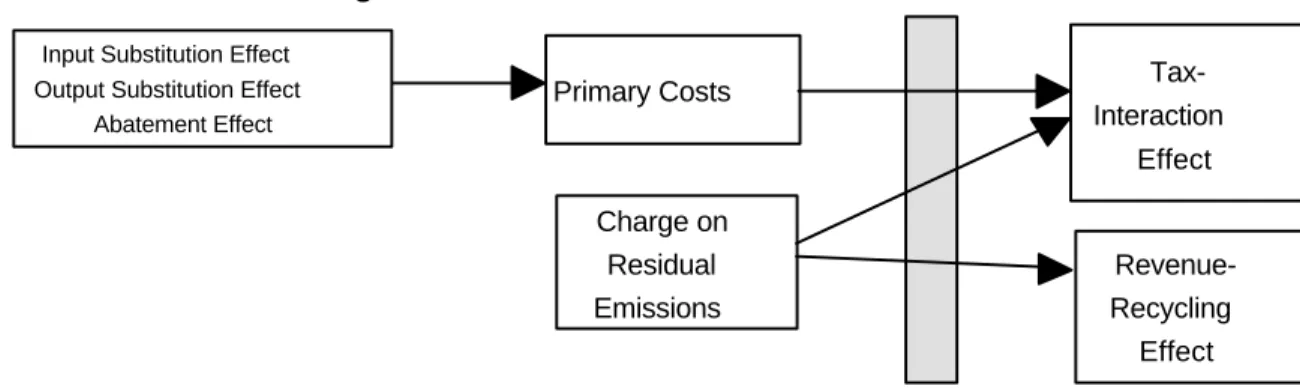
Figure 1. Determinants of Second-Best Effects
Input Substitution Effect Output Substitution Effect
Abatement Effect Primary Costs Charge on Residual Emissions Tax-Interaction Effect Revenue-Recycling Effect pre-existing taxes
In a first-best setting, the relative cost-effectiveness of different policies can be explained fully in terms of the differences in primary costs.12 But in a second-best setting, two additional cost terms come into play, as suggested by Figure 1. These additional terms are represented by ∂WR and ∂WI in (2.10B). ∂WR is the efficiency gain from the (marginal)
revenue-recycling effect. This is the product of the marginal excess burden of taxation and
the marginal revenue from the emissions tax. It represents the efficiency gain associated with using the revenues from the emissions tax to finance cuts in distortionary taxes. ∂WI is the efficiency loss from the tax-interaction effect. This effect has two components. First, the emissions tax increases the price of X, implying an increase in the cost of consumption and thus a reduction in the real wage. This reduces labor supply and produces a marginal
efficiency loss of tL(−∂L/∂pX)(dpX /dtE), which equals the tax wedge between the gross and net wage multiplied by the reduction in labor supply. In addition, the reduction in labor supply contributes to a reduction in tax revenues, which has an efficiency cost of M times the lost tax revenues, equal to the change in labor supply times the labor tax rate. As discussed below, the tax-interaction effect usually dominates the revenue-recycling effect: pre-existing distortionary taxes raise the costs of a given emissions tax, even when revenues are recycled through cuts in these prior taxes.
C. Emissions Quota
Now consider the impact of a set of (non-auctioned) quotas on emissions. In this model, where producers are homogeneous, we can think of this policy as one where the government chooses an overall acceptable level of emissions and then allocates emissions quotas to firms such that firms' required emissions reductions are proportional to their baseline emissions. The key difference between this policy and the emissions tax is that it does not raise revenues for the government, and that, consequently, the policy does not permit
12 Spulber (1985) examines in detail the relative costs of an emissions tax, emissions quota, and mandated technology in a first-best setting. These costs correspond to the primary costs examined here.
a reduction in the distortionary tax, tL . If emissions quotas were auctioned by the regulator, their effects would be identical in this model to those of an emissions tax.13
Under the non-auctioned quota, the government budget constraint is simply:
G L
tL = (2.7C)
The quota policy can be represented as a virtual tax on emissions, where the
"revenues" from this tax are rebated to firms in lump-sum fashion. Such revenues correspond to the rents generated by the quota.14 We use v
E
t to denote the virtual tax. The gross cost of
an incremental increase in the virtual tax can be decomposed as follows (see Appendix A): = − E dt dv λ 1
( )
4 4 3 4 4 2 1 A v E dW X dt da a c ′(
)
4 4 4 3 4 4 4 2 1 O v E v E dW a e t dt dX − − + 0(
)
4 4 4 4 3 4 4 4 4 2 1 I v E X X L W dt dp p L t M ∂ ∂ ∂ − + + 1 (2.10C)A comparison of (2.10C) with (2.10B) reveals that the quota involves a primary cost (dWA plus dWO) analogous to that under the emissions tax. It also induces a similar tax-interaction effect (∂WI) because, like an emissions tax, it drives up the price of consumption goods and reduces the real wage. The key difference from the emissions tax is due to the absence of the (cost-reducing) revenue-recycling effect, which implies that it is more costly to achieve a given reduction in emissions under the non-auctioned quota than under the
emissions tax.15 D. Fuel Tax
Next, consider a revenue-neutral tax of t per unit on the production of X. We refer toX
this as a fuel tax, implicitly regarding the pollution-related good X as a fuel. The general equilibrium gross efficiency cost of an incremental increase in the fuel tax is (see Appendix A):
43 42 1 O X X X dW dp dX t dt dv − = − λ 1 4 4 3 4 4 2 1 R X X W dt dX t X M ∂ + − 4 4 3 4 4 2 1 I X L W p L t M ∂ ∂ ∂ + +(1 ) (2.10D)
This expression differs from (2.10B), which applies to the emissions tax, in that the abatement effect is missing. Under this policy, profits per unit of X are:
13 Even non-auctioned quotas can generate revenues if quota rents are taxed. The extended model described later allows for the taxation of these rents.
14 Emissions quotas imply reduced output, which gives rise to economic rents.
15 Parry (1997) and Goulder et al. (1997) examine in detail the significance of the revenue-recycling effect to the relative costs of quotas and taxes.
) ( 1 t c a
pX − − X − (2.8D)
The first-order conditions for profit maximization imply a=0. Because this policy does not raise the price of emissions, it gives firms no incentive to engage in abatement expenditure. The policy generates the output-substitution effect, but no abatement effect. For this reason the fuel tax fails to generate the efficient emissions-output ratio and represents a relatively "blunt" environmental policy instrument. As demonstrated in the numerical simulations below, the primary cost of the fuel tax exceeds that of the emissions tax and quota, for a given level of emissions reduction, a reflection of the fuel tax's inability to exploit the abatement effect. The fuel tax also generates the tax-interaction and revenue-recycling effects because it increases the price of good X and raises revenue. Whether the fuel tax is more or less costly than the emissions quota depends on whether the fuel tax's failure to exploit the abatement effect is as important as the quota's inability to exploit the revenue-recycling effect. The numerical results in Section 4 will show that these relative costs depend importantly on the level of abatement.
E. Command-and-Control Policies
The literature on environmental regulation distinguishes two main types of command-and-control (CAC) policies: technology mandates and performance standards. Technology mandates require firms to adopt a specific pollution abatement technology, such as a catalytic converter on new cars or desulfurization equipment on new coal-fired power plants.
Performance standards compel firms to achieve a ratio of emissions to a measure of input or output that does not exceed a given maximum; examples are the proposed new source performance standards for NOX emissions from power plants. These are expressed in terms of the ratio of emissions to heat input, which for a given facility translates into a ratio of emissions to kilowatt-hours of electricity production. In the present, analytical model, spending on abatement is the only way to reduce emissions per unit of output. Thus, technology mandates and performance standards are equivalent here. For now we refer to these policies as the technology mandate, but it should be kept in mind that the results here hold for the performance standard as well. The extended model incorporates intermediate inputs and allows us to distinguish the impacts of the two types of policies.
If the technology mandated by the government is the most cost-effective among the available technology alternatives, we will refer to the policy as the least-cost mandated technology. If instead the regulators compel firms to adopt a technology that is not the most cost-effective, we will label the policy as a higher-cost mandated technology. We employ the parameter θ to represent the proportion by which the cost of the higher-cost technology mandate exceeds that of the least-cost mandate. Specifically, we represent the cost of the abatement effect under a technology mandate by θ c(a), where θ = 1 under the least-cost policy and θ >1 under the higher-cost policy.16
16 This is an ad hoc assumption because θ is imposed exogenously rather than determined by the model. We include the higher-cost policy as a reminder that the compliance costs of CAC policies are likely to be significantly higher in a more general model that captures heterogeneity in the costs of emissions reduction among firms and imperfect information among regulators about firms' costs of abatement.
The general equilibrium gross efficiency cost of the technology mandate is (Appendix A): = − da dv λ 1
( )
43 42 1 A dW X a c′ θ( )
4 4 4 3 4 4 4 2 1 O X X dW da dp dp dX a c − +θ(
)
4 4 4 3 4 4 4 2 1 I X X L W da dp p L t M ∂ ∂ ∂ + + 1 (2.10E)The gross cost is higher than under the emissions tax for two main reasons. First, this policy involves a higher primary cost because it does not fully utilize the output-substitution effect,
dWO. Under the technology mandate, the regulator specifies both the type of technology,
defined by θ, and the required level of abatement per unit, a. Profits per unit of X are:
) ( 1 c a
pX − −θ (2.8E)
Unlike the emissions tax, the technology mandate does not charge firms for their "residual emissions" -- the per-unit emissions that the firm continues to generate after the policy is introduced. In contrast, under the emissions tax, if a firm produces another unit of output, it incurs not only the cost of the additional inputs and additional abatement expense but also the tax on residual emissions.17 Thus, the price of output will be lower under the technology mandate than under the emissions tax, as is evident from comparing the unit cost for good X in (2.8E) (the term in brackets) with the comparable term for the emissions tax in (2.8B).18 Because the price of output is too low under the technology mandate, it does not fully exploit the output-substitution effect, and this contributes to higher primary costs.
In addition, the technology mandate involves higher second-best costs than those under the emissions tax. This results because the policy does not exploit the revenue-recycling effect. Thus, the higher gross efficiency costs of the technology mandate reflect both higher primary costs and higher second-best costs. Because the output price is lower under the technology mandate than under the emissions tax, the tax-interaction effect is smaller. However, since the revenue-recycling effect is absent, the overall second-best costs are higher. Although both primary costs and second-best costs are higher, the ratio of these costs is the same as the corresponding ratio under the emissions tax, as discussed below.
F. The Cost Impact of Pre-Existing Taxes
We now explore how pre-existing taxes affect the overall costs of emissions reductions under each policy. To do this, we compare overall gross efficiency costs (including second-best effects) to the primary costs alone. In contrast with the previous subsections, where we observed only marginal changes (from arbitrary starting points), here we are concerned with large changes. To be able to examine such changes analytically, we
17 Firms are also effectively charged for residual emissions under the emissions quota. Under tradable quotas this reflects the cost of buying permits, or the opportunity cost of using permits rather than selling them.
18 This difference in the impact on output price is offset somewhat by the larger abatement expenditure required under the technology mandate. Because this policy does not make use of the input substitution effect, it must rely more on the abatement effect to achieve the given emissions reduction.
assume demand, supply and marginal cost curves are linear over the relevant range. This approach provides second-order approximations to the efficiency costs. In the numerical simulations described in Section 4, we avoid these simplifying linearity assumptions.
Here we focus on the ultimate welfare formulas. The full derivations are in Appendix A. 1. Emissions Tax
The ratio of the general equilibrium cost of the emissions tax relative to the primary cost can be expressed as (Appendix A):
M W W W W W W O A I R O A ′ + = ∆ + ∆ ∆ + ∆ − ∆ + ∆ 1 (2.11B) where ) 1 /( 1 ) 1 /( L L u L L c t t t t M − − − = ′ ε ε (2.6′) c
ε and εudenote the compensated and uncompensated labor supply elasticity respectively and ∆ indicates a non-marginal change. Expression (2.6′) an alternative, empirically useful formula for the marginal excess burden of taxation that accounts for general equilibrium income effects.19 As discussed below, we assume values of tL = 0.4, εc= 0.4 and εu= 0.15 in our benchmark simulations. These imply M′= 0.3. When these values are applied to expression (2.11B), pre-existing taxes raise the overall cost of the emissions tax by 30 percent relative to the primary costs. The costs associated with the tax-interaction effect are only partly offset by the revenue-recycling effect. Thus, despite the fact that the revenues from the emissions tax are devoted to cuts in distortionary taxes, the gross costs (that is, the costs before netting out environmental benefits) are positive. This is the case because the policy raises revenues from a narrow-based (emissions) tax at the expense of revenues from a broad-based (labor) tax, and narrow-broad-based taxes involve higher gross costs.20
Under this policy, the net efficiency impact from the combination of the
tax-interaction and revenue-recycling effects is proportional to primary cost. The magnitude of the tax-interaction effect depends on the change in output price, which in turn is determined by the primary cost and the charge on residual emissions. The size of the revenue-recycling effect depends on the charge on residual emissions. When the revenue-recycling effect is
19 That is, when the dollar of revenue raised is returned to households as a lump-sum transfer. The formula in (2.6) is partial equilibrium and does not take into account this income effect. Hence it depends only on uncompensated elasticities. Browning (1987) provides a comprehensive discussion of the formula in (2.6′). 20 This is now a familiar result. Thus, given the initial conditions specified here, such reforms yield an environmental "dividend" but not a double (i.e., second) dividend in the form of a reduction in the overall gross cost of the tax system. For more discussion, see the surveys by Oates (1995), Goulder (1995b), and Bovenberg and Goulder (1997) and the references therein. The formula in (2.11B) assumes that X and Y are equal
substitutes for leisure. If X were instead a relatively weak substitute or a complement for leisure, the revenue-recycling effect could exceed the tax-interaction effect (Parry, 1995).
subtracted from the tax-interaction effect, the contributions from the charge on residual emissions cancel, and thus the net efficiency impact is proportional to primary cost. 2. Emissions Quota
The general equilibrium cost of the quota expressed relative to the primary cost of the quota is (Appendix A):
(
)
{
}
0 0 / 2 / 1 2 1 E E E E M W W W W W O A I O A ∆ ∆ − ′ + = ∆ + ∆ ∆ + ∆ + ∆ (2.11C) This expression exceeds 1+M′ so long as the proportionate emissions reduction, ∆E/E0, is less than unity. Thus, interactions with the tax system raise the cost of the quota proportionately more than they raise the costs of the emissions tax. This occurs because the quota does not generate the efficiency benefit from the revenue-recycling effect. Because the importance of the revenue-recycling effect depends on the amount of emissions, the difference in cost between the tax and quota crucially depends on the level of emissions reduction. Equation (2.11C) indicates that when the proportionate reduction in emissions is 10 percent, interactions with the tax system raise the overall cost of the quota by 570 percent!21 However, in the limit as the proportionate emissions reduction approaches unity, the cost discrepancy between the emissions quota and emissions tax declines to zero. This happens because at 100 percent emissionsreduction the emissions tax generates no revenue and hence no revenue-recycling effect.22 3. Fuel Tax
The ratio of general equilibrium costs to primary costs under the fuel tax is again 1+M′ (Appendix A), just as under the emissions tax. For the same reasons as applied under the emissions tax, the net impact of the tax-interaction and revenue-recycling effects is proportional to primary cost.
4. Technology Mandate
For the technology mandate, in order to obtain a tractable formula, we compare the size of the tax-interaction effect with the cost of the abatement effect. The latter gives a reasonable approximation to the primary costs at modest levels of emissions reduction, when the output-substitution effect is quite small. We obtain (see Appendix A):
∆ − ∆ − ′ + = ∆ ∆ + ∆ 0 0 / 1 2 / 1 1 X X X X M W W W A I A (2.11D)
21 The tax-interaction effect is empirically important because the economic cost per unit reduction in labor supply is "large." This arises because various taxes combine to drive a substantial wedge between the gross and net wage. For more discussion of this point see Parry (1997).
This formula indicates that pre-existing taxes will raise the overall costs of the technology mandate by around 30 percent when the emissions reduction (and thus the change in X) is small. This indicates that pre-existing taxes raise the costs of the technology mandate by a proportion closer to that under the emissions tax than under the emissions quota. Like the emissions quota, the technology mandate does not generate the revenue-recycling effect. However, this is compensated for by the fact that the tax-interaction effect is relatively weaker than under the emissions tax and quota. Note that θ does not enter (2.11D): although θ directly affects the primary costs of a technology mandate, it has no effect on the ratio of overall costs to primary costs.
5. Summary
This analysis has decomposed the overall efficiency costs of different instruments into primary costs (reflecting the abatement and output-substitution effects) and the second-best tax-interaction and revenue-recycling effects. In a first-best setting, the emissions tax and emissions quota have identical primary costs (for a given amount of emissions reduction). The fuel tax and technology mandate have higher primary costs because they do not fully exploit all the channels that are involved in cost-effective abatement. In a second-best setting, the cost-rankings can change significantly. Second-best interactions especially raise the cost of the emissions quota relative to other policies, because the quota does not generate the revenue-recycling effect to counteract the tax-interaction effect. (The technology mandate does not produce the revenue-recycling effect either, but this is compensated for by the fact that it produces a relatively weak tax-interaction effect.) At "low" levels of emissions abatement, the marginal revenue-recycling effect of revenue-raising policies is very large. Hence at low levels of abatement the presence or absence of the revenue-recycling effect is an especially important determinant of the relative costs of different policies.
3. THE NUMERICAL MODEL
We now extend the previous model by incorporating intermediate inputs in production. This yields a new channel for emissions-reduction: now emissions can be reduced not only through output-substitution and abatement effects but also by way of the input-substitution
effect -- altering the mix of intermediate inputs. Incorporating intermediate goods provides
greater realism and allows the performance standard and technology mandate to have different economic impacts. We distinguish two intermediate goods: a polluting intermediate good (D) and a "clean" intermediate good (N). As before, there are two final consumption goods: CN represents final output from industries that use N relatively more intensively, and CD represents final output from industries that use D relatively more intensively.
The extended model is solved numerically to obtain "exact" welfare assessments, in contrast with the second-order approximations to welfare effects obtained above. This is potentially important for "large" reductions in emissions. We now describe the structure and calibration of the model. A complete description of the model is in Appendix B.
A. Model Structure
1. Household Behavior
As in the previous model, a representative household derives utility from consumption (of CN and CD) and from non-market time or leisure. The representative household has the following nested CES utility function:
(
l C C E)
l C( )
E U U U U U U U U F l N D α α φ σ σ σ σ σ σ − + = = − − −1 1 1 , , , (3.1)where C is composite consumption, defined by C = αCDCD σC−1 σC +α CNCN σC−1 σC σC σC−1 (3.2) and where l≡L−L represents leisure time, E is aggregate emissions, and the α's are
parameters.23 σU and σC are the elasticities of substitution between goods and leisure and between the two consumption goods, respectively.
The household maximizes utility subject to the budget constraint:
pCDCD +pCNCN = pLL
(
1−tL)
+π(
1−tR)
+pCG (3.3)where tL is the tax rate on labor income, tR is the tax rate on rent income, L is labor time, π is policy-generated rent (applicable under the quota policy), G is (constant) real government spending in the form of transfers to households, and pC is the composite price of consumption. Labor and rent income are taxed at the rates tL and tR , respectively. Except in the sensitivity analysis in Section V, the two tax rates are assumed to be the same.24 Taxes finance a fixed
level of government transfers to households. 2. Firm Behavior
We use a constant-elasticity-of-substitution (CES) form for production functions in all industries: 1 1 , , − − =
∑
j j j j i j i j i j X X σ σ σ σ α , i={D, N , L}, j={
D,N,CD,CN}
(3.4)23 Homothetic preferences over consumption goods, together with separability between consumption goods and leisure, imply that consumption goods are equal substitutes for leisure (Deaton, 1981).
24 The effective tax rates on labor and profit income are roughly the same (see for example Lucas, 1990). Labor is subject to personal income taxes and payroll taxes, and capital to personal and corporate income taxes.
where X is output, the αi,j's are share parameters, and the σj's are the elasticities of substitution between factors in production.
Pollution emissions from industry j, Ej, follow
− = γ β α β j D D j e j D D j X a X E , , 1 (3.5)
where aj is the expenditure by industry j on emissions abatement; αεand γ are parameters describing the emissions abatement technology; and βD represents emissions per unit of use of the polluting intermediate good. This functional form ensures that the emissions function is homogenous of degree one in abatement spending and in the amount of the polluting
intermediate good used; which is consistent with the assumption of pure competition (constant-returns-to-scale production). The parameter γ determines the curvature of the abatement cost function. This function is assumed to be convex: γ <1. Our central case value for γ is 0.5, which implies a linear schedule for marginal abatement costs.
Producers choose the profit-maximizing input quantities and level of abatement
expenditure, taking input and output prices as given and subject to any constraints imposed by pollution regulation. Profits equal the value of output minus expenditures on labor,
intermediate good inputs and abatement, less any tax charged per unit of residual emissions (τe) or per unit of output (τj). Thus, profit for industry j (πj) is:
(
)
e j i j i i j j j j p τ X p X τ E π = − −∑
, − (3.6)where pi and pj are the prices of inputs and outputs, respectively. Note that because the production function and abatement function both exhibit constant returns to scale, profits will equal zero under all policies except the quota policy, under which profits equal quota rents. 3. Government Policy
With this extended model we examine five policies: an emissions tax, emissions quota, fuel tax, performance standard, and technology mandate. These correspond to the policies examined in the previous section, except that by including intermediate inputs we now can distinguish the performance standard and technology mandate. As before we distinguish between a least-cost and higher-cost technology mandate. In this model the fuel tax is levied on a (polluting) intermediate input rather than on a final good.
We need to specify how the various policies treat the industries distinguished in the numerical model. To facilitate meaningful policy comparisons, we assume that each policy is implemented in a way that avoids introducing additional efficiency losses attributable to the uneven treatment of industries. Therefore in all cases policies are introduced so as to ensure that the private marginal cost of emissions reduction is equated across all industries. Hence the emissions tax policy applies the same tax rate to all industries, the emissions quota is set such that the shadow price of the quota is constant across industries, and so forth. Appendix B
provides greater detail on each policy's implementation and derives firms' behavior under each of the various policies.
The government's budget constraint is:
(
−)
+ +∑
+∑
= j j j j j e R L CG t T l t E X p π τ τ (3.7)The tax rates tL and tR on labor income and rents are adjusted to compensate for the effects of pollution regulation on government revenue.
4. Equilibrium Conditions
In general equilibrium, supply must equal demand for all produced goods, government revenue must equal government transfer payments, and pollution emissions must equal a specified target. Because production and abatement functions are linearly homogeneous, the supply of each good is perfectly elastic at given factor prices and tax rates. Under these conditions we can reduce the set of equilibrium conditions to three equations: aggregate labor demand equals aggregate supply, government revenue equals expenditures, and pollution emissions equal the target level.25
B. Data and Parameters
Table 2 summarizes our benchmark data set, which depicts the United States economy in 1990. Production data were obtained from the Commerce Department Bureau of Economic Analysis. The pollution-related intermediate good comprises fossil fuels (oil, coal, and
natural gas), while the clean intermediate good includes all other intermediates. The
consumer good CD is a composite of the consumer goods whose production involves intensive use of fossil fuels (consumer utilities, motor vehicles, and gasoline), while the good CN
embraces all other final goods.
Elasticities of substitution in the production functions and the inner nest of the consumer utility function are taken from the disaggregated general equilibrium data set developed by Cruz and Goulder (1992). The α distribution parameters for production functions were calibrated based on the assumed elasticities of substitution and the identifying restriction that each industry utilized the cost-minimizing mix of inputs, or, equivalently, the restriction that in the absence of a new emissions-control policy, the model will replicate the benchmark data.26
25 The model is solved by adjusting the pre-tax wage (pL,), the tax rate on labor income (tL), and the level of
pollution regulation under a given policy such that these three conditions hold. The solution algorithm for the model only uses the government budget and pollution emissions conditions. By Walras's law, if these two conditions are satisfied, then the aggregate excess demand for labor must also equal zero. As a check on the computation, we verify that the third equilibrium condition holds, and also that the result is consistent with the appropriate homogeneity conditions in prices and quantities.
Table 2. Benchmark Data for the Numerical Model
A. Input-Output Flows (in millions of 1990 dollars per year except as otherwise noted)
D N CD CN Leisure Time Total Output Value D 91441.0 111842.7 156881.1 6264.3 366429.1 N 88073.5 4741097.5 464159.9 2670485.6 7963816.5 L 186914.7 3110876.3 1832106.1 5129897.1
Total Output Value 366429.1 7963816.5 621041.0 2676750.0 Emissions (millions of
tons)
23.0
B. Parameter Values
σD= σN=0.8 (elasticities of substitution in intermediate goods production)
σCD= σCN=0.9 (elasticities of substitution in final goods production)
σC=0.85, σU=0.96 (elasticities of substitution between final goods and between consumption and leisure,
respectively)
αE= 1.55 x 10⁻⁴ (effectiveness of technological abatement)
γ=0.5 (curvature of abatement cost function--implies linear marginal abatement costs)
An important preference parameter is σU, the consumption-leisure substitution elasticity. We choose this, along with the labor time endowment, to imply uncompensated and compensated labor supply elasticities of 0.15 and 0.4 respectively. These are typical estimates from the literature, and are meant to represent the effects of changes in the real wage on average hours worked, the labor force participation rate and effort on the job.27 We assume a pre-existing tax rate on labor of 40 percent.28 These parameters imply a marginal
excess burden of labor taxation in our model equal to 0.3, which is consistent with other studies (see, e.g., Browning, 1987).
Our purpose here is to use the numerical model to yield some generic insights applicable to a range of pollutants and policy instruments. Although we aim to convey general relationships, we must of course commit ourselves to specific parameters in running the model. Our central case values for pollution-related parameters are based on
characteristics of NOx emissions. In particular, the pollution content for the polluting intermediate good (the βD parameter) is derived by dividing the actual 1990 emissions of
27 See for example the survey by Russek (1996). We use a slightly higher value for the compensated elasticity since the studies in the survey do not capture effort effects.
28 Other studies use similar values (for example Lucas, 1990, and Browning, 1987). The sum of federal income, state income, payroll and consumption taxes amounts to around 36 percent of net national product. The marginal tax rate is higher because of various deductions.
NOx, as given by Pechan (1996), by the quantity of the polluting good. The parameter αe, which expresses the effectiveness of abatement, was calibrated so that 2.2 million tons (out of a total of 23.0 million tons emitted) of emissions abatement could be achieved at a marginal cost of $500 per ton, a figure extrapolated from Pechan (1996). To illustrate how alternative characteristics of pollution generation or abatement might affect policy costs, we consider broad departures from these central case values.
4. NUMERICAL RESULTS
This section presents results from the numerical model. Subsections A and B compare the first-best and second-best costs, respectively, of the different environmental policies in our central case scenario. In our central case, the abatement effect predominates; subsection C considers alternative scenarios that might be applicable to pollutants where the input substitution and output substitution effects are more important. Subsection D compares the maximum welfare gain from the policy instruments for varying levels of environmental benefits. Subsection E offers a further sensitivity analysis.
To facilitate comparisons, we generally use the emissions tax costs as a reference point, comparing the costs of other policies to these costs. It should be kept in mind that our emphasis is on qualitative, rather than quantitative, differences across policies. The
quantitative differences can vary depending on production, abatement, and utility-function (consumer demand) parameters, which determine (among other things) the relative
contributions of the output, abatement, and input-substitution effects. It is also important to recognize that our analysis abstracts from heterogeneity in firms' production technologies and (thus) abatement costs. Such heterogeneity can affect -- perhaps dramatically -- the relative costs of policies by imposing additional informational burdens or affecting the extent to which regulations equate marginal abatement costs across firms. These impacts may vary depending on the policy involved, and thus heterogeneity can alter the relative cost-effectiveness of different policies.
A. First-Best Costs
We first examine the costs in a first-best setting (tL=0). Figure 2a‡ shows the costs under the different policy instruments in this setting, where only the primary costs apply. The differences across policies are expressed as the ratio of the total costs of the policy in question to the total costs under the emissions tax.29
The curve for the emissions quota is constant at unity; that is, the costs of the emissions tax and emissions quota are identical at all levels of emissions reduction. In the absence of distortionary taxes, the tax-interaction and revenue-recycling effects do not apply, and thus the source of differences in cost impacts -- the revenue-recycling effect -- is absent.
‡ Figures 2a to 4b follow appendices at the end of this document.
29 These are calculated by setting the labor tax in the numerical model equal to zero, and returning any government revenues from the policies as lump sum transfers to households.
In a first-best setting, there is no opportunity to use revenues from the emissions tax to cut pre-existing taxes; hence, from an efficiency standpoint, it is no better than a quota that generates untaxed rents.
The first-best cost of the performance standard exceeds that of the emissions tax. This is the case because the performance standard does not charge firms for residual emissions; hence the output-substitution effect is weak (Table 1) and consumers do not have sufficient incentive to reduce their consumption of final goods produced from polluting inputs.
However, the cost discrepancy between the two instruments is very small in this central case because the output-substitution effect is relatively unimportant.30
The cost of the least-cost technology mandate is higher than that of the performance standard. The technology mandate is the more restrictive of the two policies because firms are not rewarded for reducing emissions by input-substitution (Table 1). We assume that the abatement costs under the higher-cost technology mandate are twice those under the least cost mandate (i.e., θ= 2). Under this assumption, the general equilibrium total costs of the higher-cost technology mandate turn out to be roughly twice those of the least-higher-cost mandate at all levels of emissions reduction. This squares with the analytical model's prediction (equation (2.11D)) that the ratio of general equilibrium costs to primary costs under the technology mandate is independent of θ.
Finally, the first-best cost of the fuel tax exceeds that of the emissions tax. Under the fuel tax, the abatement effect is absent. In our central case the bulk of emissions reductions under the emissions tax come from the abatement effect; this explains why the fuel tax is several times more costly than the emissions tax.
Importantly--and perhaps surprisingly--the costs of the least-cost technology mandate and performance standard converge to those of the emissions tax and quota at 100 percent emissions reduction. This finding is robust to different parameter assumptions, as confirmed in the sensitivity analysis below.31 Both the emissions tax and the performance standard fully
exploit the input substitution and abatement effects. However, the costs of the performance standard differ from those of the emissions tax because the technology mandate does not charge firms for their residual emissions, and thus the output-substitution effect is not fully utilized. This difference declines in importance the greater the extent of emissions abatement because at higher levels of abatement residual emissions are lower. At 100 percent emissions reduction, there are no residual emissions, and both policies have the same effect on the price
30 In the central case, a 50-percent reduction in emissions under an emissions tax achieves 79.0 percent of that reduction through the abatement effect, 18.5 percent through the input-substitution effect, and only 2.5 percent through the output-substitution effect.
31 The form of our abatement cost function (equation (3.2)) implies that firms can eliminate emissions entirely at finite cost. For many pollutants -- for example, lead and chlorofluorocarbons -- this is a realistic assumption, since there are substitute inputs or alternative processes that yield the same economic services and involve nearly zero pollution. But the assumption is not always apt. Williams (1998b) examines the scenario where marginal abatement costs approach infinity as emissions approach zero, and finds that the convergence result holds under some circumstances within this scenario.
of the polluting good and the same output-substitution effect. Thus, their costs converge to the same value.32 Similarly, the technology mandate differs from the performance standard in
that it does not fully exploit the input substitution effect, but the importance of that effect also falls at higher levels of emissions reduction. Thus, the costs of the technology mandate also converge to the same value as the costs of the other policies.
B. The Significance of Pre-Existing Taxes
Figure 2b shows the general equilibrium costs of the policy instruments in a second-best setting with tL = 0.4 initially. These costs are expressed relative to the costs of the
emissions tax in a first-best world. By comparing results of Figure 2b with those in Figure 2a, one can observe the impact of pre-existing taxes.33
For the emissions tax, second-best costs exceed first-best costs by a constant factor of 1.35 -- together the tax-interaction and revenue-recycling effects raise the overall cost of the emissions tax by 35 percent.34 For the emissions quota, interactions with the tax system raise the overall costs by a larger amount, reflecting the fact that the quota does not generate a revenue-recycling effect to counteract the tax-interaction effect. The differences in costs are most striking for modest levels of abatement. For emissions reductions below 23 percent, the cost of the quota is more than double that of the tax. However, under the emissions tax the marginal revenue-recycling effect declines with the level of emissions reductions as the tax base is eroded. At 100 percent abatement, no emissions tax revenues are raised and there is no revenue-recycling effect. Hence at this level of abatement the total costs of the emissions tax and quota are equivalent.35
The second-best costs of the performance standard, technology mandate and fuel tax exceed those of the emissions tax by the same proportions as in Figure 2a; pre-existing taxes
32 Figure 2a also shows that the relative inefficiency of the fuel tax is larger, the greater the extent of emissions reduction. This is not necessarily a general result, but arises because of our assumed functional forms. The marginal abatement cost function is linear, while the marginal costs of input- and output-substitution are convex. Consequently the relative importance of the abatement effect increases with the level of emissions reduction under the emissions tax. This implies a greater relative cost under the fuel tax, which does not exploit the abatement effect.
33 The impact of pre-existing taxes is not necessarily captured entirely by the magnitudes of the tax-interaction and revenue-recycling effects. The reason is that pre-existing taxes conceivably could affect primary costs (by altering relative prices and thereby influencing the extent to which abatement, input-substitution, and output-substitution effects are utilitized). However, our numerical simulations indicate that primary costs change very little when pre-existing taxes are introduced.
34 The results above are very close to those predicted by the analytical model. Similar empirical results for sulfur dioxide and carbon dioxide emissions abatement were obtained by Goulder et al. (1997) and Parry et al. (1996), respectively.
35 Note that the numerical model incorporates an indirect revenue-recycling effect from the taxation of quota rents. This equals 40 percent of the revenue-recycling effect under the emissions tax. Thus, the difference between the tax and quota is smaller than would be predicted by the analytical model, which ignores the taxation of quota rents.
raise the costs of all these policies by about 35 percent. The net impact of the tax-interaction and revenue-recycling effects is proportional to primary cost.36
Figure 2b's results for the relative costs of the emissions quota are particularly striking. Four points deserve emphasis. First, only the quota policy has positive marginal costs at initial, incremental abatement. The emissions tax has zero marginal costs at initial abatement, so the cost-ratio associated with the quota is infinite. For all the other instruments, at this initial increment the tax-interaction and revenue-recycling effects either are zero or they exactly offset each other, so that marginal costs are zero.37 Thus, for these other policies, the
ratio of costs is finite at initial, incremental abatement.
Second, in this analysis the efficiency consequences of the quota depend importantly on the fact that the quota is not auctioned, which means that the revenue-recycling effect is not exploited. If, in contrast, quotas were auctioned and the revenues used to finance cuts in the marginal rates of pre-existing taxes, the efficiency impacts of the quota would be the same as that of the emissions tax.
Third, these results bear importantly on the evaluation of tradable permits systems. A key attraction of such systems is that they help achieve a more efficient allocation of abatement effort by promoting an equilibrium in which producers' marginal costs of abatement are equal. Typical estimates indicate that allowing for trades can reduce costs of compliance by 30 percent or more relative to the costs of a system with fixed emissions quotas (that is, with no trades).38 Figure 2b's results indicate that second-best considerations can have an equal or
36 For the two tax instruments, this proportionality occurs because the revenue-recycling effect exactly offsets the portion of the tax-interaction effect resulting from the charge on residual emissions, leaving a net second-best effect that is proportional to the first-best cost of the tax, as discussed in Section 2. The technology mandate and performance standard do not charge firms for residual emissions; hence under these policies the increase in price of final output only depends on the costs of abatement and input substitution -- the first-best costs. Thus, in these cases, the tax-interaction effect itself is proportional to the first-best cost of the policy. Since these policies do not involve a revenue-recycling effect, the overall second-best effect is proportional as well.
37In the case of the performance standard and technology mandate, the tax-interaction and revenue-recycling effects are both zero at initial abatement. Thus the marginal cost curves emerge from the origin. A similar result was obtained by Fullerton and Metcalf (1997) under their technology-restriction policy, which resembles the performance standard considered here. The quota policy's marginal cost curve does not emerge from the origin because it has an efficiency loss from the tax-interaction effect and no offsetting revenue-recycling effect. There are other cases under which the net impact of the tax-interaction and revenue-recycling effects is strictly positive at incremental abatement. These include the case where the government introduces an emissions tax and returns the revenues in lump-sum fashion, and the case where the government policy increases the returns to a perfectly inelastic factor of production (Williams, 1997, and, in the context of trade policy, Williams, 1998a). What is common to all these cases is that the government policy has effectuated a lump-sum transfer to the private sector, either by generating untaxed scarcity rents (the case emphasized by Fullerton and Metcalf), by providing explicit sum transfers, or by generating additional rents to fixed factors. In a world with distortionary taxes, lump-sum transfers from the government to the private sector are costly in efficiency terms because the government ultimately must finance such transfers through distortionary taxes.
38 Tietenberg (1985) surveyed 11 studies, with costs under command and control estimated to be over six times larger on average as costs under the ideal least-cost approach. Numerous other studies have found significant cost savings from tradable pollution permit programs, although costs under these programs typically exceed the theoretical minimum by a substantial amount, in part because of flaws in program design (Hahn, 1989).