UNF Digital Commons
UNF Graduate Theses and Dissertations Student Scholarship
2004
Development and Performance Evaluation of a
Real-Time Web Search Engine
Burr S. Watters IV
University of North Florida
This Master's Thesis is brought to you for free and open access by the Student Scholarship at UNF Digital Commons. It has been accepted for inclusion in UNF Graduate Theses and Dissertations by an authorized administrator of UNF Digital Commons. For more information, please contactDigital Projects.
© 2004 All Rights Reserved
Suggested Citation
Watters, Burr S. IV, "Development and Performance Evaluation of a Real-Time Web Search Engine" (2004).UNF Graduate Theses and Dissertations. 295.
DEVELOPMENT AND PERFORMANCE EVALUATION OF A REAL-TIME WEB SEARCH ENGINE
by
BurrS. Watters IV
A thesis submitted to the
Department of Computer and Information Sciences in partial fulfillment of the requirements for the degree of
Master of Science in Computer and Information Sciences
UNIVERSITY OF NORTH FLORIDA
DEPARTMENT OF COMPUTER AND INFORMATION SCIENCES December, 2004
Copyright(©) 2004 by BurrS. Watters IV
All rights reserved. Reproduction in whole or in part in any form requires the prior written permission of Burr Watters or designated representative.
The thesis "Development and Performance Evaluation of a Real-Time Web Search Engine" submitted by Burr Sells Watters N in partial fulfillment of the requirements for the degree of Master of Science in Computer and Information Sciences has been
Approved by the thesis committee: Date
Dr. Behrooz Se<Jed-AlJbaSSi
Thesis Adviser and Committee Chairperson
Dr. Yap Chua
1 2.1 I
.J
I/o '-/
Accepted for the Department of Computer and Information Sciences:
Accepted for the College of Computing, Engineering, and Construction:
Dr. Neal Coulter Dean of the College
1,/u) !.C
Signature Deleted
Signature Deleted
Signature Deleted
Signature Deleted
Signature Deleted
Signature Deleted
ACKNOWLEDGEMENT
I wish to thank my family for their loving support throughout this last accomplishment of my academic career. In addition, I thank my friends, both here and abroad, for their constant words of encouragement through some of the difficult and tedious times. I thank Dr. Behrooz Seyed-Abbassi for his directions and guidance to a goal which I thought was unattainable.
Lastly, I dedicate this thesis in honor and in memory of my father, BurrS. Watters III.
Contents Figures lX Tables X Abstract . . . x1 Chapter 1: Chapter 2: Chapter 3: Chapter 4: Introduction ... . Contemporary Search Engines ... . 1 5 2.1 Traditional Search Engines .. .. .. .. .. .. .. .. .. .. .. .. .. .. .. .. .. .. .. .. .. .. .. .. .. .. 6
2.2 Meta Search Engines ... 8
2.3 Distributed Search Architecture ... 9
2.4 Content Ranking ... ... ... ... ... ... .... ... .. ... .. .... .... 10
2.5 Directories and Crawlers ... ... 10
2.6 The Methods of Traversing the Web ... 11
2.7 Web Page Content Extraction ... 12
2.8 Providing a Direction for Web Traversing ... 15 Real-Time Search Engines ... . Proposed Application ... . 4.1 Searching Without a Catalog Index ... . 4.2 The Approach for Improving Performance
4.2.1 Approach 1: Traversing the Web
19 25 25 26
Chapter 5: Chapter 6: Chapter 7: Chapter 8: Chapter 9: 4.2.3 Approach 3: Concurrency ... . Traversing Through the Web ... .
32 34
5.1 Defining a Search Domain ... 34
5.2 Removing Cyclic Loops from Traversal Paths ... 36
5.3 Depth-First and Breadth-First Traversal in Search Domain .. 37
5.4 Pruning the Search Domain ... 40
Real-Time Caching ... 44
6.1 Overview of Caching ... 44
6.2 Real-Time Search Cache ... 45
6.3 Implementing Real-Time Search Caching ... 46
Concurrency . . . 48 7.1 7.2 Overview of Concurrency Example of Concurrency 48 51 7.3 Necessity for Concurrency in Real-Time Search Engines ... 52
7.4 The Multithreaded Real-Time Search Engine ... 53
The Process of the Real-Time Search Engine .. .. .. .. .. .. .. .. .. .. .. .. .. .. .. .. .. .. 54
8.1 Setting the Environment for the Search ... 54
8.2 Spider and Parser ... ... .... .. ... ... ... .... .. .... 56
8.3 Conceptual Transversal ofthe Web ... 61
8.4 Parsing HTML ... 64
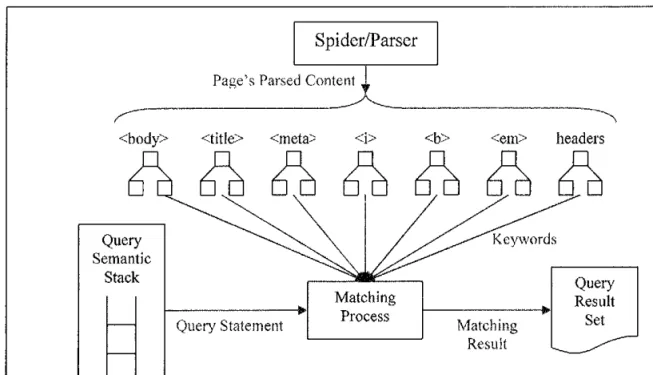
8.5 Query Processing ... 65
8.6 Web Search vs. Web\Database Search ... 67
Results and Analysis ... 70
9.1 Limitations of Current Implementation .. .. .. .. .. .. .. .. .. .. .. .. .. .. .. .. . 71 9.2 9.3 9.4 9.5 9.6 9.7 Analysis of Web Traversal Implementation Analysis of Multithreaded Implementation Analysis of Pruning Traversal Implementation ... . Analysis of Caching Implementation ... . Comparison with Current Search Engines ... . Result Set Quality ... . 73 80 82 86 88 89 Chapter 10: Conclusion ... 91
10.1 Implementing Better Performance ... 92
1 0.1.1 Traversing the Web .. .. ... ... .. .. .. ... 92
10.1.2 Concurrency ... 93
10.1.3 Web Searching with Caching ... 94
10.2 Practicality ofthe Real-Time Search Engine ... 94
10.3 Future Enhancements ... 96
10.4 Impressions ... 97
References 98 Additional Resources . .. .. .. .. .. .. .. .. .. .. . .. .. .. .. .. .. .. .. .. .. .. .. .. .. .. .. .. .. . .. .. .. .. .. .. .. . .. .. .. .. .. .. .. .. .. .. .. . 101
Appendix A: DTD for Book Example ... .... ... ... 103
Appendix B: Examples of Traversal and Multithreaded Implementations ... 104
Appendix C: Example of Pruning Traversal Implementation ... .... ... 110
Appendix D: Example of Web Search with Caching Implementation ... 113
Spider.java ... 121 Matching.java ... 142 TraversalMethods.java ... 150 BreadthFirstTraversal.java ... .. ... ... .. .. ... .... .. .. ... .... ... ... .. ... 151 DepthFirstTraversal.java ... 154 Node.java ... 157 StatementParser.java ... 159 ParsedHtmlNode.java ... 175 ParsedStatementNode.java ... 176 Stats.java ... ... .... ... ... .. .. ... ... .. ... .. .. ... .. ... .... .. .. ... 177 SynchQueue.java . ... ... ... ... .. ... .. ... ... ... 180 TimeNode.java ... 182 MatchedNode.java ... 183 AATree.java ... 184 DuplicateltemException.java 190 ItemN otF oundException.j ava 192 SQL Table Defintions for Cache Database ... ... 194
Vita 195
Figures
Figure 2-1: Visual Representation of Web as a Tree Structure Figure 5-1: Depth Level in a Tree Representation of the Web
7 36
Figure 5-2: Depth-First Traversal Search ... 38
Figure 5-3: Breadth-First Traversal Search ... 39
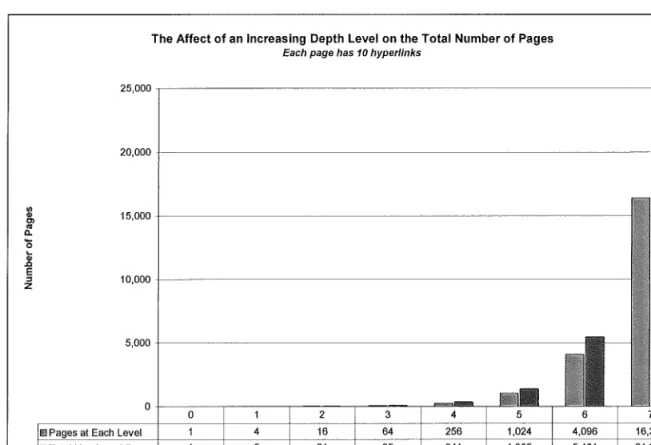
Figure 5-4: The Effect of Depth Level on Total Number of Searched Pages ... 41
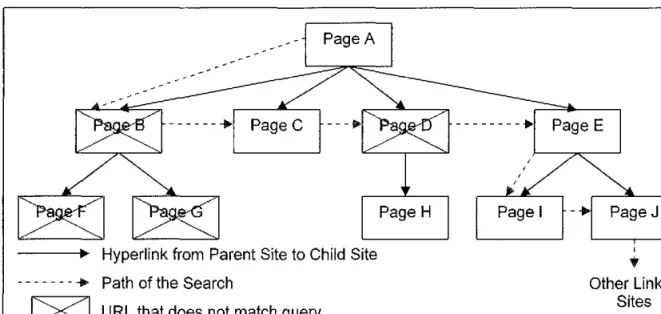
Figure 5-5: Pruning Traversal Path ... 43
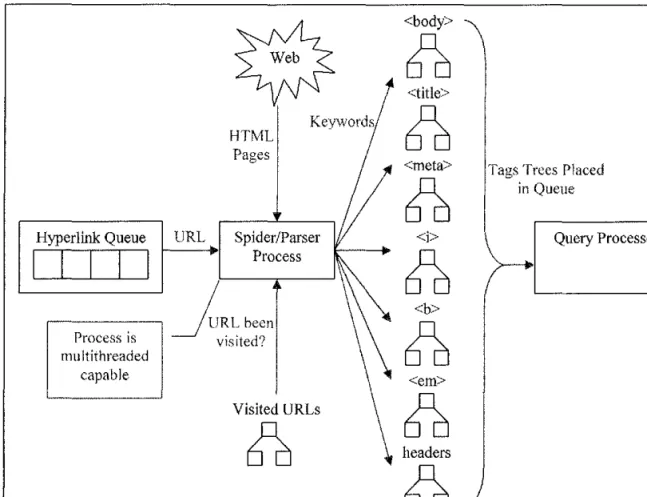
Figure 8-1: Flow Diagram of the Spider and Parser Function . . . 58
Figure 8-2: HTML Parser Process ... 60
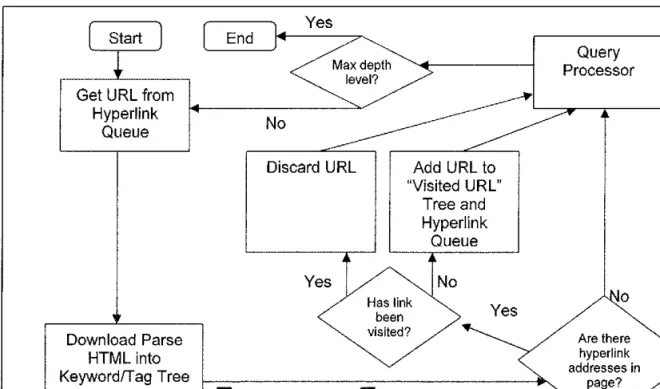
Figure 8-3: Lifecycle ofProcessing Hyperlinks During Traversal ... 62
Figure 8-4: The Query Processor ... 66
Figure 9-1: Execution of Global Traversal Methods at Depth Level 1 (Intranet) 77 Figure 9-2: Execution of Global Traversal Methods at Depth Level 1 (Internet) 77 Figure 9-3: Execution of Global Traversal Methods at Depth Level2 (Intranet) 78 Figure 9-4: Execution of Global Traversal Methods at Depth Level 2 (Internet) 78 Figure 9-5: Execution of Global Traversal Methods at Depth Level 3 (Intranet) 79 Figure 9-6: Execution of Global Traversal Methods at Depth Level 3 (Internet) 79 Figure 9-7: Results of Pruning Traversal . . . .. . . 84
Tables
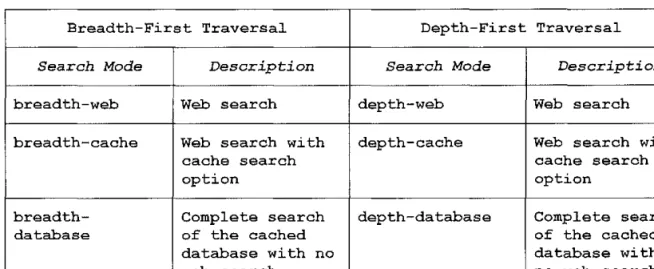
Table 8-1: Search Modes for the Real-Time Search Engine ... 55 Table 9-1: Execution Times for Commercial Search Engines . . . 89
Abstract
As the World Wide Web continues to grow, the tools to retrieve the information must develop in terms of locating web pages, categorizing content, and retrieving quality pages. Web search engines have enhanced the online experience by making pages easier to find. Search engines have made a science of cataloging page content, but the data can age, becoming outdated and irrelevant.
By searching pages in real time in a localized area of the web, information that is retrieved is guaranteed to be available at the time of the search. The real-time search engines intriguing premise provides an overwhelming challenge. Since the web is searched in real time, the engine's execution will take longer than traditional search engines. The challenge is to determine what factors can enhance the performance of the real-time search engine.
This research takes a look at three components: traversal methodologies for searching the web, utilizing concurrently executing spiders, and implementing a caching resource to reduce the execution time of the real-time search engine. These components represent some basic methodologies to improve performance. By determining which
Chapter 1
Introduction
During the early 1990s, the World Wide Web (WWW) received its start from many organizations as a means to communicate with the public. For the previous twenty years, the government, its agencies, and large universities relied on the network to relay data across the country in a matter of minutes, and eventually seconds. As the Internet became more commercially and publicly based, Internet users had very few resources to find information on the web in a timely fashion. The resulting solution was the creation of online search companies that allowed people to traverse the web for business or pleasure to search the web on any topic.
In its most basic format, the WWW is a massive repository of semi-organized
information. There is not a day that goes by where someone is not adding, updating, or changing its content. With so much information available at our finger tips, search engines provide a way to search this massive repository of information. To take
advantage of the vast amount of knowledge and data available on the WWW, researchers are continuously exploring and developing new methodologies of searching for content relative information.
-Through web search engines, companies, such as Lycos, AltaVista, and WebCrawler, have enhanced the online experience by making websites easier to find. In describing the development ofLycos, Michael Mauldin pointed out that the major functions in the operation of a web engine include gathering hyperlinked pages across the web into an index, storing the pages in a database repository, and returning the hyperlinks to web pages based on keywords, phrases, and ideas matched against the database of indexed pages [Knoblock97].
According to Filman and Pant, "the search engine industry has evolved two dominate ways of finding information: directories and spiders" [Filman98, page 21]. Directories are maintained by people who categorize web sites, which are primarily submitted by outside sources, into different subject areas based on their content. It can be "labor-intensive" to process the pages and to change categories if the page content is modified [Filman98]. Spiders (or bots) are an alternative to directories. Most of the spiders that scour the web work in completely different ways, though they accomplish the same task of searching for information [Knoblock97].
The goal of the search engine is to allow the user to quickly find a web page that pertains to the user's topic of interest. More often than not, search results from a search query could contain many web pages that are not relevant to the search. Either the search engine returns a link that is dead, or the contents have been changed from the time the page was indexed.
A solution to address these problems is to create a dynamic search engine whose purpose is to search for web content in real time. The objective is to provide the user with web content that is consistent and relevant to a user's needs by searching a dynamic area of web pages in real time. The concept also revolves around searching in an area of the web containing pages with similar content. The process would start by choosing a page to become the authority page of the group of pages. The authority page, referred to as a root page, should be a reference page to other pages of similar content. The process would continue by searching the authority page for content and then traversing the authority's hyperlink:s for additional searching. This would allow the user to find information across several pages that are related via hyperlinks. Searching in real time would eliminate the problems of retrieving dead links and provide a better chance of retrieving more relevant content for the web surfer.
The purpose of this research is to provide the user with web content that is consistent and relevant to a user's needs by searching a dynamic domain of web pages in real time. The focus is on the development of a real-time search engine and measuring the performance of the different implementations of the engine. Testing the best performance relies on a couple of component implementations.
The first component is the method of traversing the hyper links to discover new content. This looks at such techniques as breadth-first and depth-first searching. A more unique method known as a pruning searching is also examined.
-The second component focuses on two implementations of quickly retrieving and searching information from a web page in real time. The first method is a total web search approach in which every page is downloaded from the web. The second method is derived from a web caching solution.
The third component looks at the effectiveness of threads in a real-time engine. It would not be unexpected that the multithreaded design will provide better results over a single thread, so the research will focus on the difference in performance using various numbers of threads.
Overall, the mission of the research focuses on what factors in these three implementation areas will have a greater impact on the performance of a real-time search engine. The remainder of the thesis is organized as follows. Chapter 2 discusses some of today' s current uses of search engine technology. Chapter 3 describes the concepts and the processes behind a real-time search engine. Chapter 4 highlights the design of the
proposed application. Chapter 5 delves into the methodologies of traversing web content. Chapter 6 focuses on caching web content and determining what is deemed as a query hit. Chapter 7 explains how threads play an important role in real-time performance. Chapter 8 describes the processes involved in executing a real-time search engine. The research wraps up with an analysis of the results in Chapter 9 and concluding research overview in Chapter 10.
Chapter 2
Contemporary Search Engines
"People think searching is a monolithic activity," said Werbach. "But it isn't. The reality is that sometimes you will want to use different techniques for different reasons"
[Greenberg99, page 11]. His quote sums up the essence of this chapter. On the outside, search engines appear to perform in the same manner. However the implementation and research that goes into developing different contemporary search engines tells a different story.
In an article titled, "Searching the World Wide Web," Michael L. Mauldin explained how he developed Lycos into the search engine wonder that it is today [Knoblock97]. He briefly touched upon the operation of a web engine by pointing out its major functions. A forging program would first gather hyperlink:ed pages across the web into an index. Next, the pages are stored in a database repository. Finally, a retrieval system returns hyperlinks to web pages based on keywords, phrases, and ideas matched against the database of indexed pages [Knoblock97]. On a fairly simplistic level, Mauldin was describing the process of web query retrieval. It can be quite a daunting task, but companies like Lycos, AltaVista, and WebCrawler have enhanced the online experience by making web pages easier to find.
-Web search and retrieval architectures can be categorized loosely as traditional search engines, metasearch engines, and distributed architecture search engines [Pokorny04]. All three categorizations make up the general-purpose search engines that most people are familiar with on the web. Essentially, a user enters a topic into a graphical web interface in the form of a word, phrase, or groups of phrases. The engines return a set of ranked web pages that pertain to the user's general topic. Ranking web pages is a useful tool for search engine users as it recommends the best possible page that pertains to the search topic.
2.1 Traditional Search Engines
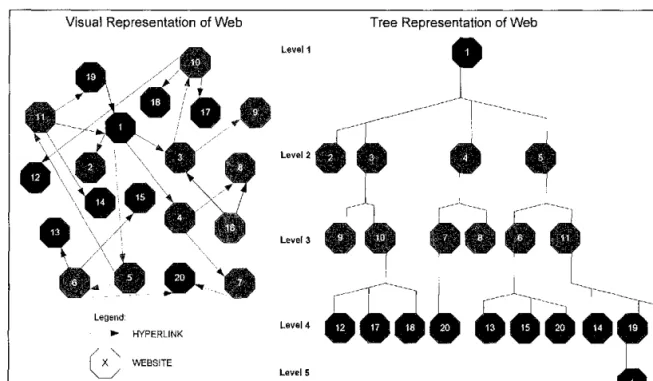
Traditional search engines, also known as centralized search engines, consist of the following components: crawlers, page repositories, indexers, query engines, and ranking algorithms [Pokorny04]. Crawlers, known as spiders or bots, perform the basic task of scouring the web for web content. Their sole task is to download content from the pages they traverse in the web via hyperlinks. The interconnecting web ofhyperlinks creates a web map which the crawler's control module uses to determine where the crawler has been and will search. A visual representation can be seen in Figure 2-1.
Visual Representation of Web Tree Representation of Web Level1 level2 level3 Legend: level4 - - - HYPERLINK
0
WEBSITE levelSFigure 2-1: Visual Representation of Web as a Tree Structure
The content retrieved from the crawler is stored in page repositories for further processing by the traditional search engine. Indexers are processes that parse the downloaded page content within page repositories. The indexers are responsible for determining how the page should be categorized within the search engine.
The last major part of the traditional search engine is the query engine. The query engine's responsibility is to locate which pages in the page repository match the user's query. The query engine uses the indexed content in a database system to discover the pages and displays them according to a ranking scheme. The ranking algorithm
concludes the relevance of a page to a user's particular search topic. The page's ranking can be based on query-independent criteria, such as lists of related pages or similarity indexes, or it can be based on query-dependent criteria, like the page's length and vocabulary, the publication date, or the number of pages connecting to a particular page.
-Of course, a mixture of query dependent and independent methodologies can be used to contribute to a more refined ranking.
2.2 Meta Search Engines
Another facet of the web is a concept known as the hidden web. This term describes the vast amount of web pages that are not reachable by traditional search engines
[Pokorny04]. Such information typically resides in text databases. In some cases, the data is located in the "deep web" where it is only reachable through web form interfaces or user authentication [Hafri04]. The metasearch architecture is a searching methodology that utilizes the strengths of text-based and web-based search engines to discover pages that satisfy a query. It achieves this by searching multiple databases simultaneously. Examples of such an architecture would be Metacrawler and Dogpile. One disadvantage of this architecture is that the referenced databases must have a descriptive tag or
summary about its contents. Many databases do not publicly announce this information, so the number of resources for a metasearch architecture are limited. Research has been in development to automate the extraction of content from these databases to form a database summary.
A metasearch engine has three major components: a database selection process, a query translation process, and a result compilation process. The database selection process is critical to the entire application, as it is responsible for determining which third party
provided by each search database. The query translation process must modify the original metasearch query into a query format that is compatible with the third party database. Lastly, the metasearch has to merge the results of the responding databases and rank them accordingly for the user.
2.3 Distributed Search Architecture
The third search engine architecture is described as a distributed search architecture. The web in general is a large peer-to-peer network that contains distributed information and processes. With traditional and metasearch engines, the crawling and querying
processing takes place in a centralized area or application. Pokorny highlighted two potential issues with centralized search engines: high computational costs and potentially poor rankings. The distributed search architecture aims to divide the tasks of searching and categorizing the web among several search engine systems, thus relieving the burden and increasing the effectiveness of the search engine process on centralized systems or applications [Pokorny04].
Pokorny states that this architecture is not a new one, but the research in recent years has started to develop some very interesting techniques. A system known as Apoidea
manages the load in a decentralized system by distributing the crawling process based on the geographical proximity to web resources [Singh03]. Another technique uses
decentralized crawlers to find web content based on the document rankings of pages
-[Aberer03]. A more common method of distributed searching utilizes a decentralized group of metasearchers to query and obtain results from specialized search engines.
2.4 Content Ranking
Searching, retrieving, and matching web pages are not the only functions that are
performed by search engines. Search engines provide the extra service of recommending which pages will most likely satisfy the search topic. This process is known as ranking. Ranking is the search engine's attempt at measuring the importance of a page in regards to the search topic. The ranking is typically rated on the following three approaches: linking, content, and anchors [Pokorny04].
2.5 Directories and Crawlers
Directories are maintained by people categorizing web pages into different subject areas based upon their content. This assures the user that what they locate in a category only pertains to the search topic. Most pages that are classified by directories are submitted from outside sources. The disadvantage is the processing of pages can be
"labor-intensive" [Filman98]. If a page changes content, it will take time before a classifier can review the page so it can be moved to another category. Filman and Pant also mention that if a page is not found within a catalog, there is a good chance that it will not be in the directory at all [Filman98].
An alternative to directories are bots or spiders. Lycos1 creator Michael Maudlin says that most spiders that scour the web searching for information function in different ways, though they accomplish the same task [Knoblock97]. The idea behind the spider's functionality came from observing how the typical web surfer visits web pages by jumping from one page to another via hyperlinks. Essentially, spiders scour the web by traversing through the same hyperlinks [SzymanskiOl].
Mauldin modified John Leavitt's LongLegs search engine [December94] and added the Pursuit retrieval engine [Knoblock97] to create the Lycos search engine. The basic goal of the spider was to catalog the information on the web by reviewing a web page,
extracting its hyperlinks, cataloging the page contents, and then moving on to process the page's hyperlinks. Maudlin mentions that Lycos' early spiders were written in Perl. This allowed the storage queues, which the spider populated, to be stored in a Database
Management System (DBMS) for effective access [Knoblock97]. Presently, Lycos is a proprietary spider written in C for quicker processing.
2.6 The Methods of Traversing the Web
The next issue is how to explore web sites. The depth-first search is a good traversal methodology, but this can cause a tremendous load on some servers. The breadth-first search is an alternative to reduce the load, but Mauldin says that the algorithm favors "smaller web servers over large mega sites such as universities and Internet service
1
Lycos was named for the wolf spider, Lycosidae lycosa, which catches its prey by pursuit, rather than in a web.
-providers" [Knoblock97, page 9]. Lycos settled on a popularity heuristic approach. This algorithm basically notes the number of external servers linking to one web page. The more links found would determine popularity of the page and the direction of the search.
2.7 Web Page Content Extraction
Most web documents are written in a language known as Hypertext Markup Language (HTML). Although other file formats have become popular over the years, HTML remains the foundation for formatting web documents. HTML' s purpose is to notify a web client about how a document should be displayed in a web browser. The HTML code is made up of a series of tags, end tags, and data content. Some of the functions performed by HTML can dictate the title of the page, give a summary of the page's content, and inform how the content should be laid out in the page. This is achieved by placing the data content between a HTML tag and HTML end tag, as displayed as below:
<title> This is an example </title>
Because HTML tags are used for formatting, it is difficult to use HTML to describe the data content of a web page. As a result, Extensible Mark Language (XML) was
developed for the purpose of describing a document's content. Fortunately, this does not mean that content cannot be retrieved from an HTML document.
and Ishizuka's Emerging Topic Tracking System (ETTS) provides a good example [BunO 1]. By using HTML tags as a reference to where data can be located in a document, ETTS uses a parser to remove and replace HTML tags with sentence delimiters. After the HTML tags are removed, the result is raw text in a semi-sentence structured format. ETTS compares this text to a previously recorded text for changes and updates in an index database system with those modifications.
Lycos' Maudlin points out there could be a copyright violation with such techniques, so Maudlin chose to parse the HTML pages based on "weighty" terms [Knoblock97]. Through statistical sampling, the spider is able to determine how often certain words are used in a page. The top one quarter of keywords with high statistical scores are chosen as "representatives" of the page and written to the database repository. Eventually, these keywords and scores are used to approximate how useful a page might be to a Lycos user.
Unlike Bun and Ishizuka' s ETTS, Lakshumanan, Sadri, and Subramanian developed WebLog, a query language which categorized web pages based on a keyword's
relationship to the page's HTML code [Lakshmanan96]. In essence, important keywords are obtained by their association with HTML tags. This relationship, known as rel-infon pairs, is used during processing to match a query to a web page. One example of
WebLog's syntax would be
<url> [<rid> <attr> ~ <val>]
13-where <url> is the URL of the page, <rid> is the name of the rel-infon, <attr> is the HTML tag, and <val> is the value being searched. One disadvantage of the query language is the cryptic syntactical structure for a simple query.
When a subset ofXML-QL, called XQL, was prototyped by Ishikawa et al. of Fujitsu Laboratories, a simple query language design was created to search XML documents [Ishikawa99]. Although XML is not intended to be used as a document structure language like HTML, the principals behind designing a query language were similar. The creators noticed that a relational database's capacity to relate categorize data was very similar to XML's ability to classify data.
The popularity of XML stems from its ability to allow designers to create a document that can self-describe the content it contains. XML allows for the development of personalized tags to define, transmit, validate, and interpret data between different sources [Webopedia]. XML is assisted by a document known as the document type definition (DTD) that describes the customized tags and format of an XML document. XML has gained recognition with system designers by allowing different systems to communicate via a common data format.
Developing a language to query XML documents based on relational database's Structured Query Language (SQL) was not a difficult step to make. Ishikawa and company proposed using an SQL-like language to query XML documents. The format
SELECT $book.author
FROM bib URI "www.a.b.c/bib.xml", book $bib.book WHERE.$book.publisher.name ="Addison-Wesley"
The DTD for this statement appears in the Appendix A. In this statement, the query statement is satisfied if the publisher's name is "Addison-Wesley" from the Universal Resource Identifier (URI) "www.a.b.c/bib.xml. If a match is found, then the book's author would be displayed. Modeling the XQL language after SQL has some real
advantages. The structured of the XQL language is similar to SQL's SELECT statement. This provides an easy transition for users who are familiar with standard SQL to create XQL queries. Another advantage is derived from the similarities on how data is
retrieved. Through the convenience of a single select statement, the user can specify the data needed, where to find the data, and what criteria the data needs to satisfy in order to be retrieved.
2.8 Providing a Direction for Web Traversing
No matter which spider/crawler/bot implementation is used, there are still a couple of issues that need to be addressed when searching the web. First and foremost, what determines which page should be downloaded? How does the crawler know which hyperlink in the page will provide the most useful and comprehensive results? Pokorny states that certain measures can be used, such as interested-driven metrics, popularity-driven metrics, and location-popularity-driven metrics, which can assist a web searching system with finding meaningful pages [Pokorny04].
15-The second issue is how often searched pages should be refreshed. Most search engines rely on database management systems to house page content downloaded from the
crawlers. Twenty-three percent of web pages change on a daily basis [Pokorny04]. Most updates occur on a monthly schedule. Such a time frame can cause many page listings in the search database to become obsolete and stale within a relatively short time frame. One suggestion is known as a proportional refresh, which tracks the update frequency of a particular web page and schedules the crawler to coincide with the frequency of the update.
Pokorny mentions the final issue as developing a parallelized crawling process without duplicating efforts [Pokorny04]. If a set of crawlers start categorizing the web, paying no attention to the work efforts of its peers, there is little doubt that several crawlers could download the same page causing duplication of work. The crawler would have to be aware of what pages have been parsed by its siblings in order to ensure time and resources are not wasted on duplicated work.
Greenberg addresses some new approaches to searching and ranking that could be integrated into new projects [Greenberg99]. Greenberg mentions the concept of human annotation, which bases search results off of the behavior of previous user web searches. In essence, as the search engine is used, it tracks which pages are popular for a particular topic. Those pages are related to the topic or keywords and used the next time another user searches on the same topic. The downside, according to critics, is that the more
popular pages will overcome less popular ones and diminish the usefulness of searching for content on rarely visited pages.
Direct Hit is another approach known as a popularity engine [Greenberg99]. Cofounder Gary Culliss cites that his application anonymously tracks a user's surfing habits to determine which content is of interest to the user. The tracking habits are calculated through a proprietary algorithm to provide for ranking the relevance of web pages and sites.
Another methodology is the Googlebot used by Google [Greenberg99]. The creators, Sergey Brin and Larry Page, describe the process as a mixture of keyword and human-annotation based approaches. Googlebot uses the topological structure of the web to determine the importance of a page within a web ofhyperlinked content. During
keyword searches in Google, text-matching operations, as well as some other algorithms, are performed on neighboring pages via hyperlinks. The search returns the web location addresses with similar content within a web of interconnected sites and pages.
Clever [Charkabrti99] was developed in 1996 as a means of determining the validity of a page as an authority of its content. Clever provides the method of determining "a topic's most definitive and authoritative web pages" [Charkabrti99, page 9]. In essence, these pages become the most relevant and qualified resource, or authority, that a user can find on a particular topic. Once a page is determined to be authority, its ranking becomes much more important based on its quality and relevance to the topic. The second area of
17-focus in the Clever project is reviewing the hyperlinks that connect the vast amount of web pages together. The creators of Clever contend that the hyperlinks from one page act as an endorsement to another page. Thus, mining and processing the web for a collection of these endorsements can lead to the discovery of authorities. The collections of
hyperlinks are referred to as hubs.
Granted, on several web pages, hyperlinks can refer to content that is considered invalid or useless. The idea is that through processing link structure between interconnecting pages, Clever can create an aggregated list of links (i.e. a hub) that point to one page as the authority of all pages within that topical area. By analyzing the density, direction, and clustering of links, the Clever application can determine which pages will provide the most beneficial content based on a user's search needs [SzymanskiOl].
In summary, the basic search engine needs to crawl through the web and retrieve data content that it believes is relevant to the topic of the page. That data must be categorized and weighted in an index to determine the quality and relevance of the topic. A query language is used to query the index and retrieve URL addresses that pertain to the user's query. To create a real-time search engine, the design will have to utilize features of contemporary search engines, such as to provide a simplified query language, categorize semi-structured data into meaningful relationships, and traverse the web in a manner that will not exceed the user's patience.
Chapter 3
Real-Time Search Engines
In the world of the web, the content that embodies it is constantly changing. Jarolav Pokorny states there are two types of changes on the web: persistence of web pages and page content modification [Pokorny04]. Persistence of web pages refers to the lifespan of the page, or in other words, how long does a web page stay on the web. One study would suggest that the web page lifespan seems to be a little under two years
[Koehler99]. The site that houses a page seems to average a little over two years. In a web of about 3 billion web pages by today's estimate [Hafri04], having a page only exist for two years creates a lot of dead links and content turn over. In addition to a page's existence on the web, the page also undergoes content changes. The page and its web address still exist, but the content in it changes. Twenty-three percent of all web pages change every day [Pokorny04]. Constant change can render completely new content within just a couple of days. Web addresses gathered by spiders and search bots might no longer reference the same content that might have been previously present.
The challenge is to provide fast and efficient methods for searching the web. Real time search engines provide one type of solution to the dynamic nature of the web. By
searching pages in real time in a localized area of the web, information that is retrieved is guaranteed to be available for the user at the time of the search. With traditional
19-based search engines, the data can age, becoming outdated and irrelevant to the user's needs. One symptom of searching an index of cataloged content is the presence of dead hyperlink addresses in the result set. For example, as previously mentioned, nearly a quarter of the web pages change daily. This means that the page must be constantly monitored and the catalog updated to maintain continuity with the current web page.
A spider or bot would have to refresh its catalog content constantly just to keep the addresses up-to-date. Constantly monitoring a change in a web page can be time consuming for a web crawling system and place undue stress on a web server. As a result, a spider may only visit a page a couple times per month. Visits may occur more if the page is highly visited by web traffic. With infrequent updates from web spiders, the catalog is bound to contain web addresses to content that may not exist.
The reliance on indexes can also give a different set of results based on the traditional search engine that is used. As these engines search the web independently of each other, the engines' spiders could catalog data using different processing algorithms or crawl to pages that competitor spiders never encountered. Unlike metasearch engines, a
traditional search engine cannot utilize a competitor's index to process a query. As a result, different traditional search engines will return different result sets.
In another scenario, the server hosting the page may be experiencing technical problems which keep it from serving web pages. Such a case would prevent the spider from
Since a search is performed in real time, the result set contains live and up-to-date content that satisfies the user's needs. Real-time search engines can eliminate inactive webpages by dropping those web addresses that it cannot reach.
One of the technicalities of a real-time search engine can also allow it to become one of its greatest weaknesses. Since pages are searched in real time, it is possible that the search could take several seconds to complete. Essentially, the real-time search engine has its crawler download and parse web pages as the user waits. Since traditional web crawlers can take several hours to find, download, and categorize the pages, a reasonable assumption is that the real-time search engine crawler would have the same type of performance. In order to be effective, the real-time search engine must search an area of the web that is much smaller than the traditional search engines.
Some research has been done in the area of real-time search engines. In one paper, the authors A. Iekji and F. Fotouth developed an adaptive real-time search engine to address the issues with traditional search engines [Ikeji99]. The Ikeji's real-time engine allows the user to specify where the searching should begin by giving an URL address. The engine will review the contents of the address and determine if it satisfies the query given by the user. Anchor tags or hyperlinks that are found in the page's HTML are stored so they are searched next.
Due to the time and space constraints, the process cannot continue to search the web indefinitely. Only a partial sample of the web can be searched. The process will
-continue until the search time expires or the engine has traversed a certain amount of links from the original page. The user will have specified both the time and number of hyperlinks in a statement that is very similar to relational database's SQL and to
WebSQL [Mendelzon96]. In addition to searching content, the engine also searches for web page attributes, such as the last time the page was modified, the title, the size of the document, and images contained within the HTML document.
Traditional search engines utilize an index for categorizing page content. With Ikeji's real-time engine, no index is needed. The information is retrieved directly from the web page and processed, allowing the results to be current and accurate. Because time is limited in real-time searches, the engine must decide the appropriate path to take in a real-time search. This algorithm can vary among search engines, and may remain confidential in the case of commercialized engines. Ikeji's engine utilizes a scoring system to determine which traversal path might present the best results. An alternative method would be the brute-force approach, also known as a linear search. The web traversing alternative would basically download and process every page that is linked from the original page. Brute-force technique lacks the finesse of estimating the pockets of web pages that would likely satisfy the query. Consequently, the brute-force search would expend more system resources and time to execute.
Ikeji's methodology is encouraging, as it closely resembles the direction of this body of research. The advantage to Ikeji's real-time engine is that by focusing search efforts on
the result set will contain information that is valid and valuable to the user [Ikeji99]. The results of the engine were mentioned in terms of how many pages satisfied the query during the authors' testing. There were no indications of processing time or comparisons against other engines.
Another real-time search engine is called Orase. Although very little research could be found on this engine, a brief description of the engine's abilities can be found at its website2 [Franz04]. The application was written by Markus Franz. The engine "guesses" different URLs based on the query entered into the system. Those URLs are then
searched for content.
Other research into real-time search engines focused on dividing the massive search content onto a distributed architecture [Hafri04] and determining how to categorize real-time content for presentation to the user [ChauOl]. Although the implementations were not discussed, the distributed architecture and presentation research is beyond the scope of this paper.
The real-time engine is not meant to replace traditional search engines, but to enhance the user's ability to find additional information in a quicker amount of time. This would be analogous to the "FIND" function in a word processing application. One web page is used as a primer address for the search engine. The address should be selected by the user and should have some relevance to the search criteria. The real-time search engine will search through a web of connected hyperlinks starting at the primer address. This
2
Orase can be found at http://www.orase.com.
-23-methodology provides two advantages: the result set content from the search should be relevant to the subject of the primer page and the amount of time needed to execute the search should be minimal as it only searches the immediate web pages of the primer page.
Chapter 4
Proposed Application
The concept of a real-time search engine stemmed from the development of a web-based query language graduate project. Varieties ofweb query languages have been, and still are being, developed to retrieve relevant results and/or provide an easier language for web querying. The purpose of the research is to review the performance of a real-time search engine in three different component implementations. The web query language models the semantics and syntax structure of the web. The application is designed to query web pages and retrieve the results of the query, but do so in a real-time execution of the query language.
4.1 Searching Without a Catalog Index
Current web search research relies on database management systems as the source of the web page content. A database schema, modeling the structure of web pages, would create a more accurate picture of how data is represented on the Internet. With a schema in place, a more descriptive query language could be used to retrieve information from that database which houses details on web pages and their informational content. As described in Chapter 2, the structure of the web content makes it very difficult to find
25-some way of relating data to its location on the Internet. This includes multimedia content, dynamic content, content hidden behind password secured sites, and static HTML-based content.
In the development of the language and its engine, the thought of retrieving the data was of great concern. One logical course of action was to search the web itself instead of peering into a database of semi-related, and possibly outdated, web content. Thus, the implementation of a real-time search engine was built as a method of finding content that is as current as possible. The prototype function according to its design, and the query language provided the needed semantics of retrieving HTML-based web content. The issue at hand was the performance of the crawler and data content retrieval system.
4.2 The Approach for Improving Performance
In this research, three approaches are used to enhance the researcher's previously developed query language engine prototype. The application dynamically searches web pages and their adjacent pages for a result set that satisfies the query. A series of feature enhancements are being implemented to increase the performance of the search engine. The prototype has been in development for two years to test the theory behind a real-time web query language for searching a dynamic web environment. The prototype had encouraging results, but suffered in performance when the number of pages that needed to be searched grew at an exponential rate.
The basic functionality behind the real-time search engine is no different from traditional search engines with respects to the crawler and the query processor. The distinction is seen in the implementation and integration of these two processes into a real-time
environment. Basically, users submit their search topic in the form of a query to the real-time search engine. The user is defined as the person who gives queries to the system for the purpose of searching for web pages that suits a topic of interest. The query is the statement that a user gives to the system to state the intention of the search. The query contains a web address, specified by the user, which acts as the first page to be
downloaded, parsed, and processed against the query. Any hyperlink: addresses found in the page are stored in memory. The content of the page is parsed and matched against the conditions stated in the user's query. If the page contains keywords that match the
condition, the web address is placed in the result set. If not, the web address is dropped. The result set is described as the set of web addresses that are returned to the user after the search has been completed.
The second part of this process is the repetitive search of pages in real time. Once a page has been processed, the spider downloads the next page from the list of hyperlink:
addresses that were stored earlier. The page is parsed and processed. The entire
repetitive process ends when the spider has reached its search domain boundary specified by the user. The search domain is the boundary which keeps the engine from endlessly searching the web. The boundary is set by the user in the form of a depth-level number, which represents a current web page's position within a search domain.
-27-The query processing is complete when there are no more pages to be matched. Lastly, the result set, which is a list all URLs that satisfy the user's query, is displayed to the user. A query is satisfied when a webpage matches the user's query statement.
This describes the basic process of a search engine. Traditional search engines and the proposed real-time search engine differ in the execution timing between the crawler and the query processor. Traditional engines download and parse web content in advance of a user's need to search the web. The query processor searches the database of indexed content and retrieves those pages that might be of interest. The wait time between the start of query processing and receiving a list ofURL addresses can take as little as a tenth of a second, depending on the search engine3. With real-time search engines, the
crawlers traverse the web immediately after the user submits the query and the query processor starts matching pages after the first page has been downloaded by the crawler. Due to the fact that the process downloads and search pages in real time, the execution takes longer than traditional search engines. It is important to note that the enhancements mentioned in this research are being applied to improve the real-time performance.
The development of a query language was the goal of the prototype. As this research is based on developing a better performing real-time search engine, the query language structure does not have an actual impact on performance. It allows the user to specify under what conditions the search engine will operate. Performance results of the real-time search engine will be compared to the various operations the user can set in the
are needed to allow the user to make performance-based enhancements to the search engme.
4.2.1 Approach 1: Traversing the Web
First and foremost, the performance of a web crawler will depend on the method of web traversal and the amount of pages that will be visited. The more time spent traversing the web, the longer the user will have to wait for some sort of search results. Essentially the web is a massive interconnected hive of web pages. By traversing from one page to another page, a traversal path is created. In some instances, a traversal path could revisit pages that have been visited. Such an event would create an infinite traversal loop. In a real-time search engine, this can have disastrous effects on performance. Thus, the engine must track and avoid pages already visited.
The second issue involving performance with real-time search engines is coping with the great amount of pages on the web. Commercial crawlers could take days to traverse just a section of the web. With a real-time search engine, this time has to be drastically reduced to be of any benefit to the users. Hence, the number of pages a real-time search engine processes will be much more limited than its traditional search engine
counterparts. As a result, the real-time engine would be more suited to searching within a domain name or a small group of related web pages. The simplest analogue is to
compare the real-time search engine to the "FIND" feature for a large word processing application. The content is limited, but the size of the document is too great to review by
-29-the human eye. Thus, a boundary must be in place to prevent -29-the engine from traversing too far and executing too long. The boundary can be specified in the query statement as a maximum search depth. By using a specified depth, the user can control the amount of pages visited and how deep into the web the engine will search.
With a search boundary specified, the application must have a traversal method. Web traversal may be accomplished basically via three approaches: a breadth-first approach, a depth-first approach, and a selective path variation of both the breath-first and depth-first search. The goal for implementing these traversal methods is determining which method provides the largest result set in the shortest amount of time. The depth-first and breath-first searches are referred to as global searches, which means they will search every page within the search domain. The selective path variation of these two traversal approaches, developed for this research, is known as pruned branch traversal, which selectively chooses one traversal path over another based on the content of the pages.
The depth-first search drills down to the bottom of the search domain tree by searching a parent page and moving to the first available child page. Essentially this creates a
vertical search pattern in the tree. One downside is that the depth-first search could cause a tremendous load on some web servers.
The second traversal method is the breadth-first search. This method traverses through the search domain tree by searching one depth level at a time. This would be similar to a
reduce the load on servers, but the algorithm could favor "smaller web servers over large mega sites, such as universities and Internet service providers" [Filman98].
The last method utilizes a selective path approach of the depth-first and breadth-first methods. With the previous traversal methods, all pages within the traversal domain are searched. It is reasonable that some pages will link to child pages that have no
commonality in topic or content to the user's query. Such pages can be "pruned" from the traversal domain if there is no relevance in topic or content. Pruning refers to the intentional removing of a section of the search domain that has no relevance to the search query. This has the effect of reducing the number of child pages that must be processed, thus reducing execution time of the real-time search engine.
4.2.2 Approach 2: Real-Time Caching
The current traditional search engines do not search the WWW in real time. These search engines scour the web, placing their findings in large database repositories for later
retrieval by users via a web graphical user interface. In order to retain the real-time nature of the application, the web search has to be executed when the user wants to perform a web search. Another method used to increase performance among many computing functions is caching. Essentially, the traditional search engine is a large repository of cached web content that is searched during a query. As highlighted earlier, the information can become stale and old after a short period of time. But if constantly
-updated, cache can reduce the time of retrieving data from a cached page versus downloading the content over the web.
By consulting when the last time a page was updated during traversal, a crawler can determine if a newly modified page should be downloaded, parsed, and cached or if a cached version of the page will do. Creating a hybrid matching solution utilizing the database as a cache repository and using the memory-based search tree as the matching engine, the goal is to determine if a real-time caching method performs better for the search engine. Using a hybrid of a real-time downloading and caching, the search engine would avoid any network/internet lag that might be encountered while downloading pages.
4.2.3 Approach 3: Concurrency
The final performance enhancement will be developing the search engine into a
parallelized threading architecture. Since the goal of the application is to parse pages in real-time, parallelizing the execution through the use of threads will have an influence on performance. In a multi-threaded environment, threads can be employed to execute tasks that are functionally independent of each other. By creating several threads to work together to crawl and process HTML pages, the information will process much faster. The real-time search engine prototype is executed in a single threaded instance. This means that the engine downloaded, parsed, and matched one page at a time to accomplish
separated into threaded objects, allowing the creation of multiple crawlers to run concurrently.
It is not expected that the real-time engine will be competitive when compared to today's current search engines. The goal is to provide another tool to supplement searching on a smaller section of the web. In doing so, the real-time search engine will provide results of pages that are current and more relevant to the user's search needs.
33-Chapter 5
Traversing Through the Web
The user gives a query statement that specifies the search conditions. The query supplies a primer URL address, the search conditions, and how deep into the web the program should search. A primer URL address is used as the initial page for starting the search process. In order for the real-time search engine to be effective, the search must begin in an area of the web that is applicable to the topic. For example, if a user wanted to search for the diet habits of the bald eagle, it would be reasonable to physically start a search at a site pertaining to eagles or a site about animal diets or a even a site of a zoo that exhibits eagles. Such information would not be found at sites that do not deal with the subject of eagles or animal diets. Thus, a real-time search engine needs a primer page, or URL address, of a site that relates to the topic of interest to establish the searching process. The value of the real-time search engine comes into play when it returns page results that are linked from the primer page.
5.1 Defining a Search Domain
typically relate to a specific subject matter. In terms of web searching, a search domain describes those pages that the real-time search engine discovers and processes. The search domain may consist of pages outside of a topic area, or it may simply link to other pages that have not been encountered. The idea is that the group of interconnected web pages creates a searching area for the real-time engine to search simply by being
connected to each other.
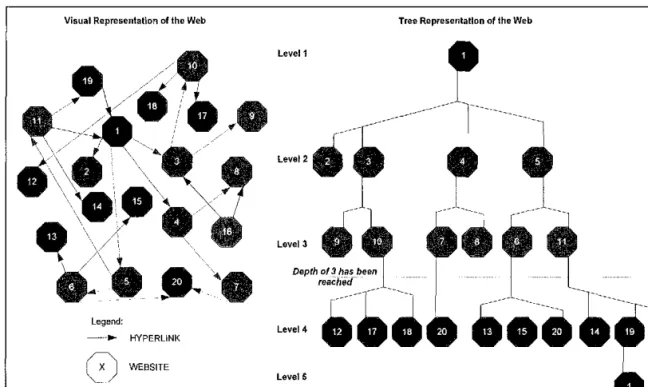
Starting with the primer URL address, which forms the "root" of the search domain, the search domain can be pictured as the common data structure known as a "tree." The diagram ofthe search domain tree can be found in Figure 5-1. In the tree structure, the top page (i.e. the page from which the search begins) is known as the root of the tree. The hyperlinks of the root page are known as child pages. In the example in Figure 5-l, the root's child pages would be categorized on level two of the search domain tree. Those level two pages would have hyperlinks to child pages which would be located on level three of the search domain. The remaining level numbers are given accordingly.
In Figure 5-l, it can be seen that the interlinking pages form a tree that has a level assigned to it by the traversal algorithm. This allows the engine to determine how far it has searched into the web. In this diagram, a depth level of 3 was specified by the user in the query statement. When the engine encounters child nodes with a level number
greater than 3, the spider discontinues adding links to the hyperlink queue. At the time the hyperlink queue is exhausted, the search engine stops executing.
35-Visual Representation of the Web Tree Representation of the Web
Legend:
HYPERLINK
8
WEBSITEFigure 5-1: Depth Level in a Tree Representation of the Web
As the spider traverses from node to node in the search domain, the content is downloaded and processed by the engine to determine if the page satisfies the user's query. At this point, the spider thread retrieves another URL from a hyperlink queue and repeats until the appropriate depth level is reached.
5.2 Removing Cyclic Loops from Traversal Paths
Pages can refer back to themselves, creating a cyclic loop in the tree that is highly undesirable. In such circumstances, a search engine could find itself looping through multiple pages that it has already visited, thus having disastrous effects on performance.
data structure known as an AA Tree. When a hyperlink in a page is encountered, the link's address is listed in the tree, if not already present. The real-time spider consults the tree to see if the URL address has been visited. If it has not been visited, the address is queued for downloading and processing. If it has been visited, the address is simply discarded.
5.3 Depth-First and Breadth-First Traversal in Search Domain
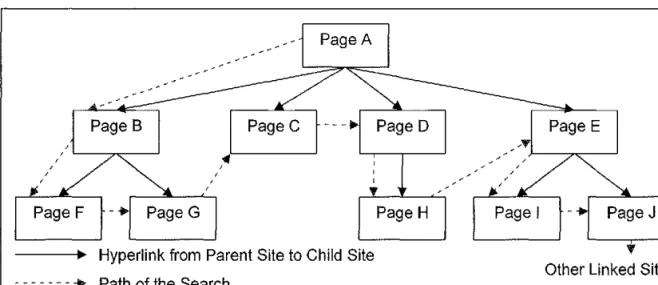
There are two types of traversal methods mentioned by Mauldin [Filman98] that are implemented in this application: the depth-first search and the breadth-first search. The first type of traversal implemented in the research is the first traversal. The depth-first search method describes the process of traversing down to the leaf node of a branch of a tree. The process is detailed in Figure 5-2. In the figure, the tree has a depth of 3, but on the web, the depth could be limitless. As a result, the search would be unending, which is clearly not an option for real-time searches.
37-Hyperlink from Parent Site to Child Site - - - + Path of the Search
Figure 5-2: Depth-First Traversal Search
Other Linked Sites
With a depth of 3 specified in the query statement and a URL starting at Page A, the depth-first search would take the path of A, B, F. When F is encountered as the depth limit, the program would search for additional children at Page B. In this case, the page would be Page G. The search would continue as G, C, D, H, E, I, and J. This
methodology performs well, but there is a disadvantage stated by Mauldin. With a depth-first search, the Hypertext Transfer Protocol (HTTP) server could become overwhelmed with hits from the search engine if the links consistently referred to the same web server.
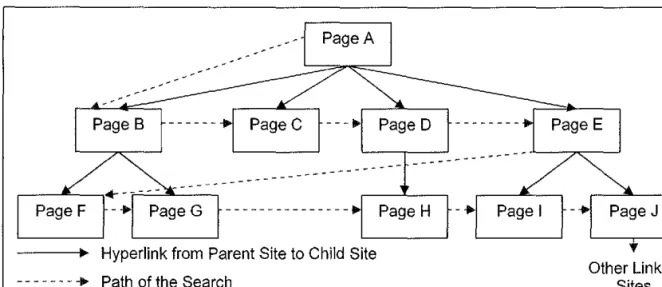
The second implementation, and an alternative to depth-first searching, is the breadth-first traversal. This search process visits all nodes on the same level before searching any of these nodes' children at the next level. This process is demonstrated in Figure 5-3. When the search begins at Page A with a depth level of 3, the path the algorithm takes is A, B, C, D, and E. These pages are related to Page A by being a direct child of A.
Hyperlink from Parent Site to Child Site - - - • Path of the Search
Figure 5-3: Breadth-First Traversal Search
l'
Other Linked Sites
When B, C, D, and E are searched, the algorithm records their children in a queue. The process pulls the front node from the queue, parses it, and inserts any hyperlink URL addresses on that page at the rear of the queue. This gives a level by level traversal during the dynamic search.
The HTTP server could still become burdened by requests if a page only makes link references to pages on that HTTP server. Chances are the page has links to another HTTP server, thus the search engine will not burden one single HTTP server for a great deal of time. With a greater depth level, there is better chance that child pages will refer to links outside the initial root site. In these cases, the request load that the real-time engine makes of the HTTP server should only come in waves, and not all at once. In essence, the breath-first traversal improves the response performance by allowing the server to respond with current requests before burdening it with more hits.
-39-5.4 Pruning the Search Domain
The third traversal technique is an algorithm designed to reduce the amount of pages that are searched by the real-time search engine. The method, developed from this research, is known as the pruned branch traversal. As described earlier, the pages within a search domain can be laid out in a traversal path that is similar to a multi-node tree data
structure. At the root level, there is the root page that is the head of the tree.
The root page could have no hyperlinks or several hyperlinks that leads to other pages contained within it. Those pages from the root page could also have no hyperlinks to several hyper links embedded in its pages. In a theoretical example, if every page in the search domain had four hyperlinks, at each depth level the number of pages that would have to be searched would quadruple. In Figure 5-4 at a depth level seven, 21,845 pages would have to be search. In reality, the total number of pages to be searched would vary based on the number ofhyperlinks on each paged search.
The Affect of an Increasing Depth Level on the Total Number of Pages
Each page has 10 hyper/inks
2 5 , 0 0 0 - , - - - ,
Figure 5-4: The Effect of Depth Level on Total Number of Searched Pages
The depth-first and breath-first searches must search every page in the search domain before the real-time engine can stop execution. In some cases, a hyperlink might direct the spider to traverse to pages that have very little in common with the search criteria specified by the user. For example, if the topic was based on the feeding habits of eagles and the root page for the search was the front page of a zoo, one of the child pages could easily point the crawler to a page off-topic, such as the zoo sponsor's website or the zoo's human resources website. Such topics do not relate to the topic being search, but are directly linked from the site so they must be searched.
-Thus, the issue that resides with depth-first and breath-first traversal methods is that they inherently will search all pages irrelevant of the page's topic. For searches that are specified to reach a shallow depth level, this may not be much of an issue. But certainly for searches that would like to traverse deep into a website or the web itself, some sort of pruning would have to occur to remove the non-topic relate web pages. In an article titled "Local Searching the Internet," the authors describe the concept of just searching one website or the site's neighboring sites [Angelaccio02]. It is similar to commercial search engines allowing a search to take place in one web domain. Localized searching is easy to control by filtering pages according to the web domain in which they reside. The only downside to this technique is that the crawler has a limited search domain according to the web domain specified in the search query.
Instead of eliminating pages because they do not fall within a particular domain, the concept of eliminating individual pages from the search domain based on content was incorporated in this research. This is termed as "pruning" the search domain. Pruning utilizes the breath-first or depth-first search methodology, but filters pages based on content, not according to the web domain to which it belongs. In this methodology, the spider can crawl outside the web domain specified by the root URL address and traverse to neighboring pages on its own free will. As a page is encountered in the traversal, it is processed to determine if it matches the user's criteria. The filtering process is based on whether the page contains any of the keywords given in the user's query statement. A traversal path similar to Figure 5-5 is created with the pruning traversal.
Hyperlink from Parent Site to Child Site - - - • Path of the Search
IZJ
URL that does not match queryFigure 5-5: Pruning Traversal Path
I
...
Other Linked Sites
Thus, those parent pages that have successfully passed through the filter will have their child pages searched. Those pages that do not successfully pass thought the filter are dropped, thus pruning them from the search domain. As branches are pruned from the search domain tree, the size of the search domain will be reduced. Having a reduced search domain decreases the crawlers' traversal and downloading time; thereby improving the performance of the real-time search engine.
An issue of the pruned methodology is determining the number ofURL addresses that are returned from a breadth-first/depth-first search and from a pruned search. Since a smaller number of pages are searched in pruned search, it is possible that the result set will be less than the results of depth-first or breath-first traversal techniques. Consequently, the quality of the pruned-based search is tested during execution as well as the performance.
-43-Chapter 6
Real-Time Caching
Every HTTP request to a web server creates traffic on the web. The more data traffic that appears on the web, the longer it takes to send or retrieve data. As a result, high traffic will cause high network latency. Network latency refers to the amount of time it takes for data to travel from one computer to another over a network. To reduce latency, network traffic will have to ease with the decrease of requests, or at least appear to be easmg.
6.1 Overview of Caching
Caching is the technique of storing data closer to the requesting computer in an effort to reduce the amount of time it takes to send the data. Caching is implemented in memory systems and hard drives by retaining a copy of highly used data in quick access retrieval systems. As web traffic increases, web caching is used to reduce bandwidth, decrease user perceived latencies, and reduce the load strain on web servers [DavidsonO 1].
If another request was made for the same page, the request would only have to travel to the closest cached resource and send it back to the user. Network resources and time are saved as a result of that request not having to be sent directly to the web server. Users notice the improved time it takes to retrieve the requested web page. Web server administrators note that the system is not burdened as much due to a reduction in requests, thus allowing the server to respond to additional requests.
Despite the advantages, there are some potential problems with caching web pages. Just as data indexed in a web search engine can grow old and stale, the pages placed in a caching system can suffer the same fate. In addition, some web resources should never be cached, such as personal information or time-sensitive data.
The second issue can have an increasing effect on latency. When a request comes to a server that performs web caching, response time is decreased if the page is present in cache. This is known as a hit. If the page is not present in cache, it is considered a miss and the request is forwarded to the next cache source or to the web server. Since
additional time is taken while verifying a cache miss, the user can perceive an increase in latency as the request is passed from one cached source to another.
6.2 Real-Time Search Cache
Caching, in terms of a web browsing, can take place at the web server, the client's browser, or at a proxy server. Under ideal conditions, caching will decrease network
45-latency and improve the response time of web requests. If applied to a real-time search engine, web crawlers can utilize a cached resource, when available, instead of retrieving data from the web. If the spider recognizes a change has not be made to a web page that has been visited in the past, the system can opt to have the spider visit a local caching resour