Deutsches Institut für Wirtschaftsforschung
www.diw.de
Elke Holst • Andrea Schäfer • Mechthild Schrooten
Gender, Migration, Remittances:
Evidence from Germany
111
SOEPpapers
on Multidisciplinary Panel Data Research
SOEPpapers on Multidisciplinary Panel Data Research at DIW Berlin
This series presents research findings based either directly on data from the German Socio-Economic Panel Study (SOEP) or using SOEP data as part of an internationally comparable data set (e.g. CNEF, ECHP, LIS, LWS, CHER/PACO). SOEP is a truly multidisciplinary household panel study covering a wide range of social and behavioral sciences: economics, sociology, psychology, survey methodology, econometrics and applied statistics, educational science, political science, public health, behavioral genetics, demography, geography, and sport science.
The decision to publish a submission in SOEPpapers is made by a board of editors chosen by the DIW Berlin to represent the wide range of disciplines covered by SOEP. There is no external referee process and papers are either accepted or rejected without revision. Papers appear in this series as works in progress and may also appear elsewhere. They often represent preliminary studies and are circulated to encourage discussion. Citation of such a paper should account for its provisional character. A revised version may be requested from the author directly.
Any opinions expressed in this series are those of the author(s) and not those of DIW Berlin. Research disseminated by DIW Berlin may include views on public policy issues, but the institute itself takes no institutional policy positions.
The SOEPpapers are available at
http://www.diw.de/soeppapers
Editors:
Georg Meran (Vice President DIW Berlin) Gert G. Wagner (Social Sciences)
Joachim R. Frick (Empirical Economics) Jürgen Schupp (Sociology)
Conchita D’Ambrosio (Public Economics)
Christoph Breuer (Sport Science, DIW Research Professor) Anita I. Drever (Geography)
Elke Holst (Gender Studies)
Frieder R. Lang (Psychology, DIW Research Professor) Jörg-Peter Schräpler (Survey Methodology)
C. Katharina Spieß (Educational Science) Martin Spieß (Survey Methodology)
Alan S. Zuckerman (Political Science, DIW Research Professor)
ISSN: 1864-6689 (online)
German Socio-Economic Panel Study (SOEP) DIW Berlin
Mohrenstrasse 58 10117 Berlin, Germany
Gender, Migration, Remittances:
Evidence from Germany
by Elke Holst*
Andrea Schäfer**
and Mechthild Schrooten***
Abstract
Gender-specific determinants of remittances are the subject of this study based on German SOEP data (2001-2006). In 2007, about 7.3 million foreigners were living in Germany. While the total number of foreigners has decreased over the last decade, female migration to Germany has increased. A feminization of migration is observable all over the world, and is changing gender roles in the households of origin as well. Today, women constitute 48.6% of migratory flows to Germany, although the proportion varies significantly by country of origin. A feminization of migration is observable all over the world, and is changing gender roles in the households of origin as well.
To date, research has failed to address the gender-specific determinants of remittances from Germany. Here we attempt to fill this gap, focusing on gender roles and network effects. We distinguish between three different groups of migrants: foreigners, Germans with migration background, and all individuals with personal migration experience. Our main findings show, above all, that gender matters. However, the gender differences identified disappear after controlling for transnational (family) networks. Taking interaction terms into account reveals gender-specific network effects. In addition, different groups of migrants show remarkable differences in international networking. We find that female foreigners, but not female migrants with German citizenship, remit less than males if their children live abroad as well. Female migrants with German citizenship send more money home if their siblings remain in the home country. We find the reverse in the case of female migrants with foreign citizenship.
Our findings show that female migrants tend to support their children first and foremost, while male migrants tend to support a wider network of more distant family members and friends. This finding is in sharp contrast to previous studies on remittances. It makes clear that there is little evidence supporting the assumption that remittances simply follow income-difference based altruism or that women are more altruistic than men. Furthermore, there seems to be evidence that the specific differences detected in remittance behavior might be due to gender-specific migration patterns and the relative role of the migrant within the transnational network. (348 words)
JEL-classification: F24, J16, D13
Keywords: Remittances, Economics of Gender, Immigrant Workers
*DIW Berlin and University of Flensburg
**Bremen International Graduate School of Social Sciences and DIW Berlin ***University of Applied Science Bremen and DIW Berlin
1 Introduction
In 2007, about 7.3 million foreigners were living in Germany. While the total number of foreigners has decreased over the last decade, female migration to Germany has increased. Today, women make up 48.6% of the migratory flows to Germany, though the proportion varies significantly by country of origin (Federal Statistical Office 2008). A feminization of migration is observable all over the world and is changing gender roles in the households of origin as well (Ramirez 2005). Of course, both male and female migrants send money home. From a global perspective, these remittances are considered the driving force behind migration and indicate the existence of transnational private networks and transnational family life (Guarnizo 2003; The World Bank 2005). Worldwide remittances are increasing. In 2007, remittances from Germany amounted to more than twelve billion US dollars, making Germany one of the top five source countries for this kind of cross-border transfers (The World Bank 2008).
From a theoretical perspective, remittances are usually analyzed from the angle of international labor economics and in the context of the economics of migration. Seminal work was done by Lucas and Stark (Lucas/Stark 1985; Stark 1995), who analyze altruism-driven remittances and explained this phenomenon in the context of the new economics of labor migration (NELM). More recent models assume that migration and remittances offer the possibility for portfolio diversification and insurance against income uncertainty (Rosenzweig 1988; Poirine 1997; Foster/Rosenzweig 2001). One common prediction of all these approaches is that remittances will decline over time – a finding that is in sharp contrast to many studies based on macro-data. Furthermore, gender-specific patterns of migration have been neglected in the theoretical literature on remittances to date. This might be due partly to the focus on labor migration, in combination with the assumption that most migrant workers are men, and that women are their dependents. In redressing this analytical imbalance, several empirical studies emerged since taking gender as a central dimension of social structure and economic decision-making (Portes 1997; Pessar/Mahler 2003; Sørenson 2005; Ramirez/Dominguez/Morais 2005; Orozco/Lowell/ Schneider 2006). However, the results are not clear-cut when studying different countries and different data sets.
A study that addresses the gender-specific determinants of remittances from Germany is still lacking. One common finding of the existing papers on remittances from Germany is that females remit less than males (Merkle/Zimmermann 1992; Oser 1995; Holst/Schrooten 2006; Holst/
Schaefer/Schrooten 2008). Studies analyzing remittances in the context of savings support this view (Sinning 2007). However, pooling men and women in the estimation can be justified only if the crucial explanatory variables indeed do not vary by sex.1
Here and in contrast to earlier studies, we check this assumption empirically. In doing so, our paper fills at least three analytical gaps. First, we show that gender-specific determinants of remittances exist. Second, we analyze the importance of private networks abroad for gender-specific patterns of remittances. Third, we investigate whether different groups of migrants such as foreigners and Germans with a migration background vary in their remittance decisions. The analysis is based on data provided by the German Socio-Economic Panel (SOEP). We pooled data from the years 2001-2006.2 In this survey, participants answer a broad range of questions concerning their socio-economic status, demographic characteristics, as well as integration into country of destination and family and friends networks in both host and home country. We are thus able to exploit information not only on the recent social status of the migrant in the host country but also on the existing networks in the home country.
The paper is organized as follows. Section 2 gives some insights into the determinants of remittances and networks from a theoretical point of view. In Section 3, the data set, the general estimation approach, and the variables employed are explained. The results of the econometric models are discussed in Section 4. The conclusions (Section 5) present not only policy recommendations but also potentially fruitful directions for further research.
2 Remittances: Networks, Transnationalism, and Gender – The Theoretical Background
Seminal work on remittances was done by Lucas and Stark (1985). Their basic microeconomic model relies on altruism. With altruism, the utility function of the migrant depends not only on her own consumption, but also on the utility of the relatives left behind (Lucas/Stark 1985; Stark 1995). Their utility is a function of consumption, which depends on the income either generated at home or received in the form of remittances, as well as their degree of altruism. Important
1 Technically speaking, when controlling for sex using a dummy variable, all coefficients are assumed to be the same for men and women.
implications are that transfers cannot increase with the recipient’s income and will decrease over time.3
A second class of models emphasizes the family of the migrant as the important decision-making unit. Within this context, migration and remittances are considered to result from social interactions. The most important approaches take insurance or investment motives into account (see for overview Rapoport/Docquier 2005). Within this framework, the existence of an intra-family contract, either to reduce uncertainty or finance investment, is assumed. Usually the decision-making processes are analyzed within a two-member family living for two periods. For each member, the income I1 is given in period 1, the income in period 2 is random and amounts to Ih with probability p and Ih with probability (1-p). It is assumed that Ih < Ih. This framework
allows the formulation of a function of expected utility E(V), which depends not only on the income and the probability to realize a certain income but also on the degree of risk aversion ν with ν '> 0,ν ''< 0
(3) E(V ) = I 1 + p ν (Ih) + (1− p)*ν* (Ih) .
It is assumed that migration reduces income uncertainty. However, migration-specific transaction costs (t) have to be covered. These costs are high and range between
(4) I1 < t < 2* I1.
The existence of these costs requires financing from larger kinship networks (the “extended or transnational family”). Since these migration costs have to be shared by the potential migrant and the non-migrant, there exists a set of Pareto-efficient contracts that have to fulfill the following condition
(5) Max E(V m ) + λ [E(V h)− V h ].
3 Other models focusing on the individual utility function of the migrant underscore the argument of payment for services at home (exchange) or strategic behavior. While the exchange argument is covered relatively well by the standard model – the amount of remittances increases with increasing demand for services at home – arguments based on strategic behavior require a more sophisticated approach. The general assumption that migrants compensate non-migrants for staying at home is interesting (Stark 1995; Stark/Wang 2002).
Important factors are the share of migration costs covered by the migrant and λ, the relative bargaining power of the non-migrant. In general, these kinds of models consider the family to reduce uncertainty and therefore to be a substitute for a smoothly functioning insurance and financial sector in the remitter’s home country. Models relying on the investment motive argue that migration costs related to the creation of human capital and education are covered by the family through an intra-family loan (Poirine 1997). Within such framework, better educated migrants transfer more than low-skilled migrants because of their more demanding responsibilities.4 Models using the insurance motive point out that the risks at home and the risks in the foreign country are not correlated.5
These theoretical models are usually tested empirically by checking for the explanatory power of the age of the migrant, education, the length of the stay abroad, the migrant’s income, and the household size in the host country.6 According to the theoretical models relying on insurance and investment, there is no reason for a decrease of remittances with the length of stay. In addition, better education should lead to higher remittances. Remittances out of investments and insurance are expected to be more likely and higher as the distance from the family increases.7 However,
the theoretical approaches presented above neglect the importance of structure of the transnational (family) network. Nevertheless, there seems to be evidence that these network effects matter (Sana/Massey 2005). Within the theoretical framework presented above, migration costs play a critical role and these transaction costs have been treated as exogenous. It is known from the huge body of sociological literature that migration costs tend to decrease with the size of the relevant network of migrants in the destination country. In addition, recent approaches argue that only a small proportion of migrants settle permanently in the destination country assimilate
4 In practice, of course, the strength of personal ties between the remitter and the recipient also plays a major role within the altruism model, as VanWey (2004) indicates. Galor and Stark (1990) demonstrate that the positive probability of immigrants to return to their home countries positively affect remittances (see also Rapoport/Docquier 2005 for a review).
5 Migration and remittances are considered to be a component of intra-family allocation decisions, mainly compensating for weaknesses in the domestic social security system and financial sector.
6 In practice, however, it can be assumed that remittances are not driven by a single motive. Some recent theoretical models therefore combine different motives, for example, altruism and insurance (Foster/Rosenzweig 2001). Nevertheless, these models often suffer from the fact that the different motives cannot be discriminated completely. Furthermore, remittances made out of altruistic motives might induce “spillover effects”, given that some services or investment opportunities are offered specifically to migrants.
7 The theoretical literature draws no differentiation between the probability to remit and the amount remitted.
into the new culture (Lucassen 2006; Morawska 2002). Furthermore, a great deal of migration is circular (Constant/Zimmermann 2007). Transnationalism – with respect to migration – refers from our perspective to migrants who are constantly involved in cross-border economic, socio-cultural, and political activities (Bash 1994). Thus, relations between the destination country and home country are forged and sustained to maintain ties or cope with experiences in country of destination, however differently for men and women (Itzigsohn/Giorguli-Saucedo 2005).
Until now the link between transnational activities – such as remittances – integration and private network relations has inspired very few theoretical works (Feist 2000; Morawska 2002). In particular, the analysis of the linkages between networks, migration, remittances, and gender roles is a fairly new branch of the research (Ramirez 2005). However, it becomes clear that migration and remittances have an important impact on economic and social life not only in the host country but also in the home country. Consequently, to analyze the determinants of remittances one must take into account the structural and personal characteristics of the migrants themselves, and their households (social interaction) in both the host and the home country (Table 1).
Table 1: Dimension of Social Integration and Determinants of Remittances
Dimension Determinants
… at origin Family and Friends Network:
(grand)parents, children, siblings, further relatives, friends
Social (Interaction)
… at destination Householdsize in Germany
Marital Status Structural (Placement in destination country) Individual Income
Family Income Education
Personal (Identification with destination country) Remigration Plans Relative Duration of Stay
Source: authors’ based on Esser (2001:16)
The distribution of economic power within a family can also change with female migration. In this context it can be argued that gender is a central dimension of the structure of transnational life in the globalised world (Figure 1).
Figure 1: Gender, Networks and Remittances
Source: Ramirez (2005:23).
It starts with the fact that female migrants are increasingly considered as a part of the labor market in the host country, which is usually a highly developed economy. This labor market participation leads to changes in gender roles and affects the structure of social nets and the distribution of economic power within the family of the migrant. Again, these changes have a considerable impact on the economic life in the home country of the migrant. If migration becomes more attractive to women, the relative (economic) position of the women in the home country changes. The gender dimension enters the equation due to the fact that the relative position of the migrant might determine her responsibilities within a given family network. Nevertheless, there seems to be empirical evidence that females are comparably risk adverse (Grazier/Sloane 2006). They are willing to change money for security and stability, an argument which was already used in the early 1950s to explain wage differences between men and women (Friedman 1953). Within a given transnational family network, females were thought to support those network structures that appeared to offer a high degree of security and to reduce risks.
3 Data and Econometric Approach
The German Socio-Economic Panel Study (SOEP) provides data on private households and individuals. In our analysis, we use data from the years 2001-2006 (study time 2000 to 2005) on the individual level. In this survey, participants answer a broad range of questions concerning their socio-economic status, demographic characteristics as well as on their integration into German society. In addition, they provide information on family and friend networks in both the host and the home country. For those born outside of Germany and those without German citizenship, we obtain valid information on their network outside of Germany (relatives in the home country) with the question “Do you have close relatives who do not live in Germany?”. In our estimation, this information is captured in dummy variables stating whether or not one has relatives of an older generation (parents/grandparents), younger generation (children), the same generation (siblings), or other relatives or non-relatives living abroad.
In our case, the dependent variable is the natural log of the annual “amount of remittances”. Remittances are measured and for data from 2001 converted in euro.8 Since we focus on the
determinants of the amount of remittances, which are defined as individual cross-border transfers by foreigners or migrants, the retrospective question in the SOEP questionnaire is crucial: “Have you personally provided payments or support during the last year (2001) to relatives or other persons outside of your household? How much in the year as a whole? Where does the recipient live? Germany – Abroad”? 9 All participants have to state whether they transferred money to their (step)parents, (step)children, (ex)spouse, or other relatives or relatives. In case of non-payment, they could check the box: “No, I have not given any payment or support”. We thus obtain individual information, not only on the frequency of transfers to certain people but also on the amount transferred.
Cross-border transfers to relatives and friends living in the home country are not only made by foreigners: many Germans with personal migration experience send money back to their country of origin as well. Fortunately, the structure of the SOEP data set enables us to differentiate between foreigners and naturalized migrants (Holst/Schrooten 2006).10 Therefore we distinguish
8 The exchange rate for one Euro was 1.95585 DM. 9 For details see: http://www.diw.de/deutsch/sop/service.
10 However, we do not take into consideration migration within Germany (from East to West or opposite) and do not consider the migration status of other household members (household migration context)
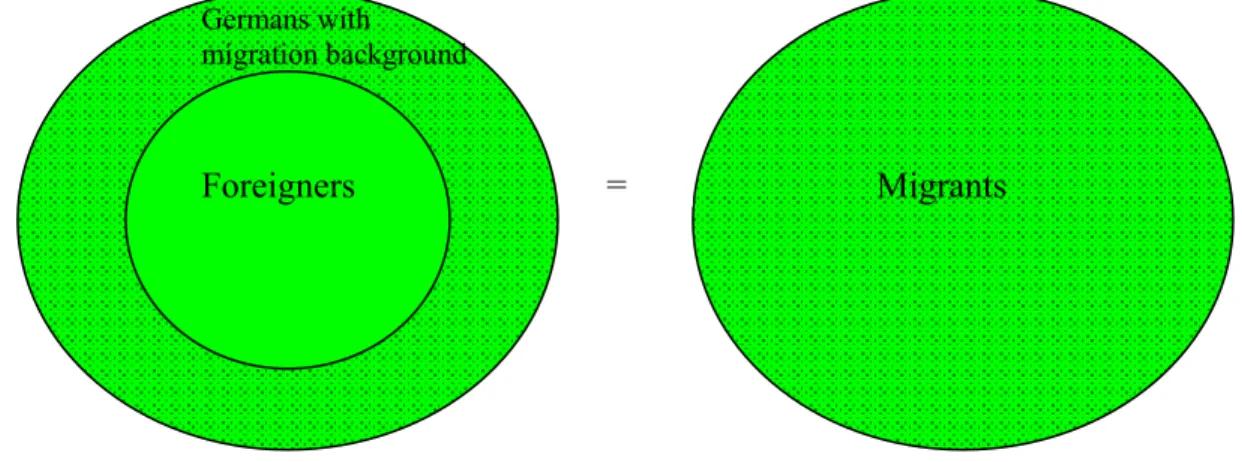
between the broader group of migrants, i.e., people with a personal migration experience and Germans with migration background, the narrower group of Germans with migration background and foreigners (Figure 2).
Figure 2: Migrants, Foreigners and Germans with Migration Background
Foreigners
Germans with migration background
= Migrants
Source: authors’.
We expect that foreigners and German migrants have different remittance patterns due to their different integration and status in Germany. Analyzing solely the remittance behavior of the broad group of migrants would not enable us to disentangle these effects. Table 2 provides some basic information about the average remittances sent.
Table 2: The Amount of Remittances in Euro (annually), 2001-2006
Migrants Foreigners
Women Men Women Men
Year Mean Median Mean Median Mean Median Mean Median
2001 1 066 767 1 456 1 022 1 247 1 022 1 565 1 022 2002 1 340 675 1 631 1 000 1 656 1 000 2 127 1 000 2003 1 469 800 1 612 1 000 1 750 1 000 1 866 1 200 2004 1 458 750 1 662 1 000 1 737 1 000 2 004 1 500 2005 1 423 625 2 010 1 000 1 690 1 000 2 362 1 000 2006 1 529 500 2 331 1 000 1 705 950 3 234 1 500
Note: persons older than 18 years living in private households; weighted mean Source: 2001-2006 SOEP, authors’ calculations
All in all, the average amount of remittances increased over time. This finding is totally in line with macro data on remittances. The highest growth was reached in the group of male foreigners. In 2006, the average amount remitted by this group was as twice as high as in 2001 and accounted for more than 3 200 euros. In general, foreigners remit more than migrants, which might be due to the higher pressure on them for return migration. This finding holds true for both women and men. In addition, gender-specific patterns are observable. In both groups, foreigners and migrants, women remit less than men. In 2006, the average amount remitted by foreign women accounted for only 50 percent of the average amount remitted by foreign men.
To explain the determinants of the amount remitted, several standard explanatory variables are employed:
Age: According to the theoretical literature, the age of the remitter plays a positive role. However, beyond a certain age, this tends to decline. This finding is reported in many empirical studies and often explained by the assumption that personal ties in the recipient countries become more distant with age. The variable “age squared” is used to control for these non-linearities. In accordance with the existing literature, we expect a positive sign of the variable age and a negative one in the case of the variable age squared.
Gender: Many empirical studies report a significant influence of gender on the amount of remittances. While Lucas and Stark (1985) found in their seminal work on remittances that women show a higher probability to remit, more recent studies have produced the opposite finding. Here we use a dummy variable to check for the gender effect. The variable “gender” is 1 in the case of a female remitter and 0 in the case of a male remitter.
Marital status: Several empirical studies come to the conclusion that married migrants send larger amounts of remittances abroad (Merkle/Zimmermann 1992; Sinning 2007). Therefore we expect a positive sign of this dummy variable.
Education: The value of the migrant’s human capital is reflected in years of education. According to theoretical models that rely on altruism as well as on intra-family-investment schemes, better education leads to higher transfers. Therefore a positive sign is expected here.
Income: To capture the influence of the migrant’s income, we use monthly individual income data. In addition, we construct the net equivalent family income in subtracting the individual income from the household income, which should capture the income of other family members
and make it easier to compare persons in households with different numbers of members. According to the theoretical literature, remittances increase with the migrant’s per capita income. This finding is reported in all microeconomic models. Therefore, we expect this variable to show a positive sign for the personal labor income of the migrant and foreigner.
Household size in Germany: One important determinant of the amount of remittances is the household size of the migrant in the host country. The more members of the household live in Germany, the more Germany can be considered the locus of family life. Therefore, and in line with the theoretical models and empirical findings, we assume that the amount of remittances decrease with increasing numbers of members in the migrant’s household in Germany.
Relative duration of stay: The variable “relative duration of stay” is constructed as “years in Germany divided by age” and reflects the influence of the years spent in Germany on remittances. The variable ranges between 0 and 1 and takes the value of 1 if the migrant has spent his or her entire lifetime in Germany. This variable can be taken as a proxy for the influence of the duration of the stay in Germany (relative to the age of the migrant). According to the construction of the variable, we expect a negative sign, which is in line with the findings from several previous empirical studies showing that remittances decrease with the length of the stay abroad.
Remigration plans: In addition, the migrant’s plan for return migration may influence the decision on remittances. Fortunately the SOEP data enable us to check for this. We assume that personal remigration plans are strongly linked to social networks abroad. Remittances are one important tie between the social network in the home country and the migrant. Therefore we expect a positive sign in the case of future return migration plans.
Social networks: In addition to these standard variables, we check for the existence of social networks in the home country. To analyze the network effects, we construct dummy variables for having (grand)parents, children, siblings, or other relatives or friends abroad. In line with the literature on remittances, we assume that in general the existence of social networks abroad will lead to higher remittances. Therefore we expect positive signs of all the network variables employed.
After excluding all observations with missing values on one of the variables used in the analysis, the panel data set contains 10 440 observations in the case of migrants and 6 627 observations in the case of foreigners (2001-2006). Because not all immigrants remit, the data set contains many
zeros. To deal with this issue, in analyzing the determinants of the amount of remittances we perform estimations of Tobit models, which enable us to analyze the determinants of the positive amount in relation to socio-economic variables. For all panel models, Hausman statistics were calculated to test the choice between random or fixed effects models. Although random effects models do not control for omitted characteristics of the individuals, our objective was to include stable covariates such as family network of the individual.
4 Empirical Results
The fact, that one person remits can be interpreted as an indicator of the existence of personal ties to the home country. As the descriptive statistic shows, about one-fifth of the migrants living in Germany send money home. What determines the amount of remittances? Here, we proceed in three steps. All the models are estimated separately for the broad group of migrants, for Germans with a migration background, and for foreigners (Tables 3, 4, 5). First, we estimate the “core” equation, which answers the question of how important the standard variables are in general. In doing, so we check for the importance of the variable “gender” (Model a). Second, since we want to attain further insights into network effects and gender-specific differences in remittances, we estimate an extended equation (Model b). In addition, we estimate Model b separately for males and females (Model c). Third, and foremost we introduce interaction terms and check for their explanatory power (Table 6).
4.1 The Core Model
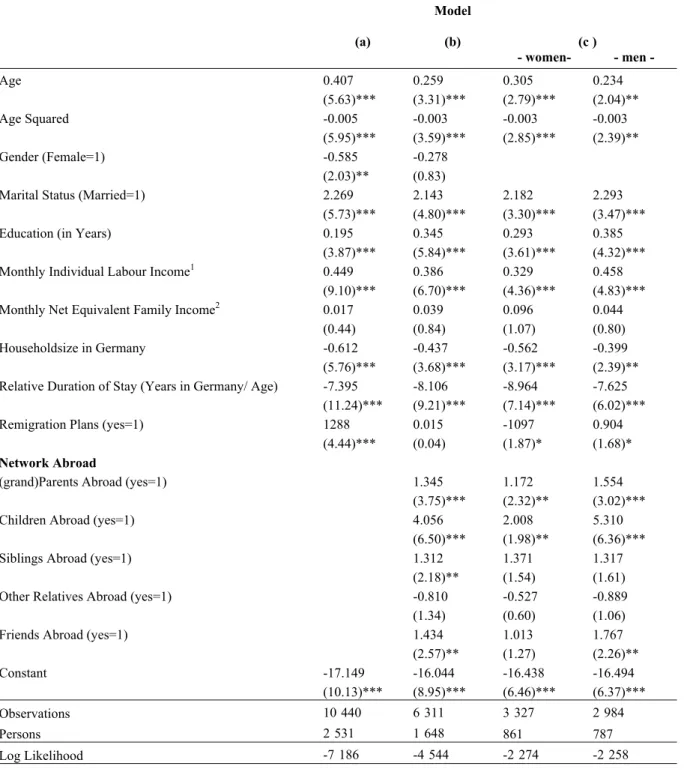
Tables 3, 4, 5 present the results of the “core” model in all three cases: migrants, foreigners, and Germans with migration background (Column 1). Focusing on the broad group of migrants, our central findings are: female migrants remit significantly less than males. Remittances increase with the age of the migrant. However, this relationship is not linear. This is in accordance to the finding that with the duration of the stay, the amount remitted decreases significantly. Being married and plans for remigration lead to significantly higher remittances. The same holds true for higher personal income. Nevertheless, no significant influence of net household equivalent income on remittances is reported. In addition, better education leads to significantly higher remittances. All in all, the results reported support the view that remittances can be at least partly
considered as a tool for international insurance and risk diversification. This is totally in line with the existing literature on remittances from Germany (Merkle/Zimmermann 1995; Oser 1995; Sinning 2007).
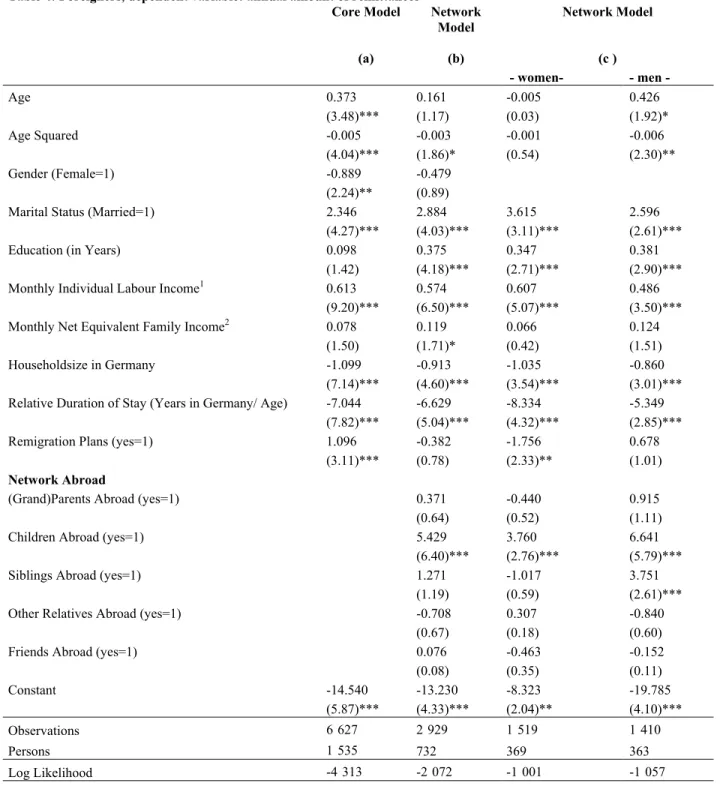
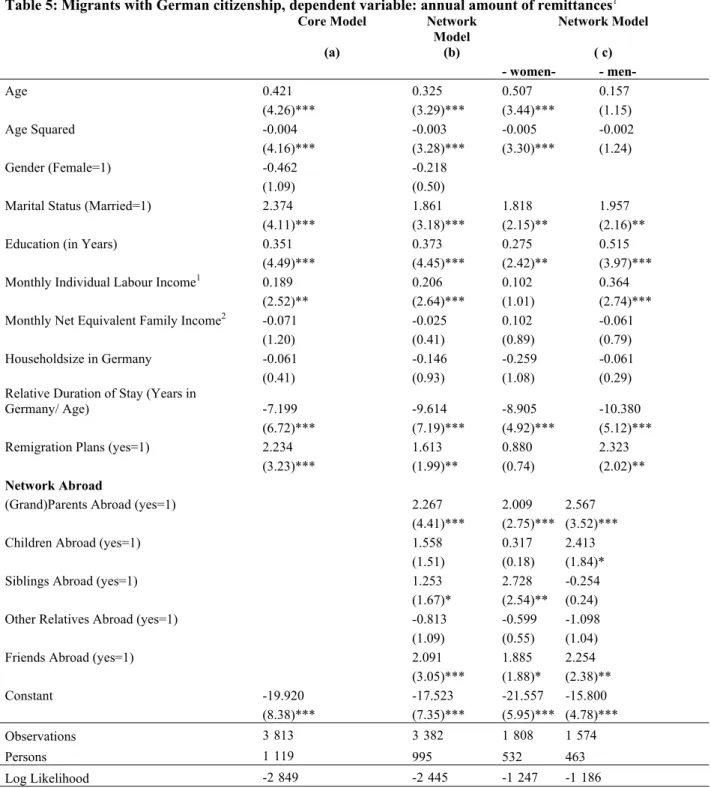
Turning now to the subgroups of foreigners and Germans with a migration background, we find several differences in remittance behavior. While female foreigners remit significantly less than males, the variable “gender” has become insignificant in the case of Germans with a migration background. In addition, the household size in Germany has no significant effect on remittances of Germans with a migration background. In the case of foreigners, it becomes clear that there is no significant linkage between the level of education and the amount remitted.
4.2 Network effects
Now we check for the explanatory power of transnational (family) networks. Model b clearly reveals that networks are important for all three groups. However the effects of the different network variables on remittances vary widely between the three groups. Focusing on migrants, it becomes clear that having children, siblings, and friends abroad has a positive impact on the amount remitted (Table 3). Nevertheless, intergenerational transfers seem to go first and foremost to the younger generation. It appears noteworthy that after controlling for network effects, the gender variable becomes insignificant, indicating that the remittance decisions of men and women follow a similar structure. In addition, remigration plans are no longer significantly related to remittances. At first glance, there is little reason to assume that the gender-pooled estimation leads to misleading results. However, turning to Model c, which enables us to distinguish between the groups of women and men, we see that gender-specific differences in remittances do exist. Men and women send more money home if parents, grandparents, or children live abroad. Having friends living abroad indicates higher remittances only in the case of men. In contrast to earlier studies using a specific data set (Orozco/Lowell/Schneider 2006), there seems to be evidence that women’s remittances are concentrated on intergenerational transfers. In other words, men seem to have a wider network than women.
Similar patterns can be detected in the case of foreigners (Table 4). Again, after checking for network effects, the variable gender becomes insignificant. However, within the set of variables on social networks only the variable “children abroad” shows a significantly positive impact on remittances. Model c reveals that women and men differ concerning their remittance behavior.
While, men also seem to feel responsible for siblings and children abroad, women focus their remittances on children.
Turning now to the group of Germans with a migration background (Table 5, Model b) it can be shown that having parents/grandparents, siblings or friends abroad leads to higher remittances. Focusing on the gender-specific aspects of remittances (Model c), it becomes clear that females remit more if parents/grandparents, siblings, or friends are living in the home country. In the case of men, significantly higher remittances are reported if parents/grandparents, children, or friends are living abroad. All in all, remittances seem to depend on the relative position of the migrant within the transnational family.
4.3 What determines the gender-specific pattern of remittances?
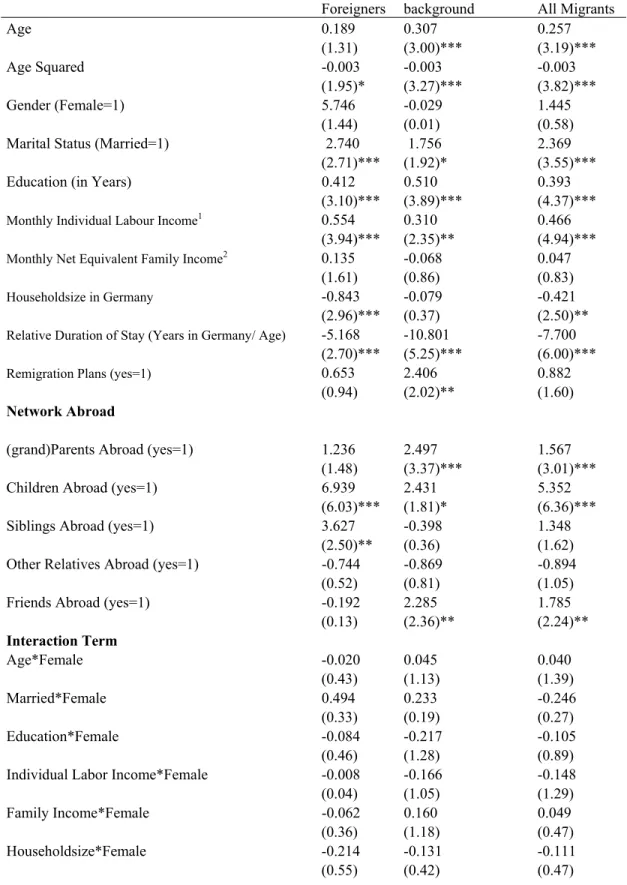
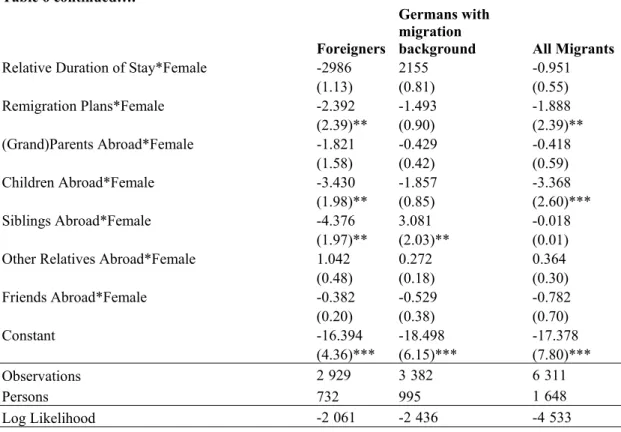
Do our findings for the two separated groups of women and men also mean that the amount remitted depends significantly on gender-specific patterns? To check for significant differences, we use interaction terms (Table 6). For the broad group of migrants, we see that if parents/grandparents or children are living abroad, females remit less than males. Only by looking at the two subgroups of foreigners and Germans with a migration background we can identify different social network effects on the amount of remittances. First we see for foreigners with remigration plans that women remit less than men, an effect that is not significant for the group of German migrants. Second, in the case of foreigners with children abroad, women remit significantly less than men. This effect is also not significant in the group of Germans with a migration background. Third, in the group of foreigners with siblings abroad, women remit less than men. Here we find that just the opposite is true for Germans with a migration background: women remit even more than men. In the estimation for the broad group of migrants, this effect was not significant because the effects of the subgroups canceled each other out. All in all, these findings indicate that the relative position of the migrant within the transnational family seems to play an important role for remittances.
Table 3: Migrants, dependent variable: annual amount of remittances1 Core Model (a) Network Model (b) Network Model (c ) - women- - men - Age 0.407 0.259 0.305 0.234 (5.63)*** (3.31)*** (2.79)*** (2.04)** Age Squared -0.005 -0.003 -0.003 -0.003 (5.95)*** (3.59)*** (2.85)*** (2.39)** Gender (Female=1) -0.585 -0.278 (2.03)** (0.83) Marital Status (Married=1) 2.269 2.143 2.182 2.293
(5.73)*** (4.80)*** (3.30)*** (3.47)*** Education (in Years) 0.195 0.345 0.293 0.385 (3.87)*** (5.84)*** (3.61)*** (4.32)*** Monthly Individual Labour Income1 0.449 0.386 0.329 0.458
(9.10)*** (6.70)*** (4.36)*** (4.83)*** Monthly Net Equivalent Family Income2 0.017 0.039 0.096 0.044
(0.44) (0.84) (1.07) (0.80) Householdsize in Germany -0.612 -0.437 -0.562 -0.399 (5.76)*** (3.68)*** (3.17)*** (2.39)** Relative Duration of Stay (Years in Germany/ Age) -7.395 -8.106 -8.964 -7.625
(11.24)*** (9.21)*** (7.14)*** (6.02)*** Remigration Plans (yes=1) 1288 0.015 -1097 0.904
(4.44)*** (0.04) (1.87)* (1.68)*
Network Abroad
(grand)Parents Abroad (yes=1) 1.345 1.172 1.554
(3.75)*** (2.32)** (3.02)*** Children Abroad (yes=1) 4.056 2.008 5.310
(6.50)*** (1.98)** (6.36)*** Siblings Abroad (yes=1) 1.312 1.371 1.317
(2.18)** (1.54) (1.61) Other Relatives Abroad (yes=1) -0.810 -0.527 -0.889
(1.34) (0.60) (1.06) Friends Abroad (yes=1) 1.434 1.013 1.767
(2.57)** (1.27) (2.26)** Constant -17.149 -16.044 -16.438 -16.494 (10.13)*** (8.95)*** (6.46)*** (6.37)*** Observations 10440 6311 3327 2984 Persons 2531 1648 861 787 Log Likelihood -7186 -4544 -2274 -2258 1 ln; 2 ln of monthly net equivalent family income minus individual’s income.
Note: Spouse abroad: N<3. Variables not reported here are: Imputation Flags for Individual Labor Income and Family Labor Income.
Absolute value of z statistics in parentheses; * significant at 10%; ** significant at 5%; *** significant at 1%. Source:SOEP, 2001-2006, authors’ calculations
Table 4: Foreigners, dependent variable: annual amount of remittances1 Core Model (a) Network Model (b) Network Model (c ) - women- - men - Age 0.373 0.161 -0.005 0.426 (3.48)*** (1.17) (0.03) (1.92)* Age Squared -0.005 -0.003 -0.001 -0.006 (4.04)*** (1.86)* (0.54) (2.30)** Gender (Female=1) -0.889 -0.479 (2.24)** (0.89) Marital Status (Married=1) 2.346 2.884 3.615 2.596
(4.27)*** (4.03)*** (3.11)*** (2.61)*** Education (in Years) 0.098 0.375 0.347 0.381
(1.42) (4.18)*** (2.71)*** (2.90)*** Monthly Individual Labour Income1 0.613 0.574 0.607 0.486
(9.20)*** (6.50)*** (5.07)*** (3.50)*** Monthly Net Equivalent Family Income2 0.078 0.119 0.066 0.124
(1.50) (1.71)* (0.42) (1.51) Householdsize in Germany -1.099 -0.913 -1.035 -0.860
(7.14)*** (4.60)*** (3.54)*** (3.01)*** Relative Duration of Stay (Years in Germany/ Age) -7.044 -6.629 -8.334 -5.349 (7.82)*** (5.04)*** (4.32)*** (2.85)***
Remigration Plans (yes=1) 1.096 -0.382 -1.756 0.678
(3.11)*** (0.78) (2.33)** (1.01)
Network Abroad
(Grand)Parents Abroad (yes=1) 0.371 -0.440 0.915
(0.64) (0.52) (1.11) Children Abroad (yes=1) 5.429 3.760 6.641
(6.40)*** (2.76)*** (5.79)*** Siblings Abroad (yes=1) 1.271 -1.017 3.751
(1.19) (0.59) (2.61)*** Other Relatives Abroad (yes=1) -0.708 0.307 -0.840
(0.67) (0.18) (0.60) Friends Abroad (yes=1) 0.076 -0.463 -0.152
(0.08) (0.35) (0.11) Constant -14.540 -13.230 -8.323 -19.785 (5.87)*** (4.33)*** (2.04)** (4.10)*** Observations 6627 2929 1519 1410 Persons 1535 732 369 363 Log Likelihood -4313 -2072 -1001 -1057 1 ln; 2 ln of monthly net equivalent family income minus individual’s income.
Note: Spouse abroad: N<3. Control variables not reported here are: Imputation Flags for Individual Labor Income and Family Labor Income.
Absolute value of z statistics in parentheses; * significant at 10%; ** significant at 5%; *** significant at 1%. Source:SOEP, 2001-2006, authors’ calculations
Table 5: Migrants with German citizenship, dependent variable: annual amount of remittances1 Core Model (a) Network Model (b) Network Model ( c) - women- - men- Age 0.421 0.325 0.507 0.157 (4.26)*** (3.29)*** (3.44)*** (1.15) Age Squared -0.004 -0.003 -0.005 -0.002 (4.16)*** (3.28)*** (3.30)*** (1.24) Gender (Female=1) -0.462 -0.218 (1.09) (0.50) Marital Status (Married=1) 2.374 1.861 1.818 1.957
(4.11)*** (3.18)*** (2.15)** (2.16)** Education (in Years) 0.351 0.373 0.275 0.515
(4.49)*** (4.45)*** (2.42)** (3.97)*** Monthly Individual Labour Income1 0.189 0.206 0.102 0.364
(2.52)** (2.64)*** (1.01) (2.74)*** Monthly Net Equivalent Family Income2 -0.071 -0.025 0.102 -0.061
(1.20) (0.41) (0.89) (0.79) Householdsize in Germany -0.061 -0.146 -0.259 -0.061
(0.41) (0.93) (1.08) (0.29) Relative Duration of Stay (Years in
Germany/ Age) -7.199 -9.614 -8.905 -10.380
(6.72)*** (7.19)*** (4.92)*** (5.12)*** Remigration Plans (yes=1) 2.234 1.613 0.880 2.323
(3.23)*** (1.99)** (0.74) (2.02)**
Network Abroad
(Grand)Parents Abroad (yes=1) 2.267 2.009 2.567
(4.41)*** (2.75)*** (3.52)*** Children Abroad (yes=1) 1.558 0.317 2.413
(1.51) (0.18) (1.84)* Siblings Abroad (yes=1) 1.253 2.728 -0.254
(1.67)* (2.54)** (0.24) Other Relatives Abroad (yes=1) -0.813 -0.599 -1.098
(1.09) (0.55) (1.04) Friends Abroad (yes=1) 2.091 1.885 2.254
(3.05)*** (1.88)* (2.38)** Constant -19.920 -17.523 -21.557 -15.800 (8.38)*** (7.35)*** (5.95)*** (4.78)*** Observations 3813 3382 1808 1574 Persons 1119 995 532 463 Log Likelihood -2849 -2445 -1247 -1186
1 ln; 2 ln of monthly net equivalent family income minus individual’s income.
Note: Spouse abroad: N<3. Control variables not reported here are: Imputation Flags for Individual Labor Income and Family Labor Income.
Absolute value of z statistics in parentheses; * significant at 10%; ** significant at 5%; *** significant at 1%. Source:SOEP, 2001-2006, authors’ calculations.
Table 6: Networks and Gender, dependent variable: annual amount of remittances1
Foreigners Germans with
migration
background All Migrants
Age 0.189 0.307 0.257 (1.31) (3.00)*** (3.19)*** Age Squared -0.003 -0.003 -0.003 (1.95)* (3.27)*** (3.82)*** Gender (Female=1) 5.746 -0.029 1.445 (1.44) (0.01) (0.58)
Marital Status (Married=1) 2.740 1.756 2.369
(2.71)*** (1.92)* (3.55)***
Education (in Years) 0.412 0.510 0.393
(3.10)*** (3.89)*** (4.37)***
Monthly Individual Labour Income1 0.554 0.310 0.466
(3.94)*** (2.35)** (4.94)***
Monthly Net Equivalent Family Income2 0.135 -0.068 0.047
(1.61) (0.86) (0.83)
Householdsize in Germany -0.843 -0.079 -0.421
(2.96)*** (0.37) (2.50)**
Relative Duration of Stay (Years in Germany/ Age) -5.168 -10.801 -7.700
(2.70)*** (5.25)*** (6.00)***
Remigration Plans (yes=1) 0.653 2.406 0.882
(0.94) (2.02)** (1.60)
Network Abroad
(grand)Parents Abroad (yes=1) 1.236 2.497 1.567
(1.48) (3.37)*** (3.01)***
Children Abroad (yes=1) 6.939 2.431 5.352
(6.03)*** (1.81)* (6.36)***
Siblings Abroad (yes=1) 3.627 -0.398 1.348
(2.50)** (0.36) (1.62)
Other Relatives Abroad (yes=1) -0.744 -0.869 -0.894
(0.52) (0.81) (1.05)
Friends Abroad (yes=1) -0.192 2.285 1.785
(0.13) (2.36)** (2.24)** Interaction Term Age*Female -0.020 0.045 0.040 (0.43) (1.13) (1.39) Married*Female 0.494 0.233 -0.246 (0.33) (0.19) (0.27) Education*Female -0.084 -0.217 -0.105 (0.46) (1.28) (0.89)
Individual Labor Income*Female -0.008 -0.166 -0.148
(0.04) (1.05) (1.29)
Family Income*Female -0.062 0.160 0.049
(0.36) (1.18) (0.47)
Householdsize*Female -0.214 -0.131 -0.111
Table 6 continued….
Foreigners Germans with
migration
background All Migrants
Relative Duration of Stay*Female -2986 2155 -0.951
(1.13) (0.81) (0.55) Remigration Plans*Female -2.392 -1.493 -1.888 (2.39)** (0.90) (2.39)** (Grand)Parents Abroad*Female -1.821 -0.429 -0.418 (1.58) (0.42) (0.59) Children Abroad*Female -3.430 -1.857 -3.368 (1.98)** (0.85) (2.60)*** Siblings Abroad*Female -4.376 3.081 -0.018 (1.97)** (2.03)** (0.01)
Other Relatives Abroad*Female 1.042 0.272 0.364
(0.48) (0.18) (0.30) Friends Abroad*Female -0.382 -0.529 -0.782 (0.20) (0.38) (0.70) Constant -16.394 -18.498 -17.378 (4.36)*** (6.15)*** (7.80)*** Observations 2929 3382 6311 Persons 732 995 1648 Log Likelihood -2061 -2436 -4533
1 ln; 2 ln of monthly net equivalent family income minus individual’s income.
Note: Spouse abroad: N<3. Control variables not reported here are Imputation Flags for Individual Labor Income and Family Labor Income.
Absolute value of z statistics in parentheses; * significant at 10%; ** significant at 5%; *** significant at 1%. Source:SOEP, 2001-2006, authors’ calculations
5 Conclusions
The results presented show that gender-specific patterns of remittances exist. In addition, the study underlines the hypothesis that one important motivation of remittances might be the existence of transnational (family) networks. We have shown that female migrants tend to send support to their children first and foremost, while male migrants tend to support a wider network of more distant family members and friends. This finding is in sharp contrast to previous studies on remittances. It makes clear that there is little room for the assumption that remittances simply follow income-difference-based altruism or that women are more altruistic than men.
The specific differences in remittance behavior identified here might be due to gender-specific migration patterns. However, they also might be due to the relative position of the migrant within the transnational network: in other words, whether or not the migrant is considered the major breadwinner for a broader range of family members living abroad.
This study can be considered a first step in the analysis of remittances from the perspective of gender economics. The analysis of linkages between the structure of transnational networks and gender-specific remittance behavior also shows a potentially interesting direction for future research. One natural extension of this paper would be a deeper investigation of the social determinants of remittances, possibly linking the social networks literature to the economic literature on remittances. Such a study should analyze how the quality of the transnational network influences the decision to remit. In addition, deeper investigation of the potential gender-specific motivations of migrants might be possible using the tools of experimental economics (Fehr/Fischbacher/Rosenbladt/Schupp/Wagner 2002).
References
Bash, L., Glick Schiller, N. and C. Blanc-Szanton (1998): Nations Unbound: Transnational Projects, Postcolonial Predicaments, and Deterritorialized Nation-States. New York: Gordon and Breach.(Reprint 4)
Constant, A. and K. Zimmermann (2007): Circular Migration : Counts of Exits and Years away from the Host Country. In: DIW Discussion Paper 718
Constant, A., L. Gataullina and K. Zimmermann (2007): Naturalization Proclivities, Ethnicity and Integration. In: DIW Discussion Paper
Esser, H. (2001): Integration und ethnische Schichtung. In: Arbeitspapiere - Mannheimer Zentrum für Europäische Sozialforschung (40). Mannheim
Fehr, E., U. Fischbacher, B. von Rosenbladt, J. Schupp, and G.G. Wagner (2002): A Nation- Wide Laboratory. Examining trust and trustworthiness by integration behavioral experiments into representative surveys. In: Schmollers Jahrbuch (Journal of Applied Social Science Studies), (122)4: 519-542
Faist, T. (2000): The Volume and Dynamics of International Migration and Transnational Social Spaces. Oxford: Oxford University Press
Foster, A.D. and M.R. Rosenzweig (2001): Imperfect commitment, altruism and the family: evidence form transfer behavior in low-income rural areas. In: Review of Economics and Statistics, LXXXIII (3): 389-407
Friedman, M. (1953): Choice, Chance, and the Personal Distribution of Income. In: J.P.E.61, (August 1953), 4: 277-90
Galor. O. and Stark. O. (1990): Migrants' Savings, the Probability of Return Migration and Migrants' Performance. In: International Economic Review, (31) 2: 463-467
Grazier, S. and Peter J. Sloane (2006): Accident Risk, Gender, Family Status and Occupational Choice in the UK. In: IZA DP (2302) September 2006
Guarnizo, L. E. (2003): The Economics of Transnational Living. In: International Migration Review, 37 (3): 666-699
Holst, E. and M. Schrooten (2006): Migration and Money – What Determines Remittances? Evidence from Germany. In: DIW Discussion Paper 566
Holst, E., A. Schaefer and M. Schrooten (2008): Bringing home the Money – Xenophobia and Remittances. The Case of Germany. In: DIW Discussionpaper 774. http://www.diw.de/deutsch/sop/service
Itzigsohn, J. and S. Giorguli-Saucedo (2005): Incorporation, Transnationalism, and Gender: Immigrant Incorporation and Transnational Participation as Gendered Processes. In: International Migration Review, 39(4): 895–920
Lucas, R.E.B. and O. Stark (1985): Motivations to Remit: Evidence from Botswana. In: Journal of Political Economy, 93: 901-918
Lucassen, L. (2006): Is Transnationalism Compatible with Assimilation? Examples from Western Europe since 1850.In: IMIS-BEITRÄGE 29: 15-35
Massey, D.S., and M. Sana (2005): Household Composition, Family Migration, and Community Context. Migrant Remittances in Four Countries. In: Social Science Quarterly, 86 (2): 509-528 Merkle, L. and K. F. Zimmermann (1992): Savings, remittances, and return migration. In: Economic Letters, 38: 77-81
Morawska, E. (2002): Immigrant Transnationalism and Assimilation: A Variety of Combinations and the Analytic Strategy it Suggests. In: Morawska, E., Joppke, C. (eds.): Toward Assimilation and Citizenship in Liberal Nation-States. London: Palgrave Macmillan, 133-176
Orozco, M., B. L. Lowell and J. Schneider (2006): Gender Specific Determinants of Remittances: Differences in Structure and Motivation. In: Report to the World Bank Group, mimeo
Oser, U. (1995): Remittances of Guest Workers to their Home Countries: An Econometric Analysis. In: Diskussionspapier (25) Konstanz: Universität Konstanz, Fakultät für Wirtschaftswissenschaften und Statistik
Pessar P. and Mahler, S. (2003): Transnational Migration – Bringing Gender In. In: International Migration Review 37(3): 812-843
Poirine, B. (1997): A Theory of Remittances as an Implicit Family Loan Arrangement. In: World Development, 25 (4): 589-611
Portes, A. (1997): Immigration Theory for a New Century: Some Problems and Opportunities. In: International Migration Review 31(4):799-825
Ramirez, C. (2005): Conceptual Framework on Gender and Remittances. Presentation prepared for the International Forum on Remittances June 28th, 29th & 30th, 2005. Washington DC. www.instraw.org
Ramirez, C., M.G. Dominguez and J.M. Morais (2005): Crossing Borders: Remittances, Gender and Development. In: UN-Istraw. Working Paper
Rapoport, H. and F. Docquier (2005): The Economics of Migrants’ Remittances. In: IZA Discussion Paper (1531)
Rosenzweig, M.R. (1988): Risk, private information, and the family. In: American Economic Review – Papers and Proceedings, 78 (2): 245-250
Sinning, M. (2007): Determinants of Savings and Remittances: Empirical Evidence from Immigrants to Germany. In: IZA Discussion Paper (2966)
SOEP Group (2001): The German Socio-Economic Panel (GSOEP) after more than 15 years - Overview. In: Elke Holst, Dean R. Lillard und Thomas A. DiPrete (Hg.): Proceedings of the 2000 Fourth International Conference of German Socio-Economic Panel Study Users (GSOEP2000), Vierteljahrshefte zur Wirtschaftsforschung., 70 (1): 7-14
Sørenson, N. (2005) : Migrant remittances, development and gender. Dansk Institut for Internationale Studier, Copenhagen, Denmark. DIIS brief
Stark, O. and Y.O. Wang (2002): Migration Dynamics, Economics Series 112, Institute for Advanced Studies
Stark, O. (1995): Altruism and Beyond. MIT Press, Cambridge, MA
Federal Statistical Office (2008): Bevölkerung und Erwerbstätigkeit. Ausländische Bevölkerung Ergebnisse des Ausländerzentralregisters. Fachserie 1 Reihe 2
The World Bank (2005): Global Economic Perspectives. Economic Implications of Migration and Remittances. Washington D.C
The World Bank (2008): Migration and Remittances. Factbook. Washington D.C.
VanWey, L.K. (2004): Altruistic and Contractual Remittances Between Male and Female Migrants and Households in Rural Thailand. In: Demography, 41 (4): 739-756