1
MEASURING MULTI-FACTOR PRODUCTIVITY BY INDUSTRY: METHODOLOGY AND FIRST RESULTS FROM THE OECD PRODUCTIVITY DATABASE
Benoit Arnaud, Julien Dupont, Seung-Hee Koh, Paul Schreyer
Table of contents
Introduction ... 2
II) Measuring labour and capital inputs and multi-factor productivity at the industry level ... 3
II.1) Labour input (total hours worked) ... 3
II.2) Labour remuneration and labour shares ... 4
II.3) Capital input ... 4
a. Estimating depreciation rates ... 5
b. Measuring initial capital stocks ... 5
c. Estimating net capital stocks ... 6
d. Measuring the user cost of capital by industry ... 6
II.4) Estimating multi-factor productivity growth ... 7
III) First results ... 8
III.1). Labour productivity and multi-factor productivity ... 8
III.2) Descriptive growth accounts ... 12
III.3) Comparison of MFP between PDBi and EU KLEMS ... 13
IV) How to access PDB and PDBi? ... 14
Conclusions and further progress ... 14
Annex 1. List of variables included in the OECD Productivity database by industry and related indicators from STAN ... 15
Annex 2. List of industrial activities, according to STAN, based on ISIC Rev.3 ... 16
Annex 3. Coverage of labour productivity and multi-factor productivity data in PDBi ... 17
2
MEASURING MULTI-FACTOR PRODUCTIVITY BY INDUSTRY: METHODOLOGY AND FIRST RESULTS FROM THE OECD PRODUCTIVITY DATABASE
Introduction
Since 2003, the OECD Productivity database1 (hereafter PDB) has provided time series of productivity measures and their components for international comparisons and productivity analysis. In particular, the PDB offers measures of Multi-factor productivity (MFP) that compares the evolution of output with the evolution of combined labour and capital inputs. These MFP series have been constructed at the level of entire economies. While useful for many purposes, there has also been increasing interest in industry-level productivity MFP measures. Such industry-level information exists but only for labour productivity, the ratio between output and labour input. A joint project between the OECD Directorate for Science, Technology and Industry and the OECD Statistics Directorate was launched in 2008 with the aim of developing MFP measures by industry.
These new productivity measures by industry (PDBi) should comply with the following criteria:
First, there should be full compatibility with the industry-level data that the OECD compiles in its STructural ANalysis database (STAN). Indeed, measures of output and labour input required to construct industry-level MFP series, should be directly sourced from STAN.
Second, there should be regular updates so as to make the new MFP data attractive to those researchers inside and outside the OECD who put a particular premium on timeliness. STAN ensures timeliness through a rolling update (as opposed to updates at fixed intervals) that follows as closely as possible countries‟ release calendars of industry-level national accounts data. PDBi will also be managed with a rolling update procedure.
Third, the methodology for PDBi series should reflect the standards put forward in the OECD Manuals on Measuring Productivity (2001) and Measuring Capital (2009). These recommendations have been followed for the productivity measures at the total economy level in the PDB.
The main missing ingredient for MFP computations by industry was a measure of capital input by industry. Consequently, at the heart of the project presented here is the construction of a new series of capital measures by industry using a common methodology for all countries. In terms of the first and second criterion mentioned above, the project has been successful. With regard to the third criterion, data constraints imposed a deviation from recommended practice. More specifically, information on investment by industry and by type of asset is not generally available and a simplified method had to be used to measure capital inputs. In essence, capital stocks were measured rather than capital services. The former take no account of differences in the relative productivity of different types of assets, the latter does and constitutes the conceptually preferable measure of capital input. This deficiency will be rectified as more
1http://www.oecd.org/statistics/productivity
3
detailed industry-level source data becomes available. For the time being, however, the PDBi measures have to rely on the simplified stock approach.
One consequence of this simplification is that industry-level data are not directly comparable with the economy-wide MFP data that are based on a measure of capital services. However, within PDBi, consistent aggregate productivity measures are being presented allowing for instance for a de-composition of aggregate productivity growth into contributions by different industries.
Both PDB and PDBi cover about twenty countries although some differences in coverage remain: some countries that are unavailable in PDB are covered in PDBi (Czech Republic, Greece, Iceland, Norway and Poland) while some results are available in PDB level but not in PDBi (Australia, Japan, New Zealand, Portugal and Switzerland).
Finally, an important feature of both PDB and PDBi is that no assumption is made with regard to perfect competition and constant returns to scale used in growth accounting. This offers interesting analytical opportunities to measure and study differences in returns to scale and mark-ups across industries and countries.
This paper presents at some detail the methodology and data sources used in the PDBi. There are also first results on labour productivity and MFP by industry, and growth accounts. Finally, the document indicates how to access PDB and PDBi series.
II) Measuring labour and capital inputs and multi-factor productivity at the industry level
II.1) Labour input (total hours worked)
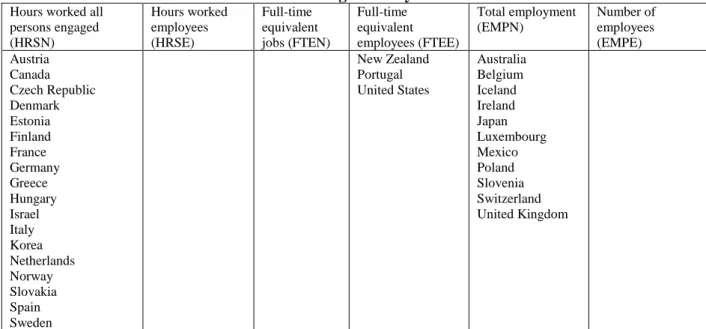
Hours actually worked by all persons engaged is the conceptually preferred measure of unadjusted2 labour input (L) for estimating productivity, but National Statistical Offices often do not publish these data by industry. Where available (and published in the STAN database - see OECD Productivity database by industry data coverage in annex 3), total hours worked (HRSN) have been used as the labour input measure. When HRSN was missing, the hours worked of employees (HRSE) were used as proxy.
In the absence of information about hours worked by industry, hours worked at the level of the total economy (from the OECD Productivity database) were allocated to industries using the structure of the following variables (by order of priority): full-time equivalent jobs (FTEN), full-time equivalent employees (FTEE), total employment (EMPN) and number of employees (EMPE).3
2 The labour input measure is unadjusted for differences in skills and education. An adjusted labour input measure (see Jorgenson, Gollop and Fraumeni 1987) reflects these elements of labour quality.
3 These estimates have been compiled by the OECD for the purpose to estimate labour input for MFP calculations only. There are not publicly available when MFP estimates by industry are not available.
4
Table 1. Variables used for allocating economy-wide hours worked to industries Hours worked all
persons engaged (HRSN) Hours worked employees (HRSE) Full-time equivalent jobs (FTEN) Full-time equivalent employees (FTEE) Total employment (EMPN) Number of employees (EMPE) Austria Canada Czech Republic Denmark Estonia Finland France Germany Greece Hungary Israel Italy Korea Netherlands Norway Slovakia Spain Sweden New Zealand Portugal United States Australia Belgium Iceland Ireland Japan Luxembourg Mexico Poland Slovenia Switzerland United Kingdom
Source: OECD STAN Database for Industry Analysis
II.2) Labour remuneration and labour shares
National accounts provide information on the remuneration of employees. However, for the self-employed, only total income measures are available from the national accounts („mixed income‟) and these comprise both labour and capital income accruing to the self-employed. Labour income of the self-employed was approximated as the average remuneration per employee multiplied by the number of self-employed. Average remuneration per employee is measured as compensation of employees as defined in the System of National Accounts, including all costs for employers such as their contributions to the employee‟s social security.
The share of labour in total costs by industry was then computed as follows:
Labour share ALPHA=
) ) .( ( )) .( ( RK EMPE EMPN WL EMPE EMPN WL (1)
with WL referring to the compensation of employees (LABR in STAN), EMPN to total employment, EMPE to the number of employees and RK the remuneration of capital, described below.
II.3) Capital input
An increasing number of national statistical offices in OECD countries are publishing capital measures by industry, usually gross capital stocks and/or net capital stocks. The difference between these two concepts is depreciation that is reflected in net capital stocks but not in gross capital stocks. However, international comparability of the national data is uncertain, due to differences in methodology and level of detail4. For the purpose at hand, therefore, the OECD computed a series of net capital stocks by industry, using the same assumptions across countries about depreciation patterns and the same level of asset detail.
4
Further information on availability of capital measures in OECD databases is available on internet at the following address: http://www.oecd.org/dataoecd/47/13/37542921.pdf.
5
It is of note that neither gross nor net capital stocks are the conceptually correct measure of capital input. Capital input is best captured by a measure of capital services that weighs different assets with their marginal contribution to output. While measures of capital services have been constructed for the OECD‟s total economy productivity measures, the lack of comprehensive information on investment cross-classified by asset and by industry hampers the computation of capital services measures at the industry level. Recourse had therefore to be taken to a simple measure of the net capital stock. From comparisons at the total economy level it would appear that in most cases measures of capital services growth quicker than the net capital stock. In other words, using the net capital stock as a substitute for a measure of capital services is likely to entail an underestimation of contribution of capital to economic growth, and by implication an overestimation of MFP. This needs to be kept in mind when using and interpreting the new set of industry-level MFP figures.
a. Estimating depreciation rates
Depreciation is the loss of value of an asset due to ageing and the rate of depreciation is asset-specific and specific. In the absence of asset- and specific data on capital, no asset- and industry-specific depreciation rates can be applied. However, rather than applying the same average depreciation rate across industries, an element of industry-specific asset composition was introduced by the use of depreciation rates by industry and by asset (hardware and office equipment, communication equipment, other machinery and equipment, transport equipment, non residential structures, software, and land and residential real estate) from the EU-KLEMS5 database. Thus, despite the fact that PDBi does not contain capital services, these industry-specific depreciation rates do capture some of the overall structure of capital by type of asset. They vary by country, industry and time.
b. Measuring initial capital stocks
Another issue with capital data is the measurement of the initial capital stock. Its choice can significantly influence growth rates of the ensuing capital stock. There are several approaches to measuring an initial capital stock Ko. At the whole economy level, OECD estimates the initial stock using long-term series of investment that are cumulated based on the perpetual inventory method.
For the purpose at hand, the objective was to rely as far as possible on national information on net capital stocks for early years as available in the STAN6 database. When this information was missing (Canada, Greece, Ireland, Korea and the United States), the initial capital stock was approximated following a simple procedure (Kohli 1982) that is based on the average growth of volume investment over the period 1960-19837. With geometric depreciation patterns, the net stock at the beginning of the benchmark year t0 can be approximated by the cumulative depreciated investment of previous years:
K0 = [I t0-1
+ (1-δ)It0-2 + (1-δ)2It0-3 + …] (2)
Call the long-run growth rate of investment θ. By definition, one has It=It-1(1+ θ). This relation can be inserted into the expression above
5 Depreciation rates by industry and by asset available in the EUKLEMS database are not country specific and the US ones have probably been used as proxy for other countries.
6 1970 for Australia, Belgium (for most of industries), Denmark, Norway, Spain and the United Kingdom; 1975 for Finland (for most of industries); 1976 for Austria (for most of industries); 1978 for France; 1980 for Italy, 1990 for Iceland, 1991 for Germany (for most of industries) and the Netherlands (for most of industries), 1993 for Sweden, 1995 for Czech republic and Israel, 2000 for Estonia and Poland.
7 Long-run growth rates of volume investment (volume investment time-series available in STAN are backward extrapolated to 1960 using volume investment time-series from ANA database).
6
[It0-1 + (1-δ)It0-2 + (1-δ)2It0-3 + …] = It0-1 [1 + (1-δ)(1+ θ) + (1-δ)2(1+ θ)2 + …]
= It0-1 (1+ θ) / (δ+ θ) (3)
= It0 / (δ+θ)
Then, given an estimate of θ (which could be based on the long-run relationship between the growth of GDP and investment) and an estimate of the average rate of depreciation, expression (3) provides an estimate for the initial capital stock.
c. Estimating net capital stocks
Basically, net capital stock is estimated by cumulating gross fixed capital formation (GFCF) year by year and by netting out depreciation and retirement. This is the Perpetual Inventory Method (PIM). Net capital stocks by industry are computed with geometric rates. Geometric rates encompass both depreciation and retirement (see OECD 2009 for a full discussion). For each industry i, the net capital stock at the beginning of period t, Ki
t
, has been computed as follows: Ki t = Ii t-1 + (1-δi)Ii t-2 + (1-δi) 2 Ii t-3 +… + (1-δi) T-1 Ii t-T-2 + (1-δi) T K0 (4)
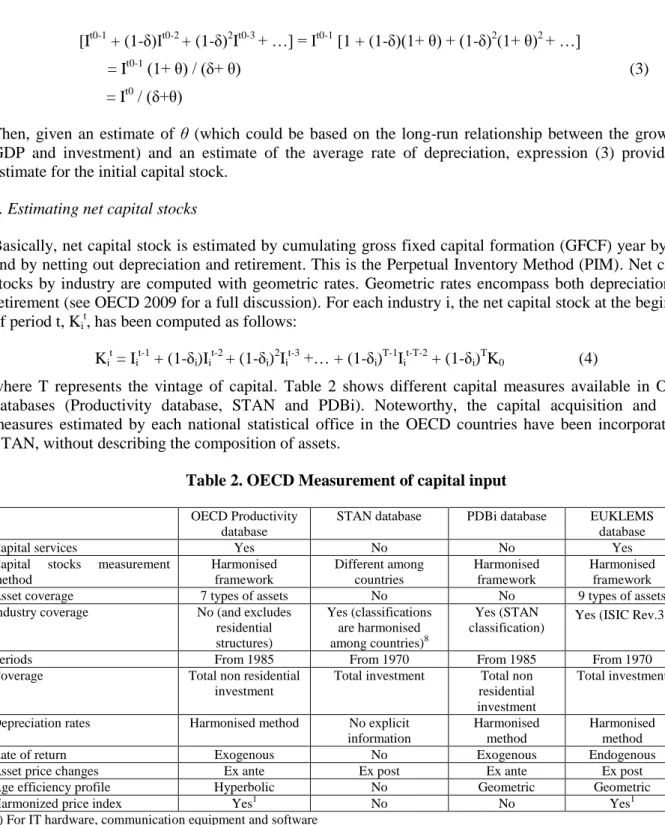
where T represents the vintage of capital. Table 2 shows different capital measures available in OECD databases (Productivity database, STAN and PDBi). Noteworthy, the capital acquisition and stock measures estimated by each national statistical office in the OECD countries have been incorporated in STAN, without describing the composition of assets.
Table 2. OECD Measurement of capital input OECD Productivity
database
STAN database PDBi database EUKLEMS
database
Capital services Yes No No Yes
Capital stocks measurement
method Harmonised framework Different among countries Harmonised framework Harmonised framework
Asset coverage 7 types of assets No No 9 types of assets
Industry coverage No (and excludes
residential structures) Yes (classifications are harmonised among countries)8 Yes (STAN classification)
Yes (ISIC Rev.3)
Periods From 1985 From 1970 From 1985 From 1970
Coverage Total non residential
investment
Total investment Total non
residential investment
Total investment
Depreciation rates Harmonised method No explicit
information
Harmonised method
Harmonised method
Rate of return Exogenous No Exogenous Endogenous
Asset price changes Ex ante Ex post Ex ante Ex post
Age efficiency profile Hyperbolic No Geometric Geometric
Harmonized price index Yes1 No No Yes1
1) For IT hardware, communication equipment and software
d. Measuring the user cost of capital by industry
The measurement of capital remuneration in the PDBi is based on a similar framework as the one used in the Productivity database: it measures the user cost of capital in each industry as the product of unit user
8
The common industry classification across countries is not set in the current study. See OECD Capital Manual (OECD 2009) for the discussion on the industry classification in measuring capital and the recommended kind-of-activity classification.
7
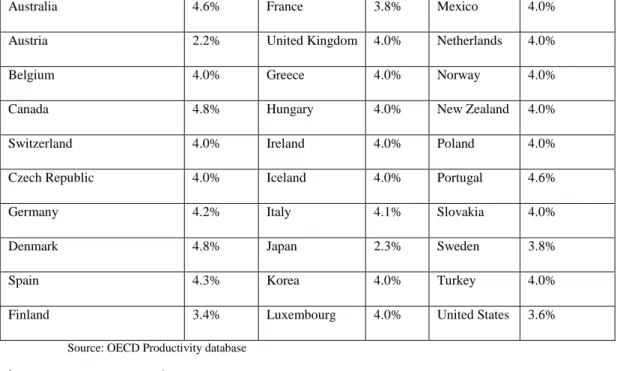
cost and the net capital stock. Unit user costs are composed of a real rate of return and the rate of depreciation. The real rate of return has been chosen in its ex ante formulation, as a long-run constant rate that is country specific and sourced from the OECD Productivity database (see table 3 below).
Table 3. Exogenous real rates of return
Australia 4.6% France 3.8% Mexico 4.0%
Austria 2.2% United Kingdom 4.0% Netherlands 4.0%
Belgium 4.0% Greece 4.0% Norway 4.0%
Canada 4.8% Hungary 4.0% New Zealand 4.0%
Switzerland 4.0% Ireland 4.0% Poland 4.0%
Czech Republic 4.0% Iceland 4.0% Portugal 4.6%
Germany 4.2% Italy 4.1% Slovakia 4.0%
Denmark 4.8% Japan 2.3% Sweden 3.8%
Spain 4.3% Korea 4.0% Turkey 4.0%
Finland 3.4% Luxembourg 4.0% United States 3.6%
Source: OECD Productivity database
With r*t as the interest rate, P as the investment deflator as available from the STAN database, kt,i tias the depreciation rate and Ki
t
as the net capital stock, the user cost of capital for industry i is given as t i t i t t i , k t i P .(r* )K R (5)
An alternative way to compute capital compensation would have been to use an endogenous rate of return equating the total remuneration of capital to the sum of the gross operating surplus and the capital component of mixed income. Then, the value of capital services would completely exhaust capital income and the user cost would have been interpreted as the marginal revenue of each unit of capital services. However, the user cost could also be interpreted as the marginal cost associated with each unit of capital services and this is in line with the method applied for PDBi. Note that the assumption that capital remuneration equals non-labour income implies assuming constant returns to scale of the underlying production or cost function and marginal cost pricing on output markets, i.e. perfect competition. If there are non-constant returns to scale, imperfect competition on output markets, or unobserved assets, only part of the profits correspond to payment for capital services.
II.4) Estimating multi-factor productivity growth
One drawback of the simplified approach outlined above is that it neglects capital services and is therefore not the preferred measure for capital input and productivity calculations.9 This has to be kept in mind when using the simplified multi-factor productivity measures for each industry i that were computed as follows:
9 Net capital stock and capital services could differs unless the unrealistic case applies where the prices of all types of assets move at the same rate and each type of asset depreciates at the same rate.
8 ) K ln( ) ( ) L ln( ) Q ln( MFP it t i t i t i t i t i 1 (6) where t i t i t i t i t i t i t i K u L w L w
is the share of labour in total costs in industry i, . ( ti) t i t i 05 1 its average over two periods, (1-αi
t
) is the share of capital in total costs, Qit is value-added at constant prices from STAN (VALK), Lti the labour input from STAN (HRSN), and
t i
K the capital input computed as described above.
An important feature of this project is to allow for the possibility of imperfect competition and non-constant returns to scale at the industry level. In the situation of imperfect competition, independent information on the price of capital is needed because unlike in the situation where total costs equal total revenues, the remuneration of capital does not correspond to the residual non labour income which includes a profit-margin above and beyond the payment of capital input. As a consequence, the shares of capital and labour in output valued at marginal costs no longer measure the elasticity of output with respect to inputs and significant markups and non constant return to scale generate differences between Solow residual as usually defined and Multi-factor productivity growth.
As shown in Hall (1990), a way of overcoming the imperfect competition bias is to calculate the Solow residual using cost shares rather the revenue shares because, unlike the situation where total costs equal total revenues, the remuneration of capital is not simply a residual non labour income. Using cost shares rather than revenue shares corrects for a possible mark-up of prices over marginal costs and was used in the OECD Productivity database for the total economy. In a further stage, mark-ups and returns to scale can be computed although these require parametric methods. Evidence on mark-up pricing in manufacturing and services industries was previously estimated for instance in Oliveira Martins et al. (1996) and Oliveira Martins and Scarpetta (1999).
III) First results
III.1). Labour productivity and multi-factor productivity
The methodology described in the previous section governs the principles we observed for the compilation of variables and thus governs the construction of PDBi. MFP is defined for a given individual industry as a quantity change in value added output divided by a quantity change in combined labour and capital input. A single factor productivity, such as labour productivity, is defined as a quantity change of value added ouptut divided by a quantity change in a labour input.
The PDBi contains six variables at the industry level for 19 OECD10 countries from 1990 onwards:
- productivities: multi-factor productivity and labour productivity, rate of growth for 2 consecutive years
- output: real value added, rate of growth for 2 consecutive years
- inputs : labour input and capital input, rate of growth for 2 consecutive years
- relative input importance: labour share in total cost
10
To date, data for 19 countries is available: Austria, Belgium, Canada, Czech Republic, Denmark, Finland, France, Germany, Iceland, Ireland, Italy, Korea, the Netherlands, Norway, Poland, Spain, Sweden, United Kingdom, and the United States. Data for other countries will be added in the productivity by industry database as they become available in the STAN database.
9
The public release of the PDBi covers 14 industries selected from the current version of STAN based on ISIC Rev. 311: 9 industries at the most aggregated level possible distinguishing categories, 2 detailed sectors for machinery and transport equipment in the manufacturing, 2 other detailed sectors in the wholesale and retail trade-restaurants and hotels, and finally the total industry. The public sectors, such as public administration, education, etc., constituting “community, social and personal services” is not considered for publication at this time. For the sake of readability, the data is restricted to the 14 industries excluding real estate activities for which the estimates are nearly compiled taking into consideration which sectors researchers and analysts are frequently looking for.
Value-added based multi-factor productivity and labour productivity changes are presented in Table A and Table B respectively. These tables illustrate the comparative levels of productivity as average annual growth rates over the period from 1990 to 2009 or the closest years comparable12, allowing the comparison of productivity growth across countries and across industries.
Overall, the change in productivity is higher in manufacturing than in financial and business services. In particular, the United States and Sweden are marked by a sharp high growth of their productivity in the machinery and equipment (11% of annual growth). Most countries show negative or slow productivity in construction and in the hotels and restaurant sectors. Depending on the industries or countries, the MFP year coverage is not identical to that of labour productivity, since the former requires data of labour and capital composition which series are different.
11 Data based on ISIC Rev. 4 will be included in PDBi when an ISIC Rev.4 version of STAN will be made available. 12
The year coverage differs among countries, industries and variables. For a given country, the starting year or ending year available for the time series is not the same among industries. Details on year coverage of multi-factor productivity and labour productivity are available in Annex 3.
10
Table 4. Labour productivity, average annual percent change, 1990-2009 (or closest years available)
AUT BEL CAN CZE DEU DNK ESP FIN FRA GBR IRL ISL ITA KOR NLD NOR POL SWE USA CTOTALX TOTAL (excluding real estate activities) 1.5 1.2 1.3 3.5 1.8 1.2 1.1 2.2 1.7 2.4 2.7 0.9 5.1 1.3 1.7 4.4 2.1 1.9 C01T05 AGRICULTURE, HUNTING, FORESTRY
AND FISHING
3.0 -3.9 2.9 4.0 3.3 5.0 3.2 4.7 3.8 2.0 0.6 3.1 3.3 5.5 1.4 5.4 2.3 3.8 3.4 C10T14 MINING AND QUARRYING 4.0 3.9 -0.3 0.9 0.3 4.0 0.7 2.5 3.6 2.0 5.0 0.8 -0.1 2.2 0.1 -0.2 C15T37 MANUFACTURING 2.8 2.6 2.4 6.3 2.2 2.1 0.8 5.2 3.5 3.4 7.2 4.4 0.8 8.9 2.4 1.6 8.2 4.6 4.6 C29T33 Machinery and equipment 2.3 2.5 3.3 9.2 4.1 2.8 0.3 7.8 4.2 0.3 0.5 3.2 10.3 11.6 C34T35 Transport equipment 3.0 2.2 3.0 11.7 3.2 -2.4 -0.9 1.0 2.1 3.2 -0.6 -1.9 0.5 2.4 2.5 C40T41 ELECTRICITY GAS AND, WATER
SUPPLY
3.9 1.8 0.1 1.8 4.0 1.4 1.9 4.2 3.8 5.3 3.8 2.5 5.3 3.1 3.2 2.7 -0.9 1.8 C45 CONSTRUCTION 0.4 1.1 0.5 -0.9 -0.6 -1.7 0.6 0.0 0.5 1.7 0.0 0.0 -1.2 2.6 -0.1 -0.6 2.4 0.3 -1.2 C50T55 WHOLESALE AND RETAIL TRADE -
RESTAURANTS AND HOTELS
0.9 -1.0 1.9 5.6 1.2 1.3 0.2 0.7 1.5 2.0 3.1 0.6 3.5 2.7 4.5 2.8 3.1 2.8 C50T52 Wholesale and retail trade - repairs 1.2 -1.0 2.2 8.0 1.6 1.9 0.8 0.7 1.8 2.2 3.1 0.8 4.1 2.4 5.0 2.8 3.5 3.6 C55 Hotels and restaurants -0.1 -1.2 0.1 -8.7 -0.9 -3.2 -1.0 0.9 0.2 1.0 3.4 -0.1 2.2 -1.3 1.3 2.9 0.5 0.2 C65T74X FINANCE, INSURANCE AND
BUSINESS SERVICES
1.5 4.6 1.1 1.6 2.6 1.1 2.0 0.0 0.1 6.2 4.8 1.8 4.0 1.0 -0.6 6.2 -0.6 1.5 C10T41 INDUSTRY INCLUDING ENERGY 3.0 2.6 2.2 5.3 2.4 2.1 1.2 5.1 3.6 3.5 8.5 4.6 1.0 8.9 2.2 1.9 6.7 4.1 4.2 C50T74X BUSINESS SECTOR SERVICES
(excluding real estate activities)
1.4 1.5 1.7 3.7 2.2 1.5 0.9 1.4 1.4 4.3 4.8 1.4 5.1 1.8 2.5 4.1 1.8 2.4
11
Table 5. Multi-factor productivity, average annual percent change, 1990-2009 (or closest years available)
AUT BEL CAN CZE DEU DNK ESP FIN FRA GBR IRL ISL ITA KOR NLD NOR POL SWE USA CTOTALX TOTAL (excluding real estate activities) 1.2 1.0 4.1 1.2 0.7 0.3 1.8 1.2 4.0 1.6 1.9 2.2 1.2 C01T05 AGRICULTURE, HUNTING, FORESTRY
AND FISHING
2.1 -1.9 2.3 2.8 3.0 0.0 2.4 3.2 2.3 0.2 -5.1 2.5 2.3 4.0 0.6 5.3 4.2 4.3 2.7 C10T14 MINING AND QUARRYING 2.8 2.2 -1.7 0.1 -3.3 1.8 1.5 1.0 -0.6 5.9 0.3 0.6 -3.3 -3.6 -1.1 C15T37 MANUFACTURING 2.3 1.8 1.8 6.3 1.2 2.1 0.7 4.3 2.8 3.5 5.2 3.1 0.7 6.9 2.6 1.4 5.3 4.8 3.5 C29T33 Machinery and equipment 1.8 2.0 2.6 8.4 3.9 3.0 1.0 7.1 4.8 0.9 3.3 2.7 10.8 10.1 C34T35 Transport equipment 3.1 0.9 2.1 9.9 2.1 0.0 1.2 0.6 0.9 3.1 -1.4 3.5 0.1 2.8 1.5 C40T41 ELECTRICITY GAS AND, WATER
SUPPLY
3.3 1.3 -0.4 5.0 2.8 -0.2 0.3 2.0 3.0 1.0 0.5 0.5 2.9 3.2 3.3 2.9 0.4 0.0 C45 CONSTRUCTION 0.3 0.6 0.3 -2.0 -0.8 -1.6 -1.5 -0.3 0.3 -0.1 -1.7 0.0 -1.4 2.1 -0.1 -1.2 0.1 -1.2 -1.6 C50T55 WHOLESALE AND RETAIL TRADE -
RESTAURANTS AND HOTELS
0.9 -1.4 1.3 4.3 1.0 0.9 -0.3 0.5 1.2 2.4 4.8 0.4 2.7 3.0 5.3 0.7 2.9 2.4 C50T52 Wholesale and retail trade - repairs 1.2 -1.4 1.6 5.8 1.4 1.3 0.6 0.5 1.6 2.8 4.9 0.7 3.6 5.9 0.8 3.1 3.1 C55 Hotels and restaurants 0.1 -1.3 -0.1 -5.9 -0.5 -2.2 -1.8 0.7 -0.1 0.9 4.1 -0.5 -1.1 1.4 -0.7 1.2 0.0 C65T74X FINANCE, INSURANCE AND
BUSINESS SERVICES
0.6 0.2 1.4 0.7 0.5 2.3 -0.4 -0.6 6.3 3.2 0.7 1.0 0.2 0.4 C10T41 INDUSTRY INCLUDING ENERGY 2.5 1.8 1.0 6.1 1.3 1.7 0.8 4.2 2.8 5.4 2.6 0.7 6.6 2.4 1.4 4.3 4.3 3.0 C50T74X BUSINESS SECTOR SERVICES
(excluding real estate activities)
0.9 1.3 3.4 1.1 1.4 0.4 1.1 0.9 3.7 1.9 3.7 2.2 1.5
12 III.2) Descriptive growth accounts
The seminal paper by Solow (1957) defined MFP growth as a residual and provided a decomposition of economic growth between contributions of factor input (capital and labour) and growth in MFP allowing the identification of the sources of growth, as described above in equation 6.
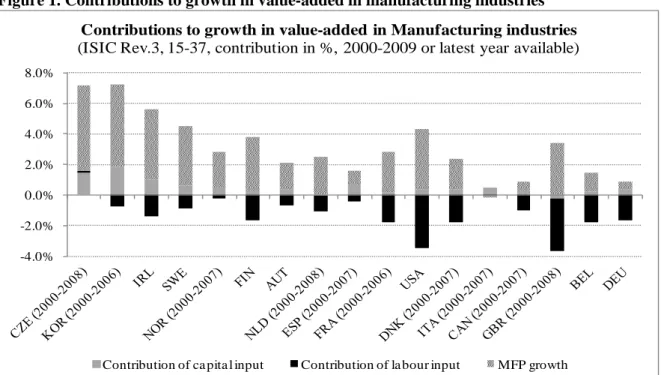
More disaggregated productivity estimates than whole economy data can help to compare contributions to growth in value-added for an individual sector across countries and/or to understand which sectors are responsible for the changes in the sources of growth in a specific country. Indeed, the figure presents growth accounting components in manufacturing industries across countries and shows different trends across countries in growth in MFP and in contributions of factor inputs to growth in value-added. The figure 1 suggests a negative contribution of labour input to the growth in value-added in manufacturing industries in most countries over the years from 2000 to 2009 while the growth in MFP contributed significantly to the growth in value-added in most countries over the same period. During this twenty-years period, the contribution of capital to growth in value-added was less significant except in Czech Republic, Korea and Ireland.
Figure 1. Contributions to growth in value-added in manufacturing industries
-4.0% -2.0% 0.0% 2.0% 4.0% 6.0% 8.0%
Contributions to growth in value-added in Manufacturing industries (ISIC Rev.3, 15-37, contribution in %, 2000-2009 or latest year available)
Contribution of ca pita l input Contribution of la bour input MFP growth
Source: OECD Productivity by industry database, June 2011.
As regards the US, the contribution of labour input accounted negatively on the growth in value-added in manufacturing industries over the years from 2000 to 2009, while MFP growth had a significant positive impact on growth in value-added. The comparison of growth accounting components across US industries would be helpful for understanding if these productivity trends also concerns other sectors of the US economy. As confirmed in the figure 2, labour input contributed negatively to growth in value added in the US manufacturing industries, especially machinery and equipment and transport equipment, and growth in MFP in these sectors contributed positively to the gross in value-added over the past twenty years. In the same time, an important driver in the decline of MFP growth in the US is the construction sector.
13
Figure 2.Contributions to growth in value-added by industry in the United States
Source: OECD Productivity by industry database, June 2011.
Looking for possible explanations of these trends in productivity would require more detailed information, in particular on quality changes in inputs and outputs. In the absence of such adjustments, as this is the case at this stage for the series available in PDBi, more rapid growth in value-added due to a rise in skills of the labour force or due to the rise in efficiency of capital input is captured by the MFP residual and not attributed to the contribution of the corresponding factor, labour or capital. This should be kept in mind when interpretating components of growth in value-added from PDBi. However, PDBi allows international comparisons of productivity by industry and a preliminary identification of productivity trends by industry.
III.3) Comparison of MFP between PDBi and EU KLEMS
The estimates of MFP can be fruitfully compared to that of EU-KLEMS datatabase albeit the difference in methodology makes it impossible to do so at this stage. Due to the lack of required series, the PDBi is populated with a simplified approach.
Focusing on the input, PDBi uses the standard measures of labour input (hour worked) and of capital input (net capital stocks) while EU-KLEMS adopted experimental measures of quality adjusted labour services and capital services, which take into account the volume of labour and capital but also the change in composition of labour and capital over time. To measure the labour services, further various characteristics of labour force such as gender, age and educational attainment are taken in consideration at the industry level. The combined input is weighted with the cost shares of each input in the total cost for the PDBi rather than in the revenue shares for the EU-KLEMS. The measure of capital services is described in details above.
The coverage of estimates in PDBi and EU-KLEMS databases allows the comparison of the industry-level MFP for 13 countries (Austria, Belgium, Denmark, Germany, Finland, France, Ireland, Italy, the Netherlands, Spain, Sweden, the United Kingdom and the United States). Table C compares average
14
annual growth in MFP between PDBi and EU-KLEMS in manufacturing and services for the period from 1990 to 200713. At first glance, the PDBi provides higher estimates than EU-KLEMS. The productivity from the PDBi shows better performance than EU-KLEMS in two sectors, in particular the productivity from the EU-KLEMS has declined or stagnated.
Table 6. Multi-factor productivity in manufacturing (C1537) and services (C65T74X) average annual percent change, 1990*-2007
AUT BEL DEU DNK ESP FIN FRA GBR IRL ITA NLD SWE USA C15T37 PDBi 3.37 2.30 2.82 2.14 0.69 5.64 2.80 4.07 4.74 0.78 3.14 5.91 4.01
EU KLEMS 3.88 1.00 2.10 1.00 -0.42 4.42 1.93 3.18 -0.31 0.41 2.02 4.30 2.37
C65T74X PDBi 2.05 4.50 4.62 2.11 3.12 1.95 1.20 6.41 1.16 4.08 2.66 5.66 0.21 EU KLEMS -1.46 -0.38 -0.87 -0.68 0.46 -0.50 -0.23 0.38 0.00 -0.04 -0.23 -0.31 -0.05
* Note : C15T37 - 1996 for Austria, Belgium, Netherlands, Spain, 1995 for Germany, 1997 for Denmark, Sweden, 2000 for United Kingdom; C65T74 - 2001 for Spain 2002 for Netherlands
Source: OECD Productivity database by industry 2011, EU KLEMS productivity and growth accounts database 2009 IV) How to access PDB and PDBi?
PDB and PDBi are freely available on OECD.Stat (select productivity and then the dataset productivity by industry refers to OECD PDBi while other datasets refer to OECD PDB). The database will be updated on an ongoing basis and expanded to enhanced country and sector coverage as soon as new information is available in the OECD STAN database. Feedback on the data or methodology as well as on the accessibility of the databases is most welcome at the following address:
Conclusions and further progress
The estimates presented in this first release of the PDBi are a starting point and subject to further improvement. PDBi is intended to be updated regularly and expanded to enhance country and sector coverage. It is well recognised that, absent solid information on investment by industry cross-classified by asset, the capital measures used here are only proxies to state of the art methodology. This affects measures of productivity growth but it is hoped to a degree that preserves basic usefulness of the estimates. As measures of capital services tend to grow faster than measures of capital stocks, the bias implicit in our estimates is likely to be upward although its size will vary between countries, industries and over time.
Labour input measures can also be improved by estimating labour composition or labour quality14 using information on skills, age, and gender by industry. However, more data development work will be needed before implementation of labour quality measures. In addition, basic data on hours worked should also be improved alongside with the implementation of labour quality adjustments.
Finally, the PDBi will have to move to ISIC Rev.4 as countries will progressively switch over to the new classification.
13
The year 2007 is the latest year available in EU KLEMS‟ November 2009 database, which has not been updated since.
15
Annex 1. List of variables included in the OECD Productivity database by industry and related indicators from STAN
Variable Description of variable Source
ALPHA Share of labour cost in total factor costs PDBi
K Growth in capital input PDBi
L Growth in labour input PDBi
LP Growth in labour productivity PDBi
MFP Growth in Multi-factor productivity PDBi
Q Growth in value-added PDBi
CPNK Net capital stock, volumes STAN
EMPE Number of employees STAN
EMPN Number of persons engaged (total employment) STAN
FTEE Full-time equivalents - employees STAN
FTEN Full-time equivalents - total engaged STAN
GFCF Gross fixed capital formation, current prices STAN GFCK Gross fixed capital formation, volumes STAN GFCP Gross Fixed Capital Formation, deflators STAN
HRSE Hours worked - employees STAN
HRSN Hours worked - total engaged STAN
LABR Labour costs (compensation of employees) STAN
VALU Value added, current prices STAN
16
Annex 2. List of industrial activities, according to STAN, based on ISIC Rev.3
Code Description
CTOTALX TOTAL (excluding real estate activities)
C01T05 AGRICULTURE, HUNTING, FORESTRY AND FISHING
C10T14 MINING AND QUARRYING
C15T37 MANUFACTURING
C29T33 Machinery and equipment C34T35 Transport equipment
C40T41 ELECTRICITY GAS AND, WATER SUPPLY
C45 CONSTRUCTION
C50T55 WHOLESALE AND RETAIL TRADE - RESTAURANTS AND HOTELS
C50T52 Wholesale and retail trade - repairs C55 Hotels and restaurants
C65T74X FINANCE, INSURANCE AND BUSINESS SERVICES
C10T41 INDUSTRY INCLUDING ENERGY
17
Annex 3. Coverage of labour productivity and multi-factor productivity data in PDBi
Labour productivity (LP)
AUT BEL CAN CZE DEU DNK ESP FIN FRA GBR IRL ISL ITA KOR NLD NOR POL SWE USA
CTOTALX TOTAL (excluding real estate activities) 96-09 96-09 90-07 96-08 92-09 90-09 01-09 90-09 90-07 95-08 92-08 90-09 93-09 02-09 90-09 96-08 94-09 90-09 C01T05 AGRICULTURE, HUNTING, FORESTRY AND FISHING 96-09 96-09 90-07 96-08 92-09 90-09 96-09 90-09 90-07 90-08 96-09 92-08 90-09 93-09 96-09 90-09 96-08 90-09 90-09 C10T14 MINING AND QUARRYING 96-09 96-09 90-07 96-08 92-09 90-09 01-09 90-09 90-08 90-09 93-09 96-09 90-09 96-08 90-09 90-09 C15T37 MANUFACTURING 96-09 96-09 90-07 96-08 92-09 90-09 96-09 90-09 90-07 90-08 96-07 92-08 90-09 93-09 96-09 90-09 96-08 90-09 90-09
C29T33 Machinery and equipment 96-09 96-09 90-07 96-08 03-08 90-09 01-09 90-09 90-08 90-09 02-09 90-09 94-09 90-09
C34T35 Transport equipment 96-09 96-09 90-07 96-08 03-08 90-09 01-09 90-09 90-07 90-08 90-09 02-09 90-09 94-09 90-09
C40T41 ELECTRICITY GAS AND, WATER SUPPLY 96-09 96-09 90-07 96-08 92-09 90-09 01-09 90-09 90-07 90-08 92-08 90-09 93-09 96-09 90-09 96-08 90-09 90-09 C45 CONSTRUCTION 96-09 96-09 90-07 96-08 92-09 90-09 96-09 90-09 90-07 90-08 96-09 92-08 90-09 93-09 96-09 90-09 96-08 90-09 90-09 C50T55 WHOLESALE AND RETAIL TRADE - RESTAURANTS AND HOTELS 96-09 96-09 90-07 96-08 92-09 90-09 01-09 90-09 90-07 90-08 92-08 90-09 93-09 96-09 90-09 96-08 94-09 90-09 C50T52 Wholesale and retail trade - repairs 96-09 96-09 90-07 96-08 92-09 90-09 01-09 90-09 90-07 95-08 92-08 90-09 93-09 02-09 90-09 96-08 94-09 90-09 C55 Hotels and restaurants 96-09 96-09 90-07 96-08 92-09 90-09 01-09 90-09 90-07 95-08 92-08 90-09 93-09 02-09 90-09 96-08 94-09 90-09 C65T74X FINANCE, INSURANCE AND BUSINESS SERVICES 96-09 96-09 90-07 96-08 92-09 90-09 01-09 90-09 90-07 95-08 92-08 90-09 93-09 02-09 90-09 96-08 94-09 90-09 C10T41 INDUSTRY INCLUDING ENERGY 96-09 96-09 90-07 96-08 92-09 90-09 96-09 90-09 90-07 90-08 96-09 92-08 90-09 93-09 96-09 90-09 96-08 90-09 90-09 C50T74X BUSINESS SECTOR SERVICES (excluding real estate activities) 96-09 96-09 90-07 96-08 92-09 90-09 01-09 90-09 90-07 95-08 92-08 90-09 93-09 02-09 90-09 96-08 94-09 90-09
Multi-factor productivity (MFP)
AUT BEL CAN CZE DEU DNK ESP FIN FRA GBR IRL ISL ITA KOR NLD NOR POL SWE USA
CTOTALX TOTAL (excluding real estate activities) 96-09 98-05 99-08 95-09 97-07 01-07 90-09 90-07 93-06 02-08 90-07 97-08 90-09 C01T05 AGRICULTURE, HUNTING, FORESTRY AND FISHING 96-09 96-09 90-07 99-08 95-09 97-07 96-07 90-09 90-07 00-08 99-08 94-08 90-09 93-06 96-08 90-07 01-06 97-08 90-09
C10T14 MINING AND QUARRYING 96-09 96-09 90-07 99-08 95-09 97-07 01-07 90-09 90-07 93-06 96-08 90-07 01-06 97-08 90-09
C15T37 MANUFACTURING 96-09 96-09 90-07 99-08 95-09 97-07 96-07 90-09 90-06 00-08 99-07 94-08 90-07 93-06 96-08 90-07 01-06 97-08 90-09
C29T33 Machinery and equipment 96-09 96-09 90-05 99-08 03-08 97-07 01-07 90-09 00-07 90-07 02-07 90-07 97-08 90-09
C34T35 Transport equipment 96-09 96-09 90-05 99-08 03-08 97-07 01-07 90-09 90-07 00-07 90-07 02-07 90-07 97-08 90-09
C40T41 ELECTRICITY GAS AND, WATER SUPPLY 96-09 96-09 90-07 99-08 95-09 97-07 01-07 90-09 90-07 00-07 94-08 90-07 93-06 96-08 90-07 01-06 97-08 90-09 C45 CONSTRUCTION 96-09 96-09 90-07 99-08 95-09 97-07 96-07 90-09 90-07 00-08 99-08 94-08 90-09 93-06 96-08 90-07 01-06 97-08 90-09 C50T55 WHOLESALE AND RETAIL TRADE - RESTAURANTS AND HOTELS 96-09 96-09 90-07 99-08 95-09 97-07 01-07 90-09 90-07 00-07 94-08 90-07 93-06 96-08 90-07 01-06 97-08 90-09 C50T52 Wholesale and retail trade - repairs 96-09 96-09 90-07 99-08 95-09 97-07 01-07 90-09 90-07 00-07 94-08 90-07 02-07 90-07 01-06 97-08 90-09 C55 Hotels and restaurants 96-09 96-09 90-07 99-08 95-09 97-07 01-07 90-09 90-07 00-07 94-08 90-07 02-07 90-07 01-06 97-08 90-09 C65T74X FINANCE, INSURANCE AND BUSINESS SERVICES 96-09 98-03 99-08 95-09 97-07 01-07 90-09 90-07 00-07 93-06 02-08 90-07 01-06 97-08 90-09 C10T41 INDUSTRY INCLUDING ENERGY 96-09 96-09 90-07 99-08 95-09 97-07 96-07 90-09 90-06 99-08 94-08 90-07 93-06 96-08 90-07 01-06 97-08 90-09 C50T74X BUSINESS SECTOR SERVICES (excluding real estate activities) 96-09 98-03 99-08 95-09 97-07 01-07 90-09 90-07 00-07 02-08 90-07 97-08 90-09
18
REFERENCES
BÖHM-BAWERK, E. v. (1891). The Positive Theory of Capital. New York: G.E. Stechert.
DUPONT, J., GUELLEC, D., & and OLIVEIRA MARTINS, J. (2011). OECD Productivity Growth in the 2000s: A Descriptive Analysis of the Impact of Sectoral Effects and Innovation. OECD Journal: Economic Studies, Volume 2011 .
FRAUMENI, B. (1997). The Measurement of Depreciation in the U.S. National Income and Product Accounts. Survey of Current Business .
HALL, R. E. (1990). The Invariance Properties of Solow's Productivity Residual. Dans P. Diamond,
Growth, Productivity, Unemployment. Cambridge: MIT Press.
HALL, R. E. (1988). The Relation Between Price and Marginal cost in U.S. Industries. Journal of Political Economy, vol. 96, n°5 , 921-47.
HULTEN, C. R. (1990). The Measurement of Capital. Dans E. R. BERNDT, & J. TRIPLETT, Fifty Years of Economic Measurement (pp. 119-152). Chicago: University of Chicago Press. JORGENSON, D. W., & GRILICHES, Z. (1967). The Explanation of Productivity Change. Review of
Economic Studies 34(3) , 249-83.
JORGENSON, D. W., & SULLIVAN, M. A. (1981). Inflation and Corporate Capital Recovery. Dans C. R. HULTEN, Depreciation, Inflation and the Taxation Income from Capital (pp. 171-237). Washington D.C.: The Urban Institute Press.
JORGENSON, D. W., GOLLOP, F. M., & FRAUMENI, B. (1987). Productivity and U.S. Economic Growth. Amsterdam: North-Holland.
JORGENSON, D. W., HO, M., & and STIROH, K. (2005). Information Technology and the American Growth Resurgence. Cambridge: MIT Press.
KOHLI, U. (1982). Production Theory, Technological Change, and the Demand for Imports: Switzerland 1948-1974. European Economic review 18 , 369-86.
OECD. (2009). Measuring Capital: OECD Manual: Second Edition. Paris: OECD.
OECD. (2001). Measuring productivity-OECD Manual: Measurement of Aggregate and Industry-Level Productivity Growth. Paris: OECD.
OECD. (2008). Productivity Measurement and Analysis. Paris: OECD and Swiss Federal Statistical Office.
OLIVEIRA MARTINS, J., & SCARPETTA, S. (1999). The Levels and Cyclical Behaviour of Mark-ups Across Countries and Market Structures. OECD Economics Department Working Papers N°213 . OECD.
OLIVEIRA MARTINS, J., SCARPETTA, S., & PILAT, D. (1996). Mark-up Ratios in Manufacturing Industries: Estimates for 14 OECD Countries. OECD Economics Department Working Paper N°162 .
ROEGER, W. (1995). Can Imperfect Competition Explain the Differences between Primal and Dual Productivity Measures? Estimates for US Manufacturing. Journal of Political Economy 103 , pp. 316-330.
SCHREYER, P. (2002). Computer Price Indices and International Growth and Productivity Comparisons. Review of Income and Wealth, series 48, vol. 1 , pp. 15-33.
SCHREYER, Paul; DUPONT, Julien and Pierre-Emmanuel BIGNON. (2003). OECD Capital Services Estimates: Methodology and A First Set of Results. OECD Statistics Working Paper 2003/6 . OECD.
SCHWERDT, G., & TURUNEN, J. (2008). Changes in Human Capital: Implications for Productivity Growth in the Euro Area. Productivity Measurement and Analysis (pp. 259-281). Paris: OECD and Swiss Federal Statistical Office.
SOLOW, R. (1957). Technical Change and the Aggregate Production Function. Review of Economics and Statistics, 39 , pp. 312-320.