An exploration of the effect of devolution on
Human Resource Management
Brian Daly
A dissertation submitted in partial fulfilment for
BA Hons in Human Resource Management
National College of Ireland
Mayor Street, IFSC, Dublin 1
Declaration:
I herby certify that this material, which I now submit for assessment o f the
programme o f study leading to the award o f BA Hons in Human Resource
Management, is entirely my own work and has not been taken from the work
o f others, save and to the extent that such work has been cited and
acknowledged within the text o f my work.
I wish to express my thanks to. my family Laura, Graham and Eimear for
being so supportive over the last year. You are the best.
This is dedicated to my son Ian who inspired me while he was with us
and continues to inspire me every day. Your memory lives on forever.
Table of contents:
Chapter 1: Introduction... 6
1.1 Objectives of research...7
Chapter 2: Literature Review...9
2.1 L iterature...10
2.2 Devolution... 13
2.3 Organisational Change... 15
2.3.1 Effect of Devolution... 16
2.3.2 HR as part of a Line managers role...18
2.4 Issues for a Devolved HR department...19
2.5 Tools that facilitate Devolution... 21
Chapter 3: Research Methodology... 24
3.1 Research objectives... ... 25
3.2 Appropriate research methods... 26
3.2.1 Questionnaires... 28
3.2.2 Interviews... 29
3.2.3 Unobtrusive observations...30
3.3 Choosing a relevant method of research... 30
3.4 D etailed description of research m eth o d s... 30
3.4.1 Interview... 30
3.4.2 Questionnaires... 31
3.5 Limitations... 33
Chapter 5: Conclusions and Recommendations...45
5.1 HR D epartm ent... 46
5.2 Line Managers and Employees...48
5.3 Recommendations...49
Bibliography... 51
Appendix 1 ...53
Appendix 2 ...54
Appendix 3 ...56
Appendix 4 ...
60
Appendix 5 ...63
This dissertation seeks to explore how the techniques used in Human Resource Management [HRM] have changed in recent years. It will review the changes that have happened in HRM over the last 10 years. It will review the theory as put forward by the acknowledged experts in the field and will review how the theory has been implemented over time and compare it with the organisation I am studying with particular emphasis on resolving the objectives I have set out in this chapter.
It will look at the development of HRM within a large manufacturing organisation, the role devolution has played in that development and what benefits it can bring to the organisation.
1.1 My objectives
1. To determine what has been the driving force behind HRM change.
2. To investigate the effect HRM change has had on the organisation [HR department, management of employees and on the employees].
Chapter 2 will explore the theories put forward by the acknowledged experts in the field. There is an abundance of theory on this subject and I propose to show how this theory has developed over time. I will talk about the strength of competition in the organisation’s industry. This will allow a sense of the unique competitive pressures that are present in the environment it operates in.
Chapter 3 will outline the methodology I followed in completing my research. I will give an outline and explanation of the research methods I used including Qualitive and Quantitive sampling and explain why I chose them. I will provide a profile of the respondents to my surveys and the reasons why I chose them.
Chapter 4 analyses the results of my research. Here I will be looking for trends and patterns to emerge so I can gauge what stage the organisation is at in the HRM change
process. This data will form an important part of developing my hypotheses and will help link the different strands of the dissertation together.
Chapter 5 consists of my conclusions based on the information I have gathered and how it ties in with the theory. I will put forward some recommendations that may benefit the organisation. I would hope to be able to make recommendations to any organisation that is contemplating streamlining it’s HR function. I will also outline what areas I would concentrate more on if completing a similar dissertation in the future.
Chapter 2 - Literature review
2.1
Literature
In this section I want to explore the literature about how HR brings value to an organisation and how that focus has changed from People Management to Human Resource Management. I will briefly explain the difference between People Management and HRM and will outline some of the key terms involved.
People management is concerned with the regulation of the employment contract in pursuit of organisational goals. However employers and employees will debate about those goals and how they are obtained. Torrington and Hall (1987) describe people management as a process that allows employers and employees to agree on objectives and how they will reach those objectives. So it is primarily concerned with 'the regulation o f the employment relationship’ Legge (1995).
Human Resource Management is the successor of people management and is concerned with ensuring HR issues are considered when an organisation is completing it’s strategic plans. It looks at the management of a companies most valued assets, it’s human resources, so that there is a mutual benefit to the employees and the organisation. It assumes that employees want to improve their knowledge to complete tasks and that the organisation can provide training to fill that gap. Therefore HRM is focused on 'the interplay between people, tasks and the organisation’ so that maximum value is gained
for all parties. (Brewster and Holt-Larsen, 2000 p2). In doing this HRM will enhance it’s status by contributing significantly to the objectives and goals of an organisation (Tyson, 1987). ‘ The ultimate test o f an HR organisation is the extent to which it serves customers,
investors, Line managers, and employees.’ (Ulrich and Brockbank, 2005. p i 98)
So HR departments that are People Management focused are concerned primarily with the management of the organisations human resources and deal with issues as they arise. An HR department that has a Human Resource Management focus will be looking at opportunities to become involved in strategic decision making and ensuring that there is mutual benefit for the organisation and it’s human resource assets.
Devolution is the entrustment of some Human Resource Management [HRM] activities to people managers. Brewster and Larsen define it as ’...the allocation to line managers o f responsibilities or tasks formerly undertaken by the personnel specialists'
(Brewster and Larsen, 2000, p. 196). So in effect it is the allocation of authority to line managers to deal with these tasks. The tasks are operational or transactional in nature and involve, but are not limited to, such responsibilities as appraisals, disciplinary procedures, absence tracking, reward and recognition schemes, training and development, communications and team building. It is important to note that while tasks like these have been allocated to line managers the strategic decision making and HR planning remains with the HR specialists (Ulrich, 1998). It is suggested that the role of HR personnel is now more professional and less administrative (Hall and Torrington (1998). They go on to say that the HR role is now more of a consultant and advisor due to the devolution of the administrative tasks. This in turn allows HR the opportunity to add value to the organisation by it’s interventions.
Ulrich and Brockbank (2005) talk about HRM having five major roles. They are shown in figure 2.1.
Employee advocate
This role requires the HR professional to act on the employees behalf when dealing with issues. It involves listening to the employee’s issues and having compassion with them while at the same time guiding the employee to a successful resolution that will satisfy both them and their manager. This role is very important in ensuring that employees remain motivated as they are a very important asset in any organisation. The HR professional will also represent the employee interest during negotiations on realignment of resources whether that is a reduction in workforce or an increase due to expansion. Similarly they will monitor the internal environment in which the business is conducted to ensure fairness and equity to all employees and ensure no group is excluded. This is particularly important in the early part of the 21st century when there are many diverse groups and nationalities in every organisation. This particular role plays a very important part in showing how HR adds significant value to the organisation by helping to create a motivated workforce that is not only productive but quality focused which in turn directly affects its customers.
Human Capital Developer
Ulrich and Brockbank p.206 refer to human capital development as focusing on the ‘wealth created through and by people in the o r g a n is a tio nThis involves aligning the human resource skills of the organisation with future opportunities. Where those skills do not exist then HR will offer opportunities for employees to develop them. It also involves ensuring team dynamics are best utilised to achieve desired results. In this role the HR professional will act as a mentor to employees and managers to ensure continuous development. This adds value to the organisation thereby making it attractive to investors.
Functional Expert
This aspect of being an HR professional involves being competent in the skills required of the HR profession. It involves using the knowledge the profession has gained over time and using it to resolve HR related issues. These can be as simple as
using the organisations intranet to upload HR solutions that all employees can access. It could also involve guiding senior management on the best decisions to take when reviewing HR issues such as succession planning. The depth of knowledge required to be an expert in all areas of HR is to great for one individual. Ulrich and Brockbank recommend that the HR professional specialise in one area so they can properly deal with any concerns that arise or at least know where to go to research answers.
Strategic Partner
The strategic partner element of the HR professional allows them generate strategies in conjunction with management that creates value for the organisation. It involves them being business literate and aware of current and future industry trends so resources can be aligned to maximise return to the organisation. The strategic partner role involves being able to coordinate the different elements of the plan and project manage them to a successful conclusion. Their expertise in human resources and organisational development ensures they can guide decisions in the right direction.
2.2 Devolution
As Hall and Torrington pointed out in order for HRM to be able to concentrate on high value duties it needs to divest itself of the transactional duties. It looks at devolution as a way to do this. Devolution of Human Resource Management was first talked about in the late 1980’s and early 1990’s. Guest suggested ‘I f HRM is to be taken seriously, personnel managers must give it away.' (Guest 1987, p. 51). By this Guest was implying that HRM needed to become more involved in making business decisions right from the strategic planning stages. This would ensure that HRM issues were taken into account when initial plans were being formed and help prevent these issues from arising at a later stage when they might be more complex to resolve. To free up their time to do this they needed to allocate responsibility for routine tasks to other departments. This point was also expressed by Cunningham and Hyman, 1999 who suggested that HR professionals needed to free up their time so they could become involved in strategic business decisions. Ulrich, 1997 talks about HRM being in
partnership with line managers as human resource champions that help create value and deliver results. By giving line managers responsibility for routine HR tasks this will again allow the HR professional to free up their time to concentrate on roles that will involve them in more strategic decision making.
Ulrich also suggests that HR needs to develop it’s role as not only a strategic partner in the organisation but as a business partner. He defines business partner
as:-‘Business Partner = Strategic Partner + Administrative Expert + Employee
Champion + Change Agent. '
(Ulrich 1997, p. 37).
In parallel with this move to devolve transactional tasks to line managers organisations were also looking for ways to maximise their efficiency and create a competitive advantage in the way they operate (Gunnigle et al., 2002). Over recent years the focus has turned on internal operations to see how value added they are. Companies reviewed their approaches to managing their Human Resources [HR] as a way to gain a sustainable competitive advantage ( Jackson and Schuler, 2000).
The key here is that the organisation reviews its HR management as a way to gain a competitive advantage. This should be the principal reason for the review and the aim to achieve superior performance through the knowledge and actions of it’s employees must be foremost in all decisions.
'The quality o f the human or intellectual capital possessed by organisations is seen generally as the key factor in differentiating them from their rivals and achieving superior results.’ (Armstrong and Brown, 2001)
There has been a lack of clarity about the way the devolution of HR has happened and how both the HR and line manager roles have changed. Storey (1992) notes this and points out that in some cases the reduction in headcount in the HR department was seen
to happen due to a more strategic role being envisaged for HR while in other cases it was taken purely to cut costs with minimum thought given to the effect on the department.
So as part of the review of their department HR needs to show how it adds value to the organisation to justify its costs and show how they contribute to the overall profitability of the organisation. The contribution of the HR department to profitability comes from:
• Improving productivity Improving quality of work life • Increasing the firms legal compliance • Gaining competitive advantage
Assuring workforce flexibility (Schuler and Huber 1993)
‘Nirvana fo r the HR profession must therefore be evidence o f a demonstrable and causal link between people management and organisational performance. ‘(Pilbeam & Corbridge, 2002)
2.3
Organisational Change
The changing nature of competitive strategies such as customisation of products and services, reduced product cycle time so organisations get new products to market faster all have implications for the HR department (Gunnigle et al. 1997). This has led to much discussion on the merits or demerits of moving responsibility for dealing with people management issues away from the HR department to line managers (Hall and Torrington 1998; Cunningham & Hyman, 1999; Renwick, 2003). It makes sense to allow the person responsible for day to day management of employees, their line manager, deal with people management issues that arise. Line managers are critical players in implementing new initiatives and generating new behaviours and attitudes [Ulrich 1997], Many theorists have pointed out that regular contact with employees allows managers to control and reward them and also allows effective implementation of HR policies.
Brewster and Söderström (1994), Downie and Coates (1995), Storey (1995), Limerick (1992).
2.3.1
Effect of Devolution
Sisson and Storey (2000,P219) talk about how the devolution of HR responsibilities to line managers allows the following:
• Decisions to be made that suit local situations • These decisions can be made more quickly • Shortens the lines of communication • Problems are solved at a lower level.
Line managers become more responsible.
• Managers become more aware of HR issues in each area • Improves the efficiency of the system resulting in cost savings. • Frees HR professionals to pursue more strategic roles
This shows how devolution has contributed to not only cost savings but also how it has allowed HR professionals the freedom to pursue more strategic, value added roles.
There is a need for line managers to be involved in implementing particular
HR
practices as put forward byGuest and King (2001).
They suggest that good people management is as much about developing a good relationship with your staff as it is about implementation of relevantHR
policies. The thinking behind this is that the manager has built up a direct relationship with their employees that facilitate an understanding of the history behind anyHRM
issues that may arise and makes them best able to resolve them. (Sisson and Storey, 2000).When considering the devolution of tasks to line managers as a means to free up their time for more value added duties the HR professional needs to aware of the pitfalls involved. Issues may arise if the line manager’s HRM knowledge is insufficient to consistently apply policy fairly across the whole team they are responsible for (Hutchinson & Wood 1995). Moreover line managers may adopt differing approaches to
solving similar HR issues, leading to a split in the application of HR policy. This in turn can cause confusion between different departments of an organisation.
Managers need to be aware of the synergy between human, financial, and physical resources and be aware it is a necessary precondition for the success of the organisation. (Brewster and Holt-Larsen, 2000). This would suggest that for HR professionals to do a good job they are required to have a general knowledge of how the business runs overall so they can align resources and plan to upskill or acquire the necessary skills that will be required in the future.
In their application of HR policies line managers may be seen to favour certain employees who are contributing well to area output. This can create friction in the team. It is also important to note that HR tasks are being given to line managers in addition to their other tasks so they place the HR tasks low on their list of priorities as they concentrate on area output and other metrics which are measured by their manager and therefore get a lot of focus (Brewster and Holt-Larsen, 2000).
There is an important point to note about responsibility for more tasks being given to individuals. They will pick out the tasks that they are more comfortable with and this may differ from person to person depending on the person’s strengths. The other tasks will receive a lower priority on the person’s to-do list. Gennard and Kelly 1997 talk about line managers tending to avoid the less pleasant aspects of people management i.e. disciplinary procedures; issue resolution; regular appraisals. Given the typical manager workload they will not give HR as much priority as their other tasks unless HR is a metric they are measured on. Also they will not be able to keep up to date with the latest HR thinking resulting in outdated HR methods. One example is their tendency to increase staff at times of high workload and reduce staff at times of low workload rather than thinking of alternative solutions (short time working, alternative working arrangements) or of the long term implications of both tactics (e.g. cost of training). (Brewster et al, 1996).
Hutchinson and Wood, 1995 found that when devolution had occurred some line managers were not competent to carry out HR roles due to a combination of a lack of
time and insufficient training. It was found that in Norway and the UK in excess of 33% of managers were trained in HR tasks, yet these two countries have some of the lowest devolution rates in the study. In contrast it was found that in Denmark, which has a high devolution rate amongst its managers, they were given little training in HR tasks. The most likely explanation for this anomaly is that managers who have a talent for dealing successfully with HR issues in the workplace learn from each issue and go on to make a more successful impact in that area of their job. In effect success breeds success. It follows that, in this situation, managers who are successful in taking on HR tasks will continue to do so as their career progresses. While a manager who is less able to deal with HR tasks and is not given the training required to correct this will gravitate out of the role to a more technical job resulting in the majority of managers being successful.
2.3.2 HR as part of a line managers role
While these are important potential issues for the HR department to monitor it is significant to note that Brewster and Holt-Larsen (2000) go on to outline reasons why HR should be part of the line managers role.
1. Cost centered or profit centered approach.
As the cost of employees is one of the biggest costs to an organisation it makes sense to give the responsibility to the person responsible for managing them, the line manager.
2. Need for a comprehensive approach to HRM.
This is best accomplished by unifying responsibilities under the employees direct manager as they motivate and interact more than HR with the employee.
3.
Growing influence of the service sector.
Here the focus is on making the customer feel comfortable with their decisions. So prompt timing of the HR intervention is required. This is best exercised by the employee’s manager.
4. Real time decisions
Allocation of tasks, performance appraisals, staffing levels etc are all decisions that need to be made real time to prevent delay in the process.
5. Change in philosophy and organisation structures.
As organisations become flatter in spans of control, cost structures become more transparent. These costs need to be justified and HRM needs to justify its costs. So it devolves some of its work out to Line managers.
(Brewster and Holt-Larsen, 2000).
When discussing the impact employees have on customers Ulrich and Brockbank say 4Loyalty comes from relationships, and relationships come from personal
care’
(Ulrich & Brockbank, 2005 p. 202).
So in order to gain the loyalty of our employees we need to manage them and nurture the manager: employee relationship as it has a direct effect on our customers. By their manager being the first point of contact for HR questions and being able to resolve some of these issues it can only help the relationship. Employees who feel appreciated and are motivated by their manager become more engaged in quality output. The outcome of this is that it becomes vital that mangers are competent when dealing with their devolved HR tasks.Ulrich and Brockbank go on to talk about the effect Organisational Development [OD] can have. They explain OD as referring to ' ...change interventions at the organisation and team levels'. These interventions allow the organisation to change their training and development interventions so they focus on the metrics required then and in the future which in turn will maximise productivity. They feel that the training of managers in HR is crucial to this.
2.4 Issues for a devolved HR department
There would seem to be a need for the HR department to remain in control of certain tasks so that there is consistent application of centralised solutions across all areas of an organisation.
Without a central HR department, control on metrics like recruitment, training, employee reviews, pay there are likely to be many different solutions that are
Brewster and Holt-Larsen also talk about the need for HRM to maintain control of devolution. When devolving HR tasks care needs to be taken that the process is managed correctly by the HR department to ensure fair application of policies with all groups in the organisation. Policies need to be developed to prevent a *policy vacuum’
where managers have noting to refer to and so end up going back to the HR department to get the required information.(Brewster and Holt-Larsen, 2000 p208).
Support must be available to line managers so their concerns are resolved and any learnings that result must be made available to all managers.
'A decentralised managing o f personnel issues will lead to different kinds o f s o lu tio n s(Brewster and Holt-Larsen, 2000, p.205).
Pilbeam & Corbridge talk about HR being a business partner 1st and HR 2nd. This emphasises the need to be seen to add value to the org by supporting business objectives through effective human resource planning.
‘The HR business partner must ensure that HR policies and processes are characterised by effective administration, fairness and equity, compliance with the law and effective practice but in order to add real value, it is argued, the HR business
partner is expected to appreciate and understand corporate strategy, identify with the
objectives o f their managerial colleagues and contribute to the optimisation o f people performance, and thereby organisational performance.’ (Pilbeam & Corbridge, 2002)
Hiltrop, Despres, and Sparrow (1995) point out that devolution could be a threat to HR and may result in line managers taking over more and more responsibility for the role. However it is also noted that the HR role has become more complex and the knowledge required to administer HR policy effectively is beyond that of line managers. Also if HR professionals become involved as business partners and are seen to add value then their role is assured.
Guest and Barron (2000) published findings from their research that show organisations can gain a competitive advantage by remaining up to date with people management practices. Yet their study found that only 10% of the chief executives they interviewed prioritised people management ahead of finance or marketing. This suggests that organisations are not fully aware of the positive impact that approved HRM practices can have on an organisations bottom line.
Areas where it was felt it was key to interact with were:- o Use of psychometric tests for selection o Well developed induction training
o Provision of ongoing training for experienced employees o Profit related bonuses
o Provision of information on the organisation’s business plan and targets o Harmonised holiday entitlement
To coordinate these policies and ensure they remain upto date will need central planning through the HR department.
2.5 Tools that facilitate devolution
E-HR is one of the components that aid the devolution of HR.The components that go to make up e-HR according to Pilbeam and Corbridge (2002) are the use of the company intranet, e-mail, the internet and the use of business level HR specialists to facilitate HR activity across the organisation. An HR intranet is a series of computers linked to a central database similar to the internet. The data on this central database is only accessible from within the organisation. It allows employees to access basic level information on some or all of the following
topics:-> HR policies and procedures > Employee HR self service > Health and Safety information > Grievance procedures
> Compensation and benefits, > Payroll and pensions
> Promotion opportunities, > Training
This can then be updated centrally to ensure it remains up to date. It also reduces the requirement for frontline HR personnel interaction, thus freeing them up for use on the more value added advisory and strategic matters /concerns / roles.
More comprehensive access for managers is allowed to a people management section which may contain links to various management training courses, requests for relevant reports, checklists for dealing with various situations including appraisals, pay reviews and disciplinary procedures. This is termed ‘disintermediation’, Pilbeam and Corbridge (2002, p.43) whereby there is no personal intermediary occurs between the information and it’s recipient.
When an issue cannot be resolved by reference to the on line facilities it can be escalated to an HR specialist through the intranet. These specialists can advise on more complex PM issues like disciplinary procedures, employment law and compensation and benefits disputes.
This system has proved to be a success in reducing the number of low level queries that HR departments get while also standardising the process across all departments for dealing with these concerns.
When reducing HR headcount it is more important to note the number of HR specialists in the HR team compared to administrative staff. Specialists are afforded higher credibility in the organisation as they tend to be more highly educated (Tyson and Wikander, 1994).The more specialists in the team the more influence they can bring to bear on line manager practice and the need or otherwise for devolution so they can be freed up to work on more strategic HR initiatives.
Reilly (2000) mentions the downside of E-HR and says that HR may lose the opportunity to take the pulse of the organisation through lack of communication with employees.
After reviewing the theorists two hypotheses emerge.
1. That HRM policies increase the level of devolution in an organisation.
2. Those employees left in a devolved HR department will need to have specialist skills and knowledge to ensure the organisation remains compliant.
I think Pilbeam and Corbridge summed up the changes in HR very well,
‘Line managers have always undertaken the management o f Human Resources, but they now may be doing more o f it; the personnel practitioner has always had to have a business orientation, but perhaps it is sharper now; the personnel professional has always had to be aware o f strategy, perhaps there is now a greater emphasis on this.
The chapter provides a detailed discussion of the research carried out for this thesis. Section 3.1 reintroduces the objectives of the thesis.
Section 3.2 discusses appropriate research methods for a study of this kind.
Section 3.3 discusses the choice of particular research method that I used and why. Section 3.4 describes in detail the research method employed in this study.
Section 3.5 describes the limitations in the methods chosen
3.1 Research Objectives
This research attempts to answer the following questions.
1. To determine what has been the driving force behind any HRM change.
2. To investigate the effect HRM change has had on the organisation [HR department, management of employees and on the employees].
My research takes place in a large manufacturing organisation and as such will reflect the vision, culture and aspirations of that org. It will be interesting to see how the results compare with theory and what impact this has had on the HR department and those involved in devolution.
To maintain the confidentiality of all parties involved in my research I am calling the organisation involved in my research LINET Corp. It is a multinational company that is operating in Ireland since 1989. Figures for 2007 show that the company employs over 4000 people in Ireland and over 90,000 people worldwide. The company manufactures advanced technological solutions for business and home digital appliances. It is seen as a market leader in the industry and produces approximately 80% of the industry output. Ireland is one of two European manufacturing sites that between them contribute 20% of this output (wwwA.cmpnet.com). However the organisation’s operating margins have been put under pressure since the turn of the decade as one of it’s main
competitors developed a more advanced product that allowed it’s customers a technological lead. Over the last number of years the claim for technological leadership has see-sawed between the two companies. This focus has led to a twin approach of needing to create a lean organisation that can develop ideas and bring them to market with minimum delay but also do this with minimum cost so the end user benefits from not only leading edge technological advances but also at a reduced cost to them.
Since 2006 LINET has been restructuring its operations in an effort to gain efficiencies in all areas. This included cutting its worldwide workforce numbers by 10%. This reduction had a significant impact on LINET’s Human Resources department in Ireland. The company had a HR: Employee ratio of 1:30 two years ago. It is now 1:53 which compares favourably with industry benchmarks. However these industry ratios depend considerably on the types of systems that are in place to automate the transactional tasks mentioned earlier. So benchmarks are not a true reflection of the health of the dept.
‘The HR department provides a greater level o f support than similar companies who might only provide support fo r high risk issues .*
HR Generalist manager
As the Ireland site HR director said ‘We were lagging behind other companies in the industry until we took these measures to bring the site back in line. ’
3.2 Appropriate Research methods
In order to answer the research objectives mentioned in Section 3.1 I have used both primary and secondary data. Primary data is data that I generated myself through quantitive surveys and qualitive interviews. Quantitive data is any data gathering technique that creates or uses numerical data while Qualitive data is any data gathering technique that creates non-numerical data (Saunders, Lewis & Thornhill, 2007). Secondary data is data that has already been collected by organisations and is available for reuse.
The primary research is guided by the typical Organisation Development (OD) data- collection feedback cycle which involves planning to collect data, collecting data, analysis of data, feeding back data and follow up as depicted in figure below Fig 3.1
Figure 3.1: Data-Collection Feedback Cycle (Ref:Cummings & Worley,2004)
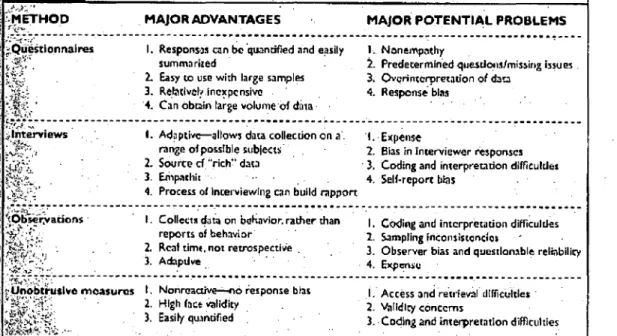
There are a number of direct techniques available to collect data i.e. questionnaires, Interviews, Observations and Unobtrusive observations. Each has their own distinct advantages and disadvantages. See Figure 3.2 below.
M E T H O D M A J O R A D V A N T A G E S M A J O R P O T E N T I A L P R O B L E M S
^Q ue stio n n a ire s
W '
1. Responsos can be quantified and easily summariied
2. Easy to use with large samples 3. Relative!;/inexpensive 4. Can obtain large volume o f data
1. Non empathy
2. Predetermined questions/missing issues . 3. Ovcrinccrpretation of data
4. Response bias
¿.Interviews
'0 i
* * *
1. Adaptive—allows data collection on a . range o f possible subjects
2. Source cf ;‘richM data 3. EmpathU
4. Process of interviewing can build rapport
'I.-.Expense
2. Bias in interviewer responses 3. Coding and interpretation difficulties 4. Self-report bias
^O bse rva tio n s '
■■ :
-1. Collects data on behavior, rather than reports of behavior
2. Real tim«, not retrospective . 3. Adaptive
1. Coding and interpretation difficulties 2. Sampling inconsistcncios
3. Observer bias and questionable reliability 4. Expense
U n o b tru s iv e m easures
I S : ■
1. Nonreaaive— no response bias 2. High face validity . 3. Easily quantified
1. Access and retrieval difficulties 2. Validity conccms
3. • Coding and interpretation difficulties
Figure 3.2: Data Collection Techniques (RefrCummings & Worley,2004)
Questionnaires are an efficient way of collecting quantitive data. They contain fixed- response questions that enquire into the aspect of the research topic. Using IT systems they can be easily administered to samples of the organisation and as the responses are fixed i.e. limited degrees of freedom, the data can be easily quantified and evaluated using appropriate software i.e. spreadsheet programs or statistical packages. For the questionnaires used in this thesis
I
used the website www.survevmonkev.com . This allowed easy editing and reediting of the questions and efficient distribution of the questionnaire and collection of responses.However, questionnaires have a number of disadvantages. The responses are fixed- responses which means that additional information is left unrecorded. For example in the questionnaire
I
used,I
asked the respondents who was responsible for training in the company and gave the options of the HR department, Managers or Both. I also provided a comments section for this question. A number of respondents used the comments section to reply that the training department was responsible. This would seem to suggest that they feel the Training department is not part of HR. In an interview situation I would be able to clarify this point with them and explore what areas they felt made up the HR department. Yet in the two line manager interviews I conducted they both seemed clear that HR was made up of more than just the people they interacted with when dealing with grievance and disciplinary issues.Another disadvantage is people may answer in a way that is acceptable to the culture of the organisation rather than risk bringing focus on themselves. So where a company places great emphasis on quality, a question on the importance of quality in the organisation may receive a more positive response than is reflective of the attitudes in the work area. Questionnaires also tend to be impersonal and thus do not provide an opportunity for the researcher to read between the lines, where in a lot of cases there can be a lot of useful information. Finally, the effectiveness of the questionnaire depends highly on it’s construction. When creating the questionnaire the researcher needs to develop it in such a way that the respondent completely understands what is being asked, so choice of words and structure of sentences is very important.
3.2.2 Interviews
Interviews, both individual and group, are probably the most widely used data gathering
technique (Cummings & Worley, 2004; Saunders, Lewis & Thornhill, 2007). The
interviewer asks the interviewee direct questions that are designed to provide information about the aspect of the organisation being studied.
The interviews I conducted were semi-structured. According to Saunders, Lewis & Thornhill, 2004, semi structured interviews are those where structured questions are in place but if an interesting theme emerges then it is followed to conclusion. Interviews provide qualitative information which is both an advantage and disadvantage, on the plus side qualitative data is easy to interpret and analyse and does not require the use of complicated numeric methods, on the minus side the interpretation and questioning can be subject to the interviewer’s perceptual bias. So care needs to be taken that the results are a true reflection of what was said at the interview. Other disadvantages are that it is expensive as it consumes a lot of time for both the interviewer and interviewee. The skills o f the interviewer are important in order to overcome the limitations o f the interview technique. They need to remain neutral when conducting the interview and later when analysing the results.
3.2.3 Observations
Observations can be a very direct way o f gathering information that reflects a persons real feeling on the subject. For instance if you are cognitive of opinions expressed during casual conversations with members of the group you are sampling, an accurate picture can be built up over time of feelings in the group on a particular subject. This is due to people feeling relaxed talking about the subject and their true feelings being expressed. When doing this care must be taken to engage people who express differing opinions so a balanced result is achieved. The sampling regime needs to be constructed in such a way that it collects enough data on all aspects and levels of the organisational attributes or behaviours under investigation.
3.2.3 Unobtrusive observations
Unobtrusive observations are a secondary data collection technique where company records are collected and analysed. They provide a relative objective view of the organisation and can be useful for analysis of all levels of the organisation i.e. organisational, group and individual level.
Unobtrusive observations are a useful method that can readily augment other methods e.g. absenteeism and labour turnover can be very quickly assessed from company record and both give a strong indication of organisation climate.
3.3 Choosing a Relevant Method of Research
For this dissertation I chose to use both qualitive interviews and quantitive surveys. I felt that by conducting the interviews before the surveys it would allow me to focus on particular areas of interest that came out in the discussions. Also it would be interesting to see if the information gained from both methods correlated. On the 7th June I contacted the HR Director and suggested that I conduct two interviews with HR and two interviews with line managers and then conduct a survey o f 35 employees. These 35 employees would be made up from a mix of HR personnel, line managers and shift employees. After discussion it was agreed that I would conduct two simultaneous HR interviews with the Human Resource Director and the Human Resource Generalist manager. I would also conduct two line manager interviews. I would also send out a survey to five HR personnel, eleven line managers and twenty two employees. The surveys for HR, line managers and employees were different.
3.4 Detailed Description of research methods
3.4.1 InterviewI conducted four semi-structured interviews. Two with HR. One was with the Human Resource Director and one with the Human Resource Generalist manager. Due to
time constraints in the HR department these interviews took place simultaneously. The interview time was 35 minutes and the interviewees preferred not to be recorded.
The other two interviews were conducted with line managers. Again these managers preferred not to be recorded. Due to time pressures on other managers I could not conduct any more line manager interviews. These interviews represented 20% o f the HR sample population and 7% of the line m anger population. The interviews were carried out before the questionnaires were created. This allowed me to design the questions based on the themes that came out in the interviews.
On the 10th June I held my two line manager interviews. One line manager is with the company seven years and the second line manager is with the company fourteen years. Both worked as maintenance technicians with the company prior to becoming managers. For the interviews I used the list of questions listed in Appendix 1. However as all interviews I conducted were semi-structured, not all the questions were asked. I found that I was able to gain more information by following the themes that emerged during the interviews.
I conducted the two HR interviews with the HR D irector and the Human Resource Generalist [HRG] manager on 20th June. The HR Director is working in HR with the company for 11 years and she has a vast experience of Human Resource practices. The HRG manager is working in HR for 17 years and has held HR positions in both unionised and non unionised companies in both the public and private sectors. The questions I proposed to use are listed in appendix 2. As these were also semi-structured interviews not all the questions were asked.
3.4.2 Questionnaires
I analysed results from my line manager interviews and then constructed a survey on the 12th June using Survey M onkey.com to be sent out to the 11 line managers. I reviewed the questions with two line managers. Both agreed that the questions were clear and unambiguous. Based on their feedback I changed the answer section of question eight which had a matrix answer. So if you chose one option for part of your answer you could not use that option again later in your answer. I was able to change this so
people had completed the survey. The survey was sent out on 16th June. The survey questions are listed in appendix 3.
I constructed the employee survey on 12th June using Survey Monkey.com. I read through the survey with an employee and asked for feedback on clarity and purpose of the survey. The employee felt the survey was clear and that the objectives were
understandable. I then sent the survey out to twenty two employees on the 16th June. A copy of the employee survey is in appendix 4.
The HR survey was constructed using Survey M onkey.com on 20th June after my interviews with the HR Director and the HRG manager. I used the information gained in the interview to construct the questions. The survey was sent out to five HR employees on 20th June. A copy of the HR survey is in appendix 5.
All the questionnaires were developed with the recipients in mind. They were designed to see if the respondents felt there was a change in their role or the HR support they received. I was also attempting to find out what their reaction to any change was as outlined in my objectives.
The first few questions on each survey were designed to relax the respondent prior to sourcing information. The line manager questionnaire was composed o f nineteen questions, the Human Resource survey was composed of fourteen questions and the employee survey had sixteen questions.
I approached managers and asked them to nominate employees from their department to take part in the surveys. This prevented any bias on my part as to whom I
chose. The participants all agreed to take part in the study. The line manager
questionnaire was sent to 11 people. This represents 30% o f the line manager population in the company and the response rate was 64% [7 responses]. The employee questionnaire was sent to 22 manufacturing employees. This represents 5% of the manufacturing em ployee population and the response rate was 77% [17 responses]. The HR questionnaire was sent to 5 HRGs. This represents 60% of the HRG employees. There was a 100% response rate [5 replies].
For this research topic I found access to information difficult to com e by due to the sensitive nature of the organisations business and the need to keep operational metrics within the confines o f the organisation.
The general limitations to my research were related to the current environment in the organisation. Due to the restructuring in 2006 peoples roles have changed and they have to make better use o f the resources available to them. This has meant a change in the mindset of the people involved and is still being worked through at the time o f this research. I therefore found that people were time constrained as they adjusted to the new methods o f carrying out their job.
There were also other issues getting my research data. Some of the people I surveyed in the manufacturing environment thought the survey was part of the current cost saving initiatives and that the data would be used to initiate headcount reduction in their department. Once the reason for the survey was explained the respondents were happy to partake.
Due to the sensitive nature of the topic and the heavy workload on individuals I found it difficult to get people to agree to interviews. As stated in my objectives I wanted to gauge the effect of any HR change on those most affected and hence that was why I chose these respondents.
I also noticed that there was a need for me to gain the trust of the people I wanted to question. There was a lot of apprehension about some of the questions I was asking as they made the respondents question their management techniques e.g. ‘How often do you meet with your employees to review their perform ance’. This was particularly so as it was a question I was asking of my peers and some perceived it as questioning their ability.
The final limitation I encountered was my skills as an interviewer and survey designer. Some of he questionnaire questions were not as simple as they could have been and required some qualification from the first version. Also my ability to document all the discussion during the interviews was quite weak and would defiantly need to improve for future investigations.
Chapter Four - Analysis of Results
This chapter reviews the results of my research for this dissertation. The aim of the research was to measure the effect on the organisation of changes in the provision of HR services.
The two line managers I interviewed are working with the organisation for 7 years and 14 years respectively. The Human resource managers I interviewed have worked in HR for between 11 years and 17 years respectively. As a result o f this they all felt comfortable expressing their opinion about the topics we spoke on as they could speak from past experience.
I explained about the changing focus of the HR department over the last number of years from People M anagem ent to Human Resource M anagem ent and the role devolution has played in that. The interviewees all felt that devolution of HR tasks had already happened in their departments. The conversations quickly moved on to the effect that devolution had on line managers and on the Human Resource department.
The HR interviewees agreed that the HR role had become more complex over the last ten years and is now seen as a business. W hile it is a big part o f the role still, the HR department has moved on from sourcing, training and retaining people to ensuring that the company remains com pliant with legislation.
‘ The department is still fo cu sed on employee wellbeing, but a huge part o f the jo b is keeping the company compliant with current legislation’
HR director
4M anagers have authority to deal with H R issues in their areas upto a certain level.
For high risk decisions HR will get involved
‘ Our company is a showcase with respect to Human Resource practices in Ireland and w orldw ide'
HR Director
I found that the HR changes in LINET mirrors theory and the industry in that all the department members are upskilled and not only aware of the need to add value to the organisation but also aware o f how they are going to achieve that. It cam e out in the research that the remodelling of HR in the organisation came about as a result of assessing where savings could be made w ithout compromising the service HR offered for high risk issues. This would support both hypotheses outlined in Chapter 2 that,
1. HRM policies increase the level of devolution in an organisation
2. A devolved HR department will need skilled personnel to ensure the organisation remains legally compliant.
The result o f the recent restructuring was the streamlining of the department in an endeavour to gain efficiencies. This mirrors the Europe wide effort to improve HR productivity and devolve some o f their authority to line managers and give them more responsibility for resolving HR issues in their teams and therefore reduce their dependence on the HR department (Brewster and Holt-Larsen, 2000). However they also point out that HRM is the catalyst that ensures line managers are successful in the managing of their teams.
One section that was closed in the restructuring of the HR department was the employee support centre where employees could ask for advice on HR issues. This was replaced by a web site where employees can ask their questions. The questions are then directed to an expert in that area. This has proved to be a great saving and mirrors the direction taken by other organisations. H owever there was a feeling among employees and managers that it was more difficult to get answers because they were not meeting face to face with HR. Over 82% of respondents to the employee survey were happy about how HR information was made available. However there were two notable
comments about HR interaction from employees with over 10 years experience in the organisation,
‘It has become less personal ’ Employee
‘Simplify the process’
Employee
In essence any HR department needs to be run as a business that must justify its reason for existence. It needs to ensure that HR matters are part of all
organisational strategies and objectives.(Brewster & Holt-Larsen, 200).
Part of the reason for devolution is cost pressures as outlined previously. With tasks being assigned to line managers it leaves less work for the HR department to complete. So a corresponding reduction in headcount occurs. H owever this cost saving needs to be weighed up against the potential cost if a line manager makes an incorrect decision resulting in increased costs, lost productivity or even legal action. This point was emphasised greatly during my HR interviews and also in the HR surveys. The HR director was very adamant that not only HR, but senior management were very conscious of the need to keep the organisation legally compliant. This again emphasises hypothesis two that the realigned HR department contains highly skilled employees. This requirement permeates all conversations and decisions made on the site. So no matter what cost savings are talked about as part o f any changes in HR there is an absolute need to ensure that due diligence is not com prom ised in the process.
The line managers felt that they had become more involved in tasks over the last ten to twelve years such as hiring, training, regular performance appraisals, recognition, absence tracking and disciplinary procedures.
‘ I am always pushing to have members o f my team trained to the next level o f competence. I own that and am ju d g ed on my success in that by my manager. The training department coordinates the logistics fo r m e.’
Line manager.
This backs up hypothesis one that HR policies have helped increase the level of devolution. So for them devolution had already happened and they were now looking at ways to improve their HR skills. They would like to have an approved method of dealing with infrequent issues on a management intranet. This would aid resolution of these issues without the need to consult HR. However there were a number of responses from managers that suggested they were unsure of how far they could go with making HR related decisions. One manager said,
‘ Resolution o f H R issues takes longer now as initial drafts are supplied to HR and come back, promptly, but with inevitable changes to be made. Previously this was sorted out in one fa ce to fa ce meeting
Line manager
HR responses also tend to err on the cautious side. However he felt that if line managers are taking more of the HR role then there is a possibility that these decisions will be taken more quickly by managers. When asked about updates on new HR legislation both line managers said they had a mail from HR about legislation change which they had not read yet. This potentially could lead to the possibility that some HR updates may be missed.
When asked how much o f his time was spent on HR matters one manager
responded that it was approximately 60% HR and 40% operations. He went on to say that he was happy with HR matters taking up 60% of his time as he viewed him self primarily as a people manager. So some managers embrace the opportunity to manage their employees closely. This can be seen by the survey response to question 14 of the line
manager survey where 57% o f respondents regularly meet with their em ployees every 5-8 weeks for a formal performance review. See figure 4.1
This is because it fits in with their managerial ability to strategically align their resources to achieve improved output.
H ow often d o y ou fo rm a lly m eet with y o u r e m p lo y e e s to review their p e rfo rm a n ce ?
R e s p o n s e R e s p o n s e P e rce n t C o u n t 0.0% 0 0.0% 0 57.1% 4 42.9% 3 answered question F ig 4.1
However other managers are less human resource focused and do not see the utilisation o f human resources as a means to achieve improved output. This is seen by the 43% who review their performance with their em ployees less often. They view human resources as something to be exploited in the achievement o f improved performance. While this may work in the short term it has negative long term impacts i.e. Demotivation and Labour turnover etc. This type o f manager will typically not allocate time to motivate staff or deal with HR issues that may be a potential roadblock to improved performance.
When asked in the survey to prioritise six tasks [two HR and four operational) all the line managers had HR related tasks as priority one, two or three. However 57% said they were unable to complete these tasks in this order due to operational pressures. See figure 4.2.
Are there any barriers to you completing these tasks in the order you specified? answer options Response Percent Response Count Yes 57.14% 4 No 42.86% 3
If you answered Yes please comment. 4
a n s w e r e d q u e s t i o n s k i p p e d q u e s t i o n
Fig 4.2 1
This supports the thinking that managers will concentrate on the things that their manager deems important and this could be a potential barrier to devolution of HR tasks.
One o f the themes that cam e out in the interviews and surveys was that it w as very important that the HRGs were knowledgeable in the application o f the organisation’s HR policies. This was very important so that there was consistency in approach on resolving issues and ensuring the organisation remains legally compliant. This again backs up hypothesis two. One line manager commented that if he was dealing with an experienced HRG his issues were resolved a lot quicker than if he was dealing with a relatively new HRG member. The line mangers generally felt reassured in making HR decisions once they had discussed them with an HRG. The feeling was that the learning fora conducted by HR are very valuable and that more o f these would benefit managers.
The line managers felt that E-HR involving use o f the company intranet and on line policies supported the objectives of devolution well and this also backs up hypothesis one. They could get any information they needed to resolve a lot o f minor HR issues and it was available 24 hours a day. The feeling was that the mangers felt more in control o f their teams because they had been given more authority to deal with any matters that arose.
E-HR also received positive support front the HRG’s survey. They all agreed that it had freed up their time and that it allowed them work on more value added initiatives such as helping managers and employees. This is also backed up by 60% feeling thai managers deal with more HR issues currently than they did 18 months ago.
‘ . . k e e p i n g t h e b u s i n e s s l e g a l t h r o u g h p r o v i d i n g c o a c h i n g , a d v i c e a n d s u p p o r t i n g e m p l o y e e s i n H R r e l a t e d i n v e s t i g a t i o n s ' .
HRG
Responses from the HRG survey also confirmed this with 80% o f requests for support coming from E-HR sources. See figure 4.3.
W hat is the prim ary m ethod m a n a g e rs u s e to c o n ta c t y o u for s u p p o rt?
R e s p o n s e R e s p o n s e Percent C o u n t A s k __________ ___ E S Phone ■■■■■1 40.0% 20 0% 2 i 1 E ' t v . v /O 1 1 mail 40.0% 2 Other 0.0% 0 | Fig. 4 J
Employees also embraced E-HR initiatives. They use an E-HR process or their manager to get information on HR topics except Learning and Development and they are happy that they receive the information they need. See figure 4.4. Over 70% find this method easy to use with the exception o f one respondent who commented that they found it difficult to find the exact answer to specific questions. It is also worth noting that 59% o f the employees who responded had not needed to contact HR in the previous year as all the information they needed was available on the intranet. One employee who is with the organisation over 10 years commented.
W hen looking for information on the following topics what one method d o you use m ost often? My m anager Intranet Email H R Ask E S Phone H R Other R e s p o n s e C o u n t Policies 29.4% (5) 52.9% (9) 0.0% (0) 17.6% (3) 0.0% (0) 0.0% (0) 17 Form s 5.9% (1) 58.8% (10) 0.0% (0) 29.4% (5) 0.0% (0) 5.9% (1) 17
Internal job transfer 23.5%
(4) 58.8% (10) 0.0% (0) 17.6% (3) 0.0% (0) 0.0% (0) 17
Learning and Development 58.8% (10) 23.5% (4) 0.0% (0) 17.6% (3) 0.0% (0) 0.0% (0) 17 Fig. 4.4
In contrast 59% o f employee respondents contact their manager when they are looking for information on Learning and Development. The employee survey shows that there is little E-HR engagement when seeking information on Learning and Development initiatives. Line managers point out development opportunities at performance reviews with their employees and guidance is given on where on the organisations intranet the classes can be found. However em ployees tend to come back for their next review 5-8 weeks later unable to source the class and their request for classes have not been actioned by the time of their next review meeting. This is borne out by 29% o f employees
sometimes having issues enrolling on classes. See figure 4.5.
P le a s e rate th is statem ent. 1 know how to a c c e s s a n d e n ro ll o n c la s s e s 1 n e e d ’
R e s p o n s e R e s p o n s e P e rce n t C o u n t Y e s a B B H m 52.9%
9 I
Som etim es M H M M 29.4%5 I
No im Ê ÊÊ Ê m m 17.7%3 I
F ig 4.5Feedback from 10% o f the line managers surveyed was that the lack of physical presence o f HR could be daunting as they were not available sometimes when decisions needed to be made. However feedback from one o f the HRGs was that line managers were reluctant to make decisions without consulting them and as a result HRGs were still performing a lot o f administrative tasks.
HR should no longer be doing administrative tasks fo r managers. This is slowly taking affect. However som e m anagers still come to HR fo r help on these tasks.'
HRG
The HRG also felt that line managers tended to default to asking HR before making a minor HR decision and that a mindset change was required on the managers part. This would suggest there is a disconnect between managers and HR on what the expectations o f each other are.
HRG s all agreed that they add value, their workload has improved and they are more in control o f their job. They feel better able to provide a quality service and their role is now more varied as they support both managers and employees. Also 80% responded that they have more opportunity to use their HR skills and all respondents felt they had the opportunity to upskill so they could maintain pace with new HR concepts.
The devolved HR dept seems better able to provide a quality streamlined service to it’s customers as can be seen by the line manager feedback where nearly 86% were happy that they could access the HR information necessary to manage their employees. See figure 4.6.
P le a s e rate th e follo w in g statem ent. ' 1 h ave a c c e s s to th e H R in fo rm a tio n 1 n eed to c o m p e te n tly manage my em p loy e e s'. R e s p o n s e P e rce n t R e s p o n s e C o u n t Very Easy 0.0% 0 E a s y ■ ■ ■ § 85.7% 6 Difficult m im m Ê a Ê Ê Ê m Ê Ê m 14.3% 1 Very Difficult 0.0% 0 F ig 4.6
As a result of the interviews and questionnaires with the HR department it is apparent that the role the HR department plays in the success of the organisation has become more complex over the last 10 years. It has moved from a department that was primarily responsible for the recruitment and development o f employees to one which now plays a central role in ensuring the company remains legally compliant for all HR issues. The HR Director pointed out that the department is now ranked alongside the Finance department in terms of im portance and influence and is seen as a showcase in terms o f HR practices not only in Ireland but worldwide. The HR director sits on the board and plays a key part in the decisions that are made there and ensures people issues are kept to the fore in all decisions. This is very important in allowing HR to look at the future needs of the organisation, people, skills, legal compliance, costs etc.
'HR drives the agenda at board level and acts as a catalyst in creating tension to fo rce decisions to be m a d e’
HR director
There was a strong feeling that HR is strategic in LINET and that they add value to the organisation. They are present at every m ajor decision and ensure people concerns are taken into account. In fact the HR director said that in many cases they drive senior management to take actions so the organisation remains both com pliant with current employment legislation and is preparing for future employee skills needs