Scenario Analysis on LTE
mobile network virtualization
School of Electrical Engineering
Thesis submitted for examination for the degree of Master of Science in Technology.
Espoo 31 July 2013
Thesis supervisor:
Prof. Heikki Hämmäinen Thesis instructor:
M.Sc. (Tech.) Nan Zhang
AALTO UNIVERSITY ABSTRACT OF THE SCHOOL OF ELECTRICAL ENGINEERING MASTER’S THESIS
Author: Xue Bai
Name of the Thesis: Scenario Analysis on LTE mobile network virtualization Date: 31 July 2013 Language: English Number of pages: 9+54 Department of Communications and Networking
Professorship: Communications Ecosystem Code: S-38 Supervisor: Prof. Heikki Hämmäinen
Instructor: M.Sc. (Tech.) Nan Zhang
The LTE mobile network has dominated the mobile market nowadays. However, the LTE mobile network cannot deal with the growing data traffic due to the insufficient capacity and lack of network flexibility. The LTE mobile network virtualization, on the other hand, is a technology enable the LTE mobile network to meet those increasing requirements. Some researches of the LTE mobile network virtualization have been done in terms of the technology study and cost measurement. Yet, no research deployed in the LTE mobile network virtualization take the uncertainties into account. This thesis focuses on figuring out the overview LTE ecosystem in the next five years by considering uncertainties.
The key trends and uncertainties which have the huge influence to the future LTE mobile network virtualization are identified in brainstorm sessions. The final two key uncertainties are 1) What will be the competition level of the mobile market (high or low)? 2) Will virtualization of LTE lower the costs significantly? Then the four alternative scenarios of the future LTE mobile network are developed in the end of the scenario planning process based on the final key uncertainties.
The scenarios indicate that the LTE mobile network virtualization will be developed by different stakeholders in different scenarios. Also, the degree of the LTE mobile network virtualization depends on the willingness to invest of stakeholders.
Preface
This Master’s Thesis has been written as a partial fulfillment for the Master of Science Degree at Aalto University, School of Electrical Engineering. The work was carried out in the Department of Communications and Networking.
I am grateful to all of people who have supported me in last two years. Firstly, I wish to thank Professor Heikki Hämmäinen for guiding me from the first day I started my study in Aalto University. Then I wish to give special thanks to Nan Zhang for her valuable advice and patience for me during the last half year. Furthermore, I wish to thanks all of experts who have contributed to the data collection for my thesis.
Finally, I wish to express my gratitude to my family and friends with all my heart.
Espoo, 31 July 2013 Xue Bai
Table of Content
Preface III
Table of Content IV
List of Figures VI
List of Tables VII
Acronyms and Terms VIII
1 Introduction 1
1.1 Research Question and Objectives 2
1.2 Scope 3 1.3 Stakeholders 3 1.4 Research Methods 5 1.5 Structure of Thesis 5 2 Research Methods 7 2.1 Scenario Planning 7 3 Overview of LTE 9 3.1 LTE Architecture 9 3.2 Characteristics of LTE 11
4 LTE Network Virtualization 12
4.1 Motivations of LTE Mobile Network Virtualization 12
4.2 LTE Core Network Virtualization Framework 13
4.3 LTE Radio Access Network Virtualization Framework 14
5 Scenario Planning Process 16
5.1 Brainstorms 16
5.2 Key Trends 17
5.3 Key Uncertainties 20
5.4 Correlation Matrix 27
6 Scenarios 29
6.1 CloudSPs Controlled - Highly Virtualized LTE 29
6.2 MNOs Controlled LTE Virtualization 32
6.3 Cooperation under the LTE Virtualization 34
7 Conclusion 39
7.1 Key Findings 39
7.2 Discussion 40
7.3 Future Research 41
Reference 42
Appendix A - Trends Collected From Brainstorm Sessions 48
List of Figures
Figure 1: Key stakeholders in the LTE mobile market ... 4
Figure 2: Structure of the thesis ... 6
Figure 3: Scenario planning process [21] ... 8
Figure 4: scenario matrix ... 8
Figure 5: Basic LTE system architecture [23] ... 10
Figure 6: LTE multiple access schemes ... 11
Figure 7: 3GPP compliant OpenFlow controlled gateway architecture [4] ... 14
Figure 8: Virtualized LTE eNodeB protocol stack [35] ... 15
Figure 9: Key words in brainstorm session ... 16
Figure 10: Final scenario matrix ... 29
Figure 11: The value network of future LTE mobile network in Sc.1 ... 30
Figure 12: The value network of future LTE mobile network in Sc.2 ... 33
Figure 13: The value network of future LTE mobile network in Sc.3 ... 36
List of Tables
Table 1: Key trends ... 17 Table 2: Key uncertainties ... 21 Table 3: Correlation matrix of final uncertainties ... 28
Acronyms and Terms
3G Third Generation
3GPP Third Generation Partnership Project
4G Fourth Generation
CAPEX Capital Expenditure CloudSP Cloud Service Provider
E2E End to end
EDGE Enhanced Data rates for GSM Evolution EPC Evolved Packet Core Network
EPS Evolved Packet System
eNodeB Evolved Node B
ETSI European Telecommunications Standards Institute E-UTRAN Evolved Universal Terrestrial Radio Access Network GPRS General Packet Radio Service
GSM Global System for Mobile Communications GTP General Packet Radio Service Tunneling Protocol HSPA High Speed Packet Access
ICT Information and Communications Technology IaaS Infrastructure as a Service
IT Information Technology
LTE Long Term Evolution
M2M Machine to machine
MCP Mobile Content Provider
MME Mobility Management Entity
MNO Mobile Network Operator
MVNO Mobile Virtual Network Operator
NEP Network Equipment Provider
OPEX Operational Expenditure
OTT Over The Top
PCEF Policy and charging Enforcement Function PCRF Policy and Charging Resource Function
P-GW Packet Data Network Gateway PaaS Platform as a Service
PMIP Proxy Mobile IP
PRB Physical Radio Resource Blocks
QoE Quality of Experience
QoS Quality of Service
R&D Research and Development
SDN Software Defined Network
S-GW Serving Gateway
SaaS Software as a Service
UE User Equipment
UP User Plane
UMTS Universal Mobile Telecommunications System UTRAN Universal Terrestrial Radio Access Network WCDMA Wideband Code Division Multiple Access
1
Introduction
More than one billion of smart phones and tablets are in use worldwide [1]. Also, the number is predicted to double in the next five years [2]. Therefore, both mobile users and mobile data traffic are growing dramatically. The mobile data traffic grew 70 percent in 2012 globally [3].
Much more capacity is required in Long Term Evolution (LTE) mobile networks, because the condition of traffic concentration on the single gateway may happen in the current centralized LTE mobile network architecture [4]. Since LTE mobile network virtualization allows dynamic on-the-fly resource allocation, it can be seen as one of the most efficient ways to cope with the capacity problem by transferring mobile data more effectively [5] [6].
The mobile network operators (MNO) can operate the virtualized LTE mobile network with standard mobile network hardware and separate the control and management software [7]. The development of the LTE mobile network also offers opportunities to the network equipment providers (NEPs) to provide the technology support and equipment to the new virtualized LTE mobile network.
Cloud giants, such as Google and Amazon, are controlling the cloud service and reaping huge returns from this potential market. Nevertheless, the virtualization of LTE will allow MNOs to expand their capabilities to enter the cloud market, because the elastic allocation of the network resources can lead to the provisioning of the cloud service. The one who is more capable to control the cloud market will gain the golden chance to be the leader of the whole mobile market. Therefore, the future of the LTE mobile market will be influenced by the one who controls cloud service.
As a result, the LTE mobile network virtualization can be considered as an advanced technology which is able to solve both the technology and business problems in the current LTE mobile network. The mobile market will change a lot because of the LTE mobile network virtualization.
However, the LTE network virtualization technology has not been deployed so far. The predictions about those outcomes in the real mobile market are concluded based only on the academic researches and simulations. In other word, the commercial
virtualized LTE mobile network services have not been launched to the mobile market. Therefore, issues such as cost of the LTE mobile network development and regulatory restrictions should also be taken into consideration. For example, Software Defined Network (SDN) and virtualization make LTE mobile network system and operations more software technologies oriented. Professionals who are operating the mobile LTE networks are lack knowledge about analyzing traffic in virtualized LTE mobile network. Therefore, the re-training of employees will increase the cost in LTE mobile network virtualization.
In this circumstance, it is difficult to evaluate the future LTE mobile market because of those complex uncertainties. Exploring scenarios, on the other hand, is one way to understand the big picture of the future LTE ecosystem.
1.1
Research Question and Objectives
While the virtualization brings the advanced technology changes, it can be considered as one of the motivations for research and development of LTE mobile network virtualization. However, the LTE mobile network virtualization commercialization process has an ambiguous effect on the future LTE mobile market. Thus, the main research questions are as follows:
What are the scenarios of future LTE mobile market?
Which future scenarios drive the virtualization of LTE mobile networks?
The LTE mobile network will be virtualized in the future scenarios listed in the answers of the second question. Therefore, the research of the scenarios can be done further by solving supplementary questions:
What will be the level of virtualization in the LTE mobile network? Who are the main stakeholders in LTE mobile network virtualization? Who will invest in the LTE mobile network virtualization?
The objectives of the thesis are set and listed below to solve the above issues:
Identify the technologies of LTE mobile network and LTE mobile network virtualization.
Identify key trends and key uncertainties of the virtualization of the LTE mobile network by organizing brainstorm sessions.
Create scenarios for future LTE mobile market.
Analyze each of the scenarios with the support of the value network.
1.2
Scope
As elaborated in Section 4, the LTE mobile network virtualization is now studied in the virtualization in core network and in radio access network. To make the research more applicable to the whole LTE mobile market, the LTE mobile network virtualization mentioned in this thesis means the virtualization of the both parts.
The time frame is five years from 2013 to 2018. The scenarios are formed and valid within the European LTE mobile network, as LTE mobile network is available now in most of the European countries [8]. In other words, the commercial use of the LTE mobile network is fundamental to the future research and development of the virtualized LTE mobile network. Some of the countries, such as Iceland, Ireland and Turkey, will launch the LTE mobile network latest in 2016 [9].
1.3
Stakeholders
As seen in Figure 1, five key stakeholders are involved in the LTE mobile market: cloud service provider (CloudSP), mobile network operator (MNO), mobile virtual network operator (MVNO), NEP and end-user. The network router vendor and the mobile network vendor are considered as a whole (i.e. NEPs) in this thesis.
Cloud service provider delivers the user demand "as a service" [10]. Every one of the CloudSPs has its own mechanism of cloud service provision [11]. In particular, the cloud service provided by CloudSPs can be any resource over the Internet. For end-users, the cloud service resources include as Infrastructure as a Service (IaaS), Software as a Service (SaaS) and Platform as a Service (PaaS).
Mobile network operator provides the mobile services to end users. Mobile network access, communication services such as voice and data are all provided
by the MNOs. The MNOs also control the LTE mobile network infrastructure and radio spectrum in the current LTE mobile market.
Mobile equipment provider
Network router vendor Cloud service provider End-user Mobile virtual network operators Mobile network operator Mobile network vendor
Figure 1: Key stakeholders in the LTE mobile market
Mobile virtual network operator provides the mobile services to end-users but does not own the LTE mobile network infrastructure or the radio spectrum. The MNO sells the access to LTE mobile network to MVNO. Then end-users of MVNOs can access to the LTE mobile network by paying to MNVOs. The price of the mobile service is set by MVNOs independently.
Network equipment provider delivers LTE mobile network infrastructure to MNOs and is responsible for maintaining of the LTE mobile network in the current mobile market. The NEPs can be divided into two groups. Those who mainly provide the infrastructure to the LTE core network are called network router vendors. Those ones who provide infrastructure to other parts of LTE mobile network are named as Mobile network vendors.
End-user consumes and uses the mobile service as well as the cloud service. The end-user in this thesis includes both individual and enterprise.
1.4
Research Methods
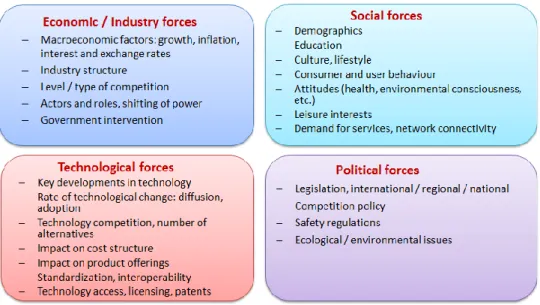
Two main research methods are implemented in this thesis: brainstorming and scenario planning. The brainstorm is organized to collect forces which influence the future LTE mobile market. Brainstorming, as a problem-solving and concept generation technique, was used to collect key trends and key uncertainties for scenario construction [12] [13]. Experts are invited to join the sessions to discuss the trends and uncertainties based on their professional knowledge and insight of the market development. The PEST framework is used to support experts to identify the macro-environmental forces.
Scenario planning is utilized to obtain the overview of the probable and improbable futures in LTE ecosystem. The scenarios are built and analyzed using the key trends and key uncertainties collected in the brainstorm session.
In the description part of each scenario, the evolved value network is illustrated. Both business and technical relationship among key stakeholders in the LTE mobile market can be clarified quickly. The key stakeholders stay the same in all of scenarios while the possible changes of the relationships in different scenarios are drawn out.
1.5
Structure of Thesis
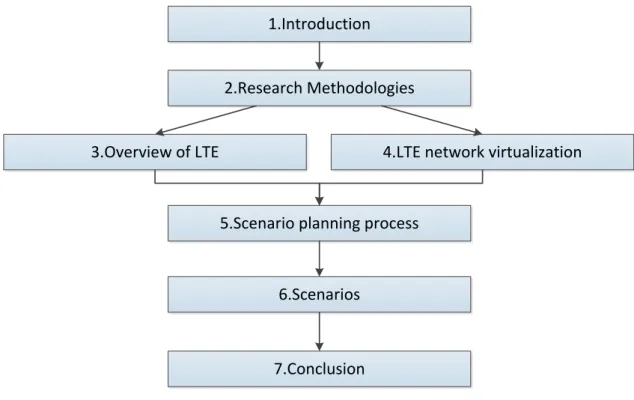
As presented in Figure 2, the thesis starts with the introduction of the research. Then Section 2 describes the research framework and methods used.
Section 3 and Section 4 explain the technology background of the thesis. The characteristics and architecture of the LTE mobile network is described in Section 3. Two different LTE mobile network virtualization frameworks are elaborated in Section 4.
The process of the scenario planning is explained in Section 5, where key trends and key uncertainties are also listed. The detailed description of the scenarios is written in Section 6. And the thesis is concluded by Section 7 with the evaluation of the work.
1.Introduction
2.Research Methodologies
3.Overview of LTE 4.LTE network virtualization
5.Scenario planning process
6.Scenarios
7.Conclusion
2
Research Methods
Several essential research methods are utilized in this thesis and the reason behind for choosing them to analyze the research questions will be elaborated in the upcoming sections.
2.1
Scenario Planning
The scenario planning method studies different possible future and it helps an organization to react and prepare for those scenarios. It was started in 1950s to develop the scenario techniques [14]. In 1970, the scenarios are applied successful by Shell to resist the oil crisis. [15]
The scenario planning works effectively in the telecommunication industry. For instance, the scenarios were utilized in the wireless industry evolution, digital home management, the usage of the mobile peer-to-peer services and wireless local area access market [16] [17] [18] [19].
Since the LTE mobile network virtualization has not been implemented so far, scenario planning is the proper tool to build alternative futures by combining the uncertainties.
The method is well defined by Shoemaker in1993 who divides the method process into 10 steps. A rough picture for analysis is defined and identified by the first four steps: 1) scope definition 2) major stakeholder identification 3) basic trends identification and 4) key uncertainties identification. The key uncertainties and trends are the main input for further analysis. The scenarios are further developed and analyzed by rest of the steps: 5) construction of initial scenario themes 6) consistency and plausibility check 7) development of learning scenarios 8) identification of research needs 9) development of quantitative models and 10) evolve towards decision scenarios [20].
Figure 3 indicates the summarized scenario planning process by Levä [21]. The scope of the scenario planning should be set in the very beginning. Then the key trends and key uncertainties can be identified together in the brainstorm sessions. The third step is to form the scenario matrix based on the key uncertainties. The analysis of the
scenarios is also included in the matrix construction. The qualitative modeling is out of the scope of this thesis.
Figure 3: Scenario planning process [21]
The main scenarios are usually structured by crossing two key uncertainties in a matrix. Figure 4 illustrates an example scenario matrix for planning a day, which is created by two key uncertainties: weather conditions and availability of company. Four scenarios are formed by the matrix.
3
Overview of LTE
Long Term Evolution (LTE) was defined by the 3rd Generation Partnership Project (3GPP) as a standard for wireless communication. It is based on the GSM/EDGE and UMTS/HSPA network technologies, increasing the capacity and speed using a different radio interface together with core network improvements. [22]
The scenario planning and other analysis in this thesis are both performed on top of the LTE mobile network. Therefore, it is essential to have a general understanding of the technology background of the LTE mobile network. In this chapter, the development process, which includes the architecture and characteristics of LTE mobile network, will be described.
3.1
LTE Architecture
The 3GPP started their work about the LTE from 2004 [23]. The targets were firstly defined. And then it spent five years from setting the system targets to the commercial deployment using interoperable standards [24]. The network architecture utilized by LTE is illustrated in Figure 5.
The total architecture is divided into four main domains: User Equipment (UE), Evolved UTRAN (E-UTRAN), Evolved Packet Core Network (EPC), and the Services domain. Among these domains, the UE, E-UTRAN and EPC together are called the Internet Protocol Connectivity Layer, or Evolved Packet System (EPS). This layer is served to provide IP based connectivity [25].
The E-UTRAN concentrates on the evolved Node B (eNodeB). E-UTRAN is simply a mesh of eNodeBs connected to neighboring eNodeBs. The eNodeB works as a bridge between UE and EPC. It is the termination point of all the radio protocols towards the UE. [26]
In the EPC, there are some important elements to the whole architecture. Mobility Management Entity (MME) is the main control element in the EPC. It has a logical connection to the UE, and this connection is used as the control channel between UE and the network. Its main functionality includes authentication, security, mobility management, subscription profile management and service connectivity. [27]
Figure 5: Basic LTE system architecture [23]
Serving Gateway (S-GW) is in charge of the user place tunnel management, switching, and the data transmission between eNodeB and P-GW. Another function of the S-GW is allocating its own resources depends on the requests from MME, P-GW or PCRF. This is called Bearer Binding and Event Reporting Function. [23]
Packet Data Network Gateway (P-GW) is the edge router between the EPS and external packet data networks. It performs as the highest level mobility anchor in the system. When a UE moves among the different S-GWs, the bearers in the P-GW will be switched. The indication of switching is transferred by S-GW. The P-GW also allocates the IP address to the UE so that the UE could communicate with other IP hosts in internet. As the P-GW includes the Policy and charging Enforcement Function (PCEF),
it performs gating functions required by the policies and collects the related charging information. [28]
3.2
Characteristics of LTE
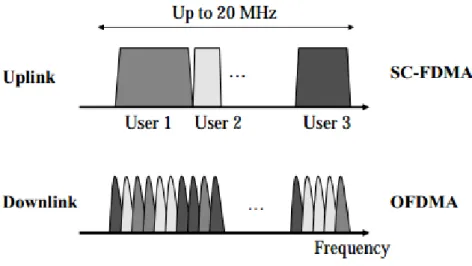
To satisfy the large range of requirements for covering different bandwidths and data rates, LTE utilizes the different mode of modulation in uplink with downlink instead of just extending WCDMA [23].
Figure 6: LTE multiple access schemes
As shown in Figure 6, LTE uses OFDMA for multiple accesses in the downlink direction. The basic principle of OFDMA was already known in the 1950s. Since the widespread use of digital technology for communications, OFDMA also became more feasible and affordable for consumers. The OFDMA has the properties of good performances, low complexity, good spectral properties, link adaptation and compatibility with advanced receiver etc. That’s why OFDMA has been widely adopted in many areas during recent years. [28]
In the uplink direction, LTE uses SC-FDMA for multiple accesses. SC-FDMA has drawn great attention as an attractive alternative to OFDMA, especially in the uplink communications where lower peak-to-average power ratio greatly benefits the mobile terminal in terms of transmitting power efficiency and reducing cost of the power amplifier. The basic form of SC-FDMA could be seen equal to the QAM modulation. Frequency domain generation of the signal adds the OFDMA property of
good spectral waveform in contrast to time domain signal generation with a regular QAM modulator. Thus the need for guard bands between different users can be avoided. [23]
The LTE-Advanced, which is specified in the 3GPP Release 10, is the one who really satisfies the ITU-R requirements, and it is admitted as 4G by the ITU-R organization in its IMT-Advanced specification [29] [30]. Although LTE (Release 8 and 9) was called 4G wireless service, it does not really satisfy the 3GPP’s technical requirements about 4G [31]. However, the WIMAX, HSPA and LTE do lead to the significant advancements in comparison to the 3G technologies [32]. Meanwhile under the marketing pressures, ITU finally decided to call LTE as 4G technologies [33]. Therefore, LTE mentioned in this thesis is seen as 4G network.
4
LTE Network Virtualization
Why the virtualization of LTE mobile network is necessary? The reason will be discussed at the beginning of this chapter. Then, as the LTE mobile network can be divided into several parts based on the different functions, two LTE mobile network virtualization structures will be explained. SDN and OpenFlow related technologies are deployed in the LTE core network in the first LTE mobile network virtualization framework. And then the virtualization of the eNodeBs is implemented in the second LTE mobile network virtualization framework.
4.1
Motivations of LTE Mobile Network Virtualization
The current LTE mobile network is built as an evolved mobile network comparing with 3G mobile network. Higher data transmission speed and more network capacity are achieved in LTE mobile network. However, the increasing dynamic computing and data storage need a more flexible mobile network. So far, no change has been made to the LTE mobile network to solve the challenge.
The separation of the information forwarding and controlling in LTE mobile network is considered as an effective approach to tackle the problem. So the integration of the data transmission and analysis make the LTE mobile network has to be reexamined in the today’s dynamic LTE mobile network environment [34].
Typically, the virtualization of the LTE mobile network means to virtualize the infrastructure of the LTE mobile network [35]. Theoretically, multiple MNOs can establish their own virtual network [36].
4.2
LTE Core Network Virtualization Framework
In the current LTE mobile network, the mobility management procedures are not always optimal. For instance, in order to optimize the routing it may trigger the relocation of the gateway elements which have been distributed during the frequency handover [4]. The LTE mobile network virtualization, as a fresh technology to LTE mobile network, opens the door for the on-demand resource allocation.
The LTE core network known as EPC consists components of HSS, MME, PCRF and SAE GW. The virtualization of the LTE core network in thesis this mainly introduce the virtualization of SAE GW, which is built on the SDN and OpenFlow technologies.
SDN belongs to one kind of network architectures. The forwarding in the network can be decoupled from the network control [7]. Besides, it is more flexible to program the forwarding logic. The network intelligence is centralized in the controllers of the SDN, which can be work well in software. In this way it enables the virtualization of the network [37].
OpenFlow is a standard communication interface defined between the controlling and forwarding layers in the SDN architecture [38]. It is seen as the enabler of SDN and able to centralize the control plane logically [37].
As mentioned in Chapter 3, the S-GW and G-GW are responsible for the data forwarding, signaling termination, IP address allocation, etc. in other words, these two gateways more than one functionalities other than transferring data only [4]. This is the reason why the data forwarding and data control cannot be separated in the current LTE mobile network.
The separation of the data forwarding and data control can be enabled by applying the SDN approach in the SAE GW of LTE mobile network. As illustrated in Figure 7, the OpenFlow controller is added in the SAE GW on top of S-GW and P-GW. As a
result, the intelligence, decision making and signaling termination are centralized in the data control part, which can be processed based on the software. [4]The functionality of data forwarding is kept in the gateways.
HSS MME PCRF UE E-UTRAN OpenFlow Controlled GW S-GW P-GW OpenFlow Controller forwarding forwarding Operator’s IP services S1-MME S1-U LTE-Uu SGi Gx Rx S11 S6a 1-n
Figure 7: 3GPP compliant OpenFlow controlled gateway architecture [4]
4.3
LTE Radio Access Network Virtualization Framework
The radio access network in LTE mobile network mainly means E-UTRAN. The eNodeBs are included in this part. The research of the LTE radio access network virtualization it to study the air interface virtualization of the LTE mobile network. [39]
In order to virtualize the LTE air interface, it is necessary to virtualize eNodeB in E-UTRAN of the LTE mobile network. As shown in Figure 8, a “Hypervisor” is built on top of the physical resources in the LTE mobile network to virtualize the eNodeBs. Also, the hypervisor can collect information such as the channel condition and traffic loads of users, the requirements and contract of MVNOs. Then, the hypervisor is in charge of scheduling the air interface resources among MVNOs. [35]
The OFDMA is utilized in the downlink of the LTE mobile network. Thus the frequency band can be seen as the combination of sub-bands. Since the air interface is actually Physical Radio Resource Blocks (PRB), the scheduling of PRBs means splitting the frequency spectrum. [36].
5
Scenario Planning Process
The process of the key forces identification will be presented in this chapter. The chapter will begin with a brief introduction about the brainstorm sessions. The selected key trends and uncertainties will be explained afterwards. The correlation table of the key uncertainties in the end of the chapter will be formed and be prepared for the scenario construction in the next chapter.
5.1
Brainstorms
Three brainstorms sessions were held during April and June of year 2013. The first two brainstorm sessions were organized in Finland. Four invited experts represented the view of NEPs and another four experts are from the telecommunication research group in the local university. The last brainstorm session was held in German, in which several participants joined from other industry sectors. Each of the brainstorm sessions lasted about two hours and was divided into four mini-sessions based on the PEST framework. In each of the mini-sessions, experts were firstly given 5-10 minutes to think individually about the forces which would impact the future of the LTE mobile network virtualization and then wrote down their ideas on Post-it notes. The key words of each aspect of PEST framework were provided to the participants as shown in Figure 9. After that, each of the written ideas was discussed with the whole group. The identified forces can be found in the Appendix A and Appendix B.
5.2
Key Trends
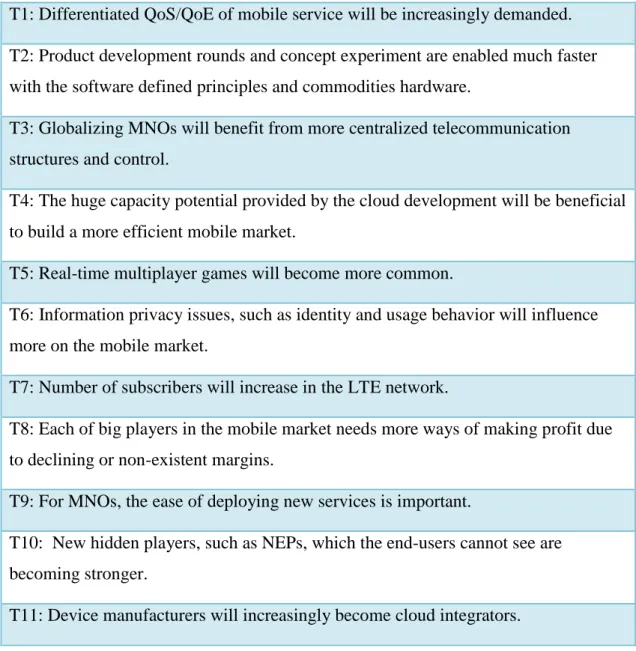
Key trends are those environmental factors which can be predicted by the development process of the industry. Although the consequences of those trends have not been showed, they have high influence on the future of the industry and the current strategy of the organization. [21] [14] Table 1 lists the most important trends and elaborated here. In addition, the impact of trends to the mobile market in the future will be explained. For the full list of trends, please refer to Appendix A1.
Table 1: Key trends
T1: Differentiated QoS/QoE of mobile service will be increasingly demanded. T2: Product development rounds and concept experiment are enabled much faster with the software defined principles and commodities hardware.
T3: Globalizing MNOs will benefit from more centralized telecommunication structures and control.
T4: The huge capacity potential provided by the cloud development will be beneficial to build a more efficient mobile market.
T5: Real-time multiplayer games will become more common.
T6: Information privacy issues, such as identity and usage behavior will influence more on the mobile market.
T7: Number of subscribers will increase in the LTE network.
T8: Each of big players in the mobile market needs more ways of making profit due to declining or non-existent margins.
T9: For MNOs, the ease of deploying new services is important.
T10: New hidden players, such as NEPs, which the end-users cannot see are becoming stronger.
T1: Differentiated QoS/QoE of mobile service will be increasingly demanded. Network applications need to apply differentiated QoS/QoE depending on different services. For example, the mobile service, such as on-demand video, needs wider bandwidth than pure data transmission service[40].Currently, the LTE mobile network bandwidth is allocated constantly to all of mobile services. In the future, to maximize the bandwidth efficiency, mobile services, such as health care, E2E and M2M service, can be performed with differentiated bandwidth based on different QoS/QoE requirements.
T2: Product development rounds and concept experiments are enabled much faster with the software defined principles and commodities hardware.
Current trend of commodity hardware combined with existing and available component, together with product differentiation in software will continue in the mobile market [41]. Meanwhile, virtualized LTE network provides the opportunity for the research by giving the software development rounds and concept experimental possibilities with the existing hardware.
T3: Globalizing MNOs will benefit from more centralized telecommunication structures and control.
The multiplexing gain in several dimensions, such as time zone and national habit, will be enabled. For small operators, it is uneconomical to operate their own networks. So the mobile market will open up the field for operators operating networks more globally. T4: The huge capacity potential provided by the cloud development will be beneficial to build a more efficient mobile market.
The telecommunication industry will be reinvented since the rapid mobile traffic, subscriber and mobile data usage growth request higher capacity [26]. However, the market force will not work efficiently, if the mobile operator can decide whether there is the exploit potential or not.
The future LTE mobile network should balance the network performance. The LTE mobile network could satisfy users by providing users high bitrates to those multiuser real-time services and comparative low bitrate to non-real-time services. [42]
T6: Information privacy issues, such as identity and usage behavior, will influence more on the mobile market.
It is a common understanding in mobile market that user’s information is worth a lot [43]. For example, user behavior can be analyzed and then specific advertisement will be promoted based on users’ preference [44]. Furthermore, mobile services, such as bigger data package and shorter voice connections, can be bundled and provided to users who are used to play with data service. Hence, utilizing user information properly can both increase users’ satisfaction and the profit of the service providers. However, collecting and analyzing data in an innovative way may cause security issues, such as information and privacy disclosure. In the future LTE network mobile market, these security issues have to be taken into consideration by every stakeholder, especially smartphone users and data controllers [45] [46].
T7: Number of subscribers will increase in the LTE mobile network.
It has been more than 30 years since people learned how to use internet. And the mobile internet is now a part of people’s life. It is clear that LTE network is more attractive than previous 3G or 2G networks, because of its better performance. Therefore, a huge market will open up to players, such as MNO, CloudSP and NEP.
T8: Each of big players in the mobile market needs more ways of making profit due to declining or non-existent margins.
Most of MNOs operate flat rate instead of usage based charging system, which means few margin profit can be expect then. The same situation is faced by other players in the market. The LTE mobile network virtualization provides the opportunity for MNOs to expand to the new cloud services. Also, the better control of the LTE mobile network enabled by virtualization can benefit MNOs from data centers and billing systems. T9: For MNOs, the ease of deploying new services is important.
MNOs will prefer saving manpower and cost with the simple and effective virtual network. Since the MNO is the most powerful stakeholder in the mobile market at the moment, the development level of the virtual network will be determined by the network convenience.
T10: New hidden players, such as NEPs, which the end-users cannot see are becoming stronger.
The competition among the visible players is increasing. For instance, MNOs are competing with each other intensely. Thus, these hidden players such as NEPs could become the winners of the game as suppliers of MNOs.
T11: Device manufacturers will increasingly become cloud integrators.
In recent years, the device manufactures have gained more value in collaboration with over-the-top (OTT) content players in the mobile ecosystem [2]. For instance, device manufactures can deliver software to install in the mobile devices and then integrate to the cloud mobile service. The device manufacturer’s value chain is reduced by changes from hardware and software integration to just software integration.
5.3
Key Uncertainties
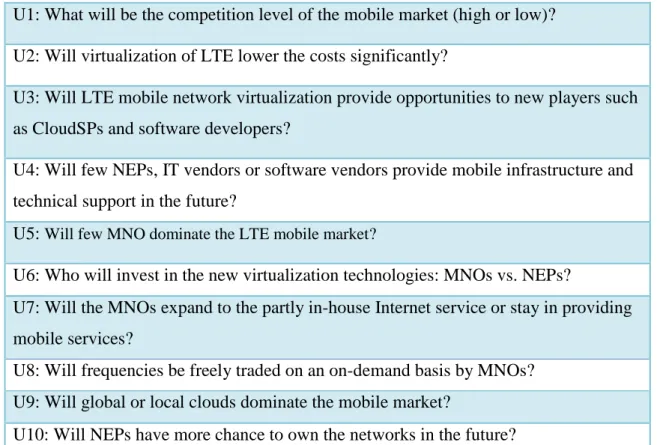
Key uncertainties are factors which have the huge influence on the future development of chosen stakeholder but they are unpredictable at the same time in the current technology and business environment [20]. The most important uncertainties are those critical forces to the future mobile market considered by most of stakeholders. On the other hand, other key uncertainties are regarded as less circumstantial forces but still have power to impact the market. The key uncertainties listed in Table 2 are summarized from brainstorm sessions and will be elaborated in following section. U1: What will be the competition level of the mobile market (high or low)?
At the moment, MNOs are granted permission to bid in spectrum auctions, repurpose 2G and 3G spectrum to 4G and to deploy the network and launch services [47]. Consequently, the mobile market is dominated by those powerful MNOs, so that the competition stays in low level.
Table 2: Key uncertainties
U1: What will be the competition level of the mobile market (high or low)? U2: Will virtualization of LTE lower the costs significantly?
U3: Will LTE mobile network virtualization provide opportunities to new players such as CloudSPs and software developers?
U4: Will few NEPs, IT vendors or software vendors provide mobile infrastructure and technical support in the future?
U5: Will few MNO dominate the LTE mobile market?
U6: Who will invest in the new virtualization technologies: MNOs vs. NEPs?
U7: Will the MNOs expand to the partly in-house Internet service or stay in providing mobile services?
U8: Will frequencies be freely traded on an on-demand basis by MNOs? U9: Will global or local clouds dominate the mobile market?
U10: Will NEPs have more chance to own the networks in the future?
The bargaining power of MNOs is relatively high to its suppliers, such as NEPs and Mobile Content providers (MCP). And high barrier is set to new entrants.
In some European countries, the price for the 4G licenses was significant lower than the expectation in the auction, because of insufficient competitions. For instance, the 4G licenses auction results were released by the telecommunication regulator of United Kingdom Ofcom in the February of 2013. Only £2.34 billion was raised by Ofcom, which was expected to be £3.5 billion, let alone comparing with the £22 billion raised from the 3G auction in 2000 [48] [49]. Considering the interests of competition, Ofcom reserved spectrum in the auction to a wholesaler who did not own sufficient spectrum to support 4G mobile services [50]. Nonetheless, whether one more player in the mobile market could increase the competition intensity is questionable.
As a result, the regulatory authority for the telecommunications industry, known as the regulators in the mobile market, may allow more entrants involving in the competition to protect the public interests for end-users and pursuit higher social
welfare. Typically, the more choices end-users have, naturally the competition among service providers will raise higher and higher. Therefore, the mobile market may be reshuffled, if the regulators promote the competition. Besides, the MNOs will be forced to cut costs and then to enhance the competitiveness due to the high competition among each other. But it is not clear whether the competition is sufficient or not to make the LTE virtualization happen.
On the other hand, the security and data protection will become the major problems if more players enter the mobile market. The leakage of information has happened even though users’ mobile identity and behavioral data is nowadays collected and processed within few MNOs. New entrants may be capable to provide mobile services with a short adaption period. However, more aspects such as security and information privacy cannot be guaranteed due to new entrants’ inexperience. Therefore, there exists the possibility that the regulator may decline more new entrants to serve in the mobile market. The competition will stay in low level by then. The other possibility is that the regulation will increase in basic telecommunication market as described before, but it is still uncertain that whether the regulator will promote the competition or not with respect to unimplemented clouds in the mobile network.
All in all, the development of the future LTE mobile network will be highly influenced by the competition of the mobile market in the next years.
U2: Will virtualization of LTE lower the costs significantly?
The LTE mobile network investors need to fully weigh the cost and benefit before deploying a new technology or a network. Thus, the speed and efficiency of LTE virtualization deployment depend on its cost to a large extent. In this thesis, the costs include both the CAPEX (Capital Expenditure) and the OPEX (Operational Expenditure).
In particular, the virtualization of LTE has not been deployed yet. So it would be possible that the performance of the network, in other words, QoS/QoE become worse, if the cost is reduced in virtualized LTE network. In this circumstance, the network operators may take a risk to lose both users and profit. So the cost reduction is not attractive enough to the investors. Accordingly, network operators should measure what
is the required performance to run the service in the cloud and evaluate how much will it cost beforehand.
As mentioned in the introduction, much more capacity will be needed in the future LTE mobile network. Generally speaking, more LTE mobile network infrastructure needs to be established to improve the lack of capacity. For example, the density of base station of LTE mobile network will grow based on the increased capacity requirement. And it will cost enormous sums of money. Virtualization, on the other hand, may become a way to reduce costs by applying the same or more capacity with fewer infrastructures. A few paper and simulation studies have indicated that the virtualized LTE mobile network could be operated with less mobile network equipment than the LTE mobile network [7]. As researches are in the early phase and no virtualized LTE network have been ran to end-users, it is too early to say whether the LTE mobile network virtualization is able to save infrastructure as well as costs. Furthermore, all of those researches about the LTE mobile network virtualization mentioned only the cost reductions in capital expenditures, instead of the total cost including both CAPEX and OPEX.
In addition, the LTE mobile network consists of several elements, which means the network can be virtualized in different level. The background part of the thesis introduced technology development of virtualization in LTE radio access network as well as core network. The challenge is to figure out the most cost-effective level of virtualization. Issues, such as how many employees will be needed in the R&D department, how hard it is to virtualize different functions of the network and is virtualization of LTE cost effective considering backward compatibility, are all needed to be taken into account.
U3: Will LTE mobile network virtualization provide opportunities to new players such as CloudSPs and software developers?
At present, the MNOs occupy the dominant position in the mobile market. They have the clear advantage in terms of spectrum license and mobile network control. The mobile services and mobile network access are provided as a bundled. From the end-user’s point of view, there are few choices to consume the mobile service. The industry
structure therefore is vertical, leading to a low level of competitions in the market. But it is uncertain will the new entrants be allowed to enter the mobile market in the future.
The spectrum license may be issued to more players. The mobile network can be controlled and operated by different players other than only MNOs, because of the LTE mobile network virtualization. For example, if the CloudSPs enter the mobile market, the cloud service and the mobile service can be bundled and delivered to end-users with low price. The other possibility is that new entrants, such as CloudSPs, will not control the mobile network but operate the cloud. In this case, the MNOs will lose some of the control since the LTE mobile network enable part of the network operated in the cloud. U4: Will few NEPs, IT vendors or software vendors provide mobile infrastructure and technical support in the future?
In mobile network infrastructure provision, two forces are competing. On one hand, most of the LTE mobile network infrastructure and technical support are provided by the big NEP giants such as Network Siemens Networks and Huawei nowadays. On the other hand, the LTE mobile network virtualization is probable to decrease the technology barriers and reduce the huge infrastructure investments for new entrants based on some recent research [35]. It offers opportunities to IT and software vendors who have fundamental competence and experience in mobile industry to provide the infrastructure and technical support such as maintenance in the future. However, it is uncertain that whether the cloud new entrants are capable to compete with NEPs in terms of coping with the complexity, reliability and quality of mobile infrastructure of LTE mobile network.
The virtualization will change the LTE mobile network to depend more on software. So another related uncertainty is whether the network hardware vendors will be the software providers because of the virtualization of LTE.
U5: Will few MNO dominate the LTE mobile market?
Typically, a few MNOs are permitted by regulators to provide the mobile service business in the mobile market. The competition among MNOs is relatively low. For example, the competition among MNOs in Europe is much lower than those in India mobile market since the regulators in the Europe have decided to support such vertical
industry structure. However, more MNOs in the India mobile market cause the operators are squeezing the cost and price down. This may inspire regulators to increase the number of MNOs in the market to get more positive mobile market.
U6: Who will invest in the new virtualization technologies: MNOs vs. NEPs? The MNOs invested in the current LTE mobile market and pay for infrastructure and mobile network maintenance to NEPs. As suppliers, NEPs also got involved in the research and development of the LTE mobile network infrastructure and operating management. The construction of the virtualized LTE mobile network, on the other hand, is different from that of the LTE mobile network. The MNOs may take a risk to lose the control of the mobile network due to the separation of the physical network elements and control. The NEPs may benefit from the LTE mobile network virtualization since the new mobile network absolutely needs new technology support and the new facilities.
U7: Will the MNOs expand to the partly in-house Internet service or stay in providing mobile services?
The internet has become a part of daily life for almost everyone. More and more study and work have to be done in the internet. Connecting with the mobile wireless network, however, cannot satisfy people to access the Internet as fast as connecting to the Internet through the cable or fiber [51]. Some of the Internet-related service providers have started to establish the high speed Internet. For example, Google has invested in the broadband Internet infrastructure Google Fiber [52] [53]. The MNOs can take advantage of technical strength and customer loyalty into expanding to the in-house Internet. Also, they have to evaluate the failure risk which may be the obstacle in the expansion.
U8: Will frequencies be freely traded on an on-demand basis by MNOs?
The frequencies are now allocated by regulators through the auction. The MNOs can bid for the frequency but has no right to sell them out freely without the permission of the regulators [54]. Some of the MNOs bid for too much frequency that they cannot deploy efficiently. On the other hand, some of the MNOs cannot serve the mobile services due to the lack of frequency. The unbalance situation may occur and finally the
end customers have to pay for the waste and inadequate frequencies since the cost has to be shared. Therefore free traded frequencies based on the demand of the MNOs may be the way to solve the problem. But the regulator could insist to keep the right to allocate the frequencies by taking the possibility of the monopoly and malign competition into consideration.
U9: Will global or local clouds dominate the mobile market? There are two questions related to this uncertainty:
*Do the same rules apply across boundaries?
*What will happen with roaming? Will it exist or become fictitious?
Since the cloud computing technology has not been implemented in the LTE mobile network, it is uncertain whether the cloud will go global or stay in local in the future mobile market. End-users are nowadays under the control of operators in whatever country. But users’ data storage and traffic inspection might happen in distant clouds since the cloud can be controlled remotely.
The regulators might prevent mobile data being transferred over the country boarders, as the security issues are still bothering some countries in Europe. Also, the regulators may protect the local industry and players so that the players will be kept away. The experts who participated the first brainstorm session believe that different rules may be applied even if the global clouds is permitted in different countries, because of the different mobile network industry competences and regulations.
National borders are rising in internet. Once the local clouds dominate the mobile market, it may become the main limitation to scale advantages of the big players.
U10: Will NEPs have more chance to own the networks in the future?
Some of the large NEPs are providing almost the entire LTE mobile network infrastructure. Besides, the NEPs are in charge of tasks related to the mobile network operating management such as software updates. The NEPs are proven capable of hardware manufacturing and software development in the mobile network. So it can be expected that NEPs own the mobile network in the future. However, the MNOs will
definitely make effort to prevent the NEPs competing with them in mobile service market.
The virtualized LTE mobile network enable the separation of the network control and data transmission, so that another related uncertainty can be formed in the future: will the regulators force a split between the physical network and the operated network on top?
5.4
Correlation Matrix
The correlation matrix is a tool to identify interrelationships between each of the uncertainties [20]. Since it is necessary to construct the final scenario matrix with two independent uncertainties, the correlation matrix is handy to verify conformance of the chosen uncertainties.
As shown in Table 3, a “yes” answer of an uncertainty (for example U2) increased the chance of a “yes” answer for the other uncertainty (for example U10). In addition, the selection of the former viewpoint of an uncertainty (for example U1) increased the happening chance of the former viewpoint of the other uncertainty (for example U10). In both cases, the symbol “+” will be filled in the form and the correlation is identified to be positive between the chosen pair of uncertainties.
The symbol “0” indicates two of uncertainties are independent with each other. And the symbol “?” is used to represent the indeterminate relationship between the chosen pair of uncertainties.
The negative correlation (-) exists between two uncertainties in other situations. The independent uncertainties such as U1 and U2 can be formed as a pair and be used to build final scenario matrices. In this way, several scenario matrices can be produced. Final key uncertainties U1 and U2 are chosen to construct the final scenario matrix, while other important uncertainties will support the analysis of each scenario based on the results in Table 3.
Table 3: Correlation matrix of final uncertainties U1 U2 U3 U4 U5 U6 U7 U8 U9 U10 U1 X 0 + - ? - ? - 0 + U2 X ? - 0 ? 0 0 0 + U3 X - 0 - + - 0 + U4 X 0 0 0 0 0 0 U5 X 0 0 0 + 0 U6 X - + 0 - U7 X 0 0 0 U8 X 0 - U9 X 0 U10 X
6
Scenarios
The final scenario matrix is illustrated in and Figure 10. Both of the two final key uncertainties are root forces. One of them is the cost related uncertainty while the other one is the actor related uncertainty. Therefore, the final scenario matrix can be applied more broadly. H ig h c o m p et it io n Lo w c o m p et it io n
Major cost reduction Minor cost reduction
C
o
m
p
e
ti
ti
o
n
L
e
v
e
l
Cost reduction level of LTE
virtualization
Sc.3 Cooperation under the LTE virtualization Sc.4 Regulator Intervention - Undetermined LTE virtualization Sc.2 MNOs controlled LTE virtualization Sc.1 CloudSPs controlled -
Highly virtualized LTE
Figure 10: Final scenario matrix
Each of the scenarios is named based on their characteristic.
Other important uncertainties illustrated in Table 3 contribute to the detailed explanation of scenarios. Value network will support the elaboration of scenarios.
6.1
CloudSPs Controlled - Highly Virtualized LTE
As shown in Figure 11, the CloudSPs controlled mobile market is quite different from the current one. More players are involved in the mobile service as well as the cloud service.
The key stakeholders are intensely competing with each other in mobile market, so it is essential to seek a way to cut down the cost to achieve the competitiveness and attract more end-users with the price advantage. The LTE mobile network virtualization, at this point, is capable to reduce the total cost of the LTE mobile network significantly. Logically, the LTE mobile network is highly virtualized so that most of value creators are from the cost saving. The regulators increase the social welfare and end-users enjoy more choice of mobile and cloud services with lower price.
The MNOs faces a difficult situation as they are not the only players who control the LTE mobile network and the radio spectrum. The previous value chain of MNOs could be remained, but they are not the most powerful stakeholder in the value network. On the other hand, the virtualization of the LTE mobile network would support MNOs to save the costs and to provide the new cloud service. Thus, MNOs need to balance the advantage and disadvantage of the LTE mobile network virtualization and look for the proper strategy to cope with the tough condition. The further analysis about the competition environment of the MNOs will be discussed in the next chapter.
Because of the significant cost saving of the LTE mobile network virtualization, the CloudSP is capable to establish its own mobile network with less expense than building a normal LTE mobile network. Also the regulator pushed high competition mobile market empowers CloudSPs to own the mobile network and spectrum license. Besides, the CloudSPs, as pioneers, are far superior to any other competitor in the cloud service. Once they enter the mobile service business, it is possible to win lots of end-users, thereby seizing the mobile market from traditional MNOs by taking advantage of customer loyalty of their cloud computing technology. The CloudSPs would achieve the leading position by providing both cloud service and mobile service to end customers.
The NEPs are likely to own the mobile network, because of the low cost of building the virtualized LTE mobile network. In addition, the NEPs have been responsible for maintaining the LTE mobile network nowadays, so they are experienced in R&D of the mobile network with trained professionals. Besides the MNOs have lost the absolute power to control neither the mobile network nor the spectrum license, the NEPs would be a strong player in the mobile market.
The infrastructure sharing decreases costs. So the MVNOs who do not own or operate the LTE mobile network could save the cost from renting the network and spectrum from not only MNOs, but also from those strong new players such as NEPs and CloudSPs. Also, the MVNOs could expand to the cloud service.
High competition benefits end-users by keeping the low price and more choices of the mobile and cloud service [55]. Also, the high competition can promote innovation. Players in the mobile market will improve the QoE/QoS, security of service or implement the differentiated strategy to make mobile and cloud service better in ways end-users prefer.
The CloudSPs, NEPs and MVNOs are willing to invest in the virtualization of the LTE mobile network as a result of the tremendous interest. The MNOs are forced to invest in the virtualization of LTE mobile network not only because the network virtualization can lower the cost, but also because they have to fight with competitors in the field of new cloud service to keep the end-users and profit.
6.2
MNOs Controlled LTE Virtualization
The MNOs controlled LTE virtualization means the MNO would stay ahead in the mobile market. Figure 12 illustrates this situation.
The low competition among key stakeholders exists in the mobile market. In other words, the MNOs seize the initiative in virtualized LTE mobile network development. The MNOs would justify the development degree of virtualization of LTE mobile network by taking into consideration the cost savings, investments and competition to maximize gains for themselves.
Since the virtualization of LTE is cost-effective, MNOs would like to launch cloud service to compete with CloudSP based on the virtualized LTE mobile network. Also, the virtualization of the LTE mobile network could make MNOs rely less on NEPs in terms of maintenance and software update. Others who want to provide the cloud service can rent the cloud from MNOs, which increases the revenue for the MNOs. However, to keep the leader position in the market, MNOs would like to virtualize only parts of LTE mobile network to prevent other players owning the control of the LTE mobile network after the virtualization.
Under the sharp restriction of operating the mobile network and bidding for spectrum licenses, the CloudSPs is at an inferior position in the competition. The combination of the mobile and cloud service would help the MNOs wrest cloud service market’s share away from big CloudSP.
Even though the virtualized LTE mobile network is under the MNOs’ control, the NEPs profit from offering the virtualized LTE mobile network infrastructure and other regular mobile network infrastructure. Expanding the service to Information and Communications Technology (ICT) solutions is another way to benefit more from the LTE mobile network virtualization for NEPs. The long-term partnerships have given NEPs the advantage to understand the MNOs’ needs profoundly. Compering with other IT and software vendors, the NEPs are superior in the integration of providing and managing the service.
MVNOs would keep providing mobile services without expanding to cloud service since the MNOs set high barriers to others in the profitable cloud service in virtualized LTE mobile network. To achieve the highest satisfaction and the lowest price, end-users can consume the cloud service provided by CloudSPs while subscribe mobile service served by MNOs separately. However, if the MNOs bundle the mobile and cloud service together, end-users will have little choice in the matter.
The MNOs and NEPs prefer to invest in the LTE mobile network virtualization. Other key stakeholders such as CloudSPs would like to make effort on hampering expansion of MNOs in cloud service. Neither the profit nor the cost of MVNOs in mobile service is influenced by the LTE mobile network virtualization. Therefore, the MVNOs are not involved in the battle of competition.
6.3
Cooperation under the LTE Virtualization
As shown in Figure 13, the key stakeholders choose to cooperate instead of competing with each other to maximize their benefit with the lowest cost. The MNOs cooperate with NEPs and MNOs by sharing the LTE mobile network, thereby reducing the cost.
The competition is fierce in the mobile market that the virtualization of LTE mobile market is developed by stakeholders to enhance their competitive power. The details why the LTE mobile network evolves into the virtualized LTE mobile network
in this scenario will be explained here from the perspectives of different key stakeholders. However, the very small cost reduction of the LTE mobile network virtualization results in the virtualization being available in limited level.
Even though the cost of the LTE mobile network virtualization cannot attract MNOs, they have no choice but to develop and implement the new LTE mobile network competing with CloudSPs who enter the mobile market with the sophisticated cloud computing technology and locked customer. The cooperation with other players could facilitate the MNOs in the competition with CloudSPs and achieve a win-win situation with partners. For example, sharing the mobile network and with NEPs under the restrictive contract can make sure of the cost saving as well as minor losses in the market control.
Confronted with the huge cost of the mobile network, the NEPs have the choice to rent or buy the mobile network and spectrum license from other players. The NEPs can expand their business to mobile service, since NEPs are allowed to provide such services by regulator.
Another fresh business brought to NEPs is to provide the virtualized LTE mobile network infrastructure and technology support to CloudSPs and MNOs.
Despite that the MVNOs own neither the LTE mobile network nor the spectrum license, the high competition in the mobile market offer more choices to them to rent or buy the necessary infrastructure and license. Both CloudSPs and MNOs want to cooperate with MVNOs to share the cost and compete with each other. As a result, the MVNOs could serve both mobile and cloud service with small amount of the investment.
For end-users, lower price can be expected, because of the intense competition with their service providers (MNOs, CloudSPs, and MVNOs). Nevertheless, those service providers would transfer the large amount of cost in establishing new virtualized mobile network to end-users.
The competition between MNOs and CloudSPs would cause the LTE mobile network virtualization. MNOs, CloudSPs, MVNOs and NEPs are willing to invest in the LTE mobile network virtualization, because they all have to face the keen competition. The sharing of the virtualized LTE mobile network benefits all of them.
6.4
Regulator Intervention - Undetermined LTE Virtualization
As seen in Figure 14, in the scenario of Regulator Intervention, there is small probability to evolve the LTE mobile network to the virtualized LTE mobile network.
The MNOs keep their leadership positions in the mobile market when there is no tough competition. The effort put into the research and development of the LTE mobile network virtualization is little thanks to the little cost saving it gives.
Therefore, the mobile market stays the same as is in the current situation. The MNOs dominate the mobile service market except the cloud service. The MVNOs provide the mobile service under the control of MNOs. The cloud service is served by CloudSPs, while the CloudSPs have little chance to expand business to the mobile service.
The NEPs make profit from selling the mobile network infrastructure and maintaining the mobile network to MNOs. End-users have little bargaining power to MNOs and CloudSPs.
Under these circumstances, the regulator need get involved into the mobile market if the virtualization of the LTE mobile network would cause the positive development of the mobile market in the long term.
7
Conclusion
The key findings of the research will be described in this section. Also, the issues that impact the results will be discussed in the discussion section. The possible future work will be explained in the end.
7.1
Key Findings
Most of the LTE mobile network equipment is specialized and monolithic, thereby not allowing the separation between the control and transmission of the data. While the demand from the end-users for the dynamic and more flexible mobile networks, which can be realized in virtualized LTE mobile network, is rising. The mismatch between the requirements and capabilities becomes one of the critical motivations to put effort on the LTE mobile network virtualization. [7]
However, several uncertainties make the future of the LTE mobile network virtualization unpredictable. The most important uncertainties are:
1) What will be the competition level of the mobile market (high or low)? 2) Will virtualization of LTE lower the costs significantly?
Four scenarios are created from these uncertainties.
The first scenario, CloudSPs controlled - Highly virtualized LTE, means the CloudSPs are the winners, because of the high competition and significant cost reduction. They become stronger in the cloud service market as the virtualized LTE mobile network is able to provide the new cloud service. The LTE mobile network is highly virtualized so that the MNOs lose the control to the LTE mobile network and market. The NEPs can benefit not only from the LTE mobile network virtualization infrastructure and technical support, but also from the expansion to provide the mobile services and cloud services. End-users are benefit from more choices and lower price thanks to the high competition among other key stakeholders. CloudSPs, NEPs, MVNOs and MNOs would invest in the LTE mobile network virtualization.
In the second scenario, MNOs controlled LTE virtualization. MNOs control the LTE mobile market as well as the development of the LTE mobile network virtualization. NEPs can make profit by providing the LTE mobile network virtualization infrastructure and
technical support. CloudSPs and end-users face a tough situation. MNOs and NEPs would make an investment in the LTE mobile network virtualization.
MNOs seek the cooperation with NEPs and MVNOs to compete with CloudSPs in scenario 3, Cooperation under the LTE virtualization. The small cost reduction of the LTE mobile network might lead to a limited development of

![Figure 3: Scenario planning process [21]](https://thumb-us.123doks.com/thumbv2/123dok_us/509998.2560164/17.892.328.677.772.1020/figure-scenario-planning-process.webp)
![Figure 5: Basic LTE system architecture [23]](https://thumb-us.123doks.com/thumbv2/123dok_us/509998.2560164/19.892.170.768.150.710/figure-basic-lte-system-architecture.webp)
![Figure 7: 3GPP compliant OpenFlow controlled gateway architecture [4]](https://thumb-us.123doks.com/thumbv2/123dok_us/509998.2560164/23.892.157.782.203.488/figure-gpp-compliant-openflow-controlled-gateway-architecture.webp)
![Figure 8: Virtualized LTE eNodeB protocol stack [35]](https://thumb-us.123doks.com/thumbv2/123dok_us/509998.2560164/24.892.155.780.103.477/figure-virtualized-lte-enodeb-protocol-stack.webp)