Security Model
Santiago Zanella B´eguelin1, Gustavo Betarte2, and Carlos Luna2
1
FCEIA, Universidad Nacional de Rosario, Argentina [email protected]
2
InCo, Facultad de Ingenier´ıa, Universidad de la Rep´ublica, Uruguay {gustun,cluna}@fing.edu.uy
Abstract. This paper overviews a formal specification, using the Cal-culus of Inductive Constructions, of the application security model de-fined by the Mobile Information Device Profile 2.0 for Java 2 Micro Edition. We present an abstract model of the state of the device and security-related events that allows to reason about the security prop-erties of the platform where the model is deployed. We then state and sketch the proof of some desirable properties of this model.
Keywords: Calculus of Inductive Constructions, Coq, formal specifi-cation, MIDP 2.0, security.
1 Introduction
Mobile devices, like cell phones, manipulate sensitive personal data (e.g con-tact lists and call recordings), and are capable of establishing connections with external entities. Users of such devices may, in addition, download and install potentially dangerous applications. Since any security breach may expose sensi-tive data, prevent the use of the device, or allow applications to perform actions that incur a charge for the user, it is essential to provide an application security model that can be relied upon – the slightest vulnerability may imply millionaire losses due to the scale the technology has been adopted.
Java 2 Micro Edition (J2ME) is a version of the Java platform targeted at resource-constrained devices. J2ME comprises two kinds of components: con-figurations and profiles. A configuration is composed of a virtual machine and a set of APIs that provide the basic functionality for a particular category of devices. Profiles further specify the target technology by defining a set of higher level APIs built on top of an underlying configuration. This two-level architec-ture enhances portability and enables developers to deliver applications that run on a range of devices with similar capabilities.
The Connected Limited Device Configuration (CLDC) is a J2ME configu-ration designed for devices with slow processors, limited memory and intermit-tent connectivity. CLDC together with the Mobile Information Device Profile (MIDP) provides a complete J2ME runtime environment tailored for devices like mobile phones and personal data assistants. MIDP defines an application life cycle, a security model, and APIs that offer the functionality required by mobile applications, including networking, user interface, push activation and persistent local storage. Many mobile device manufacturers have adopted MIDP
since the specification was made available. Literally millions of MIDP enabled devices are deployed worldwide and the market acceptance of the specification is expected to continue to grow steadily.
In the original MIDP 1.0 specification [1], any application not installed by the device manufacturer or a service provider runs in a sandbox that prohibits access to security sensitive APIs or functions of the device (e.g. push activation). Although this sandbox security model effectively prevents any rogue application from jeopardising the security of the device, it is excessively restrictive and does not allow many useful applications to be deployed after issuance.
MIDP 2.0 [2] introduces a new security model based on the concept of protection domains. Each sensitive API or function on the device may define permissions in order to prevent it from being used without authorisation. An installed MIDlet suite is bound to a unique protection domain that defines a set of permissions granted either unconditionally or with explicit user au-thorisation. Untrusted MIDlet suites are bound to a protection domain with permissions equivalent to those in a MIDP 1.0 sandbox. Trusted MIDlet suites may be identified by means of cryptographic signatures and bound to more per-missive protection domains. This security model enables applications developed by trusted third parties to be downloaded and installed after issuance of the device without compromising its security.
Some effort has been put into the evaluation of the security model for MIDP 2.0; [3, 4] analyse the application security model, spot vulnerabilities in various implementations and suggest improvements to the specification. Although these works report on the detection of security holes, they do not intend to prove their absence. The formalisation we overview here, however, provides a formal basis for the verification of the model and the understanding of its intricacies.
We developed our specification using the Coq proof assistant [5, 6], an im-plementation of the Calculus of Inductive Constructions (CIC). CIC is a de-pendently typed lambda calculus that extends Coquand and Huet’s Calculus of Constructions [7] with inductive definitions as first-class objects. The interested reader may refer to [8, 9] for further background on these calculi.
The rest of the paper is organized as follows, Section 2 defines the notation used, Section 3 describes the formalisation of the MIDP 2.0 security model. Section 4 presents some of its verified properties, and finally Section 5 concludes.
2 The Notation Used
We use standard notation for equality and logical connectives (∧,∨,¬,→,∀,∃). Implication and universal quantification may be encoded using CIC dependent product, while equality and the other connectives can be defined inductively. Anonymous predicates are introduced using lambda notation, e.g (λ n . n= 0) is a predicate that when applied tonis true iff n= 0.
We extensively use record types; a record type definition
Rdef= {f ield1:type1, . . . , f ieldn :typen} (1)
generates a non-recursive inductive type with just one constructor, mkR, and projections functions f ieldi : R → typei. We often write ha1, . . . , ani instead
of mkR a1. . . an when the type is obvious from the context. Application of
projections functions is abbreviated using dot notation, i.e.f ieldir≡r.f ieldi.
For each field f ieldi in a record type we define a binary relation'f ieldi over objects of the type as
r1'f ieldi r2def= ∀j, j=6 i→r1.f ieldj =r2.f ieldj . (2)
A parametric inductive type T : type1 → . . . → typen → sort is defined by
giving for each constructorck an introduction rule of the form
P1a1 . . . an · · · Pma1 . . . an
T a1 . . . an
ck
where Pj, j = 1, . . . , m are predicates over the parameters of the type. We
assume as predefined inductive types, the parametric type option T with con-structors N one: option T and Some : T → option T, and the type seq T of finite sequences overT. We denote the empty sequence by [ ], and the construc-tor that appends an element ato a sequences assaa. We represent with ⊕
the concatenation operation on sequences.
3 Formalisation of the MIDP 2.0 Security Model
In this section we present the formal specification of the security model.
3.1 Sets and Constants
In MIDP, applications (MIDlets) are packaged and distributed as suites. A MI-Dlet suite can contain one or more MIMI-Dlets and is distributed as two files, an application descriptor file and an archive file that contains the actual classes and resources. A suite that needs access to protected APIs or functions must de-clare the corresponding permissions in its descriptor. MIDlet suites may dede-clare permissions either as required or as optional.
LetP ermissionbe the total set of permissions defined by every protected API or function on the device andDomainthe set of all protection domains. Let us introduce, as a way of referring to individual MIDlet suites, the setSuiteID of valid suite identifiers. We will represent an application descriptor as a record composed of two predicates, requiredand optional, that identify respectively the set of permissions declared as required and those declared as optional,
Descriptordef= {required, optional:P ermission→P rop} . (3) For the sake of conciseness let us introduce a record type to represent installed suites, with fields for its identifier, associated protection domain and descriptor,
Suitedef= {sid:SuiteID, domain:Domain, descriptor:Descriptor} . (4) Permissions may be granted by the user to an active MIDlet suite in either of three modes, only once (oneshot), until it is terminated (session), or until it
is uninstalled (blanket). Let M ode be the enumerated set of user interaction modes –{oneshot, session, blanket}– and≤man order relation such that
oneshot≤msession≤mblanket . (5) We will assume for the rest of the formalisation that the security policy of the protection domains on the device is an anonymous constant of type
P olicydef= {allow :Domain→P ermission→P rop,
user :Domain→P ermission→M ode→P rop} (6)
such thatallow d pholds when domaindunconditionally grants the permission panduser d p mwhen domaindgrants permissionpwith explicit user authori-sation and maximum allowable modem(w.r.t≤m). The permissions effectively
granted to a MIDlet suite are the intersection of the permissions requested in its descriptor with the union of the allowed and user granted permissions.
3.2 Device State
To reason about the MIDP 2.0 security model most details of the device state may be abstracted; it is sufficient to specify the set of installed suites, the permissions granted or revoked to them, and the currently active suite in case there is one. The active suite and the permissions granted or revoked to it for the session are grouped into a record structure
SessionInf odef= {sid :SuiteID,
granted, revoked:P ermission→P rop} . (7) The abstract device state is described as a record of type
Statedef= {suite :Suite→P rop, session :option SessionInf o,
granted, revoked:SuiteID→P ermission→P rop} . (8)
Some conditions must hold for an elements:Statein order to represent a valid state for a device. These conditions are specified in the rest of this section.
A MIDlet suite can be installed and bound to a protection domain only if the set of permissions declared as required in its descriptor are a subset of the permissions the domain offers (with or without user authorization). This compatibility relation between des : Descriptor and dom : Domain can be stated formally as follows,
desodomdef= ∀p:P ermission,
des.required p→allow dom p ∨ ∃m:M ode, user dom p m . (9) For s to be a valid state, every installed suite must be compatible with its associated protection domain,
SuiteCompatibledef=
Whenever there exists a running session, the suite identifier in s.session must correspond to an installed suite,
CurrentInstalleddef= ∀ses:SessionInf o, s.session=Some ses→
∃ms:M IDletSuite, s.suite ms∧ms.sid=ses.sid . (11) The grantedpredicate should be valid, i.e. the set of permissions granted for the session must be a subset of the permissions requested in the application descriptor of the active suite, and the associated protection domain policy must allow them to be granted for the session,
V alidSessionGranteddef= ∀ses:SessionInf o, s.session=Some ses→ ∀p:P ermission, ses.granted p→
∀ms:M IDletSuite, s.suite ms→ms.sid=ses.sid→
(ms.descriptor.required p ∨ms.descriptor.optional p)∧
(user ms.domain p session ∨ user ms.domain p blanket) .
(12)
Every installed suite shall have a unique identifier,
U niqueSuiteIDdef= ∀ms1ms2:M IDletSuite,
s.suite ms1→s.suite ms2→ms1.sid=ms2.sid→ms1=ms2 . (13) Additionally, for every installed suite with identifier sid,s.granted sid should be valid with respect to its descriptor and associated protection domain (V alidGranted s). It must also be ensured that any granted permission is not being revoked at the same time and viceversa (V alidGrantedRevoked s). We omit the detailed formalisation of these conditions.
3.3 Events
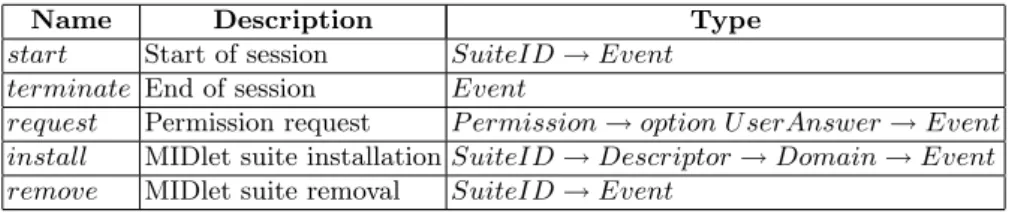
We define a setEventfor those events that are meaningful with respect to our abstraction of the device state (Table 1).
Table 1.Events.U serAnswerdef={ua allow m, ua deny m|m∈M ode}
Name Description Type
start Start of session SuiteID→Event terminate End of session Event
request Permission request P ermission→option U serAnswer→Event install MIDlet suite installationSuiteID→Descriptor→Domain→Event remove MIDlet suite removal SuiteID→Event
The behavior of the events is specified by defining their pre- and postcondi-tions by means of the predicatesP reandP osrespectively. Preconditions (Table 2) are defined in terms of the device state, while postconditions (Table 3) are defined in terms of the before and after states, and an optional response which is only meaningful for the request event and indicates whether the requested permission is given,
Table 2.Event preconditions. Therequestevent is omitted for reasons of space
P re s(start sid)def=
s.session=N one ∧ ∃ms:M IDletSuite, s.suite ms∧ms.sid=sid P re s terminatedef= s.session6=N one
P re s(install sid des dom)def=
desodom∧ ∀ms:M IDletSuite, s.suite ms→ms.sid6=sid. P re s(remove sid)def=
(∀ses:SessionInf o, s.session=Some ses →ses.sid6=sid)∧ ∃ms:M IDletSuite, s.suite ms∧ms.sid=sid
Table 3.Event postconditions. Therequestevent is omitted for reasons of space
P os s s0r(start sid)def=
r=N one∧s'sessions0 ∧s0.session=Somehsid,(λx.F alse),(λx.F alse)i
P os s s0r terminatedef= r=N one∧s'sessions0 ∧s0.session=N one
P os s s0r(install sid des dom)def=
r=N one∧ (∀ms:M IDletSuite, s.suite ms→s0.suite ms)∧
(∀ms:M IDletSuite, s0.suite ms→s.suite ms ∨ms=hsid, dom, desi)∧ s0.suitehsid, dom, desi ∧s0.session=s.session∧
(∀p:P ermission,¬s0.granted sid p∧ ¬s0.revoked sid p)∧ (∀sid1:SuiteID, sid16=sid→
s0.granted sid1=s.granted sid1 ∧s0.revoked sid1=s.revoked sid1) P os s s0r(remove sid)def=
r=N one∧s'suites0∧
(∀ms:M IDletSuite, s.suite ms→ms.sid6=sid→s0.suite ms)∧ (∀ms:M IDletSuite, s0.suite ms→s.suite ms∧ms.sid6=sid)
P re:State→Event→P rop
P os:State→State→option Response→Event→P rop . (14) For example, an event representing a permission request not authorized by the user can only occur when the active suite has declared that permission in its descriptor and is bound to a protection domain that specifies an user interaction mode for the permission (otherwise, the request would be immediately accepted or rejected). Furthermore, the requested permission must not have been revoked or granted for the rest of the session or the MIDlet suite life,
P re s(request p(Some(ua deny m)))def=
∃ses:SessionInf o, s.session=Some ses∧
∀ms:M IDletSuite, s.suite ms→ms.sid=ses.sid→
(ms.descriptor.required p ∨ms.descriptor.optional p)∧
(∃m1:M ode, user ms.domain p m1)∧ ¬ses.granted p∧ ¬ses.revoked p∧
¬s.granted ses.sid p∧ ¬s.revoked ses.sid p .
When m = session, the user revokes the permission for the rest of the ses-sion, therefore, the response denies the permisses-sion, and the state is updated accordingly,
P os s s0 r(request p(Some(ua deny session)))def= r=Some denied ∧s'sessions0∧
∀ses:SessionInf o, s.session=Some ses→ ∃ses0:SessionInf o,
s0.session=Some ses0 ∧ses0 'revokedses ∧ses0.revoked p∧
(∀q:P ermission, q6=p→ses0.revoked q=ses.revoked q) .
(16)
3.4 One-step Execution
When an event occurs for which the precondition does not hold, the state must remain unchanged. Otherwise, the state may change in such a way that the event postcondition is established. The behavioral specification of the execution of an event is given by the,→relation with the following introduction rules:
¬P re s e s ,−−−−−→e/N one s npre P re s e P os s s0r e s ,−−→e/r s0 pre . (17) 3.5 Sessions
A session is a period of time spanning from the start of a session to its termina-tion. A session for a suite with identifiersid(Fig. 1) is determined by an initial states0and a sequence of stepshei, si, rii(i= 1, . . . , n) such that the following
conditions hold, – e1=start sid; – P re s0e1 ; – ∀i∈ {2, . . . , n−1}, ei6=terminate; – en=terminate; – ∀i∈ {1, . . . , n}, si−1,−−−→ei/ri si . s0,start sid/r1 −−−−−−−−→s1,e2/r2 −−−→s2,e3/r3 −−−→ · · ·,−−−−−−−→en−1/rn−1 sn−1,−−−−−−−−−→terminate/rn sn
Fig. 1.A session for a suite with identifiersid
To define the session concept it is better to introduce before the concept of partial session. A partial session is asessionfor which theterminateevent has not yet been elicited; it may be defined inductively by the following rules,
P re s0(start sid) s0,−start sid/r−−−−−−−→1 s1
P Session s0(ssalast) e6=terminate last.s ,−−→e/r s0
P Session s0(ssalastahe, s0, ri) psession app . (19) Now, sessions can be easily introduced as follows,
P Session s0(ssalast) last.s ,−−−−−−−−→terminate/r s0
Session s0(ssalastahterminate, s0, ri) session terminate . (20)
4 Verification of (Security) Properties
In what follows we state some propositions about the specification. Although detailed proofs of these propositions have been constructed and checked using Coq, we only give here an outline of the proofs.
4.1 An Invariant of One-step Execution
We call one-step invariant a property that remains true after theexecution of every event if it is true before. We expect the validity of the device state to be a one-step invariant of our specification.
Theorem 1.Let V alidbe a predicate overStatedefined as the conjunction of the validity conditions in Sect. 3.2. For any s s0 : State, r : option Response
ande:Event, ifV alid sand s ,−−→e/r s0 hold, thenV alid s0 also holds.
Proof. By case analysis ons,−−→e/r s0. WhenP re s edoes not hold,s=s0ands0is valid becausesis valid. Otherwise,P os s s0r emust hold and we proceed by case analysis on e. We will only show the case request p(Some(ua deny session)), obtained after further case analysis onawhene=request p(Some a).
The postcondition (16) entails that s0.granted = s.granted, s0.revoked = s.revoked, s0.suite=s.suite, and that there existsses0 such that s0.session= Some ses0,ses0.sid=ses.sid, ses0.granted=ses.grantedand
∀q, q6=p→ses0.revoked q=ses.revoked q . (21) Rewriting with these equalities, we immediately prove SuiteCompatible s0, CurrentInstalled s0, U niqueSuiteID s0 and V alidGranted s0 from the valid-ity of s. It remains to proveV alidGrantedRevoked s0.
Let q be any permission. If q 6= p, then from (21) ses0.revoked q = ses.revoked q, and because qwas not granted and revoked simultaneously be-fore the event, neither it is after. Ifq=p, then we know from the precondition (15) that pwas not granted before, and so it is not granted after. This proves V alidGrantedRevoked s0, and together with the previous results,V alid s0. ut
4.2 Session Invariants
We call session invariant a property of a step that holds for the rest of a session once it is established in any step. LetP be a predicate overT, we defineall P as an inductive predicate defined overseq T by
all P [ ] all nil
all P ss P s
all P (ssas) all app (22)
Theorem 2.If s0 is a valid state, andP Session s0ss, then
all(λ step . V alid step.s)ss . (23)
Proof. By induction on the structure ofP Session s0ss.
– When it is constructed usingpsession start,ssis like [ ]ahstart sid, s1, r1i
ands0,start sid/r1
−−−−−−−−→s1holds. We must prove
all(λ step . V alid step.s) ([ ]ahstart sid, s1, r1i) . (24) By applying all appand thenall nil the goal is simplified toV alid s1, and is proved froms0,start sid/r1
−−−−−−−−→s1andV alid s0 by applying Theorem 1. – When it is constructed usingpsession app,sshas the formss1alastahe, s0, ri
andlast.s ,−−→e/r s0 holds. The induction hypothesis is
all(λ step . V alid step.s) (ss1alast) (25) and we must prove all(λ step . V alid step.s) (ss1alastahe, s0, ri). By ap-plyingall appand then (25) the goal is simplified toV alid s0. From (25) we know that last.sis a valid state. The goal is proved from last.s ,−−→e/r s0 and V alid last.sby applying Theorem 1. ut
The above theorem may be easily extended from partial sessions to sessions by applying Theorem 1. State validity is just a particular property that is true for a partial session once it is established, the result can be generalised for other properties as in the following lemma.
Lemma 1.For any propertyP of a step satisfying
e6=terminate∧s ,e0/r0
−−−→s0∧P he, s, ri →Phe0, s0, r0i , (26)
if P Session s0(ssastep⊕ss1)andP stepthenall P ss1 holds.
Perhaps a more interesting property is that once a permission is revoked by the user for the rest of a session, any further request for the same permission in the same session is rejected.
Lemma 2.The following property satisfies (26),
(λ step .∃ses, step.s.session=Some ses∧ses.revoked p) . (27)
Theorem 3.For any permission p, ifP Session s0 (ssastepastep1⊕ss1),
step1.e=request p(Some(ua deny session))andP re step.s step1.e, then
all(λ step .∀o, step.e=request p o→step.r6=Some allowed)ss1 . (28)
Proof. SinceP os step.s step1.s step1.r step1.eholds,pis revoked for the session instep1.s. From Lemmas 1 and 2,premains revoked for the rest of the session. Lete=request p obe an event in a stepstepinss1. We know thatpis revoked for the session in the state beforestep.s. If the precondition foredoes not hold in the state before1, thenstep.r=N one. Otherwise, the postcondition foreis true and in any case it entailsstep.r=Some denied6=Some allowed. ut
1
5 Conclusions
The informal specification in [2] puts forward an application security model that any implementation of the profile must satisfy. Although testing implementa-tions of that model might help discover vulnerabilities, it is not an exhaustive technique and does not compare to the assurance level that gives a formal ver-ification of the model.
We have produced an unprecedented verifiable formalisation of the MIDP 2.0 security model and have also constructed the proofs of several important properties that should be satisfied by any implementation that fulfills the ification of the security model. It is shown in this paper that the formal spec-ification is precise and detailed enough to study, for instance, the interference between the security rules that control access to the device resources and mech-anisms such as application installation. Two simplifying assumptions have been made: 1) the security policy is static; 2) up to one suite may be active at a time. Most implementations actually enforce these assumptions, however, it would be interesting to further explore the consequences of relaxing them.
We strongly believe the specification we have produced can be formally refined down to an executable specification. As a future work, we plan to com-plete such a refinement and obtain executable functional code using the Coq extraction mechanism.
References
1. JSR 37 Expert Group.Mobile Information Device Profile for Java 2 Micro Edition. Version 1.0. Sun Microsystems, Inc. (2000).
2. JSR 118 Expert Group. Mobile Information Device Profile for Java 2 Micro Edi-tion. Version 2.0. Sun Microsystems, Inc. and Motorola, Inc. (2002).
3. O. Kolsi and T. Virtanen. MIDP 2.0 Security Enhancements. In: Proceedings of the 37th Annual Hawaii International Conference on System Sciences (HICSS’04)
(IEEE Computer Society, 2004), p. 90287.3.
4. M. Debbabi, M. Saleh, C. Talhi, and S. Zhioua. Security Analysis of Wireless Java. In:Proceedings of the 3rd Annual Conference on Privacy, Security and Trust
(2005), pp. 1–11.
5. The Coq Development Team.The Coq Proof Assistant Reference Manual – Version V8.0 (2004).
6. Y. Bertot and P. Cast´eran. Interactive Theorem Proving and Program Develop-ment. Coq’Art: The Calculus of Inductive Constructions. Texts in Theoretical Computer Science (Springer-Verlag, 2004).
7. T. Coquand and G. Huet. The Calculus of Constructions. In: Information and Computation, vol. 76 (Academic Press, 1988), pp. 95–120.
8. C. Paulin-Mohring. Inductive Definitions in the system Coq - Rules and Properties. In:First Int. Conf. on Typed Lambda Calculi and Applications, edited by M. Bezem and J. F. Groote,LNCS, vol. 664 (Springer-Verlag, 1993), pp. 328–345.
9. B. Werner. Une Th´eorie des Constructions Inductives. Phd Thesis, Universit´e Paris 7, France (1994).