EE 508
Lecture 11
The Approximation Problem
Classical Approximations
Butterworth Approximations
• Analytical formulation:
–
All pole approximation
–
Magnitude response is maximally flat at ω=0
–
Goes to 0 at ω=∞
–
Assumes value at ω=1
–
Assumes value of 1 at ω=0
–
Characterized by {n,ε}
• Emphasis almost entirely on performance at
single frequency
"On the Theory of Filter Amplifiers", Wireless Engineer (also called
Experimental Wireless and the Radio Engineer), Vol. 7, 1930, pp. 536-541.
2 1 1 Review from Last Time
1 1 ω LP T j
Butterworth Approximation
Poles of TBW(s)
1/ 1 sin 1 2 cos 1 2 2 2 n k p k j k n n 1 n k=0,1, ... 2 for n even 1/ sin 1 2 cos 1 2 2 2 n k p k j k n n
1/ 1 0 n n p j n-3 k=0, ... 2 for n odd Re Im n 1 n Re Im n 1 n Review from Last TimeButterworth Approximation
What is the Q of the highest Q pole for the BW approximation?
1/ 0 sin cos 2 2 n p j j n n Re Im n 1 n Highest Q Pole 2 2 2 MAX Q 1 1 2 2 sin cos 1 2 2 2 sin 2sin 2 2 n n MAX n n Q n n 1 2sin 2 MAX Q n
Butterworth Approximation
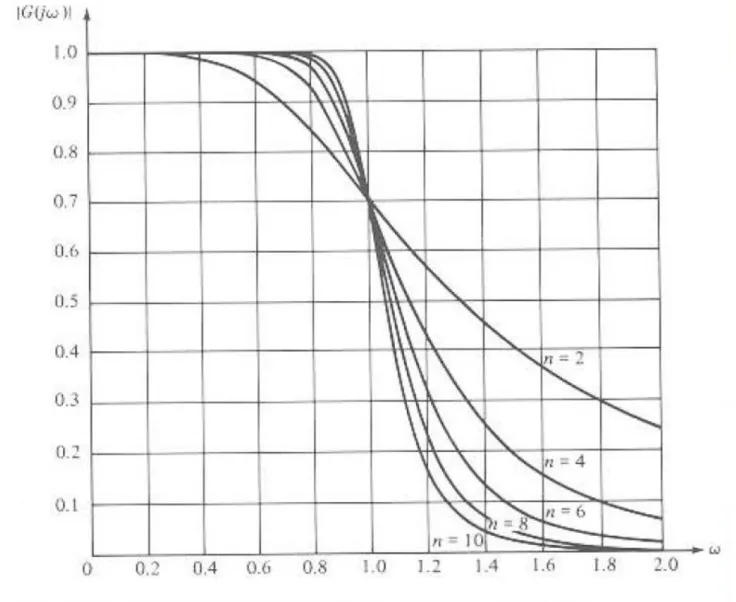
Order needs to be rather high to get steep transition
Figure from Passive and Active Network Analysis and
Synthesis, Budak Re v iew from Las t T ime
Butterworth Approximation
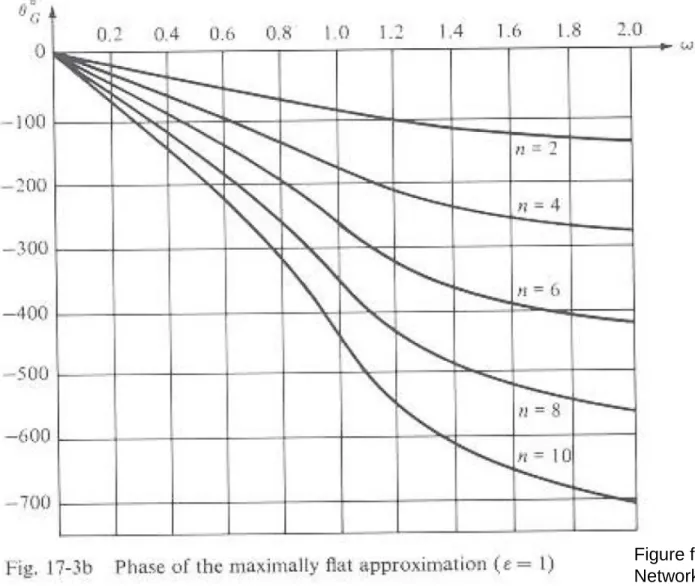
1 2 2sin 2n Phase is quite linear in passband (benefit unrelated to design requirements)
Figure from Passive and Active Network Analysis and
Synthesis, Budak Re v iew from Las t T ime
Butterworth Approximation
• Widely Used Analytical Approximation • Characterized by {ε,n}
• Maximally flat at ω=0
• Almost all emphasis placed on characteristics at single frequency (ω=0) • Transition not very steep (requires large order for steep transition)
• Pole Q is quite low
• Pass-band phase is quite linear (no emphasis was placed on phase!) • Poles lie on a circle
• Simple closed-form analytical expressions for poles and |T(jω)|
Summary Re v iew from Las t T ime
Approximations
• Magnitude Squared Approximating Functions – H
A(ω
2)
• Inverse Transform - H
A(ω
2)→T
A
(s)
• Collocation
• Least Squares Approximations
• Pade Approximations
• Other Analytical Optimizations
• Numerical Optimization
• Canonical Approximations
– Butterworth
– Chebyschev
– Elliptic
– Bessel
– Thompson
1 1 ω LP T jPafnuty Lvovich Chebyshev
Born May 16, 1821
Died December 8,1894
Nationality Russian
Chebyshev Approximations
• Analytical formulation:
–
All pole approximation
–
Magnitude response bounded between 1 and
in the pass band
–
Assumes the value of at ω=1
–
Goes to 0 at ω=∞
–
Assumes extreme values maximum no times in [0 1]
–
Characterized by {n,ε}
• Based upon Chebyshev Polynomials
Chebyshev polynomials were first presented in: P. L. Chebyshev (1854) "Théorie des mécanismes connus sous le nom parallelogrammes," Mémoires des Savants
étrangers présentes à l'Academie de Saint-Pétersbourg, vol. 7, pages 539-586.
2 1 1 2 1 1
Type I Chebyshev Approximations
1 1 ω LP T j
Chebyshev Approximations
• Analytical formulation:
–
Magnitude response bounded between 0 and
in the stop band
–
Assumes the value of at ω=1
–
Value of 1 at ω=0
–
Assumes extreme values maximum times
in [1 ∞]
–
Characterized by {n,ε}
• Based upon Chebyshev Polynomials
2 1 2 1 1
Type II Chebyshev Approximations (not so common)
1 1 ω LP T j
Chebyshev Approximations
Chebyshev Polynomials
The Chebyshev polynomials are characterized by the property that
the polynomial assumes the extremum values of 0 and 1 a maximum number of times in the interval [0,1] and go to ∞ for x large.
In polynomial form they can be expressed as C0(x)=1
C1(x)=x
Cn+1(x)=2xCn(x) - Cn-1(x)
Or, equivalently, in trigonometric form as
cos cos [ 1,1] cosh cos 1 1 cosh cos 1 n n n arc x x C x n arc h x x n arc h x x Chebyshev Approximations
Chebyshev Polynomials
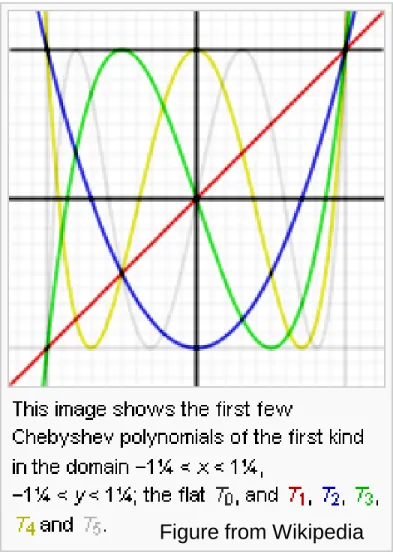
Figure from Wikipedia
0 1 2 2 3 3 4 2 4 5 3 5 6 4 2 6 7 5 3 7 8 6 4 2 8 1 2 1 4 3 8 8 1 16 20 5 32 48 18 1 64 112 56 7 128 256 160 32 1 C x C x x C x x C x x x C x x x C x x x x C x x x x C x x x x x C x x x x x The first 9 CC polynomials:
• Even-indexed polynomials are functions of x2
• Odd-indexed polynomials are product of x and function of x2
Chebyshev Approximations
Type 1
BW 2 2n1
H
ω =
1+
ω
2 2 n1
H
ω =
1+
F
ω
Butterworth A General Form
Fn(ω2) close to 1 in the pass band and gets very large in stop-band
Observation:
The square of the Chebyshev polynomials have this property
CC
2 2
n
1
H
ω =
1+
C
ω
Chebyshev Approximations
Type 1
CC
2 2
n
1
H
ω =
1+
C
ω
Im Re Poles of HCC(ω) lie on an ellipse with none on the real axisChebyshev Approximations
Type 1
CC
2 2
n
1
H
ω =
1+
C
ω
Im Re Im Re Poles of TCC(s) Inverse MappingChebyshev Approximations
Type 1 Im Re 2 2 1 1 1sinh 1 sinh cosh 1 sinh
n n k k arc arc
Chebyshev Approximations
Type 1 Im
Re
Poles of TCC(s)
1 1
1sin sinh cos cosh
k π π 1 p 1+2k sinh 1+2k sinh 2n narc j 2n narc k p k jk 2 2 1 1 1
sinh 1 sinh cosh 1 sinh
n n k k arc arc
Properties of the ellipse
Chebyshev Approximations
Type 1 ω 1 2 1 1
CC T ω Even order 1 2 1 1 ω 1
CC T ω Odd order• |TCC(0)| alternates between 1 and with index number • Substantial pass band ripple
• Sharp transitions from pass band to stop band
2 1 1
Chebyshev Approximations
Type 1
Sharp transitions from pass band to stop band
Chebyshev Approximations
Type 1
CC transition is much steeper than BW transition From Budak Text
Comparison of BW and CC
Responses
• CC slope at band edge much steeper than that
of BW
• Corresponding pole Q of CC much higher than
that of BW
• Lower-order CC filter can often meet same
band-edge transition as a given BW filter
• Both are widely used
• Cost of implementation of BW and CC for same
order is about the same
1
1
2 2
(
)
[
(
)]
CC BWn
Slope
n
Slope
Chebyshev Approximations
Type 1
From Budak Text
Analytically, it can be shown that, at the band-edge
2 3 2 2 1 BW d T j n d
2 3 2 2 2 1 CC d T j n d Chebyshev Approximations
Type 1
CC phase is much more nonlinear than BW phase From Budak Text
Chebyshev Approximations
Type 1 Im
Re
1 1
1sin sinh cos cosh
k π π 1 p 1+2k sinh 1+2k sinh 2n narc j 2n narc
Maximum pole Q of CC approximation can be obtained by considering pole with index k=0
1 1 1
sin sinh cos cosh
0 π π 1 p sinh sinh 2n narc j 2n narc 2 2 2 MAX Q 0 p = j Recall 2 cos 1 1 1 2sin sinh MAX,CC π 2n Q π 1 sinh 2n narc
Chebyshev Approximations
Type 1
Comparison of maximum pole Q of CC approximation with that of BW approximation
2 cos 1 1 1 2sin sinh MAX,CC π 2n Q π 1 sinh 2n narc 1 2sin 2 MAX,BW Q n 2 cos 1 1 sinh MAX,CC MAX,BW π 2n Q Q 1 sinh narc
Example – compare the Q’s for n=10 and ε=1 QBW=3.19 QCC=35.9
Chebyshev Approximations
Type 2
BW 2 2n1
H
ω =
1+
ω
2 2 n1
H
ω =
1+
F
ω
Butterworth A General Form
1
CC2
2 2
n
1
H
ω =
1
1+
C
ω
Another General Form
2 2 n1
H
ω =
1
1+
F 1/ω
Note: The second general form is not limited to use of the Chebyshev polynomials
Chebyshev Approximations
Type 2
1
CC2 2 2 n1
H
ω =
1
1+
C
ω
• Equal-ripple in stop band • Monotone in pass band
• Both poles and zeros present
• Poles of Type II CC are reciprocal of poles of Type I
• Zeros of Type II are inverse of the zeros of the CC Polynomials
1
cos
π
2k-1
2
n
kz
j
1 1 1 1sin sinh cos cosh
k p π π 1 1+2k sinh 1+2k sinh 2n narc j 2n narc
Chebyshev Approximations
Type 2
1
CC2 2 2 n1
H
ω =
1
1+
C
ω
1 2 1 1 1
CC T ω Odd order 2 1 1 1 1
CC T ω Even orderChebyshev Approximations
Type 2
1
CC2 2 2 n1
H
ω =
1
1+
C
ω
1 2 1 1 1
CC T ω• Transition region not as steep as for Type 1 • Considerably less popular
Chebyshev Approximations
Type 2
1
CC2 2 2 n1
H
ω =
1
1+
C
ω
• Pole Q expressions identical since poles are reciprocals • Maximum pole Q is just as high as for Type 1
1 Re Im 1 Re Im